Whenever you’re working in UX (User Experience) design, you have to understand user expectations if you’re going to be able to group information effectively. Card sorting is a handy and relatively simple way to engage participants so they categorize topics in a way they find logical. This approach helps you uncover user preferences for content arrangement to help create a coherent and user-friendly structure for websites or apps.
You’ve likely come across the concept of card sorting (whether or not you’re in UX). It's a popular, low-tech research technique used to organize complex datasets into intuitive information architecture, menu structures, and navigation workflows. Running a card sort may seem simple, but there is an art to doing it effectively. To get the best results, you need to master the nuance, so let's take a look at the essential do’s and don’ts.
What Is Card Sorting in UX Research?
When you perform a card sort, you involve users in organizing information by having them group labeled cards based on their understanding of the content. Card sorting reveals how users expect to find information on a website. The insights you gain are potentially powerful tools for creating intuitive, user-friendly structures that align with users' mental models to ensure seamless and efficient navigation.
Here’s an example of how a card sorting session might work. Imagine you're the researcher for a grocery store brand creating a new website. You want to see how customers approach the store and what categories they would use for various items. You give the participants cards with items like “Dairy,” “Bread,” “Fruits,” “Toothpaste,” “Deodorant,” “Eggs,” “Insect Repellent,” and “Garbage Bags.” The users then put these into categories. For instance, they might place “Dairy” and “Bread” under “Daily Essentials,” “Toothpaste” and “Deodorant” under “Toiletries,” and “Garbage Bags” and “Insect Repellent” under “Sundries.” However, some participants might consider toothpaste a daily essential. Even though they don't need to buy a new tube every day, they might still categorize it that way based on their daily routine.
Welcome to the “magic” of card sorting, where logic can be subjective! In the example above, you would be able to harvest these insights to organize the website's menu and categories in the way that works best for your users. This process makes it easy for shoppers to find exactly what they need based on their own expectations.
Watch as Design Consultant Donna Spencer provides an excellent example of a card sort in her IxDF Master Class, “How To Use Card Sorting For Better Information Architecture.”
Show
Hide
video transcript
- Transcript loading…
Why Do We Use Card Sorting?
Card sorting helps you understand how people think about ideas and concepts rather than just physical items. Once you have a clear understanding of how users perceive a digital design, you can arrange content in a way that makes sense to them as you organize a website's structure or navigation. A card sort reveals how a person’s background and personal experience affect their expectations and the way they envision information. This provides a helpful vantage point to accommodate their worldview and fine-tune your interface design to match their natural way of grouping things.
Card sorting helps you figure out:
Categorization: What items belong together and the logic behind those groupings.
Organizational Patterns: Different ideas and methods for organizing content.
User Consensus: Whether people think similarly or differently about specific concepts or items.
While people use card sorting more often to create IAs, website navigation, and menu structures, the strength of card sorting is how it translates across the board, and you can also use it for internal communication and politics.
In this clip, Donna Spencer explains one of the less obvious uses of card sorting and what it can tell us.
Show
Hide
video transcript
- Transcript loading…
You will find card sorting effective for enhancing your information architecture, but you should not expect it to create the IA for you. Because card sorting is qualitative and exploratory, it often yields inconsistent results that make it unreliable for building an architecture from scratch. Similarly, it cannot tell you whether your IA actually works. Even though the card sort informs your design, you will not know if the final structure is effective until you test it. Donna Spencer suggests using a tree test for that purpose instead.
What’s more, card sorting isn’t suitable when you’re after the following:
Definitive, black and white answers.
Quantitative, statistically valid data.
Advantages and Disadvantages of Card Sorting
Advantages of Card Sorting
Simplicity: Very few techniques are as easy as handing someone a deck of cards and then asking them to sort them. It’s direct and basic.
Cost-effectiveness: You only need plain cards and either printer ink or pen ink. You may also use sticky notes or some tape.
Speed: You can run this exercise quickly and repeat it as many times as necessary until you get the data you need.
User-centric: Card sorting focuses on user input, which is crucial for product success. Since it values user perspectives over assumptions, it can save many design headaches later.
Familiarity: This technique has been around for a long time. People, including your users, understand it easily and don't need much explanation on how to perform it.
Insightful: While it is not the most in-depth approach, card sorting provides valuable insights regarding how users categorize information. You can leverage these insights effectively to improve your design.
Disadvantages of Card Sorting
Task ignorance: Card sorting doesn't always consider the practical application of the insights it generates. It pays to be cautious about how you translate those results into your product because the data doesn't always dictate a clear design path.
Inconsistency: Results can vary significantly due to individual differences in perception and categorization. These quirks and idiosyncrasies in how people see the world can lead to data that's difficult to generalize.
Time-consuming analysis: While a card sort is quick to perform, analyzing the results is another matter. It can lead to long processing times, especially when you're dealing with complex or large data sets.
Surface-level insights: Some fundamental issues or contextual nuances may be beyond the scope of this technique. The top-level view a card sort provides often hides more intricate matters that may require deeper research to uncover.
Types of Card Sorting
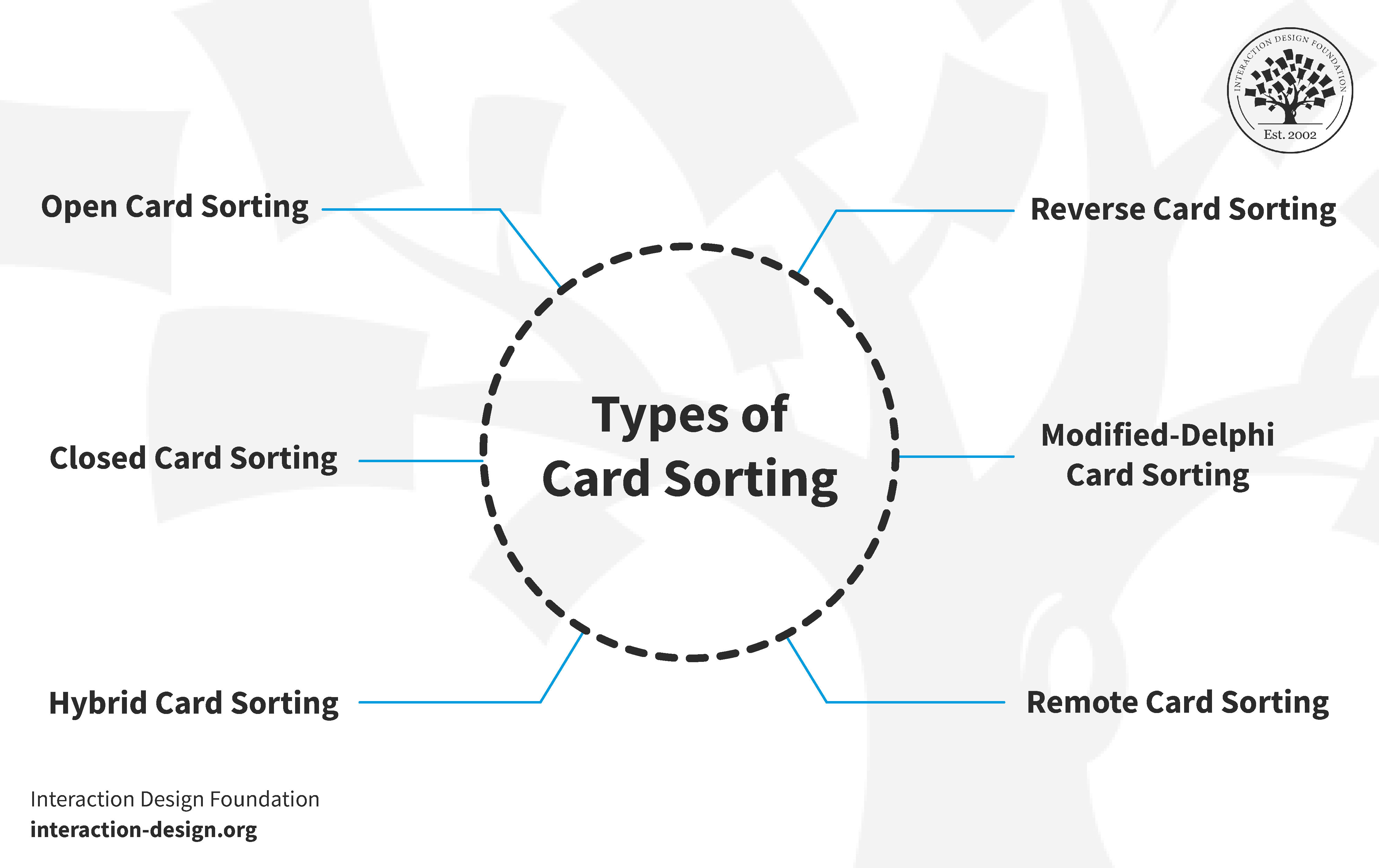
© Interaction Design Foundation, CC BY-SA 4.0
Card sorting is a versatile UX research technique with different types to suit various needs. Each type offers unique insights into how users organize information. Let’s explore these card sorting methods in detail and look at some examples of when to use them.
1. Open Card Sorting
In an open card sort, participants organize cards into categories that they create themselves. This is an excellent approach if you want to understand how users naturally group information without your own preconceived categories guiding their decisions or influencing how they see the content.
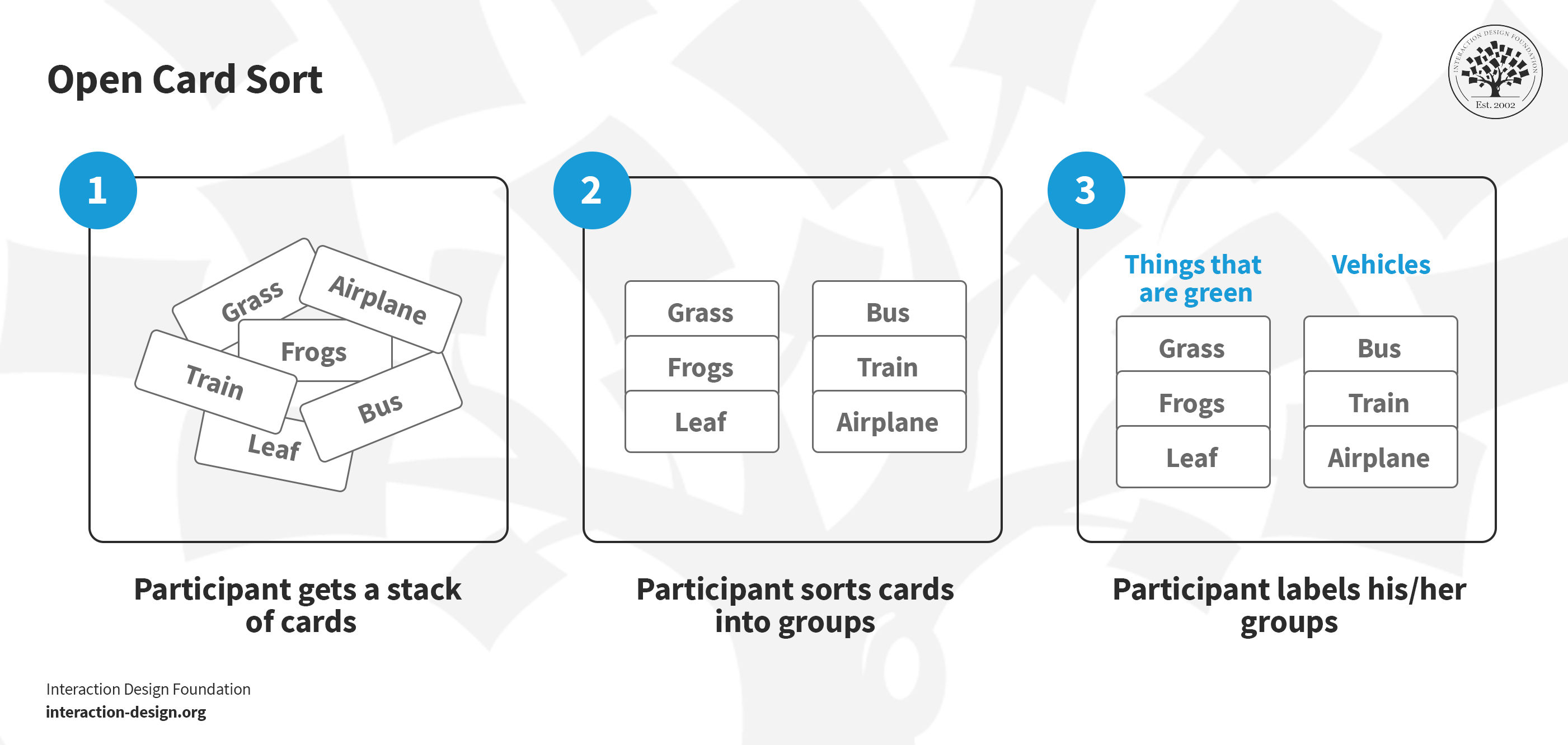
Say you get a stack of cards and you sort cards into groups and label these groups; that’s an open card sort.
© Interaction Design Foundation, CC BY-SA 4.0
2. Closed Card Sorting
In closed card sorting, participants sort cards into categories that you have already defined. This method is particularly useful when you want to test specific groupings or if you already have a basic structure in place that needs validation.
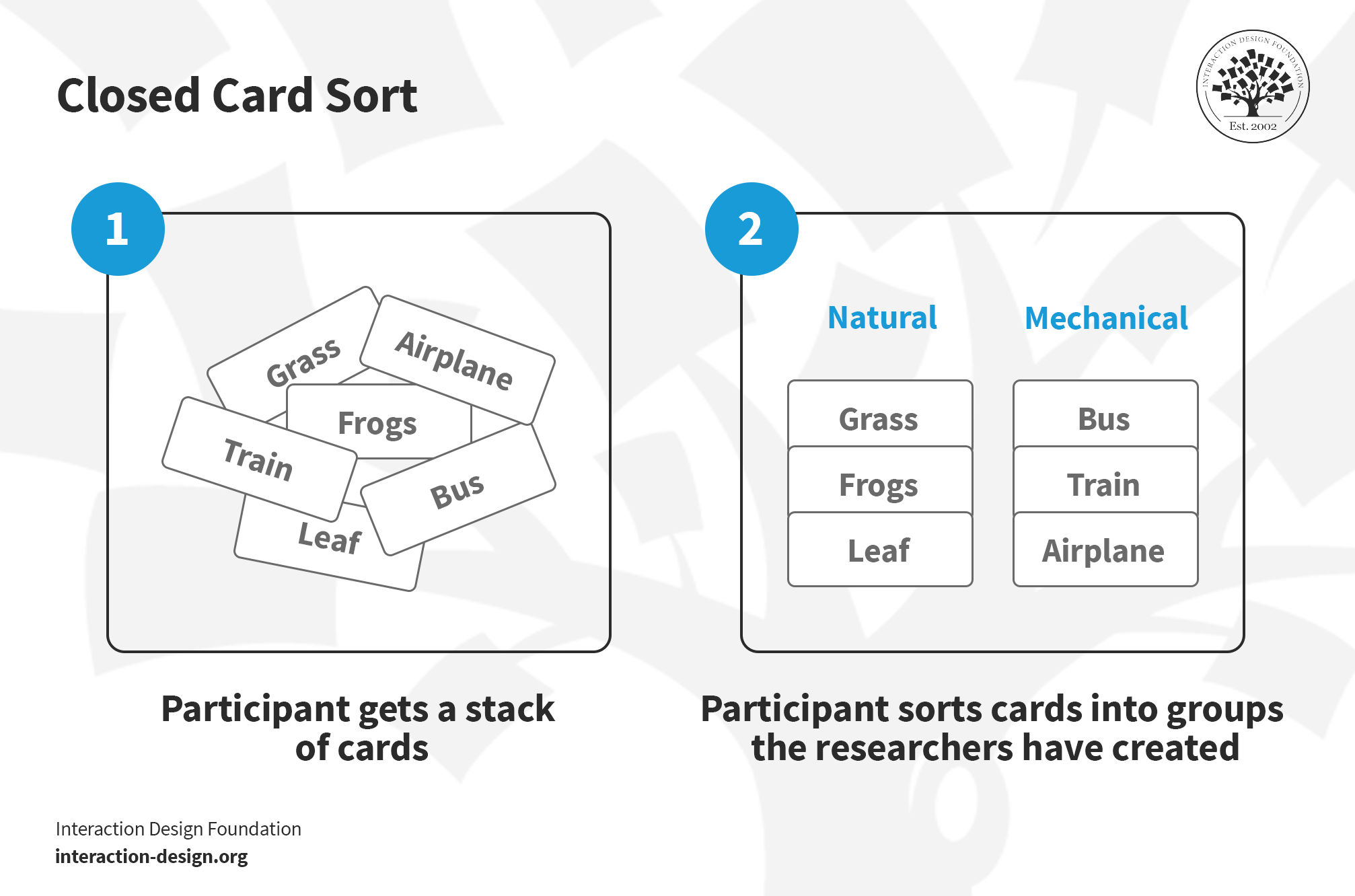
You get a stack of cards, and you’ve got to sort them based on groups the researchers have created—that’s a closed card sort.
© Interaction Design Foundation, CC BY-SA 4.0
3. Hybrid Card Sorting
Hybrid card sorting is a blend of open and closed card sorting. Participants sort cards into provided categories but can also create new ones of their own. This approach offers a great deal of flexibility for the participants and provides deeper insights into user preferences for you.
Example: Imagine you're building a website for a travel operator that manages tourist resorts. You are conducting a card sort where users sort destinations and activities into predefined categories such as "Beaches," "Mountains," and "Cities". Because this is a hybrid sort, users aren't restricted to your categories. They can create entirely new ones like “Adventure Travel,” “Historic Trails,” or “Family-friendly.” From this, you'll be able to gather much more nuanced insights into how they categorize their travel experiences.
4. Reverse Card Sorting
Reverse card sorting, also known as tree testing, is a process where users work backward within an existing framework. Instead of sorting cards into groups, participants deduce where a specific card should go inside a pre-defined structure. This is an excellent way to test how intuitive a site’s navigation is. At the end of a session, you can evaluate the results by comparing how many users placed the item in the "right" category.
Example: Imagine a website dedicated to cookery, featuring recipes, products, and services. You give a specific recipe card, such as “Vegetarian Lasagna,” to users and ask them to find where it fits within a pre-made set of categories. By observing where they look, you can test if the organization of the site truly makes sense to each user.
5. Modified-Delphi Card Sorting
Modified-Delphi card sorting is a method that evolves with each participant. It begins with the first participant conducting a complete card sort to organize items in a way that makes sense to them. This forms the baseline model. Subsequent participants then refine this model by building on the previous person's work until the process is complete.
Example: Let's picture a team designing a health app that includes features like “Exercise Tracking,” “Diet Plans,” and “Mental Wellness.” The first participant creates an initial structure for these features. The next participant reviews that structure and makes adjustments based on their own logic. This continues through several rounds, allowing the team to reach a consensus on the most intuitive layout for the app.
6. Remote Card Sorting
Remote card sorting allows participants to sort cards through online tools. It is a convenient way to reach a broader and more diverse audience.
Example: An e-commerce brand might use an online tool to have users sort product categories such as "Electronics," "Home Goods," and "Fashion." Participants complete the task on their own computers instead of having to attend a formal in-person session.
Tree Testing vs. Card Sorting: Which One Should You Choose?
First off, here’s a quick overview of both techniques:
In tree testing, users navigate through a simplified text version of a site's structure to find specific items. This technique reveals how easily they can locate information within a set framework.
Card sorting helps you understand how users categorize information. In a card sort, participants organize topics or items into groups that make sense to them.
To learn more about getting started with this method, watch this video where William Hudson, UX Designer and Author, discusses tree testing in detail. His insights will help you understand how to apply this technique to your own research projects.
Show
Hide
video transcript
- Transcript loading…
If you’re going to pick between these methods, it’ll depend on your project's stage and goals for which one’s best. If your current IA seems to be causing problems and you need to assess how effective it is, then do start with tree testing, as it’ll show you where users struggle to find information; what’s more, it’ll give you a clear picture of the areas that need improvement.
After you’ve grasped what’s wrong with your current IA through tree testing, then it’s time to go ahead with card sorting so you can get a helping hand at understanding how users think you should organize your content. An open card sort is what lets you capture your users' natural categorizations and terminologies—that’s a crucial ingredient for making an intuitive and user-friendly IA.
Last—but not least—do another tree test after you’ve reworked your IA based on card sorting insights. It’ll help you compare the new IA against the old one using similar tasks, and it’s a comparison that will highlight just how effective your changes actually are—plus, it’ll help you get your updated IA more in line with users’ expectations and behaviors.
What Tools Do You Need to Conduct a Card Sort?
Card sorting doesn’t call for any fancy tools, and you can just use basic office supplies to sort with, say, index cards and markers. With that said, though, there are several digital tools you’ll find that can enhance the research process, and below we show six online tools that can help you streamline your card-sorting process.
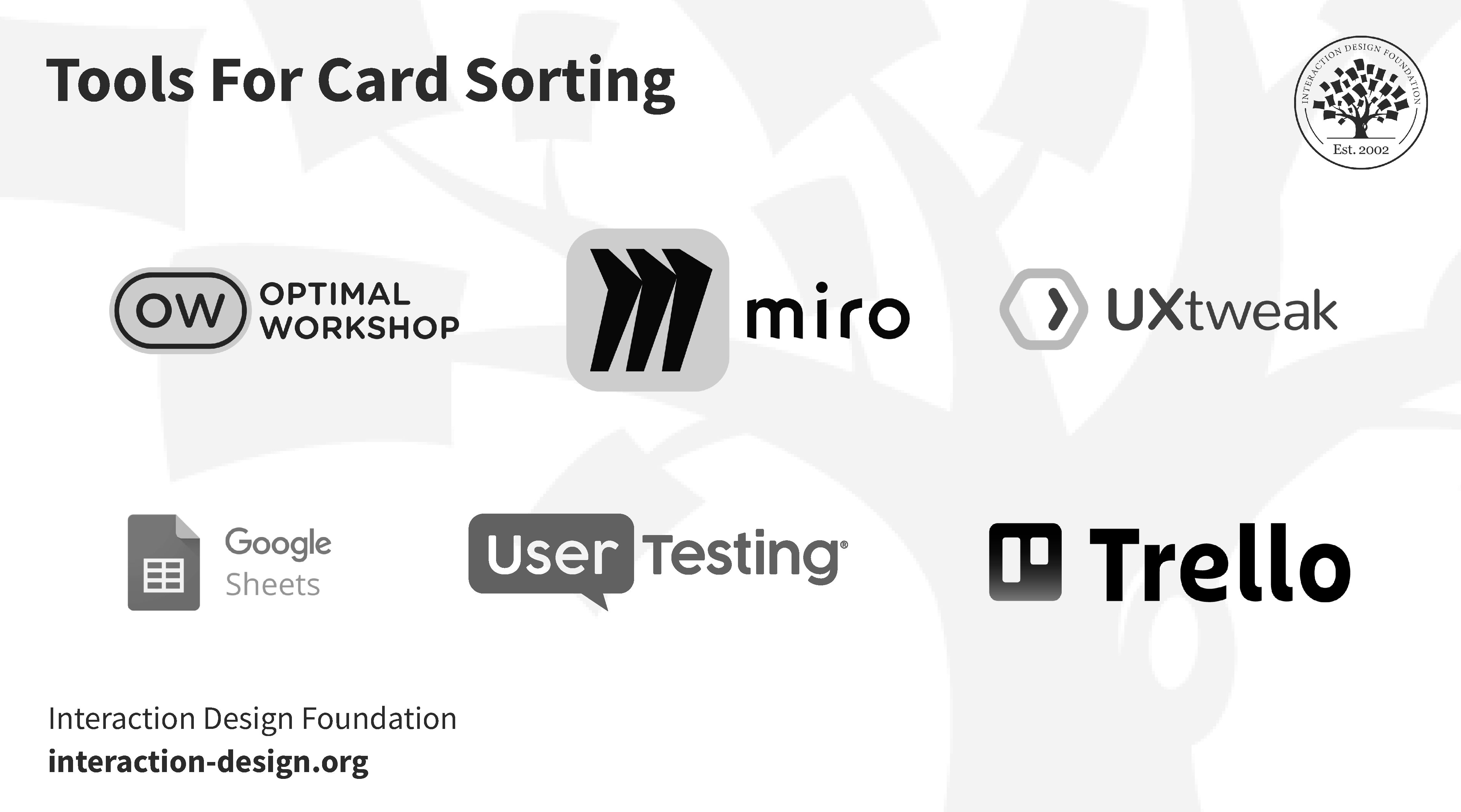
© Interaction Design Foundation, CC BY-SA 4.0
Considerations for Choosing a Card Sorting Tool
You’ve got to consider several factors while you’re picking the right card-sorting tool for your project, so let’s see four important ones:
Study size: Tools vary in their capacity to handle different study sizes, so, for larger studies, go for tools that have got robust data-handling capabilities.
Study format: Decide if your study is to be a remote or an in-person one, and that’s because tools for remote sorting have got features like online collaboration, while in-person tools might focus more on physical interaction.
Analysis needs: Some tools come equipped with advanced analytics, which are ideal for detailed data interpretation—so, work out how deeply you’ll need the analysis to go.
Budget constraints: Be sure to balance the need for features with what you’re prepared to pay for.
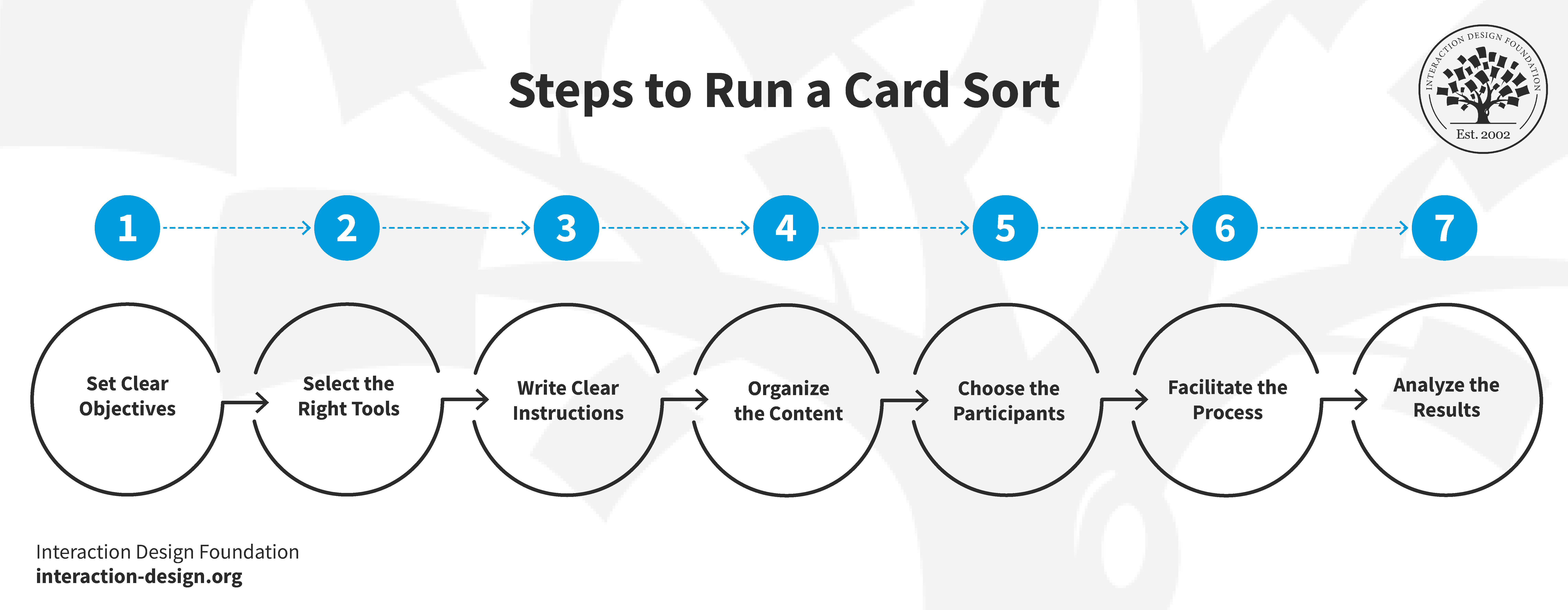
How to Run a Card Sort?
© Interaction Design Foundation, CC BY-SA 4.0
1. Set Clear Objectives
Just like any other research methodology, you’ve got to work out exactly what it is that you want to learn and then—once you’ve done that—consider whether card sorting is actually the best way to learn it.
2. Select the Right Tools
You’ll need some cards, and plain index cards or Post-it notes work well for an in-person card sort. You can use anywhere from a handful to about 100—sometimes more, but it’ll depend on the project—but do try to limit the number of cards to 50 if you’re going to do a virtual card sort.

Index cards or Post-it notes work well for card sorting.
© UX Indonesia, Unsplash License
You can find several card sorting tools online—such as OptimalSort, but applications like Trello, Miro, or GitHub can work well, too. If you use a card sorting tool, it’ll offer you a great benefit, and that’s immediate availability for analysis on the computer and—what’s more and a happy little extra—you’ll be spared the tedious task of transferring results from physical cards to a spreadsheet.
3. Write Clear Instructions for Effective Participation
You’ve got to prepare your instructions before your card sort begins—and that’s no matter if it’s to be done physically or digitally—and they’ve got to be clear so your participants know what to do.
Think about the questions people may ask, and, if you’re conducting your card sort online, be sure to include the answers to those questions in your instructions so you’ll pre-empt them. If you’re going to be doing an in-person card sort, prepare your answers in advance.
Participants may ask questions like:
“This card fits with more than one group; can I put it in multiple places?”
“I don’t understand this card; can I exclude it?”
“There seems to be some content missing; can I add a card?”
Another important factor for you to consider before you start is your analysis, and it’s here where you’ve got to think about the optimal results you want; as in, you may wish to have only five people in your sample or as many as 25. If you do an in-person card sort, then it’s important that you figure out how to get your data from the physical world into the digital.
4. Organize the Content
Your content is one of the most critical parts of card sorting—if not the most—and your results will come from the content you give your participants; and that’s why you’ve got to evaluate them well.
Donna Spencer describes some of the elements and their significance of your card sorting content:
Show
Hide
video transcript
- Transcript loading…
If you’ve got an extensive content set, it may be wise to split them into several card sorts so you get the desired results.
Steer clear of jargon. Avoiding technical terms like that is a vital thing, and that’s because if people can’t understand your content, they won’t be able to group the cards that well and it may affect your results and distort things. People tend to force associations and make connections that aren’t there when they don’t fully understand the information, and that’s why it’s so important to be sure you use clear and direct content; it’s one of the factors that your getting the best possible outcome depends on.
5. Choose the Participants
The people you select for your card sort are really important; Donna Spencer explains what you need to consider.
Show
Hide
video transcript
- Transcript loading…
You might wonder about what the ideal number of participants is for your card sort. Sure, due to space and time constraints, you’ll find in-person card sorts easier to manage. For an online card sort, send the exercise to a small group first, as it’ll let you revise and adapt your card sort and, if you have to, you can always reach out to more people later.
6. Facilitate the Process
It’s best to start out with an introduction, give your participants a bit of context, and then go through the instructions. In a physical card sort, you can speak to your participants, but, if you do it remotely via Zoom or something similar, then you’ll have to write them for most virtual card sorts.
Don’t keep explaining or overhelp. One or some of your participants may likely look to you for guidance in the session; you can repeat the instructions, sure, but don’t go into more detail. You’ll get better results if they carry on without further assistance from you.
It’s better not to tell the people in your card sort that they’ll label the groups they create. Unfortunately, that’s not something you can do in a virtual card sort with an online tool. Language and labels will influence the categories—your participants are going to think more about the categories than the content that goes into them, and you’ll lose the fluidity of the card-sorting process.
Take notes during the card sorting process, and be sure to listen to what your participants say. Try not to hover, though, as this can get in the way of the organic conversation between the participants.
Offer incentives—they’re remarkably effective—and you’ll find this especially valuable in virtual settings where people commit less. Think about what might motivate your participants—such as a small gift, a discount voucher, or even a chance to win something bigger.
7. Analyze the Results
You'll find analysis tends to be easier with an online card sort, and that’s because it directly inputs results into your computer. For an in-person card sort, though, you can use numbers and a spreadsheet to simplify things, and number each card and put it into your spreadsheet, along with the card’s content; then, all you’ve got to do is input the numbers.
First, you want to get an overview. Donna Spencer shares how you do this:
Show
Hide
video transcript
- Transcript loading…
Then, go into more depth, compare participants in detail, and see what the similarities and differences in their results are. And then look at what insights you can pull from the variations you find. For an IA, did they all make an “About Us” section? If they did, then what cards did they put into that group? Sometimes, people will create the same groupings but put different cards into the groupings. You can look at specific cards, too, and see where each person puts them.
Remember, it’s a qualitative research exercise, so you’re trying to get insights—and you want to discover what’s interesting or what stands out in your results. Review your user research objectives and what you wanted to learn from the card sort.
Learn more about quantitative and qualitative user research in this video.
Show
Hide
video transcript
- Transcript loading…
Last—but not least—apply your findings to your project, and it’s best to combine them with other research methods.
Card Sorting Tips and Best Practices
© Interaction Design Foundation, CC BY-SA 4.0
You can leverage card sorting as a powerful tool in user experience research, but its success really does hinge on how you conduct it. You can consider this method a vital step in designing intuitive interfaces.
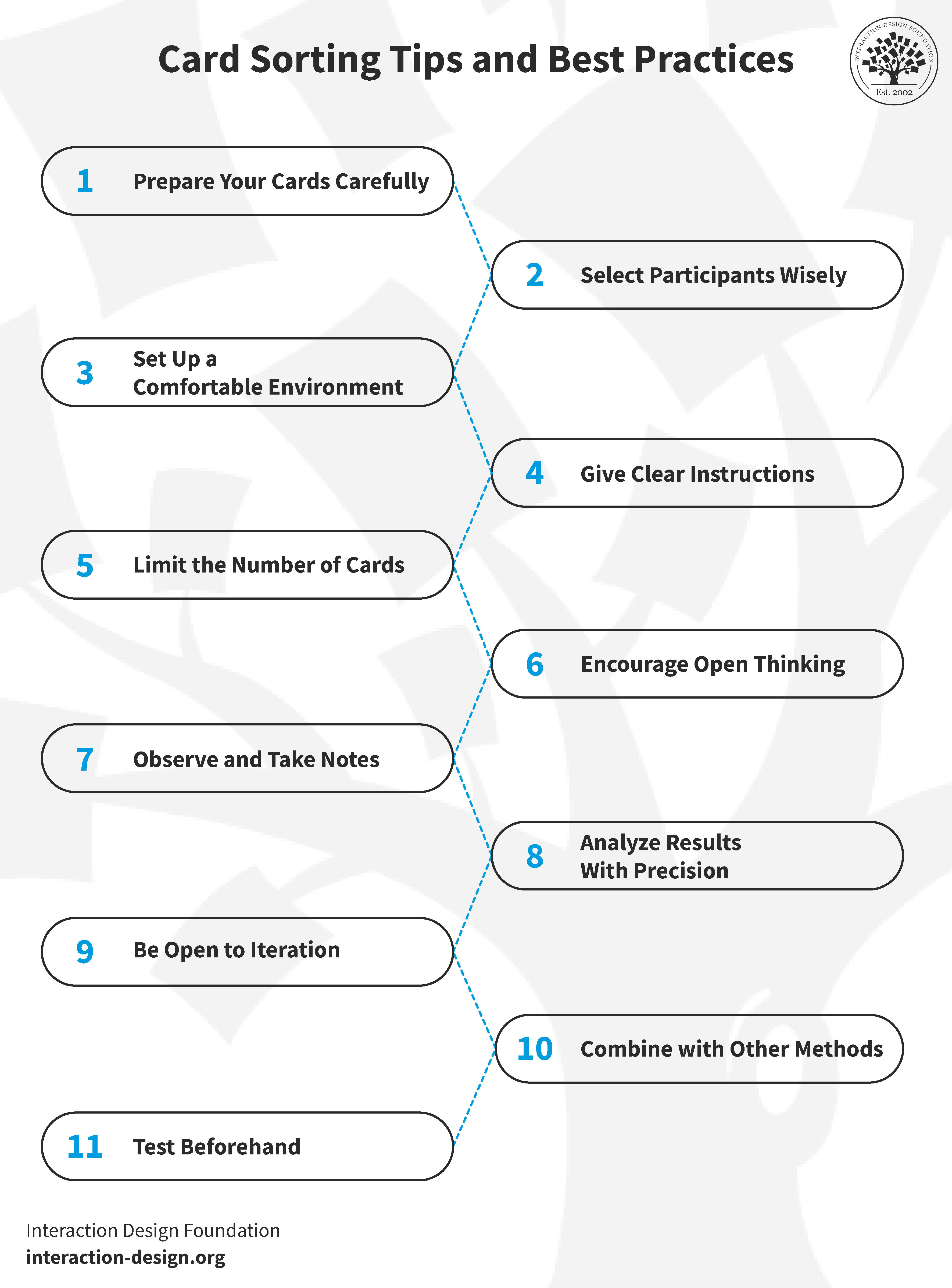
With that said, though, you’ve got to stick to certain tips and best practices if you’re to fully capitalize on its benefits. Follow these guidelines (which are numbered to match the diagram above) as they’ll help you conduct productive card-sorting sessions that yield actionable results.
Use relevant and straightforward cards. Avoid jargon and complex terms—remember, the clarity of your cards can impact the quality of your results.
Choose a diverse group of participants who represent your target audience; diversity is a powerful engine that brings varied perspectives.
Whether it’s online or in-person, make sure you provide a user-friendly sorting environment for participants. For online sorts, pick a tool that's easy to navigate. For in-person ones, make sure there’s a comfortable and distraction-free space.
Give your participants concise, understandable instructions. Be sure to clarify any ambiguities and be ready to answer questions, remembering that good instructions lead to more accurate sorting.
Too many cards can swamp and overwhelm participants, so it’s best to aim for a balanced number that's comprehensive yet manageable, typically around 40-50 cards.
Encourage participants to think freely in open sorts, as that openness is what can lead to innovative categorizations and unexpected insights.
Observe things quietly during the sort, and make notes about how participants interact with the cards and listen to their comments. The user observations you make can end up being as valuable as the sort itself.
“Post-sort” (i.e. after the session), spend time analyzing the results. Look for patterns, outliers, and surprising groupings, and this detailed analysis is where the real value of card sorting lies.
Don't hesitate to run multiple card sorting sessions, and that’s because iterations can refine your understanding and lead to more robust conclusions.
Use card sorting with other research methods like surveys or user interviews—it’s wise as this multi-method approach will give you a more comprehensive view.
Test your method before using card sorting, and it’ll ensure that it’s not just effective but means it’s nice and tailorable for meaningful insights, too.
The Take Away
When you want to know how your users see and think about concepts and items you need to design for, then card sorting is a handy way to reveal patterns so you can organize websites, apps, and the like in a way that matches their mental models best. Key factors like approach (i.e., in-person or remote), objectives, tools, content, participants (including the number of them who are participating in the card sort) are things to bear in mind, although you’ll likely find the process straightforward—but you’ll need to consider each element with care.
To be sure, card sorting is one technique that can offer invaluable insights, but it’ll still call for you to be mindful that the results you get from it may not always be clear. That said, it’s still a handy go-to thanks to its low cost, simplicity, and low investment of effort—so try it, use it carefully, and you may come away with some of the most helpful insights you can hope for to guide how your website or app ends up looking and functioning successfully.
References and Where to Learn More
Dive deeper into card sorting with Donna Spencer’s Master Class, How To Use Card Sorting For Better Information Architecture
Learn how to run card sorts and what tools to use:
William Hudson explains How to Screen Research Participants