Do your personas drive decisions or collect dust in forgotten folders? It’s hard to watch your carefully researched personas get ignored. Meanwhile, your team struggles to make decisions, builds products nobody wants, and gets stuck in endless revision cycles—all of which stagnate progress. But if you can turn your personas from pretty documents into indispensable decision-making tools, you’ll help shape every feature, influence every strategy meeting, and prove your worth through measurable business results.
Think of this as your persona health checkup—a quick scan to see how strong and useful your personas really are. Each “problem” below comes with tell-tale symptoms you might recognize in your own work—along with treatments that actually fix them.
So, pick your biggest pain point. Apply the treatment. Watch how it changes not just your personas, but also how your entire team makes decisions. After all, design without personas falls short, as William Hudson, User Experience Strategist and Founder of Syntagm Ltd, explains in this video.
Show
Hide
video transcript
- Transcript loading…
Ready for your diagnosis? Let's start with one of the most common persona conditions.
Diagnosis #1: Multiple Persona Disorder
“Persona A will love this! But persona F will find it frustrating…” This is a common dilemma we face with personas. With the best intentions, you want to give as many people as possible the best experience, so you create 10 personas. But this is what happens:
Your team debates are paralyzed by too many persona options.
Every new feature, service, or product offering seems justified for somebody.
Nothing gets prioritized effectively.
Everything gets built poorly because your focus is scattered.
Treatment
It’s time to go back to basics. Start with one primary persona. That's it.
Choose the user group that represents your biggest opportunity. These are the people whose problems your product, service, or experience can solve best, creating the most value for them and your business.
Use secondary personas only for slight variations of your primary persona. If Melissa (your primary persona) books flights for business travel, your secondary persona might be Sergei, who books flights for family vacations. They have similar core needs, just different contexts.
Audit your existing personas ruthlessly and eliminate the redundant ones. If two personas have the same goals and behaviors, merge them or delete one.
By doing this, you're not ignoring your other users. You're choosing who to delight while ensuring everyone else gets a good experience.
Diagnosis #2: Demographic Tunnel Vision
Does your persona read like a dating profile? "Sarah, 32, marketing manager, lives in Chicago, earns $75K, drinks oat milk lattes." On the surface, this seems helpful, but it leads to these problems:
The marketing team’s personas contradict your user personas.
Age, income, and other demographic details do not help you predict user behavior.
You find yourself focused on who your customers are, not what they do and why they do it.
Treatment
Make the change from surface-level demographics to behaviors, needs, and motivations. Find out the following about your users:
What triggers them to use your product?
What's their context when they interact with your solution?
What frustrates them most about current alternatives?
How do they measure success?
Keep demographics minimal and relevant. Income matters for investment portfolio apps, but it rarely matters for note-taking tools.
In this video, Celia Hodent, PhD, Game UX Strategist and author of The Gamer's Brain, explains two key types of motivation—intrinsic and extrinsic. When you understand these types of motivation, you can create personas that show your team exactly how to design for what really drives them, resulting in optimal experiences. For instance, if a persona loves learning (intrinsic) but also enjoys earning badges (extrinsic), your team can craft features that fuel both.
Show
Hide
video transcript
- Transcript loading…
Diagnosis #3: Isolation-Induced Blindness
You spent months researching and creating beautiful persona documents all by yourself. It’s a wonderful achievement. But after that, you presented them to your team, they all nodded politely, and now:
Nobody references them after the initial presentation.
Stakeholders question your conclusions and why they should dictate decisions.
Team members don't feel ownership of the personas.
Treatment
For maximum effect, personas should be collaborative from day one. Include developers, managers, and other key stakeholders in user research sessions. Nothing builds empathy faster than watching real people struggle with your product, service, or experience.
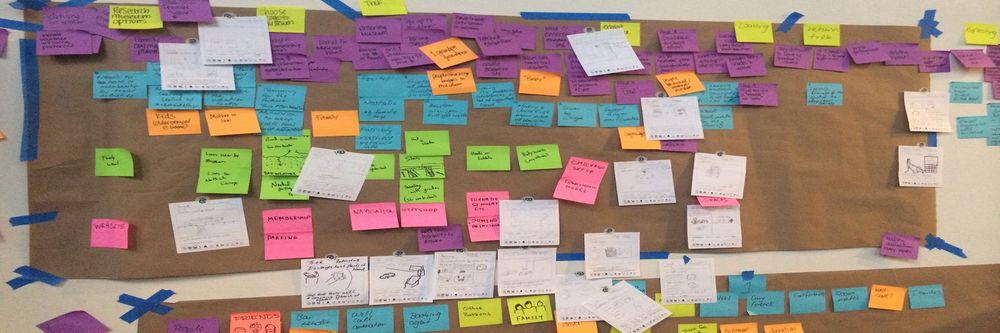
Then run collaborative affinity diagramming sessions where you organize your findings. Facilitate discussions about what the data means. If you enable your teammates to discover the behavior patterns that become part of your personas, they will believe in the insights.
In this video, William Hudson, User Experience Strategist and Founder of Syntagm Ltd, shows you how to create affinity diagrams collaboratively for persona research.
Show
Hide
video transcript
- Transcript loading…
When you create personas as a team activity, everyone becomes invested in using them. After this, your mission is to put personas left, right, and center of your team’s view:
Replace user stories with persona stories. Instead of "As a user, I want to save my work," write "Jessica wants to save her presentation draft so she can continue working on it during her commute home." Specific personas create better features than generic roles.
Inject personas into your environment. Display personas prominently in digital workspaces. Print cardboard cutouts for your workspace. Create coffee mugs with persona photos. Put persona posters on conference room walls. Digital and physical reminders keep personas top-of-mind as you make important decisions.
Reference personas in design reviews. Ask "How does this benefit Marcus?" instead of "Do users need this?" Specific questions generate specific answers.
Diagnosis #4: Research Deficiency
Does your persona feel like an unrelatable movie character, rather than the fellow human next to you on the bus? Do you make decisions based on them that get you nowhere? This is what happens when assumptions and opinions form the foundation of personas:
You can’t back up your persona-based decisions with real data.
Stakeholders dismiss your personas as "made up."
Teams ignore them and default to what they think users need.
Treatment
Strengthen your personas with a steady diet of real research data.
Start with qualitative research. Conduct user interviews and observations. Watch people use your product, service, or experience in their natural environment. Ask open-ended questions about their workflows and frustrations.
Use the "voice of the customer" approach for relatability and empathy. Write your observations in first person using actual user quotes: "I get frustrated when the system doesn't save my progress," instead of "Users want auto-save functionality."
Apply triangulation to validate findings. If observations reveal a pattern, verify it with surveys or analytics data. Multiple research methods strengthen your confidence even further. This type of triangulation is called methodological triangulation, as William Hudson explains in this video:
Show
Hide
video transcript
- Transcript loading…
Diagnosis #5: Expired Persona Poisoning
The rewards you get from a well-researched persona are numerous: better product fit, happy users, higher profits. But it can be easy to rest on our laurels and leave our personas as they are. But user needs and behaviors evolve, and if your personas don’t keep up, you might:
Build features for your personas that don’t please users.
Fill in the blanks with assumptions that don’t reflect real user needs.
Treatment
Establish a regular check-in schedule to prevent persona decay. At a minimum, review personas every six months and ask:
Do our current users still match these personas?
Have new user types emerged?
Do the pain points still reflect reality?
Have goals and motivations shifted?
Update your personas when project goals change significantly. If you pivot from consumer to enterprise users, you need to completely revise your personas.
Refresh personas when major market conditions shift. A global pandemic changes user behavior overnight. Economic downturns alter usage patterns.
If you work in an Agile or Lean UX environment, schedule regular "persona health checks" before sprints. Update with any new research findings, customer support trends, or sales feedback that’s relevant.
Diagnosis #6: Funding Failure Fever
When your project manager questions why you spent precious resources interviewing users for 3 weeks, it can be hard to convince them why. They might also say:
"We already know our customers, there’s no need to research.”
“We need to invest more in development; the research budget is cut.”
"Personas are a nice-to-have, but not a priority.”
Treatment
The truth is, personas give you a huge return on investment. Here’s your winning argument to convince stakeholders:
Reduced feature creep and development costs. When teams know exactly who they're building for, they build fewer unnecessary features. Every feature, product offering, or new service gets evaluated against persona needs. Show stakeholders how much money gets wasted on things nobody buys or uses.
Faster decision-making in design reviews. Instead of endless debates about user preferences, teams reference persona research. Decisions happen in minutes, not hours. Calculate the hourly cost of your design team's time spent in meetings.
Higher user satisfaction and conversion rates. Products built for specific personas solve real problems better than products built for "everyone." Happy users become loyal customers. Connect persona research to customer retention metrics.
Team alignment and efficiency gains. Everyone understands the target user. Marketing, design, and development work toward the same goals instead of conflicting visions. Estimate productivity gains from reduced miscommunication.
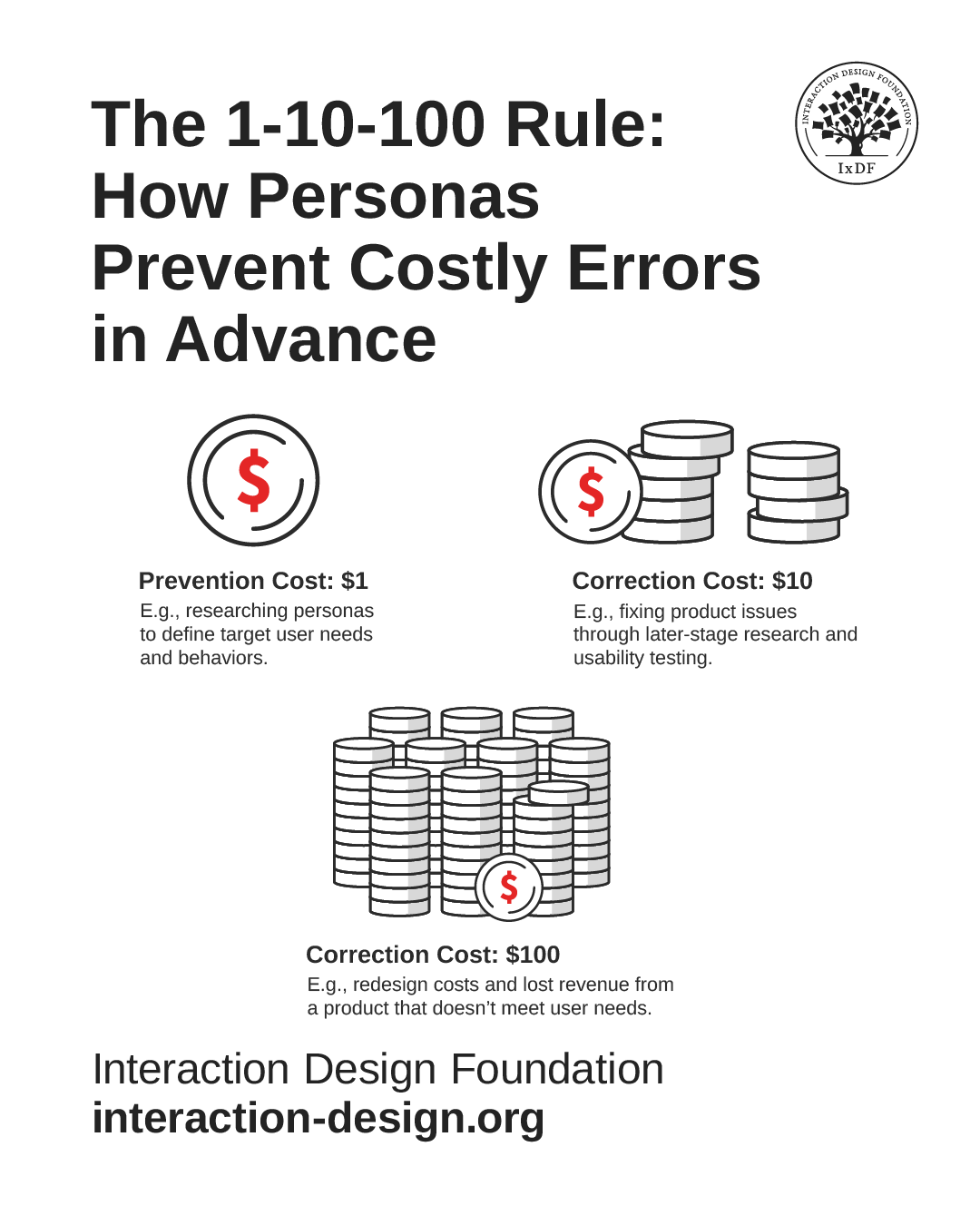
Figures speak louder than words, so use math as part of your case. For example, if persona research costs $20K but prevents one failed feature that would cost $100K to build, you've saved $80K.
© Interaction Design Foundation, CC BY-SA 4.0
Position persona research as preventive medicine, not optional treatment. The cost of building the wrong thing always exceeds the cost of understanding users first.
The Take Away
Do your personas drive decisions or collect dust? If it’s the latter, then some simple fixes and mindset shifts can take you from “the one who keeps talking about personas” to “the one who brought priceless insights, aligned our team, and drove us to success.”
The six conditions that afflict personas all stem from the same underlying cause: treating personas as documents instead of pivotal decision-making tools. When you solve these problems, your personas become living, breathing representations of the people you serve, who your team and organization can’t survive without. Here’s how:
Start with focus—one primary persona beats ten mediocre ones.
Skip the demographics and focus on real behaviors.
Involve your team in the creation process so they feel ownership.
Ground your personas in real research, not assumptions.
Keep them updated as your market evolves.
Make personas impossible to ignore. Put them in every meeting, every design review, every feature discussion.
Remind your managers and stakeholders how beneficial personas are to your team, users, and profits.
When your team can't make a decision without considering Jessica or Marcus, you've achieved full persona health.
The professionals who level up their careers and build successful products don't create perfect personas. They create useful ones backed by research, focused on behavior, and integrated into daily workflow.
References and Where to Learn More
Want to know more about personas and how to use them effectively? Personas and User Research: Design Products and Services People Need and Want will show you how to gather meaningful user insights, avoid bias, and build research-backed personas that help you design intuitive, relevant products. You’ll walk away with practical skills and a certificate that demonstrates your expertise in user research and persona creation.
Master affinity diagramming—the collaborative “sense-making” activity—in our Affinity Diagrams article.
Alan Cooper, a pioneer of Interaction Design, first introduced user personas in his seminal book The Inmates Are Running the Asylum.
Explore further persona problems (and how to solve them) in Nielsen Norman Group’s article, Why Personas Fail.
Discover persona stories, how to write them, and why they’re significantly more effective than user stories in William Hudson’s article, User Stories Don't Help Users: Introducing Persona Stories.