Are your personas not driving you to better products, happier customers, and higher profits? It’s actually quite common. You've heard about the benefits of personas and all the success stories, and you think, “let’s give this a try!" But in reality, your current personas don’t get you anywhere, don’t get used, or even put you in a worse position than you started in. It’s easy to get personas wrong. But don’t worry! It’s just as easy to get them right when you know what to avoid. Bypass these 9 mistakes, and you’ll create personas that guide you to create products, services, and experiences customers love. More love, more profits!
You may be at the point in your persona journey where you have ditched personas altogether, or you’re strongly considering it. But this would be a mistake in itself. Here’s what happens when you don’t use personas:
You design based on guesses, not real needs.
You and your team lose focus and alignment.
You risk adding features customers don’t want.
All of this leads to products, services, and experiences that don’t align with your customers’ needs, and therefore, are not sold.
In this video, William Hudson, User Experience Strategist and Founder of Syntagm Ltd, explains further.
Show
Hide
video transcript
- Transcript loading…
Now that you’ve heard our case, are you ready to give personas another shot? If you avoid all the mistakes on this list, you’ll be well on your way to game-changing personas. Let’s begin!
Mistake #1: Are You Letting AI Sabotage Your Personas?
AI has unlocked infinite possibilities for you to improve your workflows and efficiency. Ask it to create a persona for you, and you’ll have a result in seconds. However, this persona will be completely made up and not based on user research. It will guide you to solve problems your customers don’t have, and in turn, not solve the ones they do.
In that case, you can do your research and ask AI to turn it into a persona. But even this won’t work. Why? Because AI can’t truly connect with the research, empathize with human patterns, and understand what problems you need to solve. Only you can do this. Your deep, human-centered skills—your empathy, intuition, and creativity—turn customer insights into personas that keep you on track to build life-improving products.
Imagine Sarah, a persona for an online grocery shopping site. How might AI interpret the research compared to a human?
AI-generated persona: “Sarah, 34, shops online after work. She finds searching for regular items frustrating.”
AI-assisted, human-generated persona: “Sarah, 34, shops online after long shifts. She’s exhausted, and the app burying her past orders adds more effort to the process. 'I just need an easier way to order my usuals.’”
This contrast shows how you bring empathy and meaning to the data. Empathy that will motivate your team to build the best possible solution for Sarah—one that results in happy customers and higher profits.
Solution: Create Personas with AI
Wait a second? Didn’t we just say not to use AI? Of course, you should use AI! Just strategically. For example:
Ask AI to group related and recurring research data to help you identify patterns in your persona user group.
Get AI’s help to rewrite your persona summaries more directly and concisely.
Create an AI chatbot based on your persona to emulate talking to your real customers.
Remember, AI can support, but it won’t replace you. Implement it in areas where it will boost efficiency and amplify your human-centered skills to get even better results.
Mistake #2: Are Your Assumptions Leading You Astray?
Let’s say you want to build a travel booking app. You imagine you are your customer and create a persona. What are your needs? Your behaviors? Your motivations? Perhaps you need to book a flight to visit your friend in New Zealand and want the cheapest option. Well then, you can build an app that works perfectly for you!
Herein lies a primary reason why personas fail—you are not your customers. Despite the popularity of the phrase “put yourself in your customers’ shoes,” it’s an impossible task unless you understand who they are. When you assume who your customers are, you don’t meet their needs, and they don’t buy your product.
Solution: Base Your Personas on Research
To avoid assumptions, build your personas on a deep understanding of your customers and their problems. A research-backed persona is a powerful decision-making tool.
But how do you get this understanding? With the same skills of communication, empathy, attention to detail, and critical thinking that you apply everywhere else in your work and personal life.
One approach to user research that bypasses assumptions and leads to a deep understanding of customers is grounded theory. In grounded theory, you alternate data collection with data coding to build a complete picture of your users’ behavior. William Hudson explains more in this video.
Show
Hide
video transcript
- Transcript loading…
Mistake #3: Do You Have Too Many Personas to Keep Track Of?
…the successful PalmPilot has far fewer features than did General Magic's failed Magic Link computer, Apple's failed Newton, or the failed PenPoint computer. The PalmPilot owes its success to its designers' single-minded focus on its target user and the objectives that user wanted to achieve.
—Alan Cooper, The Inmates Are Running the Asylum
The example in the quote above is an old one, but its relevance is no less important today. Alan Cooper introduced personas to interaction design to give designers a medium that represents a targeted user group, on which all design efforts can be focused.
So then, when you create a persona for every type of user, you directly contradict a persona’s purpose. This takes you back to square one—you’re designing for everyone. If decisions are harder and teams lack focus, you’ll lose time, and, in the long run, customer satisfaction when your product fails to meet any needs in particular.
Solution: Use as Few Personas as Possible
If you design for an individual, you can create a focused product with great features and usability, rather than one that tries to please everyone with too many features and low usability.
Therefore, the optimal number of personas for small projects is one primary persona. If you find a user group in your research similar to your main group but with distinct differences, you can use a secondary persona. Secondary personas acknowledge the need to design ideal solutions for various user groups while maintaining most of the focus of a single persona.
For larger projects, it’s common to use multiple personas, such as in a hospital with medical staff, patients, administrators, etc. However, these personas should still be specific and targeted to build solutions that meet customer needs.
Mistake #4: Are Your Personas So Generic, They Don’t Actually Help?
A similar pitfall to having too many personas is having one persona that represents too many people. Imagine you meet a new person. There’s nothing they particularly like or don’t like, and their actions don’t tell you much about them. It’s hard to relate to this person! Would you want to design the best possible solution to their problems? (A hard task in itself when their problems are vague.) Probably not.
This mistake happens when it seems counterintuitive to build with only a percentage of customers in mind, as you’ll leave the rest out. However, this isn’t the case—this approach leads to a mediocre product at best, which consumers will overlook for a better option.
Solution: Create Specific, Targeted Personas
When you conduct your research and discover the user group you want to delight, get to know their needs, behaviors, and motivations inside out. A persona with this specificity will guide you to create something amazing for your targeted users, vs a generic persona that guides you to something average for everyone.
Where personas work is that “something amazing” will still be a great fit for many more customers than “something average” because it was built with deep empathy. Of course, there will be customers you leave out, but this is inevitable—you can’t please everyone!
Mistake #5: Are You Including Skill and Ability Levels in Your Personas?
Imagine your persona, John, includes the abilities and skills of one of your target users. John has perfect vision, great motor skills, and is highly tech-proficient. You build an app just for John:
You don’t worry about color contrast and customizable text sizes—John can see everything.
You make your buttons small and include gestures—John has no problems using those.
You don’t need a tutorial or help tips—John’s used loads of apps—he gets it.
But what about Jane? Jane is an elderly user with poor vision, reduced motor skills, and basic tech skills. She’s not in your persona user group, but she still uses your app. See the problem?
Good usability, accessibility, and learnability benefit all users, and in the case of digital products, ensure you don’t break the law by discriminating against less able customers.
Solution: Consider Skills and Abilities Separate from Your Persona
Personas shouldn’t include skills and abilities—they’re a separate consideration. Personas are about the needs, motivations, and key behavioral information common to a specific group of users.
They cannot guide you in ensuring your product is usable, accessible, and learnable to as many people as possible. William Hudson explains more in this video.
Show
Hide
video transcript
- Transcript loading…
The exception to this rule is when your product is aimed at an audience with a specific ability or skill level. For example, a product specifically for wheelchair users, or a custom shortcut app for power users.
Mistake #6: Are You Overloading Your Personas with Demographics?
Demographics offer a sense of realism and make personas feel more relatable. However, they aren't reliable predictors of user behavior and lead to ineffective personas and products built on stereotypes.
For example:
John, 81, is retired, widowed, and financially comfortable. He drives his own car but struggles with heavy grocery bags because of limited strength.
Jason, 19, a low-income student, relies on buses. He finds carrying heavy items difficult because of long commutes on public transport.
Despite significant demographic differences (age, income, family status), both customers share a similar challenge: managing heavy grocery items. Demographics alone don't reliably predict customer pain points; you must also consider behavior and context.
Solution: Keep Demographics to the Bare Minimum
You may only need an age in addition to a name and a photo. When you keep a persona’s demographics simple, you put the focus on their behaviors. It doesn’t matter if John is 81 and Jason is 19—it’s their shared behavior that will guide you in design decisions.
It’s also best practice not to use age ranges since real people do not have age ranges. Ranges are associated with groups, and we empathize more with individuals, as William Hudson explains in this video.
Show
Hide
video transcript
- Transcript loading…
Mistake #7: Are You Ignoring Your Customers’ Context?
An essential component of a persona is the context of use. This tells you where your customer will be using your product, service, or experience. What’s going around them? What are their circumstances?
In this video, Frank Spillers, Service Designer, and Founder and CEO of Experience Dynamics, explains context of use.
Show
Hide
video transcript
- Transcript loading…
When you exclude context of use, you remove a huge part of the picture. Without it, your persona may guide you to the best solution, but it’ll be for the wrong situation.
Solution: Always Include Your Customers’ Context
Imagine you’re designing a database system for warehouse workers. The tablets on which they use the system are mounted on the Segways and forklifts they use to get around. For this reason, they need large buttons and intelligent predictive text to avoid continuously dismounting and mounting the tablet.
Without this knowledge, you might design a solution that works great when you can hold the tablet in both hands, but is frustrating and difficult to use when mounted. This is why it’s essential that your team has this information in their personas.
Mistake #8: Do You Reuse Your Personas?
Imagine you’ve just released a new reusable coffee cup for commuters that you designed using a persona. It’s a success! Your customers love it. Your next project is a revolutionary water bottle, and you're tempted to use the same persona to save some time.
This would be a mistake—even if the audience for both products is similar, they will have different needs and behaviors regarding drinking water. Once again, you’ll end up with an unsuccessful product designed for a customer who doesn’t exist.
Similarly, even if you’re upgrading your award-winning coffee cup, the same persona you used might not be applicable in just a year. Behaviors, trends, and technology change.
Solution: New Project, New Persona—And Keep Them Updated
Each new project should have its own persona, or personas. While the users behind the persona might be similar, the behaviors they exhibit and the needs they have will vary between different products or even features. If you use the same persona, you will begin to make assumptions about your customers in relation to the new project.
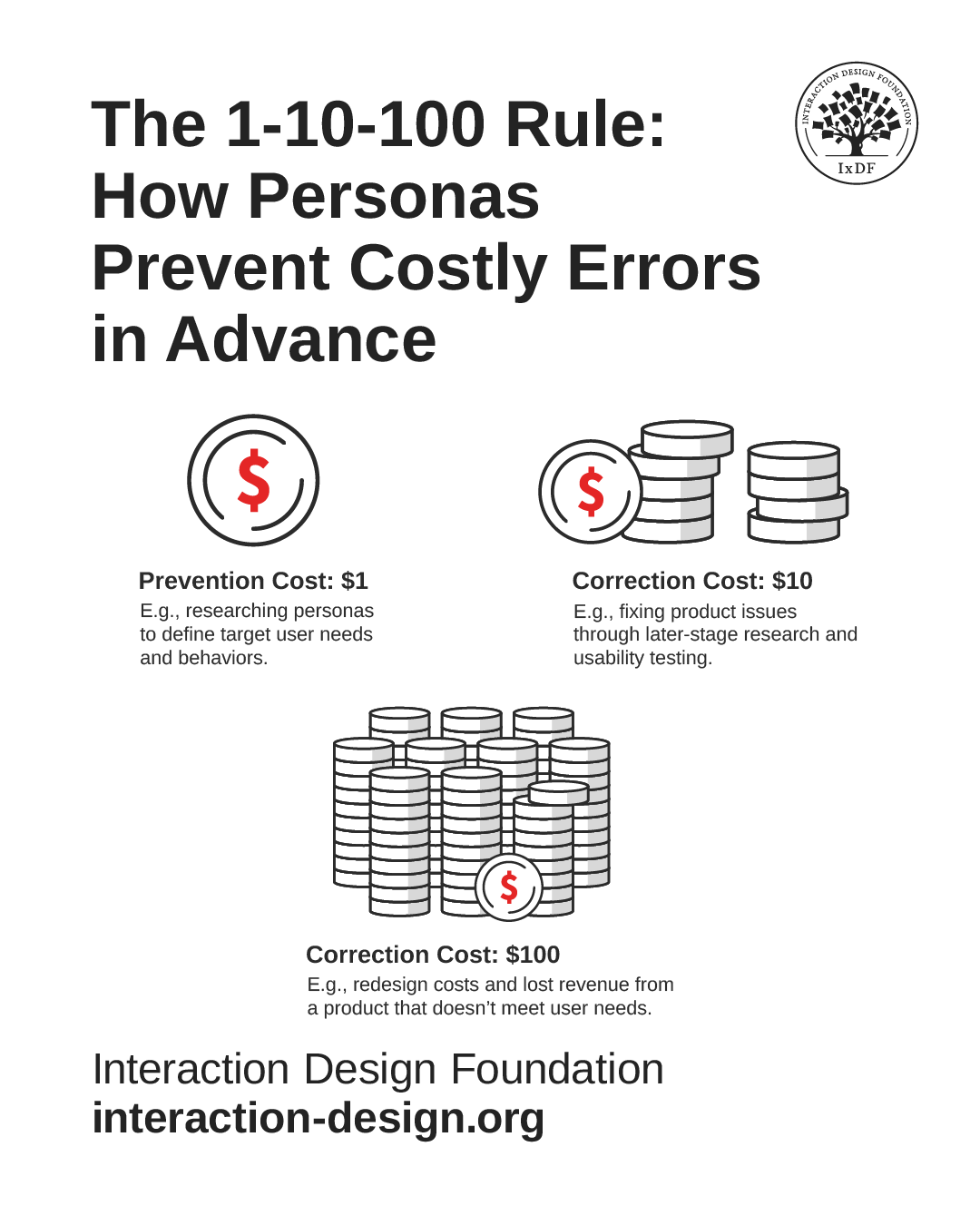
If you reuse a persona, you will save some resources in the short term. However, it will be far more expensive in the long run for you to fix low customer satisfaction than to research a new persona.
© Interaction Design Foundation, CC BY-SA 4.0
Once you’ve created your persona, keep your ear to the ground and regularly check in with your customers. You can even invite previous research participants back and ask them if anything has changed in how they use your product, service, or experience. If the same people you initially designed for have new needs, you’ll want to know about them!
Mistake #9: Is Your Team Ignoring Your Persona?
Let’s say you’ve bypassed the eight mistakes above and built a compelling persona based on deep user insights. But no one uses it.
This happens far too often. Your persona is buried and forgotten in your shared drive. Getting your team on board with personas can be tough, especially when UX design techniques raise eyebrows rather than spirits.
Solution: Get Everyone Involved and Share, Share, Share
Here’s how to get your personas adopted and used:
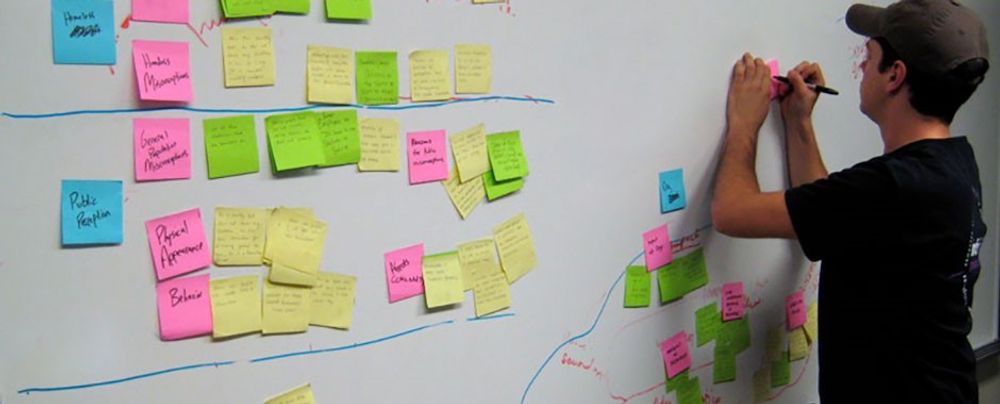
Involve stakeholders in user research: Invite your team members and other key stakeholders to participate in the user research phase. For example, you can invite colleagues to help sort and analyze your research data. One method that allows for collaborative sorting and data immersion is affinity diagramming. In this video, William Hudson describes how to create affinity diagrams.
Show Hide video transcript- Transcript loading…
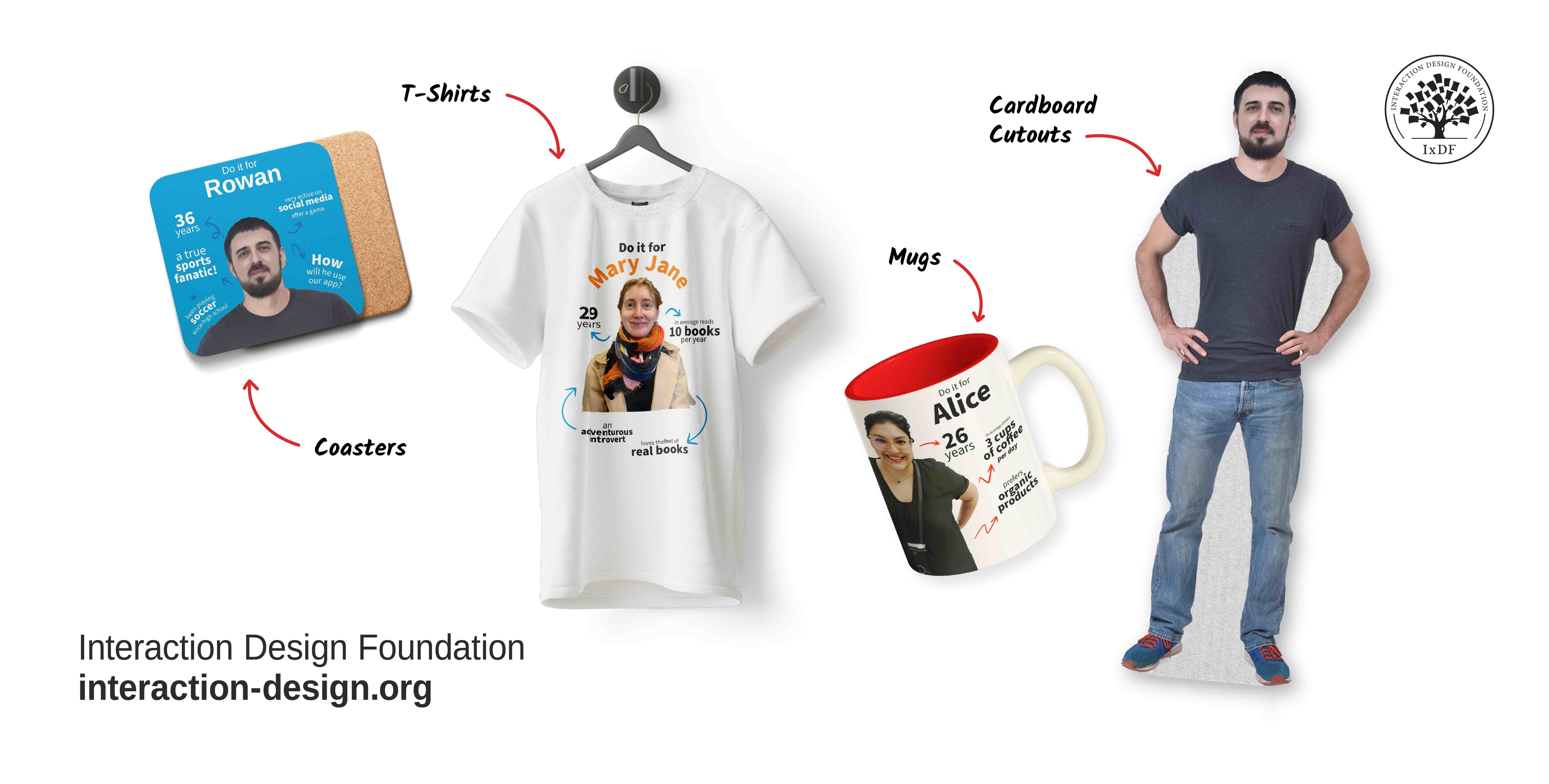
Make your personas unmissable and unforgettable: Don’t stop at a single sheet of A4 for your personas! Get creative with how you share them, for example, with merchandise.
![]()
Persona merchandise, like mugs, t-shirts, and cardboard cutouts, keeps your personas front of mind. The more your team and stakeholders see and think about your persona, the more they will connect with your customers and build products just for them.
© Interaction Design Foundation, CC BY-SA 4.0
Insert personas in stories of use: Stories of use is a term that encapsulates different narrative tools, like persona stories and storyboards, that promote empathy. Use them to communicate what your persona needs and how they will interact with the product. An example of a persona story is: “Rowan wants to ask questions about products so that he can address his uncertainties before making a purchase.”
Fix Your Personas and Boost Engagement and Sales
Now that you know these 11 common mistakes, you can avoid them and create effective personas. But what exactly is an "effective persona," and how does it help?
A persona is a constant reference to your customers that gives you a deep, realistic understanding of their behaviors, needs, and motivations.
Imagine you run a car cleaning business, and you create a research-backed persona named Jenny:
Jenny is a busy professional who values predictability and convenience above everything else.
She is less concerned about saving a few dollars and more motivated by straightforward, stress-free decision-making.
You and your team continuously reference Jenny during meetings. When restructuring your product offering and pricing, you discuss many options. Thanks to Jenny’s presence, you narrow down the list to two clearly defined service packages. This significantly reduces the complexity of choice, which would please Jenny.
You also refer to Jenny as you decide to switch to an automated texting system. Now, Jenny receives immediate notifications when the cleaning starts, and again the moment her car is ready, along with clear reminders of your opening hours. This provides her with the flexibility and peace of mind she needs.
In addition, you give each team member a mug with Jenny’s photo and key behaviors on it. When they drink from the mug daily, they’re reminded of Jenny and consider her in everything they do.
As a result, customers like Jenny feel genuinely understood and satisfied. They recommend your business to friends, leave five-star reviews, and consistently return, ultimately strengthening customer loyalty and driving growth.
The Take Away
Personas might seem simple—but using them effectively takes more than just filling out a template. If you avoid these 9 common mistakes, you’ll get your team onboard and start seeing the impact you hoped for. Here’s how to craft personas that truly resonate:
Use AI strategically—let it help you improve efficiency, but don’t let it take over.
Start with real insights—build your personas on research, not assumptions.
Keep it simple—fewer personas means more clarity. Stick to what's absolutely necessary.
Make them come alive—ensure your personas are specific, realistic, and relatable—never generic.
Consider abilities and skills separately—only include them when they're crucial to understanding user behavior.
Be strategic with demographics—only add extra details if they meaningfully clarify your users' needs or actions.
Show context clearly—describe how, where, and when customers interact with your solution.
Stay fresh and relevant—keep your personas current and create new ones whenever projects or contexts change.
Don’t let your persona gather dust on the shelf—share them actively and integrate them into your team’s daily workflow.
Personas that avoid these mistakes help you achieve better product fit. This leads to better user experiences, stronger business results, and more direct success and fulfilment for you. Because when products truly meet people’s needs, everyone benefits.
References and Where to Learn More
Want to know more about personas and how to use them effectively? Personas and User Research: Design Products and Services People Need and Want will show you how to gather meaningful user insights, avoid bias, and build research-backed personas that help you design intuitive, relevant products. You’ll walk away with practical skills and a certificate that demonstrates your expertise in user research and persona creation.
Read Alan Cooper’s seminal book that introduced personas to interaction design, The Inmates Are Running the Asylum.
Explore insights from persona expert Kim Flaherty in the Nielsen Norman Group article Why Personas Fail.
Find out why persona stories are better for user-centered design in William Hudson’s article, User Stories Don't Help Users: Introducing Persona Stories.
Discover how startups use personas, what goes wrong, and two case studies from Webflow and Nextdoor in Unusual Venture’s article, The top user persona mistakes startups make — and how to avoid them.