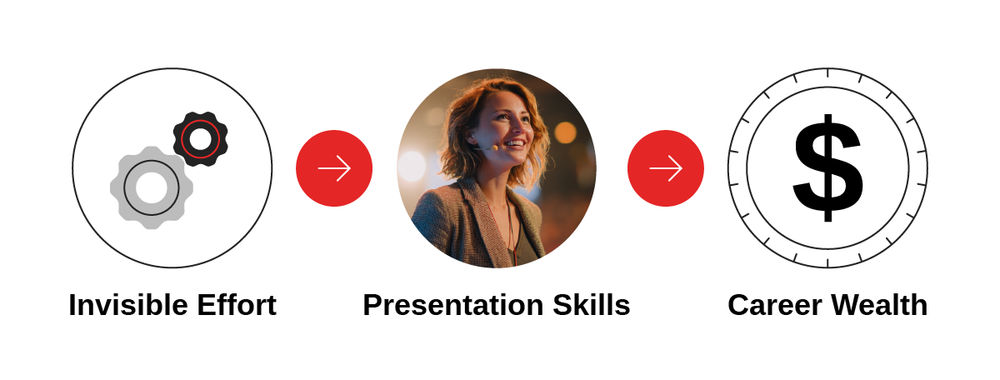
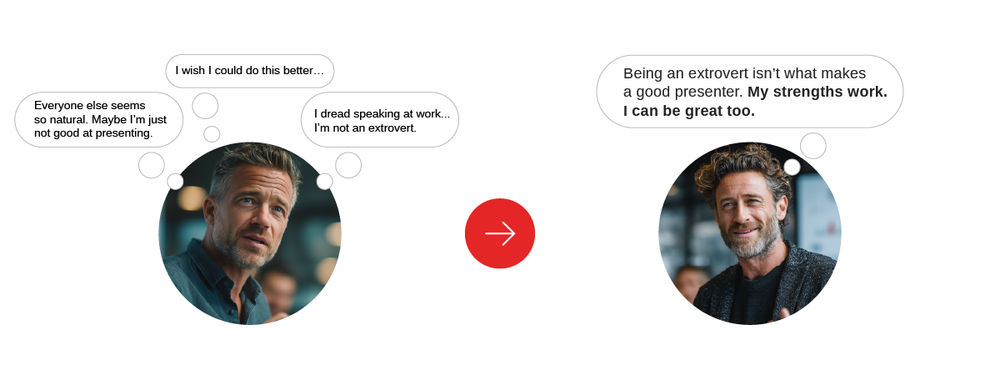
Ever walked out of a presentation thinking, “That could’ve gone so much better, maybe I’m just not a presenter”? You’re not alone. And you’re not the problem. You simply haven’t been shown an easy, clear, repeatable way to prepare, deliver and follow up.
Presenting is not an innate talent; it’s a skill taught in executive programs, practiced by leaders and absolutely easily learnable by you.
In this video, Morgane Peng, Head of Product Design & AI Transformation at Societe Generale, shows why your ideas need you to speak for them.
Show
Hide
video transcript
- Transcript loading…
Presenting isn’t about selling yourself or your work; it’s about designing understanding. And when you do that well, people say yes faster.
The Real Career Payoff: Influence over Information
You can pour months into research, design, or strategy and still watch your idea stall in a meeting. Not because the idea was bad. But because no one else truly felt its importance.
That’s the quiet heartbreak of modern work: your influence often matters more than your information. In creative, tech, and product environments, success is often about who can make others believe in their projects.
That’s why communication isn’t a “soft skill.” It’s a career-defining springboard. The people who rise are the ones who can translate complexity into conviction.
The higher you go, the less your professional value is tied to what you produce, and the more it’s tied to how you communicate that value. Communication becomes your career multiplier: it secures buy‑in faster and builds the trust that opens doors to bigger opportunities.
You’re Not a Bad Presenter, You Just Need Better Tools
If presenting has ever made you feel awkward, anxious, or out of your depth, you’re not the problem. According to scientific research, around 75% of professionals experience some form of public speaking anxiety. That’s a system failure. We’ve been taught how to share information, but not how to present it, and those are two very different things.
Most presentation advice sounds like: “Stand tall. Make eye contact. Speak up.” But none of that helps when your brain is in survival mode. Those tips are surface-level. They don’t give you the tools to manage nerves, direct attention, listen actively, or build real connection. It’s like being handed a car but never being shown how to drive it in traffic.
But in a sea of generic, unhelpful advice, these valuable tools do exist and once you master them, your mindset shifts.
You stop wondering, “Did I sound confident?”
And start asking, “Did they understand what matters?”
This mindset shift is where confidence begins.
Anxiety Isn’t Failure, It’s Energy in Disguise
© Giphy, Fair Use.
That racing heart? The shallow breath? The sweaty palms?
They’re not signs that you’re bad at presenting; they’re signs that your nervous system is doing its job. Your brain thinks something important is about to happen, and it’s trying to help you focus.
Neuroscience shows that the same adrenaline surge behind stage fright is also what fuels excitement. The difference lies in how you interpret it. Confident presenters aren’t necessarily calmer. They’ve just learned to label that surge differently.
This technique is called cognitive reappraisal, a shift in how you interpret stress.
When you think, “This is fear,” your brain triggers a threat response. But when you think, “This is energy helping me perform,” your prefrontal cortex kicks in, calming your body and sharpening your focus. It’s like being at the starting line of a race, your heart pounds, your breath quickens, and your muscles tense. Not because something’s wrong, but because your body is gearing up to perform.
Try this reframe before your next presentation:
“This isn’t public speaking anxiety. This is power.”
It may sound simple, but this is a proven neurological shortcut to regaining control. Once you learn to reframe the signal, you’ll never see presenting the same way again.
You Don’t Fear Presenting, You Fear Losing Control
Daniel had rehearsed the night before, pacing in socks, talking to his cats as if they were the board of directors. He had color-coded slides. A strong opening. Even a joke. This presentation was his chance to finally get his team behind the feature he'd been quietly obsessing over for months.
He clicked to the first slide.
Halfway through explaining the user problem, someone yawned. Another opened Slack. A manager raised an eyebrow, not out of curiosity but out of confusion.
That’s when it happened.
His voice faltered. His thoughts jammed. The flow he had rehearsed vanished, and what filled the space instead was noise: Why do they look bored? Am I losing them? Should I skip to the end? He stumbled through the final slides, made a vague call to action, and sat down to polite silence.
Daniel didn’t choke because he feared presenting. He lost control because his audience didn’t feel what he felt, and in that moment, his idea felt like it slipped away from him entirely.
That awkward moment when your “3” sounds like “Free.” Misunderstanding is what we fear most in communication. That’s the real root of public speaking anxiety: the fear of being misunderstood.
© Interaction Design Foundation, CC BY-SA 4.0
This moment when connection breaks and clarity slips is at the heart of what most of us are actually scared of. That’s why people have anxiety about public speaking. It’s the fear of being misunderstood, and that makes us feel vulnerable.
This dread is deeply human. Studies show that fear of negative evaluation, the sense that people might not “get” us, is one of the strongest predictors of presentation anxiety. It’s not the act of speaking that scares us. It’s the moment we realize we can’t control how we’re being received and interpreted.
That’s why great presenters focus on meaning instead of information. They don’t start with facts. They start with shared tension. They don’t explain everything. They build bridges from curiosity to clarity, and from confusion to conviction. So, before you start preparing your next presentation, instead of asking yourself “What do I want to say?” ask: “What do I want them to feel, and do, after this?”
That’s your real starting point.
If Daniel had framed his idea around the one thing everyone in the room already felt, like an increase in user churn, they would’ve been leaning in from slide one. If he had paused long enough for them to process, or used a real user story, or asked a question to bring them into the moment, they would want the idea to succeed, and they’d be rooting for it.
Think of presentations as a journey, from your brain to theirs. You need to meet your audience where they are and lead them where they need to go. And when you do that, the fear fades because you're no longer alone on stage, you’re taking your audience with you, and you’re walking across that bridge together.
What You Need to Unlearn to Become a Confident Presenter
Most of us walk into presentations overloaded, juggling posture, tone, pacing, timing, filler words, eye contact, and the eternal question: What are my hands doing right now? No wonder we don’t feel confident with this kind of mental traffic jam. The problem is misplaced focus.
Most of us were taught to control how we look when presenting instead of how we connect. Traditional presentation advice is rooted in performance, the illusion that confidence comes from perfect delivery rather than genuine engagement.
Before you can build a better way to present, you need to unlearn the rules that keep you stuck.
The Classic Tip: “Make Eye Contact with Everyone”
What actually works: Start with one person at a time.
Connection isn’t about scanning the room; it’s about presence. Focus on one listener as if you were in a conversation. Hold that thread for a few sentences, then move on. The connection feels natural, your attention settles, and your confidence grows from real interaction.
The Classic Tip: “Project Your Voice to Show Confidence”
What actually works: Speak with control, not volume.
The power in your delivery comes from intention. A calm pace and strategic silence can make your message easier to follow and far more believable than simply speaking louder.
The Classic Tip: “Memorize Your Script”
What actually works: Learn your structure, not your lines.
Confidence doesn’t come from perfect recall; it comes from clarity. Know your key points and how they connect so you can adapt naturally. Memorization locks you into performance mode. Structure gives you freedom to think, respond, and connect.
The Classic Tip: “Presenting Is About Talking”
What actually works: Listen as much as you speak (maybe even more).
Presentations are a conversation, even when your audience isn’t talking, you can listen with your eyes. Pay attention to faces, posture, and energy. Notice when people lean in or look away. Active listening helps you adjust tone, pacing, or examples in real time.
In this video, Morgane Peng, Head of Product Design & AI Transformation at Societe Generale, shows why active listening is essential to become a good presenter.
Show
Hide
video transcript
- Transcript loading…
When you’re aware of your audience’s signals, you don’t have to guess whether your ideas are landing. You can respond in real time, bridging the gap between what you mean to say and what they actually hear.
The Classic Tip: “Don’t Fidget”
What actually works: Move with meaning.
Stillness doesn’t equal confidence. When your gestures match your message and intention, they amplify it. A step forward emphasizes a key point. A pause anchors attention. The goal is to give movement a clear purpose, like you do in any casual conversation.
Real confidence appears when your brain focuses on what matters—your message—instead of micromanaging every gesture.
You Already Have Everything You Need to Become an Excellent Presenter
You don’t need to become someone else to be an excellent presenter. You already have everything you need: The empathy that lets you read a friend’s face mid-conversation, the awareness that helps you comfort someone who’s nervous, and the curiosity that keeps a dinner-table story alive. These same instincts power great presentations. The difference is awareness.
The human brain evolved to communicate. Long before slides and scripts, people persuaded, explained, and inspired one another through storytelling and shared attention. The same neural systems that help you navigate a meaningful conversation are the exact systems that activate when you present to a group.
Most of us approach presenting as a test, a spotlight moment that demands performance. But that mindset activates your brain’s default mode network, the region tied to self-monitoring, worry, and internal noise. You become hyper-aware of how you sound, how you look, how you move, and that self-consciousness chokes connection.
Shift your focus outward, and your brain shifts too. When you attend to your audience and notice their expressions, their posture, their energy, you engage the mirror neuron network, which synchronizes your rhythms with theirs. This alignment is what psychologists refer to as interpersonal synchrony, the neurological foundation of presence. In other words, you stop “delivering” and start connecting.
That’s why nerves simply show that you’re human. Stanford research shows that when people reframe anxiety as excitement, performance under pressure improves by nearly 30%. The adrenaline doesn’t vanish; it’s simply repurposed. Your brain reroutes energy from the amygdala (fear) to the prefrontal cortex (focus). The same surge that once felt like panic becomes fuel for clarity.
From this state, confidence grows naturally. Albert Bandura’s studies on self-efficacy explain why: belief in your ability doesn’t come from telling yourself you’re confident; it comes from witnessing your own small wins. A single nod from the audience, a clear answer to a tough question, a steady breath, each becomes neural evidence that “I can do this.”
Once you operate from this mindset, presentation frameworks and techniques finally make sense. Storytelling structures, vocal modulation, pacing, and slide design all begin to work with you instead of against you. They become amplifiers of your authenticity.
This is the starting point of every excellent presenter: A grounded awareness that presenting is simply another form of conversation. You already know how to connect, how to listen, how to adjust when you see someone’s eyes light up or drift away. Presenting just asks you to scale that skill, to bring the same attention and empathy you use in one-on-one moments to a room full of people.
You don’t need to learn how to perform; you need to remember how to relate.
Once you shift your mindset, you’ll be able to recognize confidence in yourself and reinforce it through every authentic exchange. That’s the point where communication becomes a superpower. The moment you can make others understand, trust, and care about your ideas, your career trajectory changes. You gain influence, credibility, and the ability to move projects and people forward.
The Take Away
Most presentation advice focuses on surface-level polish. But confidence doesn’t come from memorized lines or perfect posture; it comes from knowing exactly how to help people understand what matters. That’s the difference between dumping information and designing meaning. And once you shift your focus to the listener, your message lands where it should, and your career moves to the next level.
You don’t need to “fake it till you make it.” You need a system that helps you stay clear under pressure, adjust in real time, and speak in a way that builds trust. Master how to listen with your eyes, move with intention, and shape your message around what your audience needs to feel and do. When you do this, presenting stops being a performance and it becomes your most reliable way to move ideas forward and turn quiet rooms into action.
References and Where to Learn More
Storytelling is one of the core skills you’ll master in our course Present Like a Pro: Fast-Track Your Career.
Watch our Master Class Storytelling for Design Research: Influence Without Overexplaining by Product Management Expert and Technologist Adam Thomas.
Read the article Presentation Pitfalls and How You Avoid Them.
Read the article How to Find Your Voice: Speak with Confidence and Clarity.
Read the scientific article Assessing public speaking fear with the short form of the Personal Report of Confidence as a Speaker scale by Heeren, A et al.
Learn from Dr. Uri Hasson’s research on brain-to-brain coupling at Princeton University to understand how storytelling literally synchronizes speaker and listener brains for better comprehension.
Hero image: © Interaction Design Foundation, CC BY SA 4.0