You have 18 minutes to change someone's mind. Maybe less. That's all TED gives its speakers, whether you're Bill Gates or a complete unknown. No exceptions. And somehow, those 18-minute talks have generated over 1.5 million views per day and launched entire movements. There's a moment in every great TED Talk where you can see it happen: The audience leans forward. Eyes widen. Heads nod. Something clicks. An idea just transferred from one brain to thousands. And it will spread from there to millions.
When you learn to communicate with that kind of clarity, you become someone people trust, follow, and promote, whether you’re presenting to your team, pitching a project, or interviewing for your next role.
Simon Sinek did it with the concept of asking why. Brené Brown did it with vulnerability. Amy Cuddy did it with a two-minute power pose. They didn't just inform people. They changed how people think. When you can communicate an idea in this way, you influence decisions in your workplace. You help colleagues understand your perspective, align around a project, and support your recommendations.
That's not a gift. It's a skill, and it’s easier to learn than you think.
In this video, Morgane Peng, Head of Product Design & AI Transformation at Societe Generale, shows why your ideas need you to speak for them.
Show
Hide
video transcript
- Transcript loading…
Speak With Purpose: Why TED-Style Communication Matters in Your Career
It's 9:47 AM. Your presentation starts in 13 minutes. You're in the bathroom, splashing cold water on your face, trying to remember why you ever agreed to this. Your slides are perfect. Your script is memorized. But your body is staging a full-scale rebellion. Meanwhile, on the TED stage, speakers with far bigger audiences and higher stakes somehow look calm, confident, and conversational.
What do they know that you don't? And more importantly, how can you steal their secrets?
Here's what nobody tells you: The fear isn't about your lack of skill. It's about the gap between how you think you should present and how humans actually connect.
TED changed everything when it launched online in 2006. Since then, TED Talks have been viewed over 1.5 million times per day across 170 countries.
Here's what separates people who get heard from people who get ignored: The ability to transfer an idea so clearly, so compellingly, that it sticks. That skill determines who gets funding, who leads projects, who shapes strategy, and who moves up.
Whether you're pitching to investors, leading team meetings, or presenting at conferences, these nine techniques will transform how you communicate.
Tip 1: Stop the Presentation. Start the Conversation
This is mindset shift that dissolves performance anxiety. Think back to the last time you explained something you care deeply about to a friend over coffee. Did you have stage fright? Probably not. You were simply having a conversation about something that mattered.
That's exactly what TED speakers do.
The best talks are conversations. When you give a presentation, you're performing. When you have a conversation, you're present.
Presentation mode means you're on stage, separated from your audience, trying to remember your script. Conversation mode means you're with people who want to hear what you have to say, responding to their energy in real-time.
Watch Brené Brown's "The Power of Vulnerability." She doesn't perform. She talks to you like you're sitting across from her. That intimacy is why her talk has over 60 million views.
Next time you prepare, don't write a speech. Imagine you're explaining your idea to a colleague who genuinely wants to understand. Record yourself having that conversation. That's your presentation. When you use conversation-mode in meetings, people understand your ideas faster and are more willing to support them because they feel included instead of lectured.
When you shift from performance to conversation, you remove the artificial separation between you and your audience. You're not on trial. You're in dialogue.
Tip 2: Why "Ideas Worth Sharing" Means Less Is More
Here's the brutal truth about why you're nervous: You're trying to say too much.
You've crammed your presentation with every possible point because you're afraid of leaving something out. But that fear of forgetting creates a mental traffic jam that actually makes you MORE likely to go blank.
TED's tagline is "Ideas Worth Sharing," not "Everything Worth Sharing." One idea. That's it.
In this video, Morgane Peng shows you how to build your audience awareness and distill exactly what your audience needs to know and what they don’t.
Show
Hide
video transcript
- Transcript loading…
Simon Sinek's "Start With Why" TED Talk is 18 minutes about one simple concept: great leaders inspire action by starting with why, not what. One idea, meticulously developed. The result? Over 60 million views and a global movement.
Research shows people retain one to three key points from a presentation. If you give them ten, they'll remember zero. Clear communication cuts through workplace noise. When your idea is simple and memorable, colleagues repeat it, advocate for it, and act on it.
So, ask yourself: If your audience could only remember one thing from your talk, what would you want it to be? That's your talk.
Amy Cuddy's "Your Body Language May Shape Who You Are" is entirely about one insight: Power posing for two minutes can change your hormone levels and increase confidence. One idea, over 70 million views.
When you know your one idea with complete clarity, stage fright has nothing to grab onto. You're not juggling ten fragile concepts. You're holding one strong truth.
Tip 3: Use the 3-3-9-3 Structure (The Formula That Lets You Breathe)
This structure doesn’t just help on stage; it helps you pitch ideas, run meetings, and guide clients through decisions with confidence.
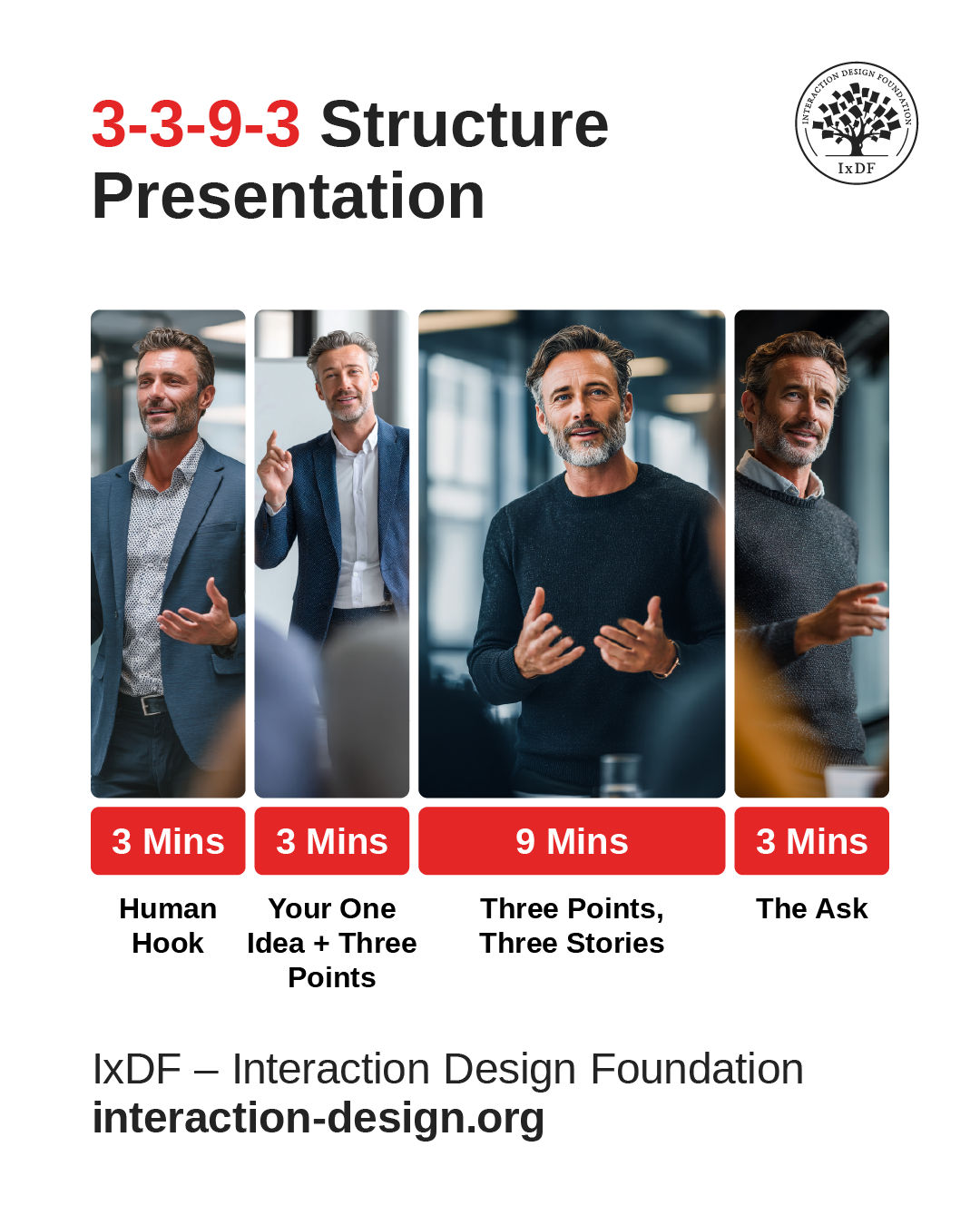
TED Talks are limited to 18 minutes because, as Anderson explains, "18 minutes is long enough to be serious and short enough to hold people's attention." However, not every presentation gets 18 minutes. The beauty of the 3-3-9-3 structure is that it scales perfectly. The proportions stay consistent because human attention works the same whether you have 30 seconds or 30 minutes.
© Interaction Design Foundation, CC BY-SA 4.0
But here's the gift: Structure eliminates anxiety. When you know exactly where you're going at every moment, the fear of "going blank" disappears.
Here's the structure that works:
Minutes 0–3: The Human Hook
Open with YOUR story. Don't start with an agenda slide. Start with a human moment that illustrates to the audience why your idea matters. Jill Bolte Taylor's "My Stroke of Insight" opens with the story of her own stroke and then she holds up a real human brain on stage. You're hooked.
Minutes 3–6: Your One Idea + Three Points
Introduce your one idea and three key points. Present your core idea clearly and break it into three supporting points. Humans remember things well in groups three.
Minutes 6–15: Three Points = Three Stories
Develop your three points with stories. Spend three minutes on each point. Use a story, example, or case study to bring each one to life.
Minutes 15–18: The Ask
Close with a call to action. What do you want people to do with your idea? Be specific.
This structure is your safety net. Print it on a notecard. When you feel lost, glance at it. You know where you are and where you're going next. And no, structure doesn't limit creativity. It liberates it. Jazz musicians improvise within structure. So do great speakers.
The 3-3-9-3 structure scales to any time constraint. For a 9-minute talk, use 1.5-1.5-4.5-1.5. For a 5-minute pitch, compress to 1-1-2-1. Even a 30-second elevator pitch follows the same pattern: story hook, core idea, call to action. The proportions remain consistent because human attention works the same whether you have 30 seconds or 30 minutes.
Tip 4: Make Slides Your Supporting Actor, Not Your Script
Use images over bullet points. Always.
When you fill slides with bullet points, you're building a safety blanket. But the moment you read from them, you've lost the audience. They can read faster than you can speak.
TED speakers use powerful images, minimal text, and lots of blank space. Why? Because you’re the presentation, not your slides.
Watch Sir Ken Robinson's "Do Schools Kill Creativity?" with over 70 million views. He uses almost no slides. When he does, they're simple images. All eyes stay on him.
© TED talks, Fair Use
The rule: If your slide can deliver your message without you, delete that slide.
Hans Rosling's "The Best Stats You've Ever Seen" uses elaborate data visualizations, but they're animations that support his narration. He's still the star.
When you remove the crutch of text-heavy slides, you're forced to actually know your material. And once you know it, you don't need the crutch. The anxiety about forgetting evaporates.
Plus, with minimal slides, you maintain eye contact with your audience. And that connection calms you and them.
Tip 5: Tell Stories (The Scientific Reason TED Talks Feel Unforgettable)
When you tell a story, the listener's brain activity begins to mirror yours. Princeton researcher Uri Hasson discovered this through fMRI brain scans. When someone tells a story, the neural patterns in the storyteller's brain literally sync with the listener's brain. This is called neural coupling.
Stories don't just make your presentation interesting. They make your ideas physically stick in people's brains.
Every memorable TED Talk is built on stories.
You have these stories too. When did you first realize this idea was important? What mistake taught you this lesson? How did this approach solve a real problem for a client?
Andrew Solomon's "Depression: The Secret We Share" weaves together stories from his own life, his research subjects, and historical figures. Each story adds a layer of understanding. When you tell stories, you stop performing and start remembering. You can't forget a story that actually happened to you. And when you're anchored in real experience, anxiety about "getting it right" disappears.
Stories give you permission to be human, vulnerable, and real. And that authenticity dissolves the barrier between speaker and audience. In work settings, stories help colleagues understand why a problem matters and why your solution works. That’s how you build trust and move projects forward.
Tip 6: Start With Why (Purpose Crushes Performance Anxiety)
The meaning behind your message matters more than perfection. Simon Sinek's "Start With Why" has 62 million views, but the principle is more powerful than the talk: when you know WHY your idea matters, fear of judgment shrinks to nothing.
When you're focused on how you look or whether you'll mess up, you're trapped in self-consciousness. But when you're focused on WHY this message needs to be heard, you shift into service. And service is the opposite of anxiety.
© TED talks, Fair Use
Are you nervous when you warn a friend not to touch a hot stove? No. Because you're focused on protecting them, not on how you sound.
Before you prepare anything, answer this: Why does this idea matter to you? How will their work improve if they listen? What changes if they ignore you?
Watch Monica Lewinsky's "The Price of Shame." Chris Anderson writes that she was terrified. After years of public humiliation, standing on that stage took immense courage. But at the top of her notes, she wrote in large letters: "THIS MATTERS." Every time she glanced down, her purpose eclipsed her fear.
Maysoon Zayid's "I Got 99 Problems... Palsy Is Just One" opens with: "I have cerebral palsy. I shake all the time." Her why is crystal clear: change how people see disability. That purpose carries her through.
When your message is bigger than your ego, anxiety becomes irrelevant. You're not trying to look impressive. You're trying to transfer an idea that could change someone's work or life.
Purpose-led communicators inspire action, which is essential whether you’re leading a team or proposing a new idea.
Tip 7: Talk With Your Hands (The 465-Gesture Secret)
In everyday work, open gestures and visible hands make you look trustworthy on video calls and in person. This doesn't mean waving your arms around dramatically, it can be as subtle as keeping your hands gently resting on the desk where people can see them, or making small, natural movements when emphasizing a point. The key is to avoid crossed arms or hidden hands, which can signal defensiveness. That’s a small habit with a big impact on how people perceive your leadership.
Science of People founder Vanessa Van Edwards led a team that analyzed hundreds of TED Talks to find patterns in the most and least popular talks. They coded every hand gesture, smile, and body movement.
The results were unbelievable:
Most popular TED Talks: speakers used an average of 465 hand gestures in 18 minutes.
Least popular TED Talks: speakers used an average of 272 hand gestures.
TED superstars like Temple Grandin, Simon Sinek, and Jane McGonigal: over 600 hand gestures.
Why? Because hand gestures signal openness, confidence, and engagement.
Open body language doesn't just affect your audience. It affects your nervous system as well. Amy Cuddy's research showed that standing in a "power pose" for two minutes could shift hormone levels, increasing testosterone and decreasing cortisol. While the science on this is still debated, the idea is intriguing: your posture might literally influence how your body feels. Your body literally changes your brain chemistry.
When you use open, expansive gestures, you signal safety to your own nervous system. You become more confident physiologically.
Keep your hands visible. Use gestures to illustrate ideas. Practice your talk while walking so natural movement creates natural gestures. Watch Tony Robbins in "Why We Do What We Do" using massive gestures, Kelly McGonigal in "How to Make Stress Your Friend" using precise gestures to illustrate science, or Celeste Headlee using gestures to count off principles in "10 Ways to Have a Better Conversation."
You don't have to fake confidence. You can embody it through how you move. And when your body is confident, your mind follows. Focusing on purposeful gestures gives your nervous energy somewhere to go.
Tip 8: Close With a Call to Action (Make It Urgent, Not Just Interesting)
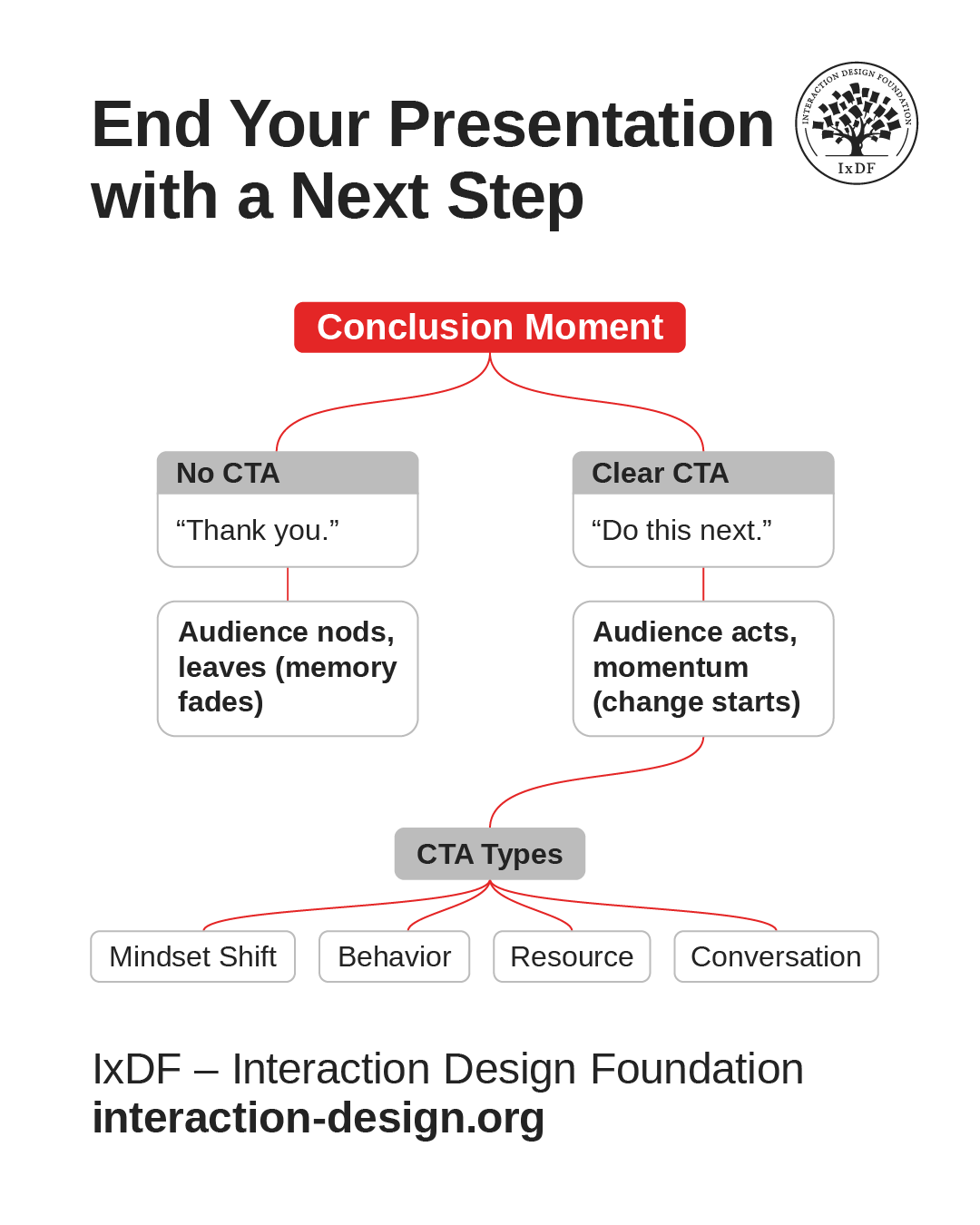
What do you want your audience to know, feel, and DO? You've spent 15 minutes building your case. And then you end with “Thank you for your time” and walk off stage.
Without a call to action, you've left your audience hanging. They're engaged, they're nodding along, but they don't know what to do with all that energy you just built. Your talk becomes interesting in the moment but forgettable by tomorrow.
With a call to action, your talk becomes a catalyst for change. The best TED speakers always close with a call to action. Al Gore's "The Case for Optimism on Climate Change" ends with specific actions the audience can take. Amanda Palmer's "The Art of Asking" closes with a reframed question; instead of asking how we can get people to pay for music, we should ask how we let people pay for music. That challenges the audience to fundamentally rethink the relationship between artists and supporters. It's a call to shift perspective, which is itself a form of action. Mel Robbins' "How to Stop Screwing Yourself Over" gives you the 5-second rule and then tells you exactly how to use it in your own life.
Your call to action can be a mindset shift ("Next time you face this, ask yourself..."), a specific behavior ("Starting tomorrow, try this..."), a resource ("Use this tool..."), or a conversation starter ("Talk to your team about...").
© Interaction Design Foundation, CC BY-SA 4.0
Make it concrete. Don't say "think differently." Say "Tomorrow, in your morning meeting, ask your team this question: What would we do if failure were impossible?"
Watch how Elizabeth Gilbert ends "Your Elusive Creative Genius": "Don't be afraid. Don't be daunted. Just do your job. Continue to show up for your piece of it. Ole to you nonetheless." Simple, emotional, and clear.
A strong call to action reframes your entire presentation. You're not just sharing information. You're inviting people into action.
When you end your meetings and pitches with a clear “next step,” people execute faster, they know what is expected of them. It reduces confusion, builds momentum, and positions you as someone who drives progress.
Tip 9: Enjoy the Best TED Speakers
There are over 3,500 TED Talks available online. When you watch great speakers repeatedly, your brain begins to internalize the patterns of excellence. You notice how they open, transition, use pauses, and land key points.
These patterns help you communicate more effectively in everyday settings, from giving feedback to presenting a roadmap to speaking with leadership.
Watch these masters:
For storytelling: Brené Brown ("The Power of Vulnerability"), Andrew Solomon ("Depression: The Secret We Share"), Chimamanda Ngozi Adichie ("The Danger of a Single Story").
For structure: Simon Sinek ("Start With Why"), Julian Treasure ("How to Speak So That People Want to Listen"), Amy Cuddy ("Your Body Language May Shape Who You Are").
For humor and humanity: Sir Ken Robinson ("Do Schools Kill Creativity?"), Celeste Headlee ("10 Ways to Have a Better Conversation"), Maysoon Zayid ("I Got 99 Problems... Palsy Is Just One").
Pick a TED talk you love and watch it three times:
First watch: just enjoy it.
Second watch: pause and jot down the structure (notice how they open, transition, build to the climax).
Third watch: focus on one delivery technique that stood out; maybe it's their use of pauses, or how they move on stage, or when they change their vocal tone. Then apply that one technique for your next presentation. That's it. One talk, one technique, immediate improvement.
Excellence isn't mysterious. It's learnable. You have thousands of talks available for free. The more you watch great communication, the more your brain rewires itself to recognize what works.
How to Bring TED-Level Presence to Your Everyday Work
You don't need a red circle to communicate like a leader. Let's come back to where we started: That feeling of terror before you present.
Here's what you now understand: The fear was never about your inadequacy. It was about a fundamental misunderstanding of what good communication looks like. You thought you needed to be polished, perfect, and impressive. TED proved the opposite. The best communicators are conversational, focused on one idea, structurally sound, story-driven, purpose-led, physically open, and action-oriented.
Even TED speakers get nervous. The difference? They've stopped trying to be perfect and started being real.
But here's the real power: These techniques don't just work for big presentations. They transform how you show up in every professional interaction. Have conversations in your Zoom meetings, not presentations. Share one clear idea in your emails. Tell stories in your team updates. Start with why when proposing changes. Use purposeful gestures even on video calls. Always close with what you want people to do next.
Your everyday communication is your leadership footprint.
The Take Away
TED proved something crucial: everyday people with real ideas can captivate rooms and change minds. That includes you. Your anxiety isn't a flaw. It's what happens when you try to be someone you're not. The best TED speakers still get nervous. But they've learned to channel that energy into presence and purpose.
You already have what you need: An idea worth sharing, stories that bring it to life, and a purpose bigger than your public speaking fear. Now you have the structure and techniques to deliver it. Use it in pitch meetings, team huddles, client calls, and strategy sessions.
When you apply these techniques in your everyday work, you make your ideas easier to understand, easier to support, and easier to act on. That’s how real career growth happens.
One idea, told through story, closed with action. That's the formula that built careers, launched movements, and changed minds.
You don't need a TED stage to do that. You need your next meeting. Make it count.
References and Where to Learn More
Want to master presentation skills? Take our course Present Like a Pro: Fast-Track Your Career.
Discover How to Find Your Voice: Speak with Confidence and Clarity.
Read about why You’re Not Bad at Presenting; You Just Haven’t Mastered the Right Way (Yet)
Learn more about the power posing study at Cuddy et al. (2010): Power Posing: Brief Nonverbal Displays Affect Neuroendocrine Levels and Risk Tolerance. Doi.org/10.1177/0956797610383437
Read the book Ted Talks: The Official TED Guide to Public Speaking by Chris Anderson.
Hero image: © The Interaction Design Foundation, CC BY-NC-SA 4.0.