You’ve heard it before “It’s not what you said—it’s how you said it.” Your voice can change how people feel—even if your message doesn’t. If you vary your tone and pacing, you can make your ideas sound more trustworthy, exciting, or urgent. Harness this neuroscience-backed communication power and you’ll take your career to the next level.
Your voice is a fantastic tool. It acoustically translates your inner self and conveys enthusiasm, defeat, or openness. In the following video, Morgane Peng, Head of Product Design & AI Transformation at Societe Generale, offers practical techniques to use your voice's full potential for effective presentations.
Show
Hide
video transcript
- Transcript loading…
Calm the Nerves, Control the Pitch
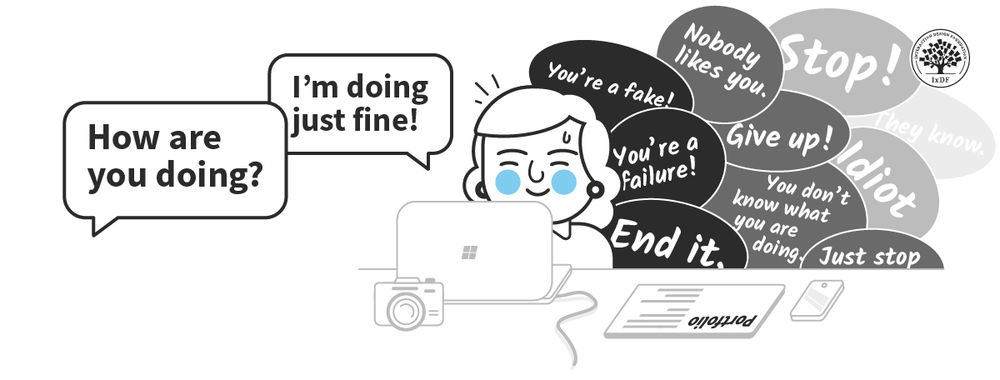
Feeling nervous, or speaking in a second language? That tension often sneaks into your voice by raising your pitch. And when your pitch spikes, your message can sound less confident—even when you know exactly what you’re talking about.
Here’s how to bring your voice (and your nerves) back under control:
Power pose: A couple of minutes in a power pose reduces cortisol and boosts confidence. Ground your posture, avoid slouching.
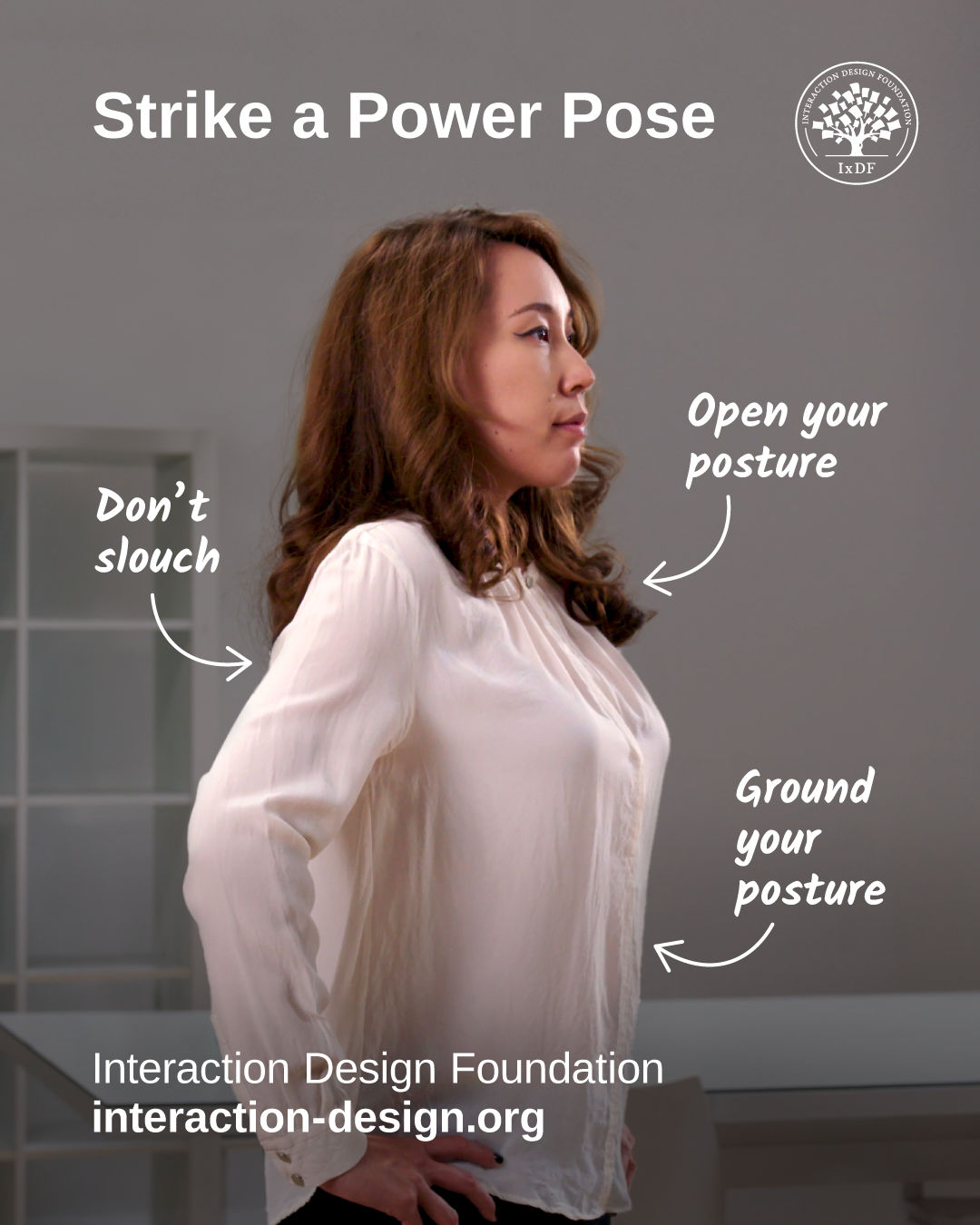
© Interaction Design Foundation, CC BY-SA 4.0
Yogic breathing: A few yoga breaths calm you and improve breathing. Practice 4-7-8 cycles: inhale 4, hold 7, exhale 8. This slows your heart rate and steadies your breath—your voice will follow.
Use Voice Variations to Keep People Engaged
Want to keep your audience’s attention? Don’t just rely on your slides—your voice is your built-in engagement tool. Use it like this:
Volume: Adjust loudness, increase for major discoveries, e.g., "80% of dropouts happened at THIS specific step!".
Pitch: Vary high or low, use higher for excitement, e.g., "redesign addresses pain points and received praise!".
Pace: Adjust speed, slow for complex flows so your audience processes information better.
Tone: Use tone to convey feelings; be empathetic, e.g., "We heard users’ frustrations; we must do something".
Articulation: Speak clearly, especially for new terms, e.g., "pro-gressive-dis-clos-sure".
Use Silence Like a Design Element
Silence isn’t awkward. It’s powerful. Like white space in design, a well-timed pause gives your content breathing room and makes your key points stand out. It creates anticipation and regains your audience’s attention.
However, be aware of cultural differences in voice variations and silences, especially across languages. For instance, French often has a higher pitch and more monotony than English—bilingual speakers commonly reflect this.
The Take Away
Your voice is powerful—it reveals your inner self and greatly influences message reception. How you use your voice shapes how people perceive you. When your pitch rises or your words rush out, people sense uncertainty—even if you know your stuff. When you pause, slow down, and let your tone match your message, people lean in. They listen. They trust what you're saying.
If you manage stress and pitch through techniques like breathwork and poses/body positions, you can maintain confidence and vocal control. Strategically employ voice variations—volume, pitch, pace, tone, and articulation—to engage your audience, emphasize key points, and convey emotion. Use silence to offer breathing room in presentations, much like white space in your designs. Remember to consider cultural interpretations of voice and silence.
When you master these vocal techniques, you’ll project a strong presence, speak clearly, and capture your audience.
References and Where to Learn More
Check out Harvard Business Review’s article, 5 Techniques to Build a More Powerful Speaking Voice.
Take a look at Toastmasters International’s resources, specifically:
Hero Image: © Interaction Design Foundation, CC BY-SA 4.0