Negative feedback hurts. There's no way around it. Your stomach drops, your heart beats faster, and your thoughts race: “Am I about to lose this client?” “Are they questioning if I'm the right person for this job?” “Will this affect my reputation?” But what if you could change your relationship with feedback and turn it into a tool for career growth, without losing confidence? You can easily master this skill: it just needs a different approach!
Think about the last time you received feedback that felt negative. Maybe you were told your presentation was confusing. Maybe someone pointed out errors in your slides. Maybe your entire approach was questioned. Your first instinct was probably to defend yourself. That's normal; we all do it!
But this defensive reaction comes from a fundamental misunderstanding about what feedback actually means. It happens because we often tie our identity to our output. When someone says your presentation needs work, your brain hears "you're not good enough." That's not what they said, but it's what you feel.
The reality is that your work is separate from your value as a professional. Once you understand this, you can approach feedback more objectively and see it as data you can use to your advantage. And like any data, not all feedback holds the same value. Sometimes what sounds like a critique of your work is more about the other person's stress, their expectations, or their own insecurities. Part of mastering feedback is knowing which pieces to take seriously and which to leave behind.
In this video, Morgane Peng, Head of Product Design & AI Transformation at Societe Generale, shares strategies to handle feedback, especially when it’s tough to hear.
Show
Hide
video transcript
- Transcript loading…
Reframe the Story You Tell Yourself
What you tell yourself about feedback determines how it affects you. Instead of "They hate what I created," try something more specific: "They think this might not align with their brand guidelines" or "They're worried this approach won't resonate with the executive team." Rather than "I failed," consider "I learned what matters most to this stakeholder" or "I now know what I need to do for this project to be a success."
With this mindset shift, here’s how your next feedback meeting will go: It’s a tough conversation, but instead of calling your friend to vent for an hour, you feel focused. Grounded. You grab coffee, sit down, and start solving the actual problem. The weight that usually sits on your chest for days is gone in minutes, and your work is even better than it was before!
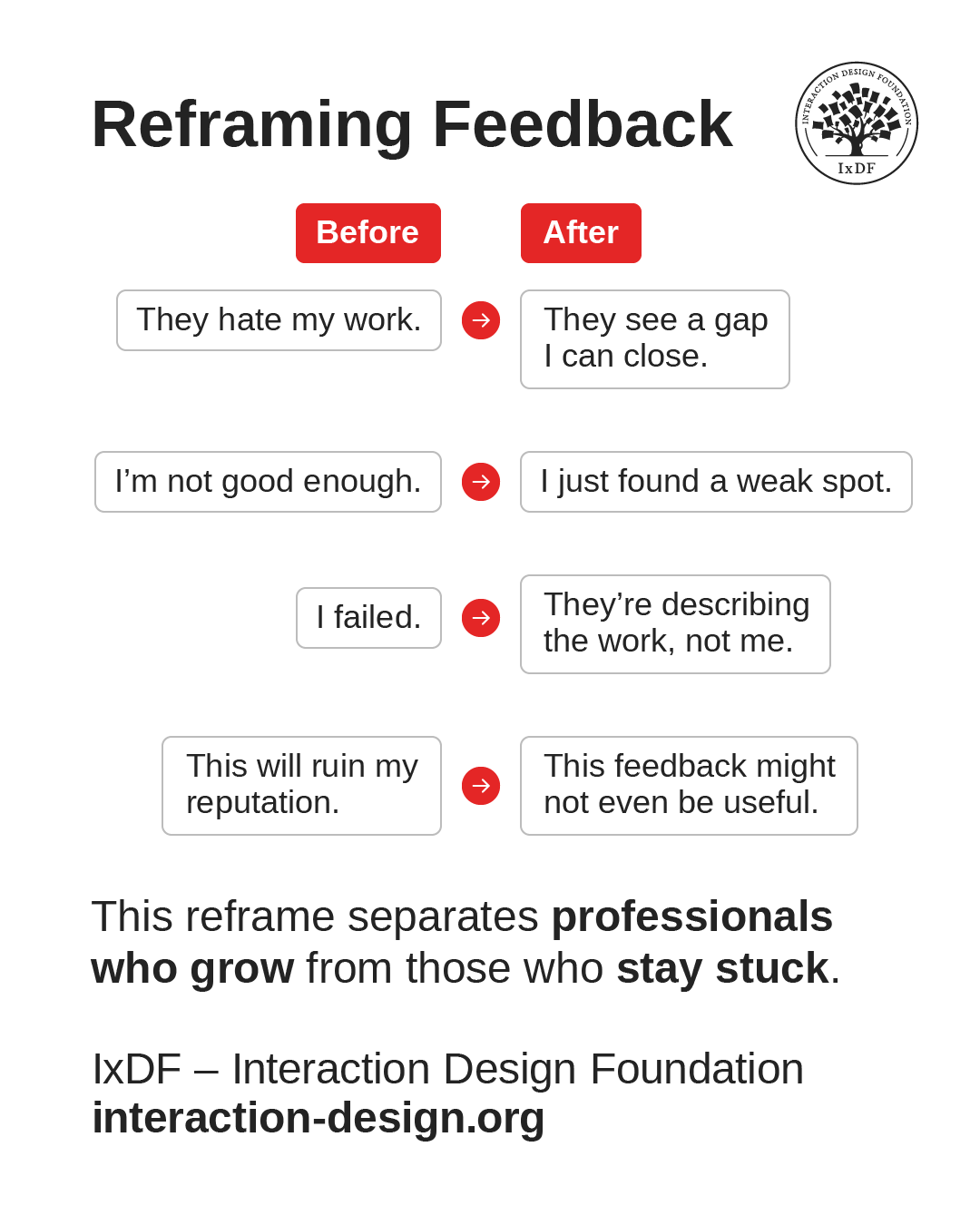
© Interaction Design Foundation, CC BY-SA 4.0
Think of your work as a prototype. Prototypes are meant to be tested, evaluated, and improved. Nobody expects the first version to be perfect. Each round of feedback helps you refine the solution until it meets the need.
When you reframe feedback as data rather than judgment, you keep your confidence intact while still taking the input seriously. You can acknowledge that something needs work without concluding that you lack competence.
It’s important to remember that feedback is often filtered through the other person's perspective. Their comment might be influenced by their own worries, their boss's pressure, or even something completely unrelated to you. Maybe they had a terrible morning. Maybe they're anxious about their own performance review. When you realize feedback can say as much about them as it does about your work, you can evaluate it more objectively.
Still, most feedback, even when it’s delivered poorly, comes from a genuine desire to improve the outcome. When you keep this in mind and assume positive intent, you become curious rather than defensive. You treat the other person as a collaborator. This changes the entire dynamic of the conversation. The goal isn’t to accept every piece of feedback as valid. The goal is to approach each response with openness so you can use whatever value it offers.
The Different Flavors of Feedback and What They Really Mean
© Giphy, Fair Use
Feedback comes in different forms, and each serves a different purpose. When you know which type you’ve received, you can decide how to use it.
Firstly, not all feedback is negative! Sometimes, it acknowledges your effort. A colleague might say your approach was interesting or that you clearly put in work. Don't brush this off. It doesn’t offer direction, but it confirms that people see your contributions.
Other feedback points out specific problems without offering solutions. Someone might tell you that a particular section feels confusing or that an important element gets lost. This type of response shows your opportunities to improve. While it doesn’t tell you how to fix the issue, it shows you where to focus your attention.
The most valuable feedback offers guidance. It explains what needs to be improved and suggests why. "Your presentation has too many slides. Try to cut it down to 15 slides maximum because people lose focus after about 10 minutes, and we need them engaged for the decision at the end." This gives you a clear path forward. You can take the suggestion as-is or use it as a starting point for your own solution.
Then, there are the vague comments. Someone says they just do not like something or that it needs more impact. These responses cause frustration because they give no clear path forward. Yet they still contain information. Vague feedback often signals that something feels wrong to the person, even if they can’t explain why.
This is your opportunity to get curious. Dig deeper with follow-up questions like:
"What specifically feels off to you?"
"Can you point to a moment where you felt that?"
"What would success look like from your perspective?"
These questions help the person articulate what they're actually reacting to. Sometimes they find they're worried about something completely different than what they first mentioned. When you approach feedback with curiosity, you turn vague comments into something you can actually use, and it shows others you genuinely care about the quality of your work.
Receive Feedback like a Pro
How you receive feedback matters just as much as the feedback itself. If you react badly, you'll create tension while missing valuable insights. But if you react well, you'll get better information and maintain good relationships.
When you can stay calm and curious in difficult conversations, people notice. Your manager stops bracing themselves before giving you feedback. They bring you into higher-stakes projects because they know you won't make feedback sessions painful. Colleagues ask to have you on their teams. You become the person everyone wants in the room when things get tough.
Here’s what to do:
1. Take a Breath
When feedback arrives, your body responds before your mind catches up. Your shoulders tense. Your jaw tightens. You might feel heat rise in your face or notice your thoughts turn defensive.
This happens whether you're sitting across from a client who just said your proposal "misses the mark," or reading an email from your manager with "concerns about your approach," or standing in front of stakeholders who are questioning your strategy. In that moment, your chest tightens and your mind races to the worst outcome.
Don’t try to suppress this reaction. Instead, take note of it. Tell yourself that feeling protective of your work is normal. If you’re in a meeting, you might take a breath and thank the person for their input before asking a clarifying question. If you get written feedback, step away before writing a response. This pause lets the intensity pass and stops you from responding in ways you might regret.
2. Listen Completely
Don't interrupt. Don't explain. Don't defend. Just listen. You can process the information later when you're calm. Right now, your job is just to understand what they're saying. This takes real discipline because your brain wants to jump in and protect itself.
3. Ask Questions for Clarity
Avoid defensive questions like "Well, what would YOU do?" and instead ask genuine questions like "Can you walk me through your thinking?" This shows you take their input seriously and invites them to explain their perspective. It also often leads them to give you more specific, actionable feedback. People tend to be more thoughtful when they see you're genuinely interested in understanding their perspective.
Sometimes people offer solutions instead of identifying problems. When this happens, ask why they suggested that change. What problem did they hope to solve? This question gets to the heart of the issue so you can find the best solution rather than just following their instructions. When you understand the issue, you’re more likely to avoid it in the future.
4. Take Notes
This might feel awkward, but it helps. You'll remember the details later, and it shows that you value their time and insights. Having something to write also gives you a productive focus during an uncomfortable conversation. Instead of just sitting there feeling defensive, you're actively taking down information.
5. Say Thank You and Then Step Away
You don't have to commit to changes or explain your reasoning in the moment. Some of the best responses come after you've had time to process emotionally and think strategically about what changes actually make sense. All you need to say is "I appreciate the feedback" and then step away to think it through.
You can always follow up later if you need to provide context or ask more questions. Immediate responses can come across as defensive, even when you don't mean them that way.
In this video, Morgane Peng gives practical strategies to manage harsh feedback in meetings without letting it dent your confidence.
Show
Hide
video transcript
- Transcript loading…
Turn Feedback into Action
Feedback is only useful if you’re able to improve your work rather than just feeling bad about it.
Be Specific
Set yourself an action plan with clear goals. Vague insights like "make better presentations" don't work. Solid, clear commitments like "limit each slide to 15 words and use one visual per concept" work. Specificity makes follow-through possible and sets you up for success. You'll know whether you actually made the change, and you'll be able to measure whether it improved your work.
Focus on What Matters
You can't fix everything at once. Start with issues multiple people mentioned. If five people said your presentation didn’t have a clear structure, fix that before you change your font choices. Some changes matter more than others. Focus on revisions that affect whether your work achieves its core purpose instead of purely cosmetic changes.
Test, Test, and Test Some More
After you make adjustments based on feedback, show your work to another person. Ask them if you’ve addressed the original concern. It doesn’t have to be the person who gave you the initial feedback, just someone who understands the context. This way you can make sure you understood the problem and that your fix actually works.
Sometimes you think you've solved a problem, but you might still be missing something. Testing catches this before you present to your final audience.
Notice Patterns in Feedback
Over time, you might notice patterns in the feedback people give you. If you often hear that your presentations lack strong conclusions, start checking for that yourself before you share your work. Eventually, you'll fix these problems before anyone else brings them up. Being proactive shows real growth and professionalism and won’t go unnoticed.
The Take Away
Feedback might always sting a little, and that’s ok. What matters is handling it in a way that helps you grow as a professional without lowering your confidence. This is a skill you can easily develop!
When you’re faced with negative feedback, take note of your immediate thoughts and feelings. If you start questioning your self-worth or your value, reframe the story in your mind. When you tell yourself "This is information about my work," feedback becomes data you can interpret objectively. You also remind yourself that feedback can’t reduce your professional value. Only you control that.
It's also up to you to figure out which feedback shows you something true about your work and which is coming from somewhere else entirely. We're all human, and what someone tells you might be filtered through their bad day, their own anxiety about the project, or miscommunication from their manager. This is where you need to use your own judgment. This doesn't mean ignoring feedback you don't want to hear! Instead, consider the source, the context, and stay as objective as you can. We all have biases and blind spots. The only way to see them is in conversation with other people. That's what makes feedback so valuable, even when it's hard to hear.
Imagine yourself six months from now. Your manager sets an unexpected feedback meeting, and your stomach stays calm. You walk in, sit down, and listen with an open mind, curious about what they’ll say. When they finish talking, you thank them, take your notes, and leave feeling energized instead of defeated. You go home without replaying every word a hundred times over in your head. You sleep well that night. The next morning, you wake up knowing exactly what to improve and you feel excited to do it. That version of you already exists; you just need to master receiving feedback differently.
References and Where to Learn More
Learn how feedback can become your competitive advantage with our course Present Like a Pro: Fast-Track Your Career.
Read about why You’re Not Bad at Presenting; You Just Haven’t Mastered the Right Way (Yet)
Discover How to Find Your Voice: Speak with Confidence and Clarity.
Hero image: © The Interaction Design Foundation, CC BY-NC-SA 4.0.