Simply matching a job description isn’t enough anymore. The right qualifications will get you considered for a position. But to actually get hired, you must make an impression. Successful candidates communicate their value with clarity and confidence. When you master how you present yourself, interviews stop feeling like interrogations and start feeling like conversations where you're in control. You walk out knowing you gave them every reason to say yes. That's the difference between hoping for an offer and expecting one.
© Giphy, Fair Use.
Another rejection email. Your heart sinks with that familiar feeling of disappointment. Why does this keep happening, especially when you do everything right?
When you apply for a job, you adjust your resume to fit the role. You only apply for positions where you’re a top candidate. You write personal cover letters, and you have a strong portfolio. You do get invites to job interviews, but no matter what happens, you just can’t seem to land an offer.
If you can relate, just know there isn’t something wrong with you! The problem is simple: In interviews, you don’t communicate your value clearly. It might be that you feel nervous, or you undersell yourself, or maybe you don’t connect with the people in the room.
How you present yourself is the difference between getting interviews and getting job offers. It's how you go from being one of many qualified candidates to being the person they can't stop thinking about after you leave the room.
In this video, Morgane Peng, Head of Product Design & AI Transformation at Societe Generale, reveals why presentations skills are so valuable for every stage of your career.
Show
Hide
video transcript
- Transcript loading…
Why a Good CV Isn’t Enough Anymore
If you compare the job market today to a few months ago, it’s completely different! LinkedIn job posts that used to attract a couple applicants now get hundreds. Entry-level roles expect years of experience. Mid- and senior-level roles attract over-qualified candidates who compete against others willing to accept much less than they deserve.
Then there's artificial intelligence (AI). It doesn’t just help us work; it does the work! Before technology like ChatGPT, humans had to spend months if they wanted to learn to code or understand datasets. Now, AI can do these things, and it can do them fast! Tasks that only a few people could do are now possible for anyone with an internet connection! This means everyone is qualified on paper (especially when AI makes sure you have the perfect resume and cover letter).
To get a job offer, you need to find a way to stand out from the crowd.
Recruiters Are Desperate for One Thing
© Giphy, Fair Use.
Imagine you’re a recruiter. Every day, you open an inbox full of applications. Everyone has the same skills. Everyone is a “results-driven professional” and “team player”. Everyone uses AI to write their applications. Soon, candidates all blur together.
That’s why recruiters are desperate for people who stand out (in the right way). You need to set yourself apart from everyone else, or you'll get lost in the stack of resumes.
Think back to your last interview. You probably talked through your resume and spoke about past experience and achievements. You might’ve spoken about the company and asked a few questions. But when you were asked more detailed questions about your work, your ideas, and your process, how did you feel? Did you communicate as clearly as you wanted to? Afterwards, did you think back and wish you’d said something differently?
A strong resume gets you to the interview, but the choice to hire you happens when you present yourself, your ideas, and your value. When you know how to present, you aren't just saying "I'm good." You're showing potential employers "Here's exactly what I bring and how that’ll benefit you when you hire me."
Just as importantly, hiring managers want someone the team will enjoy working with. Beyond your qualifications, they’re looking to see if they want to interact with you every day. When you present well, you naturally build that connection. You communicate clearly, read the room, and respond thoughtfully. You become the candidate that’s remembered, and most of the time, that's the person who gets the offer.
In this video, Morgane Peng explains the value of building trust in your career, and how you can do it too.
Show
Hide
video transcript
- Transcript loading…
Presentations Aren’t Just “Public Speaking”
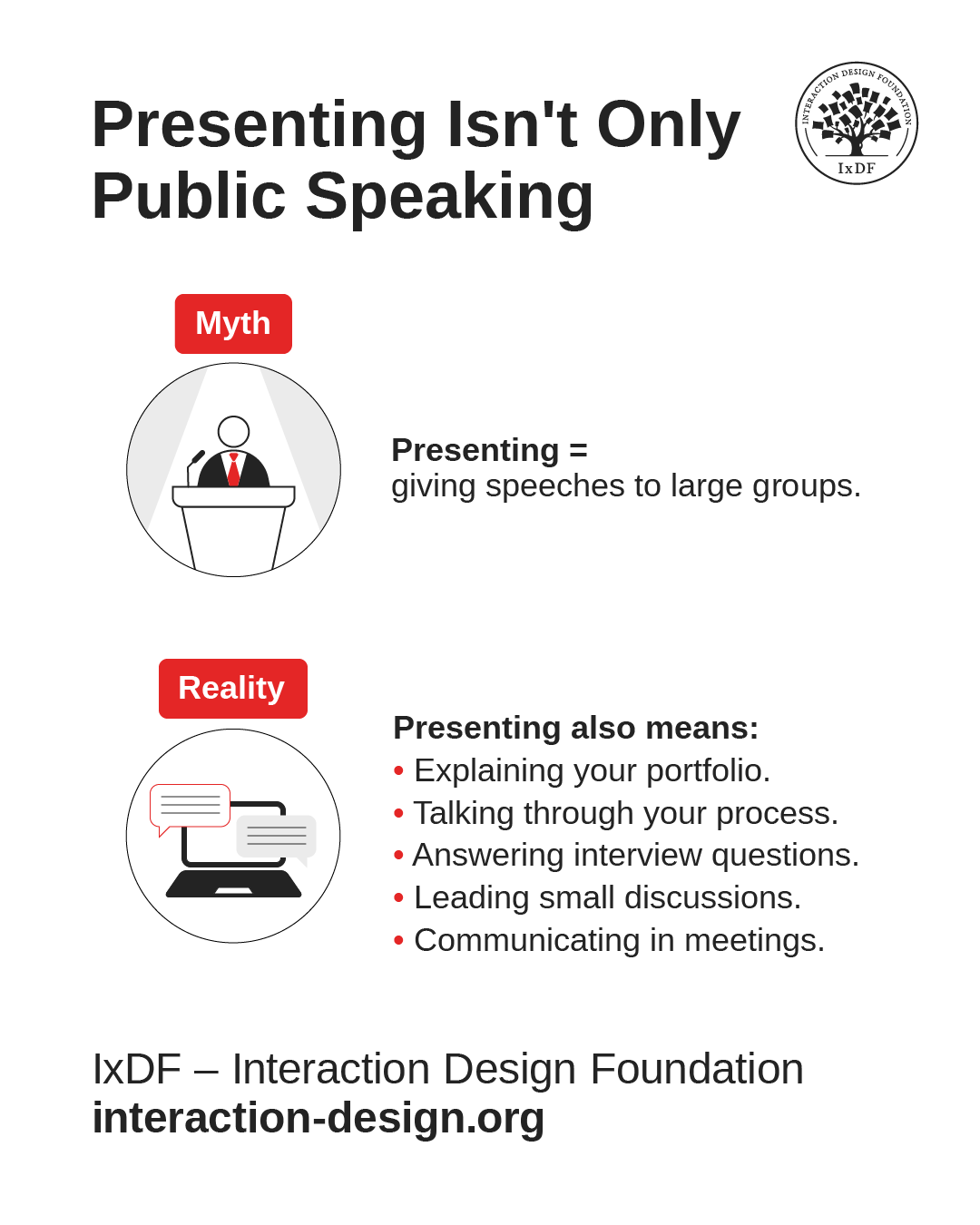
Let’s clear something up right now. When we speak about presenting, most people assume it’s public speaking. They imagine standing in front of a room full of people, lightheaded with sweaty palms. While public speaking is part of it, it’s not all of it.
When you master presentations, you learn what to say and how to use body language to come across as confident and approachable (even if you feel nervous). You use vocal techniques like pacing, pauses for dramatic effect, and adapt your energy to match the conversation. These are the things that convince someone that you’re a good fit for the role.
© Interaction Design Foundation, CC BY-SA 4.0
Let’s take Marta as an example. Here’s what happened in her last interview. She walked in prepared with her portfolio, ready to talk through her recent projects. The first 10 minutes went smoothly. She explained her background, talked about her achievements, and answered a couple standard questions about her experience.
Then the hiring manager asked her to walk through a case study. Marta knew her work inside and out, but as she tried to explain her process, she got stuck. She jumped between ideas without clear transitions. Her energy dropped as she second-guessed herself mid-sentence. She could see the interviewer losing attention. When they asked follow-up questions, Marta's answers felt scattered. She left that interview disappointed. She knew she hadn't shown them what she was truly capable of.
Marta didn’t know it, but she'd been presenting the entire interview. When she introduced herself, walked through her portfolio, and explained her approach to the case study. Every moment required the same skills: clear communication, confident body language, intentional pacing, and the ability to read the room and adjust.
What if Marta had those skills? She would've walked through that case study with a clear structure the hiring manager could follow. She would've paused at the right time to let important points have greater effect. When she noticed the interviewer's attention starting to drift, she would've shifted her energy and brought them back in. Her body language would've shown confidence even when her mind was racing.
Presenting is a skill you use in almost every professional situation. When you pitch an idea to your boss, collaborate with your team, or sit across from a hiring manager, you use the same skills. These moments happen all the time, and how you show up in them matters.
In this video, Morgane Peng describes how to capture and hold people attention, from start to finish.
Show
Hide
video transcript
- Transcript loading…
Why Great Presenting Skills Are the Common Denominator in Job Offers
A job offer depends on many things: the right skills and experience, roles that match your background, good timing, and sometimes networking or referrals. But one factor makes a huge difference in interviews: How you connect with people and communicate your value.
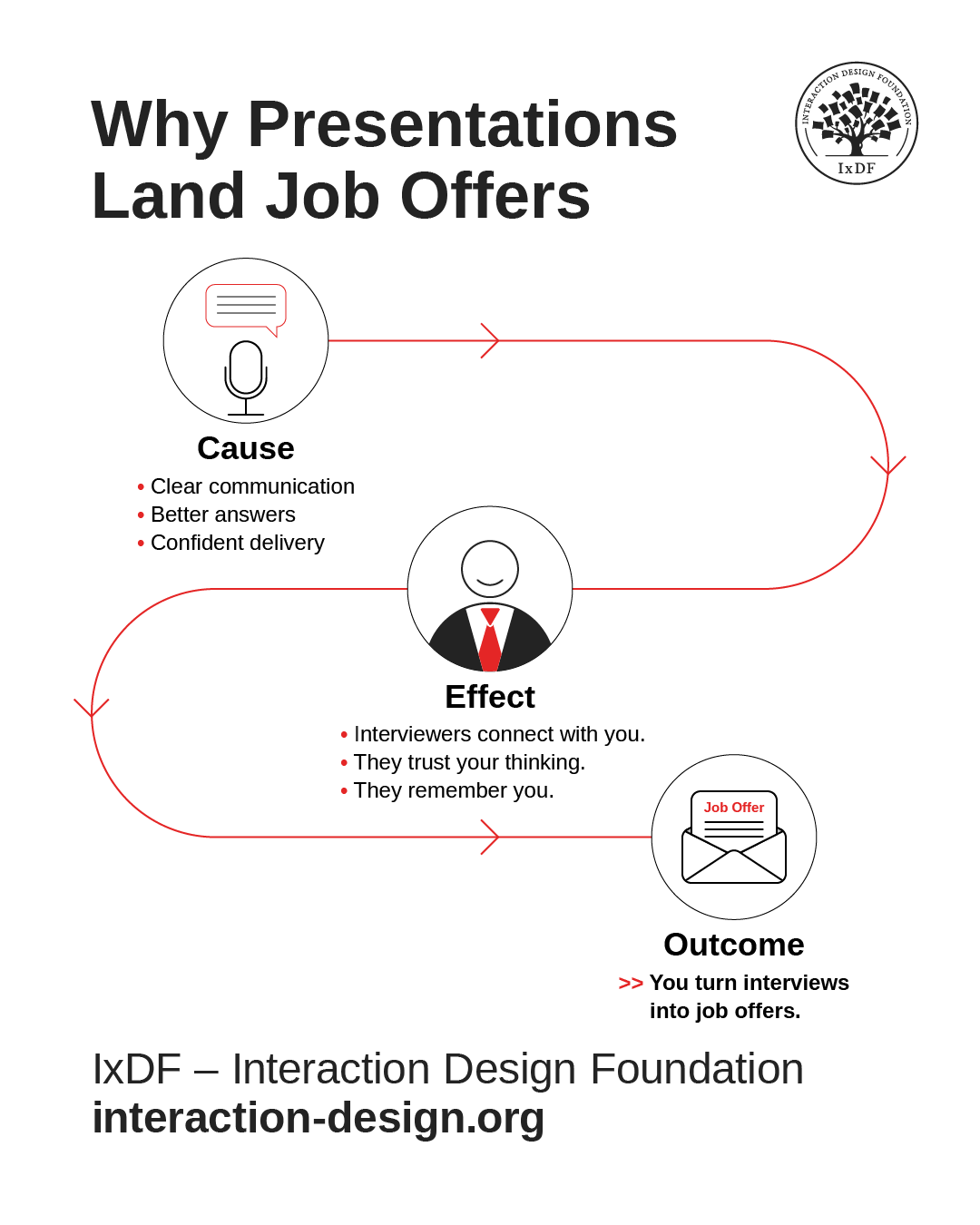
When you present well, you make special moments an algorithm can’t copy. You watch the people in the room. You notice small changes in how they sit or look and change your approach. You sense when someone is confused so you explain yourself in a different way. You make people like and trust you with your energy, personality, and because you explain difficult ideas in an understandable way.
© Interaction Design Foundation, CC BY-SA 4.0
Take Sarah, who interviewed for a senior product designer role. When she was asked to present a strategy, she structured it so clearly that everyone in the room could follow her thinking from problem to solution. When they challenged her approach, she didn't get defensive. She acknowledged their concern and showed her reasoning. Two days later, they offered her the role above her asking salary. The hiring manager later told her they were impressed by how she communicated under pressure.
Sarah’s story shows how presentation skills make you memorable. You become confident without being arrogant. You become the candidate they can actually see in the role because you've painted that picture for them. When AI can do most of the technical work, the person who can walk into a room and make people feel something is more likely to get noticed and hired.
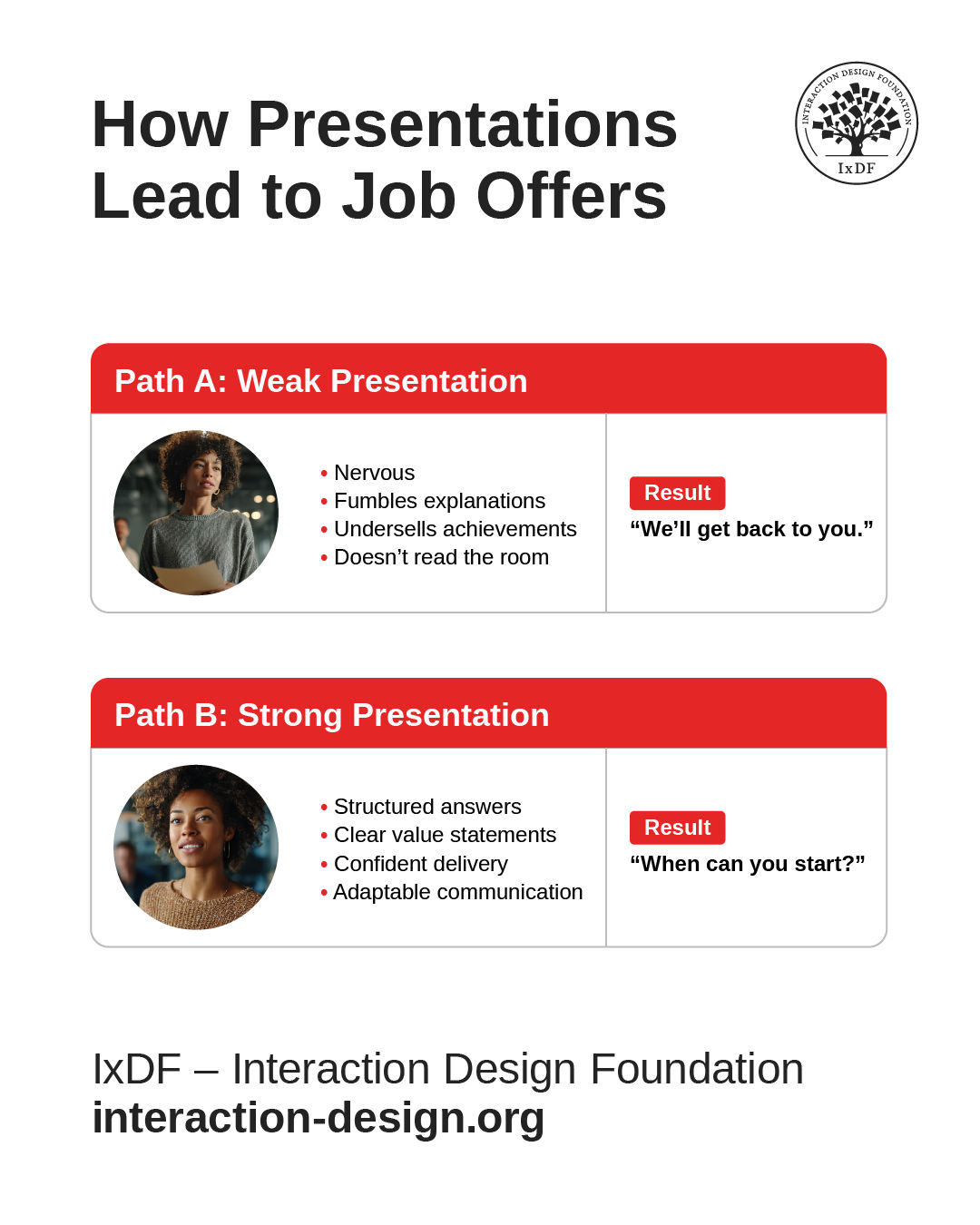
How to Go From “Thanks for Your Time” to “When Can You Start?”
The good news is that these skills are completely learnable! You don't need a special talent or years of experience to get there. Start with the basics so that when your next interview comes, you're ready.
© Interaction Design Foundation, CC BY-SA 4.0
Look up common interview questions and think back to what you’ve been asked in past interviews. Which of these are easy to answer, and which need deeper reflection? Don't just think about your answers; say them out loud. This helps you find better words and speak more smoothly.
When you practice your interview questions, stand in front of a mirror or record yourself on your phone. This can seem silly at first, but it helps you see what others see. You might notice that you fidget or use too many filler words like "um." Look for things you want to improve, then try again. The goal is to feel confident without sounding rehearsed.
Talk to friends and family about your work as if they know nothing about your industry. Ask for honest feedback: Did they understand you? Were you clear? Did you sound confident? Use their feedback to guide what you change.
Remember that you don’t need to be perfect right away. Everyone goes through this when they start out, but the more you do it, the more natural it becomes.
In this video, Morgane Peng discusses common errors in how people deliver presentations, and how to overcome them.
Show
Hide
video transcript
- Transcript loading…
What Happens After You Get Hired
Strong presentation skills don't lose value once you land the job. It’s actually the opposite! When you know how to present, opportunities start coming to you. You become the person your manager turns to when something needs explaining to leadership. You're invited to represent your team in important meetings. Your ideas get heard and acted on because you know how to communicate them clearly.
People who present well get promoted faster. Not always because they're the most technically skilled, but because they can explain complex ideas to anyone, build trust across teams, and make others feel confident in their ideas. These are the skills that turn good employees into leaders.
The Take Away
The old formula where you show up, do good work, and your career will grow naturally doesn’t work anymore. Industries have evolved and will continue to evolve. Some jobs will disappear and others will transform.
You can't predict the future or control the job market. You can't stop AI from getting smarter and faster. And you can't stop other people from applying to the same jobs as you. But you can control how you show up.
Imagine how it’ll feel when you walk into your next interview and instead of feeling nervous and second-guessing every answer, you're confident. You explain your ideas clearly. You connect with the interviewer. You leave knowing you gave them exactly what they needed to say yes. That's what strong presentation skills give you. Not just a better chance at landing a job, but a skill that keeps opening doors throughout your entire career.So don't wait until your next interview is set to start!
References and Where to Learn More
Ace your next interview using presentation skills from our course Present Like a Pro: Fast-Track Your Career.
Find out How to Find Your Voice: Speak with Confidence and Clarity.
Read about why You’re Not Bad at Presenting; You Just Haven’t Mastered the Right Way (Yet)
Learn about Presentation Pitfalls and How You Avoid Them.
Hero image: © Interaction Design Foundation, CC BY SA 4.0