Your constantly-updated definition of UX Resumes and
collection of videos and articles. Be a conversation starter: Share this page and inspire others!
197shares
What are UX Resumes?
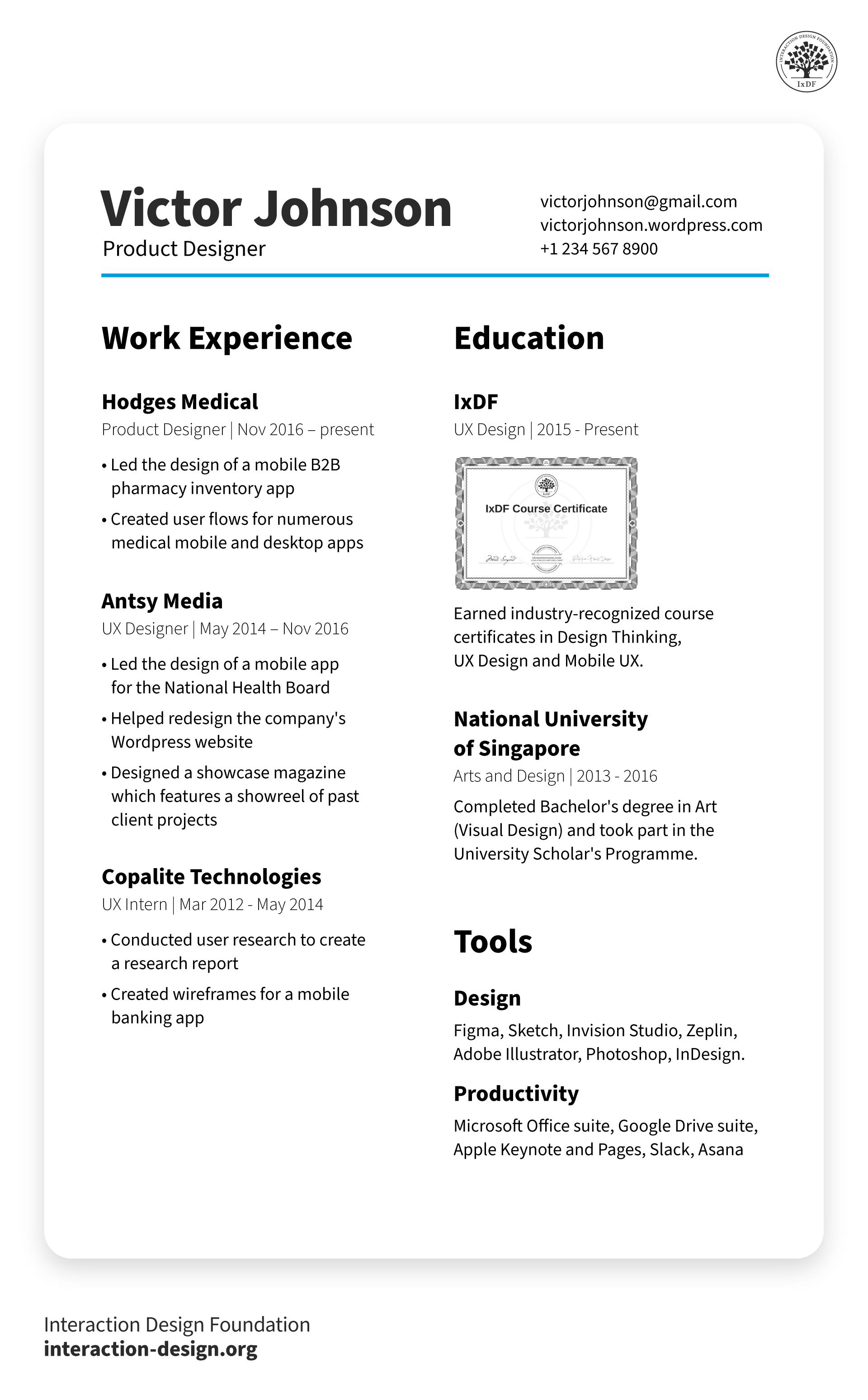
UX resumes, or user experience resumes, are specialized resumes tailored for professionals in the field of user experience (UX) design. They are concise overviews in which designers summarize their work experience, education, skills and other relevant information and highlight their accomplishments. Depending on the country, UX resumes can also be referred to as a UX CV (or UX Curriculum Vitae).
In this video, Morgane Peng, Design Director at Societe Generale CIB, talks about what a UX resume is:
ShowHide
video transcript
Transcript loading…
“You may be thrown out of consideration for a position before being properly evaluated as a candidate because of common usability issues with your resume.”
Beyond the Showcase: Your UX Resume as a Powerful Tool for Landing the Perfect Role
When looking for jobs in user experience (UX) design, designers should approach recruiters with three documents: UX portfolios, UX resumes and UX cover letters. A common misconception is that a UX portfolio will do the job of a UX resume—or a better job—because a portfolio should have more extensive content. UX resumes—like resumes in other industries—should serve as quick reference points that showcase what a designer has to offer. The challenge of a UX resume is to design a user-friendly document that appropriately promotes you as a valuable potential contributor to an organization. Because recruiters go through many applications, a resume should be easy on the eye, credible,usable and can distinguish a designer in moments. Therefore, designers must fine-tune the most appropriate, concise, impressive representation of:
Who you are: A personal summary or hook (similar to that in a UX portfolio).
What you do and have done: Your work experience.
Where you studied: Your education history (including online courses and bootcamps).
What you have to offer: Your unique value.
When recruiters or hiring managers look to fill UX roles, they typically base their decision to contact applicants on well-crafted portfolios. Nevertheless, a UX resume is a vital bridge between a cover letter and a portfolio—recruiters can scan it to see who’s a strong candidate. As with other materials, the resume should be adapted to match a specific role.
What to Include in a UX Resume: Tips to Entice Clients and Hiring Managers
A strong UX resume includes several essential components that collectively showcase a designer's skills, experiences, and professional identity. Each section should be carefully tailored to ensure relevance and maximize impact. The point is to highlight their unique qualifications for a specific job or project.
A resume should contain the following sections:
Contact information: Full name, phone number, email address, LinkedIn profile, and a link to your portfolio.
Professional summary: A brief summary highlighting expertise, experience, and key achievements in UX design.
Tip: Tailor this section to the specific job or project. Use keywords from the job description, focus on what makes you unique and mention any specializations or standout projects.
Portfolio link: A portfolio showcases your design work in detail.
Tip: If it’s a web-based portfolio, make sure the portfolio URL is easy to read and remember. A custom domain or a professional platform like Behance or Dribbble can make a strong first impression. If you have a pdf portfolio, include a Google Drive, Dropbox or WeTransfer link so the recruiter or hiring manager can download it.
A link to a LinkedIn profile: Recruiters consult LinkedIn to learn more about applicants.
Tip: Ensure your resume is consistent with your LinkedIn presence.
Tip: Categorize skills into sections like 'Design Tools', 'Research Methods', and 'Technical Skills' to make it easier for recruiters to scan. Highlight any advanced or niche skills that are in demand.
Work experience: Detailed descriptions of previous roles with a focus on UX-related responsibilities and achievements. Include company name, job title, and dates of employment.
Tip: Use bullet points to highlight specific projects and achievements. Quantify impact where possible (e.g., "Increased user satisfaction by 20% through redesigning the onboarding process"). Start each bullet point with an action verb to convey a sense of activity and accomplishment.
Education: Educational background, including degrees, institutions, and graduation dates. Include any specialized courses or certifications in UX design.
Tip: If you have completed any notable projects or received awards during your education, mention them. If you have attended UX bootcamps or workshops, include these to show your commitment to continuous learning.
Awards: Any awards or recognitions received for your work in UX design.
Tip: Include a brief description of the context and significance of the awards. If possible, link to the project or work that earned the recognition.
8. Relevant miscellany: Mention any additional experience that can be leveraged. For example:
Teaching experience;
Fluency in another language;
Authoring of UX articles on (e.g.) Medium;
Relevant achievements as a volunteer/hobbyist.
Other Tips to Get Your Resume Noticed
Overall, a resume is a story that summarizes you and presents an impressive image of yourself—achievements should speak for themselves. The words you choose portray your attitude. So, convince recruiters that you’re a powerhouse without saying it directly. Show the value you can bring them, don’t tell. Credibility is all-important, and your resume should lead users (recruiters) to a call to action (to examine your portfolio) just like anything else you design would. How to Craft a Powerful UX Resume
After carefully reading the recruiter’s specifications, you should include everything they request in your resume. This typically includes:
Personal details: Your name, job title (if appropriate) and contact information (e.g., email).
Your photo: In a professional environment or a LinkedIn-style headshot picture.
Work experience: Your current and previous jobs listed in reverse chronological order (latest first). Only include relevant roles (though some non-UX activities can show valuable personality traits—e.g., skydiving).
Education: Only university/college/vocational-school-level achievements.
A self-write-up: A brief professional summary of yourself. Highlight achievements in a few, objectively worded sentences that tell your story.
Your skills and tools: If you have niche skills (e.g., in UX research) or are skilled in a broad range of UX tools, declare them but prioritize your skills.
Relevant miscellany: Mention any experience you can leverage – e.g.,
Teaching experience;
Fluency in another language;
Authoring of UX articles on (e.g.) Medium;
Relevant achievements as a volunteer/hobbyist.
Other Tips to Get Your Resume Noticed
Overall, a resume is a story that summarizes you and presents an impressive image of yourself—achievements should speak for themselves. The words you choose portray your attitude. So, convince recruiters that you’re a powerhouse without saying it directly. Show the value you can bring them, don’t tell. Credibility is all-important, and your resume should lead users (recruiters) to a call to action (to examine your portfolio) just like anything else you design would.
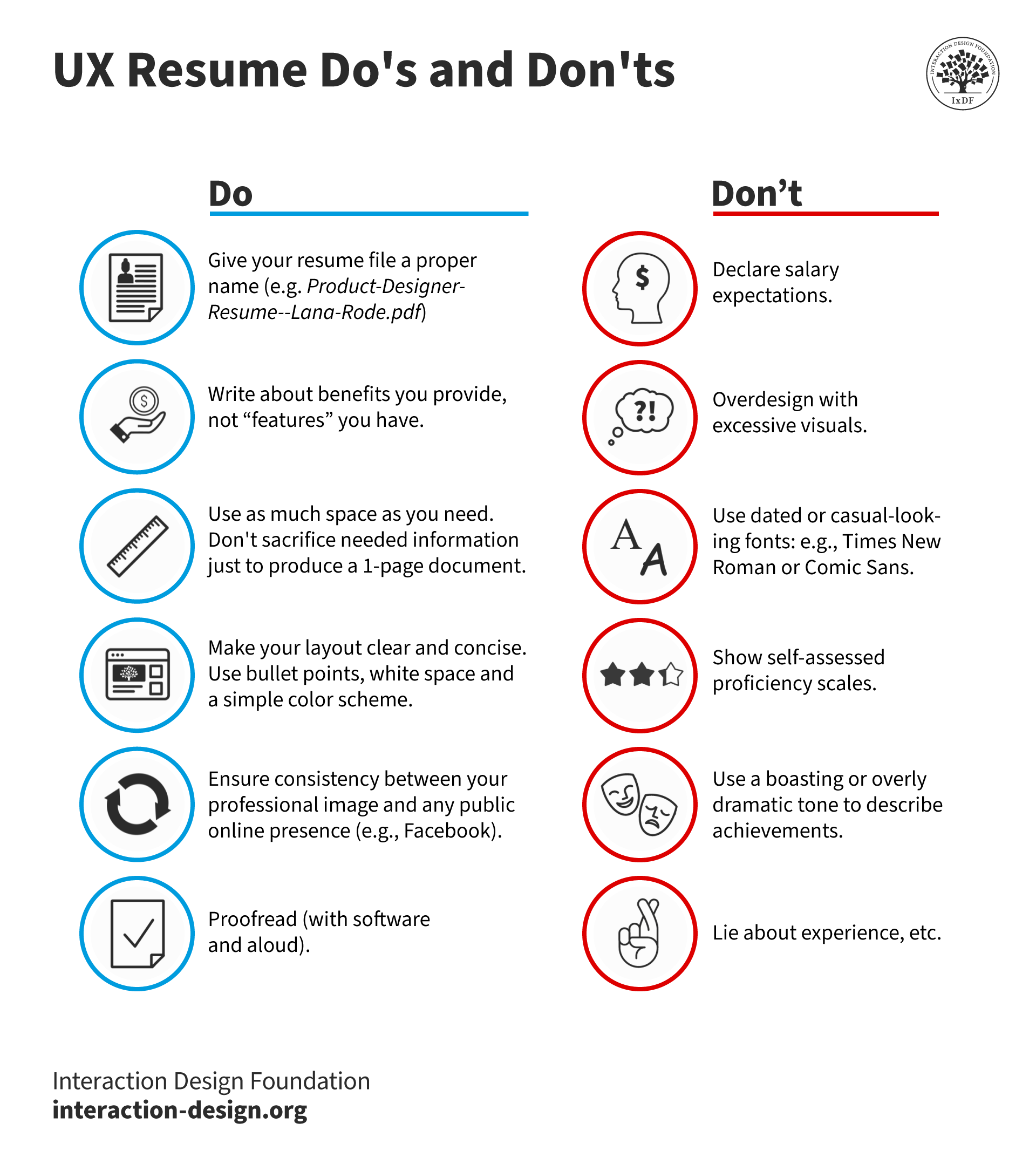
Visual design: Resumes should be visually appealing but not overly complex. Use clean, readable fonts and a logical layout. Consistency in font size, color scheme, and spacing is key.
Portfolio link: Always include a link to your online portfolio. If you have a pdf portfolio, include a Google Drive, Dropbox or WeTransfer link so the recruiter or hiring manager can download it.
Customization: This is extremely important. Resumes and portfolios should be tailored to each job application. Highlight the skills and experiences that are most relevant to the job description.
Keywords: Use keywords from the job description to pass through Applicant Tracking Systems (ATS) and to catch the recruiter's eye.
Storytelling: Much like with portfolios, use a narrative style to describe experiences and projects. Explain the problem, the approach and the results.
How do I write a compelling summary for my UX resume?
To write a compelling summary for your UX resume, begin with a strong statement about your professional identity and key achievements. Highlight your most relevant skills, experience, and what you bring to a prospective employer. For example, you might say, “Experienced UX designer with 7+ years in crafting user-centered digital experiences. Known for improving user satisfaction and engagement through innovative design solutions.” Use specific, quantifiable achievements to showcase your impact, such as "Redesigned a mobile app interface, increasing user retention by 25%."
A portfolio is greatly important in a UX resume because it demonstrates your design process, problem-solving abilities, and work results. It provides tangible evidence of your skills and experience, permitting potential employers to see how you approach design challenges and implement solutions. As portfolios are generally quite comprehensive, you can link them in the resume.
Your portfolio should include case studies that detail your UX design work—the problems you addressed, your methodologies, and the outcomes. A well-organized, visually appealing portfolio can significantly boost your chances of landing an interview.
List your UX skills in a dedicated section to make them easily noticeable. Use bullet points for clarity, including hard skills (e.g., wireframing, prototyping, usability testing) and soft skills (e.g., empathy, communication, teamwork). Tailor this section to match the job description and make sure you highlight the skills most relevant to the position you're applying for. For example, if a job emphasizes user research, list related skills prominently.
Watch as Morgane Peng: Designer, speaker, mentor, and writer who serves as Director and Head of Design at Societe Generale CIB, briefly discusses UX resumes:
ShowHide
video transcript
Transcript loading…
How do I showcase my UX projects on my resume?
Showcase your UX projects by including a dedicated “Projects” section on your resume. For each project, provide a brief description, your role, the challenge, your approach, and the outcome. Use metrics to quantify your impact, such as “Led a redesign project that increased user engagement by 40%.”
Include links to your portfolio or specific project case studies for more in-depth details. This approach demonstrates your hands-on experience and the value you’ve delivered in past roles.
How do I describe my UX job roles and responsibilities effectively?
Describe your UX job roles and responsibilities by focusing on specific tasks and achievements. Use action verbs to convey your contributions clearly, such as “Conducted user research,” “Designed wireframes,” or “Collaborated with cross-functional teams.” Highlight any measurable outcomes, like "Improved user satisfaction by 30% through iterative design and testing."
This approach not only shows what you did but also the impact of your work, making your experience more compelling to potential employers.
Get a greater understanding of UX roles and what each involves.
What are the most important skills to highlight in a UX resume?
The most important skills to highlight in a UX resume depend on your experience and what job you’re applying for. If you’re applying for a generalized UX role, include user research, wireframing, prototyping, usability testing, and interaction design.
Additionally, emphasize soft skills like empathy, communication, and collaboration, which are crucial in UX design. Make sure you tailor these skills to the specific job description, prioritizing those that align with the employer's needs.
Learn more empathy and why it is key in design:
ShowHide
video transcript
Transcript loading…
What type of UX experience should be included in my resume?
Include all relevant UX experience in your resume, from professional roles to freelance projects and internships. Highlight projects that demonstrate your ability to solve design problems and improve user experiences.Include case studies that showcase your design process, from research and ideation to prototyping and testing.
If you have experience in different industries or with various types of products (e.g., mobile apps, websites, enterprise software), mention these to illustrate your versatility.
Discover important points about other types of experience designers can leverage in their portfolios, as Morgane Peng explains:
ShowHide
video transcript
Transcript loading…
What is the best format for a UX resume?
The best format for a UX resume is clean, simple, and well-organized. Use a professional layout with clear headings, bullet points, and plenty of white space to enhance readability. Start with a compelling summary, followed by sections on your skills, experience, education, and projects.
Include links to your portfolio and ensure all content is tailored to the job you’re applying for. Avoid overly complex designs or excessive use of colors that can distract from the content. Resumes should be in PDF format.
Pick up some helpful tips about what to include in a portfolio, and what not to, in this video with Morgane Peng:
ShowHide
video transcript
Transcript loading…
How do I link my portfolio in my UX resume?
Link your portfolio in your UX resume by including a direct hyperlink in the contact information section at the top. You can also mention it in your summary and project descriptions where relevant. Ensure the link is clickable if you're submitting a digital resume. For example, you could write, “Portfolio: [yourname.com].” This approach makes it easy for recruiters to access your work and see detailed examples of your skills and projects.
Learn more about how to captivate hiring managers with an effective portfolio in this video with Morgane Peng:
ShowHide
video transcript
Transcript loading…
How do I tailor my UX resume for different job applications?
Tailor your UX resume for different job applications by customizing your summary, skills, and experience sections to match the specific job description. Highlight the most relevant skills and experiences that align with the employer's needs. Adjust the language and keywords to reflect those used in the job listing. For instance, if a job emphasizes prototyping, ensure this skill is prominently featured in your summary and skills section. This targeted approach increases your chances of passing through applicant tracking systems and catching the recruiter’s attention.
Learn more about how to make your portfolio jump out at potential employers with visual storytelling tools, in this video with Morgane Peng:
ShowHide
video transcript
Transcript loading…
Earn a Gift, Answer a Short Quiz!
Question 1
Question 2
Question 3
Get Your Gift
Try Again! IxDF Cheers For You!
0 out of 3 questions answered correctly
Remember, the more you learn about design, the more you make yourself valuable.
It's Easy to Fast-Track Your Career with the World's Best Experts
Master complex skills effortlessly with proven best practices and toolkits directly from the world's top design experts. Meet your expert for this course:
Morgane Peng: Designer, speaker, mentor, and writer who serves as Director and Head of Design at Societe Generale CIB.
7 Design Portfolio Mistakes That Are Costing You Jobs! And How to Fix Them
Don't get rejected! Here are the seven mistakes that are holding you back from landing your dream job. Hiring managers r
550 shares
6 mths ago
Open Access—Link to us!
We believe in Open Access and the democratization of knowledge. Unfortunately, world-class educational materials such as this page are normally hidden behind paywalls or in expensive textbooks.