About the authors

Picture of Karen Holtzblatt. © Karen Holtzblatt
Recognized as a leader in the design community, Karen has pioneered transformative ideas and design approaches throughout her career. Karen is the inventor of Contextual Inquiry—the industry standard for gathering field data to understand how technology impacts the way people work. Contextual Inquiry and the design processes based on it provide a revolutionary approach for designing new ...   
Read more >> 
Picture of Hugh R. Beyer. © Hugh R. Beyer
Hugh Founder and CTO of InContext. He has more than 20 years of experience building and designing applications, systems, and tools. Before co-founding InContext, Hugh acted as lead developer and architect in a range of systems at Digital Equipment Corp. His domains of experience include object-oriented repositories, databases, and integrated software development environments. Since start...   
Read more >> 

Commentaries by:


Jennifer J. Preece

Picture of Jennifer J. Preece.

Jennifer J. Preece is Dean of the College of Information Studies at the University of Maryland. She researches online communities and is known for her work on what makes such a community successful, and how usability factors interact with socialibility in onli...

More about Jennifer >>
 

Marilyn M. Tremaine

Picture of Marilyn M. Tremaine.

Dr. Marilyn Tremaine is a Research Professor at Rutgers University where she has joint appointments in the College of Communication and Information and the Department of Electrical and Computer Engineering. Prior to Rutgers University, she was a Professor in t...

More about Marilyn >>
 

Douglas Pyle

Picture of Douglas Pyle.

Douglas Pyle is "user experienced". Over the last 12 years he has led UX for web and hardware products, both in the US and Asia, at companies such as Google and Microsoft. He is also an Affiliate Faculty and board member in the Department of Human Centered Des...

More about Douglas >>
 

Editors of this chapter:


Amanda Williams

Picture of Amanda Williams. Copyright of Amanda Williams and Interaction-Design.org through the Creative Commons Share-Alike licence.

Amanda Williams is a co-founder of Wyld Collective Ltd, an independent interacti...

Read more >>
 

Rikke Friis Dam

Picture of Rikke Friis Dam. Copyright of Rikke Friis Dam and Interaction-Design.org through the Creative Commons Share-Alike licence.

Rikke Dam holds a Master's Degree in philosophy from the University of Aarhus, a...

Read more >>
 

Peer Reviewers

Reviewer 1: Name suppressed
Reviewer 2: Name suppressed

Peer-review is based on the reviewing guidelines and coordinated by the Reviewing Board.

Get Notified!

Get notified when new chapters are added to the encyclopedia!

Your Email
 

Featured chapter

Authoritative overview of Social Computing by Tom Erickson - veteran researcher at IBM Research Lab. It includes 9 HD videos filmed in Copenhagen.

Read Thomas's chapter

8. Contextual Design


Contextual Design is a structured, well-defined user-centered design process that provides methods to collect data about users in the field, interpret and consolidate that data in a structured way, use the data to create and prototype product and service concepts, and iteratively test and refine those concepts with users. This is the core of the Contextual Design philosophy - understand users in order to find out their fundamental intents, desires, and drivers. But these are invisible to the users - so the only way to glean them is to go out in the field and talk with people

Although based on theories from several disciplines, including anthropology, psychology and design, Contextual Design was designed for practical application with commercial design teams.

Since its original development, Contextual Design has been applied in a variety of industries and also used as a vehicle to teach user-centered design principles in engineering and design programs.

Contextual Design has primarily been used for the design of computer information and IT systems, including hardware (Curtis et al 1999) and software (Rockwell 1999). Parts of Contextual Design have been adapted for use as a field usability evaluation method (McDonald et al 2006). Contextual Design has also been applied to the design of digital libraries and other learning technologies (Notess 2005, Notess 2004). Contextual Design has also been used in a variety of other industries, including web applications, process reengineering, consumer product design, manufacturing, and automotive and medical device design, to name just a few.

Contextual design has also been widely used as a means of teaching user-centered design and human-computer interaction at the university level (Weinberg & Stephen 2002, Larusdottir 2006).

8.1 Motivations and Key Principles

A small number of key principles shaped the development of Contextual Design and provide the key motivations for its use as a design tool.

8.1.1 Principle: System design must support and extend users' work practice

Contextual Design is rooted in the observation that any technology or system is always situated in a larger environmental context - and that introduction of new solutions invariably changes the environment for its users. In Contextual Design, the term work practice refers to the complex and detailed set of behaviors, attitudes, goals and intents that characterize a set of users in a particular environment. All manner of activities and design domains are characterized by work practice - not only workplaces. For example, there are obviously work practices associated with business pursuits like office work, but there are also "work practices" associated with life events such as making purchases as a consumer, driving an automobile, playing music and even watching television. A central tenet of Contextual Design is that any technology, product or system must be designed to support and extend its users' work practice. If it does so well, it will be accepted and valued; if it fails to do so, it will cause dissatisfaction, frustration, avoidance and workarounds

Implications for the designer: To create a successful product, first be aware of users' work practice and design for it explicitly.

8.1.2 Principle: People are experts at what they do - but are unable to articulate their own work practice

Complicating the designer's job are two facts about work practice. The first is that people are not consciously aware of their own work practice; all of their knowledge is tacit. This is especially true when people are taken out of the context of their everyday environment. It is only when users are immersed in normal contexts of use that they can become aware of their own work practice - what they do in detail and why. They become "aware in the doing," as Michael Polanyi puts it (Polanyi 1958).

The second is that work practice is complex and varied, and that useful design data are hidden in everyday details. Many systems fall short of expectations because they fail to take into considerations seemingly insignificant details of work practice - details that are not consciously available to users when they are not engaged in the ongoing work.

Contextual Design holds that design team members must go into the field and observe and talk with users in their natural work or life environments - their natural contexts - in order to understand work practice. This is the principle of context from which the process draws its name. This aspect of Contextual Design leverages the work of earlier ethnographic methodologies (Garfinkel 1967) but extends it in important ways.

Implications for the designer: Use field interviews to reveal tacit aspects of users' work practice - the motivations, workarounds, and strategies that they may never articulate, but structure their work.

8.1.3 Principle: Good design requires partnership and participation with users

Even while in context, users are not always able to intuit and articulate their own behaviors and detailed motivations. And so Contextual Design prescribes interviews that are not pure ethnographic observations, but involve the user in discussion and reflection on their own actions, intents, and values.

The interviewer actively questions the user and partners with them to draw out and understand their work practice in detail. The interviewer thus does not enter with a preformed list of questions, as in a survey or focus group, but rather adopts a master-apprentice relationship model, seeking to understand the user's work as an apprentice would from a master, as the work is ongoing.

This key concept of partnership also comes into play in Contextual Design's use of paper prototypes and short iterations with users to work out detailed design. The thinking behind Contextual Design's iterative prototyping evolved in conjunction with, and influenced, the development of participatory design techniques in the 1980's and 1990's (Schuler & Namioka 1993).

Implications for the designer: Don't just observe when you're in the field. Ask questions and suggest interpretations of the user's actions and motivations. Articulate what matters about the work together.

8.1.4 Principle: Good design is systemic

Any good design considers the system and its impact on users as a whole: the handles on a Mini Cooper reflect the aesthetic of the entire car; the iPhone's characteristic user interface elements (including gestures) are carried through the entire design and the apps; all parts of the amazon.com site support the focus on user interests, community ratings, related material, and easy purchase. And all pages of the site look like they are part of the site - a single page could not be changed

Contextual Design provides methods that help a team keep the design coherent. The Contextual Design vision provides a high-level coherent direction; the storyboards provide coherence of task; the User Environment Design ensures structural coherence across the system. All these methods - which are explained in the following section - encourage the designer to think about the entire system, rather than treating each part as its own independent problem to be solved. This provides users with a seamless

Implications for the designer: Use concrete representations to maintain system coherence: function, structure, layout, and flow across the system.

8.1.5 Principle: Design depends on explicit representations

When people design, they create physical representations of their concepts. Whether written on the back of a napkin or captured in a high-end modeling tool, designers need a tangible representation of their thoughts. From sketches to formal diagrams, drawings enable designers to work out their ideas, capture their thinking, share it with others, discuss it, and identify weaknesses.

Contextual Design supports this need for a physical representation throughout the design process. Work models make work practice - how users approach their work - explicit, public, and sharable. The User Environment Design shows the structure of the system as experienced by the user. Each technique in Contextual Design has its own tangible representation that supports doing the work, capturing the result, and sharing it with others. These physical representations in Contextual Design are described in the next section.

Implications for the designer: Use drawings, sketches and models to capture key design considerations at every step of the process.

8.2 Description of the Contextual Design Process
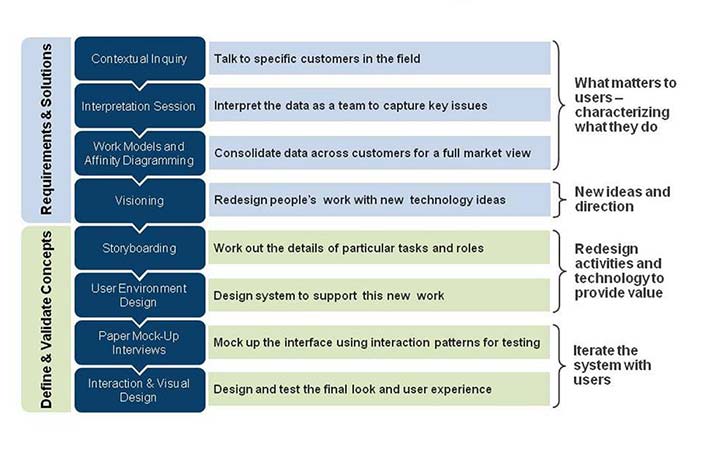
The Contextual Design Process.
Figure 8.1: The Contextual Design Process.

Contextual Design is broadly divided into two major phases (see Figure 8.1). In the following section we'll describe the initial parts of the process, from Contextual Inquiry through visioning. These initial parts are aimed at creating a structured representation of the users' work practice that is actionable for design. Later we'll describe the second phase in the process, which is aimed at working out the details of the design concepts developed in the first half of the process by way of iterative prototyping with users.

8.2.1 Contextual Inquiry

The first problem for design is to understand the customers: the people who will use the solution directly (end-users); those who provide them information or use their output (indirect users); those who manage them and are responsible for their success (managers); those who purchase the product and may have their own, quite independent, criteria. For most projects, the main focus is nearly always on the end-users, but it is important to consider and evaluate the needs of the other types of customers as well.

Contextual inquiry is an explicit step for understanding who the customers really are and how they work on a day-to-day basis. The difficulty is that, as we described above, work becomes so habitual to end-users that they often have difficulty articulating exactly what they do and why they do it. So the design team conducts one-on-one field interviews with users in their workplace to discover what matters in the work. These are not traditional question and answer interviews. Instead, a contextual interviewer observes users as they work and inquires into the users' actions as they unfold to understand their motivations and strategy. The interviewer and user, through discussion, develop a shared interpretation of the work. It is like an active inquiry into the user's world. This inquiry, done in context, is where Contextual Inquiry gets its name.

Team interpretation sessions bring a cross-functional design team together to hear the whole story of an interview and capture the insights and learning relevant to their design problem. An interpretation session lets everyone on the team bring their unique perspective to the data, sharing design, marketing, and business implications. Through these discussions, the team comes to understand the customer whose data is being interpreted and their needs, while at the same time capturing issues, drawing work models, and developing a shared understanding of the customer's world.

8.2.2 Work Modeling

As described earlier, people's work is complex and full of detail. It's also intangible - there has traditionally been no good way to write down or talk about work practice. Design teams seldom have the critical skill of seeing the structure of work done by others, looking past the surface detail to see the intents, strategies, and motivations that control how work is done - and typical development methodologies do little to encourage this perspective.

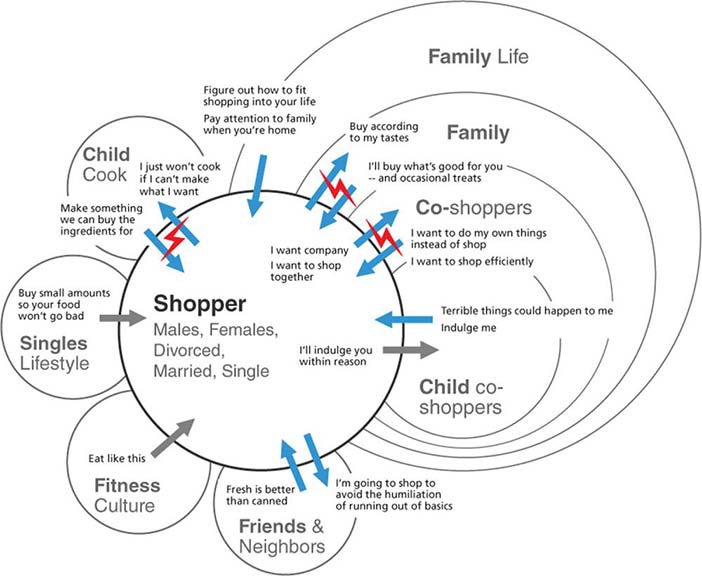
Because this is immensely important, so in Contextual Design, work models are used to capture the work of individuals and organizations in diagrams. Five different models provide five perspectives on how work is done:

  • The flow model captures communication and coordination between people to accomplish work. It reveals the formal and informal workgroups and communication patterns critical to doing the work. It shows how work is divided into formal and informal roles and responsibilities.
  • The cultural model captures culture and policy that constrain how work is done. It shows how people are constrained and how they work around those constraints to make sure the work is done.
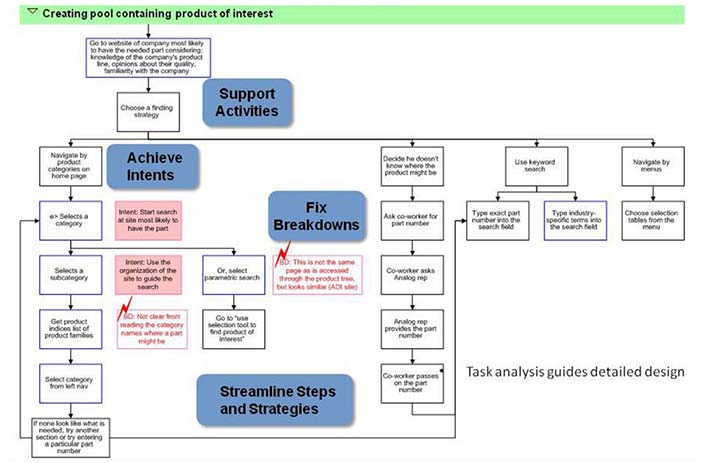
  • The sequence model shows the detailed steps performed to accomplish each task important to the work. It shows the different strategies people use, the intents or goals that their task steps are trying to accomplish, and the problems getting in their way.
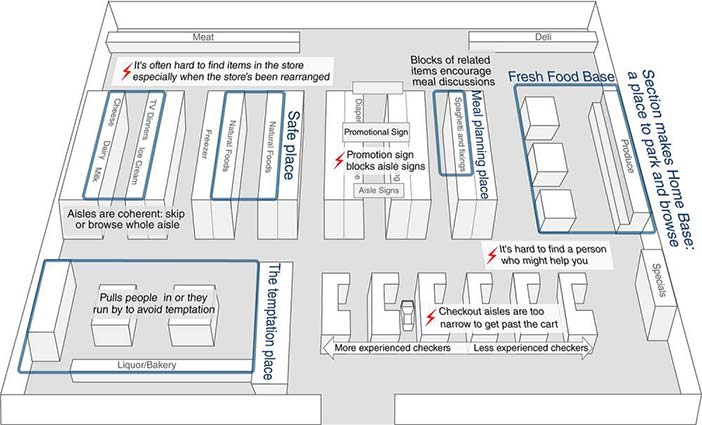
  • The physical model shows the physical environment as it supports or gets in the way of the work. It shows how people organize their environments to make their work easier.
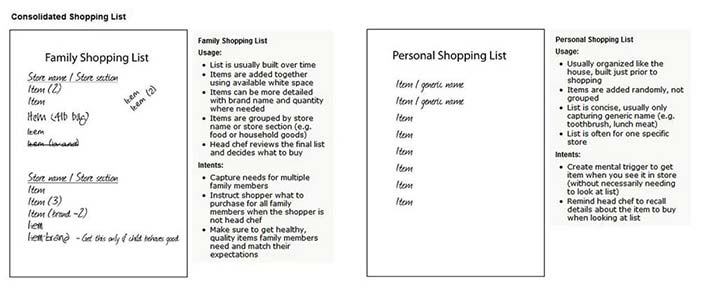
  • The artifact model shows the artifacts that are created and used in doing the work. Artifacts reveal how people think about their work - the concepts they use and how they organize them to get the work done.
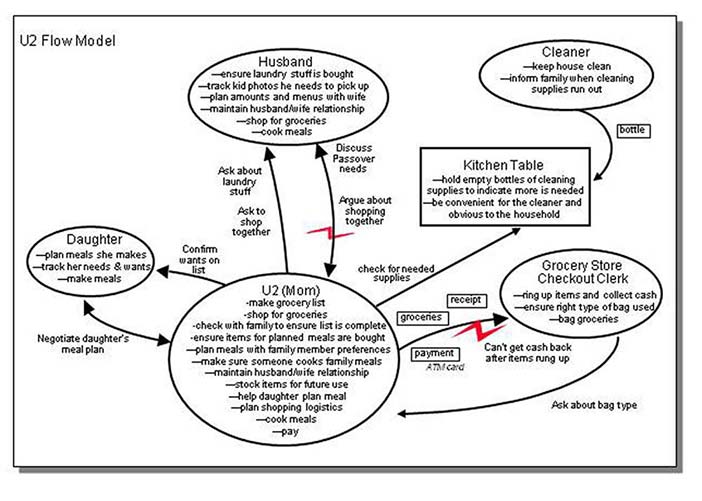
<b>The Flow Model</b> captures communication and coordination between people to accomplish work. It reveals the formal and informal workgroups and communication patterns critical to doing the work. It shows how work is divided into formal and informal roles and responsibilities.
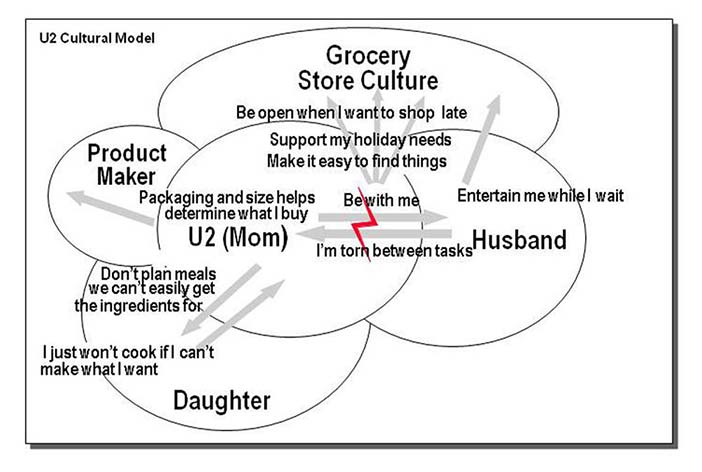
Figure 8.2: The Flow Model captures communication and coordination between people to accomplish work. It reveals the formal and informal workgroups and communication patterns critical to doing the work. It shows how work is divided into formal and informal roles and responsibilities.
<b>The Cultural Model</b> captures culture and policy that constrain how work is done. It shows how people are constrained and how they work around those constraints to make sure the work is done.
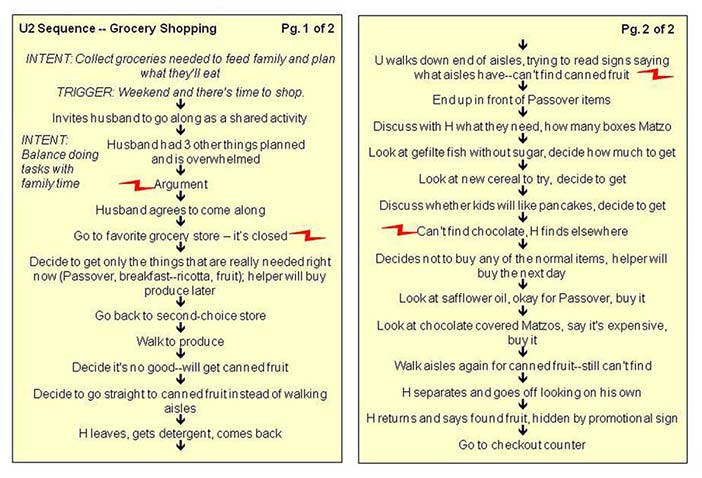
Figure 8.3: The Cultural Model captures culture and policy that constrain how work is done. It shows how people are constrained and how they work around those constraints to make sure the work is done.
<b>The Sequence Model</b> shows the detailed steps performed to accomplish each task important to the work. It shows the different strategies people use, the intents or goals that their task steps are trying to accomplish, and the problems getting in their way.
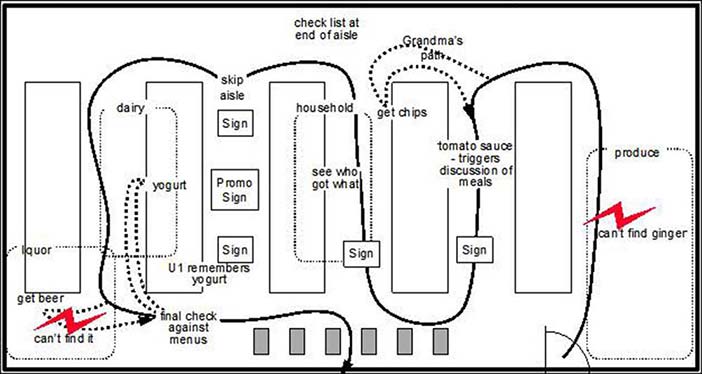
Figure 8.4: The Sequence Model shows the detailed steps performed to accomplish each task important to the work. It shows the different strategies people use, the intents or goals that their task steps are trying to accomplish, and the problems getting in their way.
<b>The Physical Model</b> shows the physical environment as it supports or gets in the way of the work. It shows how people organize their environments to make their work easier.
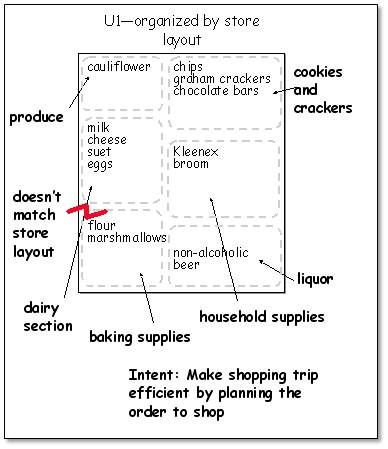
Figure 8.5: The Physical Model shows the physical environment as it supports or gets in the way of the work. It shows how people organize their environments to make their work easier.
<b>The Artifact Model</b> shows the artifacts that are created and used in doing the work. Artifacts reveal how people think about their work - the concepts they use and how they organize them to get the work done.
Figure 8.6: The Artifact Model shows the artifacts that are created and used in doing the work. Artifacts reveal how people think about their work - the concepts they use and how they organize them to get the work done.

8.2.3 Consolidation

Systems are seldom designed for a single customer. But designing for a whole customer population - the market, department, or organization that will use the system - depends on seeing the common aspects of the work different people do.

Consolidation brings data from individual customer interviews together so the team can see common pattern and structure without losing individual variation. The affinity diagram brings together issues and insights across all customers into a wall-sized, hierarchical diagram to reveal the scope of the problem.
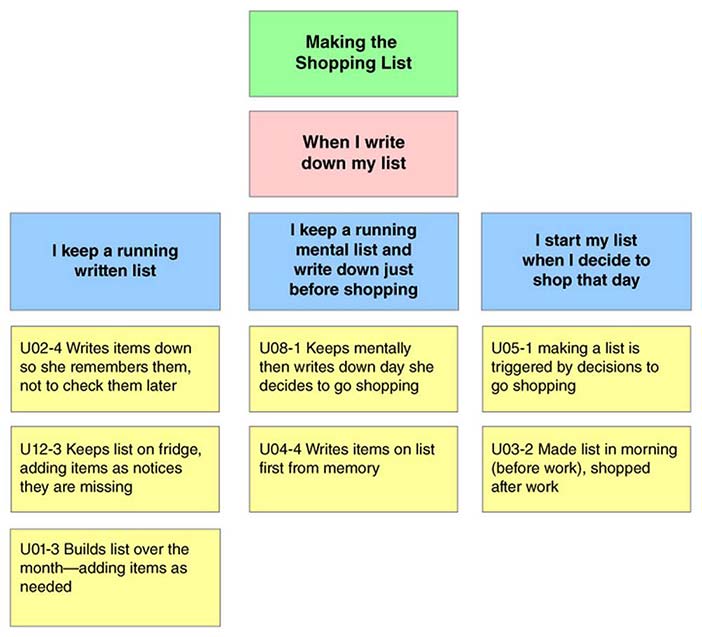
<b>Portion of an Affinity Diagram.</b> The affinity diagram brings together issues and insights across all customers into a wall-sized, hierarchical diagram to reveal the scope of the problem and the opportunities.
Figure 8.7: Portion of an Affinity Diagram. The affinity diagram brings together issues and insights across all customers into a wall-sized, hierarchical diagram to reveal the scope of the problem and the opportunities.

Consolidated work models bring together each different type of work model separately, to reveal common strategies and intents while retaining and organizing individual differences. Together, the affinity diagram and consolidated work models produce a single picture of the customer population a design will address. They give the team a focus for the design conversation, showing how the work hangs together rather than breaking it up in lists. They show what matters in the work and guide the structuring of a coherent response, including system focus and features, business actions, and delivery mechanisms.
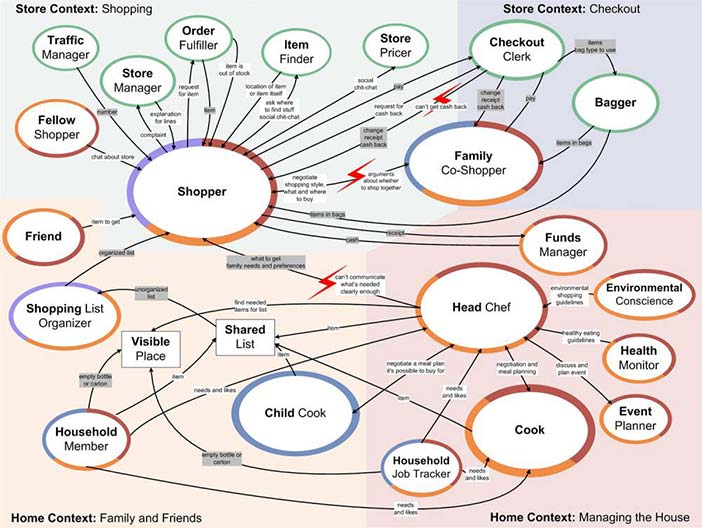
Consolidated Flow Model.
Figure 8.8: Consolidated Flow Model.
Consolidated Cultural Model.
Figure 8.9: Consolidated Cultural Model.
Portion of Consolidated Sequence Model.
Figure 8.10: Portion of Consolidated Sequence Model.
Consolidated Physical Model.
Figure 8.11: Consolidated Physical Model.
Consolidated Artifact Model.
Figure 8.12: Consolidated Artifact Model.

8.2.4 Personas built with contextual data

Personas can help bring users alive and focus the stakeholders on the relevant issues, if they are built from rich contextual data. Popularized by Alan Cooper, a persona describes typical users of the proposed system as though they were real people (Cooper 1998). Their use is becoming more widespread, though with mixed success. According to Harley Manning's research, "a persona that's not backed by rich contextual data isn't valid, which accounts for much of the mixed success." (Manning 2003)

Contextual Design calls for building personas from the field data the team collected and consolidated to help focus on the characters the design team will vision about in the next step, to help stakeholders segment their market according to practice instead of typical demographics, to clarify branding and prioritization, and to bring the users and their needs to life for developers. Contextual Design personas are built from the detailed data gathered through Contextual Inquiry interviews, so they have the richness and depth needed to drive design.

8.2.5 The Design Response: Visioning

Up to this point, a Contextual Design project focuses on understanding the users as they are. Now a team must invent the design solution using technology to transform the tasks, and possibly also designing new business processes to streamline tasks or new services to support the market. A Contextual Design team invents these solutions through visioning.

In visioning, the team uses the consolidated data to drive conversations about how to improve users' work by using technology to transform the work practice. This focuses the conversation on how to improve people's lives with technology, rather than on what could be done with technology without considering the impact on peoples' real lives.

The vision captures a story of how customers will do their work in the new world the team invents. A vision includes the system, its delivery, and support structures to make the new work practice successful. It is intentionally rough and high-level - a vision sets a possible design direction, without fleshing out every detail. This enables the team to see the overall structure of the solution and ensure its coherence.
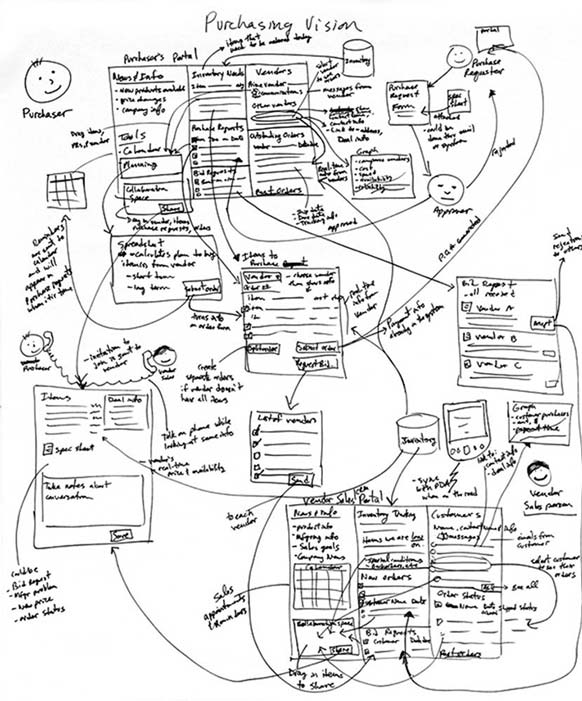
<b>The Vision</b> captures a story of how customers will do their work in the new world the team invents. A vision includes the system, its delivery, and support structures to make the new work practice successful.
Figure 8.13: The Vision captures a story of how customers will do their work in the new world the team invents. A vision includes the system, its delivery, and support structures to make the new work practice successful.

8.2.6 Storyboards

The vision defines the high-level design response to users' needs. To become actionable, the team must define the detailed function, behavior, and structure of the proposed system. This next level of design must take the users' tasks into account and ensure the right function is defined in the right system places for a smooth workflow. As you'll see in the following section, Contextual Design provides for this structural design through storyboards and the User Environment Design, and then validates the design through paper prototypes.

Each storyboard describes how users will accomplish a task in the new system. They show the steps the user will take and the system function that supports each step. The task may be handed off between users, and may be supported by several systems operating together; the storyboard ensures the task remains coherent across these boundaries.
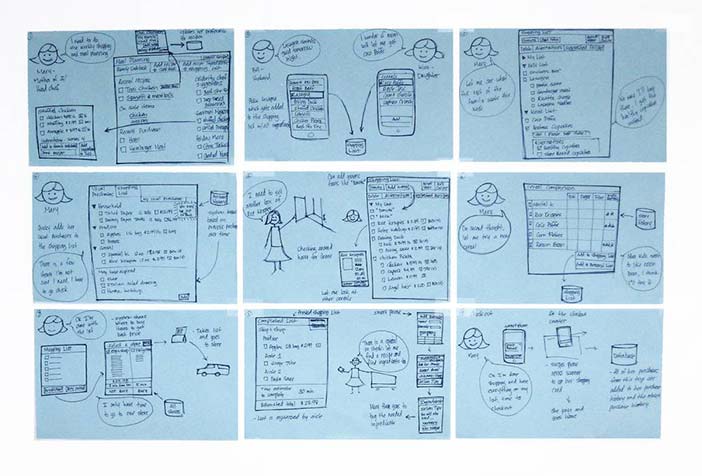
<b>Portion of a Storyboard</b>. A storyboard is represented as a sequence of &quot;freeze-frame&quot; sketches or cells, each one capturing one step in the overall task.
Figure 8.14: Portion of a Storyboard. A storyboard is represented as a sequence of "freeze-frame" sketches or cells, each one capturing one step in the overall task.

8.2.7 User Environment Design

The storyboards ensure coherence of individual tasks, but the new system must have the appropriate structure to support a natural flow of work through the system no matter what task the user is doing. Just as architects draw floor plans to see the structure and flow of a house, designers need to see the "floor plan" of their new system - the basic structure that will be revealed by the user interface drawing, implemented by an object model, and that responds to the customer work. This "floor plan" is typically not made explicit in the design process.

The User Environment Design captures the floor plan of the new system. It shows each part of the system, how it supports the user's work, exactly what function is available in that part, and how the user gets to and from other parts of the system - without tying this structure to any particular user interface.

With an explicit User Environment Design, a team can make sure the structure is right for the user, plan how to roll out new features in a series of releases, and manage the work of the project across engineering teams at a level of abstraction that is above screens and dialogs. Using a diagram which focuses on keeping the system coherent for the user counterbalances other forces that would sacrifice coherence for ease of implementation or delivery.
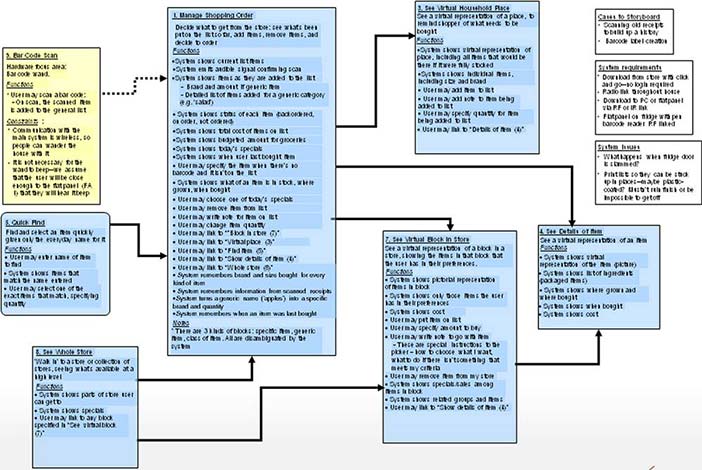
<b>Portion of a User Environment Design</b>. The User Environment Design shows each part of the system, how it supports the user's work, exactly what function is available in that part, and how the user gets to and from other parts of the system - without tying this structure to any particular user interface.
Figure 8.15: Portion of a User Environment Design. The User Environment Design shows each part of the system, how it supports the user's work, exactly what function is available in that part, and how the user gets to and from other parts of the system - without tying this structure to any particular user interface.

8.2.8 Paper prototyping

Testing is an important part of any system development. It's generally accepted that the sooner problems are found, the less it costs to fix them. So it's important to test and iterate a design early, before anyone gets invested in the design and before spending time writing code. And the simpler a testing process is, the more time is available for multiple iterations to work out the detailed design with users.

Paper prototyping develops rough mockups of the system using notes and hand drawn paper to represent windows, dialog boxes, buttons, and menus. The use of paper prototypes is described in many resources, including Carolyn Snyder's book on the subject (Snyder 2003). The design team tests these prototypes with users in their workplace, replaying real work events in the proposed system. When the user discovers problems, they and the designers redesign the prototype together to fit their needs. Rough paper prototypes of the system design test the structure of a User Environment Design and initial user interface ideas before anything is committed to code. Paper prototypes support iteration of the new system, keeping it true to the user needs. Refining the design with users gives designers a customer-centered way to resolve disagreements and work out the next layer of requirements. After several rounds of prototyping, the larger structure of the system design stabilizes. At this point, the design team can continue iterating areas of the user interface.

Once the structure and interaction design are largely stable, the team can develop and test interaction and visual design options with users.
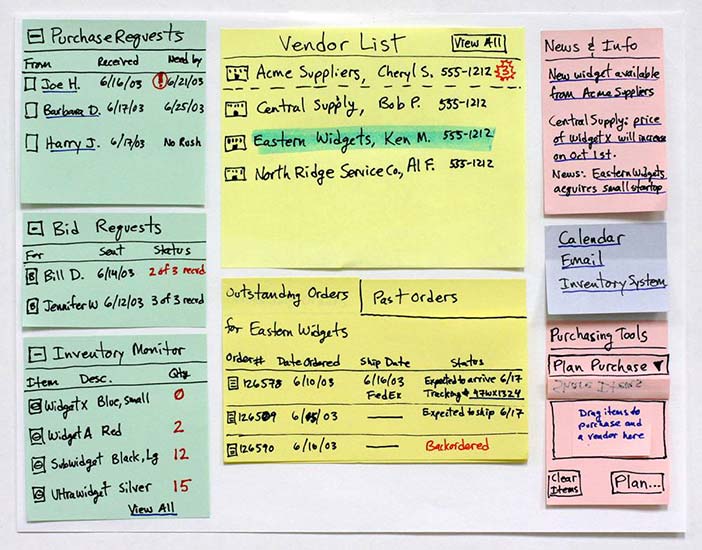
<b>Portion of a Paper Prototype.</b> Paper prototyping develops rough mockups of the system using notes and hand drawn paper to represent windows, dialog boxes, buttons, menus, and the other user interface elements the customer will use.
Figure 8.16: Portion of a Paper Prototype. Paper prototyping develops rough mockups of the system using notes and hand drawn paper to represent windows, dialog boxes, buttons, menus, and the other user interface elements the customer will use.

8.2.9 Driving Product Development

Companies implement a variety of hardware and software development methodologies within which their front-end design process, whether user-centered or not, must fit. Most methodologies define a series of stages, each with deliverables and milestones. Few define specific ways of gathering requirements, instead leaving the specific method open to definition by the product team. Contextual Design is usually included in the requirements gathering step or very early pre-commitment stage gates of these methodologies.

The translation from any kind of research on user needs to design requirements often lacks process and rigor. The structure that Contextual Design offers design teams helps bring some amount of control to this activity. The User Environment Design captures the required function and behavior of the new system, at least for the core work cases. The paper prototypes capture the proposed user interface, though usually only at a rough, wireframe level.  These can be harvested to provide the Product Requirements Document and User Interface Specification.

8.2.10 Contextual Design and Agile Development

Currently, many organizations are moving to Agile development. In contrast to traditional approaches that emphasize requirements analysis, design, and implementation as distinct phases, Agile methods seek to minimize up-front planning in favor of producing working base levels quickly and often. Feedback from these base levels is used to ensure that the resulting product is useful. Scrum (Schwaber & Beedle 2001) and XP (Beck 2004) (Extreme Programming) are two popular Agile approaches.

Agile development dovetails very nicely with user-centered design (Beyer 2010). But, Agile teams often struggle to include a reliable customer voice, something Agile methods assume they can do. Attempts to substitute stakeholders or internal product owners for the real end-user have only shown how critical that user voice is. Contextual Design provides proven techniques for collecting and using user knowledge which can be adopted by Agile teams.

Before Agile development begins, the initial stages of Contextual Design provide the team with the knowledge they need to write viable user stories. Contextual Inquiry interviews, the affinity diagram, and work models provide the deep understanding of the user needed by the team. Visioning sets the project direction and defines what kind of solution to provide. And storyboards, the User Environment Design, and paper prototypes develop and validate the right function to be included in user stories for Agile release planning. This is critical - paper prototype iterations ensure the team is developing the right design, that it is solving real user problems. It's cheaper and faster to refine the design at this point than in the middle of development iterations.

The key difference between supporting an Agile team and traditional waterfall development is that for an Agile project, the above steps are all that need be done. No writing functional specifications, user interface specifications, or architectures. The User Environment Design is kept at the level required for the team to keep its own thinking clear - it is not intended as a communication mechanism to the development team.

Instead, the User Environment Design and paper prototypes are used as the source for writing user stories in the release planning session. They provide enough detail to make it easy to write and estimate stories. Iterations can be planned so each iteration collects stories that, taken together, deliver coherent user value - as defined by the User Environment Design.

During Agile development proper, the techniques of Contextual Design continue to provide critical support to the team. Knowledge gained from field research gives the team confidence in their prioritization of user stories. The detailed user interface can be defined during iterations, usually one iteration ahead of development work. Contextual Inquiry field visits allow detailed user interface designs to be iterated with users. Completed base levels can also be tested using Contextual Inquiry techniques, and the results used to refine the direction of the project.

8.3 Background and History of Contextual Design

Karen Holtzblatt and Hugh Beyer first developed the key parts of the Contextual Design process while working at Digital Equipment Corporation (DEC) in the early 1980s. Karen, a psychologist by training, and Hugh, a developer, recognized the need for a coherent and structured design process that could integrate useful practices from their respective fields, and make it all accessible and actionable to design teams in commercial settings.

Holtzblatt's initial work was a response to the limitations of usability testing and human factors work as it existed in the early 1980's. Whiteside, Bennett, and Holtzblatt (Whiteside et al 1988) introduced and discussed the theoretical foundation for using ethnographic and hermeneutic techniques to understand user practice for the purpose of systems design. At the time, usability methods were focused on lab-based quantitative measures, but these techniques are always limited in the amount of impact they can have and do not lead to wholly new insights and design directions.

Holtzblatt brought techniques from psychology and sociology to the field, showing how the kind of verbal protocol analysis used by Ericsson (Ericsson & Simon 1984) and Piaget (Piaget 1960) could be applied to data collected from users in the field. This data forms the bases for a grounded theory, as defined by Glaser and Strauss (Glaser & Strauss 1967), and as such motivates design action. Contextual inquiry was defined as a structured method for gathering and using field data using this theoretical foundation.

The resulting techniques are similar in nature to an ethnographic study. However, contextual inquiry is constrained by the limitations of an engineering project. So field interviews are restricted to a few hours, not days or weeks, and the interaction between interviewer and user is defined as a focused conversation. The purpose of the conversation is to reveal and articulate the nature of the user's work practice, and this purpose is understood and shared by both participants.

At the same time, Holtzblatt was adapting physical mockup techniques developed by Kyng, Ehn and others (Kyng 1988; Ehn 1988) to software. In Denmark, Scandinavian countries mandated that labor representatives be included in any redesign of the workplace by creating mockups of rooms and workstations using large cardboard boxes and other simple, physical representations. Sessions were conducted with the workers in which they ran through typical tasks in his simulated environment, redesigning it to work better as they discovered problems.

Holtzblatt scaled down this method for software, using hand-drawn user interfaces on sticky notes to represent a proposed design and working through the user's own tasks, in their own workplaces, to explore the usefulness of the design. Together, designer and user would modify the prototype in the moment to eliminate problems and add needed function.

Work models were developed by Holtzblatt as a way to capture the discussion in design teams about user work practice - as a way to make elements of work practice explicit to all members of the team. The User Environment Design, similarly, was developed to capture the system structure and function without sidetracking the discussion with user interface details prematurely.

The resulting Contextual Design process was first used at DEC and later gained acceptance in the rapidly growing Human Computer Interaction (HCI) community throughout the 1980's, following the same heretic-to-accepted-practice trajectory that the HCI field itself was undergoing (Caroll 2009). Following a series of articles on various aspects of Contextual Design in the HCI literature (e.g. (Beyer & Holtzblatt 1993), (Holtzblatt & Jones 1993)), the entire process was described in the 1997 text Contextual Design (Beyer & Holtzblatt 1997). In 2005, the follow-up handbook Rapid Contextual Design (Holtzblatt et al 2005) expanded upon the method and provided more practical guidance. It also addressed an oft-heard criticism that the Contextual Design method could be too labor-intensive or lengthy for some projects.

8.4 Future Directions

The core elements of Contextual Design have been stable for over a decade and are unlikely to change fundamentally in the future. However, the context in which Contextual Design is used does change and that is likely to drive changes in how the process is used. Here are some possible directions to keep an eye on.

Agile development. As Agile processes become more widespread and more accepted, the relationship between Agile development and user-centered processes can be expected to evolve. Agile development itself is strengthened by robust user-centered techniques, but the integration of a coherent design focus with Agile development is still not well-accepted. And the introduction of new Agile methods such as Kanban will continue to provide challenges to good User Experience design.

Quantitative techniques. Ideally, the qualitative data provided by contextual inquiry would be augmented with quantitative data provided through research methods such as surveys. When making a business case, it is important to know not just what users want, but how many potential customers there are and what they are willing to pay for a solution to their problem. Contextual Design can and should be integrated into a whole product concepting and initiation process.

Enterprise-scale projects. For large-scale projects, enterprises have to coordinate multiple work streams and hundreds of people over years to accomplish the business goal. Contextual Design can play a key role in identifying the most important problems to solve, prioritizing the rollout of the solution, maintaining coherence of the system vision, and ensuring that as parts are rolled out iteratively the inevitable engineering tradeoffs do not degrade the usability of the system.

8.5 Where to Learn More

The definitive sources on Contextual Design are:

Holtzblatt, Karen and Beyer, Hugh. Contextual Design: Defining Customer-Centered Systems. San Francisco : Morgan Kaufman Publishers, 1997.

Holtzblatt, Karen, Wendell, Jessamyn and Wood, Shelley. Rapid Contextual Design: A How-to Guide to Key Technologies for User-Centered Design. San Francisco : Morgan Kaufman Publishers, 2005.

Beyer, Hugh. Contextual Design for Agile Teams. Morgan Claypool. San Rafael, CA. 2010.

Papers and case studies describing uses of Contextual Design abound in the literature. Some have been referenced below, others can be found on the InContext website at: http://www.incontextdesign.com.


8.6 Commentary by Jennifer J. Preece

How to cite this commentary in your report

Picture of Jennifer J. Preece. © Jennifer J. Preece
Jennifer J. Preece is Dean of the College of Information Studies at the University of Maryland. She researches online communities and is known for her work on what makes such a community successful, and how usability factors interact with socialibility in online communities. Preece gained her Ph.D. at the Open University, later becoming faculty there. She went on to be a Research Profess...   
Read more >> 

What a wonderful lucid and succinct description of a contextual design. The discussion is focused around a case study with colorful figures to illustrate the step-by-step process that students and those new to the topic will love. Experienced designers too will find material to interest them. For example, there is a discussion about how contextual design practices can be integrated with agile and other methods.

Drs. Karen Holtzblatt and Hugh Beyer also provide a short description of the history of contextual design. It is wisely placed at the end of the article, as many readers will be looking primarily for hands-on advice. But don’t overlook this history. It is important for appreciating just how far our discipline has come in integrating users into the design process in a deep and meaningful way that takes account of use contexts, needs, desires and emotions. Karen, a psychologist, and Hugh, a system developer, not only pioneered the development of a new and powerful design methodology, through their work they illustrate the power of interdisciplinary thinking and creativity. Along with co-workers John Whiteside and John Bennett at Digital Equipment Corporation, Karen helped identify the limitations of traditional usability testing (Whiteside et al., 1988). The key one being that while usability testing is good for identifying usability problems that when remedied create incremental improvements, it does not facilitate the large-scale design creativity needed to develop novel systems that offer users an engaging experience. Contextual Design provided the paradigm shift necessary to create a new kind of design experience, and hence, a new kind of user experience. Gradually over the last twenty plus years contextual design methodology has been refined to provide the rigorous, structured, yet flexible approach described in this article.

Successful methods have two significant characteristics: they are adopted by other researchers and developers, and they can be adapted for use in different situations. Contextual design methodology is widely employed across the world by practitioners and taught to students in human-computer interaction, product design, and related classes (Rogers et al., 2011). I saw an example of the latter first-hand last week while showing a senior administrator around Maryland’s ischool. The walls of the hallway were covered with large sheets of paper, marked with colorful markers and adorned with sticky notes – the HCI Masters students were at work! They were engaged in a contextual design exercise under the guidance of Drs. Allison Druin and Karen Holtzblatt. Groups of students were working on different parts of the design, chattering and arguing about where exactly the sticky notes should be placed. The challenge they were set was to develop a system for first-generation college students who may be under-resourced, ethnically diverse, and at times, at-risk.

Allison not only teaches contextual design she has adapted and shaped Karen and Hugh’s methodology for her own research on the design of technology for children. Know as “Cooperative Inquiry”, Allison brings together teams of adults – researchers, developers, and parents – who work in partnership with children to identify and develop innovative technologies that appeal to children (Druin, 2011). For over fifteen years these intergenerational teams have developed exciting products such as the International Children’s Digital Library (www.childrenslibrary.org).

So why has contextual design stood the test of time? There are likely several reasons. First, it was a timely solution to a real problem. Second, it is structured, rigorous and systematic. Third, it respects the needs of real users by enabling them to be partners in the design process. Fourth, it can be adopted and adapted by a wide range of designers from student learners to researchers to professional designers. And fifth, it is challenging and fun!

References

  • Whiteside, J., Bennett, J. and Holtzblatt, Karen (1988): Usability Engineering: Our Experience and Evolution. In: Helander, Martin and Landauer, Thomas K. (eds.). Handbook of Human Computer Interaction. North Holland

  • Rogers, Y., Sharp, H., Preece, J. (2011) Interaction Design: Beyond Human Computer Interaction. 3rd Edition. John Wiley & Sons: Chichester, UK. (See website: id-book.com for interviews with Karen Holtzblatt, which are also contained in the 1st and 2nd editions of the book on pages 313-315 and 578-582 respectively.)
  • Druin, A. (2011). Children as co-designers of new technologies: Valuing the imagination to transform what is possible. New directions in youth development: Theory, Practice, and Research: Youth as media creators, 128, 35-44.


8.7 Commentary by Marilyn M. Tremaine

How to cite this commentary in your report

Picture of Marilyn M. Tremaine. © Marilyn M. Tremaine
Dr. Marilyn Tremaine is a Research Professor at Rutgers University where she has joint appointments in the College of Communication and Information and the Department of Electrical and Computer Engineering. Prior to Rutgers University, she was a Professor in the Computer Science Department at the University of Toronto and prior to that, a Professor in the University of Michigan Business ...   
Read more >> 
Marilyn is working hard on her commentary. Please check back soon!


8.8 Commentary by Douglas Pyle

How to cite this commentary in your report

Picture of Douglas Pyle. © Douglas Pyle
Douglas Pyle is "user experienced". Over the last 12 years he has led UX for web and hardware products, both in the US and Asia, at companies such as Google and Microsoft. He is also an Affiliate Faculty and board member in the Department of Human Centered Design & Engineering at the University of Washington...   
Read more >> 

Contextual Design is about as close to the customer as you can get.

And for many companies customers are a smelly and scary lot: They talk too much (or not enough), say crazy stuff, and definitely slow things down. The all-too-human side of human factors can be messy, hard, and delay gratification. And by the time we ship the product it’s hard to remember how we got here.

With Contextual Design for Agile and stronger UX mindshare across industries, we've gotten over most of these fears now, but they come in new flavors. Today it's scary because if we don’t retain control of the innovation process, customers might tell us to build the wrong thing, or worse, build something prosaic/pedestrian.

And we know better than the customer. At least that's what Steve Jobs would say: "It's really hard to design products by focus groups. A lot of times, people don't know what they want until you show it to them."1 Let’s assume that rather than simply the “masses are asses”, he means that customers are not good at articulating what they need, which is also a core tenet of Contextual Design. But Jobs implies that first we need something to show users, which would make it mostly conceived and built before customers are involved.

This recent push toward design-led innovation is accompanied by the notion that anything that slows down or pollutes our game-changing design vision is at least extraneous, and at worst severely detrimental to our success in the market.
At the core of this debate2 seems to be the question of locus of innovation: Where will we find this elusive breakthrough? In the customer realm or from the visionary minds within our company? But there is no doubt that the design vision has to come from the company, and any UCD practitioner would tell you that you can’t ask customers what the vNext should be. That takes strategy and vision.

IDEO’s Tim Brown paints a picture of Design Thinking as a path to product success, and this thinking should gather inspiration from everywhere--including the customer3. But Jane Fulton Suri takes it a step further, saying: “Radical innovation requires both evidence and intuition: evidence to become informed, and intuition to inspire us in imagining and creating new and better possibilities.”4

This is refreshing to hear because although technology has always been transformative, there was a slight naivety to it in the past: products were built to meet a customer need that could usually be articulated, and research methods were very much an exercise in simple requirements and feedback gathering: “What do you want?” and “how are we doing?” Then technology strategy grew to focus on unmet or latent needs, and methods emerged to go a little deeper: site visits to gather requirements and usability studies to see how we were doing.

Now the fish are bigger, and the stakes are higher. The expectation at the outset of new concept development is that the resultant products will actively transform the way people live, and will become their new habit. To be the “architects of the new reality”, we need to be thinking much further ahead than where our customers typically focus--in minutiae of their daily lives. As Johan Redstrom would say, we are now trying to design our users5. But here is the rub: the minutiae of daily human behaviors and life is the only place we will find the seeds of innovation--in those daily experience gaps and latent desires.

Great designers can accomplish much in a design centric company and might even have some big wins. But if the design thinking is not based in deep knowledge of people’s lives and context, it will be hard to make products succeed in a repeatable way. Would Amazon attribute the success of the Kindle to their great innovation process, or a great idea with surreptitious market factors?6

Newer methods like the design probes used by Philips7 and Frog, and Richard Zaltman’s deep metaphor analysis8, are attempts to get at these critically competitive morsels: intents, desires, drivers, habits, and practices. Unfortunately many of these methods are not conducted in situ, like Contextual Design.

And when I talk to design researchers at companies like Frog, IDEO, Artefact, or other big thinking consultancies, they are hanging out with the customer. They are living with the customer. They are there not just there to get inspired, or to validate, but to learn something about humans.

People have been studying humans for years, and it takes structure to make sense of the complex interactions and environments in which we live. This is where Contextual Design excels, imbuing the insights with a structure that grounds them, lets them communicate quickly, and helps them live on to inform Big Thing v2.

  1. http://www.businessweek.com/1998/21/b3579165.htm  
  2. http://www.fastcodesign.com/1663220/user-led-innovation-cant-create-breakthroughs-just-ask-apple-and-ikea
  3. http://mitworld.mit.edu/video/357/
  4. http://www.ideo.com/images/uploads/news/pdfs/Informing_Our_Intuition.pdf
  5. http://redstrom.se/johan/abstracts/userdesign.html
  6. http://www.freakonomics.com/2009/09/17/survivor-bias-on-the-gridiron/
  7. http://www.ijdesign.org/ojs/index.php/IJDesign/article/view/305/242
  8. http://en.wikipedia.org/wiki/Zaltman_Metaphor_Elicitation_Technique; or http://www.olsonzaltman.com/html/howzmet.html


8.9 User-contributed notes

Give us your opinion! Do you have any comments/additions
that you would like other visitors to see?

 
comment You (your email) say: May 7th, 2012
#1
Add a thoughtful commentary or note to this page ! 

your homepage, facebook profile, twitter, or the like
will be spam-protected
How many?
= e.g. "6"
By submitting you agree to the Site Terms
 

8.10 References

 what's this?

Proceedings of the 33rd SIGCSE technical symposium on Computer science education 2002.

JCDL05 Proceedings of the 5th ACM/IEEE-CS Joint Conference on Digital Libraries 2005.

Armstrong, Anne-Marie (2004): Instructional Design in the Real World: A View from the Trenches. Idea Group Publishers

Beck, Kent (2004): Extreme Programming Explained: Embrace Change (2nd Edition). Addison-Wesley Professional

The new concept of Extreme Programming (XP) is gaining more and more acceptance, partially because it is controversial, but primarily because it is particularly well-suited to help the small software development team succeed. This book serves as the introduction to XP that the market will need. XP is controversial, many software development sacred cows don't make the cut in XP; it forces practitioners to take a fresh look at how software is developed. The author recognizes that this "lightweight" methodology is not for everyone. However, anyone interested in discovering what this new concept can offer them will want to start with this book.

© All rights reserved Beck and/or Addison-Wesley Professional


Beck, Kent (1999): Extreme Programming Explained: Embrace Change. Reading, MA, Addison-Wesley Publishing

The new concept of Extreme Programming (XP) is gaining more and more acceptance, partially because it is controversial, but primarily because it is particularly well-suited to help the small software development team succeed. This book serves as the introduction to XP that the market will need. XP is controversial, many software development sacred cows don't make the cut in XP; it forces practitioners to take a fresh look at how software is developed. The author recognizes that this "lightweight" methodology is not for everyone. However, anyone interested in discovering what this new concept can offer them will want to start with this book.

© All rights reserved Beck and/or Addison-Wesley Publishing


Beyer, Hugh R. (2010a): Contextual Design for Agile Teams. Morgan Claypool

Beyer, Hugh R. (2010b): User-Centered Agile Methods. Morgan and Claypool Publishers

Beyer, Hugh R. and Holtzblatt, Karen (1998): Contextual Design: Defining Customer-Centered Systems. San Francisco, Morgan Kaufmann Publishers

Beyer, Hugh R. and Holtzblatt, Karen (1997): Contextual Design: Defining Customer-Centered Systems (Interactive Technologies). Morgan Kaufmann

Beyer, Hugh R. and Holtzblatt, Karen (1993): Contextual Design: Toward a Customer-Centered Development Process. In: Software Development 93 Spring Proceedings February, 1993, Santa Clara, CA, USA.

Beyer, Hugh R. and Holtzblatt, Karen (1995): Apprenticing with the Customer. In Communications of the ACM, 38 (5) pp. 45-52

Carroll, John M. (2009). Encyclopedia chapter titled "Human Computer Interaction (HCI)". Retrieved 7 May 2012 from http://www.interaction-design.org/encyclopedia/human_computer_interaction_hci.html

Cooper, Alan (1998): The Inmates Are Running the Asylum: Why High Tech Products Drive Us Crazy and How to Restore the Sanity. Sams Publishing

The Inmates are Running the Asylum argues that, despite appearances, business executives are simply not the ones in control of the high-tech industry. They have inadvertently put programmers and engineers in charge, leading to products and processes that waste huge amounts of money, squander customer loyalty, and erode competitive advantage. They have let the inmates run the asylum. Alan Cooper offers a provocative, insightful and entertaining explanation of how talented people continuously design bad software-based products. More importantly, he uses his own work with companies big and small to show how to harness those talents to create products that will both thrill their users and grow the bottom line.

© All rights reserved Cooper and/or Sams Publishing


Cooper, Alan (1999): The Inmates Are Running the Asylum: Why High Tech Products Drive Us Crazy and How to Restore the Sanity. Sams

The Inmates are Running the Asylum argues that, despite appearances, business executives are simply not the ones in control of the high-tech industry. They have inadvertently put programmers and engineers in charge, leading to products and processes that waste huge amounts of money, squander customer loyalty, and erode competitive advantage. They have let the inmates run the asylum. Alan Cooper offers a provocative, insightful and entertaining explanation of how talented people continuously design bad software-based products. More importantly, he uses his own work with companies big and small to show how to harness those talents to create products that will both thrill their users and grow the bottom line.

© All rights reserved Cooper and/or Sams


Curtis, Paula, Heiserman, Tammy, Jobusch, David, Notess, Mark and Webb, Jayson (1999): Customer-Focused Design Data in a Large, Multi-Site Organization. In: Altom, Mark W. and Williams, Marian G. (eds.) Proceedings of the ACM CHI 99 Human Factors in Computing Systems Conference May 15-20, 1999, Pittsburgh, Pennsylvania. pp. 608-615

Qualitative user-centered design processes such as contextual inquiry can generate huge amounts of data to be organized, analyzed, and represented. When you add the goal of spreading the resultant understanding to the far reaches of a large, multi-site organization, many practical barriers emerge. In this paper we describe experience creating and communicating representations of contextually derived user data in a large, multi-site product development organization. We describe how we involved a distributed team in data collection and analysis and how we made the data representations portable. We then describe how we have engaged over 200 people from five sites in thinking through the user data and its implications on product design.

© All rights reserved Curtis et al. and/or ACM Press

Ehn, Pelle (1988): Work-Oriented Design of Computer Artifacts. Stockholm, Arbetslivscentrum

Ericsson, K. A. and Simon, Herbert A. (1984): Protocol Analysis: Verbal Reports as Data. Cambridge, MA, MIT Press

Garfinkel, Harold (1967): Studies in ethnomethodology. Englewood Cliffs, NJ, USA, Prentice Hall

Glaser, Barney and Strauss, Anselm (1967): The Discovery of Grounded Theory: Strategies for Qualitative Research. Aldine Transaction

Holtzblatt, Karen and Beyer, Hugh R. (1993): Making Customer-Centered Design Work for Teams. In Communications of the ACM, 36 (10) pp. 92-103

Holtzblatt, Karen and Jones, Sandra (1993): Contextual Inquiry: A Participatory Technique for System Design. In: Namioka, Aki and Schuler, Doug (eds.). "Participatory Design: Principles and Practice". Hillsdale, NJ, USA: Lawrence Earlbaumpp. 177-210

This article is the first published description of Contextual Inquiry. It describes the process, including three of the four interviewing principles, the interpretation session, and affinity diagrams

© All rights reserved Holtzblatt and Jones and/or Lawrence Earlbaum


Holtzblatt, Karen, Wendell, Jessamyn Burns and Wood, Shelley (2004): Rapid Contextual Design: A How-to Guide to Key Techniques for User-Centered Design (Interactive Technologies). Morgan Kaufmann

Kyng, Morten (1988): Designing for a Dollar a Day. In: Greif, Irene (ed.) Proceedings of the 1988 ACM conference on Computer-supported cooperative work September 26 - 28, 1988, Portland, Oregon, United States. pp. 178-188

This paper is about the kind of tools and techniques that are accessible to resource weak groups for use in design and evaluation of computer support. "Resource weak" means in this connection, that the economic power and the ability to control the "local environment" of the group is limited. The human resources of such groups are often (potentially) strong, but restrained by the organization of work and society; and although the tools are cheap the activities are demanding in terms of human resources. This kind of work should be seen as a supplement to participation in design processes controlled by others. When end users participate in projects set up by management, these "lay" designers often lack familiarity with the tools and techniques, they lack the power and resources to influence the choice of questions to be considered, and they are not the ones deciding how to utilize the results of a design project when actually changing the workplace. To give the context of the work on which the paper is based, I first describe the Scandinavian tradition of trade union based end user participation in systems development. Then I discuss some of the issues involved in improving the conditions for independent end user design activities. I go on by presenting a set of "cheap tools" and techniques, including the use of mock-up's. This set covers the issues of establishing the possibility of alternatives, of creating visions of new and different uses of technology, and of designing computer support. A central question in relation to the tools and techniques, is their accessibility to end users, and I discuss this based on the notions of family resemblance and "hands-on" experience.

© All rights reserved Kyng and/or ACM Press

Manning, Harley (2003). The Power Of Design Personas. Retrieved [Date unavailable] from Forrester Research: http://www.forrester.com/ER/Research/Report/Summary/0,1338,33033,00.html

Mcdonald, Sharon, Monahan, Kelly and Cockton, Gilbert (2006): Modified contextual design as a field evaluation method. In: Proceedings of the Fourth Nordic Conference on Human-Computer Interaction 2006. pp. 437-440

Downstream utility is a critical success factor for usability evaluation methods, in terms of the extent to which they can deliver value. In this paper we argue that field methods can significantly improve downstream utility through the added value they provide in terms of the range of usability problems they uncover and the contextual information they yield on user difficulties and their causal explanations. By way of an example we describe our experience of applying an adaptation of Rapid Contextual Design called Rapid Contextual Evaluation in a small scale field evaluation of a course administration system.

© All rights reserved Mcdonald et al. and/or ACM Press

Notess, Mark (2005): Using Contextual Design for Digital Library Field Studies. In: JCDL05 Proceedings of the 5th ACM/IEEE-CS Joint Conference on Digital Libraries 2005.

Notess, Mark (2004): Applying Contextual Design to Educational Software Development. In: Armstrong, Anne-Marie (ed.). "Instructional Design in the Real World: A View from the Trenches (Advanced Topics in Information Resources Management)". Idea Group Publishers

Piaget, Jean (1960): The Child's Conception of the World. Rowman and Littlefield Publishers, Inc

Polanyi, Michael (1958): Personal Knowledge: towards a post-critical philosophy. London, Routledge

Rockwell, Chris (1999): Customer connection creates a winning product: building success with contextual techniques. In Interactions, 6 (1) pp. 50-57

Schuler, Douglas and Namioka, Aki (eds.) (1993): Participatory Design: Principles and Practices. Hillsdale, NJ, USA, Lawrence Erlbaum Associates

Schwaber, Ken and Beedle, Mike (2001): Agile Software Development with Scrum. Prentice Hall

eXtreme Programming is an ideal many software shops would love to reach, but with the constant pressures to produce software quickly, they cannot actually implement it. The Agile software process allows a company to implement eXtreme Programming quickly and immediately-and to begin producing software incrementally in as little as 30 days! Implementing eXtreme Programming is easier said than done. The process can be time consuming and actually slow down current software projects that are in process. This book shows readers how to use SCRUM, an Agile software development process, to quickly and seamlessly implement XP in their shop-while still producing actual software. Using SCRUM and the Agile process can virtually eliminate all downtime during an XP implementation.

© All rights reserved Schwaber and Beedle and/or Prentice Hall


Snyder, Carolyn (2003): Paper Prototyping: The Fast and Easy Way to Design and Refine User Interfaces. Morgan Kaufmann

Written by a usability engineer with a long and successful paper prototyping history, this book is a practical, how-to guide that will prepare you to create and test paper prototypes of all kinds of user interfaces. You'll see how to simulate various kinds of interface elements and interactions. You'll learn about the practical aspects of paper prototyping, such as deciding when the technique is appropriate, scheduling the activities, and handling the skepticism of others in your organization. Numerous case studies and images throughout the book show you real world examples of paper prototyping at work.

© All rights reserved Snyder and/or Morgan Kaufmann


Weinberg, Jerry B. and Stephen, Mary L. (2002): Participatory design in a human-computer interaction course: teaching ethnography methods to computer scientists. In: Proceedings of the 33rd SIGCSE technical symposium on Computer science education 2002. pp. 237-241

Empirical evidence shows the ability for computer technology to deliver on its promises of enhancing our quality of life relies on how well the application fits our understanding of how things work. Software designers need to apply methods that provide insights into the user's mental model of the application's target task and to invite the user to be an active participant in the design process. This paper reports on our efforts to design an HCI curriculum around ethnographic techniques of data gathering and paper prototyping. Initial results are presented that study the course's effects on student's attitudes regarding approaches to software design and their long term design behavior.

© All rights reserved Weinberg and Stephen and/or ACM Press

Whiteside, John, Bennett, John and Holtzblatt, Karen (1988): Usability Engineering: Our Experience and Evolution. In: Helander, Martin and Landauer, Thomas K. (eds.). "Handbook of Human Computer Interaction". North Holland

Lárusdóttir, M. K. "Using Rapid Contextual Design at Reykjavik University", accepted paper for the workshop named "HCIEd.2006-1 inventivity: Teaching theory, design and innovation in HCI" held by British Computer Society HCI Group (BHCIG), the International Federation of Information Processing (IFIP) WG13.1 Education, and the Irish Computer Society" in Limrick in Ireland, 23rd – 24th March, 2006

Changes to this chapter

07 Dec 2011: General site news
21 Nov 2011: Modified
19 Nov 2011: Added

About this chapter

Author(s): Karen Holtzblatt and Hugh R. Beyer
Editors: Amanda Williams and Rikke Friis Dam
Reviewer 1: Name suppressed
Reviewer 2: Name suppressed

Peer-review is based on the reviewing guidelines and coordinated by the Reviewing Board.
Commentaries by: Jennifer J. Preece, Marilyn M. Tremaine and Douglas Pyle
This encyclopedia chapter has undergone double-blinded peer-review by two reviewers based on the reviewing guidelines, language copy-editing, typesetting, and reference validation.

How to cite/reference this page
URL: http://www.interaction-design.org/encyclopedia/contextual_design.html

Licensed through a Creative Commons licence Open Access

We believe in Open Access and the democratization of knowledge. Unfortunately, world class educational materials are normally hidden behind payment systems or in expensive textbooks. If you want this to change, you should help us out! Kind thoughts are not enough - you need to act!
Copyright Terms
We do NOT use copyright as a restrictive instrument, but as an instrument to protect the author against misuse while encouraging redistribution and use of his/her work. As such, these copyright terms are designed for the author and the reader, not the publisher and the profit.

Except as otherwise noted, this page/work is copyright of Karen Holtzblatt and Hugh R. Beyer and The Interaction-Design.org Foundation (Chr. Molbechs Vej 4, DK-8000 Aarhus C, Denmark) and is licensed under the following terms:
  1. The Creative Commons Attribution-NoDerivs Licence
  2. The Interaction-Design.org Addendum to the Creative Commons licence

...with the exception of materials described in...:

  1. "Exceptions"

Furthermore, your use of Interaction-Design.org signifies your consent to:

  1. the "Site Terms and Conditions"
i. Creative Commons Attribution-NoDerivs 3.0 Unported

The Creative Commons Attribution-NoDerivs 3.0 Unported License

THE WORK (AS DEFINED BELOW) IS PROVIDED UNDER THE TERMS OF THIS CREATIVE COMMONS PUBLIC LICENSE ("CCPL" OR "LICENSE"). THE WORK IS PROTECTED BY COPYRIGHT AND/OR OTHER APPLICABLE LAW. ANY USE OF THE WORK OTHER THAN AS AUTHORIZED UNDER THIS LICENSE OR COPYRIGHT LAW IS PROHIBITED.

BY EXERCISING ANY RIGHTS TO THE WORK PROVIDED HERE, YOU ACCEPT AND AGREE TO BE BOUND BY THE TERMS OF THIS LICENSE. TO THE EXTENT THIS LICENSE MAY BE CONSIDERED TO BE A CONTRACT, THE LICENSOR GRANTS YOU THE RIGHTS CONTAINED HERE IN CONSIDERATION OF YOUR ACCEPTANCE OF SUCH TERMS AND CONDITIONS.

1. Definitions

  1. "Adaptation" means a work based upon the Work, or upon the Work and other pre-existing works, such as a translation, adaptation, derivative work, arrangement of music or other alterations of a literary or artistic work, or phonogram or performance and includes cinematographic adaptations or any other form in which the Work may be recast, transformed, or adapted including in any form recognizably derived from the original, except that a work that constitutes a Collection will not be considered an Adaptation for the purpose of this License. For the avoidance of doubt, where the Work is a musical work, performance or phonogram, the synchronization of the Work in timed-relation with a moving image ("synching") will be considered an Adaptation for the purpose of this License.
  2. "Collection" means a collection of literary or artistic works, such as encyclopedias and anthologies, or performances, phonograms or broadcasts, or other works or subject matter other than works listed in Section 1(f) below, which, by reason of the selection and arrangement of their contents, constitute intellectual creations, in which the Work is included in its entirety in unmodified form along with one or more other contributions, each constituting separate and independent works in themselves, which together are assembled into a collective whole. A work that constitutes a Collection will not be considered an Adaptation (as defined above) for the purposes of this License.
  3. "Distribute" means to make available to the public the original and copies of the Work through sale or other transfer of ownership.
  4. "Licensor" means the individual, individuals, entity or entities that offer(s) the Work under the terms of this License.
  5. "Original Author" means, in the case of a literary or artistic work, the individual, individuals, entity or entities who created the Work or if no individual or entity can be identified, the publisher; and in addition (i) in the case of a performance the actors, singers, musicians, dancers, and other persons who act, sing, deliver, declaim, play in, interpret or otherwise perform literary or artistic works or expressions of folklore; (ii) in the case of a phonogram the producer being the person or legal entity who first fixes the sounds of a performance or other sounds; and, (iii) in the case of broadcasts, the organization that transmits the broadcast.
  6. "Work" means the literary and/or artistic work offered under the terms of this License including without limitation any production in the literary, scientific and artistic domain, whatever may be the mode or form of its expression including digital form, such as a book, pamphlet and other writing; a lecture, address, sermon or other work of the same nature; a dramatic or dramatico-musical work; a choreographic work or entertainment in dumb show; a musical composition with or without words; a cinematographic work to which are assimilated works expressed by a process analogous to cinematography; a work of drawing, painting, architecture, sculpture, engraving or lithography; a photographic work to which are assimilated works expressed by a process analogous to photography; a work of applied art; an illustration, map, plan, sketch or three-dimensional work relative to geography, topography, architecture or science; a performance; a broadcast; a phonogram; a compilation of data to the extent it is protected as a copyrightable work; or a work performed by a variety or circus performer to the extent it is not otherwise considered a literary or artistic work.
  7. "You" means an individual or entity exercising rights under this License who has not previously violated the terms of this License with respect to the Work, or who has received express permission from the Licensor to exercise rights under this License despite a previous violation.
  8. "Publicly Perform" means to perform public recitations of the Work and to communicate to the public those public recitations, by any means or process, including by wire or wireless means or public digital performances; to make available to the public Works in such a way that members of the public may access these Works from a place and at a place individually chosen by them; to perform the Work to the public by any means or process and the communication to the public of the performances of the Work, including by public digital performance; to broadcast and rebroadcast the Work by any means including signs, sounds or images.
  9. "Reproduce" means to make copies of the Work by any means including without limitation by sound or visual recordings and the right of fixation and reproducing fixations of the Work, including storage of a protected performance or phonogram in digital form or other electronic medium.

2. Fair Dealing Rights. Nothing in this License is intended to reduce, limit, or restrict any uses free from copyright or rights arising from limitations or exceptions that are provided for in connection with the copyright protection under copyright law or other applicable laws.

3. License Grant. Subject to the terms and conditions of this License, Licensor hereby grants You a worldwide, royalty-free, non-exclusive, perpetual (for the duration of the applicable copyright) license to exercise the rights in the Work as stated below:

  1. to Reproduce the Work, to incorporate the Work into one or more Collections, and to Reproduce the Work as incorporated in the Collections; and,
  2. to Distribute and Publicly Perform the Work including as incorporated in Collections.
  3. For the avoidance of doubt:

    1. Non-waivable Compulsory License Schemes. In those jurisdictions in which the right to collect royalties through any statutory or compulsory licensing scheme cannot be waived, the Licensor reserves the exclusive right to collect such royalties for any exercise by You of the rights granted under this License;
    2. Waivable Compulsory License Schemes. In those jurisdictions in which the right to collect royalties through any statutory or compulsory licensing scheme can be waived, the Licensor waives the exclusive right to collect such royalties for any exercise by You of the rights granted under this License; and,
    3. Voluntary License Schemes. The Licensor waives the right to collect royalties, whether individually or, in the event that the Licensor is a member of a collecting society that administers voluntary licensing schemes, via that society, from any exercise by You of the rights granted under this License.

The above rights may be exercised in all media and formats whether now known or hereafter devised. The above rights include the right to make such modifications as are technically necessary to exercise the rights in other media and formats, but otherwise you have no rights to make Adaptations. Subject to Section 8(f), all rights not expressly granted by Licensor are hereby reserved.

4. Restrictions. The license granted in Section 3 above is expressly made subject to and limited by the following restrictions:

  1. You may Distribute or Publicly Perform the Work only under the terms of this License. You must include a copy of, or the Uniform Resource Identifier (URI) for, this License with every copy of the Work You Distribute or Publicly Perform. You may not offer or impose any terms on the Work that restrict the terms of this License or the ability of the recipient of the Work to exercise the rights granted to that recipient under the terms of the License. You may not sublicense the Work. You must keep intact all notices that refer to this License and to the disclaimer of warranties with every copy of the Work You Distribute or Publicly Perform. When You Distribute or Publicly Perform the Work, You may not impose any effective technological measures on the Work that restrict the ability of a recipient of the Work from You to exercise the rights granted to that recipient under the terms of the License. This Section 4(a) applies to the Work as incorporated in a Collection, but this does not require the Collection apart from the Work itself to be made subject to the terms of this License. If You create a Collection, upon notice from any Licensor You must, to the extent practicable, remove from the Collection any credit as required by Section 4(b), as requested.
  2. If You Distribute, or Publicly Perform the Work or Collections, You must, unless a request has been made pursuant to Section 4(a), keep intact all copyright notices for the Work and provide, reasonable to the medium or means You are utilizing: (i) the name of the Original Author (or pseudonym, if applicable) if supplied, and/or if the Original Author and/or Licensor designate another party or parties (e.g., a sponsor institute, publishing entity, journal) for attribution ("Attribution Parties") in Licensor's copyright notice, terms of service or by other reasonable means, the name of such party or parties; (ii) the title of the Work if supplied; (iii) to the extent reasonably practicable, the URI, if any, that Licensor specifies to be associated with the Work, unless such URI does not refer to the copyright notice or licensing information for the Work. The credit required by this Section 4(b) may be implemented in any reasonable manner; provided, however, that in the case of a Collection, at a minimum such credit will appear, if a credit for all contributing authors of the Collection appears, then as part of these credits and in a manner at least as prominent as the credits for the other contributing authors. For the avoidance of doubt, You may only use the credit required by this Section for the purpose of attribution in the manner set out above and, by exercising Your rights under this License, You may not implicitly or explicitly assert or imply any connection with, sponsorship or endorsement by the Original Author, Licensor and/or Attribution Parties, as appropriate, of You or Your use of the Work, without the separate, express prior written permission of the Original Author, Licensor and/or Attribution Parties.
  3. Except as otherwise agreed in writing by the Licensor or as may be otherwise permitted by applicable law, if You Reproduce, Distribute or Publicly Perform the Work either by itself or as part of any Collections, You must not distort, mutilate, modify or take other derogatory action in relation to the Work which would be prejudicial to the Original Author's honor or reputation.

5. Representations, Warranties and Disclaimer

UNLESS OTHERWISE MUTUALLY AGREED TO BY THE PARTIES IN WRITING, LICENSOR OFFERS THE WORK AS-IS AND MAKES NO REPRESENTATIONS OR WARRANTIES OF ANY KIND CONCERNING THE WORK, EXPRESS, IMPLIED, STATUTORY OR OTHERWISE, INCLUDING, WITHOUT LIMITATION, WARRANTIES OF TITLE, MERCHANTIBILITY, FITNESS FOR A PARTICULAR PURPOSE, NONINFRINGEMENT, OR THE ABSENCE OF LATENT OR OTHER DEFECTS, ACCURACY, OR THE PRESENCE OF ABSENCE OF ERRORS, WHETHER OR NOT DISCOVERABLE. SOME JURISDICTIONS DO NOT ALLOW THE EXCLUSION OF IMPLIED WARRANTIES, SO SUCH EXCLUSION MAY NOT APPLY TO YOU.

6. Limitation on Liability. EXCEPT TO THE EXTENT REQUIRED BY APPLICABLE LAW, IN NO EVENT WILL LICENSOR BE LIABLE TO YOU ON ANY LEGAL THEORY FOR ANY SPECIAL, INCIDENTAL, CONSEQUENTIAL, PUNITIVE OR EXEMPLARY DAMAGES ARISING OUT OF THIS LICENSE OR THE USE OF THE WORK, EVEN IF LICENSOR HAS BEEN ADVISED OF THE POSSIBILITY OF SUCH DAMAGES.

7. Termination

  1. This License and the rights granted hereunder will terminate automatically upon any breach by You of the terms of this License. Individuals or entities who have received Collections from You under this License, however, will not have their licenses terminated provided such individuals or entities remain in full compliance with those licenses. Sections 1, 2, 5, 6, 7, and 8 will survive any termination of this License.
  2. Subject to the above terms and conditions, the license granted here is perpetual (for the duration of the applicable copyright in the Work). Notwithstanding the above, Licensor reserves the right to release the Work under different license terms or to stop distributing the Work at any time; provided, however that any such election will not serve to withdraw this License (or any other license that has been, or is required to be, granted under the terms of this License), and this License will continue in full force and effect unless terminated as stated above.

8. Miscellaneous

  1. Each time You Distribute or Publicly Perform the Work or a Collection, the Licensor offers to the recipient a license to the Work on the same terms and conditions as the license granted to You under this License.
  2. If any provision of this License is invalid or unenforceable under applicable law, it shall not affect the validity or enforceability of the remainder of the terms of this License, and without further action by the parties to this agreement, such provision shall be reformed to the minimum extent necessary to make such provision valid and enforceable.
  3. No term or provision of this License shall be deemed waived and no breach consented to unless such waiver or consent shall be in writing and signed by the party to be charged with such waiver or consent.
  4. This License constitutes the entire agreement between the parties with respect to the Work licensed here. There are no understandings, agreements or representations with respect to the Work not specified here. Licensor shall not be bound by any additional provisions that may appear in any communication from You. This License may not be modified without the mutual written agreement of the Licensor and You.
  5. The rights granted under, and the subject matter referenced, in this License were drafted utilizing the terminology of the Berne Convention for the Protection of Literary and Artistic Works (as amended on September 28, 1979), the Rome Convention of 1961, the WIPO Copyright Treaty of 1996, the WIPO Performances and Phonograms Treaty of 1996 and the Universal Copyright Convention (as revised on July 24, 1971). These rights and subject matter take effect in the relevant jurisdiction in which the License terms are sought to be enforced according to the corresponding provisions of the implementation of those treaty provisions in the applicable national law. If the standard suite of rights granted under applicable copyright law includes additional rights not granted under this License, such additional rights are deemed to be included in the License; this License is not intended to restrict the license of any rights under applicable law.
ii. The Interaction-Design.org Addendum to the Creative Commons licence

The Interaction-Design.org Addendum to the Creative Commmons licence is a placeholder for additions to the Creative Commons licence, which are deemed necessary to include in consideration of Danish law and the operation of this site and The Interaction-Design.org Foundation.

1. Attribution

Attribution must be clearly given, i.e. the author's name, the title and URL of this work/publication/web page must clearly appear. The attribution must be given in a manner appropriate to the medium in which it is given: For example, electronic copies must include a clickable URL, which does not use the nofollow attribute value.

2. Updates

The Interaction-Design.org Foundation reserves the unilateral right to update, modify, change and alter its Site Terms and Conditions as well as Copyright Terms at any time. All such updates, modifications, changes and alterations are binding on all users and browsers of Interaction-Design.org and will be posted here.

iii. Exceptions

Exceptions

In some cases, a page/work may include content, such as an image, that is not covered by the copyright terms (i.e. "The Interaction-Design.org Addendum to the Creative Commons licence" and the "Creative Commons Attribution-NoDerivs 3.0 Unported"). When this is the case, we clearly label the content. For images, we also include the copyright label inside the image file (i.e. the full-resolution version) in metadata types like EXIF, IPTC, and XMP. We only include and label content with the following copyright terms:

  1. CC-Att-SA:
        Creative Commons Attribution-ShareAlike 3.0 Unported
        Legal Code (full licence text): http://creativecommons.org/licenses/by-sa/3.0/
  2. CC-Att-SA-2:
        Creative Commons Attribution-ShareAlike 2.0 Unported
        Legal Code (full licence text): http://creativecommons.org/licenses/by-sa/2.0/
  3. CC-Att-SA-3:
        Creative Commons Attribution-ShareAlike 3.0 Unported
        Legal Code (full licence text): http://creativecommons.org/licenses/by-sa/3.0/
  4. CC-Att-SA-1:
        Creative Commons Attribution-ShareAlike 1.0 Unported
        Legal Code (full licence text): http://creativecommons.org/licenses/by-sa/1.0/
  5. CC-Att-ND:
        Creative Commons Attribution-NoDerivs 3.0 Unported
        Legal Code (full licence text): http://creativecommons.org/licenses/by-nd/3.0/
  6. CC-Att-ND-1:
        Creative Commons Attribution-NoDerivs 1.0 Unported
        Legal Code (full licence text): http://creativecommons.org/licenses/by-nd/1.0/
  7. CC-Att-ND-2:
        Creative Commons Attribution-NoDerivs 2.0 Unported
        Legal Code (full licence text): http://creativecommons.org/licenses/by-nd/2.0/
  8. CC-Att-ND-3:
        Creative Commons Attribution-NoDerivs 3.0 Unported
        Legal Code (full licence text): http://creativecommons.org/licenses/by-nd/3.0/
  9. CC-Att:
        Creative Commons Attribution 3.0 Unported
        Legal Code (full licence text): http://creativecommons.org/licenses/by/3.0/
  10. CC-Att-2:
        Creative Commons Attribution 2.0 Unported
        Legal Code (full licence text): http://creativecommons.org/licenses/by/2.0/
  11. CC-Att-3:
        Creative Commons Attribution 3.0 Unported
        Legal Code (full licence text): http://creativecommons.org/licenses/by/3.0/
  12. CC-Att-1:
        Creative Commons Attribution 1.0 Unported
        Legal Code (full licence text): http://creativecommons.org/licenses/by/1.0/
  13. AllRightsReserved:
        All Rights Reserved. Materials used with permission. Permission to use has been granted exclusively to The Interaction-Design.org Foundation and/or the author of the given work/chapter, in which the copyrighted material is used. This permission constitutes a non-transferable license and, as such, only applies to The Interaction-Design.org Foundation. Therefore, no part of this material may be reproduced, stored in a retrieval system or transmitted in any form or by any means, electronic, recording or otherwise without prior written permission of the copyright holder.
  14. AllRightsReservedUsedWithoutPermission:
        All Rights Reserved. Non-free, copyrighted materials used without permission. The materials are used without permission of the copyright holder because the materials meet the legal criteria for Fair Use and/or because The Interaction-Design.org Foundation has not been able to contact the copyright holder. The most common cases are: 1) Cover art: Cover art from various items, for identification only in the context of critical commentary of that item (not for identification without critical commentary). 2) Team and corporate logos: For identification. 3) Other promotional material: Posters, programs, billboards, ads: For critical commentary. 4) Film and television screen shots: For critical commentary and discussion of the cinema and television. 5) Screenshots from software products: For critical commentary. 6) Paintings and other works of visual art: For critical commentary, including images illustrative of a particular technique or school. 7) Images with iconic status or historical importance: As subjects of commentary. 8) Images that are themselves subject of commentary.
  15. Pd:
        Public Domain (information that is common property and contains no original authorship)
  16. Trademarks and logos:
        All trademarks, logos, service marks, collective marks, design rights, personality rights or similar rights that are mentioned, used or cited on Interaction-Design.org are the property of their respective owners. The use of any trademark on Interaction-Design.org does not vest in the author or The Interaction-Design.org Foundation any trademark ownership rights in such trademarks, nor does the use of such trademarks imply any affiliation with or endorsement of The Interaction-Design.org Foundation and its authors by such owners. As such The Interaction-Design.org Foundation can not grant any rights to use any otherwise protected materials. Your use of any such or similar incorporeal property is at your own risk.

In addition, content linked from a page is not covered by one of our licenses unless specifically noted. For example, pages may link to videos or slide decks that are not covered. The design of Interaction-Design.org (graphics, html, client-side scripts, etc.) is copyright of Mads Soegaard.

iv. The Site Terms and Conditions

Please read these terms and conditions (the "Terms") carefully before using Interaction-Design.org. By using Interaction-Design.org you signify your consent to these Terms. If you do not agree to the Terms please do not use Interaction-Design.org. The Terms addresses your legal rights and obligations and includes important disclaimers and choice of law and forum provisions. Please read carefully.

1. Ownership of Interaction-Design.org

Interaction-Design.org is owned and operated by The Interaction-Design.org Foundation, a privately held corporation incorporated under the laws of Denmark, with office in Aarhus, Denmark.

Address:
The Interaction-Design.org Foundation
Att: Mads Soegaard
Chr. Molbechs Vej 4
DK-8000 Aarhus C.
Denmark

2. Choice of Law and Forum Provisions

Interaction-Design.org is run by The Interaction-Design.org Foundation, a privately held corporation residing in Aarhus, Denmark. You agree that these Terms and your use of Interaction-Design.org are governed by the laws of Denmark. You hereby consent to the exclusive jurisdiction and venue of the courts, tribunals, agencies and other dispute resolution organizations in Denmark in all disputes

  1. arising out of, relating to, or concerning Interaction-Design.org, The Interaction-Design.org Foundation, and/or these Terms
  2. in which Interaction-Design.org, The Interaction-Design.org Foundation, and/or these Terms is an issue or a material fact
  3. or in which Interaction-Design.org, The Interaction-Design.org Foundation, and/or these Terms is referenced in a paper filed in a court, tribunal, agency or other dispute resolution organization.

The Interaction-Design.org Foundation has endeavoured to comply with all legal requirements known to it in creating and maintaining Interaction-Design.org, but makes no representation that materials on Interaction-Design.org are appropriate or available for use in any particular jurisdiction. You are responsible for compliance with applicable laws. Any use in contravention of this provision or any provision of these Terms is at your own risk and, if any part of these Terms is invalid or unenforceable under applicable law, the invalid or unenforceable provision will be deemed superseded by a valid, enforceable provision that most closely matches the intent of the original provision and the remainder of these Terms shall govern such use.

3. Liability

Your use of and browsing Interaction-Design.org is at your own risk. The Interaction-Design.org Foundation does not warrant that the software used for Interaction-Design.org, and the information, material, and content on it, or any other services provided by means of Interaction-Design.org are error-free, or that their use will be uninterrupted. The Interaction-Design.org Foundation expressly disclaims all warranties related to the above-mentioned subject matter, including, without limitation, those of accuracy, condition, merchantability and fitness for particular purpose. Notwithstanding anything to the contrary on Interaction-Design.org, in no event shall The Interaction-Design.org Foundation be liable for any loss of profits, revenues, indirect, special, incidental, consequential, or other similar damages arising out of or in connection with Interaction-Design.org or out of the use of any of the services proposed by means of Interaction-Design.org.

4. Updates

The Interaction-Design.org Foundation reserves the unilateral right to update, modify, change and alter its Site Terms and Conditions as well as Copyright Terms at any time. All such updates, modifications, changes and alterations are binding on all users and browsers of Interaction-Design.org and will be posted here.

5. Legal Disclaimer

The Interaction-Design.org Foundation and its authors make no representations as to accuracy, completeness, currentness, suitability, or validity of any information, material, or content on Interaction-Design.org.

THE MATERIAL AND CONTENT POSTED ON INTERACTION-DESIGN.ORG ARE PROVIDED "AS IS" WITHOUT ANY EXPRESS WARRANTY OR IMPLIED WARRANTY OF ANY KIND INCLUDING WARRANTIES OF MERCHANTABILITY, NON-INFRINGEMENT OF INTELLECTUAL PROPERTY, OR FITNESS FOR ANY PARTICULAR PURPOSE. IN NO EVENT SHALL THE INTERACTION-DESIGN.ORG FOUNDATION BE LIABLE FOR ANY DAMAGES WHATSOEVER (INCLUDING, WITHOUT LIMITATION, DAMAGES FOR LOSS OF PROFITS, BUSINESS INTERRUPTION, LOSS OF INFORMATION) ARISING OUT OF THE USE OF OR INABILITY TO USE THE MATERIALS, EVEN IF THE INTERACTION-DESIGN.ORG FOUNDATION HAS BEEN ADVISED OF THE POSSIBILITY OF SUCH DAMAGES.

Because some jurisdictions prohibit the exclusion or limitation of liability for consequential and or incidental damages, the above limitation may not apply to you. Furthermore, The Interaction-Design.org Foundation does not warrant the accuracy or completeness of information of links or other items contained within these materials that have been provided by third parties.

6. Provision regarding change in attribution of copyrighted materials

Please contact us at mads@interaction-design.org if you, or your organization, wish to correct or change attribution or presentation of any image/material used on Interaction-Design.org, which you, or your organization, are the rightful copyright holder of. We will request that you submit proof of your ownership of the copyright on this material but will act immediately on any reasonable request.

7. Notice and prodecure for claims of copyright infringement

Every effort has been made by the individual contributing authors as well as The Interaction-Design.org Foundation to discover and contact copyright holders of artwork/illustrations/content used on Interaction-Design.org. To the extent that a copyright holder could not be found or an inadvertent permissions or copyright error was made, The Interaction-Design.org Foundation stands ready to remove content upon notice and request by a copyright holder. In the case that you believe that any content or other material provided through Interaction-Design.org infringes your copyright, you should notify The Interaction-Design.org Foundation of your infringement claim in accordance with the procedure set forth below.

We will process each notice of alleged infringement which The Interaction-Design.org Foundation receives and take appropriate action in accordance with applicable intellectual property laws. A notification of claimed copyright infringement should be emailed to mads@interaction-design.org (subject: "Takedown Request"). You may also contact us by mail at:

The Interaction-Design.org Foundation
Att: Mads Soegaard
Chr. Molbechs Vej 4
DK-8000 Aarhus C.
Denmark

To be effective, the notification must be in writing and contain the following information:

  1. an electronic or physical signature of the copyright owner or the person authorized to act on behalf of the owner of the copyright interest
  2. a description of the copyrighted work that you claim has been infringed
  3. a description of where the material that you claim is infringing is located on Interaction-Design.org that is reasonably sufficient to enable us to identify and locate the material;
  4. how The Interaction-Design.org Foundation can contact you, such as your address, telephone number, and email address
  5. a written statement by you that you have a good faith belief that the disputed use is not authorized by the copyright owner, its agent, or the law
  6. if you represent a publisher, a written statement by you that you have a good faith belief that the material has not been placed in the public domain, or licenced under another licence, before you acquired the copyright as this would possibly invalidate your copyright
  7. and a statement by you, made under penalty of perjury, that the above information in your notice is accurate and that you are the copyright owner or authorized to act on the copyright owner's behalf.

8. Trademarks and other rights

All trademarks, logos, service marks, collective marks, design rights, personality rights or similar rights that are mentioned, used or cited on Interaction-Design.org are the property of their respective owners. The use of any trademark on Interaction-Design.org does not vest in the author or The Interaction-Design.org Foundation any trademark ownership rights in such trademarks, nor does the use of such trademarks imply any affiliation with or endorsement of The Interaction-Design.org Foundation and its authors by such owners. As such The Interaction-Design.org Foundation can not grant any rights to use any otherwise protected materials. Your use of any such or similar incorporeal property is at your own risk.

9. Screenshots

Screenshots of copyrighted computer software, for which the copyright is held by the author(s) or the company that created the software, is believed to fall under the fair use doctrine in the US (and similar laws in other countries). It is believed that reproduction for purposes such as criticism, comment, news reporting, teaching, or research is not copyright infringement. If you reuse screenshots, as well as any other information on Interaction-Design.org, you do so at your own risk and under the copyright laws of your country.

10. Copyright of Abstracts

Abstracts in the Wiki Bibliography (/references/) are submitted by their authors who use the wiki to make their research as accessible as possible. When a page on Interaction-Design.org cites/references/lists a work from the bibliography, its abstract is included. However, abstracts have varying copyrights depending which publisher the work is published through. You should assume that an abstract is copyright, all rights reserved, of its publisher and/or author and therefore always use/cite abstracts according to Fair Use. You may visit the publisher's website to learn about the specific copyright terms (e.g. ACM, IEEE, or Springer) or contact the author directly. Bottom line: Cite/use abstracts according to the principles of fair use as it may otherwise be construed as a copyright infringement and subject to legal action.

11. User Submissions / User Content

You understand and acknowledge that additions to the Wiki Bibliography (including article abstracts), additions the Conference Calendar (including conference descriptions), user-contributed notes on each page (including text, photographs, graphics), or other materials posted by users on Interaction-Design.org ("Content") are the sole responsibility of the person from whom such Content originated. This means that you, and not The Interaction-Design.org Foundation, are entirely responsible for all Content that you upload, post or otherwise make available to other users of Interaction-Design.org.

When submitting content to Interaction-Design.org, you agree to not:

  1. impersonate any person or entity or falsely state or otherwise misrepresent your affiliation with a person or entity;
  2. upload, post or otherwise make available any Content that you do not have a right to make available under any law or under contractual or fiduciary relationships (such as inside information, proprietary and confidential information learned or disclosed as part of employment relationships or under nondisclosure agreements);
  3. upload, post or otherwise make available any Content that infringes any patent, trademark, trade secret, copyright or other proprietary rights ("Rights") of any party;
  4. upload, post or otherwise make available any Content that is unlawful, harmful, threatening, abusive, harassing, tortious, defamatory, vulgar, obscene, libelous, invasive of another's privacy, hateful, or racially, ethnically or otherwise objectionable;

You acknowledge that The Interaction-Design.org Foundation shall have the right to remove any Content that violates these Site Terms and Conditions or is otherwise objectionable.

12. Third Party Websites

If we provide links or pointers to other websites, no inference or assumption should be made that The Interaction-Design.org Foundation operates, controls, or is otherwise connected with these websites. When you click on a link within Interaction-Design.org, we will not warn you that you have left a Site and are subject to the terms and conditions (including privacy policies) of the destination website. In some cases it may be less obvious than others that you have left a Site and reached another website. Please be careful to read the terms of use and privacy policy of any website before you provide any confidential information or engage in any transactions. You should not rely on these Terms for another website. The Interaction-Design.org Foundation is not responsible for the content or practices of any other website. By using Interaction-Design.org, you acknowledge and agree that The Interaction-Design.org Foundation is not responsible or liable to you for any content or other materials hosted and served from any third party website.

13. Email communication: Confidential and proprietary information notice

Email messages sent from members of The Interaction-Design.org Foundation, including emails generated from the use of the interaction-design.org website, are proprietary to The Interaction-Design.org Foundation, and are intended solely for the use of the individual to whom they are addressed. Such messages may contain privileged or confidential information and should not be circulated or used for any purpose other than for what they are intended. If you receive a message from a member of The Interaction-Design.org Foundation in error, please notify the sender immediately. If you are not the intended recipient, you are hereby notified that you are strictly prohibited from using, copying, altering, or disclosing the contents of the message. The Interaction-Design.org Foundation accepts no responsibility for loss or damage arising from the use of the information transmitted by email message including damage from virus.

14. Usage conditions

Please make sure that you understand that the information provided by The Interaction-Design.org Foundation is being provided freely, and that no kind of agreement or contract is created between you and the owners, partners, users, or authors of this site, the owners of the servers upon which it is housed, the individual contributors of the The Interaction-Design.org Foundation, any project administrators, sysops or anyone else who is in any way connected with this project. If you choose to use or copy anything from from this site it does not create or imply any contractual or extracontractual liability on the part of The Interaction-Design.org Foundation or any of its members, partners, sponsors, contributors or other users. Your use of any such or similar incorporeal property is at your own risk.

15. Legal Disputes

Any dispute arising from the use of Interaction-Design.org or the interpretation of the terms is governed by the laws of Denmark, and shall be settled by the courts of Denmark. All communications regarding legal matters must be made in writing to

The Interaction-Design.org Foundation
Att: Mads Soegaard
Chr. Molbechs Vej 4
DK-8000 Aarhus C.
Denmark


About the authors

Picture of Karen Holtzblatt. © Karen Holtzblatt
Recognized as a leader in the design community, Karen has pioneered transformative ideas and design approaches throughout her career. Karen is the inventor of Contextual Inquiry—the industry standard for gathering field data to understand how technology impacts the way people work. Contextual Inquiry and the design processes based on it provide a revolutionary approach for designing new ...   
Read more >> 
Picture of Hugh R. Beyer. © Hugh R. Beyer
Hugh Founder and CTO of InContext. He has more than 20 years of experience building and designing applications, systems, and tools. Before co-founding InContext, Hugh acted as lead developer and architect in a range of systems at Digital Equipment Corp. His domains of experience include object-oriented repositories, databases, and integrated software development environments. Since start...   
Read more >> 

Commentaries by:


Jennifer J. Preece

Picture of Jennifer J. Preece.

Jennifer J. Preece is Dean of the College of Information Studies at the University of Maryland. She researches online communities and is known for her work on what makes such a community successful, and how usability factors interact with socialibility in onli...

More about Jennifer >>
 

Marilyn M. Tremaine

Picture of Marilyn M. Tremaine.

Dr. Marilyn Tremaine is a Research Professor at Rutgers University where she has joint appointments in the College of Communication and Information and the Department of Electrical and Computer Engineering. Prior to Rutgers University, she was a Professor in t...

More about Marilyn >>
 

Douglas Pyle

Picture of Douglas Pyle.

Douglas Pyle is "user experienced". Over the last 12 years he has led UX for web and hardware products, both in the US and Asia, at companies such as Google and Microsoft. He is also an Affiliate Faculty and board member in the Department of Human Centered Des...

More about Douglas >>
 

Editors of this chapter:


Amanda Williams

Picture of Amanda Williams. Copyright of Amanda Williams and Interaction-Design.org through the Creative Commons Share-Alike licence.

Amanda Williams is a co-founder of Wyld Collective Ltd, an independent interacti...

Read more >>
 

Rikke Friis Dam

Picture of Rikke Friis Dam. Copyright of Rikke Friis Dam and Interaction-Design.org through the Creative Commons Share-Alike licence.

Rikke Dam holds a Master's Degree in philosophy from the University of Aarhus, a...

Read more >>
 

Peer Reviewers

Reviewer 1: Name suppressed
Reviewer 2: Name suppressed

Peer-review is based on the reviewing guidelines and coordinated by the Reviewing Board.

Get Notified!

Get notified when new chapters are added to the encyclopedia!

Your Email
 

Featured chapter

Authoritative overview of Social Computing by Tom Erickson - veteran researcher at IBM Research Lab. It includes 9 HD videos filmed in Copenhagen.

Read Thomas's chapter