About the author

Picture of Thomas Erickson. © Thomas Erickson
I'm an interaction designer and researcher in the Social Computing Group at IBM's Watson Labs in New York to which I telecommute from my home in Minneapolis. My research focuses on designing systems that enable groups of people to interact coherently and productively: originally focused on online systems, the scope of my work has expanded to include real world environments ranging from r...   
Read more >> 

Commentaries by:


Elizabeth Churchill

Picture of Elizabeth Churchill.

Elizabeth Churchill is a Principal Research Scientist and manager of the Internet Experiences group at Yahoo! Research. She previously worked at PARC, the Palo Alto Research Center, and before that at FXPAL, Fuji Xerox’s research lab based in Silicon Valley wh...

More about Elizabeth >>
 

David W. McDonald

Picture of David W. McDonald.

David W. McDonald is Associate Professor at the University of Washington. He has an MS (1992) in Computer Science, California State University Hayward; and an MS (1995) and PhD (2000) in Information and Computer Science. His research interests include Computer...

More about David >>
 

Andrea Forte

Picture of Andrea Forte.

I'm an assistant professor in the iSchool (College of Information Science and Technology) at Drexel University in Philadelphia. I received my PhD from the College of Computing at Georgia Institute of Technology in human-centered computing with a focus on so...

More about Andrea >>
 

Get Notified!

Get notified when new chapters are added to the encyclopedia!

Your Email
 

Featured chapter

Authoritative overview of Social Computing by Tom Erickson - veteran researcher at IBM Research Lab. It includes 9 HD videos filmed in Copenhagen.

Read Thomas's chapter

4. Social Computing


As humans we are fundamentally social creatures. For most people an ordinary day is filled with social interaction. We converse with our family and friends. We talk with our co-workers as we carry out our work. We engage in routine exchanges with familiar strangers at the bus stop and in the grocery store. This social interaction is not just talk: we make eye contact, nod our heads, wave our hands, and adjust our positions. Not only are we busy interacting, we are also remarkably sensitive to the behaviors of those around us. Our world is filled with social cues that provide grist for inferences, planning and action. We grow curious about a crowd that has gathered down the street. We decide not to stop at the store because the parking lot is jammed. We join in a standing ovation even though we didn’t enjoy the performance that much. Social interactions like these contribute to the meaning, interest and richness of our daily life.

Video 4.1: Social Computing video 1 - Introduction to Social Computing.
Video 4.2: Social Computing video 2 - Three Best Practices and Three Major Pitfalls.
Video 4.3: Social Computing video 3 - Face-to-face Interaction as Inspiration for Designing Social Computing Systems.
Video 4.4: Social Computing video 4 - Urban Planning as Inspiration for Designing Social Computing Systems.
Video 4.5: Social Computing video 5 - How to do Research in Social Computing.
Video 4.6: Social Computing video 6 - Social Computing: Visibility versus Privacy Manipulation versus Persuasion.
Video 4.7: Social Computing video 7 - How to integrate Social Computing in the Enterprise.
Video 4.8: Social Computing video 8 - The Reason IBM values Social Computing.
Video 4.9: Social Computing video 9 - Ethics in Social Computing.
 
Table of contents

4.1 Social Computing: What is it and where did it come from?

Social computing has to do with digital systems that support online social interaction. Some online interactions are obviously social – exchanging email with a family member, sharing photos with friends, instant messaging with coworkers. These interactions are prototypically social because they are about communicating with people we know. But other sorts of online activity also count as social – creating a web page, bidding for something on eBay™, following someone on Twitter™, making an edit to Wikipedia1. These actions may not involve people we know, and may not lead to interactions, but nevertheless they are social because we do them with other people in mind: the belief that we have an audience – even if it is composed of strangers we will never meet – shapes what we do, how we do it, and why we do it.

Thus when we speak of social computing we are concerned with how digital systems go about supporting the social interaction that is fundamental to how we live, work and play. They do this by providing communication mechanisms through which we can interact by talking and sharing information with one another, and by capturing, processing and displaying traces of our online actions and interactions that then serve as grist for further interaction. This article will elaborate on this definition, but first let’s look at where social computing came from.

The roots of social computing date back to the 1960’s, with the recognition that computers could be used for communications and not just computation. As far back as 1961 Simon Ramo spoke of millions of minds connected together and envisioned "a degree of citizen participation ... unthinkable today." (Ramo 1961) Perhaps the best known vision is Licklider and Taylor’s "The Computer as a Communications Device," in which they wrote of the development of “interactive communities of geographically separated people” (Kittur & Kraut 2008) organized around common interests and engaging in rich computer-mediated communication.

The first general purpose computer-mediated communication systems emerged in the 1970’s. Examples include Murray Turoff’s pioneering EMISSARY and EIES systems (Hiltz & Turoff 1993) for “computer conferencing,” PLATO Notes at the University of Illinois (Wooley 1994), and the first mailing lists on the ARPANET. Others followed and the 1980’s saw a flowering of online systems that supported social interaction via online text-based conversation: bulletin board systems, Internet Relay Chat, USENET, and MUDs (see Howard Rheingold’s The Virtual Community for a good history (Rheingold 1993)). The early 1990’s saw continued improvements in basic communications technology – speed, bandwidth and connectivity – and the advent of the Web. Although initially the Web only weakly supported social interaction by allowing people to display content and link to web pages of others (Erickson 1996), it marked the beginning of the widespread authoring and sharing of digital content by the general public.

In my view, social computing came into its own in the late 1990’s and early 2000’s when digital systems became capable of doing more than simply serving as platforms for sharing online content and conversation. The key development was the ability of digital systems to process the content generated by social interaction and feed the results of that processing back into the system. That is, while computer conferencing and its successors served as platforms that supported the production of vast tracts of online conversation, the conversation itself was understood only by humans. Digital systems provided passive media through which people interacted. The advent of modern social computing came when digital systems began to process user-generated content and make use of it for their own purposes – which often involved producing new functionality and value for their users.

A good example of creating value by processing user-generated content is Pagerank™, the algorithm used by the Google1 search engine. The fundamental insight of Pagerank is that the importance of a web page can be estimated by looking at the number of pages that point to it (weighted by the importance of those pages, which can be recursively evaluated in the same way). The underlying assumption is that the act of creating a link to a page is, on the part of a human, an indication that the page is important in one way or another. Thus Pagerank mines and aggregates the results of human judgments as expressed through link creation, and uses it to assess the importance of pages and determine the order in which to display them. This is an early, and very notable, example of the recognition that the digital actions of a large number of people can be tapped to provide a valuable service.

Let us pause, and summarize what we’ve covered so far. Social activity is a fundamental aspect of human life. Not surprisingly, digital systems have accommodated such activity for decades, initially serving as platforms that supported online conversation and other collaborative activity. More recently an important shift has occurred: systems have become able to make use of the products of their users’ social activity to provide further value, and that in turn amplifies the use of the system.

4.2 An example: A Social Computing mechanism

This is abstract, so let us look at a common example, that of the online retailer Amazon.com1. As most readers will be aware, Amazon is an online department store that sells a wide variety of goods, as well as providing an online storefront for other retailers. While there is nothing in Amazon’s core business – selling goods online – that requires social computing, Amazon is notable because it used social computing mechanisms to differentiate itself from other online stores. For illustrative purposes, we will take a close look at Amazon’s product review mechanism.

Amazon enables its users to create online product reviews. Each review consists of a textual essay, a rating of 1 to 5 stars, and the name of its author. Products may garner many reviews – for example, the best-selling book, The Girl with the Dragon Tattoo, has amassed over 2500 reviews.If this were the extent of Amazon’s review mechanism, it would be interesting and useful, but not a social computing mechanism: it would be akin to the early systems that served as platforms for producing user-generated content that was only understood by users. Like those systems, while it is valuable to provide a large number of user-generated reviews, it seems unlikely that viewers will really read through all 2500+ reviews of The Girl with the Dragon Tattoo.

What makes the difference, and moves Amazon’s review mechanism into social computing territory, is that Amazon has been clever about the kind of information it enables its users to enter. Besides the 1-5 star ratings of books from which it can produce averages and other statistics, it allows users to essentially review the reviews: readers can vote on whether a review is “helpful” or not, can flag it as “inappropriate,” and can enter a comment. And readers, in fact, do this. The “most helpful” review of The Girl with the Dragon Tattoo has been voted on by over 2,000 readers, and has received 44 comments.

This is significant because users’ votes and ratings can be used (just as Pagerank uses links) to provide valuable information. Using this information, Amazon provides two user interface components that significantly increase the utility of the user-entered information (Figure 4.1). The first is a graph of the distribution of a book’s ratings that provides viewers with an at-a-glance summary of reviewer sentiment. The second is that it uses the number of “helpful” votes to foreground particular reviews – e.g., the most helpful critical review and the most helpful favorable review.
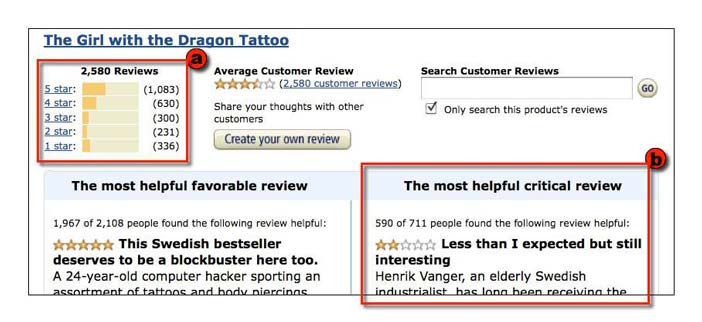
The Amazon.com book review summary includes components that show (a) the overall distribution of review ratings, and (b) the "most helpful" (in terms of readers' votes) critical review.
Figure 4.1: The Amazon.com book review summary includes components that show (a) the overall distribution of review ratings, and (b) the "most helpful" (in terms of readers' votes) critical review.

These components – which rely on computations carried out on user input – make it easier for viewers to deal with large amounts of user-generated content. The first integrates the results of all reviews of a book, providing not only the average rating but also the more informative distribution of ratings. The second uses the review’s book ratings in tandem with helpful votes to highlight particular reviews – the most helpful favorable review, and the most helpful critical review. Now, rather than wading through dozens, hundreds or thousands of reviews, the viewer can glance at the overall distribution and read through the “most helpful critical review.” This increases the useful of Amazon’s review information, and most likely increases visits by prospective purchasers. In addition, the possibility of “helpful” votes, and the chance to be recognized as the author of a “most helpful” review, may serve to incent reviewers to write better reviews. All in all, these mechanisms produce virtuous circles: positive feedback loops that promote desirable results.

This aptly illustrates the phase shift that began around the year 2000. Systems emerged that were more than platforms for social interaction: the results of users’ activities began to be usable not just by users, but by the digital systems that supported their activity. Sometimes ordinary content is made digitally tractable by dint of computation, as with Google’s Pagerank algorithm that mines the web to determined linked-to frequency. (Amazon takes this approach as well, when it uses the purchase history of a user to identify those with similar histories, and then provides users-like-you-also-bought recommendations). And sometimes the system requests that users directly enter data in a form that it can make use of – like Amazon’s ratings and “helpful” votes, or the “I like this” and “favorite” votes used in other systems. However it occurs, this ability for the information produced via social interaction to be processed and re-used by the system supporting that interaction is the hallmark of present day social computing.

4.3 The value of Social Computing

Why does social computing matter? Besides the fact that the social interaction supported by social computing systems is intrinsically rewarding, there are a number of ways in which social computing systems can provide value over and above that offered by purely digital systems.

First, social computing systems may be able to produce results more efficiently. Because Amazon can draw on its entire customer base for book reviews, it can provide far more reviews far more quickly than relying on the comparative trickle of reviews produced by Publishers Weekly and other trade outlets. The Girl with the Dragon Tattoo received five reviews within a month of its 2008 publication in English, long before it emerged from obscurity in the English language market. Similarly, Wikipedia, the online encyclopedia, offers over three and a half million articles in the English edition, and can generate articles on current events literally overnight. For example, within an hour of the 2011 Tōhoku earthquake and tsunami in Japan, a three paragraph article had appeared; that, in turn, was edited over 1,500 times in the next 24 hours to produce a well-formed article with maps, photos and 79 references. (As of this writing, nearly ten weeks after the event, the article has been edited over 5,100 times by over 1,200 users, and has 289 references; in the last 30 days it has received nearly 600,000 views.)

A second way in which social computing can be of value is by increasing the quality of results. A good example is the MatLab1 open source programming contest (MatLab Central 2010, MatLab Central 2011). MatLab is a commercial software package for doing mathematical analysis that uses its own scripting language, and one way its developers promote it is by running a programming contest. Each contest poses a problem, and the challenge is to produce a program that solves it as quickly and completely as possible. Contestants submit the MatLab source code of their programs, and the programs are immediately evaluated, scored, and listed in order of their scores. What makes the contest unusual and interesting is that each entry’s source code is also made publicly available. So when a new top-scoring program is submitted, other contestants will download it and look through the source code for ways to “tweak” it so that it runs slightly faster. The new tweaked program can be submitted, and it and its author will thereby vault ahead of the originator into first place (until another contestant tweaks that entry). As this tweaking process is repeated dozens of times (e.g., Figure 4.2), the entry is rapidly optimized, drawing on and integrating the specialized knowledge of the community of MatLab programmers (Gulley 2004).
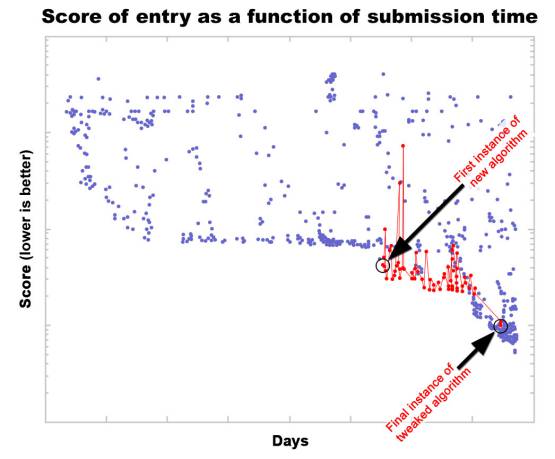
Collective optimization in the MatLab open source programming contest. Following the introduction of a new algorithm (variants shown in red), contestants refine it, gradually (and noisily) optimizing the algorithm (adapted from MatLab Central 2010).
Figure 4.2: Collective optimization in the MatLab open source programming contest. Following the introduction of a new algorithm (variants shown in red), contestants refine it, gradually (and noisily) optimizing the algorithm (adapted from MatLab Central 2010).

A third way in which social computing systems can provide value is by producing results that are seen as fairer or more legitimate. Thus, to return to Amazon, one might trust the results of ‘the crowd’ of reviewers more than an ‘official’ reviewer who may have values or biases that are out of sync with the ordinary reader. Another example is the online auction, where multiple people bid for an item – those who lose out may not like the result, but few will argue that it is not legitimate. Stepping out of the digital realm for a moment, note that the rationale for the plebiscites on which democracies are based is not that they produce more rapid decisions, nor that the decisions are necessarily of higher quality, but rather that they are representative and reflect the popular consensus. It is notable that the value of plebiscites and auctions (and even the Amazon review process) can be invalidated by failures in their processes – ballot box stuffing, vote buying and other forms of fraud in elections; shills in auctions; and collusion among bidders and reviewers. In cases like this, it is the legitimacy of the result that has been undermined; demonstrating that the decision was arrived at more quickly or is of higher quality is immaterial. In this case the value of the product is contingent upon the process through which it was derived.

A fourth way in which social computing provides value is by tapping into abilities that are uniquely human. For example, the ESP Game (Ahn & Dabbish 2004), which we will discuss in more detail shortly, is an online game in which a user and an anonymous partner look at an image and try to guess the words that occur to the other person. Both enter words simultaneously, and when they both enter the same word they ‘win’ and receive points; a side effect of this is that the players are producing textual labels for the image – a task that, in general, computer programs cannot perform. Other examples are Galaxy Zoo (Galaxy Zoo 2011, Priedhorsky et al 2007), which asks people to classify galaxies in astronomical photographs by their shapes, and Investigate Your MP (Guardian - guardian.co.uk 2011), which asks participants to read through politicians’ expense reports and flag those that seem suspicious.

To sum up, there are different ways in which social computing systems may produce value: they may produce results more quickly by multiplying effort; they may produce higher quality results by integrating knowledge from multiple participants; they may produce results that are more legitimate by virtue of representing a community; and they may carry out tasks that are beyond the capacity of current digital systems by drawing on uniquely human abilities. But while this value is of great practical import, it should not obscure the most important aspect of social computing: the social interaction itself. Greater efficiency, quality and legitimacy are important benefits, but the reason most people engage with social computing systems lies in the give and take of the interaction itself, the meaning and insight we derive from it, and the connections with others that may be created and strengthened as its result.

4.4 Social Computing as a system: The ESP Game

Thus far we’ve introduced the notion of social computing as an approach that does more than provide a platform for social interaction – it makes use of social interaction to produce various forms of value. The shift to social computing is, at the heart, driven by the ability of digital systems to process the products of the social interaction they support. The products of social interaction have been made digitally tractable, either by dint of digital computation (e.g., Pagerank), or by persuading users to enter information in a form that the digital system can use (e.g., Amazon’s “Helpful” votes and Five-star ratings).

Up to this point our principal example of social computing has been Amazon. However, while Amazon has been enormously successful at making use of social computing mechanisms, if one removed all elements of social computing from Amazon, it would still be able to carry out its basic aim of selling goods online. To expand our understanding of social computing we’ll take a look at some examples of social computing systems – that is, systems that, without social computing mechanisms, simply would not function at all.

The ESP Game (Ahn & Dabbish 2004) is one of a class of systems that have been characterized as performing “human computation.” This type of system is designed so that it enables a large number of people to perform a simple task many times (and often many many times). The art of designing this type of social computing system lies in finding a domain with a difficult problem that can be solved by the massive repetition of a simple (for humans) task, and in figuring out how to motivate the human participants to carry out a simple task many times.

The ESP Game is notable both for its practical success and for the subtleties of design that underlie its apparent simplicity. At a high level the ESP Game sets out accomplish the task of assigning textual labels to images on the web. This is a task that is difficult for computers to perform, but easy for humans. However, while easy for humans, it is not a task that is very interesting to perform, which given that there are billions of images in existence constitutes a problem. What the ESP Game does is to reframe the image labeling process as a game, and by making it fun it succeeds in recruiting large numbers of people to label images. In fact, in its first 5 years of existence, 200,000 people used it to produce more than 50 million image labels (Ahn & Dabbish 2008).

The ESP Game works as follows. A user goes to the web site, where, after a brief wait, he or she is paired with an anonymous partner and the game begins (Figure 4.3). Both participants are shown (a) an image, and are asked to type (b) words that they believe their partner will type; they may also be shown (c) “taboo words” which cannot be used as guesses. When they achieve (d) a match, they receive points, and move on to a new image; if it proves too difficult to achieve a match, a player can click (e) the “pass” button, which will generate a new image. Each game lasts three minutes, and both participants receive points each time they match on a word.
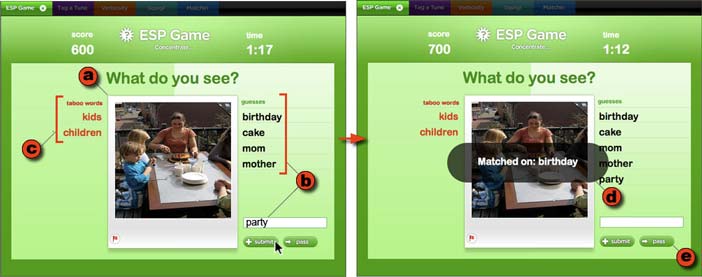
The ESP Game in Play mode. The player (a) looks at an image, (b) enters words that describe the image, except that (c) certain words called “taboo words” can’t be chosen. If the other player enters one of the same words, there is (d) a match, and both players get points. If it seems too difficult to come up with good guesses, either player can (e) pass.
Figure 4.3: The ESP Game in Play mode. The player (a) looks at an image, (b) enters words that describe the image, except that (c) certain words called “taboo words” can’t be chosen. If the other player enters one of the same words, there is (d) a match, and both players get points. If it seems too difficult to come up with good guesses, either player can (e) pass.

After a game ends the players go their separate ways, each seeing a screen (Figure 4.4) that recaps how well they did, both in the individual game, and in a cumulative score for all games played. Players are also shown how far they have to go to achieve the next “level,” and how they compare with the highest scoring player for the day.
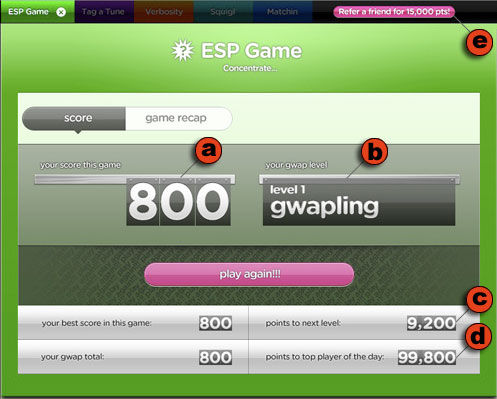
The ESP Game Score window. At the end of the game, players are shown (a) their points, (b) their level, (c) points needed to achieve the next level and (d) to beat the best player of the day (d). Players can also earn points by (e) referring friends.
Figure 4.4: The ESP Game Score window. At the end of the game, players are shown (a) their points, (b) their level, (c) points needed to achieve the next level and (d) to beat the best player of the day (d). Players can also earn points by (e) referring friends.

The ESP Game has a number of design features that illustrate issues that social computing systems, in general, must address. As we shall see later, different systems may address these issues differently, but the ESP Game provides a good starting point for grounding this discussion.

4.4.1 Computation

Social computing systems carry out various forms of work to produce value, often by applying algorithms to the results of user-generated content. The ESP Game performs computations by incenting individuals to use their perceptual and cognitive abilities to generate possible labels for an image, and aggregating results across many games to produce a valuable outcome. The result of a single game is a set of images each of which has either a word that both players typed in response to the image, or a “pass.” As multiple pairs play the game on the same images, sets of labels are produced for each image. The best labels will be those that are produced most frequently, and after a while the game will add them to the list of “taboo words” that are not allowed as guesses. This requires players to produce less obvious labels, which are in turn added to the “taboo word” list, until it becomes sufficiently difficult that when presented with an image and its list of taboo words, most players pass. At this point, the image can be ‘retired’ from the game and considered to have a complete set of labels weighted by the frequency with which people produced them. This is a result that cannot be achieved by purely digital systems.

4.4.2 Recruiting and Motivating

The ability of a social computing system to produce value relies on user-generated content, and that means that the system must take measures to ensure that it has a sufficient number of users who are motivated to participate. This was not an issue for Amazon, because the Amazon review mechanism is embedded in the larger Amazon ecosystem, and it happens that some of those attracted to Amazon by its function as an online retailer are interested in reviewing products. This is not the case with the ESP Game – it must do all the work of attracting people. It does this via its use of game-like incentive mechanisms to recruit and motivate its players. People hear about the ESP Game via word of mouth – players can earn points by referring others ­­– and come to play it because it’s fun. Once potential players arrive at the site the problem shifts to engaging them in the game. To that end the ESP Game is nicely designed with bright colors, snappy interaction and appropriate sounds. Many of its features – the limited time, the awarding of points for right answers, a graphical scale showing cumulative points, and the sound of a clock ticking during the final moments of the game – work to motivate the users during game play. When a game ends, other features – cumulative points, user levels, points needed to achieve the next level, and points needed to beat the top player of the day (Figure 4.4) – encourage the player to “play again!!!” This also provides motivation for players to register, creating online identities that can accumulate points across sessions, and that can vie for positions in the top scores lists for “today,” “this month,” and “all time.” All of these features serve to engage users, motivate them, and encourage them to return – issues that any social computing system will need to address.

4.4.3 Identity and Sociability

Not only must social computing systems attract and motivate their users, but they must make them ‘present’ within the system. Participants in a social computing system generally require identities through which to engage in interaction with others, and identity – especially identity that persists over time – is also bound up with motivation and reputation. The ESP game is actually a relatively low-identity example of a social computing system, in that its participants are not allowed to talk with one another while playing the game, so as to deter cheating. Nevertheless, the ESP Game does take pains to support identity and reinforce the social aspects of the game. As noted, players can register, creating a screen name, an icon, and other elements of a profile. While communication between a pair of players during the game is prohibited, players can join a chat room for the site as a whole (the ESP Game is part of a site called Games with a Purpose). More generally, the design shows the presence of others. Once a user chooses to play, there is a brief wait while the game is “matching you with a partner.” Once a match is made, the player is told the screen name and shown the icon of their partner. Like the incentive mechanism, these social features aim to increase the attraction and interest of the site.

But suppose you show up for a game and there is no one to play with? This is a problem in that not only can the game not take place, but the player who has come to the site may now be less likely to return. The ESP Game deals with this situation by using autonomous software programs called “bots.” If a visitor arrives at the ESP Game site and no one else is there, the visitor will still be paired up with another “player,” but unbeknownst to the visitor the other player will be a bot. The game that ensues will use images that have already been labeled by at least one pair of human players, and the bot will simply replay the responses (and timings) of one of the previous players, giving the human partner the experience of playing against someone else. This use of bots supports the experience of the game, and has another use that we will look at shortly.

4.4.4 Directing and Focusing Activity

Another issue that social computing systems need to deal with is how to focus or otherwise shape the activities of their users. In the ESP Game, this is done via taboo words. As already described, taboo words serve to increase the breadth of the set of labels generated for an image by ruling out those that many previous pairs of players have produced. Taboo words also shape the set of labels produced in a more subtle way: they can prime players to pay attention to certain aspects of the image (Ahn & Dabbish 2008) (e.g., an image with “green” as a taboo word might incline players to name other colors in the image). The ESP Game could use other approaches to focusing work such as selecting images from particular known sets (e.g., images of paintings), or recruiting players from particular populations (e.g., art school students). Many social computing systems have mechanisms, of one sort or another, that try to focus or otherwise control the nature of the computation the system performs.

4.4.5 Monitoring and Controlling Quality

While humans can perform computations that are difficult or impossible for digital systems, it is also the case that human-generated results may be inaccurate – thus many social computing systems need to address the issues of monitoring and controlling the quality of results produced. Quality problems may result from ignorance, unnoticed bias, or intentional choice. In the case of the ESP Game, the primary threat to quality is cheating. That is, the game-like incentive mechanisms work so well that players may play with the goal of getting points, rather than accurately labeling images.

As the ESP Game has developed, various cheating strategies have been identified and circumvented. Solo cheating occurs when a person logs on twice and tries to play themselves – this can be detected and prevented by IP matching. Dyadic cheating occurs when two players devise a word entry strategy (e.g., “one”, “two”, “three”) and try to log on at the same moment in the hopes of being paired up – this can be prevented by having a long enough waiting period (“matching you with a partner”) and a sufficient number of waiting players that it is unlikely that conspirators will be matched. If there are not enough players waiting to ensure a good likelihood of a random match, the ESP Game can use bots as surrogate players, as previously described. Finally, cheating can occur en mass when someone posts a word entry strategy and starting times on a public web site. This approach can be detected by a sudden spike in activity (or a sudden increase in performance), and countered by, once again, pairing players with bots.

These examples of cheating raise several points. First, with respect to designing social computing systems, cheating can be dealt with. It is simply necessary to identify cheating strategies and block them – or at least lower their probability of success to a point where it is easier to win by using the system as the designers intended. Second, note that cheating is an issue only in certain types of social computing systems. Cheating occurs primarily in systems where the incentive mechanism is unrelated to the system’s purpose. Third, note that since cheating removes the fun from the game, its existence is apt testimony to the power of the ESP Game’s game-like incentive mechanisms.

4.4.6 Summary

In this section we’ve looked at social computing systems as systems, using the ESP Game as an illustrative example. Unlike the Amazon review mechanism, which was embedded in the larger Amazon ecology, the ESP Game needs to function as a complete system, solving the problems of recruiting participants, giving them an identity within the system, focusing their attention on tasks that need doing, incenting them to do the task, and monitoring and controlling the quality of the results. The ESP Game does this by drawing on game design thinking. It is successful because the tasks on which it is focused are simple, well-formed and thus amenable to very rapid, very iterative interaction – and this, in turn, is well suited to game play.

On the other hand, while von Ahn and his colleagues have proven to be quite ingenious in their ability to find domains amenable to this approach (see Ahn & Dabbish 2008), many problems do not break down so neatly into such simple well-formed tasks. Yet, as we shall see, social computing systems – albeit with different approaches to the above issues ­­– can still make headway.

4.5 Social Computing as a system: Wikipedia

In this section we examine what is, in the view of many, the most successful example of a social computing system: Wikipedia. Besides its success Wikipedia is of interest because it offers a stark contrast with the ESP Game. Whereas the ESP Game attracts a steady stream of anonymous users who perform a simple task embedded in a game, Wikipedia is more of a community, with a core of committed participants who interact with one another while performing a variety of complex tasks. Wikipedia has also proved to be popular with researchers, making it a superbly studied example of a social computing system. Thus, our examination of Wikipedia will add breadth to our understanding of social computing.

As most readers will know, Wikipedia is, in the words of its slogan, “the free encyclopedia that anyone can edit.” With a few exceptions, every article in Wikipedia has an “edit” tab that allows anyone to edit the article (Figure 4.5, b). On the face of it, this is a bit of a paradox: how can one have an authoritative source of knowledge that anyone can change at any moment? And yet it works well enough. While generalizing about millions of articles in all stages of development is difficult, it is fair to say that Wikipedia’s accuracy is surprising. Studies have shown that some classes of articles are comparable in accuracy to their counterparts in the Encyclopedia Britannica (Giles 2005), and, more generally, that an article’s quality tends to increase with the number of edits it has received (Wilkinson & Huberman 2007, Kittur & Kraut 2008).

Regardless of how it compares to the quality of traditional encyclopedias, Wikipedia has been remarkably successful. With over three and a half million articles in the English edition alone, it is among the most visited sites on the web. And, as we saw earlier, it can generate lengthy, well-researched articles very quickly – literally over night at times. As encyclopedias go, this puts Wikipedia in a class by itself.

The Wikipedia article page for <em>The Girl with the Dragon Tattoo.</em> Most visitors come (a) to read, but they can also (b) edit the article, (c) view its history, or (d) read its discussion page. Those wishing more involvement in Wikipedia can visit (e) the Community portal.
Figure 4.5: The Wikipedia article page for The Girl with the Dragon Tattoo. Most visitors come (a) to read, but they can also (b) edit the article, (c) view its history, or (d) read its discussion page. Those wishing more involvement in Wikipedia can visit (e) the Community portal.

4.5.1 Contributing to Wikipedia

Let’s begin our examination by considering what contributors do in Wikipedia. While the aim is to create an encyclopedia article, clearly this is too large a task. Contributors do not author fully formed articles all at once. Instead, articles coalesce out of the accretion of smaller efforts. One contributor writes an article “stub,” others add paragraphs, and still others expand, modify and condense existing text. Some may add links to references, others may correct typos and grammatical errors, and still others may contribute images. This is how the article on The Girl with the Dragon Tattoo developed. Starting from an article stub that appeared at about the time of the book’s English language publication, the article grew gradually – with bursts of activity when movies were released – until today it is a well-formed article that has been edited over 600 times by 395 contributors. As of this writing, it has been viewed 234,000 times in the last 30 days.

The key question to be asked about Wikipedia is this: How it is that Wikipedia articles improve in quality over time? How is it that Wikipedia determines that a particular change – whether it’s replacing one word, adding a paragraph, or reorganizing an article – is a change for the better? Sometimes it’s obvious – for example, correcting a typo – but more often than not it isn’t obvious. The answer is that Wikipedia relies on users to judge the quality of changes to an article. But this is not much of answer. What is important is – and what constitutes the art of how Wikipedia is designed – is the way in which it supports its users in making such judgments. As we shall see, Wikipedia musters a complex array of social computing mechanisms in support of the activities of its contributors.

4.5.2 Judging Quality and Making Changes

Two things have to happen for users to be able to judge the quality of a change: individual changes must be made visible; and users must be able to express their opinions on the desirability of a change. Wikipedia accomplishes this through its revision history mechanism (Figure 4.6) that is accessed by the “View History” tab on each article. The revision history lists all the changes made to an article and provides a link that enables the viewer to undo the change. Thus, if the entire text of the article has been replaced with a string of obscenities – an action more frequent than one might expect, and referred to as “vandalism” – the viewer can click on an “undo” link and revert the article to its prior state. And indeed, one of the early and surprising research findings about Wikipedia was that such acts of vandalism were typically discovered and reverted within two to three minutes (Viégas et al 2004) this result has continued to hold up over time (Priedhorsky et al). This becomes less surprising in view of the fact that Wikipedia provides a mechanism called a “watchlist” that allows users to monitor changes to articles they care about. For instance, the article for The Girl with the Dragon Tattoo currently has 59 people watching it.
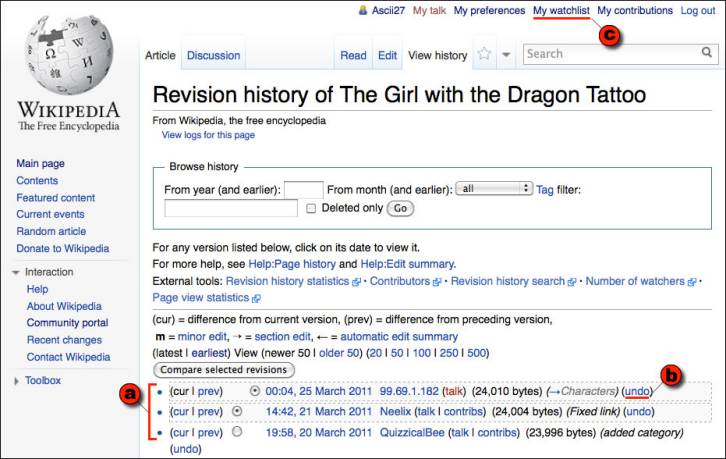
A Wikipedia revision history page. The revision history shows (a) a list of all changes made to an article, (b) provides a way to undo each change, and (c) enables those who care about an article to add it to a &ldquo;watchlist&rdquo; so changes to it can be watched.
Figure 4.6: A Wikipedia revision history page. The revision history shows (a) a list of all changes made to an article, (b) provides a way to undo each change, and (c) enables those who care about an article to add it to a “watchlist” so changes to it can be watched.

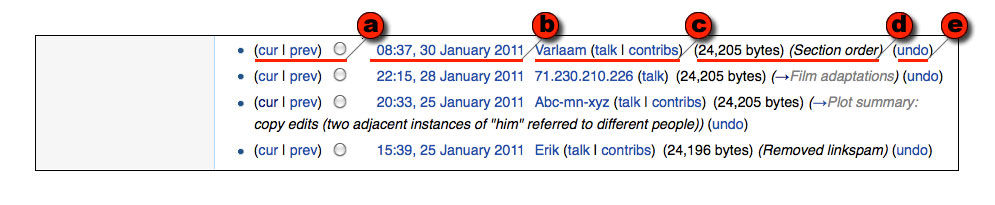
However, there is more to supporting quality than detecting and undoing vandalism. After all, vandalism is obviously a change for the worse. Much vandalism is trivial to detect. The more difficult issue is how to resolve subtler questions such as whether an explanation is clear or obscure. Or whether the reorganization of a paragraph improves it. Or whether a particular picture is helpful. Or whether a way of describing something departs from the neutrality desirable in an encyclopedia. To make decisions about these types of quality issues people need to communicate – and the revision history page lays the foundation for such communication. To see this, take a look at the section of the revision history shown in Figure 4.7.

A segment of a Wikipedia revision history showing four revisions. For each revision there is (a) a way of comparing to other revisions, (b) a time and date stamp, (c) links to the user who made the change, (d) information about the change, and (e) a way to undo the change.
Figure 4.7: A segment of a Wikipedia revision history showing four revisions. For each revision there is (a) a way of comparing to other revisions, (b) a time and date stamp, (c) links to the user who made the change, (d) information about the change, and (e) a way to undo the change.

The revision page contains a list of every change made to its article. Each entry in the list contains (a) a way to compare that change to other versions of the article, (b) the time and date of the change, (d) other information about the change), and (e) a way of undoing the change. Of particular interest for our purposes is that the entry also contains (c) information about who made the change. Specifically, the entry contains

  • the name or IP address of the person who made the revision
  • a link to that person’s talk page (which provides a way to communicate with them), and
  • a link to a list of contributions that person has made to Wikipedia (which provides a way to judge how experienced they are)

This expands the revision history into a social mechanism by introducing identity and communication channels. That is, rather than just seeing a change and deciding whether to revert it, the viewer can see who made the change, find out something about the user (via the link to their user page), their experience with Wikipedia (via the link to their contributions page), and even discuss their change with them (via the link to their talk page). Indeed, researchers have shown that the quality of Wikipedia articles is not simply related to the number of people who edit them, but that for this relationship to hold these contributors must also be engaging in communication and collaboration (Kittur & Kraut 2008, Wilkinson & Huberman 2007). For example, investigating the first entry in Figure 4.7, one can quickly discover that Varlaam is a highly experienced Wikipedia editor who has been awarded a “Master Editor” barnstar and has contributed to dozens (at least) of articles on books and films. Even if one disagreed with Varlaam’s change, one might hesitate to simply undo it, given the level of experience in evidence. The second entry is a different story – it has only an IP address associated with it, which means that this person has not registered with Wikipedia. Nevertheless, by clicking on the IP Address link, one can quickly see that the person at this IP address has been making regular contributions to Wikipedia over the last six months on a variety of articles related to films, and one can even take a look at individual contributions and see that this person has been a positive contributor.

4.5.3 Identity and Communication

The links in the revision history page illustrate another aspect of Wikipedia: it has a variety of mechanisms that support identity and communication. Every person who contributes to Wikipedia has a “user page,” a “contributions page,” and a “talk page.” The user page is like a home page, where a contributor can post whatever they like about themselves. Often this will include information that tells others about their experience and knowledge vis a vis topics they like to edit. This page is also where Wikipedia contributors display awards they’ve received from the Wikipedia community (Wikipedia has a custom of encouraging contributors to give symbolic awards – the best known example being a “barnstar” ­– to others who have helped on an article or project). In addition to the user page, there are two other automatically generated pages. The contribution page lists every change that that person has made to Wikipedia, and includes a “diff” link that shows precisely what changes the user has made. And the talk page supports conversation with that user. Both the talk and contribution pages have direct links from the entries in the revision history. In addition to user “talk pages,” there are also article “discussion pages” for discussions about the content of an article. For example, the discussion page for The Girl with the Dragon Tattoo has seven discussions, one on whether it is legitimate to characterize the protagonist as “incorruptible,” another about why the English title is so different from the original Swedish title, and yet another about whether to include a claim about an authorship dispute.

While all of these ways of finding out what people have done and talking with them might seem like a recipe for chaos, overall it appears to work. People do talk with one another, and their discussions tend to be about whether and how to change the content of the articles. For instance, more than half of the comments on talk pages are requests for coordination (Viégas et al 2007). And although argument is common, contributors often reach a rough consensus. What is interesting about this is not that people reach consensus, but rather how they reach agreement. Wikipedia has an extensive set of policies and guidelines that govern it (Figure 4.8a). For instance, one of Wikipedia’s fundamental principles is that articles should strive for a neutral point of view, and try to fairly represent all significant views that have been published by reliable sources. Another policy is verifiability – that is, that readers should be able to check that material in Wikipedia that is likely to be challenged must be attributed to a reliable source through an in-line citation.

What is important here, for the purposes of understanding social computing, is not the policies and guidelines themselves, but rather that policies and guidelines function to provide an infrastructure for discussion. Ideally, contributors who differ argue about whether something is in accord with the policies or not, rather than attacking one another. Or contributors discuss and evolve the policy itself. Just like Wikipedia articles, Wikipedia policies have their own pages with “Edit,” “Discussion,” and “View History” tabs, and, just like articles, policies and guidelines are extensively discussed and developed. Thus the article on the Neutral Point of View policy (Figure 4.8b) has seven sections that cover about 7 pages (4,300 words), and has been edited by over 1700 users over the decade it has been in existence; it has been viewed over 37,000 times in the last 30 days which, while not nearly as much as The Girl with the Dragon Tattoo, nevertheless indicates that it is an actively used resource. Both the use of policies to guide editing, and the collective evolution of policies by the community of users are discussed at length in the aptly named article, Don’t Look Now, But We’ve Created a Bureaucracy (Butler et al 2008).
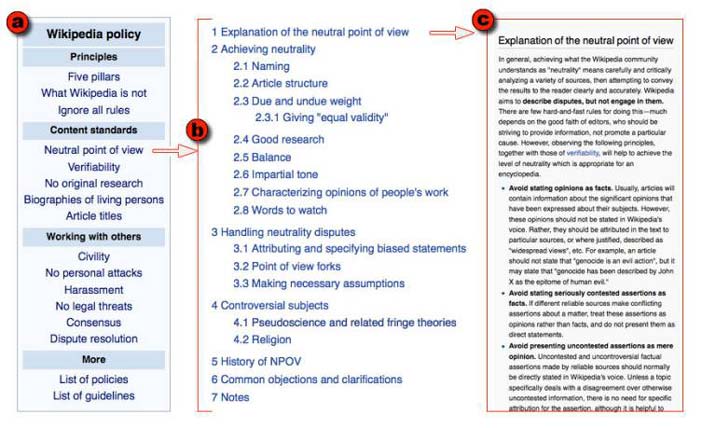
Wikipedia has a well-articulated set of guidelines and (a) policies, each of which is embodied as a Wikipedia article with (b) a detailed outline and (c) a thorough discussion, and which can be revised in the same way as ordinary articles.
Figure 4.8: Wikipedia has a well-articulated set of guidelines and (a) policies, each of which is embodied as a Wikipedia article with (b) a detailed outline and (c) a thorough discussion, and which can be revised in the same way as ordinary articles.

So what we’ve seen here is that although random people can and do click the edit tab and make changes on the spot, much of the work that happens in Wikipedia does not play out so simply. Mechanisms that support identity, communication, and the application of policies come together to enable a complex social process the guides the creation and development of high quality articles.

Given this, it is perhaps not surprising that there is a core of contributors, often referred to as Wikipedians, who are responsible for the majority of contributions. While there are various ways of defining what counts as a contribution, researchers agree that a small percentage of editors contribute the majority of content – for instance, the top 10% of contributors by number of edits provide between 80 and 90% of the viewed content (Priedhorsky et al 2007). More generally, Wikipedians do more work, make contributions that last longer (before someone else changes them), and invoke community norms to justify their edits more frequently (Panciera et al 2009). In sum, although Wikipedia “is the free encyclopedia that anyone can edit,” not just anyone tends to edit it, and there is much more to “editing” than meets the eye.

4.5.4 Summary

Wikipedia is a remarkable achievement. It is a self-governing system that produces well-structured articles – sometimes literally over night – that are sufficiently useful that it is among the most visited sites on the web. In our examination of Wikipedia we asked how it is that Wikipedia articles improve over time, noting that, for example, obvious problems like vandalism are repaired within two to three minutes. In what should by now be a recognizable motif, we saw that Wikipedia, as a system, ‘knows’ something about its content. Specifically, Wikipedia keeps track of every change ever made to every article, and it makes those individual changes visible and actionable on the revision history page of each article. Wikipedia (or, strictly speaking, the design of Wikipedia) recognizes that some changes are worth keeping, and others are not, and that by making it easy for users to view and pass judgment on those changes it can support the creation of increasingly higher quality articles. And because quality can be a subtle and contentious issue, Wikipedia provides ways for users to talk with one another about changes, and provides policies that guide users in making consistent decisions about those changes. In this we see the modus operandi of social computing: users add content, and the system processes that content in ways that make it more usable (in this case, by increasing the ability of people to discuss, evaluate and keep or undo changes in keeping with Wikipedia policy).

4.6 Social Computing: The big picture

Throughout this article we’ve looked at social computing in terms of how social computing systems work as systems: they create platforms for social interaction whose results can be drawn upon by the system to add value. This is natural because we have proceeded by looking closely at examples. However, I’d like to wrap this up by looking at social computing in a subtly different way – as a type of approach to computation.

In my view, social computing is not so much about computer systems that accommodate social activity, but rather it is about systems that perform computations on information that is embedded in a social context. That is:

Social computing refers to systems that support the gathering, processing and dissemination of information that is distributed across social collectives. Furthermore, the information in question is not independent of people, but rather is significant precisely because it linked to people, who are in turn associated with other people.

At the core of this definition is the linking of information to identity. That is, information is associated with people, and, for the purposes of social computing, the association of information with identity matters. “Identity” does not necessarily mean that information is associated with a particular, identifiable individual. For the purposes of social computing, identity can run the gamut from guaranteeing distinctiveness (i.e., that different pieces of information come from distinct individuals, as one would want in a plebiscite), to knowing some of the characteristics of each individual with whom information is associated (a set of book purchases by a distinct but anonymous individual), to knowing a person’s real world identity.

A second element of this definition is the idea that individuals are associated with one another in social collectives. Social collectives can be teams, communities, organizations, markets, cohorts, and so forth. That is, just as information is linked to a person, so are individuals associated with one another: it matters who is associated with whom, and how and why they are related. That is notto say that individuals are necessarily linked to one another in person to person relationships. Individuals may be mutual strangers, and “associated” only because they happen to share some characteristic like an interest in a particular book, or in MatLab programming.

In fact, in some cases, social computing systems are predicated on the assumption that individuals will be mutually anonymous. For example, markets and auctions attract participants with shared interests, but the underlying social computing mechanisms are designed to prevent individuals from identifying one another. A market functions most effectively when the actions of individuals are independent; otherwise, individuals can collude to affect the functioning of the market to benefit themselves, as when auctions are manipulated via shilling (false bids intended to raise the final price). In short, it is precisely because the linkage between information and individuals matters that, for the purposes of some social computations, it must be suppressed.

A third element of the definition is that social computing systems have mechanisms for managing information, identity, and their interrelationships. This follows from the mention of the gathering, use and dissemination of information distributed across social collectives. Whereas an ordinary computational system need only manage information and its processing, social computing systems must also manage the social collective, which is to say that it must provide a way for individuals to have in-system identities, relate information to those identities, and manage relationships among the identities (which, as noted, can include maintaining mutual anonymity, as in the case of markets). Social computing systems can take a number of approaches to this, and the sort of social architecture it employs fundamentally shapes the nature of the system.

4.7 What's next?

Social computing is a large area, and it is one that is growing rapidly. The examples we’ve looked at – Pagerank, the Amazon review mechanism, the MatLab Programming Contest, the ESP Game, and Wikipedia – just scratch the surface. New examples of social computing mechanisms and systems spring up seemingly over night.

This article has focused on ‘conventional’ examples of social computing. That is, they are web-based and largely draw on and appeal to educated audiences spread across the industrialized world. We are beginning to see, and will see many more, social computing systems that are designed expressly for mobile devices, that are targeted locally rather than globally, and that will include or be expressly targeted at populations in developing regions. These new domains, and the challenges they pose, will shape the further development of social computing.

Social computing is evolving with great rapidity. Designers and scholars from a wide range of disciplines – behavioral economics, computer science, game design, human-computer interaction, psychology, and sociology, to name a few – are actively studying social computing systems and applying insights gleaned from their disciplines. It is difficult to predict the future, but it seems safe to say that social computing mechanisms and systems will continue to transform the way we live, learn, work and play.

4.8 Where to learn more

The roots of social computing stretch back decades. A good starting point for those interested in the forerunners of social computing is Howard Rhinegold’s The Virtual Community (Rheingold 1993). For those interested in a deeper taste of history, Starr Roxanne Hiltz and Murray Turoff’s The Network Nation (Hiltz & Turoff 1993) – originally published in the late 70’s and revised in the early 90’s – offer an early yet comprehensive vision (portions of which still seem remarkably prescient) of forms of social intelligence and action mediated by computer networks.

For those interested the new wave of social computing systems that have been the focus of this article, the best place to begin are books that lay out the underlying rationale for social computing by showing what can be achieved by large scale collective action. The Wisdom of Crowds, by James Suroweicki (Suroweicki 2004), is an excellent introduction to a wide range of examples of social computation. Arriving in the same territory from a different direction is Eric von Hippel’s Democratizing Innovation (Hippel 2005), which examines how innovation arises from groups and communities and argues for redesigning business practices and government policies to take advantage of large scale innovation.

Those who wish a more detailed understanding of social computing systems as systems – how to design them, how to launch them, how to maintain them ­– are at the frontiers of knowledge. A variety of workshops and symposia focus on various ‘slices’ through social computing. Wikisym is a central place for research involving the use of wiki’s for collaboration, and the best place to plumb the growing pool of research on Wikipedia. The Human Computation workshop (Human Computation Workshop 2011), now in its third year, examines systems like the ESP game that engage large numbers of people in performing computations and other tasks. There is currently no annual conference that covers the full range of social computing systems, although perhaps that role will be filled by the Collective Intelligence conference to be inaugurated in 2012.

WikiSym - International Symposium on Wikis


4.9 Acknowledgements

Thanks to Robert Farrell for helpful comments on the penultimate draft of this article.

4.10 Notes

1. Amazon.com is a trademark of Amazon.com, Inc.; Google and Pagerank are trademarks of Google, Inc.; eBay is a trademark of eBay, Inc.; MatLab is a trademark of The Mathworks; Twitter is a trademark of Twitter, Inc.; Wikipedia is a registered trademark of the Wikimedia Foundation.


4.12 Commentary by Elizabeth Churchill

How to cite this commentary in your report

Picture of Elizabeth Churchill. Copyright unknown.
Elizabeth Churchill is a Principal Research Scientist and manager of the Internet Experiences group at Yahoo! Research. She previously worked at PARC, the Palo Alto Research Center, and before that at FXPAL, Fuji Xerox’s research lab based in Silicon Valley where she led the Social Computing Group. Elizabeth has a BSc in Experimental Psychology, an MSc in Knowledge Based Systems, both fr...   
Read more >> 

4.12.1 That was then, this is now and what's next - Tom Erickson talks about 'social computing'

IBM's Tom Erickson has been an active researcher in the field of social computing since its inception in the late 1990's. This set of interviews and his chapter that accompanies them is a lovely exposition on the research, design and development activities that make up social computing.

This discussion is well grounded in theory, in practice and in a rich set of analyses of existing systems. Tom offers his perspective on the coverage and concerns of the area of social computing with recourse to existing technologies: those that he has been directly engaged in designing and building (e.g., the Babble system developed and used at IBM [1]); systems that are based in research from university groups (e.g., the Grouplens Research group's fabulous example of collective, 'crowd' knowledge in the Cyclopath bike route finder [2]); and some everyday social resources and services that we all know and love (e.g., Amazon, Wikipedia, eBay).

Tom's exposition engages with all of my favourite "C words"— cooperation, collaboration, communication, conversation, competition, congregation, collective and what seems to be a relatively recently invented word 'coopetition' meaning cooperative competition. These words describe different forms of social organization and orientation for interaction with others. They define the ways in which social mechanisms and social skills are used in conducting ourselves with others to achieve personal and collective goals. Two more "C" words can be added to this collection and are discussed in essence — these are 'coercion' and 'conned'. Utopian perspectives focus on the co-development of social arrangements and the establishment of consent; the darker, dystopian perspective is that social skills and manipulative mechanisms may be used to drive non-consensual outcomes through coercion and/or through being "conned". As we are all aware, the truth about social computing systems is that they support the full panoply of human social engagement, from angelic to demonic. To illustrate how these different forms of social engagement are supported and enacted, Tom covers a number of social technologies, from low-social-touch systems that aggregate people's viewpoints in reviews and recommendations (such as the reviews and recommendations on a shopping site like Amazon) to sites where mediated interactions are richer but highly structured (such as auction sites like eBay) to high-social-touch, relatively technologically unstructured and conversational online places that support text chat (e.g., chat spaces and instant messenger), and avatar-embodied interactions in online virtual world settings like (e.g., Second Life). One could of course add inmediated, embodied audio/video interactions (e.g., Chatroulette).

As Tom speaks about the area of social computing, we are reminded that the word "social" is a tricky adjective. As I have written about elsewhere, the term can mean many different things to different people [1]. Wisely, Tom is careful to define what he means when he says 'social computing' — he defines social computing to be any situation in which people are involved in the computation. With recommendations on sites like Amazon these computations are often made without people's active involvement in the computation of the recommendation whereas in distributed collaboration and expertise sharing settings (like Slashdot for example), people may be actively collaborating. In articulating his definition of 'social computing', Tom distinguishes between social media and social computing — in social media no explicit computation is taking place. However, I would argue that many of the more general observations he makes are as appropriate for social media systems as they are for social computing systems.

In discussing the design of social computing technologies, considerable weight is given, as it should be, to the design and development process itself. Tom's favored approach is to observe human sociality as it takes place in face-to-face, embodied settings and to draw analogies to what occurs and/or could be effectively replicated in the online world. This also requires that we get off our sofas and out of our offices and open our eyes to how social interactions take place beyond our own well worn-paths, away from our familiar settings. Through illustrative examples Tom reminds us that in designing, it is easy to become myopic, to forget that the world is not necessarily configured for everyone the way it is for us. Tom's design sensibilities, in this regard, are close to those of participatory design [5]. Personally, I am deeply sympathetic to the 'get-off-your-sofa approach to design and to evaluation, and strongly believe that design/develop, launch, watch, ask, iterate and repeat (a.k.a. DELAWAIR) with an open mind are the keys to successful design in social computing. Premature design commitments and ossified interaction/infrastructures usually lead to short-lived social systems. Indeed, Tom makes clear that his development sensibilities tend to the building of mutable tools that are tested early, iteratively designed and that can be appropriated by users to their own ends — which, notably, may have nothing in common with the original design intentions.

The idea of conducting field investigations that open our eyes to differences in ways of thinking and different norms for social action is not new, but it is easy to forget to look out for how our technologies are being adopted, adapted and indeed appropriated. Tom reminds us to move beyond simple characterizations of other perspectives and to field our technologies with a view to being surprised. Indeed, he suggests if we are not surprised, perhaps we are not designing well enough. The humility of this approach is very appealing to me.

There's a lot of rich detail in this chapter and these wonderful video interviews, too much to do justice to in a short commentary. My mind is a whirl with ideas and thoughts and reactions and inspirations. Therefore, I will pick up on a couple of areas of design in social computing are mentioned and that are ripe for further investigation, especially for those with critical HCI tendencies, inclusive intentions and experience design leanings. These are not new areas per se but the world is changing. Many of us started our careers in social computing looking at the use of such technologies within fairly prescribed social groups and organizations —designing for people who were already grouped in some way, who worked within an organization or who already had a strong sense of homophily or like-mindedness. However, the world is changing and just being there, on the site, is no longer a guarantee of homophily. Nor are there, necessarily, societal or organizational macro structures governing or shaping adoption and use. We are living in a world of increasingly powerful consumer technologies, an increase in global telecommunications networks, and, as a result, expanding access to applications that enable connections with known and unknown others. There are enormous social, political and economic ramifications of these changes of course [e.g. for excellent reading on these broader implications 6, 7, 8]. However, for the purposes of this commentary, there are a couple of areas of interest that remain close to the experiences of individuals but which deserve more research investigation for how sociality and social computing are changing (or not); we may also consider in this how upcoming technological innovations will change the field of social computing experience itself. A couple of my favourite areas that Tom alludes to are: (1) emotion, (2) embodiment, (3) literacy and access, construed in the broadest sense, and finally, (4) data and instrumentation. I'll quickly talk about each in turn.

4.12.2 Emotion

We know that the connections people make with others through these systems are not just useful and transactional but also emotional; consider the 'high' of 'winning' an auction, the emotional roller-coaster of being on a dating site, the thrill of seeing a comment on a photo one has posted, the warmth one feels when a loved one sends a message through Facebook, the satisfaction one gets in seeing one's points go up in Slashdot because of one's recognized expertise and the sense of anger, fear and bewilderment when one is betrayed, assaulted or abused online. Happiness, sadness, anger are all present in our interactions in social computing systems. Emotions are not just in-the-moment and ephemeral; emotions in the now matter for my actions in the future. Emotions underlie action and abdication; emotions foster avoidance or participation. Emotions orient us toward places and spaces where we feel good, and propel us away from places where we feel violated. Like pleasures, violations can come in many forms: threatened by the service providers (what are you doing with my data?); threatened by others on the site (why are you so obnoxious to me?) and by the tenor of the site itself (goodness, this is in poor taste). There are also cultural differences that need to be taken account of; anthropologists talk of differing emotional styles, and discuss norms of emotional response—how, when and where emotions like joy, anger, pride, shame, embarrassment are expressed. Emotions are important. They matter for individual and social computation. We know emotions drive participation or avoidance, but they also underlie cognition. António Damásio argues convincingly that emotions are involved in decision-making and are the basis for social cognition. Indeed he claims they are the cornerstone of consciousness. [9] How can we understand the ways in which social computing technologies are altering our emotional landscape? In turn, how is social computing shaped by the kinds of emotions that are expressed onsite and/or (in)expressible through the technologies themselves? What. If any, issues arise from cultural differences in the expression of human emotion? What are the effects of individual and collective emotion on collective cognition?

4.12.3 Embodiment

Many of Tom's examples relate the conduct of people in physical places. Urban spaces, as he points out, are changing with the introduction of embedded sensors, within which category I include the proliferation of surveillance monitors. Embodied social computing and social computing of space and place are necessarily locative. The social computation in and of urban, social spaces is changing as we check-in to location-based social networking sites and track others individually and in the aggregate. Certainly, researchers interested in 'reality mining' are already tracking us, and applications allow us to easily see what are the most popular, most trafficked parts of town, places for us to avoid or navigate to, as we see fit. Perhaps the Cyclopath Geowiki project is a good example of how social computation is altering human ambulation through physical places as a result of the introduction of new forms of intentionally submitted and tacitly collected data. More mundanely, our behaviours in urban spaces with respect to each other are changing as we engage through our devices with others who are not physical present. Who has not collided with someone whose eyes and ears were directed firmly at a communication device as they walked blithely and ignorantly forward? Do these changes in the navigation of physical and social space and place have implications for social computation?

4.12.4 Literacy and access

Tom makes a nice point about symmetry and asymetries in social computing. Who does and does not have access and through what tools can create barriers to social participation. Literacy and access is central to the inclusive project of social computing. But exclusion is not simply a problem because it is a matter of not taking active part. Those who are not active are also not represented in models of sociality that are based on data from networked systems; the early intentions of anthropologists interested in human social networks was to understand human relationships, not just those that were easily available in accessible data sets [see 4]. This brings me to my final point of interest, again something to which Tom's analyses point us.

4.12.5 Data analytics

As social scientists, designers, developers and business people we are very keen on measurement, on metrics for success and instrumented systems through which we can interrogate social activities and develop patterns on the basis of which we make claims about the fundamentals of human sociality. When social computing systems were only used in small groups in work contexts, the methods we used to triangulate our understanding were plentiful even if they were not as easily proceduralized as systematized datamining. Usage data analysis was combined with survey and/or interviews and/or an observational study. However, with the use of social computing technologies on a large scale—on the scales of hundreds of thousands and millions to many millions of people—scale bites us. It's the seduction of large numbers and the delight of aggregates. We seem to have lost the art of designing effective instrumentation in the large to satisfy the rigors of good science and build meaningful models of systems-in-use. Typically, with the exception of a few exemplar systems, we are not instrumenting for experience analytics. 'Big data' may be everyone's favourite fetish right now, but we need to more deeply understand how a sample is drawn, how many populations are represented on a social computing platform, from what population it derives, and the extent to which that population is representative of what and who we care about. If we can't understand such basic questions, we have a seductive substrate for description and the fodder for hyperbolic claims. But it is not clear to me we really understand much more about human sociality that I could not have told you with a peek at Maslow's hierarchy of needs [10].

Looking at this more positively, we are in a world of amazing opportunity. From a science, design, development, statistics and business of social computing perspective, we live in exciting times. That said, Tom touches on ethics throughout his contributions. His comments remind us that, in the surging world of Internet scale social computing in the midst of big numbers and exciting technological capabilities, it behooves us to look to the people who are using our technologies, to how they compute collectively with and through our tools, and to how our computations of their activities reflect them.

4.12.6 Citations/references

  • [1] Erickson, T., Smith, D. N., Kellogg, W. A., Laff, M. R., Richards, J. T., and Bradner, E. "Socially Translucent Systems: Social Proxies, Persistent Conversation, and the Design of 'Babble.'" In Human Factors in Computing Systems: The Proceedings of CHI '99. ACM Press, 1999.
  • [2] For more on the Cyclopath Geowiki project from the Grouplens Research group in Minnesota see cyclopath.org
  • [3] Elizabeth F. Churchill| Socializing at Cross Purposes, interactions, Volume 17 Issue 1, 2010. New York: ACM Press
  • [4] Elizabeth F. Churchill The (Anti) Social Net, interactions, Volume 17, Issue 5. 2010/ New York: ACM Press
  • [5] Břdker, K., Kensing, F., and Simonsen, J. (2004). Participatory IT design: Designing for business and workplace realities. Cambridge, MA, USA: MIT Press.
  • [6] Manuel Castells, The Information Age trilogy: Castells, Manuel (1996, second edition, 2000). The Rise of the Network Society, The Information Age: Economy, Society and Culture Vol. I. Cambridge, MA; Oxford, UK: Blackwell. ISBN 978-0631221401.Castells, Manuel (1997, second edition, 2004). The Power of Identity, The Information Age: Economy, Society and Culture Vol. II. Cambridge, MA; Oxford, UK: Blackwell. ISBN 978-1405107136. and Castells, Manuel (1998, second edition, 2000). End of Millennium, The Information Age: Economy, Society and Culture Vol. III. Cambridge, MA; Oxford, UK: Blackwell. ISBN 978-0631221395.
  • [7] Manuel Castells, Communication Power, Oxford University Press, 2009
  • [8] Jochai Benkler, The Penguin and the Leviathan: How Cooperation Triumphs over Self-Interest. New York: Random House, 2011
  • [9] António DamásioDescartes' Error: Emotion, Reason, and the Human Brain, Putnam, 1994; revised Penguin edition, 2005
  • [10] A.H. Maslow, A Theory of Human Motivation, Psychological Review 50(4) (1943):370-96.


4.13 Commentary by David W. McDonald

How to cite this commentary in your report

Picture of David W. McDonald. © David W. McDonald
David W. McDonald is Associate Professor at the University of Washington. He has an MS (1992) in Computer Science, California State University Hayward; and an MS (1995) and PhD (2000) in Information and Computer Science. His research interests include Computer-supported cooperative work (CSCW), human-computer interaction (HCI), collaborative systems design, software architecture, softwar...   
Read more >> 
Commentary coming soon. David is almost done. Please stay tuned.


4.14 Commentary by Andrea Forte

How to cite this commentary in your report

Picture of Andrea Forte. © Andrea Forte
I'm an assistant professor in the iSchool (College of Information Science and Technology) at Drexel University in Philadelphia. I received my PhD from the College of Computing at Georgia Institute of Technology in human-centered computing with a focus on social computing and learning sciences. My MLIS is from the School of Information at University of Texas at Austin. I'm intereste...   
Read more >> 

It is hard to imagine a topic that exposes the power of good design with more salience than social computing. Creating systems in which people debate, teach, hate, play, bully and love one another is a phenomenal line of work.

Central to social computing is the idea that traces of computationally mediated activities can be exposed to users to help them make choices about how to behave. Furthermore, these traces can be aggregated or otherwise computationally manipulated and fed back into socio-technical systems to form a feedback loop. But what kinds of information should be surfaced? How can it be usefully manipulated? And what kind of influence will that information have on people’s behavior? These questions are the bread and butter of social computing design and research.

Tom Erickson begins this chapter with a simple but powerful statement, “As humans we are fundamentally social creatures.” He goes on to describe the seemingly effortless ways that average people use and create social information in their everyday lives. He talks about the challenge of designing to support interaction by reproducing or compensating for the lack of cues from the physical world. One particularly memorable proposition is that computational systems must support deception in order to support socially graceful interaction among humans.

But, in order to lie, you have to know how.

The “natural” ways that humans convey emotion through demeanor, construct identities by selecting words and dress, and reassure each other through feigned attention and other “little white lies” are skills we learn and refine throughout our lives. These social skills require different knowledge and skills in a computationally mediated world.

An example. On the social music site Last.fm, members may publish their music libraries and playlists and a log of all the music they listen to, updated in real time. To project the image of a Lady Gaga fan on Last.fm, it is not sufficient to simply state that one listens to Lady Gaga, one must actually listen to her so the software can record that activity and expose it. Others can observe the record of your listening experiences and use it as a recommendation of what to listen to (or avoid). In order to project a desired image, fans have been known to manipulate tracks so that they appear to play several times in a minute, artificially boosting their personal playcount of newly released or beloved songs and artists and influencing sitewide statistics. To do so requires proficiency with digital audio.

Computational deception requires computational literacies.

One might argue that the best designs will prove to be intuitive as users perceive and respond to social cues that map closely to their face-to-face analogs. But beyond the enticing design problems raised by the challenge of enabling humans to engage with one another “naturally” in mediated environments, there is the question of what kinds of things people might do in mediated environments that they were never able to do before. What kinds of new behaviors might socio-computational systems exhibit? What new manifestations of power might people—users and designers alike—wield over one another? And what new competencies will these new possibilities require of people?

Tom Erickson builds a compelling vision of new possibilities for mediated social interaction on a simple foundation: Humans are fundamentally social. We depend on social information to carry out the simplest tasks. We generate social information as a byproduct of every activity we carry out. What to do with that information is one of the most enticing, meaningful and complex design problems of the coming decades.


4.11 Behind the scenes

Interviewing Tom Erickson. ...

Interviewing Tom Erickson. ...

Interviewing Tom Erickson. ...

Interviewing Tom Erickson. ...

Adjusting the audio of the different scenes and denoising. ...

Editing the video. Co...


4.15 User-contributed notes

Give us your opinion! Do you have any comments/additions
that you would like other visitors to see?

 
comment You (your email) say: May 7th, 2012
#1
Add a thoughtful commentary or note to this page ! 

your homepage, facebook profile, twitter, or the like
will be spam-protected
How many?
= e.g. "6"
By submitting you agree to the Site Terms
 

4.16 References

 what's this?

Ahn, Luis von and Dabbish, Laura (2004): Labeling images with a computer game. In: Dykstra-Erickson, Elizabeth and Tscheligi, Manfred (eds.) Proceedings of ACM CHI 2004 Conference on Human Factors in Computing Systems April 24-29, 2004, Vienna, Austria. pp. 319-326

We introduce a new interactive system: a game that is fun and can be used to create valuable output. When people play the game they help determine the contents of images by providing meaningful labels for them. If the game is played as much as popular online games, we estimate that most images on the Web can be labeled in a few months. Having proper labels associated with each image on the Web would allow for more accurate image search, improve the accessibility of sites (by providing descriptions of images to visually impaired individuals), and help users block inappropriate images. Our system makes a significant contribution because of its valuable output and because of the way it addresses the image-labeling problem. Rather than using computer vision techniques, which don't work well enough, we encourage people to do the work by taking advantage of their desire to be entertained.

© All rights reserved Ahn and Dabbish and/or ACM Press

Ahn, Luis von and Dabbish, Laura (2008): Designing games with a purpose. In Communications of the ACM, 51 (8) pp. 58-67

Data generated as a side effect of game play also solves computational problems and trains AI algorithms.

© All rights reserved Ahn and Dabbish and/or ACM Press

Butler, Brian, Joyce, Elisabeth and Pike, Jacqueline (2008): Don't look now, but we've created a bureaucracy: the nature and roles of policies and rules in wikipedia. In: Proceedings of ACM CHI 2008 Conference on Human Factors in Computing Systems April 5-10, 2008. pp. 1101-1110

Wikis are sites that support the development of emergent, collective infrastructures that are highly flexible and open, suggesting that the systems that use them will be egalitarian, free, and unstructured. Yet it is apparent that the flexible infrastructure of wikis allows the development and deployment of a wide range of structures. However, we find that the policies in Wikipedia and the systems and mechanisms that operate around them are multi-faceted. In this descriptive study, we draw on prior work on rules and policies in organizations to propose and apply a conceptual framework for understanding the natures and roles of policies in wikis. We conclude that wikis are capable of supporting a broader range of structures and activities than other collaborative platforms. Wikis allow for and, in fact, facilitate the creation of policies that serve a wide variety of functions.

© All rights reserved Butler et al. and/or ACM Press

Erickson, Thomas (1996): The world wide web as social hypertext. In Communications of the ACM, 31 (1) pp. 15-17

Giles, Jim (2005): Internet encyclopaedias go head to head. In Nature, 438 pp. 900-901

Guardian, The (2011). Investigate Your MP's Expenses. Retrieved 19 June 2011 from The Guardian - guardian.co.uk:

Gulley, Ned (2004): In praise of tweaking: a wiki-like programming contest. In Interactions, 11 (3) pp. 18-23

Hiltz, Starr Roxanne and Turoff, Murray (1993): The Network Nation: Human Communication via Computer. MIT Press

A visionary book when it was first published in the late 1970s, The Network Nation has become the defining document and standard reference for the field of computer mediated communication (CMC). This revised edition adds a substantial new chapter on "superconnectivity" (invented and defined in the unabridged edition of the Online Dictionary of the English Language, 2067) that reviews the developments of the last fifteen years and updates the authors' speculations about the future.Hiltz and Turoff highlight major current organizational, educational, and public applications of CMC, integrate their theoretical understanding of the impact of CMC technology, address ethical and legal issues, and describe a scenario in 2084. They have also added a selected bibliography on the key literature.Starr Roxanne Hiltz and Murray Turoff each hold the position of Professor of Computer and Information Sciences at the New Jersey Institute of Technology. They are also members of the faculty of the Graduate School of Business at Rutgers University, Newark.

© All rights reserved Hiltz and Turoff and/or MIT Press


Hippel, Eric von (2005): Democratizing Innovation. The MIT Press

Innovation is rapidly becoming democratized. Users, aided by improvements in computer and communications technology, increasingly can develop their own new products and services. These innovating users—both individuals and firms—often freely share their innovations with others, creating user-innovation communities and a rich intellectual commons. In Democratizing Innovation, Eric von Hippel looks closely at this emerging system of user-centered innovation. He explains why and when users find it profitable to develop new products and services for themselves, and why it often pays users to reveal their innovations freely for the use of all. The trend toward democratized innovation can be seen in software and information products—most notably in the free and open-source software movement—but also in physical products. Von Hippel's many examples of user innovation in action range from surgical equipment to surfboards to software security features. He shows that product and service development is concentrated among "lead users," who are ahead on marketplace trends and whose innovations are often commercially attractive. Von Hippel argues that manufacturers should redesign their innovation processes and that they should systematically seek out innovations developed by users. He points to businesses—the custom semiconductor industry is one example—that have learned to assist user-innovators by providing them with toolkits for developing new products. User innovation has a positive impact on social welfare, and von Hippel proposes that government policies, including R&D subsidies and tax credits, should be realigned to eliminate biases against it. The goal of a democratized user-centered innovation system, says von Hippel, is well worth striving for. An electronic version of this book is available under a Creative Commons license.

© All rights reserved Hippel and/or The MIT Press


Human Computation Workshop (2011). The Human Computation Workshop. Retrieved 22 July 2011 from Human Computation Workshop: http://www.humancomputation.com/

Kittur, Aniket and Kraut, Robert E. (2008): Harnessing the wisdom of crowds in wikipedia: quality through coordination. In: Proceedings of ACM CSCW08 Conference on Computer-Supported Cooperative Work 2008. pp. 37-46

Wikipedia's success is often attributed to the large numbers of contributors who improve the accuracy, completeness and clarity of articles while reducing bias. However, because of the coordination needed to write an article collaboratively, adding contributors is costly. We examined how the number of editors in Wikipedia and the coordination methods they use affect article quality. We distinguish between explicit coordination, in which editors plan the article through communication, and implicit coordination, in which a subset of editors structure the work by doing the majority of it. Adding more editors to an article improved article quality only when they used appropriate coordination techniques and was harmful when they did not. Implicit coordination through concentrating the work was more helpful when many editors contributed, but explicit coordination through communication was not. Both types of coordination improved quality more when an article was in a formative stage. These results demonstrate the critical importance of coordination in effectively harnessing the "wisdom of the crowd" in online production environments.

© All rights reserved Kittur and Kraut and/or ACM Press

Kittur, Aniket, Suh, Bongwon, Pendleton, Bryan A. and Chi, Ed H. (2007): He says, she says: conflict and coordination in Wikipedia. In: Proceedings of ACM CHI 2007 Conference on Human Factors in Computing Systems 2007. pp. 453-462

Wikipedia, a wiki-based encyclopedia, has become one of the most successful experiments in collaborative knowledge building on the Internet. As Wikipedia continues to grow, the potential for conflict and the need for coordination increase as well. This article examines the growth of such non-direct work and describes the development of tools to characterize conflict and coordination costs in Wikipedia. The results may inform the design of new collaborative knowledge systems.

© All rights reserved Kittur et al. and/or ACM Press

Licklider, J. C. R. and Taylor, Robert W. (1968): The Computer as a Communication Device. In Science and Technology, pp. 21-31

MatLab Central (2010). MatLab Central: MatLab Programming Contest. Retrieved 19 June 2010 from MatLab Central: http://www.mathworks.com/matlabcentral/contest/

MatLab Central (2011). MatLab Central: Molecule Contest Analysis. Retrieved 19 June 2011 from MatLab Central:

Panciera, Katherine, Halfaker, Aaron and Terveen, Loren (2009): Wikipedians are born, not made: a study of power editors on Wikipedia. In: GROUP09 - International Conference on Supporting Group Work 2009. pp. 51-60

Open content web sites depend on users to produce information of value. Wikipedia is the largest and most well-known such site. Previous work has shown that a small fraction of editors -- Wikipedians -- do most of the work and produce most of the value. Other work has offered conjectures about how Wikipedians differ from other editors and how Wikipedians change over time. We quantify and test these conjectures. Our key findings include: Wikipedians' edits last longer; Wikipedians invoke community norms more often to justify their edits; on many dimensions of activity, Wikipedians start intensely, tail off a little, then maintain a relatively high level of activity over the course of their career. Finally, we show that the amount of work done by Wikipedians and non-Wikipedians differs significantly from their very first day. Our results suggest a design opportunity: customizing the initial user experience to improve retention and channel new users' intense energy.

© All rights reserved Panciera et al. and/or their publisher

Priedhorsky, Reid, Chen, Jilin, Lam, Shyong (Tony) K., Panciera, Katherine, Terveen, Loren and Riedl, John (2007): Creating, destroying, and restoring value in wikipedia. In: GROUP07: International Conference on Supporting Group Work 2007. pp. 259-268

Wikipedia's brilliance and curse is that any user can edit any of the encyclopedia entries. We introduce the notion of the impact of an edit, measured by the number of times the edited version is viewed. Using several datasets, including recent logs of all article views, we show that an overwhelming majority of the viewed words were written by frequent editors and that this majority is increasing. Similarly, using the same impact measure, we show that the probability of a typical article view being damaged is small but increasing, and we present empirically grounded classes of damage. Finally, we make policy recommendations for Wikipedia and other wikis in light of these findings.

© All rights reserved Priedhorsky et al. and/or ACM Press

Raddick, M. Jordan, Bracey, Georgia, Gay, Pamela L., Lintott, Chris J., Murray, Phil, Schawinski, Kevin, Szalay, Alexander S. and vandenBerg, Jan (2010): Galaxy Zoo: Exploring the Motivations of Citizen Science Volunteers. In Astronomy Education Review, 9 (1)

The Galaxy Zoo citizen science website invites anyone with an Internet connection to participate in research by classifying galaxies from the Sloan Digital Sky Survey. As of April 2009, more than 200,000 volunteers have made more than 100 million galaxy classifications. In this article, we present results of a pilot study into the motivations and demographics of Galaxy Zoo volunteers and define a technique to determine motivations from free responses that can be used in larger multiple-choice surveys with similar populations. Our categories form the basis for a future survey, with the goal of determining the prevalence of each motivation.

© All rights reserved Raddick et al. and/or The American Astronomical Society

Ramo, Simon (1961): The Scientific Extension of the Human Intellect. In Computers and Automation, 10 (2) pp. 9-12

Rheingold, Howard (1993): The Virtual Community: Homesteading on the Electronic Frontier. Reading, MA, The MIT Press

Howard Rheingold has been called the First Citizen of the Internet. In this book he tours the "virtual community" of online networking. He describes a community that is as real and as much a mixed bag as any physical community -- one where people talk, argue, seek information, organize politically, fall in love, and dupe others. At the same time that he tells moving stories about people who have received online emotional support during devastating illnesses, he acknowledges a darker side to people's behavior in cyberspace. Indeed, contends Rheingold, people relate to each other online much the same as they do in physical communities.Originally published in 1993, The Virtual Community is more timely than ever. This edition contains a new chapter, in which the author revisits his ideas about online social communication now that so much more of the world's population is wired. It also contains an extended bibliography.

© All rights reserved Rheingold and/or The MIT Press


Surowiecki, James (2004): The Wisdom of Crowds. Anchor

In this fascinating book, New Yorker business columnist James Surowiecki explores a deceptively simple idea: Large groups of people are smarter than an elite few, no matter how brilliant–better at solving problems, fostering innovation, coming to wise decisions, even predicting the future. With boundless erudition and in delightfully clear prose, Surowiecki ranges across fields as diverse as popular culture, psychology, ant biology, behavioral economics, artificial intelligence, military history, and politics to show how this simple idea offers important lessons for how we live our lives, select our leaders, run our companies, and think about our world.

© All rights reserved Surowiecki and/or Anchor


Viégas, Fernanda B., Wattenberg, Martin and Dave, Kushal (2004): Studying cooperation and conflict between authors with history flow visualizations. In: Dykstra-Erickson, Elizabeth and Tscheligi, Manfred (eds.) Proceedings of ACM CHI 2004 Conference on Human Factors in Computing Systems April 24-29, 2004, Vienna, Austria. pp. 575-582

The Internet has fostered an unconventional and powerful style of collaboration: "wiki" web sites, where every visitor has the power to become an editor. In this paper we investigate the dynamics of Wikipedia, a prominent, thriving wiki. We make three contributions. First, we introduce a new exploratory data analysis tool, the history flow visualization, which is effective in revealing patterns within the wiki context and which we believe will be useful in other collaborative situations as well. Second, we discuss several collaboration patterns highlighted by this visualization tool and corroborate them with statistical analysis. Third, we discuss the implications of these patterns for the design and governance of online collaborative social spaces. We focus on the relevance of authorship, the value of community surveillance in ameliorating antisocial behavior, and how authors with competing perspectives negotiate their differences.

© All rights reserved Viégas et al. and/or ACM Press

Wilkinson, Dennis M. and Huberman, Bernardo A. (2007): Cooperation and quality in wikipedia. In: Proceedings of the 2007 International Symposium on Wikis 2007. pp. 157-164

The rise of the Internet has enabled collaboration and cooperation on an unprecedentedly large scale. The online encyclopedia Wikipedia, which presently comprises 7.2 million articles created by 7.04 million distinct editors, provides a consummate example. We examined all 50 million edits made to the 1.5 million English-language Wikipedia articles and found that the high-quality articles are distinguished by a marked increase in number of edits, number of editors, and intensity of cooperative behavior, as compared to other articles of similar visibility and age. This is significant because in other domains, fruitful cooperation has proven to be difficult to sustain as the size of the collaboration increases. Furthermore, in spite of the vagaries of human behavior, we show that Wikipedia articles accrete edits according to a simple stochastic mechanism in which edits beget edits. Topics of high interest or relevance are thus naturally brought to the forefront of quality.

© All rights reserved Wilkinson and Huberman and/or ACM Press

Woolley, David R. (1994). PLATO: The emergence of online community. Retrieved 19 June 2011 from http://thinkofit.com/plato/dwplato.htm

Zoo, Galaxy (2011). Galaxyzoo.org. Retrieved 19 June 2011 from Galaxy Zoo:

Changes to this chapter

15 Nov 2011: Modified
12 Nov 2011: Added
11 Nov 2011: General site news
08 Nov 2011: Modified
03 Nov 2011: Modified

About this chapter

Author(s): Thomas Erickson
Commentaries by: Elizabeth Churchill, David W. McDonald and Andrea Forte
This encyclopedia chapter has undergone double-blinded peer-review by two reviewers based on the reviewing guidelines, language copy-editing, typesetting, and reference validation.

How to cite/reference this page
URL: http://www.interaction-design.org/encyclopedia/social_computing.html

Licensed through a Creative Commons licence Open Access

We believe in Open Access and the democratization of knowledge. Unfortunately, world class educational materials are normally hidden behind payment systems or in expensive textbooks. If you want this to change, you should help us out! Kind thoughts are not enough - you need to act!
Copyright Terms
We do NOT use copyright as a restrictive instrument, but as an instrument to protect the author against misuse while encouraging redistribution and use of his/her work. As such, these copyright terms are designed for the author and the reader, not the publisher and the profit.

Except as otherwise noted, this page/work is copyright of Thomas Erickson and The Interaction-Design.org Foundation (Chr. Molbechs Vej 4, DK-8000 Aarhus C, Denmark) and is licensed under the following terms:
  1. The Creative Commons Attribution-NoDerivs Licence
  2. The Interaction-Design.org Addendum to the Creative Commons licence

...with the exception of materials described in...:

  1. "Exceptions"

Furthermore, your use of Interaction-Design.org signifies your consent to:

  1. the "Site Terms and Conditions"
i. Creative Commons Attribution-NoDerivs 3.0 Unported

The Creative Commons Attribution-NoDerivs 3.0 Unported License

THE WORK (AS DEFINED BELOW) IS PROVIDED UNDER THE TERMS OF THIS CREATIVE COMMONS PUBLIC LICENSE ("CCPL" OR "LICENSE"). THE WORK IS PROTECTED BY COPYRIGHT AND/OR OTHER APPLICABLE LAW. ANY USE OF THE WORK OTHER THAN AS AUTHORIZED UNDER THIS LICENSE OR COPYRIGHT LAW IS PROHIBITED.

BY EXERCISING ANY RIGHTS TO THE WORK PROVIDED HERE, YOU ACCEPT AND AGREE TO BE BOUND BY THE TERMS OF THIS LICENSE. TO THE EXTENT THIS LICENSE MAY BE CONSIDERED TO BE A CONTRACT, THE LICENSOR GRANTS YOU THE RIGHTS CONTAINED HERE IN CONSIDERATION OF YOUR ACCEPTANCE OF SUCH TERMS AND CONDITIONS.

1. Definitions

  1. "Adaptation" means a work based upon the Work, or upon the Work and other pre-existing works, such as a translation, adaptation, derivative work, arrangement of music or other alterations of a literary or artistic work, or phonogram or performance and includes cinematographic adaptations or any other form in which the Work may be recast, transformed, or adapted including in any form recognizably derived from the original, except that a work that constitutes a Collection will not be considered an Adaptation for the purpose of this License. For the avoidance of doubt, where the Work is a musical work, performance or phonogram, the synchronization of the Work in timed-relation with a moving image ("synching") will be considered an Adaptation for the purpose of this License.
  2. "Collection" means a collection of literary or artistic works, such as encyclopedias and anthologies, or performances, phonograms or broadcasts, or other works or subject matter other than works listed in Section 1(f) below, which, by reason of the selection and arrangement of their contents, constitute intellectual creations, in which the Work is included in its entirety in unmodified form along with one or more other contributions, each constituting separate and independent works in themselves, which together are assembled into a collective whole. A work that constitutes a Collection will not be considered an Adaptation (as defined above) for the purposes of this License.
  3. "Distribute" means to make available to the public the original and copies of the Work through sale or other transfer of ownership.
  4. "Licensor" means the individual, individuals, entity or entities that offer(s) the Work under the terms of this License.
  5. "Original Author" means, in the case of a literary or artistic work, the individual, individuals, entity or entities who created the Work or if no individual or entity can be identified, the publisher; and in addition (i) in the case of a performance the actors, singers, musicians, dancers, and other persons who act, sing, deliver, declaim, play in, interpret or otherwise perform literary or artistic works or expressions of folklore; (ii) in the case of a phonogram the producer being the person or legal entity who first fixes the sounds of a performance or other sounds; and, (iii) in the case of broadcasts, the organization that transmits the broadcast.
  6. "Work" means the literary and/or artistic work offered under the terms of this License including without limitation any production in the literary, scientific and artistic domain, whatever may be the mode or form of its expression including digital form, such as a book, pamphlet and other writing; a lecture, address, sermon or other work of the same nature; a dramatic or dramatico-musical work; a choreographic work or entertainment in dumb show; a musical composition with or without words; a cinematographic work to which are assimilated works expressed by a process analogous to cinematography; a work of drawing, painting, architecture, sculpture, engraving or lithography; a photographic work to which are assimilated works expressed by a process analogous to photography; a work of applied art; an illustration, map, plan, sketch or three-dimensional work relative to geography, topography, architecture or science; a performance; a broadcast; a phonogram; a compilation of data to the extent it is protected as a copyrightable work; or a work performed by a variety or circus performer to the extent it is not otherwise considered a literary or artistic work.
  7. "You" means an individual or entity exercising rights under this License who has not previously violated the terms of this License with respect to the Work, or who has received express permission from the Licensor to exercise rights under this License despite a previous violation.
  8. "Publicly Perform" means to perform public recitations of the Work and to communicate to the public those public recitations, by any means or process, including by wire or wireless means or public digital performances; to make available to the public Works in such a way that members of the public may access these Works from a place and at a place individually chosen by them; to perform the Work to the public by any means or process and the communication to the public of the performances of the Work, including by public digital performance; to broadcast and rebroadcast the Work by any means including signs, sounds or images.
  9. "Reproduce" means to make copies of the Work by any means including without limitation by sound or visual recordings and the right of fixation and reproducing fixations of the Work, including storage of a protected performance or phonogram in digital form or other electronic medium.

2. Fair Dealing Rights. Nothing in this License is intended to reduce, limit, or restrict any uses free from copyright or rights arising from limitations or exceptions that are provided for in connection with the copyright protection under copyright law or other applicable laws.

3. License Grant. Subject to the terms and conditions of this License, Licensor hereby grants You a worldwide, royalty-free, non-exclusive, perpetual (for the duration of the applicable copyright) license to exercise the rights in the Work as stated below:

  1. to Reproduce the Work, to incorporate the Work into one or more Collections, and to Reproduce the Work as incorporated in the Collections; and,
  2. to Distribute and Publicly Perform the Work including as incorporated in Collections.
  3. For the avoidance of doubt:

    1. Non-waivable Compulsory License Schemes. In those jurisdictions in which the right to collect royalties through any statutory or compulsory licensing scheme cannot be waived, the Licensor reserves the exclusive right to collect such royalties for any exercise by You of the rights granted under this License;
    2. Waivable Compulsory License Schemes. In those jurisdictions in which the right to collect royalties through any statutory or compulsory licensing scheme can be waived, the Licensor waives the exclusive right to collect such royalties for any exercise by You of the rights granted under this License; and,
    3. Voluntary License Schemes. The Licensor waives the right to collect royalties, whether individually or, in the event that the Licensor is a member of a collecting society that administers voluntary licensing schemes, via that society, from any exercise by You of the rights granted under this License.

The above rights may be exercised in all media and formats whether now known or hereafter devised. The above rights include the right to make such modifications as are technically necessary to exercise the rights in other media and formats, but otherwise you have no rights to make Adaptations. Subject to Section 8(f), all rights not expressly granted by Licensor are hereby reserved.

4. Restrictions. The license granted in Section 3 above is expressly made subject to and limited by the following restrictions:

  1. You may Distribute or Publicly Perform the Work only under the terms of this License. You must include a copy of, or the Uniform Resource Identifier (URI) for, this License with every copy of the Work You Distribute or Publicly Perform. You may not offer or impose any terms on the Work that restrict the terms of this License or the ability of the recipient of the Work to exercise the rights granted to that recipient under the terms of the License. You may not sublicense the Work. You must keep intact all notices that refer to this License and to the disclaimer of warranties with every copy of the Work You Distribute or Publicly Perform. When You Distribute or Publicly Perform the Work, You may not impose any effective technological measures on the Work that restrict the ability of a recipient of the Work from You to exercise the rights granted to that recipient under the terms of the License. This Section 4(a) applies to the Work as incorporated in a Collection, but this does not require the Collection apart from the Work itself to be made subject to the terms of this License. If You create a Collection, upon notice from any Licensor You must, to the extent practicable, remove from the Collection any credit as required by Section 4(b), as requested.
  2. If You Distribute, or Publicly Perform the Work or Collections, You must, unless a request has been made pursuant to Section 4(a), keep intact all copyright notices for the Work and provide, reasonable to the medium or means You are utilizing: (i) the name of the Original Author (or pseudonym, if applicable) if supplied, and/or if the Original Author and/or Licensor designate another party or parties (e.g., a sponsor institute, publishing entity, journal) for attribution ("Attribution Parties") in Licensor's copyright notice, terms of service or by other reasonable means, the name of such party or parties; (ii) the title of the Work if supplied; (iii) to the extent reasonably practicable, the URI, if any, that Licensor specifies to be associated with the Work, unless such URI does not refer to the copyright notice or licensing information for the Work. The credit required by this Section 4(b) may be implemented in any reasonable manner; provided, however, that in the case of a Collection, at a minimum such credit will appear, if a credit for all contributing authors of the Collection appears, then as part of these credits and in a manner at least as prominent as the credits for the other contributing authors. For the avoidance of doubt, You may only use the credit required by this Section for the purpose of attribution in the manner set out above and, by exercising Your rights under this License, You may not implicitly or explicitly assert or imply any connection with, sponsorship or endorsement by the Original Author, Licensor and/or Attribution Parties, as appropriate, of You or Your use of the Work, without the separate, express prior written permission of the Original Author, Licensor and/or Attribution Parties.
  3. Except as otherwise agreed in writing by the Licensor or as may be otherwise permitted by applicable law, if You Reproduce, Distribute or Publicly Perform the Work either by itself or as part of any Collections, You must not distort, mutilate, modify or take other derogatory action in relation to the Work which would be prejudicial to the Original Author's honor or reputation.

5. Representations, Warranties and Disclaimer

UNLESS OTHERWISE MUTUALLY AGREED TO BY THE PARTIES IN WRITING, LICENSOR OFFERS THE WORK AS-IS AND MAKES NO REPRESENTATIONS OR WARRANTIES OF ANY KIND CONCERNING THE WORK, EXPRESS, IMPLIED, STATUTORY OR OTHERWISE, INCLUDING, WITHOUT LIMITATION, WARRANTIES OF TITLE, MERCHANTIBILITY, FITNESS FOR A PARTICULAR PURPOSE, NONINFRINGEMENT, OR THE ABSENCE OF LATENT OR OTHER DEFECTS, ACCURACY, OR THE PRESENCE OF ABSENCE OF ERRORS, WHETHER OR NOT DISCOVERABLE. SOME JURISDICTIONS DO NOT ALLOW THE EXCLUSION OF IMPLIED WARRANTIES, SO SUCH EXCLUSION MAY NOT APPLY TO YOU.

6. Limitation on Liability. EXCEPT TO THE EXTENT REQUIRED BY APPLICABLE LAW, IN NO EVENT WILL LICENSOR BE LIABLE TO YOU ON ANY LEGAL THEORY FOR ANY SPECIAL, INCIDENTAL, CONSEQUENTIAL, PUNITIVE OR EXEMPLARY DAMAGES ARISING OUT OF THIS LICENSE OR THE USE OF THE WORK, EVEN IF LICENSOR HAS BEEN ADVISED OF THE POSSIBILITY OF SUCH DAMAGES.

7. Termination

  1. This License and the rights granted hereunder will terminate automatically upon any breach by You of the terms of this License. Individuals or entities who have received Collections from You under this License, however, will not have their licenses terminated provided such individuals or entities remain in full compliance with those licenses. Sections 1, 2, 5, 6, 7, and 8 will survive any termination of this License.
  2. Subject to the above terms and conditions, the license granted here is perpetual (for the duration of the applicable copyright in the Work). Notwithstanding the above, Licensor reserves the right to release the Work under different license terms or to stop distributing the Work at any time; provided, however that any such election will not serve to withdraw this License (or any other license that has been, or is required to be, granted under the terms of this License), and this License will continue in full force and effect unless terminated as stated above.

8. Miscellaneous

  1. Each time You Distribute or Publicly Perform the Work or a Collection, the Licensor offers to the recipient a license to the Work on the same terms and conditions as the license granted to You under this License.
  2. If any provision of this License is invalid or unenforceable under applicable law, it shall not affect the validity or enforceability of the remainder of the terms of this License, and without further action by the parties to this agreement, such provision shall be reformed to the minimum extent necessary to make such provision valid and enforceable.
  3. No term or provision of this License shall be deemed waived and no breach consented to unless such waiver or consent shall be in writing and signed by the party to be charged with such waiver or consent.
  4. This License constitutes the entire agreement between the parties with respect to the Work licensed here. There are no understandings, agreements or representations with respect to the Work not specified here. Licensor shall not be bound by any additional provisions that may appear in any communication from You. This License may not be modified without the mutual written agreement of the Licensor and You.
  5. The rights granted under, and the subject matter referenced, in this License were drafted utilizing the terminology of the Berne Convention for the Protection of Literary and Artistic Works (as amended on September 28, 1979), the Rome Convention of 1961, the WIPO Copyright Treaty of 1996, the WIPO Performances and Phonograms Treaty of 1996 and the Universal Copyright Convention (as revised on July 24, 1971). These rights and subject matter take effect in the relevant jurisdiction in which the License terms are sought to be enforced according to the corresponding provisions of the implementation of those treaty provisions in the applicable national law. If the standard suite of rights granted under applicable copyright law includes additional rights not granted under this License, such additional rights are deemed to be included in the License; this License is not intended to restrict the license of any rights under applicable law.
ii. The Interaction-Design.org Addendum to the Creative Commons licence

The Interaction-Design.org Addendum to the Creative Commmons licence is a placeholder for additions to the Creative Commons licence, which are deemed necessary to include in consideration of Danish law and the operation of this site and The Interaction-Design.org Foundation.

1. Attribution

Attribution must be clearly given, i.e. the author's name, the title and URL of this work/publication/web page must clearly appear. The attribution must be given in a manner appropriate to the medium in which it is given: For example, electronic copies must include a clickable URL, which does not use the nofollow attribute value.

2. Updates

The Interaction-Design.org Foundation reserves the unilateral right to update, modify, change and alter its Site Terms and Conditions as well as Copyright Terms at any time. All such updates, modifications, changes and alterations are binding on all users and browsers of Interaction-Design.org and will be posted here.

iii. Exceptions

Exceptions

In some cases, a page/work may include content, such as an image, that is not covered by the copyright terms (i.e. "The Interaction-Design.org Addendum to the Creative Commons licence" and the "Creative Commons Attribution-NoDerivs 3.0 Unported"). When this is the case, we clearly label the content. For images, we also include the copyright label inside the image file (i.e. the full-resolution version) in metadata types like EXIF, IPTC, and XMP. We only include and label content with the following copyright terms:

  1. CC-Att-SA:
        Creative Commons Attribution-ShareAlike 3.0 Unported
        Legal Code (full licence text): http://creativecommons.org/licenses/by-sa/3.0/
  2. CC-Att-SA-2:
        Creative Commons Attribution-ShareAlike 2.0 Unported
        Legal Code (full licence text): http://creativecommons.org/licenses/by-sa/2.0/
  3. CC-Att-SA-3:
        Creative Commons Attribution-ShareAlike 3.0 Unported
        Legal Code (full licence text): http://creativecommons.org/licenses/by-sa/3.0/
  4. CC-Att-SA-1:
        Creative Commons Attribution-ShareAlike 1.0 Unported
        Legal Code (full licence text): http://creativecommons.org/licenses/by-sa/1.0/
  5. CC-Att-ND:
        Creative Commons Attribution-NoDerivs 3.0 Unported
        Legal Code (full licence text): http://creativecommons.org/licenses/by-nd/3.0/
  6. CC-Att-ND-1:
        Creative Commons Attribution-NoDerivs 1.0 Unported
        Legal Code (full licence text): http://creativecommons.org/licenses/by-nd/1.0/
  7. CC-Att-ND-2:
        Creative Commons Attribution-NoDerivs 2.0 Unported
        Legal Code (full licence text): http://creativecommons.org/licenses/by-nd/2.0/
  8. CC-Att-ND-3:
        Creative Commons Attribution-NoDerivs 3.0 Unported
        Legal Code (full licence text): http://creativecommons.org/licenses/by-nd/3.0/
  9. CC-Att:
        Creative Commons Attribution 3.0 Unported
        Legal Code (full licence text): http://creativecommons.org/licenses/by/3.0/
  10. CC-Att-2:
        Creative Commons Attribution 2.0 Unported
        Legal Code (full licence text): http://creativecommons.org/licenses/by/2.0/
  11. CC-Att-3:
        Creative Commons Attribution 3.0 Unported
        Legal Code (full licence text): http://creativecommons.org/licenses/by/3.0/
  12. CC-Att-1:
        Creative Commons Attribution 1.0 Unported
        Legal Code (full licence text): http://creativecommons.org/licenses/by/1.0/
  13. AllRightsReserved:
        All Rights Reserved. Materials used with permission. Permission to use has been granted exclusively to The Interaction-Design.org Foundation and/or the author of the given work/chapter, in which the copyrighted material is used. This permission constitutes a non-transferable license and, as such, only applies to The Interaction-Design.org Foundation. Therefore, no part of this material may be reproduced, stored in a retrieval system or transmitted in any form or by any means, electronic, recording or otherwise without prior written permission of the copyright holder.
  14. AllRightsReservedUsedWithoutPermission:
        All Rights Reserved. Non-free, copyrighted materials used without permission. The materials are used without permission of the copyright holder because the materials meet the legal criteria for Fair Use and/or because The Interaction-Design.org Foundation has not been able to contact the copyright holder. The most common cases are: 1) Cover art: Cover art from various items, for identification only in the context of critical commentary of that item (not for identification without critical commentary). 2) Team and corporate logos: For identification. 3) Other promotional material: Posters, programs, billboards, ads: For critical commentary. 4) Film and television screen shots: For critical commentary and discussion of the cinema and television. 5) Screenshots from software products: For critical commentary. 6) Paintings and other works of visual art: For critical commentary, including images illustrative of a particular technique or school. 7) Images with iconic status or historical importance: As subjects of commentary. 8) Images that are themselves subject of commentary.
  15. Pd:
        Public Domain (information that is common property and contains no original authorship)
  16. Trademarks and logos:
        All trademarks, logos, service marks, collective marks, design rights, personality rights or similar rights that are mentioned, used or cited on Interaction-Design.org are the property of their respective owners. The use of any trademark on Interaction-Design.org does not vest in the author or The Interaction-Design.org Foundation any trademark ownership rights in such trademarks, nor does the use of such trademarks imply any affiliation with or endorsement of The Interaction-Design.org Foundation and its authors by such owners. As such The Interaction-Design.org Foundation can not grant any rights to use any otherwise protected materials. Your use of any such or similar incorporeal property is at your own risk.

In addition, content linked from a page is not covered by one of our licenses unless specifically noted. For example, pages may link to videos or slide decks that are not covered. The design of Interaction-Design.org (graphics, html, client-side scripts, etc.) is copyright of Mads Soegaard.

iv. The Site Terms and Conditions

Please read these terms and conditions (the "Terms") carefully before using Interaction-Design.org. By using Interaction-Design.org you signify your consent to these Terms. If you do not agree to the Terms please do not use Interaction-Design.org. The Terms addresses your legal rights and obligations and includes important disclaimers and choice of law and forum provisions. Please read carefully.

1. Ownership of Interaction-Design.org

Interaction-Design.org is owned and operated by The Interaction-Design.org Foundation, a privately held corporation incorporated under the laws of Denmark, with office in Aarhus, Denmark.

Address:
The Interaction-Design.org Foundation
Att: Mads Soegaard
Chr. Molbechs Vej 4
DK-8000 Aarhus C.
Denmark

2. Choice of Law and Forum Provisions

Interaction-Design.org is run by The Interaction-Design.org Foundation, a privately held corporation residing in Aarhus, Denmark. You agree that these Terms and your use of Interaction-Design.org are governed by the laws of Denmark. You hereby consent to the exclusive jurisdiction and venue of the courts, tribunals, agencies and other dispute resolution organizations in Denmark in all disputes

  1. arising out of, relating to, or concerning Interaction-Design.org, The Interaction-Design.org Foundation, and/or these Terms
  2. in which Interaction-Design.org, The Interaction-Design.org Foundation, and/or these Terms is an issue or a material fact
  3. or in which Interaction-Design.org, The Interaction-Design.org Foundation, and/or these Terms is referenced in a paper filed in a court, tribunal, agency or other dispute resolution organization.

The Interaction-Design.org Foundation has endeavoured to comply with all legal requirements known to it in creating and maintaining Interaction-Design.org, but makes no representation that materials on Interaction-Design.org are appropriate or available for use in any particular jurisdiction. You are responsible for compliance with applicable laws. Any use in contravention of this provision or any provision of these Terms is at your own risk and, if any part of these Terms is invalid or unenforceable under applicable law, the invalid or unenforceable provision will be deemed superseded by a valid, enforceable provision that most closely matches the intent of the original provision and the remainder of these Terms shall govern such use.

3. Liability

Your use of and browsing Interaction-Design.org is at your own risk. The Interaction-Design.org Foundation does not warrant that the software used for Interaction-Design.org, and the information, material, and content on it, or any other services provided by means of Interaction-Design.org are error-free, or that their use will be uninterrupted. The Interaction-Design.org Foundation expressly disclaims all warranties related to the above-mentioned subject matter, including, without limitation, those of accuracy, condition, merchantability and fitness for particular purpose. Notwithstanding anything to the contrary on Interaction-Design.org, in no event shall The Interaction-Design.org Foundation be liable for any loss of profits, revenues, indirect, special, incidental, consequential, or other similar damages arising out of or in connection with Interaction-Design.org or out of the use of any of the services proposed by means of Interaction-Design.org.

4. Updates

The Interaction-Design.org Foundation reserves the unilateral right to update, modify, change and alter its Site Terms and Conditions as well as Copyright Terms at any time. All such updates, modifications, changes and alterations are binding on all users and browsers of Interaction-Design.org and will be posted here.

5. Legal Disclaimer

The Interaction-Design.org Foundation and its authors make no representations as to accuracy, completeness, currentness, suitability, or validity of any information, material, or content on Interaction-Design.org.

THE MATERIAL AND CONTENT POSTED ON INTERACTION-DESIGN.ORG ARE PROVIDED "AS IS" WITHOUT ANY EXPRESS WARRANTY OR IMPLIED WARRANTY OF ANY KIND INCLUDING WARRANTIES OF MERCHANTABILITY, NON-INFRINGEMENT OF INTELLECTUAL PROPERTY, OR FITNESS FOR ANY PARTICULAR PURPOSE. IN NO EVENT SHALL THE INTERACTION-DESIGN.ORG FOUNDATION BE LIABLE FOR ANY DAMAGES WHATSOEVER (INCLUDING, WITHOUT LIMITATION, DAMAGES FOR LOSS OF PROFITS, BUSINESS INTERRUPTION, LOSS OF INFORMATION) ARISING OUT OF THE USE OF OR INABILITY TO USE THE MATERIALS, EVEN IF THE INTERACTION-DESIGN.ORG FOUNDATION HAS BEEN ADVISED OF THE POSSIBILITY OF SUCH DAMAGES.

Because some jurisdictions prohibit the exclusion or limitation of liability for consequential and or incidental damages, the above limitation may not apply to you. Furthermore, The Interaction-Design.org Foundation does not warrant the accuracy or completeness of information of links or other items contained within these materials that have been provided by third parties.

6. Provision regarding change in attribution of copyrighted materials

Please contact us at mads@interaction-design.org if you, or your organization, wish to correct or change attribution or presentation of any image/material used on Interaction-Design.org, which you, or your organization, are the rightful copyright holder of. We will request that you submit proof of your ownership of the copyright on this material but will act immediately on any reasonable request.

7. Notice and prodecure for claims of copyright infringement

Every effort has been made by the individual contributing authors as well as The Interaction-Design.org Foundation to discover and contact copyright holders of artwork/illustrations/content used on Interaction-Design.org. To the extent that a copyright holder could not be found or an inadvertent permissions or copyright error was made, The Interaction-Design.org Foundation stands ready to remove content upon notice and request by a copyright holder. In the case that you believe that any content or other material provided through Interaction-Design.org infringes your copyright, you should notify The Interaction-Design.org Foundation of your infringement claim in accordance with the procedure set forth below.

We will process each notice of alleged infringement which The Interaction-Design.org Foundation receives and take appropriate action in accordance with applicable intellectual property laws. A notification of claimed copyright infringement should be emailed to mads@interaction-design.org (subject: "Takedown Request"). You may also contact us by mail at:

The Interaction-Design.org Foundation
Att: Mads Soegaard
Chr. Molbechs Vej 4
DK-8000 Aarhus C.
Denmark

To be effective, the notification must be in writing and contain the following information:

  1. an electronic or physical signature of the copyright owner or the person authorized to act on behalf of the owner of the copyright interest
  2. a description of the copyrighted work that you claim has been infringed
  3. a description of where the material that you claim is infringing is located on Interaction-Design.org that is reasonably sufficient to enable us to identify and locate the material;
  4. how The Interaction-Design.org Foundation can contact you, such as your address, telephone number, and email address
  5. a written statement by you that you have a good faith belief that the disputed use is not authorized by the copyright owner, its agent, or the law
  6. if you represent a publisher, a written statement by you that you have a good faith belief that the material has not been placed in the public domain, or licenced under another licence, before you acquired the copyright as this would possibly invalidate your copyright
  7. and a statement by you, made under penalty of perjury, that the above information in your notice is accurate and that you are the copyright owner or authorized to act on the copyright owner's behalf.

8. Trademarks and other rights

All trademarks, logos, service marks, collective marks, design rights, personality rights or similar rights that are mentioned, used or cited on Interaction-Design.org are the property of their respective owners. The use of any trademark on Interaction-Design.org does not vest in the author or The Interaction-Design.org Foundation any trademark ownership rights in such trademarks, nor does the use of such trademarks imply any affiliation with or endorsement of The Interaction-Design.org Foundation and its authors by such owners. As such The Interaction-Design.org Foundation can not grant any rights to use any otherwise protected materials. Your use of any such or similar incorporeal property is at your own risk.

9. Screenshots

Screenshots of copyrighted computer software, for which the copyright is held by the author(s) or the company that created the software, is believed to fall under the fair use doctrine in the US (and similar laws in other countries). It is believed that reproduction for purposes such as criticism, comment, news reporting, teaching, or research is not copyright infringement. If you reuse screenshots, as well as any other information on Interaction-Design.org, you do so at your own risk and under the copyright laws of your country.

10. Copyright of Abstracts

Abstracts in the Wiki Bibliography (/references/) are submitted by their authors who use the wiki to make their research as accessible as possible. When a page on Interaction-Design.org cites/references/lists a work from the bibliography, its abstract is included. However, abstracts have varying copyrights depending which publisher the work is published through. You should assume that an abstract is copyright, all rights reserved, of its publisher and/or author and therefore always use/cite abstracts according to Fair Use. You may visit the publisher's website to learn about the specific copyright terms (e.g. ACM, IEEE, or Springer) or contact the author directly. Bottom line: Cite/use abstracts according to the principles of fair use as it may otherwise be construed as a copyright infringement and subject to legal action.

11. User Submissions / User Content

You understand and acknowledge that additions to the Wiki Bibliography (including article abstracts), additions the Conference Calendar (including conference descriptions), user-contributed notes on each page (including text, photographs, graphics), or other materials posted by users on Interaction-Design.org ("Content") are the sole responsibility of the person from whom such Content originated. This means that you, and not The Interaction-Design.org Foundation, are entirely responsible for all Content that you upload, post or otherwise make available to other users of Interaction-Design.org.

When submitting content to Interaction-Design.org, you agree to not:

  1. impersonate any person or entity or falsely state or otherwise misrepresent your affiliation with a person or entity;
  2. upload, post or otherwise make available any Content that you do not have a right to make available under any law or under contractual or fiduciary relationships (such as inside information, proprietary and confidential information learned or disclosed as part of employment relationships or under nondisclosure agreements);
  3. upload, post or otherwise make available any Content that infringes any patent, trademark, trade secret, copyright or other proprietary rights ("Rights") of any party;
  4. upload, post or otherwise make available any Content that is unlawful, harmful, threatening, abusive, harassing, tortious, defamatory, vulgar, obscene, libelous, invasive of another's privacy, hateful, or racially, ethnically or otherwise objectionable;

You acknowledge that The Interaction-Design.org Foundation shall have the right to remove any Content that violates these Site Terms and Conditions or is otherwise objectionable.

12. Third Party Websites

If we provide links or pointers to other websites, no inference or assumption should be made that The Interaction-Design.org Foundation operates, controls, or is otherwise connected with these websites. When you click on a link within Interaction-Design.org, we will not warn you that you have left a Site and are subject to the terms and conditions (including privacy policies) of the destination website. In some cases it may be less obvious than others that you have left a Site and reached another website. Please be careful to read the terms of use and privacy policy of any website before you provide any confidential information or engage in any transactions. You should not rely on these Terms for another website. The Interaction-Design.org Foundation is not responsible for the content or practices of any other website. By using Interaction-Design.org, you acknowledge and agree that The Interaction-Design.org Foundation is not responsible or liable to you for any content or other materials hosted and served from any third party website.

13. Email communication: Confidential and proprietary information notice

Email messages sent from members of The Interaction-Design.org Foundation, including emails generated from the use of the interaction-design.org website, are proprietary to The Interaction-Design.org Foundation, and are intended solely for the use of the individual to whom they are addressed. Such messages may contain privileged or confidential information and should not be circulated or used for any purpose other than for what they are intended. If you receive a message from a member of The Interaction-Design.org Foundation in error, please notify the sender immediately. If you are not the intended recipient, you are hereby notified that you are strictly prohibited from using, copying, altering, or disclosing the contents of the message. The Interaction-Design.org Foundation accepts no responsibility for loss or damage arising from the use of the information transmitted by email message including damage from virus.

14. Usage conditions

Please make sure that you understand that the information provided by The Interaction-Design.org Foundation is being provided freely, and that no kind of agreement or contract is created between you and the owners, partners, users, or authors of this site, the owners of the servers upon which it is housed, the individual contributors of the The Interaction-Design.org Foundation, any project administrators, sysops or anyone else who is in any way connected with this project. If you choose to use or copy anything from from this site it does not create or imply any contractual or extracontractual liability on the part of The Interaction-Design.org Foundation or any of its members, partners, sponsors, contributors or other users. Your use of any such or similar incorporeal property is at your own risk.

15. Legal Disputes

Any dispute arising from the use of Interaction-Design.org or the interpretation of the terms is governed by the laws of Denmark, and shall be settled by the courts of Denmark. All communications regarding legal matters must be made in writing to

The Interaction-Design.org Foundation
Att: Mads Soegaard
Chr. Molbechs Vej 4
DK-8000 Aarhus C.
Denmark


About the author

Picture of Thomas Erickson. © Thomas Erickson
I'm an interaction designer and researcher in the Social Computing Group at IBM's Watson Labs in New York to which I telecommute from my home in Minneapolis. My research focuses on designing systems that enable groups of people to interact coherently and productively: originally focused on online systems, the scope of my work has expanded to include real world environments ranging from r...   
Read more >> 

Commentaries by:


Elizabeth Churchill

Picture of Elizabeth Churchill.

Elizabeth Churchill is a Principal Research Scientist and manager of the Internet Experiences group at Yahoo! Research. She previously worked at PARC, the Palo Alto Research Center, and before that at FXPAL, Fuji Xerox’s research lab based in Silicon Valley wh...

More about Elizabeth >>
 

David W. McDonald

Picture of David W. McDonald.

David W. McDonald is Associate Professor at the University of Washington. He has an MS (1992) in Computer Science, California State University Hayward; and an MS (1995) and PhD (2000) in Information and Computer Science. His research interests include Computer...

More about David >>
 

Andrea Forte

Picture of Andrea Forte.

I'm an assistant professor in the iSchool (College of Information Science and Technology) at Drexel University in Philadelphia. I received my PhD from the College of Computing at Georgia Institute of Technology in human-centered computing with a focus on so...

More about Andrea >>
 

Get Notified!

Get notified when new chapters are added to the encyclopedia!

Your Email
 

Featured chapter

Authoritative overview of Social Computing by Tom Erickson - veteran researcher at IBM Research Lab. It includes 9 HD videos filmed in Copenhagen.

Read Thomas's chapter