Mental models

The proposition that people rely on mental models was first put forward by the Scottish psychologist Kenneth Craik in 1943. In his book The Nature of Exploration (Craik 1943), he wrote that the mind constructs "small-scale models" of reality that it uses to reason, to anticipate events and to underlie explanation.

Mental models constructed from comprehension of discourse have been Philip Johnson-Laird's (1989) subject of study. He posited that a reader creates a mental model of the text being read, which simulates the 'world' being described, as the reader understands/interprets it. According to Johnson-Laird, ambiguous passages of text can lead to more than one competing mental model, which is something authors deliberately use to keep the reader confused about certain aspects of, say, a story in a novel. However, passages of text that unambiguously produce a single mental model are easier to comprehend.

Relevance for interaction design

The slower processing of ambiguous sentences is one area where mental model research is relevant to interaction design, as interaction designers are, among other things, interested in measures of learnability and ease of use. In this respect the notion of mental models has applicability and explanatory power.

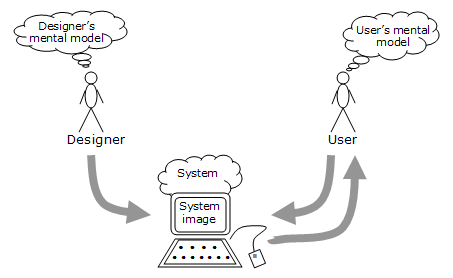
Another area of relevance are discussions of 'system causality conveyance'. The use of mental models in this sense was popularised in the HCI and interaction design community by Donald Norman in his book "The Design of Everyday Things" (Norman 1988). In his book, he used mental models to describe how a system is designed and implemented on the basis of the designer's mental model. Similar to a reader of a passage of text, the user develops a mental model of how he/she thinks the system works through interaction of the system. This model is used to reason about the system, to anticipate system behaviour and to explain why the system reacts as it does. In other words, the designer reifies (materialises) his mental model of a given design, e.g. a computer system, which becomes the only means of conveying his mental model to the user.


Figure 1 (adapted from Norman (1988) p. 16): The problem of ensuring that the user's mental model corresponds to the designer's model arises because the designer does not talk directly with the user. The designer can only talk to the user through the "system image" - the designer's materialised mental model. The system image is, like a text, open to interpretation.
Norman also speaks of conceptual models. In the article "Some Observations on Mental Models" Norman (1983) distinguishes between mental models and conceptual models: "Conceptual models are devised as tools for the understanidng or teaching of physical systems. Mental models are what people really have in their heads and what guides their use of things." In other words, the designer designs a conceptual model into the system in order for it to appear graspable and coherent to the user. If he/she manages to get the conceptual model right, the correct mental model (in the mind of the user) will follow. At least in theory.

Norman's account is of course an over-simplification, but it captures some central dilemmas of interaction design by using mental models as a vehicle for explanation and illustration.

Do people necessarily create mental models?

Whether people create mental models or use other forms of vehicles for reasoning is of course an open research question. In any case, we humans are compulsive interpreters in that we cannot help making sense of what we perceive. Thus, users do not only interpret the visible parts of the system (the "system image" in figure 1) but also make guesses as to what goes on behind the scenes ("the system" in figure 1). This makes the stringent separation of the user interface from the underlying technical processes a poor strategy for achieving ease of use (e.g. Gentner and Nielsen 1996) as users cannot help trying to understand the 'intestines' of the system anyway. This compulsion toward making a mental model of the 'internal logic' of the system may be part of the reason why many efforts in the HCI community in the early 80s were wasted since it appeared that "The aim of interface design was to invent metaphors that users could understand, but which had not much to do with the internal workings of the system" (Andersen, p.4).

Further reading

If you would like to learn more about mental model research and its applicability, see Payne (2000)

"All our ideas and concepts are only internal pictures".
-- Ludwig Boltzmann (1899)

What do YOU think?

Give us your opinion! Do you have any comments/additions
that you would like other visitors to see?

Comment Matt J says: Oct 8th, 2008
#1
I find it sad and laughable that the author attributes the invention of "mental model" to a 20th century writer. How can we ignore all the many notions of "mental model" used by philosophers and scientists for centuries before this? Even if they didn't use the exact term "mental model", it should have been pretty obvious that philosophers have been using "mental models" since at least Aquinas, with his notion of forms in the intellect of things outside the intellect, in the outside world. See, for example, De veritate, q. 2 a. 1 co, where he talks about, "forma per intellectum nostrum concepta", i.e., "a form conceived by our intellect".

Comment Anonymous says: Nov 23rd, 2008
#2
I would think it's pretty obvious that the author is discussing 'mental models' in their contemporary meaning, which is very different from Plato's ideas, Aristotle's essential qualities, Aquinas' forms, etc.


One very basic and important difference - as I understand it - would be the difference between 'form' and 'model'; where forms are what enable the world to be intelligible and knowable by man's intellect, and are both stable and part of reality itself.


Contrary to forms, models are dynamic and relate to both the structure and function of a system, giving man a 'working idea'. As well, because they are solely a part of man's cognition, they do not necessarily match the way the system actually works.


Keeping to the focus and scope of this article, the author rightly cited Craik who is generally accepted to be the first proponent of mental models in cognitive psychology literature.
Comment Matt S says: May 6th, 2009
#3
Matt J I find your comment sad and laughable. For many reasons - very pretentious.
Comment Scotto says: Dec 28th, 2009
#4
... your point being? This particular use of the mental models concept is applied (uniquely) to design, which is, I believe, something different than what Aquinas was thinking about at the time.
 
comment You say: Mar 22nd, 2010
#5
Your text will appear here ! 

  will be spam-protected


How many?
=
e.g. "6"
 

References (bibliography)

 what's this?

Andersen, Peter B. (2007). What semiotics can and cannot do for HCI. Retrieved 7 August 2003 from University of Aalborg, Denmark: http://www.cs.auc.dk/~pba/Preprints/WhatSemioticsCan.pdf

Craik, Kenneth (1943): The Nature of Exploration. Cambridge, England, Cambridge University Press

Gentner, Donald R. and Nielsen, Jakob (1996): The Anti-Mac Interface. In Communications of the ACM, 8 pp. 70-82

Johnson-Laird, P. N., Girotto, V. and Legrenzi, P. (1998). Mental models: a gentle guide for outsiders. Retrieved 7 August 2003 from The Interdisciplinary Committee on Organizational Studies, University of Michigan: http://www.si.umich.edu/ICOS/gentleintro.html

Johnson-Laird, P. N. (1989): Mental models. In: Posner, Michael I. "Foundations of Cognitive Science". MIT Press

Norman, Donald A. (1983): Some Observations on Mental Models. In: Gentner, Dedre and Stevens, Albert L. "Mental Models". Lawrence Erlbaum Associates

Norman, Donald A. (1988): The Design of Everyday Things. New York, Doubleday
 View info on Amazon.com or .co.uk This link opens in a new window 

Payne, Stephen J. (2003): Users' Mental Models: The Very Ideas. In: Carroll, John M. "HCI Models, Theories, and Frameworks". Morgan Kaufman Publishers pp. 135-154

Changes to this page

09 Dec 2006: A comment has been submitted by Chris Gielow

Get Notified!

Get notified when new entries are added to the encyclopedia!
Your Email
Want to know more?
Mar 22

I'm an enemy of what I call 'computer theology.' There's a class conflict out there. There's a techno-elite that lives in a different world.

-- Walter Mossberg

  • Share this quote on... Bookmark and Share
  • Get more quotes

Eva Hornecker on Tangible Interaction

Eva Hornecker explains the evolving concept of Tangible Interaction.

Read Eva's insightful entry here..

Licensed through a Creative Commons licence Open Content

We believe in Open Content and use the Creative Commons Copyright Licences, which makes the content of this website in effect the property of our community, not of this specific website. This page/work is copyright of Interaction-Design.org through the Creative Commons Attribution-ShareAlike Licence.
Permission to make digital/hard copy of part or all of this work for personal, classroom, and commercial use is granted without fee provided that appropriate credit is given (i.e. that the author's name, the title of this publication/article/web page, and its URL clearly appear) and that derivative works are also made available through the Creative Commons Attribution-ShareAlike Licence. See the copyright page for full details or click the 'how to cite' link above for info on how to cite this publication/article/web page.
 

Page information

Author(s): Mads Soegaard
How to cite/reference this page
URL: http://www.interaction-design.org/encyclopedia/mental_models.html