Clayton M. Christensen is professor at Harvard Business School and a New York Times bestseller. He is the architect of, and the world's foremost authority on, disruptive innovation. Consistently acknowledged in rankings and surveys as one of the world’s leading thinkers on innovation, his research has been applied to national economies, start-up and Fortune 50 companies, as well as to ... Read more >>
Commentaries by:
Donald A. Norman
Don Norman is the author of numerous books including "Emotional Design," and more recently, "Living with Complexity." He is co-founder of the Nielsen Norman group, a professor at KAIST (in Korea), and IDEO fellow, and a design theorist, studying the fundamenta...
Marc Steen works as a senior scientist at research and innovation organization TNO in the Netherlands. He earned MSc, MTD and PhD degrees in Industrial Design Engineering at Delft University of Technology and has worked at Philips and KPN before joining TNO.
...
Paul Hekkert is professor of Form Theory at the department of Industrial Design of Delft University of Technology. His main research interest is product experience, including product aesthetics, emotion, expressiveness, and attachment. Next, he is involved in ...
A disruptive technology or disruptive innovation is an innovation that helps create a new market and value network, and eventually goes on to disrupt an existing market and value network. The term is used in business and technology literature to describe innovations that improve a product or service in ways that the market does not expect. Although the term disruptive technology is widely used, disruptive innovation seems a more appropriate term in many contexts since few technologies are intrinsically disruptive; rather, it is the business model that the technology enables that creates the disruptive impact.
How can I beat my most powerful competitor? How can I know in advance of the battle whether I’m going to be able to beat the competition? Why has disruption proven to be such a consistently effective strategy for causing strong incumbent competitors to flee from their entrant attackers, rather than fight them? How can I shape a business idea into a disruptive strategy?
What if you could predict the winners in a race for innovative growth? What if you could choose your competitive battles knowing you would win nearly every time? What if you knew in advance which growth strategies would succeed, and which would fail?
Managers have long sought ways to predict the outcome of competitive fights. Some look at the attributes of the companies involved: Larger companies with more resources to throw at a problem will beat the smaller competitors. It’s interesting how often the CEOs of large, resource-rich companies base their strategies upon this theory, despite repeated evidence that the level of resources committed often bears little relationship to the outcome.
Others consider the attributes of the change: When innovations are incremental, the established, leading firms in an industry are likely to reinforce their dominance; however, compared with entrants, they will be conservative and ineffective in exploiting breakthrough innovation (footnote 48).
Our ongoing study of innovation suggests another way to understand when incumbents will win, and when the entrants are likely to beat them. The Innovator’s Dilemma (Christensen 1997) identified two distinct categories—sustaining and disruptive—based on the circumstances of innovation. In sustaining situations—when the race entails making better products that can be sold for more money to attractive customers—we found that incumbents almost always prevail. In disruptive circumstances—when the challenge is to commercialize a simpler, more convenient product that sells for less money and appeals to a new or unattractive customer set—the entrants are likely to beat the incumbents. This is the phenomenonthat so frequently defeats successful companies. It implies, of course, that the best way for upstarts to attack established competitors is to disrupt them.
Few technologies or business ideas are intrinsically sustaining or disruptive in character. Rather, their disruptive impact must be molded into strategy as managers shape the idea into a plan and then implement it. Successful new-growth builders know—either intuitively or explicitly—that disruptive strategies greatly increase the odds of competitive success.
This chapter’s purpose is to review the disruptive innovation model from the perspective of both the disruptee and the disruptor in order to help growth builders shape their strategies so that they pick disruptive fights they can win. Because disruption happens whether we want it or not, this chapter should also help established companies capture disruptive growth, instead of getting killed by it.
17.2 The Disruptive Innovation Model
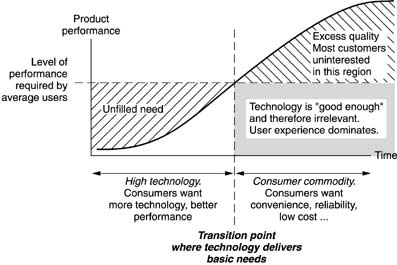
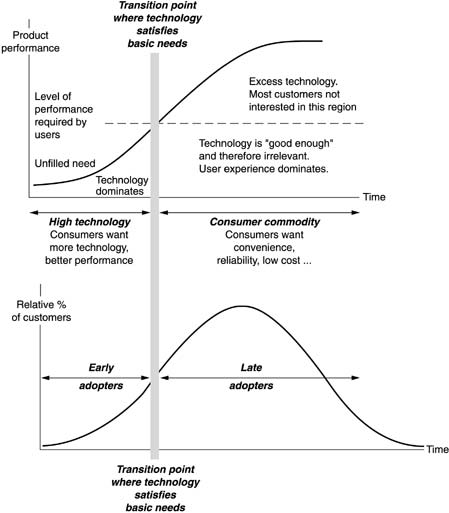
The Innovator’s Dilemma (Christensen 1997) identified three critical elements of disruption, as depicted in Figure 17.1. First, in every market there is a rate of improvement that customers can utilize or absorb, represented by the dotted line sloping gently upward across the chart. For example, the automobile companies keep giving us new and improved engines, but we can’t utilize all the performance that they make available under the hood. Factors such as traffic jams, speed limits, and safety concerns constrain how much performance we can use.
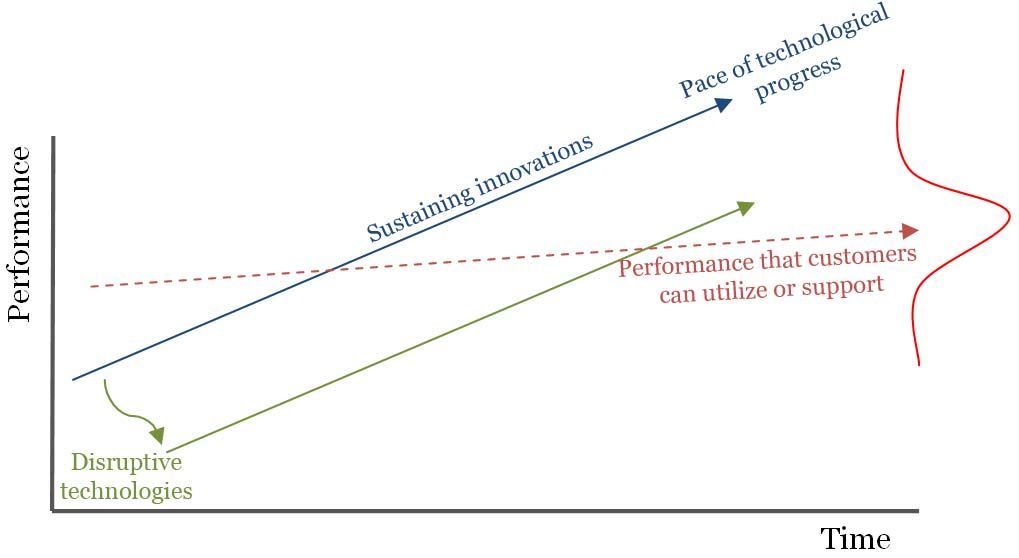
To simplify the chart, we depict customers’ ability to utilize improvement as a single line. In reality, there is a distribution of customers around this median: There are many such lines, or tiers, in a market—a range indicated by the distribution curve at the right. Customers in the highest or most demanding tiers may never be satisfied with the best that is available, and those in the lowest or least demanding tiers can be over-satisfied with very little. But on average, this dotted line represents technology that is “good enough” to serve existing mainstream customers’ needs.
Second, in every market there is a distinctly different trajectory of improvement that innovating companies provide as they introduce new and improved products. The more steeply sloping solid lines in Figure 17.1 suggest that this pace of technological progress almost always outstrips the ability of customers in any given tier of the market to use it. Thus, a company whose products are squarely positioned on mainstream customers’ current needs will probably overshoot what those same customers are able to utilize in the future. This happens because companies keep striving to make better products that they can sell for higher profit margins to not-yet-satisfied customers in more demanding tiers of the market.
To visualize this, think back to 1983 when people first started using personal computers for word processing. Typists often had to stop their fingers to let the Intel 286 chip inside catch up. As depicted at the left side of Figure 17.1, the technology was not good enough. But today’s processors offer much more speed than mainstream customers can use—although there are still a few unsatisfied customers in the most demanding tiers of the market who need even-faster chips.
The third critical element of the model is the distinction between sustaining and disruptive innovation. A sustaining innovation targets demanding, high-end customers with better performance than what was previously available. Some sustaining innovations are the incremental year-by-year improvements that all good companies grind out. Other sustaining innovations are breakthrough, leapfrog-beyond-the-competition products. It doesn’t matter how technologically difficult the innovation is, however: The established competitors almost always win the battles of sustaining technology. Because this strategy entails making a better product that they can sell for higher profit margins to their best customers, the established competitors have powerful motivations to fight sustaining battles. And they have the resources to win.
Disruptive innovations, in contrast, don’t attempt to bring better products to established customers in existing markets. Rather, they disrupt and redefine that trajectory by introducing products and services that are not as good as currently available products. But disruptive technologies offer other benefits—typically, they are simpler, more convenient, and less expensive products that appeal to new or less-demanding customers (footnote 50).
Once the disruptive product gains a foothold in new or low-end markets, the improvement cycle begins. And because the pace of technological progress outstrips customers’ abilities to use it, the previously not-good-enough technology eventually improves enough to intersect with the needs of more demanding customers. When that happens, the disruptors are on a path that will ultimately crush the incumbents. This distinction is important for innovators seeking to create new-growth businesses. Whereas the current leaders of the industry almost always triumph in battles of sustaining innovation, the odds at disruptive innovation heavily favor entrant companies (footnote 51).
Disruption has a paralyzing effect on industry leaders. With resource allocation processes designed and perfected to support sustaining innovations, they are constitutionally unable to respond. They are always motivated to go up-market, and almost never motivated to defend the new or low-end markets that the disruptors find attractive. We call this phenomenon asymmetric motivation. It is the core of the innovator’s dilemma, and the beginning of the innovator’s solution.
17.2.1 Disruption at Work: How Minimills Upended Integrated Steel Companies
The disruption of integrated steel mills by minimills, which is reviewed briefly in The Innovator’s Dilemma (Christensen 1997), offers a classic example of why established leaders are so much easier to beat if the idea for a new product or business is shaped into a disruption.
Historically, most of the world’s steel has come from massive integrated mills that do everything from reacting iron ore, coke, and limestone in blast furnaces to rolling finished products at the other end. It costs about $8 billion to build a huge new integrated mill today. Minimills, in contrast, melt scrap steel in electric arc furnaces—cylinders that are approximately twenty meters in diameter and ten meters tall. Because they can produce molten steel cost-effectively in such a small chamber, minimills don’t need the massive-scale rolling and finishing operations that are required to handle the output of efficient blast furnaces—which is why they are called minimills. Most important, though, minimills’ straightforward technology can make steel of any given quality for 20 percent lower cost than an integrated mill.
Steel is a commodity. You would think that every integrated steel company in the world would have aggressively adopted the straightforward, lower-cost minimill technology. Yet as of 2000 not a single integrated steel company had successfully invested in a minimill, even as the minimills had grown to account for nearly half of North America’s steel production and a significant share of other markets as well (footnote 52).
We can explain why something that makes so much sense has been so difficult for the integrated mills. Minimills first became technologically viable in the mid-1960s. Because they melt scrap of uncertain and varying chemistry in their electric arc furnaces, the quality of the steel that minimills initially could produce was poor. In fact, the only market that would accept the output of minimills was the concrete reinforcing bar (rebar) market. The specifications for rebar are loose, so this was an ideal market for products of low and variable quality.
As the minimills attacked the rebar market, the integrated mills were happy to be rid of that dog-eat-dog commodity business. Because of the differences in their cost structures and the opportunities for investment that they each faced, the rebar market looked very different to the disruptee and the disruptor. For integrated producers, gross profit margins on rebar often hovered near 7 percent, and the entire product category accounted for only 4 percent of the industry’s tonnage. It was the least attractive of any tier of the market in which they might invest to grow. So as the minimills established a foothold in the rebar market, the integrated mills reconfigured their rebar lines to make more profitable products.
In contrast, with a 20 percent cost advantage, the minimills enjoyed attractive profits in competition against the integrated mills for rebar—until 1979, when the minimills finally succeeded in driving the last integrated mill out of the rebar market. Historical pricing statistics show that the price of rebar then collapsed by 20 percent. As long as the minimills could compete against higher-cost integrated mills, the game was profitable for them. But as soon as low-cost minimill was pitted against low-cost minimill in a commodity market, the reward for victory was that none of them could earn attractive profits in rebar (footnote 53). Worse, as they all sought profitability by becoming more efficient producers, they discovered that cost reductions meant survival, but not profitability, in a commodity such as rebar (footnote 54).
Soon, however, the minimills looked up-market, and what they saw there spelled relief. If they could just figure out how to make bigger and better steel—shapes like angle iron and thicker bars and rods—they could roll tons of money, because in that tier of the market, as suggested in Figure 17.2, the integrated mills were earning gross margins of about 12 percent—nearly double the margins that they had been able to earn in rebar. That market was also twiceas big as the rebar segment, accounting for about 8 percent of industry tonnage. As the minimills figured out how to make bigger and better steel and attacked that tier of the market, the integrated mills were almost relieved to be rid of the bar and rod business as well. It was a dog-eat-dog commodity compared with their higher-margin products, whereas for the minimills, it was an attractive opportunity compared with their lower-margin rebar. So as the minimills expanded their capacity to make angle iron and thicker bars and rods, the integrated mills shut their lines down or reconfigured them to make more profitable products. With a 20 percent cost advantage, the minimills enjoyed significant profits in competition against the integrated mills until 1984, when they finally succeeded in driving the last integrated mill out of the bar and rod market. Once again, the minimills reaped their reward: With low-cost minimill pitted against low-cost minimill, the price of bar and rod collapsed by 20 percent, and they could no longer earn attractive profits. What could they do?
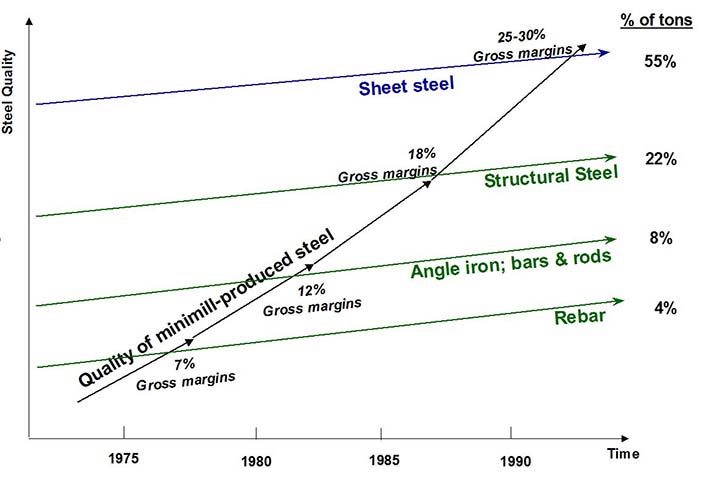
Figure 17.2: The Disruptive Attack of the Steel Minimills.
Continued up-market movement into structural beams appeared to be the next obvious answer. Gross margins in that sector were a whopping 18 percent, and the market was three times as large as the bar and rod business. Most industry technologists thought minimills would be unable to roll structural beams. Many of the properties required to meet the specifications for steel used in building and bridge construction were imparted to the steel in the rolling processes of big integrated mills, and you just couldn’t get those properties in minimills’ abbreviated facilities. What the technical experts didn’t count on, however, was how desperately motivated the minimills would be to solve that problem, because it was the only way they could make attractive money. Minimills achieved extraordinarily clever innovations as they stretched from angle iron to I-beams—things such as Chaparral Steel’s dog-bone mold in its continuous caster, which no one had imagined could be done. Although you could never have predicted what the technical solution would be, you could predict with perfect certainty that the minimills were powerfully motivated to figure it out. Necessity remains the mother of invention.
At the beginning of their invasion into structural beams, the biggest that the minimills could roll were little six-inch beams of the sort that under-gird mobile homes. They attacked the low end of the structural beam market, and again the integrated mills were almost relieved to be rid of it. It was a dog-eat-dog commodity compared with their other higher-margin products where focused investment might bring more attractive volume. To the minimills, in contrast, it was an attractive product compared with the margins they were earning on rebar and angle iron. So as the minimills expanded their capacity to roll structural beams, the integrated mills shut their structural beam mills down in order to focus on more profitable sheet steel products. With a 20 percent cost advantage, the minimills enjoyed significant profits as long as they could compete against the integrated mills. Then in the mid-1990s, when they finally succeeded in driving the last integrated mill out of the structural beam market, pricing again collapsed. Once again, the reward for victory was the end of profit.
The sequence repeated itself when the leading minimill, Nucor, attacked the sheet steel business. Its market capitalization now dwarfs that of the largest integrated steel company, US Steel. Bethlehem Steel is bankrupt at the time of this writing.
This is not a history of bungled steel company management. It is a story of rational managers facing the innovator’s dilemma: Should we invest to protect the least profitable end of our business, so that we can retain our least loyal, most price-sensitive customers? Or should we invest to strengthen our position in the most profitable tiers of our business, with customers who reward us with premium prices for better products?
The executives who confront this dilemma come in all varieties: timid, feisty, analytical, and action-driven. In an unstructured world their actions might be unpredictable. But as large industry incumbents, they encounter powerful and predictable forces that motivate them to flee rather than fight when attacked from below. That is why shaping a business idea into a disruption is an effective strategy for beating an established competitor. Disruption works because it is much easier to beat competitors when they are motivated to flee rather than fight.
The forces that propel well-managed companies up-market are always at work, in every company in every industry. Whether or not entrant firms have disrupted the established leaders yet, the forces are at work, leading predictably in one direction. It is not just a phenomenon of “technology companies” such as those involved in microelectronics, software, photonics, or biochemistry. Indeed, when we use the term technology in this chapter, it means the process that any company uses to convert inputs of labor, materials, capital, energy, and information into outputs of greater value. For the purpose of predictably creating growth, treating “high tech” as different from “low tech” is not the right way to categorize the world. Every company has technology, and each is subject to these fundamental forces.
17.2.2 The Role of Sustaining Innovation in Generating Growth
We must emphasize that we do not argue against the aggressive pursuit of sustaining innovation. Several other insightful books offer management techniques to help companies excel in sustaining innovations—and their contribution is important (footnote 55). Almost always a host of similar companies enters an industry in its early years, and getting ahead of that crowd—moving up the sustaining-innovation trajectory more decisively than the others—is critical to the successful exploitation of the disruptive opportunity. But this is the source of the dilemma: Sustaining innovations are so important and attractive, relative to disruptive ones, that the very best sustaining companies systematically ignore disruptive threats and opportunities until the game is over.
Sustaining innovation essentially entails making a better mousetrap. Starting a new company with a sustaining innovation isn’t necessarily a bad idea: Focused companies sometimes can develop new products more rapidly than larger firms because of the conflicts and distractions that broad scope often creates. The theory of disruption suggests, however, that once they have developed and established the viability of their superior product, entrepreneurs who have entered on a sustaining trajectory should turn around and sell out to one of the industry leaders behind them. If executed successfully, getting ahead of the leaders on the sustaining curve and then selling out quickly can be a straightforward way to make an attractive financial return. This is common practice in the health care industry, and was the well-chronicled mechanism by which Cisco Systems “outsourced” (and financed with equity capital, rather than expense money) much of its sustaining-product development in the 1990s.
A sustaining-technology strategy is not a viable way to build new-growth businesses, however. If you create and attempt to sell a better product into an established market to capture established competitors’ best customers, the competitors will be motivated to fight rather than to flee (footnote 56). This advice holds even when the entrant is a huge corporation with ostensibly deeper pockets than the incumbent.
For example, electronic cash registers were a radical but sustaining innovation relative to electromechanical cash registers, whose market was dominated by National Cash Register (NCR). NCR totally missed the advent of the new technology in the 1970s—so badly, in fact, that NCR’s product sales literally went to zero. Electronic registers were so superior that there was no reason to buy an electromechanical product except as an antique. Yet NCR survived on service revenues for over a year, and when it finally introduced its own electronic cash register, its extensive sales organization quickly captured the same share of the market as the company had enjoyed in the electromechanical realm (footnote 57). The attempts that IBM and Kodak made in the 1970s and 1980s to beat Xerox in the high-speed photocopier business are another example. These companies were far bigger, and yet they failed to outmuscle Xerox in a sustaining-technology competition. The firm that beat Xerox was Canon—and that victory started with a disruptive tabletop copier strategy.
Similarly, corporate giants RCA, General Electric, and AT&T failed to outmuscle IBM on the sustaining-technology trajectory in mainframe computers. Despite the massive resources they threw at IBM, they couldn’t make a dent in IBM’s position. In the end, it was the disruptive personal computer makers, not the major corporations who picked a direct, sustaining-innovation fight, that bested IBM in computers. Airbus entered the commercial airframe industry head-on against Boeing, but doing so required massive subsidies from European governments. In the future, the most profitable growth in the airframe industry will probably come from firms with disruptive strategies, such as Embraer and Bombardier’s Canadair, whose regional jets are aggressively stretching up-market from below (footnote 58).
17.2.3 Disruption Is a Relative Term
An idea that is disruptive to one business may be sustaining to another. Given the stark odds that favor the incumbents in the sustaining race but entrants in disruptive ones, we recommend a strict rule: If your idea for a product or business appears disruptive to some established companies but might represent a sustaining improvement for others, then you should go back to the drawing board. You need to define an opportunity that is disruptive relative to all the established players in the targeted market space, or you should not invest in the idea. If it is a sustaining innovation relative to the business model of a significant incumbent, you are picking a fight you are very unlikely to win.
Take the Internet, for example. Throughout the late 1990s, investors poured billions into Internet-based companies, convinced of their “disruptive” potential. An important reason why many of them failed was that the Internet was a sustaining innovation relative to the business models of a host of companies. Prior to the advent of the Internet, Dell Computer, for example, sold computers directly to customers by mail and over the telephone. This business was already a low-end disruptor, moving up its trajectory. Dell’s banks of telephone salespeople had to be highly trained in order to walk their customers through the various configurations of components that were and were not feasible. They then manually entered the information into Dell’s order fulfillment systems.
For Dell, the Internet was a sustaining technology. It made Dell’s core business processes work better, and it helped Dell make more money in the way it was structured to make money. But the identical strategy of selling directly to customers over the Internet was very disruptive relative to Compaq’s business model, because that company’s cost structure and business processes were targeted at in-store retail distribution.
The theory of disruption would conclude that if Dell (and Gateway) had not existed, then start-up Internet-based computer retailers might have succeeded in disrupting competitors such as Compaq. But because the Internet was sustaining to powerful incumbents, entrant Internet computer retailers have not prospered.
17.2.4 A Disruptive Business Model Is a Valuable Corporate Asset
A disruptive business model that can generate attractive profits at the discount prices required to win business at the low end is an extraordinarily valuable growth asset. When its executives carry the business model up-market to make higher-performance products that sell at higher price points, much of the increment in pricing falls to the bottom line—and it continues to fall there as long as the disruptor can keep moving up, competing at the margin against the higher-cost disruptee. When a company tries to take a higher-cost business model down-market to sell products at lower price points, almost none of the incremental revenue will fall to its bottom line. It gets absorbed into overheads. This is why established firms that hope to capture the growth created by disruption need to do so from within an autonomous business with a cost structure that offers as much headroom as possible for subsequent profitable migration up-market.
Moving up the trajectory into successively higher-margin tiers of the market and shedding less-profitable products at the low end is something that all good managers must do in order to keep their margins strong and their stock price healthy. Standing still is not an option, because firms that stop moving up find themselves in a rebar-esque situation, slugging it out with hard-to-differentiate products against competitors whose costs are comparable (footnote 59).
This ultimately means that in doing what they must do, every company prepares the way for its own disruption. This is the innovator’s dilemma. But it also is the beginning of the innovator’s solution. It does not guarantee success, but it sure helps: The Innovator’s Dilemma (Christensen 1997) showed that following a strategy of disruption increased the odds of creating a successful growth business from 6 to 37 percent (footnote 60). Because the established company’s course of action is mandated so clearly, it is also clear what executives who seek to create new-growth businesses should do: Target products and markets that the established companies are motivated to ignore or run away from. Many of the most profitable growth trajectories in history have been initiated by disruptive innovations.
17.3 Two Types of Disruption
For the sake of simplicity, The Innovator’s Dilemma (Christensen 1997) presented the disruptive innovation diagram in only two dimensions. In reality, there are two different types of disruptions, which can best be visualized by adding a third axis to the disruption diagram, as shown in Figure 17.3. The vertical and horizontal axes are as before: the performance of the product on the vertical axis, with time plotted on the horizontal dimension. The third axis represents new customers and new contexts for consumption.
Our original dimensions—time and performance—define a particular market application in which customers purchase and use a product or service. In geometric terms, this application and set of customers reside in a plane of competition and consumption, which The Innovator’s Dilemma called a value network. A value network is the context within which a firm establishes a cost structure and operating processes and works with suppliers and channel partners in order to respond profitably to the common needs of a class of customers. Within a value network, each firm’s competitive strategy, and particularly its cost structure and its choices of markets and customers to serve, determines its perceptions of the economic value of an innovation. These perceptions, in turn, shape the rewards and threats that firms expect to experience through disruptive versus sustaining innovations (footnote 61).
The third dimension that extends toward us in the diagram represents new contexts of consumption and competition, which are new value networks. These constitute either new customers who previously lacked the money or skills to buy and use the product, or different situations in which a product can be used—enabled by improvements in simplicity, portability, and product cost. For each of these new value networks, a vertical axis can be drawn representing a product’s performance as it is defined in that context (which is a different measure from what is valued in the original value network).
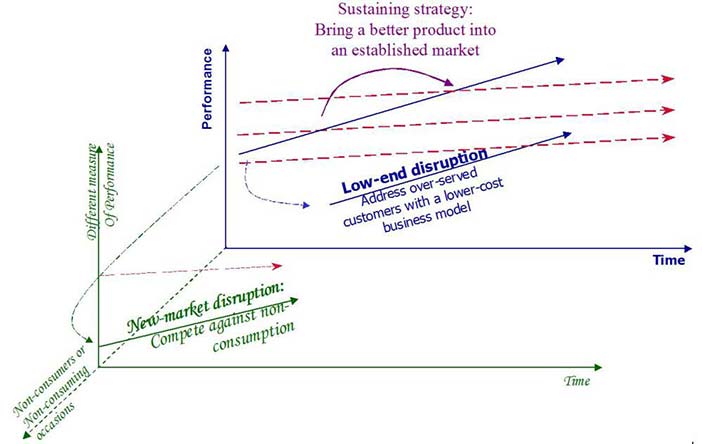
Different value networks can emerge at differing distances from the original one along the third dimension of the disruption diagram. In the following discussion, we will refer to disruptions that create a new value network on the third axis as new-marketdisruptions. In contrast, low-enddisruptions are those that attack the least-profitable and most overserved customers at the low end of the original value network.
17.3.1 New-Market Disruptions
We say that new-market disruptions compete with “nonconsumption” because new-market disruptive products are so much more affordable to own and simpler to use that they enable a whole new population of people to begin owning and using the product, and to do so in a more convenient setting. The personal computer and Sony’s first battery-powered transistor pocket radio were new-market disruptions, in that their initial customers were new consumers—they had not owned or used the prior generation of products and services. Canon’s desktop photocopiers were also a new-market disruption, in that they enabled people to begin conveniently making their own photocopies right in their offices, rather than taking their originals to the corporate high-speed photocopy center where a technician had to run the job for them. When Canon made photocopying so convenient, people ended up making a lot more copies. New-market disruptors’ challenge is to create a new value network, where it is non-consumption, not the incumbent, that must be overcome.
Although new-market disruptions initially compete against non-consumption in their unique value network, as their performance improves they ultimately become good enough to pull customers out of the original value network into the new one, starting with the least-demanding tier. The disruptive innovation doesn’t invade the mainstream market; rather, it pulls customers out of the mainstream market into the new one because these customers find it more convenient to use the new product.
Because new-market disruptions compete against non-consumption, the incumbent leaders feel no pain and little threat until the disruption is in its final stages. In fact, when the disruptors begin pulling customers out of the low end of the original value network, it actually feels good to the leading firms, because as they move up-market in their own world, for a time they are replacing the low-margin revenues that they lose to the disruptors with higher-margin revenues (footnote 62).
17.3.2 Low-End Disruptions
We call disruptions that take root at the low end of the original or mainstream value network low-end disruptions. Disruptions such as steel minimills, discount retailing, and the Korean automakers’ entry into the North American market have been pure low-end disruptions in that they did not create new markets—they were simply low-cost business models that grew by picking off the least attractive of the established firms’ customers. Although they are different, new-market and low-end disruptions both create the same vexing dilemma for incumbents. New-market disruptions induce incumbents to ignore the attackers, and low-end disruptions motivate the incumbents to flee the attack.
Low-end disruption has occurred several times in retailing (footnote 63). For example, full-service department stores had a business model that enabled them to turn inventories three times per year. They needed to earn 40 percent gross margins to make money within their cost structure. They therefore earned 40 percent three times each year, for a 120 percent annual return on capital invested in inventory (ROCII). In the 1960s, discount retailers such as Wal-Mart and Kmart attacked the low end of the department stores’ market—nationally branded hard goods such as paint, hardware, kitchen utensils, toys, and sporting goods—that were so familiar in use that they could sell themselves. Customers in this tier of the market were overserved by department stores, in that they did not need well-trained floor salespeople to help them get what they needed. The discounters’ business model enabled them to make money at gross margins of about 23 percent, on average. Their stocking policies and operating processes enabled them to turn inventories more than five times annually, so that they also earned about 120 percent annual ROCII. The discounters did not accept lower levels of profitability—their business model simply earned acceptable profit through a different formula (footnote 64).
It is very hard for established firms not to flee from a low-end disruptor. Consider, for example, the choice that executives of full-service department stores had to make when the discount retailers were attacking the branded hard goods at the low end of department stores’ merchandise mix. Retailers’ critical resource allocation decision is the use of floor or shelf space. One option for department store executives was to allocate more space to even higher-margin cosmetics and high-fashion apparel, where gross margins often exceeded 50 percent. Because their business model turned inventories three times annually, this option promised 150 percent ROCII.
The alternative was to defend the branded hard goods businesses, which the discounters were attacking with prices 20 percent below those of department stores. Competing against the discounters at those levels would send margins plummeting to 20 percent, which, given the three-times inventory turns that were on average inherent in their business model, entailed a ROCII of 60 percent. It thus made perfect sense for the full-service department stores to flee—to get out of the very tiers of the market that the discounters were motivated to enter (footnote 65).
Many disruptions are hybrids, combining new-market and low-end approaches, as depicted by the continuum of the third axis in Figure 17.3. Southwest Airlines is actually a hybrid disruptor, for example. It initially targeted customers who weren’t flying—people who previously had used cars and buses. But Southwest pulled customers out of the low end of the major airlines’ value network as well. Charles Schwab is a hybrid disruptor. It stole some customers from full-service brokers with its discounted trading fees, but it also created new markets by enabling people who historically were not equity investors—such as students—to begin owning and trading stocks (footnote 66).
Figure 17.4 shows where some of history’s more successful disruptors were positioned along the continuum of new-market to low-end disruption at their inception. The appendix to this chapter offers a brief historical explanation of each of the disruptive products or companies listed on the chart. This is not a complete census of disruptive companies, of course, and their position on the chart is only approximate. However, the array does convey our sense that disruption is a primary wellspring of growth. The prevalence of Japanese companies such as Sony, Nippon Steel, Toyota, Honda, and Canon in the period between 1960 and 1980and the absence of new disruptive companies in the 1990s, for example, explain a lot about why Japan’s economy has stagnated. Many of its most influential companies grew dramatically by disrupting others; but the structure of Japan’s economic system inhibits the creation of new waves of disruptive growth that might threaten these same companies today (footnote 67).
The chart also shows that disruption is an ongoing force that is always at work—meaning that disruptors in one generation become disruptees later. The Ford Model T, for example, created the first massive wave of disruptive growth in automobiles. Toyota, Nissan, and Honda then created the next wave, and Korean automakers Hyundai and Kia have now begun the third. AT&T’s wireline long distance business, which disrupted Western Union, is being disrupted by wireless long distance. Plastics makers such as Dow, DuPont, and General Electric continue to disrupt steel, even as their low end is being eaten away by suppliers of blended polyolefin plastics such as Himont.
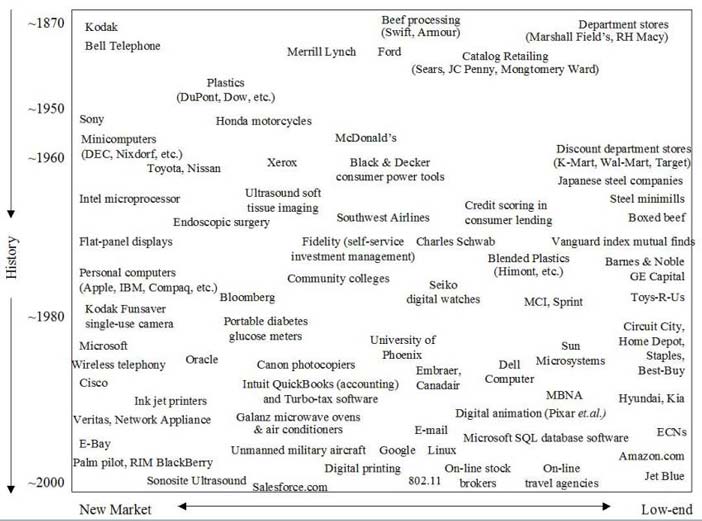
Figure 17.4: A Sampling of Companies Whose Origins Were in Disruption.
17.4 Shaping Ideas to Become Disruptive: Three Litmus Tests
At the beginning of this chapter, we mentioned that few technologies or product ideas are inherently sustaining or disruptive when they emerge from the innovator’s mind. Instead, they go through a process of becoming fleshed out and shaped into a strategic plan in order to win funding. Many—but not all—of the initial ideas that get shaped into sustaining innovations could just as readily be shaped into disruptive business plans with far greater growth potential. The shaping process must be consciously managed, however, and not left in an autopilot mode.
Executives must answer three sets of questions to determine whether an idea has disruptive potential. The first explores whether the idea can become a new-market disruption. For this to happen, at least one and generally both of two conditions must be satisfied:
Is there a large population of people who historically have not had the money, equipment, or skill to do this thing for themselves, and as a result have gone without it altogether or have needed to pay someone with more expertise to do it for them?
To use the product or service, do customers need to go to an inconvenient, centralized location?
If the technology can be developed so that a large population of less skilled or less affluent people can begin owning and using, in a more convenient context, something that historically was available only to more skilled or more affluent people in a centralized, inconvenient location, then there is potential for shaping the idea into a new-market disruption.
The second set of questions explores the potential for a low-end disruption. This is possible if these two conditions exist:
Are there customers at the low end of the market who would be happy to purchase a product with less (but good enough) performance if they could get it at a lower price?
Can we create a business model that enables us to earn attractive profits at the discount prices required to win the business of these overserved customers at the low end?
Often, the innovations that enable low-end disruption are improvements in manufacturing, service, or business processes, which enable a company to earn attractive returns on lower gross margins, coupled with processes that turn assets faster.
Once an innovation passes the new-market or low-end test, there is still a third critical consideration, or litmus test, to apply:
Is the innovation disruptive to all of the significant incumbent firms in the industry? If it appears to be sustaining to one or more significant players in the industry, then the odds will be stacked in that firm’s favor, and the entrant is unlikely to win.
If an idea fails the litmus tests, then it cannot be shaped into a disruption. It may have promise as a sustaining technology, but in that case we would expect that it could not constitute the basis of a new-growth business for an entrant company.
For summary, Table 17.1 contrasts the characteristics of the three strategies that firms might pursue in creating new-growth businesses: sustaining innovations, new-market disruptions, and low-end disruptions. It compares the targeted product performance or features, the targeted customers or markets, and the business model implications that each route entails. We hope that managers can use this as a template so that they can categorize and see the implications of different plans that might be presented to them for approval.
Executives can use this categorization and the litmus tests to foresee the competitive consequences of alternative strategies as they shape an idea. To illustrate, we’ll examine three questions: whether Xerox could disrupt Hewlett-Packard’s ink-jet printing business, how to create growth in air conditioning, and whether online banking had (or has) the disruptive potential to create a new-growth business.
Dimension
Sustaining Innovations
Low-end disruptions
New Market Disruptions
Targeted performance of the product or service
Results in performance improvement in attributes most valued by the industry’s mainstream customers. These improvements may be incremental or breakthrough in character.
Technology yields products that are good enough along the traditional metrics of performance at the low end of the mainstream market.
Results in lower performance in “traditional” attributes, but improved performance in new attributes – typically simplicity and convenience.
Targeted customers or market application
The most attractive (i.e., profitable) customers in the mainstream markets who are willing to pay for improved performance.
Targets over-served customers in the low end of the mainstream market.
Targets non- consumption: customers who historically lacked the money or skill to buy and use the product.
Impact on the required business model (processes and cost structure)
Improves or maintains profit margins by exploiting the existing processes and cost structure, and making better use of current competitive advantages.
Utilizes a new operating and / or financial approach – a different combination of lower gross profit margins and higher asset utilization that can earn attractive returns at the discount prices required to win business at the low end of the market.
Business model must make money at lower price per unit sold, and at unit production volumes that initially will be small emerging market. Gross margin dollars per unit sold will be significantly lower.
Table 17.1: Distinguishing Characteristics of Sustaining vs. Low-End and New-Market Disruptions.
17.4.1 Could Xerox Disrupt Hewlett-Packard?
We don’t actually know if Xerox has considered the possibility of creating a new business of the sort we will examine here, and we use the companies’ names only to make the example more vivid. We’ve based this scenario solely on information from public sources. Xerox reportedly has developed outstanding ink-jet printing technology. What can it do with it? It could attempt to leapfrog Hewlett-Packard by making the best ink-jet printer on the market. Even if it could make a better printer, however, Xerox would be fighting a battle of sustaining technology against a company with superior resources and more at stake. HP would win that fight. But could Xerox craft a disruptive strategy for this technology? We’ll test the conditions for a low-end strategy first.
To determine whether this strategy is viable, Xerox’s managers should test whether customers in the lowest market tiers might be willing to buy a “good enough” printer that is cheaper than prevailing products (footnote 68). At the highest tier of the market, customers seem willing to pay significantly more for a faster printer that produces sharper images. However, consumers in the less-demanding tiers are becoming increasingly indifferent to improvements. It is likely they would be interested in lower-cost alternatives. So the first question gets an affirmative answer.
The next question is whether Xerox could define a business model that could generate attractive returns at the discounted prices required to win business at the low end. The possibilities here don’t look good. HP and other printer companies already outsource the fabrication and assembly of components to the lowest-cost sources in the world. HP makes its money selling ink cartridges—whose fabrication also is outsourced to low-cost suppliers. Xerox could enter the market by selling ink cartridges at lower prices, but unless it could define an overhead cost structure and business processes that would allow it to turn assets faster, Xerox could not sustain a strategy of low-end disruption (footnote 69).
This means we’ll need to evaluate the potential for a new-market disruption—competing against non-consumption. Is there a large, untapped population of computer owners who don’t have the money or skill to buy and use a printer? Probably not. Hewlett-Packard already competed successfully against non-consumption when it launched its easy-to-use, inexpensive ink-jet printers
What about enticing existing printer owners to buy more printers, by enabling consumption in a new, more convenient context? Now, this might be achievable. Documents created on notebook computers are not easy to print. Notebook users have to find a stationary printer and connect to it either over a network or a printer cable, or they must transfer the file via removable media to a computer that is connected to a printer. If Xerox incorporated a lightweight, inexpensive printer into the base or spine of a notebook computer so that people on the go could get hard copies when and where they needed them, the company could probably win customers even if the printer wasn’t as good as a stationary ink-jet printer. Only Xerox’s engineers could determine whether the idea is technologically feasible. But as a strategy, this would pass the litmus tests.
If Xerox attempted this, we would expect HP to ignore this new-market disruption at the outset because the market would be much smaller than the stationary printer market. HP’s printer business is huge, and the company needs large sources of new revenue to sustain its growth. To trap Hewlett-Packard in an innovator’s dilemma, Xerox should develop a business model that’s attractive to Xerox but unattractive to the managers of HP and other leading established printer companies. This might entail pricing ink cartridges for embedded notebook printers low enough that the executives of HP’s ink jet printer business would find the market unattractive relative to investments they might make to move up-market in search of the higher profits they could find by competing against higher-cost stationary laser printers.
17.4.2 Conditions for Growth in Air Conditioners
The window-mounted air conditioner market is widely known to be mature, dominated by giants such as Carrier and Whirlpool. Could a company like General Electric (GE) wallop them? We would predict GE’s defeat if it tried to enter this market with a quieter product that offered more features and better energy efficiency (footnote 70). Is a low-end disruption viable? Our sense is that there are overserved customers at the low end of the existing market. They signal their overservedness by opting for the least-expensive models they can find, unwilling to pay premium prices for the alternative products that are available to them. GE might expand its already substantial manufacturing operations in China, making air conditioners for export to developed economies. This might bring modest but temporary success, because after the established companies respond by setting up their own manufacturing operations in China, GE would find itself locked in a battle with competitors whose costs are comparable and whose distribution and service infrastructure are strong, and where the targeted customers already have manifested an unwillingness to pay premium prices for better products. Employing low-cost labor constitutes a low-cost business model only until competitors avail themselves of the same option.
How about a new-market disruption, however? There are hundreds of millions of non-consumers of residential air conditioning in China, who have been blocked from that market because the power-hungry, expensive machines that historically have been available don’t fit in the average family’s pocketbook or apartment. If GE could design a $49.95 product that would easily slip into the window of a cramped Shanghai apartment and reduce the temperature and humidity in a ten-foot by ten-foot room with ten amps of current, things might get interesting—because once GE had a business model that could make money at that price point, taking on the rest of the up-market world would be easy. Parenthetically, while Western executives are understandably concerned about the threat that low-cost manufacturing in China poses to them, our guess is that China’s greatest competitive asset is the unfathomable amount of non-consumption in its markets, which makes them fertile ground for new-market disruptive companies of many sorts.
17.5 Afterword
Disruption is a theory: a conceptual model of cause and effect that makes it possible to better predict the outcomes of competitive battles in different circumstances. The asymmetries of motivation chronicled in this chapter are natural economic forces that act on all businesspeople, all the time. Historically, these forces almost always have toppled the industry leaders when an attacker has harnessed them, because disruptive strategies are predicated upon competitors doing what is in their best and most urgent interest: satisfying their most important customers and investing where profits are most attractive. In a profit-seeking world, this is a pretty good bet.
Not all innovative ideas can be shaped into disruptive strategies, however, because the necessary preconditions do not exist; in such situations, the opportunity is best licensed or left to the firms that are already established in the market. On occasion, entrant companies have simply caught the leaders asleep at the switch and have succeeded with a strategy of sustaining innovation. But this is rare. Disruption does not guarantee success: It just helps with an important element in the total formula.
17.6 Acknowledgements
This chapter is adapted from the author’s book, The Innovator's Solution, isbn 1578518520
[Editor's note: We highly recommend this seminal book. Published in 2003, it is still as relevant today as in 1997, and has had
tremendous impact on how we think about - and practice - innovation worldwide.]
17.7 Appendix: A Brief Description of the Disruptive Strategies of the Firms in Figure 4
Table 17.2 briefly summarizes our understanding of the disruptive roots of the success of the companies that are arrayed in Figure 17.4. Because of space limitations, much important detail has been omitted. The companies are listed in alphabetical, rather than chronological, order. We do not pretend to be strong business historians, and as a consequence can only present here a partial listing of disruptive companies. Furthermore, it is often difficult to identify a specific year in which each firm’s disruptive strategy was launched. Some firms existed for a considerable period, often in other lines of business, before the disruptive strategy that led to their ultimate success was implemented. In some cases it seems easier to visualize the disruption in terms of a product category, rather than by listing the name of one company. Hence, we ask our readers to regard this information as only suggestive, rather than definitive.
Company or Product
Description
802.11
This is a protocol for high bandwidth wireless transfer of data. It has begun disrupting local area wireline networks. Its present limitations are that the signals can’t travel long distances.
Amazon.com
A low-end disruption relative to traditional bookstores.
Apple, Compaq et.al., Personal computers
Microprocessor-based computers made by firms such as Apple, IBM and Compaq were true new-market disruptions, in that for years they were sold and used in their unique value network before they began to capture sales from higher-end professional computers.
Beef Processing
In the 1880s, Swift and Armour began huge, centralized beef slaughtering operations that transported large sides of beef by refrigerated railcar to local meat cutters. This disrupted local slaughtering operations.
Bell Telephone
Bell’s original telephone could only carry a signal for 3 miles, and therefore was rejected by Western Union, whose business was long-distance telegraphy, because Western Union couldn’t use it. Bell therefore started a new-market disruption, offering local communication – and as the technology improved, it pulled customers out of telegraphy’s long distance value network into telephony.
Black & Decker
Prior to 1960, hand-held electric tools were heavy and rugged, designed for professionals – and very expensive. B&D introduced a line of plastic-encased tools with universal motors that would only last 25-30 hours of operation – which actually was more than adequate for most do-it-yourselfers who drill a few holes per month. In today’s dollars, B&D brought the cost of these tools down from $150 to $20, enabling a whole new population to own and use their own tools.
Blended Plastics
These blends of inexpensive polyolefin plastics like polypropylene, sold by firms like Himont, create composite materials that in many ways share the best properties of their constituent materials. They are getting better at a stunning rate, disrupting markets that historically had been the province of engineering polycarbonate plastics made by firms like GE Plastics.
Bloomberg LP
Bloomberg began by providing basic financial data to investment analysts and brokers. It gradually has improved its data offerings and analysis, and subsequently moved into the financial news business. It has substantially disrupted Dow Jones and Reuters as a result. More recently it has created its own ECN to disrupt stock exchanges. Issuers of government securities can auction their initial offerings over the Bloomberg system, disrupting investment banks.
Boxed beef
The “boxed beef” model of Iowa Beef Packers completed the disruption of local butchering operations. Instead of shipping large sides of beef to local meat cutters for further cutting, IBP cut the beef into finished or nearly finished cuts, for placement directly in supermarket cases.
Canon photocopiers
Until the early 1980s when we needed photocopiers, we had to take our originals to the corporate photocopy center, where a technician ran the job for us. He had to be a technician, because the high-speed Xerox machine in there was very complicated, and needed servicing frequently. When Canon and Ricoh introduced their countertop photocopiers, they were slow, produced poor-resolution copies, and didn’t enlarge or reduce or collate. But they were so inexpensive and simple to use that we could afford to put one right around the corner from our office. At the beginning we still took our high-volume jobs to the copy center. But little by little Canon improved its machines to the point that today, immediate, convenient access to high-quality, full-featured copying is almost a constitutional right in most workplaces.
Catalog retailing
Sears, Roebuck and Montgomery Ward took root as catalog retailers – enabling people in rural America to buy things that historically had not been accessible. Their business model, entailing annual inventory turns of 4x and gross margins of 30%, was disruptive relative to the model of full-service department stores, which relied upon 40% gross margins because they turned inventories only 3x annually. Sears and Wards later moved up-market, building retail stores.
Charles Schwab
Started in 1975 as one of the first discount brokers. In the late 1990s Schwab created a separate organization to build an on-line trading business. It was so successful that the company shut down its original organization of telephone brokers.
Circuit City, Best Buy
Disrupted the consumer electronics departments of full-service and discount department stores, which has sent them up-market into higher-margin clothing.
Cisco
Cisco’s router uses packet-switching technology to direct the flow of information over the telecommunications system, compared to the circuit-switching technology of the established industry leaders such as Lucent, Siemens and Nortel. The technology divides information into virtual “envelopes” called packets, and sends them out over the Internet. Each packet might take a different route to the addressed destination; and when they arrive, the packets are put in the right order and “opened” for the recipient to see. Because this process entailed a few seconds’ latency delay, packet switching could not be used for voice telecommunications. But it was good enough to enable a new market to emerge – data networks. The technology has improved to the point that today, the latency delay of a packet-switched voice call is almost imperceptibly slower than that of a circuit-switched call – enabling VOIP, or voice-over-Internet-protocol telephony.
Community colleges
In some states, up to 80% of the graduates of reputable four-year state universities took some or all of their required general education courses at much less expensive community colleges, and then transferred those credits to the university – which (unconsciously) is becoming a provider of upper-division courses. Some community colleges have begun offering four-year degrees. Their enrollment is booming, often with non-traditional students who otherwise would not have taken these courses.
Concord School of Law
Founded by Kaplan, a unit of the Washington Post Company, this on-line law school has attracted a host of (primarily) non-traditional students. The school’s accreditation allows its graduates to take the California Bar exam, and its graduates’ success rate is comparable to those of many other law schools. Many of its students don’t enroll to become lawyers, however. They want to understand law to help them succeed in other careers.
Credit scoring
A formulaic method of determining creditworthiness, substituting for the subjective judgments of bank loan officers. Developed by a Minneapolis firm, Fair Isaac. Used initially to extend Sears and Penny’s in-store credit cards. As the technology improved, it was used for general credit cards, and then auto, mortgage and now small business loans.
Dell Computer
Dell’s direct-to customer retailing model and its fast-throughput, high asset-turns manufacturing model allowed it to come underneath Compaq, IBM and Hewlett Packard as a low-end disruptor in personal computers. Clayton Christensen, the quintessential low-end consumer, wrote his doctoral thesis on a Dell notebook computer purchased in 1989, because it was the cheapest portable computer on the market. Because of Dell’s reputation for marginal quality, students needed special permission from Harvard to use doctoral stipend money to buy a Dell rather than a computer with a more reputable brand. Today Dell supplies most of the Harvard Business School’s computers.
Department Stores
Department stores like Z.C.M.I. in Salt Lake City, Marshall Field in Chicago, and R.H. Macy in New York, disrupted small shopkeepers. The department stores made money by accelerating inventory turns to 3x per year, which enabled them to earn attractive profit with 40% gross margins. Because their salespeople were much less knowledgeable about products, at the outset department stores had to start at the simplest end of the merchandise mix, with products that were so familiar in use that they “sold themselves.”
Digital animation
The fixed cost and skill required to make a full-length animated movie historically was so high that almost nobody could do it except Disney. Digital animation technology now enables far more companies (Such as Pixar) to compete against Disney.
Discount department stores
Department stores like Korvette’s in New York, K-Mart in Detroit, and later Wal-Mart and Target disrupted full-service department stores. The discount stores made money by accelerating inventory turns to 5x per year, which enabled them to earn attractive profit with 23% gross margins. Because their salespeople were much less knowledgeable about products, at the outset the discount department stores had to start at the simplest end of the merchandise mix, with branded hard goods that were so familiar in use that they “sold themselves.” They subsequently have moved up-market into soft goods such as clothing.
E-Bay
Most of the Internet start-ups of the late 1990s attempted to use the Internet as a sustaining innovation relative to the business models of established companies. E-Bay was a notable exception, as it pursued a new-market disruptive strategy – enabling owners of collectibles that could never turn the head of auction house executives, now to be able to sell off things that they no longer needed.
ECNs
Electronic clearing networks (ECNs) allow buyers and sellers of equities to exchange them over a computer, at a fraction of the cost of doing it on a formal stock exchange. Island, one of the leading ECNs, can handle on one workstation volume amounting to 20% of the NASDAQ’s volume.
E-mail
E-mail is disrupting postal services around the globe. The volume of personal communication that is done by letter is dropping precipitously, leaving postal services with magazines, bills and junk mail.
Embraer & Canadair regional jets
The regional passenger jet business is booming, as their capacity over the past 15 years has stretched from 30 to 50, 70 and now 106. As Boeing and Airbus struggle to make bigger, faster jets for transcontinental and transoceanic travel, their growth has stagnated; the industry has consolidated (Lockheed and McDonnell Douglas have been folded in); and the growth is at the bottom of the market.
Endoscopic Surgery
Minimally invasive surgery was actively disregarded by leading surgeons because the technique could only address the simplest procedures. But it has improved to the point that even certain relatively complicated heart procedures are done through a small port. The disruptive impact has primarily been on equipment makers and hospitals.
Fidelity management
Created “self-service” personal financial management through its easy-to-buy families of mutual funds, 401k accounts, insurance products, etc. Fidelity was founded a few years after WWII; but began its disruptive movements in the 1970s, as best we can tell.
Flat panel displays (Sharp et.al.)
We normally think of disruptive technologies as being inexpensive, and many people are puzzled at how we could call flat panel displays disruptive. Haven’t they come from the high end? Actually, no. Flat panel LCD displays took root in digital watches; and then moved to calculators, notebook computers and small portable televisions. These were applications that historically had no electronic displays at all, and LCD displays were much cheaper than alternative means of bringing imaging to those applications. Flat screens have now begun invading the mainstream market of computer monitors and in-home television screens, disrupting the cathode ray tube. They are able to sustain substantial premium prices because of their 2-D character.
Ford
Henry Ford’s Model T was so inexpensive that he enabled a much larger population of people who historically could not afford cars, now to own one.
Galanz
China’s Galanz captured nearly 40% of the world microwave oven market in the 1990s. While the company could have followed a strategy of low-end disruption – using low-cost Chinese labor to make appliances for export, it instead chose to be a new-market disruptor, making ovens that were small enough and consumed little-enough power to be used in cramped Chinese apartments; and were cheap enough for non-microwave oven owners to afford. Once they had built a business model that could make market-enabling price points for the domestic Chinese market, then taking on the rest of the world was as easy as egg-drop soup.
GE Capital
Has disrupted major portions of the commercial banks’ historical markets, primarily through low-end disruptive strategies.
Google
Google and its competing Internet search engines are disrupting directories of many sorts, including the Yellow Pages.
Honda motorcycles
Honda’s Supercub, introduced in the late 1950s, disrupted makers of big, thunderous motorcycles such as Harley Davidson, Triumph, BMW and many others. It took root as an off-road recreational motorized bicycle, and then improved. Honda was joined by Yamaha, Kawasaki and Suzuki.
Ink jet printers
These were a disruption to the laser jet printer, and a sustaining technology relative to the dot-matrix printer. We put ink jet printers toward the “new market” end of the disruption spectrum, because their compact size, light weight and low initial cost enabled a whole population of computer owners – primarily students – each to own and use a printer. While they were slow and produced fuzzy images at the outset, ink jet printers are now the mainstream printer of choice, having pushed laser jets to the high end. Hewlett Packard stayed atop this industry by setting up an autonomous ink jet business unit to compete against its laser jet printer business.
Intel micro-processor
Intel’s earliest microprocessor in 1971 could only constitute the brain of a four-function calculator. Makers of computers whose logic circuitry is microprocessor-based have disrupted firms that made mainframe and minicomputers, whose logic circuitry was printed wiring board-based.
Intuit’s QuickBooks accounting software
Whereas the established industry leaders in accounting software enabled small business managers to run all sorts of sophisticated reports for analytical purposes, QuickBooks, which was a derivative of Intuit’s personal finance software product Quicken, basically helped them keep track of their cash. It created a huge new market amongst very small business owners (most less than five employees) who historically did not keep their books on computer. Within two years of launch Intuit had seized 85% of the small business accounting software market – mainly by creating new growth. The stealing of the established companies’ customers came later, as QuickBooks’ functionality improved.
Intuit’s Turbotax
PC-based accounting software is disrupting personal tax preparation services such as H&R Block.
Japanese Steel Makers
Firms like Nippon Steel, Nippon Kokkan and Kobe and Kawasaki Steel began their growth by exporting very low quality steel to western markets starting in the late 1950s. As their customers (including disruptive Japanese auto makers like Toyota) grew, the Japanese steel industry had to increase capacity dramatically, enabling it to incorporate the latest steelmaking technology like continuous casting and basic oxygen furnaces in the new mills. This accelerated their up-market trajectory dramatically.
Jet Blue
Whereas Southwest Airlines initially followed a strategy of new-market disruption, Jet Blue’s approach is low-end disruption. Its long-range viability depends upon the major airlines’ motivation to run away from the attack, as integrated steel mills and full-service department stores did.
Kodak
Until the late 1800s, photography was extremely complicated. Only professionals could own and operate the expensive equipment. George Eastman’s simple “point and shoot” “Brownie” camera allowed consumers to take their own pictures. They could then mail the encased roll of film to Kodak, which would develop and return the photos by mail.
Kodak Funsaver
Kodak’s Funsaver-brand single-use camera was born out after painful labor within Kodak, because its profit model – gross margins – were lower than Kodak could earn by selling roll film; and the quality of the images was not as good as those taken in high-quality 35mm cameras. But Kodak commercialized it through a different division, and it sold almost exclusively to people who would not have bought film anyway – because they didn’t have a camera. While it has potential to move up-market taking share against traditional cameras with a new brand, Maxx, we sense that Kodak has stopped driving it in this direction.
Korean auto manufacturers: Hyundai & Kia
Korean automakers, including Hyundai and Kia, gained more points of worldwide market share in the 1990s than any other country’s automakers. And yet few of the established firms are concerned, because their gains have come in what is, to them, the lowest-profit portion of the market.
MBNA
We noted above that credit scoring is a formulaic method of determining the creditworthiness of a loan applicant. It was originally implemented in commercial banks as a sustaining technology – to reduce their costs of credit evaluation. In the 1990s, however, it was deployed in high-volume, low-cost “monoline” business models by firms such as MBNA, Capital One and First USA, which have substantially disrupted commercial banks’ credit card business. At the time of this writing, in fact, Citibank is the only major commercial bank with a substantial and profitable credit card business.
McDonald’s
The fast food industry has been a hybrid disruptor, making it so inexpensive and convenient to eat out that they created a massive wave of growth in the “eating out” industry. Their earliest victims were “mom-and-pop” diners. In the last decade the advent of food courts has taken fast food up-market. Expensive, romantic high-end restaurants still thrive at the high end, of course.
MCI, Sprint
These firms were low-end disruptors relative to AT&T’s long distance telephone business. They enjoyed a unique opportunity to do this, because AT&T’s long distance rates were set by regulation at artificially high levels, in order to subsidize local residential telephone service.
Merrill Lynch
Charles Merrill’s mantra in 1912 was to “Bring Wall Street to Main Street.” By employing salaried rather than commissioned brokers, he made it inexpensive enough to trade stocks that middle-income Americans could become equity investors. Merrill Lynch moved up-market over the next 90 years towards higher net worth investors. Most of the brokerage firms that held seats on the New York Stock exchange in the 1950s and 60s have been merged out of existence, because Merrill Lynch disrupted them.
Microsoft
Its operating system was inadequate versus those of mainframe and minicomputer makers; versus Unix; and versus Apple’s system. But its migration from DOS to Windows to Windows NT is taking the firm up-market, to the point that the Unix world is seriously threatened. Microsoft, in turn, faces a threat from Linux.
Mini-computers
Companies like Digital Equipment, Prime, Wang, Data General and Nixdorf were new-market disruptors relative to mainframe computer makers. Their relative simplicity and low price enabled departments (particularly engineering) in organizations to have their own computers, instead of having to rely on inconvenient, centralized mainframe computers that typically were optimized for generating financial reports.
On-line stock brokers
On-line trading of equities is a sustaining technology relative to the business models of discount brokers such as Ameritrade, and is disruptive relative to full-service brokers such as Merrill Lynch. For Schwab, which started as a bare-bones discount broker but had moved up towards the mainstream market by the mid-1990s, Internet-based trading was disruptive enough that the company had to set up a separate division.
On-line travel agencies
Enabled by electronic ticketing, on-line travel agencies such as Expedia and Travelocity have so badly disrupted full-service, bricks-and-mortar agencies such as American Express that many airlines have dramatically cut the substantial commissions that historically they had paid to travel agencies.
Oracle
Oracle’s relational database software was disruptive relative to that of the prior leaders, Cullinet and IBM, whose hierarchical or transactional database software ran on mainframe computers and was used to generate standard financial reports. Relational databases ran on minicomputers (and then microprocessor-based computers). Users without deep programming expertise could readily create their own custom reports and analyses using Oracle’s modular, relational architecture.
Palm Pilot, RIM BlackBerry
Hand-held devices are new-market disruptions relative to notebook computers.
Plastics
Plastics as a category have disrupted steel and wood, in that the “quality” of plastic parts often was inferior to those of wood and steel, along the metrics by which performance was measured in traditional applications. But their low cost and ease of shaping created many new applications, and plastics have pulled many applications out of the original metal and wood value networks into the plastic network. The disruption is particularly obvious if you look at where plastics were used in automobiles 30 years ago, versus today.
Portable diabetes blood glucose meters
Disrupted makers of large blood glucose testing machines in hospital laboratories, enabling patients with diabetes to monitor their own glucose levels.
Salesforce.com
This company, with its inexpensive, simple Internet-based system, is disrupting the leading providers of customer relationship management software like Siebel Systems.
Seiko watches
Remember when Seiko watches were those cheap, throw-away black plastic watches? They, Citizen and Texas Instruments (which subsequently exited) disrupted the American and European watch industries.
Sonosite
This firm makes a hand-held ultrasound device that enables healthcare professionals who historically needed the assistance of highly trained technicians with expensive equipment, now to look inside the bodies of patients in their care, and thereby to provide more accurate and timely diagnoses. The company floundered for a time attempting to implement its product as a sustaining innovation. But as of the time this book was being written, it seemed to have caught its disruptive stride in an impressive way.
Sony
Sony pioneered the use of transistors in consumer electronics. Its portable radios and portable televisions disrupted firms like RCA that made large TVs and radios using vacuum tube technology. During the 1960s and 1970s, Sony launched a series of new-market disruptions, with products like video tape players, hand-held consumer video recorders, cassette tape players, the Walkman, and the 3.5-inch floppy disk drive.
Southwest Airlines
It was a hybrid disruptor because its original strategy was to compete against driving and busses, and to fly in and out of non-mainstream airports. In addition, because its prices were so low it also took business from established airlines. Just as Wal-Mart enjoys profit protection from being in small towns whose market can only support one discount store, many of Southwest’s routes offer the same protection.
SQL database software
Microsoft’s SQL database software product is disrupting Oracle, which has moved up-market into expensive, integrated enterprise systems.
Staples
With its direct competitors Office Max and Office Depot, Staples disrupted small stationery stores as well as business-to-business office supplies distributors.
Steel minimills
Have been disrupting integrated mills around the world since the mid-1960s, as recounted in the text.
Sun Microsystems
Sun, Apollo (HP) and Silicon Graphics, which built their systems around RISC microprocessors, took root in essentially the same value network as minicomputers, and disrupted them. These firms, in turn, are now being disrupted by CISC microprocessor-based computer makers such as Compaq and Dell.
Toyota
Entered the US market with cheap sub-compact cars like the Corona. These were so inexpensive that people who historically couldn’t afford a new car now could buy one; or families could acquire a second car. Toyota now makes Lexuses, you may have noticed. Nissan has migrated from its Datsun to Infiniti; and Honda has progressed from its miniature CVCC to Accura.
Toys-R-Us
Disrupted the toy departments of full-service and discount department stores, which has sent them up-market into higher-margin clothing.
Ultrasound
Ultrasound technology is disruptive, relative to X-Ray imaging. Hewlett Packard, Accuson, and ATL created a multi-billion-dollar industry by imaging soft tissues, which traditional X-ray technology could not capture. The leading X-Ray equipment makers, including General Electric, Siemens and Philips, became leaders in the two major radical sustaining technology revolutions in imaging: CT scanning and magnetic resonance imaging (MRI). Because ultrasound was a new market disruption, none of the X-ray companies participated in ultrasound until very recently, when they acquired major ultrasound equipment companies.
University of Phoenix
A unit of Apollo, the University of Phoenix is disrupting four-year colleges and certain professional graduate programs. It began by providing employee training courses for businesses, often de facto, but sometimes by formal contract. Its programs have expanded into a variety of open-enrollment, degree-granting programs. Today it is one of the largest educational institutions in the United States, and is one of the leading providers of on-line education.
Unmanned aircraft
These machines took root initially as drone targets to uncover hidden anti-aircraft emplacements. They then moved up-market into surveillance roles, and in the 2001-02 war in Afghanistan, moved for the first time into limited weapons-carrying roles.
Vanguard
Index mutual funds have been a low-end disruption relative to managed mutual funds. At the time of this writing, Vanguard’s assets had grown to rival closely those of the former undisputed mutual fund leader, Fidelity management.
Veritas & Network Appliance
Network-attached storage and IP storage area networks are disruptive approaches to enterprise data storage, relative to the centralized storage systems supplied by companies like EMC. Some of these distributed networked storage are so simple to augment that an office assistant can simply “snap” an additional storage server onto a network.
Wireless Telephony
Cellular and digital wireless phones have been on a disruptive path against wireline phones for 25 years. Initially they were large, power-hungry car phones with spotty efficacy; but gradually have improved to the point where, by some estimates, nearly one-fifth of mobile telephone users have chosen to “cut the cord” and do without wireline telephone service. The viability of the wireline long distance business is now in jeopardy.
Xerox
Photocopying has been a new-market disruption relative to offset printing, enabling non-printers to make smaller volumes of copies in the convenience of their workplace. Xerox’s initial machines were so expensive and complicated that they were housed in corporate photocopy centers manned by technicians.
Table 17.2: A Brief Description of the Disruptive Roots of the Companies and Industries Listed in Figure 4.
X
Close
Moggridge, 2007
Moggridge, Bill (2007): Designing Interactions. The MIT Press
Inglehart, Ronald (1997): Modernization and Postmodernization: Cultural, Economic, and Political Change in 43 Societies. Princeton University Press
Ronald Inglehart argues that economic development, cultural change, and political change go together in coherent and even, to some extent, predictable patterns. This is a controversial claim. It implies that some trajectories of socioeconomic change are more likely than others--and consequently that certain changes are foreseeable. Once a society has embarked on industrialization, for example, a whole syndrome of related changes, from mass mobilization to diminishing differences in gender roles, is likely to appear. These changes in worldviews seem to reflect changes in the economic and political environment, but they take place with a generational time lag and have considerable autonomy and momentum of their own. But industrialization is not the end of history. Advanced industrial society leads to a basic shift in values, de-emphasizing the instrumental rationality that characterized industrial society. Postmodern values then bring new societal changes, including democratic political institutions and the decline of state socialist regimes. To demonstrate the powerful links between belief systems and political and socioeconomic variables, this book draws on a unique database, the World Values Surveys. This database covers a broader range than ever before available for looking at the impact of mass publics on political and social life. It provides information from societies representing 70 percent of the world's population--from societies with per capita incomes as low as $300 per year to those with per capita incomes one hundred times greater and from long-established democracies with market economies to authoritarian states.
Schulze, Gerhard (1992): Die Erlebnisgesellschaft: Kultursoziologie der Gegenwart. Campus Verlag
1992 erschien Die Erlebnisgesellschaft zum ersten Mal – und machte rasch Furore. Heute kann der Text mit Fug und Recht als moderner Klassiker der Soziologie gelten. Gerhard Schulze konstatierte einen umfassenden Wandel in unserer Gesellschaft, durch den das Leben zum Erlebnisprojekt geworden ist. Die Erlebnisorientierung ist die unmittelbarste Form der Suche nach Glück. Eine Suche, die noch längst nicht abgeschlossen ist – diese neue Art zu leben müssen wir erst lernen und die Folgen noch bewältigen. Dies gilt auch heute noch: Die Sucht nach dem Kick und nach Performance ist eher gewachsen, und damit ist Gerhard Schulzes Analyse aktueller denn je.
Schulze, Gerhard (2005): Die Erlebnisgesellschaft: Kultursoziologie der Gegenwart.
1992 erschien Die Erlebnisgesellschaft zum ersten Mal – und machte rasch Furore. Heute kann der Text mit Fug und Recht als moderner Klassiker der Soziologie gelten. Gerhard Schulze konstatierte einen umfassenden Wandel in unserer Gesellschaft, durch den das Leben zum Erlebnisprojekt geworden ist. Die Erlebnisorientierung ist die unmittelbarste Form der Suche nach Glück. Eine Suche, die noch längst nicht abgeschlossen ist – diese neue Art zu leben müssen wir erst lernen und die Folgen noch bewältigen. Dies gilt auch heute noch: Die Sucht nach dem Kick und nach Performance ist eher gewachsen, und damit ist Gerhard Schulzes Analyse aktueller denn je.
Inglehart, Ronald (1997): Modernization and Postmodernization: Cultural, Economic, and Political Change in 43 Societies. Princeton University Press
Ronald Inglehart argues that economic development, cultural change, and political change go together in coherent and even, to some extent, predictable patterns. This is a controversial claim. It implies that some trajectories of socioeconomic change are more likely than others--and consequently that certain changes are foreseeable. Once a society has embarked on industrialization, for example, a whole syndrome of related changes, from mass mobilization to diminishing differences in gender roles, is likely to appear. These changes in worldviews seem to reflect changes in the economic and political environment, but they take place with a generational time lag and have considerable autonomy and momentum of their own. But industrialization is not the end of history. Advanced industrial society leads to a basic shift in values, de-emphasizing the instrumental rationality that characterized industrial society. Postmodern values then bring new societal changes, including democratic political institutions and the decline of state socialist regimes. To demonstrate the powerful links between belief systems and political and socioeconomic variables, this book draws on a unique database, the World Values Surveys. This database covers a broader range than ever before available for looking at the impact of mass publics on political and social life. It provides information from societies representing 70 percent of the world's population--from societies with per capita incomes as low as $300 per year to those with per capita incomes one hundred times greater and from long-established democracies with market economies to authoritarian states.
Maslow, Abraham H. (1954): Motivation and Personality. HarperCollins Publishers
Loading info on Abraham H. Maslow...
X
Close
Inglehart 1997
Inglehart, Ronald (1997): Modernization and Postmodernization: Cultural, Economic, and Political Change in 43 Societies. Princeton University Press
Ronald Inglehart argues that economic development, cultural change, and political change go together in coherent and even, to some extent, predictable patterns. This is a controversial claim. It implies that some trajectories of socioeconomic change are more likely than others--and consequently that certain changes are foreseeable. Once a society has embarked on industrialization, for example, a whole syndrome of related changes, from mass mobilization to diminishing differences in gender roles, is likely to appear. These changes in worldviews seem to reflect changes in the economic and political environment, but they take place with a generational time lag and have considerable autonomy and momentum of their own. But industrialization is not the end of history. Advanced industrial society leads to a basic shift in values, de-emphasizing the instrumental rationality that characterized industrial society. Postmodern values then bring new societal changes, including democratic political institutions and the decline of state socialist regimes. To demonstrate the powerful links between belief systems and political and socioeconomic variables, this book draws on a unique database, the World Values Surveys. This database covers a broader range than ever before available for looking at the impact of mass publics on political and social life. It provides information from societies representing 70 percent of the world's population--from societies with per capita incomes as low as $300 per year to those with per capita incomes one hundred times greater and from long-established democracies with market economies to authoritarian states.
Schmitt, Bernd H. (1999): Experiential Marketing: How to Get Customers to Sense, Feel, Think, Act, Relate. Free Press
Loading info on Bernd H. Schmitt...
X
Close
Bongiovann 2010
Bongiovann, Gary (2010). PollStar 2010 Midyear Business Analysis. Retrieved 9 November 2010 from PollStar Pro: http://www.pollstarpro.com/specialfeatures2010/2010MidYearBusinessAnalysis.PDF
Loading info on Gary Bongiovann...
X
Close
Schock (2010)
Schock, Artur (2010). Gut finden und kaufen steht in keinem Verhältnis. Retrieved 9 November 2010 from Spiegel Online: http://www.spiegel.de/netzwelt/web/0,1518,710269,00.html
Loading info on Artur Schock...
X
Close
Huxley (2010)
Huxley, Rich (2010). Music is Not Our Currency. Retrieved 9 November 2010 from Creative Deconstruction: http://www.creativedeconstruction.com/2010/05/music-is-not-our-currency/
Understanding experience is a critical issue for a variety of professions, especially design. To understand experience and the user experience that results from interacting with products, designers conduct situated research activities focused on the interactions between people and products, and the experience that results. This paper attempts to clarify experience in interactive systems. We characterize current approaches to experience from a number of disciplines, and present a framework for designing experience for interactive system. We show how the framework can be applied by members of a multidisciplinary team to understand and generate the kinds of interactions and experiences new product and system designs might offer.
Hassenzahl, Marc (2010): Experience Design: Technology for All the Right Reasons. Morgan and Claypool Publishers
In his In the blink of an eye, Walter Murch, the Oscar-awarded editor of The English Patient, Apocalypse Now, and many other outstanding movies, devises the Rule of Six -- six criteria for what makes a good cut. On top of his list is "to be true to the emotion of the moment," a quality more important than advancing the story or being rhythmically interesting. The cut has to deliver a meaningful, compelling, and emotion-rich "experience" to the audience. Because, "what they finally remember is not the editing, not the camerawork, not the performances, not even the story---it's how they felt." Technology for all the right reasons applies this insight to the design of interactive products and technologies -- the domain of Human-Computer Interaction, Usability Engineering, and Interaction Design. It takes an experiential approach, putting experience before functionality and leaving behind oversimplified calls for ease, efficiency, and automation or shallow beautification. Instead, it explores what really matters to humans and what it needs to make technology more meaningful.
The book clarifies what experience is, and highlights five crucial aspects and their implications for the design of interactive products. It provides reasons why we should bother with an experiential approach, and presents a detailed working model of experience useful for practitioners and academics alike. It closes with the particular challenges of an experiential approach for design. The book presents its view as a comprehensive, yet entertaining blend of scientific findings, design examples, and personal anecdotes.
Russell, James A. (2003): Core Affect and the Psychological Construction of Emotion. In Psychological Review, 110 (1) p. 145–172
At the heart of emotion, mood, and any other emotionally charged event are states experienced as simply
feeling good or bad, energized or enervated. These states— called core affect—influence reflexes,
perception, cognition, and behavior and are influenced by many causes internal and external, but people
have no direct access to these causal connections. Core affect can therefore be experienced as free-
floating (mood) or can be attributed to some cause (and thereby begin an emotional episode). These basic
processes spawn a broad framework that includes perception of the core-affect-altering properties of
stimuli, motives, empathy, emotional meta-experience, and affect versus emotion regulation; it accounts
for prototypical emotional episodes, such as fear and anger, as core affect attributed to something plus
various nonemotional processes.
Three studies compared 10 candidate psychological needs in an attempt to determine which are truly
most fundamental for humans. Participants described "most satisfying events" within their lives and then
rated the salience of each of the 10 candidate needs within these events. Supporting self-determination
theory postulates (Ryan&Deci, 2000)—autonomy, competence, and relatedness, were consistently
among the top 4 needs, in terms of both their salience and their association with event-related affect.
Self-esteem was also important, whereas self-actualization or meaning, physical thriving, popularity or
influence, and mbney-luxury were less important. This basic pattern emerged within three different time
frames and within both U.S. and South Korean samples and also within a final study that asked, "What's
unsatisfying about unsatisfying events?" Implications for hierarchical theories of needs are discussed.
Subsumed under the umbrella of User Experience (UX), practitioners and academics of Human–Computer Interaction look for ways to broaden their understanding of what constitutes “pleasurable experiences” with technology. The present study considered the fulfilment of universal psychological needs, such as competence, relatedness, popularity, stimulation, meaning, security, or autonomy, to be the major source of positive experience with interactive technologies. To explore this, we collected over 500 positive experiences with interactive products (e.g., mobile phones, computers). As expected, we found a clear relationship between need fulfilment and positive affect, with stimulation, relatedness, competence and popularity being especially salient needs. Experiences could be further categorized by the primary need they fulfil, with apparent qualitative differences among some of the categories in terms of the emotions involved. Need fulfilment was clearly linked to hedonic quality perceptions, but not as strongly to pragmatic quality (i.e., perceived usability), which supports the notion of hedonic quality as “motivator” and pragmatic quality as “hygiene factor.” Whether hedonic quality ratings reflected need fulfilment depended on the belief that the product was responsible for the experience (i.e., attribution).
This paper offers an exploration of the attitudes of older adults to keeping in touch with people who are important to them. We present findings from three focus groups with people from 55 to 81 years of age. Themes emerging from the findings suggest that older adults view the act of keeping in touch as being worthy of time and dedication, but also as being something that needs to be carefully managed within the context of daily life. Communication is seen as a means through which skill should be demonstrated and personality expressed, and is understood in a very different context to the lightweight interaction that is increasingly afforded by new technologies. The themes that emerged are used to elicit a number of design implications and to promote some illustrative design concepts for new communication devices.
Subsumed under the umbrella of User Experience (UX), practitioners and academics of Human–Computer Interaction look for ways to broaden their understanding of what constitutes “pleasurable experiences” with technology. The present study considered the fulfilment of universal psychological needs, such as competence, relatedness, popularity, stimulation, meaning, security, or autonomy, to be the major source of positive experience with interactive technologies. To explore this, we collected over 500 positive experiences with interactive products (e.g., mobile phones, computers). As expected, we found a clear relationship between need fulfilment and positive affect, with stimulation, relatedness, competence and popularity being especially salient needs. Experiences could be further categorized by the primary need they fulfil, with apparent qualitative differences among some of the categories in terms of the emotions involved. Need fulfilment was clearly linked to hedonic quality perceptions, but not as strongly to pragmatic quality (i.e., perceived usability), which supports the notion of hedonic quality as “motivator” and pragmatic quality as “hygiene factor.” Whether hedonic quality ratings reflected need fulfilment depended on the belief that the product was responsible for the experience (i.e., attribution).
Intimacy is a crucial element of domestic life, and many interactive technologies designed for other purposes have been appropriated for use within intimate relationships. However, there is a deficit in current understandings of how technologies are used within intimate relationships, and how to design technologies to support intimate acts. In this paper we report on work that has addressed these deficits. We used cultural probes and contextual interviews and other ethnographically informed techniques to investigate how interactive technologies are used within intimate relationships. From this empirical work we generated a thematic understanding of intimacy and the use of interactional technologies to support intimate acts. We used this understanding to inform the design of intimate technologies. A selection of our design concepts is also presented.
Wagstaff, Jeremy (2007). The Anti-iPod: The Buddha Machine Shows That Bells and Whistles Aren't Always Better. Retrieved 9 November 2010 from Creative Deconstruction: http://online.wsj.com/article/SB117712103492177617.html
Loading info on Jeremy Wagstaff...
X
Close
Walker (2007)
Walker, Rob (2007). Boxed Set. Retrieved 9 November 2010 from The New York Times: http://www.nytimes.com/2007/07/29/magazine/29wwln-consumed-t.html?_r=1
Loading info on Rob Walker...
X
Close
Heater 2008
Heater, Brian (2008). Hands On: Buddha Machine 2. Retrieved 9 November 2010 from Gearlog: http://www.gearlog.com/2008/11/hands_on_buddha_machine_2.php
In our increasingly decentralized world, demands to maintain relationships over long distances continue to increase. It is more and more difficult to maintain a sense of connection with others, to communicate with others in an emotionally rich way, and to know whether one is available for initiating a conversation in an appropriate context.This paper describes the design process and our solution to this challenge. The ComSlipper is a lightweight yet expressive sensible slipper that enhances the quality of computer-mediated relationships. The ComSlipper was developed using a human-centered design approach to better understand user behaviors and needs. The ComSlipper empowers the wearer to create a sense of connection to others. The wearer uses body gesture and tactile manipulation to feel and express emotions and availability to distant loved ones. The ComSlipper provides a natural and intimate way of communicating, and facilitates the development of intimate relationships.
Social exchange, intimacy and relatedness are a basic human need. Not surprisingly, there is a number of means to mediate relatedness over a distance, such as the telephone, Skype or Facebook. However, each of these imposes a particular way of communication, constrained by the employed technology rather than deliberately shaped by the designer. In line with an experience-driven approach to technology design, we suggest linked. as a communication device for teenage boys. An ethnography-inspired study revealed that teenage boys tend to "squabble" to express and fulfill their need for relatedness and physicality. linked. draws upon this. It is a modular pillow-like device, enabling boys to squabble over a distance, thereby providing a means to experience relatedness in a novel, emotional, but socially appropriate ways.
Wikipedia's success is often attributed to the large numbers of contributors who improve the accuracy, completeness and clarity of articles while reducing bias. However, because of the coordination needed to write an article collaboratively, adding contributors is costly. We examined how the number of editors in Wikipedia and the coordination methods they use affect article quality. We distinguish between explicit coordination, in which editors plan the article through communication, and implicit coordination, in which a subset of editors structure the work by doing the majority of it. Adding more editors to an article improved article quality only when they used appropriate coordination techniques and was harmful when they did not. Implicit coordination through concentrating the work was more helpful when many editors contributed, but explicit coordination through communication was not. Both types of coordination improved quality more when an article was in a formative stage. These results demonstrate the critical importance of coordination in effectively harnessing the "wisdom of the crowd" in online production environments.
Hiltz, Starr Roxanne and Turoff, Murray (1993): The Network Nation: Human Communication via Computer. MIT Press
A visionary book when it was first published in the late 1970s, The Network Nation has become the defining document and standard reference for the field of computer mediated communication (CMC). This revised edition adds a substantial new chapter on "superconnectivity" (invented and defined in the unabridged edition of the Online Dictionary of the English Language, 2067) that reviews the developments of the last fifteen years and updates the authors' speculations about the future.Hiltz and Turoff highlight major current organizational, educational, and public applications of CMC, integrate their theoretical understanding of the impact of CMC technology, address ethical and legal issues, and describe a scenario in 2084. They have also added a selected bibliography on the key literature.Starr Roxanne Hiltz and Murray Turoff each hold the position of Professor of Computer and Information Sciences at the New Jersey Institute of Technology. They are also members of the faculty of the Graduate School of Business at Rutgers University, Newark.
Rheingold, Howard (1993): The Virtual Community: Homesteading on the Electronic Frontier. Reading, MA, The MIT Press
Howard Rheingold has been called the First Citizen of the Internet. In this book he tours the "virtual community" of online networking. He describes a community that is as real and as much a mixed bag as any physical community -- one where people talk, argue, seek information, organize politically, fall in love, and dupe others. At the same time that he tells moving stories about people who have received online emotional support during devastating illnesses, he acknowledges a darker side to people's behavior in cyberspace. Indeed, contends Rheingold, people relate to each other online much the same as they do in physical communities.Originally published in 1993, The Virtual Community is more timely than ever. This edition contains a new chapter, in which the author revisits his ideas about online social communication now that so much more of the world's population is wired. It also contains an extended bibliography.
We introduce a new interactive system: a game that is fun and can be used to create valuable output. When people play the game they help determine the contents of images by providing meaningful labels for them. If the game is played as much as popular online games, we estimate that most images on the Web can be labeled in a few months. Having proper labels associated with each image on the Web would allow for more accurate image search, improve the accessibility of sites (by providing descriptions of images to visually impaired individuals), and help users block inappropriate images. Our system makes a significant contribution because of its valuable output and because of the way it addresses the image-labeling problem. Rather than using computer vision techniques, which don't work well enough, we encourage people to do the work by taking advantage of their desire to be entertained.
Wikipedia's brilliance and curse is that any user can edit any of the encyclopedia entries. We introduce the notion of the impact of an edit, measured by the number of times the edited version is viewed. Using several datasets, including recent logs of all article views, we show that an overwhelming majority of the viewed words were written by frequent editors and that this majority is increasing. Similarly, using the same impact measure, we show that the probability of a typical article view being damaged is small but increasing, and we present empirically grounded classes of damage. Finally, we make policy recommendations for Wikipedia and other wikis in light of these findings.
We introduce a new interactive system: a game that is fun and can be used to create valuable output. When people play the game they help determine the contents of images by providing meaningful labels for them. If the game is played as much as popular online games, we estimate that most images on the Web can be labeled in a few months. Having proper labels associated with each image on the Web would allow for more accurate image search, improve the accessibility of sites (by providing descriptions of images to visually impaired individuals), and help users block inappropriate images. Our system makes a significant contribution because of its valuable output and because of the way it addresses the image-labeling problem. Rather than using computer vision techniques, which don't work well enough, we encourage people to do the work by taking advantage of their desire to be entertained.
The rise of the Internet has enabled collaboration and cooperation on an unprecedentedly large scale. The online encyclopedia Wikipedia, which presently comprises 7.2 million articles created by 7.04 million distinct editors, provides a consummate example. We examined all 50 million edits made to the 1.5 million English-language Wikipedia articles and found that the high-quality articles are distinguished by a marked increase in number of edits, number of editors, and intensity of cooperative behavior, as compared to other articles of similar visibility and age. This is significant because in other domains, fruitful cooperation has proven to be difficult to sustain as the size of the collaboration increases. Furthermore, in spite of the vagaries of human behavior, we show that Wikipedia articles accrete edits according to a simple stochastic mechanism in which edits beget edits. Topics of high interest or relevance are thus naturally brought to the forefront of quality.
Wikipedia's success is often attributed to the large numbers of contributors who improve the accuracy, completeness and clarity of articles while reducing bias. However, because of the coordination needed to write an article collaboratively, adding contributors is costly. We examined how the number of editors in Wikipedia and the coordination methods they use affect article quality. We distinguish between explicit coordination, in which editors plan the article through communication, and implicit coordination, in which a subset of editors structure the work by doing the majority of it. Adding more editors to an article improved article quality only when they used appropriate coordination techniques and was harmful when they did not. Implicit coordination through concentrating the work was more helpful when many editors contributed, but explicit coordination through communication was not. Both types of coordination improved quality more when an article was in a formative stage. These results demonstrate the critical importance of coordination in effectively harnessing the "wisdom of the crowd" in online production environments.
The Internet has fostered an unconventional and powerful style of collaboration: "wiki" web sites, where every visitor has the power to become an editor. In this paper we investigate the dynamics of Wikipedia, a prominent, thriving wiki. We make three contributions. First, we introduce a new exploratory data analysis tool, the history flow visualization, which is effective in revealing patterns within the wiki context and which we believe will be useful in other collaborative situations as well. Second, we discuss several collaboration patterns highlighted by this visualization tool and corroborate them with statistical analysis. Third, we discuss the implications of these patterns for the design and governance of online collaborative social spaces. We focus on the relevance of authorship, the value of community surveillance in ameliorating antisocial behavior, and how authors with competing perspectives negotiate their differences.
Wikipedia's success is often attributed to the large numbers of contributors who improve the accuracy, completeness and clarity of articles while reducing bias. However, because of the coordination needed to write an article collaboratively, adding contributors is costly. We examined how the number of editors in Wikipedia and the coordination methods they use affect article quality. We distinguish between explicit coordination, in which editors plan the article through communication, and implicit coordination, in which a subset of editors structure the work by doing the majority of it. Adding more editors to an article improved article quality only when they used appropriate coordination techniques and was harmful when they did not. Implicit coordination through concentrating the work was more helpful when many editors contributed, but explicit coordination through communication was not. Both types of coordination improved quality more when an article was in a formative stage. These results demonstrate the critical importance of coordination in effectively harnessing the "wisdom of the crowd" in online production environments.
The rise of the Internet has enabled collaboration and cooperation on an unprecedentedly large scale. The online encyclopedia Wikipedia, which presently comprises 7.2 million articles created by 7.04 million distinct editors, provides a consummate example. We examined all 50 million edits made to the 1.5 million English-language Wikipedia articles and found that the high-quality articles are distinguished by a marked increase in number of edits, number of editors, and intensity of cooperative behavior, as compared to other articles of similar visibility and age. This is significant because in other domains, fruitful cooperation has proven to be difficult to sustain as the size of the collaboration increases. Furthermore, in spite of the vagaries of human behavior, we show that Wikipedia articles accrete edits according to a simple stochastic mechanism in which edits beget edits. Topics of high interest or relevance are thus naturally brought to the forefront of quality.
Wikis are sites that support the development of emergent, collective infrastructures that are highly flexible and open, suggesting that the systems that use them will be egalitarian, free, and unstructured. Yet it is apparent that the flexible infrastructure of wikis allows the development and deployment of a wide range of structures. However, we find that the policies in Wikipedia and the systems and mechanisms that operate around them are multi-faceted. In this descriptive study, we draw on prior work on rules and policies in organizations to propose and apply a conceptual framework for understanding the natures and roles of policies in wikis. We conclude that wikis are capable of supporting a broader range of structures and activities than other collaborative platforms. Wikis allow for and, in fact, facilitate the creation of policies that serve a wide variety of functions.
Wikipedia's brilliance and curse is that any user can edit any of the encyclopedia entries. We introduce the notion of the impact of an edit, measured by the number of times the edited version is viewed. Using several datasets, including recent logs of all article views, we show that an overwhelming majority of the viewed words were written by frequent editors and that this majority is increasing. Similarly, using the same impact measure, we show that the probability of a typical article view being damaged is small but increasing, and we present empirically grounded classes of damage. Finally, we make policy recommendations for Wikipedia and other wikis in light of these findings.
Open content web sites depend on users to produce information of value. Wikipedia is the largest and most well-known such site. Previous work has shown that a small fraction of editors -- Wikipedians -- do most of the work and produce most of the value. Other work has offered conjectures about how Wikipedians differ from other editors and how Wikipedians change over time. We quantify and test these conjectures. Our key findings include: Wikipedians' edits last longer; Wikipedians invoke community norms more often to justify their edits; on many dimensions of activity, Wikipedians start intensely, tail off a little, then maintain a relatively high level of activity over the course of their career. Finally, we show that the amount of work done by Wikipedians and non-Wikipedians differs significantly from their very first day. Our results suggest a design opportunity: customizing the initial user experience to improve retention and channel new users' intense energy.
Rheingold, Howard (1993): The Virtual Community: Homesteading on the Electronic Frontier. Reading, MA, The MIT Press
Howard Rheingold has been called the First Citizen of the Internet. In this book he tours the "virtual community" of online networking. He describes a community that is as real and as much a mixed bag as any physical community -- one where people talk, argue, seek information, organize politically, fall in love, and dupe others. At the same time that he tells moving stories about people who have received online emotional support during devastating illnesses, he acknowledges a darker side to people's behavior in cyberspace. Indeed, contends Rheingold, people relate to each other online much the same as they do in physical communities.Originally published in 1993, The Virtual Community is more timely than ever. This edition contains a new chapter, in which the author revisits his ideas about online social communication now that so much more of the world's population is wired. It also contains an extended bibliography.
Hiltz, Starr Roxanne and Turoff, Murray (1993): The Network Nation: Human Communication via Computer. MIT Press
A visionary book when it was first published in the late 1970s, The Network Nation has become the defining document and standard reference for the field of computer mediated communication (CMC). This revised edition adds a substantial new chapter on "superconnectivity" (invented and defined in the unabridged edition of the Online Dictionary of the English Language, 2067) that reviews the developments of the last fifteen years and updates the authors' speculations about the future.Hiltz and Turoff highlight major current organizational, educational, and public applications of CMC, integrate their theoretical understanding of the impact of CMC technology, address ethical and legal issues, and describe a scenario in 2084. They have also added a selected bibliography on the key literature.Starr Roxanne Hiltz and Murray Turoff each hold the position of Professor of Computer and Information Sciences at the New Jersey Institute of Technology. They are also members of the faculty of the Graduate School of Business at Rutgers University, Newark.
Hippel, Eric von (2005): Democratizing Innovation. The MIT Press
Innovation is rapidly becoming democratized. Users, aided by improvements in computer and communications technology, increasingly can develop their own new products and services. These innovating users—both individuals and firms—often freely share their innovations with others, creating user-innovation communities and a rich intellectual commons. In Democratizing Innovation, Eric von Hippel looks closely at this emerging system of user-centered innovation. He explains why and when users find it profitable to develop new products and services for themselves, and why it often pays users to reveal their innovations freely for the use of all. The trend toward democratized innovation can be seen in software and information products—most notably in the free and open-source software movement—but also in physical products. Von Hippel's many examples of user innovation in action range from surgical equipment to surfboards to software security features. He shows that product and service development is concentrated among "lead users," who are ahead on marketplace trends and whose innovations are often commercially attractive. Von Hippel argues that manufacturers should redesign their innovation processes and that they should systematically seek out innovations developed by users. He points to businesses—the custom semiconductor industry is one example—that have learned to assist user-innovators by providing them with toolkits for developing new products. User innovation has a positive impact on social welfare, and von Hippel proposes that government policies, including R&D subsidies and tax credits, should be realigned to eliminate biases against it. The goal of a democratized user-centered innovation system, says von Hippel, is well worth striving for. An electronic version of this book is available under a Creative Commons license.
Human Computation Workshop (2011). The Human Computation Workshop. Retrieved 22 July 2011 from Human Computation Workshop: http://www.humancomputation.com/
X
Close
Sellen & Harper 2001
Sellen, Abigail and Harper, Richard H. R. (2001): The Myth of the Paperless Office. MIT Press
Over the past thirty years, many people have proclaimed the imminent arrival of the paperless office. Yet even the World Wide Web, which allows almost any computer to read and display another computer's documents, has increased the amount of printing done. The use of e-mail in an organization causes an average 40 percent increase in paper consumption. In The Myth of the Paperless Office, Abigail Sellen and Richard Harper use the study of paper as a way to understand the work that people do and the reasons they do it the way they do. Using the tools of ethnography and cognitive psychology, they look at paper use from the level of the individual up to that of organizational culture.Central to Sellen and Harper's investigation is the concept of "affordances" -- the activities that an object allows, or affords. The physical properties of paper (its being thin, light, porous, opaque, and flexible) afford the human actions of grasping, carrying, folding, writing, and so on. The concept of affordance allows them to compare the affordances of paper with those of existing digital devices. They can then ask what kinds of devices or systems would make new kinds of activities possible or better support current activities. The authors argue that paper will continue to play an important role in office life. Rather than pursue the ideal of the paperless office, we should work toward a future in which paper and electronic document tools work in concert and organizational processes make optimal use of both.
Sutherland, Ivan E. (1963). Sketchpad, A Man-Machine Graphical Communication System. PhD Thesis at Massachusetts Institute of Technology, online version and editors' introduction by Alan Blackwell & K. Rodden. Technical Report 574. Cambridge University Computer Laboratory
The Sketchpad system uses drawing as a novel communication medium for
a computer. The system contains input, output, and computation programs
which enable it to interpret information drawn directly on a computer display.
It has been used to draw electrical, mechanical, scientic, mathematical, and
animated drawings; it is a general purpose system. Sketchpad has shown the
most usefulness as an aid to the understanding of processes, such as the notion
of linkages, which can be described with pictures. Sketchpad also makes
it easy to draw highly repetitive or highly accurate drawings and to change
drawings previously drawn with it. The many drawings in this thesis were all
made with Sketchpad.
Despite causing many debates in human-computer interaction (HCI), the term "metaphor" remains a central element of design practice. This article investigates the history of ideas behind user-interface (UI) metaphor, not only technical developments, but also less familiar perspectives from education, philosophy, and the sociology of science. The historical analysis is complemented by a study of attitudes toward metaphor among HCI researchers 30 years later. Working from these two streams of evidence, we find new insights into the way that theories in HCI are related to interface design, and offer recommendations regarding approaches to future UI design research.
Pérez-Gómez, Alberto and Pelletier, Louise (1997): Architectural Representation and the Perspective Hinge. MIT Press
The relationship between the architectural representation and its intended product--a building--has undergone a profound transformation over the centuries. Before the age of modern technology, the systematically predictive role of architectural drawing so taken for granted today was less dominant in the evolution from architectural idea to built work. The age of computer-aided design has brought with it a stricter standard of fidelity. However, contemporary architecture need not simply accept the inevitability of a technological imperative. This book demonstrates that representation is never a neutral tool or mere picture of a future building. Writing from inside the discipline of architecture, rather than from the more common extrapolations from the history of painting and philosophy, Alberto Pérez-Gómez and Louise Pelletier focus on the implications of the tool of perspective (and the hegemony of vision) for architectural representation. Their primary thesis is that tools of representation have a direct influence on the conceptual development of projects and generation of forms, and that there are alternatives to the reductive working methods of most contemporary practice.
Ware, Colin (2004): Information Visualization: Perception for Design, 2nd Ed. San Francisco, Morgan Kaufman
Loading info on Colin Ware...
X
Close
Blackwell (2002)
Blackwell, Alan (2002): Psychological perspectives on diagrams and their users. In: Anderson, Michael, Meyer, Bernd and Olivier, Patrick (eds.). "Diagrammatic Representation and Reasoning". London, UK: pp. 109-123
Loading info on Alan Blackwell...
X
Close
Norman (1988)
Norman, Donald A. (1988): The Design of Everyday Things. New York, Doubleday
Loading info on Donald A. Norman...
X
Close
Horton (1994)
Horton, William (1994): The Icon Book: Visual Symbols for Computer Systems and Documentation. John Wiley and Sons
Loading info on William Horton...
X
Close
Shneiderman & Plaisant 2009
Shneiderman, Ben and Plaisant, Catherine (2009): Designing the User Interface: Strategies for Effective Human-Computer Interaction (5th ed.). Addison-Wesley
The much-anticipated fourth edition of Designing the User Interface provides a comprehensive, authoritative introduction to the dynamic field of human-computer interaction (HCI). Students and professionals learn practical principles and guidelines needed to develop high quality interface designs—ones that users can understand, predict, and control. It covers theoretical foundations, and design processes such as expert reviews and usability testing. Numerous examples of direct manipulation, menu selection, and form fill-in give readers an understanding of excellence in design. Recent innovations in collaborative interfaces, online help, and information visualization receive special attention. A major change in this edition is the integration of the World Wide Web and mobile devices throughout the book. Chapters have examples from cell phones, consumer electronics, desktop displays, and Web interfaces.
Bederson, Benjamin B. and Shneiderman, Ben (2003): The Craft of Information Visualization: Readings and Reflections. Morgan Kaufman Publishers
Loading info on Benjamin B. Bederson...
Loading info on Ben Shneiderman...
X
Close
Spence (2001)
Spence, Robert (2001): Information Visualization. Addison Wesley
This is the first fully integrated book on the emerging area of information visualization, incorporating dynamic examples on an accompanying website to complement the static representations within the book. Its emphasis is on real-world examples and applications of computer-generated/interactive information visualization. Readers will learn how to display information to: pick out key information from large data streams; present ideas clearly and effectively; and increase the usability and efficiency of computer systems. It takes a dynamic approach to the subject using software examples on an associated website. This book is appropriate for readers interested in information visualization, human-computer interaction, business information technology, and computer graphics
Blackwell, Alan and Green, T. R. G. (2003): Notational Systems - The Cognitive Dimensions of Notations Framework. In: Carroll, John M. (ed.). "HCI Models, Theories, and Frameworks". San Francisco: Morgan Kaufman Publisherspp. 103-133
Loading info on Alan Blackwell...
Loading info on T. R. G. Green...
X
Close
Card et al 1999
Card, Stuart K., Mackinlay, Jock D. and Shneiderman, Ben (eds.) (1999): Readings in Information Visualization: Using Vision to Think. Academic Press
Loading info on Stuart K. Card...
Loading info on Jock D. Mackinlay...
Loading info on Ben Shneiderman...
X
Close
Ware 2008
Ware, Colin (2008): Visual Thinking: for Design. Morgan Kaufmann
Increasingly, designers need to present information in ways that aid their audience's thinking process. Fortunately, results from the relatively new science of human visual perception provide valuable guidance. In Visual Thinking for Design, Colin Ware takes what we now know about perception, cognition, and attention and transforms it into concrete advice that designers can directly apply. He demonstrates how designs can be considered as tools for cognition - extensions of the viewer's brain in much the same way that a hammer is an extension of the user's hand. Experienced professional designers and students alike will learn how to maximize the power of the information tools they design for the people who use them. . Presents visual thinking as a complex process that can be supported in every stage using specific design techniques.. Provides practical, task-oriented information for designers and software developers charged with design responsibilities.. Includes hundreds of examples, many in the form of integrated text and full-color diagrams.. Steeped in the principles of "active vision," which views graphic designs as cognitive tools.
Farrand, William A. (1973). Information display in interactive design, Doctoral Thesis. University of California at Los Angeles
Loading info on William A. Farrand...
X
Close
Modine 2008
Modine, Austin (2008). Apple patents OS X Dock. Retrieved 9 November 2010 from The Register: http://www.theregister.co.uk/2008/10/08/apple_patents_osx_dock/
Loading info on Austin Modine...
X
Close
Apperley & Spence 1981
Apperley, Mark and Spence, Robert (1981). Focus on Information: the Office of the Professional (videotape), Imperial College Television Studio Production No. 1009. Retrieved 9 November 2010 from Imperial College Television Studio: http://www.youtube.com/watch?v=IaTIMhCbhFo
The potential of the computer to assist in the everyday information handling activities of professional people has received little attention. This paper proposes a number of novel facilities to produce, for his purpose, an office environment in which needed item of information can rapidly be sought and identified. It involves a new display technique which overcomes the classical "windowing" problem, and the use of natural dialogues utilizing simple actions such as pointing, gesturing, touching and spoken commands. The simple dialogue makes the scheme well suited to the professional person, who is most likely unwilling to learn complex command languages. Little disturbances to the appearance of the office need be involved.
Imagine that one could stretch a geographical map so that areas with many people would appear large,
and areas with few people would appear small. If such a map could be made one would expect all voting
districts to be the same size for they should contain equal numbers of people. Drawing on such maps
should simplify the process of creating district boundaries. The construction of maps of the requisite type
is shown to require the simultaneous solution of a pair of nonlinear partial differential equations, for which
an iterative computer solution procedure has been devised. An experimental attempt to district using this
method is described
Tasks that involve large information spaces overwhelm workspaces that do not support efficient use of space and time. For example, case studies indicate that information often contains linear components, which can result in 2D layouts with wide, inefficient aspect ratios. This paper describes a technique called the Perspective Wall for visualizing linear information by smoothly integrating detailed and contextual views. It uses hardware support for 3D interactive animation to fold wide 2D layouts into intuitive 3D visualizations that have a center panel for detail and two perspective panels for context. The resulting visualization supports efficient use of space and time.
We propose the metaphor of rubber sheet stretching for viewing large and complex layouts within small display areas. Imagine the original 2D layout on a rubber sheet. Users can select and enlarge different areas of the sheet by holding and stretching it with a set of special tools called handles. As the user stretches an area, a greater level of detail is displayed there. The technique has some additional desirable features such as areas specified as arbitrary closed polygons, multiple regions of interest, and uniform scaling inside the stretched regions.
In many contexts, humans often represent their own "neighborhood" in great detail, yet only major landmarks further away. This suggests that such views ("fisheye views") might be useful for the computer display of large information structures like programs, data bases, online text, etc. This paper explores fisheye views presenting, in turn, naturalistic studies, a general formalism, a specific instantiation, a resulting computer program, example displays and an evaluation.
Apperley, Mark and Spence, Robert (1981). Focus on Information: the Office of the Professional (videotape), Imperial College Television Studio Production No. 1009. Retrieved 9 November 2010 from Imperial College Television Studio: http://www.youtube.com/watch?v=IaTIMhCbhFo
Since the advent of graphical user interfaces, electronic information has grown exponentially, whereas the size of screen displays has stayed almost the same. Multiscale interfaces were designed to address this mismatch, allowing users to adjust the scale at which they interact with information objects. The technology has progressed quickly and the theory has lagged behind. Multiscale interfaces pose a stimulating theoretical challenge: reformulating the classic target-acquisition problem from the physical world into an infinitely rescalable electronic world. We address this challenge by extending Fitts' original pointing paradigm: we introduce the scale variable, thus defining a multiscale pointing paradigm. This article reports on our theoretical and empirical results. We show that target-acquisition performance in a zooming interface must obey Fitts' law and, more specifically, that target-acquisition time must be proportional to the index of difficulty. Moreover, we complement Fitts' law by accounting for the effect of view size on pointing performance, showing that performance bandwidth is proportional to view size, up to a ceiling effect. Our first empirical study shows that Fitts' law does apply to a zoomable interface for indices of difficulty up to and beyond 30 bits, whereas classical Fitts' law studies have been confined in the 2-10 bit range. Our second study demonstrates a strong interaction between view size and task difficulty for multiscale pointing, and shows a surprisingly low ceiling. We conclude with implications of these findings for the design of multiscale user interfaces.
Presentation techniques for topological networks can be broadly classified as distortion-oriented and nondistortion-oriented. Although there has been a growing interest in applying various distortion-oriented techniques, the application of an earlier example, the bifocal display, has so far been underexploited. This article describes a number of human-computer interface techniques potentially relevant to the presentation and navigation of topological networks associated with transport systems, and describes a preliminary experimental study of a number of techniques for presenting the London Underground map as part of a real-time information system for travelers.
Tasks that involve large information spaces overwhelm workspaces that do not support efficient use of space and time. For example, case studies indicate that information often contains linear components, which can result in 2D layouts with wide, inefficient aspect ratios. This paper describes a technique called the Perspective Wall for visualizing linear information by smoothly integrating detailed and contextual views. It uses hardware support for 3D interactive animation to fold wide 2D layouts into intuitive 3D visualizations that have a center panel for detail and two perspective panels for context. The resulting visualization supports efficient use of space and time.
Spence, Robert (2001): Information Visualization. Addison Wesley
This is the first fully integrated book on the emerging area of information visualization, incorporating dynamic examples on an accompanying website to complement the static representations within the book. Its emphasis is on real-world examples and applications of computer-generated/interactive information visualization. Readers will learn how to display information to: pick out key information from large data streams; present ideas clearly and effectively; and increase the usability and efficiency of computer systems. It takes a dynamic approach to the subject using software examples on an associated website. This book is appropriate for readers interested in information visualization, human-computer interaction, business information technology, and computer graphics
We present a new focus+context (fisheye) scheme for visualizing and manipulating large hierarchies. The essence of our approach is to lay out the hierarchy uniformly on the hyperbolic plane and map this plane onto a circular display region. The projection onto the disk provides a natural mechanism for assigning more space to a pardon of the hierarchy while still embedding it in a much larger context. Change of focus is accomplished by translating the structure on the hyperbolic plane, which allows a smooth transition without compromising the presentation of the context.
We present a new visualization, called the Table Lens, for visualizing and making sense of large tables. The visualization uses a focus+context (fisheye) technique that works effectively on tabular information because it allows display of crucial label information and multiple distal focus areas. In addition, a graphical mapping scheme for depicting table contents has been developed for the most widespread kind of tables, the case-by-variables table. The Table Lens fuses symbolic and graphical representations into a single coherent view that can be fluidly adjusted by the user. This fusion and interactivity enables an extremely rich and natural style of direct manipulation exploratory data analysis.
Calendar applications for small handheld devices are growing in popularity. This led us to develop DateLens, a novel calendar interface for PDAs designed to support complex tasks. It uses a fisheye representation coupled with compact overviews to give the big picture in a small space. The interface also gives users control over the visible time period, as well as supporting integrated search to discover patterns and outliers. Designed with device scalability in mind, DateLens currently runs on desktop computers as well as PDAs. Two user studies were conducted to examine the viability of DateLens as a replacement for traditional calendar visualizations. In the first study, non-PDA users performed complex tasks significantly faster with DateLens than with the Microsoft Pocket PC 2002TM calendar (using a PDA emulator). In addition, they rated DateLens as being easier to use than the default calendar application for a majority of the tasks. In the second study, the participants were expert Pocket PC users and the software was run on their own devices. Again, DateLens performed significantly faster for the complex tasks, and there were satisfaction differences favoring each calendar for different kinds of tasks. From these studies, it is clear that DateLens is superior for more complex tasks such as those associated with longer time periods. For daily event tracking, users familiar with the default Pocket PC calendar strongly preferred its daily view and behaviors.
Qualitative user-centered design processes such as contextual inquiry can generate huge amounts of data to be organized, analyzed, and represented. When you add the goal of spreading the resultant understanding to the far reaches of a large, multi-site organization, many practical barriers emerge. In this paper we describe experience creating and communicating representations of contextually derived user data in a large, multi-site product development organization. We describe how we involved a distributed team in data collection and analysis and how we made the data representations portable. We then describe how we have engaged over 200 people from five sites in thinking through the user data and its implications on product design.
Downstream utility is a critical success factor for usability evaluation methods, in terms of the extent to which they can deliver value. In this paper we argue that field methods can significantly improve downstream utility through the added value they provide in terms of the range of usability problems they uncover and the contextual information they yield on user difficulties and their causal explanations. By way of an example we describe our experience of applying an adaptation of Rapid Contextual Design called Rapid Contextual Evaluation in a small scale field evaluation of a course administration system.
Notess, Mark (2004): Applying Contextual Design to Educational Software Development. In: Armstrong, Anne-Marie (ed.). "Instructional Design in the Real World: A View from the Trenches (Advanced Topics in Information Resources Management)". Idea Group Publishers
Empirical evidence shows the ability for computer technology to deliver on its promises of enhancing our quality of life relies on how well the application fits our understanding of how things work. Software designers need to apply methods that provide insights into the user's mental model of the application's target task and to invite the user to be an active participant in the design process. This paper reports on our efforts to design an HCI curriculum around ethnographic techniques of data gathering and paper prototyping. Initial results are presented that study the course's effects on student's attitudes regarding approaches to software design and their long term design behavior.
Polanyi, Michael (1958): Personal Knowledge: towards a post-critical philosophy. London, Routledge
Loading info on Michael Polanyi...
X
Close
Garfinkel 1967
Garfinkel, Harold (1967): Studies in ethnomethodology. Englewood Cliffs, NJ, USA, Prentice Hall
Loading info on Harold Garfinkel...
X
Close
Schuler & Namioka 1993
Schuler, Douglas and Namioka, Aki (eds.) (1993): Participatory Design: Principles and Practices. Hillsdale, NJ, USA, Lawrence Erlbaum Associates
Loading info on Douglas Schuler...
Loading info on Aki Namioka...
X
Close
Cooper 1998
Cooper, Alan (1998): The Inmates Are Running the Asylum: Why High Tech Products Drive Us Crazy and How to Restore the Sanity. Sams Publishing
The Inmates are Running the Asylum argues that, despite appearances, business executives are simply not the ones in control of the high-tech industry. They have inadvertently put programmers and engineers in charge, leading to products and processes that waste huge amounts of money, squander customer loyalty, and erode competitive advantage. They have let the inmates run the asylum. Alan Cooper offers a provocative, insightful and entertaining explanation of how talented people continuously design bad software-based products. More importantly, he uses his own work with companies big and small to show how to harness those talents to create products that will both thrill their users and grow the bottom line.
Manning, Harley (2003). The Power Of Design Personas. Retrieved [Date unavailable] from Forrester Research: http://www.forrester.com/ER/Research/Report/Summary/0,1338,33033,00.html
Loading info on Harley Manning...
X
Close
Snyder 2003
Snyder, Carolyn (2003): Paper Prototyping: The Fast and Easy Way to Design and Refine User Interfaces. Morgan Kaufmann
Written by a usability engineer with a long and successful paper prototyping history, this book is a practical, how-to guide that will prepare you to create and test paper prototypes of all kinds of user interfaces. You'll see how to simulate various kinds of interface elements and interactions. You'll learn about the practical aspects of paper prototyping, such as deciding when the technique is appropriate, scheduling the activities, and handling the skepticism of others in your organization. Numerous case studies and images throughout the book show you real world examples of paper prototyping at work.
Schwaber, Ken and Beedle, Mike (2001): Agile Software Development with Scrum. Prentice Hall
eXtreme Programming is an ideal many software shops would love to reach, but with the constant pressures to produce software quickly, they cannot actually implement it. The Agile software process allows a company to implement eXtreme Programming quickly and immediately-and to begin producing software incrementally in as little as 30 days! Implementing eXtreme Programming is easier said than done. The process can be time consuming and actually slow down current software projects that are in process. This book shows readers how to use SCRUM, an Agile software development process, to quickly and seamlessly implement XP in their shop-while still producing actual software. Using SCRUM and the Agile process can virtually eliminate all downtime during an XP implementation.
Beck, Kent (2004): Extreme Programming Explained: Embrace Change (2nd Edition). Addison-Wesley Professional
The new concept of Extreme Programming (XP) is gaining more and more acceptance, partially because it is controversial, but primarily because it is particularly well-suited to help the small software development team succeed. This book serves as the introduction to XP that the market will need. XP is controversial, many software development sacred cows don't make the cut in XP; it forces practitioners to take a fresh look at how software is developed. The author recognizes that this "lightweight" methodology is not for everyone. However, anyone interested in discovering what this new concept can offer them will want to start with this book.
Whiteside, John, Bennett, John and Holtzblatt, Karen (1988): Usability Engineering: Our Experience and Evolution. In: Helander, Martin and Landauer, Thomas K. (eds.). "Handbook of Human Computer Interaction". North Holland
Loading info on John Whiteside...
Loading info on John Bennett...
Loading info on Karen Holtzblatt...
X
Close
Ericsson & Simon 1984
Ericsson, K. A. and Simon, Herbert A. (1984): Protocol Analysis: Verbal Reports as Data. Cambridge, MA, MIT Press
Loading info on K. A. Ericsson...
Loading info on Herbert A. Simon...
X
Close
Piaget 1960
Piaget, Jean (1960): The Child's Conception of the World. Rowman and Littlefield Publishers, Inc
Loading info on Jean Piaget...
X
Close
Glaser & Strauss 1967
Glaser, Barney and Strauss, Anselm (1967): The Discovery of Grounded Theory: Strategies for Qualitative Research. Aldine Transaction
This paper is about the kind of tools and techniques that are accessible to resource weak groups for use in design and evaluation of computer support. "Resource weak" means in this connection, that the economic power and the ability to control the "local environment" of the group is limited. The human resources of such groups are often (potentially) strong, but restrained by the organization of work and society; and although the tools are cheap the activities are demanding in terms of human resources. This kind of work should be seen as a supplement to participation in design processes controlled by others. When end users participate in projects set up by management, these "lay" designers often lack familiarity with the tools and techniques, they lack the power and resources to influence the choice of questions to be considered, and they are not the ones deciding how to utilize the results of a design project when actually changing the workplace. To give the context of the work on which the paper is based, I first describe the Scandinavian tradition of trade union based end user participation in systems development. Then I discuss some of the issues involved in improving the conditions for independent end user design activities. I go on by presenting a set of "cheap tools" and techniques, including the use of mock-up's. This set covers the issues of establishing the possibility of alternatives, of creating visions of new and different uses of technology, and of designing computer support. A central question in relation to the tools and techniques, is their accessibility to end users, and I discuss this based on the notions of family resemblance and "hands-on" experience.
Holtzblatt, Karen and Jones, Sandra (1993): Contextual Inquiry: A Participatory Technique for System Design. In: Namioka, Aki and Schuler, Doug (eds.). "Participatory Design: Principles and Practice". Hillsdale, NJ, USA: Lawrence Earlbaumpp. 177-210
This article is the first published description of Contextual Inquiry. It describes the process, including three of the four interviewing principles, the interpretation session, and affinity diagrams
Beyer, Hugh R. and Holtzblatt, Karen (1997): Contextual Design: Defining Customer-Centered Systems (Interactive Technologies). Morgan Kaufmann
Loading info on Hugh R. Beyer...
Loading info on Karen Holtzblatt...
X
Close
Kock, 1998
Kock, Ned (1998): Can Communication Medium Limitations Foster Better Group Outcomes? An Action Research Study. In Information and Management, 34 (5) pp. 295-305
Loading info on Ned Kock...
X
Close
Kock et al., 2000
Kock, Ned, Auspitz, Camile and King, Brad (2000): Using the Web to Enable Industry-University Collaboration: An Action Research Study of a Course Partnership. In Informing Science, 3 (3) pp. 157-167
Loading info on Ned Kock...
Loading info on Camile Auspitz...
Loading info on Brad King...
X
Close
Davis, 2001
Davis, Erica (2001): Applying a Personalized System of Instruction to Internet-Based Training. Doctoral Dissertation. Philadelphia, USA, Temple University
Loading info on Erica Davis...
X
Close
DeLuca et al., 2006
DeLuca, Dorothea, Gasson, Susan and Kock, Ned (2006): Adaptations that Virtual Teams Make so that Complex Tasks Can be Performed Using Simple e-Collaboration Technologies. In International Journal of e-Collaboration, 2 (3) pp. 64-90
Loading info on Dorothea DeLuca...
Loading info on Susan Gasson...
Loading info on Ned Kock...
X
Close
Kock & Antunes, 2007
Kock, Ned and Antunes, Pedro (2007): Government Funding of E-Collaboration Research in the European Union: A Comparison with the United States Model. In International Journal of e-Collaboration, 3 (2) pp. 36-47
Lieberman, Henry, Paterno, Fabio, Klann, Markus and Wulf, Volker (2006): End-user development: An emerging paradigm. End User Development. In: Lieberman, Henry, Paterno, Fabio and Wulf, Volker (eds.). "End User Development (Human-Computer Interaction Series)". Springerpp. 1-8
Most programs today are written not by professional software developers, but by people with expertise in other
domains working towards goals for which they need computational support. For example, a teacher might write
a grading spreadsheet to save time grading, or an interaction designer might use an interface builder to test some
user interface design ideas. Although these end-user programmers may not have the same goals as professional
developers, they do face many of the same software engineering challenges, including understanding their requirements,
as well as making decisions about design, reuse, integration, testing, and debugging. This article
summarizes and classifies research on these activities, defining the area of End-User Software Engineering
(EUSE) and related terminology. The article then discusses empirical research about end-user software engineering
activities and the technologies designed to support them. The article also addresses several crosscutting
issues in the design of EUSE tools, including the roles of risk, reward, and domain complexity, and self-efficacy
in the design of EUSE tools and the potential of educating users about software engineering principles.
Burnett, Margaret M. (2010): End-User Software Engineering and Why it Matters. In JOEUC, 22 (1) pp. 1-22
End-user programming has become ubiquitous, so much so that there are more end-user programmers today than there are professional programmers. End-user programming empowersbut to do what? Make really bad decisions based on really bad programs? Enter software engineerings focus on quality. Considering software quality is necessary, because there is ample evidence that the programs end users create are filled with expensive errors. In this paper, I consider what happens when we add to end-user programming environments considerations of software quality, going beyond the create a program aspect of end-user programming. I describe a philosophy to software engineering for end users, and then survey several projects in this area. A basic premise is that end-user software engineering can only succeed to the extent that it respects the fact that the user probably has little expertise or even interest in software engineering.
Most programs today are written not by professional software developers, but by people with expertise in other
domains working towards goals for which they need computational support. For example, a teacher might write
a grading spreadsheet to save time grading, or an interaction designer might use an interface builder to test some
user interface design ideas. Although these end-user programmers may not have the same goals as professional
developers, they do face many of the same software engineering challenges, including understanding their requirements,
as well as making decisions about design, reuse, integration, testing, and debugging. This article
summarizes and classifies research on these activities, defining the area of End-User Software Engineering
(EUSE) and related terminology. The article then discusses empirical research about end-user software engineering
activities and the technologies designed to support them. The article also addresses several crosscutting
issues in the design of EUSE tools, including the roles of risk, reward, and domain complexity, and self-efficacy
in the design of EUSE tools and the potential of educating users about software engineering principles.
Brancheau, James C. and Wetherbe, James C. (1987): Key Issues in Information Systems Management. In MIS Quarterly, 11 (1) pp. 23-45
Loading info on James C. Brancheau...
Loading info on James C. Wetherbe...
X
Close
Bricklin et al 1979
Bricklin, D., Frankston, B. and Fylstra, D. (1979). VisiCalc, Software Arts. Retrieved 31 May 2011 from http://www.bricklin.com/history/intro.htm
Loading info on D. Bricklin...
Loading info on B. Frankston...
Loading info on D. Fylstra...
X
Close
Jones et al 2003
Jones, Simon L. Peyton, Blackwell, Alan and Burnett, Margaret M. (2003): A user-centred approach to functions in Excel. In SIGPLAN Notices, 38 (9) pp. 165-176
We describe extensions to the Excel spreadsheet that integrate userdefined
functions into the spreadsheet grid, rather than treating
them as a “bolt-on”. Our first objective was to bring the benefits of
additional programming language features to a system that is often
not recognised as a programming language. Second, in a project involving
the evolution of a well-established language, compatibility
with previous versions is a major issue, and maintaining this compatibility
was our second objective. Third and most important, the
commercial success of spreadsheets is largely due to the fact that
many people find them more usable than programming languages
for programming-like tasks. Thus, our third objective (with resulting
constraints) was to maintain this usability advantage.
Simply making Excel more like a conventional programming language
would not meet these objectives and constraints. We have
therefore taken an approach to our design work that emphasises the
cognitive requirements of the user as a primary design criterion.
The analytic approach that we demonstrate in this project is based
on recent developments in the study of programming usability, including
the Cognitive Dimensions of Notations and the Attention
Investment model of abstraction use. We believe that this approach
is also applicable to the design and
Won, Markus, Stiemerling, Oliver and Wulf, Volker (2006): Component-based approaches to tailorable systems. In: Lieberman, Henry, Paterno, Fabio and Wulf, Volker (eds.). "End User Development (Human-Computer Interaction Series)". Springerpp. 115-141
Flexibility is one of the most striking features of modern software. As the idea of integrating components
is easily understood by programmers as well as end users, component architectures seem to be very
promising to serve as a technological basis. In this paper we give an overview of our work in the last
years. A component model called FLEXIBEANS has been designed with the special notion to develop
highly flexible and tailorable applications. The FREEVOLVE platform then serves as an environment in
which compositions can be run and tailored. The second part of the paper deals with the development and
evaluation of different tailoring environments in which end users can compose their own applications or
tailor existing ones. Users tests showed that besides a coherent technical basis and a manageable visual
tailoring environment, there is a need for additional support techniques. We discuss how techniques to
support users’ individual and collective tailoring activities can be integrated into the user interface.
Won, Markus, Stiemerling, Oliver and Wulf, Volker (2006): Component-based approaches to tailorable systems. In: Lieberman, Henry, Paterno, Fabio and Wulf, Volker (eds.). "End User Development (Human-Computer Interaction Series)". Springerpp. 115-141
Flexibility is one of the most striking features of modern software. As the idea of integrating components
is easily understood by programmers as well as end users, component architectures seem to be very
promising to serve as a technological basis. In this paper we give an overview of our work in the last
years. A component model called FLEXIBEANS has been designed with the special notion to develop
highly flexible and tailorable applications. The FREEVOLVE platform then serves as an environment in
which compositions can be run and tailored. The second part of the paper deals with the development and
evaluation of different tailoring environments in which end users can compose their own applications or
tailor existing ones. Users tests showed that besides a coherent technical basis and a manageable visual
tailoring environment, there is a need for additional support techniques. We discuss how techniques to
support users’ individual and collective tailoring activities can be integrated into the user interface.
Most programs today are written not by professional software developers, but by people with expertise in other
domains working towards goals for which they need computational support. For example, a teacher might write
a grading spreadsheet to save time grading, or an interaction designer might use an interface builder to test some
user interface design ideas. Although these end-user programmers may not have the same goals as professional
developers, they do face many of the same software engineering challenges, including understanding their requirements,
as well as making decisions about design, reuse, integration, testing, and debugging. This article
summarizes and classifies research on these activities, defining the area of End-User Software Engineering
(EUSE) and related terminology. The article then discusses empirical research about end-user software engineering
activities and the technologies designed to support them. The article also addresses several crosscutting
issues in the design of EUSE tools, including the roles of risk, reward, and domain complexity, and self-efficacy
in the design of EUSE tools and the potential of educating users about software engineering principles.
Nardi, Bonnie A. (1993): A Small Matter of Programming: Perspectives on End User Computing. Cambridge, Massachusetts, MIT Press
A SMALL MATTER OF PROGRAMMING asks why it has been so difficult for end users to command programming power and explores the problems of end user-driven application development that must be solved to afford end users greater computational power. Drawing on empirical research on existing end user systems, A SMALL MATTER OF PROGRAMMING analyzes cognitive, social, and technical issues of end user programming. In particular, it examines the importance of task-specific programming languages, visual application frameworks, and collaborative work practices for end user computing, with the goal of helping designers and programmers understand and better satisfy the needs of end users who want the capability to create, customize, and extend their applications software. The ideas in the book are based on the author's research on two successful end user programming systems -- spreadsheets and CAD systems -- as well as other empirical research. Nardi concentrates on broad issues in end user programming, especially end users' strengths and problems, introducing tools and techniques as they are related to higher-level user issues.
Programming-by-demonstration (PBD) can be used to create tools and methods that eliminate the need to learn difficult computer languages. Gamut is a PBD tool that nonprogrammers can use to create a broader range of interactive software, including games, simulations, and educational software, than they can with other PBD tools. To do this, Gamut provides advanced interaction techniques that make it easier for a developer to express all aspects of an application. These techniques include a simplified way to demonstrate new examples, called "nudges," and a way to highlight objects to show they are important. Also, Gamut includes new objects and metaphors like the deck-of-cards metaphor for demonstrating collections of objects and randomness, guide objects for demonstrating relationships that the system would find too difficult to guess, and temporal ghosts which simplify showing relationships with the recent past. These techniques were tested in a formal setting with nonprogrammers to evaluate their effectiveness.
Cypher, Allen (1993): Watch What I Do: Programming by Demonstration. Cambridge, MA, The MIT Press
Loading info on Allen Cypher...
X
Close
Cypher 1993
Cypher, Allen (1993): Watch What I Do: Programming by Demonstration. Cambridge, MA, The MIT Press
Loading info on Allen Cypher...
X
Close
Yang et al 1997
Yang, Sherry, Burnett, Margaret M., DeKoven, Elyon and Zloof, Moshé M. (1997): Representation Design Benchmarks: A Design-Time Aid for VPL Navigable Static Representations. In J. Vis. Lang. Comput., 8 (5) pp. 563-599
A weakness of many interactive visual programming languages (VPLs) is their static
representations. Lack of an adequate static representation places a heavy cognitive
burden on a VPL’s programmers, because they must remember potentially long
dynamic sequences of screen displays in order to understand a previously written
program. However, although this problem is widely acknowledged, research on how to
design better static representations for interactive VPLs is still in its infancy.
Building upon the cognitive dimensions developed for programming languages by
cognitive psychologists Green and others, we have developed a set of concrete
benchmarks for VPL designers to use when designing new static representations. These
benchmarks provide design-time information that can be used to improve a VPL’s
static representation.
( 1997 Academic Press
Modern enterprises are replete with numerous online processes. Many must be performed frequently and are tedious, while others are done less frequently yet are complex or hard to remember. We present interviews with knowledge workers that reveal a need for mechanisms to automate the execution of and to share knowledge about these processes. In response, we have developed the CoScripter system (formerly Koala [11]), a collaborative scripting environment for recording, automating, and sharing web-based processes. We have deployed CoScripter within a large corporation for more than 10 months. Through usage log analysis and interviews with users, we show that CoScripter has addressed many user automation and sharing needs, to the extent that more than 50 employees have voluntarily incorporated it into their work practice. We also present ways people have used CoScripter and general issues for tools that support automation and sharing of how-to knowledge.
Most programs today are written not by professional software developers, but by people with expertise in other
domains working towards goals for which they need computational support. For example, a teacher might write
a grading spreadsheet to save time grading, or an interaction designer might use an interface builder to test some
user interface design ideas. Although these end-user programmers may not have the same goals as professional
developers, they do face many of the same software engineering challenges, including understanding their requirements,
as well as making decisions about design, reuse, integration, testing, and debugging. This article
summarizes and classifies research on these activities, defining the area of End-User Software Engineering
(EUSE) and related terminology. The article then discusses empirical research about end-user software engineering
activities and the technologies designed to support them. The article also addresses several crosscutting
issues in the design of EUSE tools, including the roles of risk, reward, and domain complexity, and self-efficacy
in the design of EUSE tools and the potential of educating users about software engineering principles.
Developments in ubiquitous computing mean that domestic appliances are increasingly programmable, providing new opportunities for end-user control and configuration. Unfortunately home programming, just as with end-user programming in professional contexts, is associated with stereotypically masculine learning styles. This is likely to result in future inequalities surrounding domestic technology. This paper summarises recent experimental evidence regarding the role of self-efficacy in learning through experimentation, demonstrates that similar genderlinked behaviour can be found in both domestic and professional contexts, and recommends a new approach to promoting such experimentation among women.
We report on a participatory design workshop in which residents of a community collaborated in learning about and designing projects for a visual simulation environment. Nine participants (five middle school teachers, four senior citizens) first conducted a participatory evaluation of a tutorial developed for the Stagecast Creator simulation tool. They then worked in pairs to brainstorm ideas for Creator simulation projects that would help raise and promote discussion of issues relevant to their community. After sharing these ideas, each pair chose 2-3 simulation ideas to refine as a specification for subsequent implementation. We discuss the participants' learning and design activities, as well as their contributions to our long term goal of supporting cross-generational collaboration and learning through community simulation projects.
Costabile, Maria Francesca, Fogli, Daniela, Mussio, Pero and Piccinno, Antonio (2006): End-user development: The software shaping workshop approach. In: Lieberman, Henry, Paterno, Fabio and Wulf, Volker (eds.). "End User Development (Human-Computer Interaction Series)". Springerpp. 183-205
In the Information Society, end-users keep increasing very fast in number, as well as in their demand with
respect to the activities they would like to perform with computer environments, without being obliged to
become computer specialists. There is a great request to provide end-users with powerful and flexible
environments, tailorable to the culture, skills and needs of a very diverse end-user population. In this
paper, we discuss a framework for End-User Development (EUD) and present our methodology for
designing software environments that support the activities of a particular class of end-users, called
domain-expert users, with the objective of making their work with the computer easier. Such
environments are called Software Shaping Workshops, in analogy to artisan workshops: they provide
users only with the necessary tools that allow them to accomplish their specific activities by properly
shaping software artefacts without being lost in virtual space.
Fischer, Gerhard and Giaccardi, Elisa (2006): A framework for the future of end-user development. In: Lieberman, Henry, Paterno, Fabio and Wulf, Volker (eds.). "End User Development (Human-Computer Interaction Series)". Springerpp. 427-457
We report an empirical study of nonprogrammers who built a database-centered web application using an end-user web development tool. Half of the users spent time planning their project by creating a concept map before starting the programming; across planning conditions, half of the users were males and half female. Participants who did concept mapping or who were male were more attracted to database programming; however planning did not affect feelings of success and in general females felt more successful than males. We discuss the implications of these findings for work on gender and for future EUP tools and training.
Lieberman, Henry, Paterno, Fabio, Klann, Markus and Wulf, Volker (2006): End-user development: An emerging paradigm. End User Development. In: Lieberman, Henry, Paterno, Fabio and Wulf, Volker (eds.). "End User Development (Human-Computer Interaction Series)". Springerpp. 1-8
Loading info on Henry Lieberman...
Loading info on Fabio Paterno...
Loading info on Markus Klann...
Loading info on Volker Wulf...
X
Close
Newman et al 2003
Newman, Mark W., Lin, James J. W., Hong, Jason I. and Landay, James A. (2003): DENIM: An Informal Web Site Design Tool Inspired by Observations of Practice. In Human-Computer Interaction, 18 (3) pp. 259-324
Through a study of Web site design practice, we observed that designers
employ multiple representations of Web sites as they progress through the
design process and that these representations allow them to focus on different
aspects of the design. In particular, we observed that Web site designers focus
their design efforts at 3 different levels of granularity-site map, storyboard,
and individual page-and that designers sketch at all levels during the early
stages of design. Sketching on paper is especially important during the early
phases of a project, when designers wish to explore many design possibilities
quickly without focusing on low-level details. Existing Web design tools do not
support such exploration tasks well, nor do they adequately integrate multiple
site representations. Informed by these observations we developed DENIM: an
informal Web site design tool that supports early phase information and
navigation design of Web sites. It supports sketching input, allows design at
different levels of granularity, and unifies the levels through zooming.
Designers are able to interact with their sketched designs as if in a Web
browser, thus allowing rapid creation and exploration of interactive
prototypes. Based on an evaluation with professional designers as well as usage
feedback from users who have downloaded DENIM from the Internet, we have made
numerous improvements to the system and have received many positive reactions
from designers who would like to use a system like DENIM in their work.
We describe the critiquing approach to building knowledge-based interactive systems. Critiquing supports computer users in their problem solving and learning activities. The challenges for the next generation of knowledge-based systems provide a context for the development of this paradigm. We discuss critics from the perspective of overcoming the problems of high-functionality computer systems, of providing a new class of systems to support learning, of extending applications-oriented construction kits to design environments, and of providing an alternative to traditional autonomous expert systems. One of the critiquing systems we have built -- JANUS, a critic for architectural design -- is used as an example of the key aspects of the critiquing process. We also survey additional critiquing systems developed in our and other research groups.
Powell, Stephen G. and Baker, Kenneth R. (2003): The Art of Modeling with Spreadsheets: Management Science, Spreadsheet Engineering, and Modeling Craft. Wiley
Fischer, Gerhard and Giaccardi, Elisa (2006): A framework for the future of end-user development. In: Lieberman, Henry, Paterno, Fabio and Wulf, Volker (eds.). "End User Development (Human-Computer Interaction Series)". Springerpp. 427-457
Loading info on Gerhard Fischer...
Loading info on Elisa Giaccardi...
X
Close
Costabile et al 2006
Costabile, Maria Francesca, Fogli, Daniela, Mussio, Pero and Piccinno, Antonio (2006): End-user development: The software shaping workshop approach. In: Lieberman, Henry, Paterno, Fabio and Wulf, Volker (eds.). "End User Development (Human-Computer Interaction Series)". Springerpp. 183-205
In the Information Society, end-users keep increasing very fast in number, as well as in their demand with
respect to the activities they would like to perform with computer environments, without being obliged to
become computer specialists. There is a great request to provide end-users with powerful and flexible
environments, tailorable to the culture, skills and needs of a very diverse end-user population. In this
paper, we discuss a framework for End-User Development (EUD) and present our methodology for
designing software environments that support the activities of a particular class of end-users, called
domain-expert users, with the objective of making their work with the computer easier. Such
environments are called Software Shaping Workshops, in analogy to artisan workshops: they provide
users only with the necessary tools that allow them to accomplish their specific activities by properly
shaping software artefacts without being lost in virtual space.
In this paper, we discuss the use of visual representations of web design patterns to help end-users and casual developers to identify the patterns they can apply in a specific project. The main goal is to promote design knowledge reuse by facilitating the identification of the right patterns, taking into account that these users have little or no knowledge about web design, and certainly not about design patterns, and that each pattern might include some trade-offs users should consider to make more rational decisions.
Scaffidi, Christopher (2009). Topes: Enabling End-User Programmers to Validate and Reformat Data, PhD Dissertation, Technical Report CMU-ISR-09-105. Institute for Software Research (ISR), Carnegie Mellon University
Millions of people rely on software for help with everyday tasks. For example, a
teacher might create a spreadsheet to compute grades, and a human resources worker might
create a web form to collect contact information from co-workers.
Yet, too often, software applications offer poor support for automating certain activities, which people must do manually. In particular, many tasks require validating and reformatting short human-readable strings drawn from categories such as company names and
employee ID numbers. These string-containing categories have three traits that existing applications do not reflect. First, each category can be multi-format in that each of its instances
can be written several different ways. Second, each category can include questionable values
that are unusual yet still valid. During user tasks, such strings often are worthy of doublechecking, as they are neither obviously valid nor obviously invalid. Third, each category is
application-agnostic in that its rules for validating and reformatting strings are not specific to
one software application—rather, its rules are agreed upon implicitly or explicitly by members of an organization or society.
For example, a web form might have a field for entering Carnegie Mellon office
phone numbers like “8-3564” or “412-268-3564”. Current web form design tools offer no
convenient way to create code for putting strings into a consistent format, nor do they help
users create code to detect inputs that are unusual but maybe valid, such as “7-3564” (since
our office phone numbers rarely start with “7”).
In order to help users with their tasks, this dissertation presents a new kind of abstraction called a “tope” and a supporting development environment. Each tope describes how to
validate and reformat instances of a data category. Topes are sufficiently expressive for creating useful, accurate rules for validating and reformatting a wide range of data categories commonly encountered by end users. By creating and applying topes, end users can validate and
reformat strings more quickly and effectively than they can with currently-practiced techniques. Tope implementations are reusable across applications and by different people, highlighting the leverage provided by end-user programming research aimed at developing new
kinds of application-agnostic abstractions. The topes model demonstrates that such abstractions can be successful if they model a shallow level of semantics, thereby retaining usability
without sacrificing usefulness for supporting users’ real-world goals
Spreadsheet languages, which include commercial spreadsheets and various research systems, have had a substantial impact on end-user computing. Research shows, however, that spreadsheets often contain faults. Thus, in previous work we presented a methodology that helps spreadsheet users test their spreadsheet formulas. Our empirical studies have shown that end users can use this methodology to test spreadsheets more adequately and efficiently; however, the process of generating test cases can still present a significant impediment. To address this problem, we have been investigating how to incorporate automated test case generation into our testing methodology in ways that support incremental testing and provide immediate visual feedback. We have used two techniques for generating test cases, one involving random selection and one involving a goal-oriented approach. We describe these techniques and their integration into our testing environment, and report results of an experiment examining their effectiveness and efficiency.
Abraham, Robin and Erwig, Martin (2007): UCheck: A spreadsheet type checker for end users. In J. Vis. Lang. Comput., 18 (1) pp. 71-95
Spreadsheets are widely used, and studies have shown that most end-user spreadsheets
contain non-trivial errors. Most of the currently available tools that try to mitigate this
problem require varying levels of user intervention. This paper presents a system, called
UCheck, that detects errors in spreadsheets automatically. UCheck carries out automatic
header and unit inference, and reports unit errors to the users. UCheck is based on two
static analyses phases that infer header and unit information for all cells in a spreadsheet.
We have tested UCheck on a wide variety of spreadsheets and found that it works accurately
and reliably. The system was also used in a continuing education course for high
school teachers, conducted through Oregon State University, aimed at making the participants
aware of the need for quality control in the creation of spreadsheets.
There are many common errors in spreadsheets that traditional spreadsheet systems do not help users find.
This paper presents a statically-typed spreadsheet language that adds additional information about the
objects that spreadsheet values represent. By annotating values with both units and labels, users denote
both the system of measurement in which the values are expressed as well as the properties of the objects
to which the values refer. This information is used during computation to detect some invalid
computations and allow users to identify properties of resulting values
Chambers, Chris and Erwig, Martin (2009): Automatic detection of dimension errors in spreadsheets. In J. Vis. Lang. Comput., 20 (4) pp. 269-283
We present a reasoning system for inferring dimension information in spreadsheets.
This system can be used to check the consistency of spreadsheet formulas and thus is
able to detect errors in spreadsheets.
Our approach is based on three static analysis components. First, the spatial
structure of the spreadsheet is analyzed to infer a labeling relationship among cells.
Second, cells that are used as labels are lexically analyzed and mapped to potential
dimensions. Finally, dimension information is propagated through spreadsheet
formulas. An important aspect of the rule system defining dimension inference is that
it works bi-directionally, that is, not only ‘‘downstream’’ from referenced arguments to
the current cell, but also ‘‘upstream’’ in the reverse direction. This flexibility makes the
system robust and turns out to be particularly useful in cases when the initial dimension
information that can be inferred from headers is incomplete or ambiguous.
We have implemented a prototype system as an add-in to Excel. In an evaluation
of this implementation we were able to detect dimension errors in almost 50% of
the investigated spreadsheets, which shows (i) that the system works reliably in
practice and (ii) that dimension information can be well exploited to uncover errors
in spreadsheets
Modern enterprises are replete with numerous online processes. Many must be performed frequently and are tedious, while others are done less frequently yet are complex or hard to remember. We present interviews with knowledge workers that reveal a need for mechanisms to automate the execution of and to share knowledge about these processes. In response, we have developed the CoScripter system (formerly Koala [11]), a collaborative scripting environment for recording, automating, and sharing web-based processes. We have deployed CoScripter within a large corporation for more than 10 months. Through usage log analysis and interviews with users, we show that CoScripter has addressed many user automation and sharing needs, to the extent that more than 50 employees have voluntarily incorporated it into their work practice. We also present ways people have used CoScripter and general issues for tools that support automation and sharing of how-to knowledge.
There has been little research on end-user program development beyond the activity of programming. Devising ways to address additional activities related to end-user program development may be critical, however, because research shows that a large proportion of the programs written by end users contain faults. Toward this end, we have been working on ways to provide formal "software engineering" methodologies to end-user programmers. This paper describes an approach we have developed for supporting assertions in end-user software, focusing on the spreadsheet paradigm. We also report the results of a controlled experiment, with 59 end-user subjects, to investigate the usefulness of this approach. Our results show that the end users were able to use the assertions to reason about their spreadsheets, and that doing so was tied to both greater correctness and greater efficiency.
Web macros give web browser users ways to "program" tedious tasks, allowing those tasks to be repeated more quickly and reliably than when performed by hand. Web macros face dependability problems of their own, however: changes in websites or failure on the part of end-user programmers to anticipate possible macro behaviors can cause macros to act incorrectly, often in ways that are difficult to detect. We would like to provide at least some of the benefits of software engineering methodologies to the creators of web macros. To do this we adapt assertions to web-macro programming scenarios. While assertions are well-known to professional software engineers, our web macro assertions are unique in their focus on website evolution, are generated automatically, and encode the expectations and assumptions of a rapidly growing group of users who often have limited formal programming expertise. We have integrated our techniques for assertion generation and evaluation into a web macro tool, and performed an empirical study investigating its use. Our results show that the assertions can help web macro users detect macro failures and correct macro faults.
Scaffidi, Christopher (2009). Topes: Enabling End-User Programmers to Validate and Reformat Data, PhD Dissertation, Technical Report CMU-ISR-09-105. Institute for Software Research (ISR), Carnegie Mellon University
Millions of people rely on software for help with everyday tasks. For example, a
teacher might create a spreadsheet to compute grades, and a human resources worker might
create a web form to collect contact information from co-workers.
Yet, too often, software applications offer poor support for automating certain activities, which people must do manually. In particular, many tasks require validating and reformatting short human-readable strings drawn from categories such as company names and
employee ID numbers. These string-containing categories have three traits that existing applications do not reflect. First, each category can be multi-format in that each of its instances
can be written several different ways. Second, each category can include questionable values
that are unusual yet still valid. During user tasks, such strings often are worthy of doublechecking, as they are neither obviously valid nor obviously invalid. Third, each category is
application-agnostic in that its rules for validating and reformatting strings are not specific to
one software application—rather, its rules are agreed upon implicitly or explicitly by members of an organization or society.
For example, a web form might have a field for entering Carnegie Mellon office
phone numbers like “8-3564” or “412-268-3564”. Current web form design tools offer no
convenient way to create code for putting strings into a consistent format, nor do they help
users create code to detect inputs that are unusual but maybe valid, such as “7-3564” (since
our office phone numbers rarely start with “7”).
In order to help users with their tasks, this dissertation presents a new kind of abstraction called a “tope” and a supporting development environment. Each tope describes how to
validate and reformat instances of a data category. Topes are sufficiently expressive for creating useful, accurate rules for validating and reformatting a wide range of data categories commonly encountered by end users. By creating and applying topes, end users can validate and
reformat strings more quickly and effectively than they can with currently-practiced techniques. Tope implementations are reusable across applications and by different people, highlighting the leverage provided by end-user programming research aimed at developing new
kinds of application-agnostic abstractions. The topes model demonstrates that such abstractions can be successful if they model a shallow level of semantics, thereby retaining usability
without sacrificing usefulness for supporting users’ real-world goals
There has been little research on end-user program development beyond the activity of programming. Devising ways to address additional activities related to end-user program development may be critical, however, because research shows that a large proportion of the programs written by end users contain faults. Toward this end, we have been working on ways to provide formal "software engineering" methodologies to end-user programmers. This paper describes an approach we have developed for supporting assertions in end-user software, focusing on the spreadsheet paradigm. We also report the results of a controlled experiment, with 59 end-user subjects, to investigate the usefulness of this approach. Our results show that the end users were able to use the assertions to reason about their spreadsheets, and that doing so was tied to both greater correctness and greater efficiency.
Debugging is still among the most common and costly of programming activities. One reason is that current debugging tools do not directly support the inquisitive nature of the activity. Interrogative Debugging is a new debugging paradigm in which programmers can ask why did and even why didn't questions directly about their program's runtime failures. The Whyline is a prototype Interrogative Debugging interface for the Alice programming environment that visualizes answers in terms of runtime events directly relevant to a programmer's question. Comparisons of identical debugging scenarios from user tests with and without the Whyline showed that the Whyline reduced debugging time by nearly a factor of 8, and helped programmers complete 40% more tasks.
When software developers want to understand the reason for a program's behavior, they must translate their questions about the behavior into a series of questions about code, speculating about the causes in the process. The Whyline is a new kind of debugging tool that avoids such speculation by instead enabling developers to select a question about program output from a set of why did and why didn't questions derived from the program's code and execution. The tool then finds one or more possible explanations for the output in question, using a combination of static and dynamic slicing, precise call graphs, and new algorithms for determining potential sources of values and explanations for why a line of code was not reached. Evaluations of the tool on one task showed that novice programmers with the Whyline were twice as fast as expert programmers without it. The tool has the potential to simplify debugging in many software development contexts.
The results of a machine learning from user behavior can be thought of as a program, and like all programs, it may need to be debugged. Providing ways for the user to debug it matters, because without the ability to fix errors users may find that the learned program's errors are too damaging for them to be able to trust such programs. We present a new approach to enable end users to debug a learned program. We then use an early prototype of our new approach to conduct a formative study to determine where and when debugging issues arise, both in general and also separately for males and females. The results suggest opportunities to make machine-learned programs more effective tools.
The act of customizing software is generally viewed as a solitary activity that allows users to express individual preferences. In this study, users at two different research sites, working with two different kinds of customizable software, were found to actively share their customization files with each other. This sharing allowed the members of each organization to establish and perpetuate informally-defined norms of behavior. A small percentage of people within the organization were responsible for most of the sharing. One group of these were highly-skilled software engineers, who were usually the first to try new software. They used customization as a way to experiment with and learn about the software and made their files available to others through various broadcast mechanisms. This group did not try to determine whether their customizations were useful to other users. The second group were less skilled technically but much more interested in interpreting the needs of their colleagues and creating customization files tailored to those needs. They acted as translators between the highly technical group and the rest of the organization. The spontaneous sharing of customization files within an organization has implications for both organizations and for software designers. Managers should 1) recognize and support the role of translators, 2) recognize that not all sharing is beneficial, and 3) provide opportunities for the exchange of customization files and innovations among members of the organization. Software designers should 1) provide tools that allow users to evaluate the effectiveness of their customizations through reflective software, 2) provide well-tested examples of customization files with the first release of the software, 3) explicitly support sharing of customizations, and 4) p
In recent years major web services have opened their systems to outside use through the implementation of public APIs. As a result, web developers have begun to experiment with mashups -- software applications that merge separate APIs and data sources into one integrated interface. Because the APIs and data sources are publicly available, in principle anyone can create a mashup. However, because relatively advanced programming languages are required to integrate these APIs, creating a mashup still requires considerable programming expertise. In this paper we share the results of an exploratory study of web developers and their experiences with building mashups. We profile the characteristics of mashup developers, examine the mashups they create, and the reasons they create mashups. From the results of this initial survey we outline a course for future research.
Fischer, Gerhard and Giaccardi, Elisa (2006): A framework for the future of end-user development. In: Lieberman, Henry, Paterno, Fabio and Wulf, Volker (eds.). "End User Development (Human-Computer Interaction Series)". Springerpp. 427-457
Loading info on Gerhard Fischer...
Loading info on Elisa Giaccardi...
X
Close
Costabile et al 2006
Costabile, Maria Francesca, Fogli, Daniela, Mussio, Pero and Piccinno, Antonio (2006): End-user development: The software shaping workshop approach. In: Lieberman, Henry, Paterno, Fabio and Wulf, Volker (eds.). "End User Development (Human-Computer Interaction Series)". Springerpp. 183-205
In the Information Society, end-users keep increasing very fast in number, as well as in their demand with
respect to the activities they would like to perform with computer environments, without being obliged to
become computer specialists. There is a great request to provide end-users with powerful and flexible
environments, tailorable to the culture, skills and needs of a very diverse end-user population. In this
paper, we discuss a framework for End-User Development (EUD) and present our methodology for
designing software environments that support the activities of a particular class of end-users, called
domain-expert users, with the objective of making their work with the computer easier. Such
environments are called Software Shaping Workshops, in analogy to artisan workshops: they provide
users only with the necessary tools that allow them to accomplish their specific activities by properly
shaping software artefacts without being lost in virtual space.
Lowgren, Jonas (2008). Encyclopedia chapter titled "Interaction Design". Retrieved 7 May 2012 from http://www.interaction-design.org/encyclopedia/interaction_design.html
Loading info on Jonas Lowgren...
X
Close
Svanaes 2000
Svanaes, Dag (2000): Understanding Interactivity: Steps to a Phenomenology of Human-Computer Interaction. Trondheim, Norway, Norges Teknisk-Naturvitenskapelige Universitet (NTNU)
Loading info on Dag Svanaes...
X
Close
Harel 1987
Harel, David (1987): Statecharts: A Visual Formalism for Complex Systems. In Sci. Comput. Program., 8 (3) pp. 231-274
In this paper, we suggest a requirement engineering process that
generates a user interface prototype from scenarios and yields a formal
specification of the system in form of a high-level Petri net. Scenarios are
acquired in the form of sequence diagrams as defined by the Unified Modeling
Language (UML), and are enriched with user interface information. These
diagrams are transformed into Petri net specifications and merged to obtain a
global Petri net specification capturing the behavior of the entire system. From
the global specification, a user interface prototype is generated and embedded in
a user interface builder environment for further refinement. Based on end user
feedback, the input scenarios and the user interface prototype may be iteratively
refined. The result of the overall process is a specification consisting of a global
Petri net, together with the generated and refined prototype of the user interface.
The need for communication among a multiplicity of cooperating roles in user interface development translates into the need for a common set of interface design representation techniques. The important difference between design of the interaction part of the interface and design of the interface software calls for representation techniques with a behavioral view -- a view that focuses on user interaction rather than on the software. The User Action Notation (UAN) is a user- and task-oriented notation that describes physical (and other) behavior of the user and interface as they perform a task together. The primary abstraction of the UAN is a user task. The work reported here addresses the need to identify temporal relationships within user task descriptions and to express explicitly and precisely how designers view temporal relationships among those tasks. Drawing on simple temporal concepts such as events in time and preceding and overlapping of time intervals, we identify basic temporal relationships among tasks; sequence, waiting, repeated disjunction, order independence, interruptibility, one-way interleavability, mutual interleavability, and concurrency. The UAN temporal relations, through the notion of modal logic, offer an explicit and precise representation of the specific kinds of temporal behavior that can occur in asynchronous user interaction without the need to detail all cases that might result.
Elkoutbi, Mohammed and Keller, Rudolf K. (2000): User Interface Prototyping Based on UML Scenarios and High-Level Petri Nets. In: ICATPN 2000 2000. pp. 166-186
In this paper, we suggest a requirement engineering process that
generates a user interface prototype from scenarios and yields a formal
specification of the system in form of a high-level Petri net. Scenarios are
acquired in the form of sequence diagrams as defined by the Unified Modeling
Language (UML), and are enriched with user interface information. These
diagrams are transformed into Petri net specifications and merged to obtain a
global Petri net specification capturing the behavior of the entire system. From
the global specification, a user interface prototype is generated and embedded in
a user interface builder environment for further refinement. Based on end user
feedback, the input scenarios and the user interface prototype may be iteratively
refined. The result of the overall process is a specification consisting of a global
Petri net, together with the generated and refined prototype of the user interface.
It is usually very hard, both for designers and users, to reason reliably about user interfaces. This article shows that 'push button' and 'point and click' user interfaces are algebraic structures. Users effectively do algebra when they interact, and therefore we can be precise about some important design issues and issues of usability. Matrix algebra, in particular, is useful for explicit calculation and for proof of various user interface properties. With matrix algebra, we are able to undertake with ease unusally thorough reviews of real user interfaces: this article examines a mobile phone, a handheld calculator and a digital multimeter as case studies, and draws general conclusions about the approach and its relevance to design.
Card, Stuart K., Moran, Thomas P. and Newell, Allen (1983): The Psychology of Human-Computer Interaction. Hillsdale, NJ, Lawrence Erlbaum Associates
Loading info on Stuart K. Card...
Loading info on Thomas P. Moran...
Loading info on Allen Newell...
X
Close
Norman 1988
Norman, Donald A. (1988): The Psychology of Everyday Things. New York, Basic Books
Loading info on Donald A. Norman...
X
Close
Winograd & Flores 1986
Winograd, Terry and Flores, Fernando (1986): Understanding Computers and Cognition. Norwood, NJ, Intellect
Loading info on Terry Winograd...
Loading info on Fernando Flores...
X
Close
Heidegger 1996
Heidegger, Martin (1996): Being and Time (translated by Joan Stambaugh and Dennis J. Schmidt). State University of New York Press
Loading info on Martin Heidegger...
X
Close
Merleau-Ponty 1962
Merleau-Ponty, Maurice (1962): Phenomenology of Perception: An Introduction. Routledge
Loading info on Maurice Merleau-Ponty...
X
Close
Vogt & Magnussen 2007
Vogt, Stine and Magnussen, Svein (2007): Expertise in pictorial perception: eye-movement patterns and visual memory in artists and laymen. In Perception,
In two sessions with free scanning and memory instructions, eye-movement patterns from nine artists were compared with those of nine artistically untrained participants viewing 16 pictures representing a selection of categories from ordinary scenes to abstraction: 12 pictures were made to accommodate an object-oriented viewing mode (selection of recognisable objects), and a pictorial viewing mode (selection of more structural features), and 4 were abstract. The artistically untrained participants showed preference for viewing human features and objects, while the artists spent more scanning time on structural/abstract features. A group by session interaction showed a change of viewing strategy in the artists, who viewed more objects and human features in the memory task session. A verbal test of recall memory showed no overall difference in the number of pictures remembered, but the number of correctly remembered pictorial features was significantly higher for artists than for the artistically untrained viewers, irrespective of picture type. No differences in fixation frequencies/durations were found between groups across sessions, but a significant task-dependent-group by session interaction of fixation frequency/duration showed that the artistically untrained participants demonstrated repetition effects in fewer, longer fixations with repeated viewing, while the opposite pattern obtained for the artists.
While affective computing explicitly challenges the
primacy of rationality in cognitivist accounts of human
activity, at a deeper level it relies on and reproduces the
same information-processing model of cognition. In
affective computing, affect is often seen as another kind of
information - discrete units or states internal to an
individual that can be transmitted in a loss-free manner
from people to computational systems and back. Drawing
on cultural, social, and interactional critiques of cognition
which have arisen in HCI, we introduce and explore an
alternative model of emotion as interaction: dynamic,
culturally mediated, and socially constructed and
experienced. This model leads to new goals for the design
and evaluation of affective systems - instead of sensing and
transmitting emotion, systems should support human users
in understanding, interpreting, and experiencing emotion in
its full complexity and ambiguity.
How we design and evaluate for emotions depends crucially on what we take emotions to be. In affective computing, affect is often taken to be another kind of information -- discrete units or states internal to an individual that can be transmitted in a loss-free manner from people to computational systems and back. While affective computing explicitly challenges the primacy of rationality in cognitivist accounts of human activity, at a deeper level it often relies on and reproduces the same information-processing model of cognition. Drawing on cultural, social, and interactional critiques of cognition which have arisen in human-computer interaction (HCI), as well as anthropological and historical accounts of emotion, we explore an alternative perspective on emotion as interaction: dynamic, culturally mediated, and socially constructed and experienced. We demonstrate how this model leads to new goals for affective systems -- instead of sensing and transmitting emotion, systems should support human users in understanding, interpreting, and experiencing emotion in its full complexity and ambiguity. In developing from emotion as objective, externally measurable unit to emotion as experience, evaluation, too, alters focus from externally tracking the circulation of emotional information to co-interpreting emotions as they are made in interaction.
Using computational approaches to emotion in design appears problematic for a range of technical, cultural and aesthetic reasons. After introducing some of the reasons as to why I am sceptical of such approaches, I describe a prototype we built that tried to address some of these problems, using sensor-based inferencing to comment upon domestic ‘well-being’ in ways that encouraged users to take authority over the emotional judgements offered by the system. Unfortunately, over two iterations we concluded that the prototype we built was a failure. I discuss the possible reasons for this and conclude that many of the problems we found are relevant more generally for designs based on computational approaches to emotion. As an alternative, I advocate a broader view of interaction design in which open-ended designs serve as resources for individual appropriation, and suggest that emotional experiences become one of several outcomes of engaging with them.
We propose that an interactional perspective on how emotion is constructed, shared and experienced, may be a good basis for designing affective interactional systems that do not infringe on privacy or autonomy, but instead empowers users. An interactional design perspective may make use of design elements such as open-ended, ambiguous, yet familiar, interaction surfaces that users can use as a basis to make sense of their own emotions and their communication with one-another. We describe the interactional view on design for emotional communication, and provide a set of orienting design concepts and methods for design and evaluation that help translate the interactional view into viable applications. From an embodied interaction theory perspective, we argue for a non-dualistic, non-reductionist view on affective interaction design.
Ellsworth, Phoebe C. and Scherer, Klaus R. (2003): Appraisal processes in emotion. In: Davidson, Richard J., Sherer, Klaus R. and Goldsmith, H. Hill (eds.). "Handbook of Affective Sciences". Oxford University Press, USA
Loading info on Phoebe C. Ellsworth...
Loading info on Klaus R. Scherer...
X
Close
LeDoux, 1996
Ledoux, Joseph (1996): The Emotional Brain: The mysterious underpinnings of emotional life. Simon and Schuster
Loading info on Joseph Ledoux...
X
Close
Damasio, 1995
Damasio, Antonio R. (1995): Descartes' Error: Emotion, Reason, and the Human Brain. Harper Perennial
Loading info on Antonio R. Damasio...
X
Close
Katz, 1999
Katz, Jack (1999): How Emotions Work. University of Chicago Press
Loading info on Jack Katz...
X
Close
Dunbar, 1997
Dunbar, Robin (1997): Grooming, Gossip, and the Evolution of Language. Harvard University Press
Loading info on Robin Dunbar...
X
Close
Lutz 1986
Lutz, Catherine (1986): Emotion, Thought, and Estrangement: Emotion as a Cultural Category. In Cultural Anthropology, 1 (3) pp. 287-309
Loading info on Catherine Lutz...
X
Close
Lutz 1988
Lutz, Catherine A. (1988): Unnatural Emotions: Everyday Sentiments on a Micronesian Atoll and Their Challenge to Western Theory. University of Chicago Press
Loading info on Catherine A. Lutz...
X
Close
LeDoux, 1996
Ledoux, Joseph (1996): The Emotional Brain: The mysterious underpinnings of emotional life. Simon and Schuster
Loading info on Joseph Ledoux...
X
Close
Sheets-Johnstone, 2009
Sheets-Johnstone, Maxine (2009): The Corporeal Turn: An Interdisciplinary Reader. Imprint Academic
Loading info on Maxine Sheets-Johnstone...
X
Close
Katz, 1999
Katz, Jack (1999): How Emotions Work. University of Chicago Press
Loading info on Jack Katz...
X
Close
Lutz, 1986
Lutz, Catherine (1986): Emotion, Thought, and Estrangement: Emotion as a Cultural Category. In Cultural Anthropology, 1 (3) pp. 287-309
Loading info on Catherine Lutz...
X
Close
Lutz 1988
Lutz, Catherine A. (1988): Unnatural Emotions: Everyday Sentiments on a Micronesian Atoll and Their Challenge to Western Theory. University of Chicago Press
Lutz, Catherine (1986): Emotion, Thought, and Estrangement: Emotion as a Cultural Category. In Cultural Anthropology, 1 (3) pp. 287-309
Loading info on Catherine Lutz...
X
Close
Lutz 1988
Lutz, Catherine A. (1988): Unnatural Emotions: Everyday Sentiments on a Micronesian Atoll and Their Challenge to Western Theory. University of Chicago Press
Loading info on Catherine A. Lutz...
X
Close
Katz (1999)
Katz, Jack (1999): How Emotions Work. University of Chicago Press
Loading info on Jack Katz...
X
Close
Cañamero, 2005
Cańamero, Lola (2005): Emotion understanding from the perspective of autonomous robots research. In Neural Networks, 18 (4) pp. 445-455
How we design and evaluate for emotions depends crucially on what we take emotions to be. In affective computing, affect is often taken to be another kind of information -- discrete units or states internal to an individual that can be transmitted in a loss-free manner from people to computational systems and back. While affective computing explicitly challenges the primacy of rationality in cognitivist accounts of human activity, at a deeper level it often relies on and reproduces the same information-processing model of cognition. Drawing on cultural, social, and interactional critiques of cognition which have arisen in human-computer interaction (HCI), as well as anthropological and historical accounts of emotion, we explore an alternative perspective on emotion as interaction: dynamic, culturally mediated, and socially constructed and experienced. We demonstrate how this model leads to new goals for affective systems -- instead of sensing and transmitting emotion, systems should support human users in understanding, interpreting, and experiencing emotion in its full complexity and ambiguity. In developing from emotion as objective, externally measurable unit to emotion as experience, evaluation, too, alters focus from externally tracking the circulation of emotional information to co-interpreting emotions as they are made in interaction.
While affective computing explicitly challenges the
primacy of rationality in cognitivist accounts of human
activity, at a deeper level it relies on and reproduces the
same information-processing model of cognition. In
affective computing, affect is often seen as another kind of
information - discrete units or states internal to an
individual that can be transmitted in a loss-free manner
from people to computational systems and back. Drawing
on cultural, social, and interactional critiques of cognition
which have arisen in HCI, we introduce and explore an
alternative model of emotion as interaction: dynamic,
culturally mediated, and socially constructed and
experienced. This model leads to new goals for the design
and evaluation of affective systems - instead of sensing and
transmitting emotion, systems should support human users
in understanding, interpreting, and experiencing emotion in
its full complexity and ambiguity.
Using computational approaches to emotion in design appears problematic for a range of technical, cultural and aesthetic reasons. After introducing some of the reasons as to why I am sceptical of such approaches, I describe a prototype we built that tried to address some of these problems, using sensor-based inferencing to comment upon domestic ‘well-being’ in ways that encouraged users to take authority over the emotional judgements offered by the system. Unfortunately, over two iterations we concluded that the prototype we built was a failure. I discuss the possible reasons for this and conclude that many of the problems we found are relevant more generally for designs based on computational approaches to emotion. As an alternative, I advocate a broader view of interaction design in which open-ended designs serve as resources for individual appropriation, and suggest that emotional experiences become one of several outcomes of engaging with them.
We have designed and built a mobile emotional messaging system named eMoto. With it, users can compose messages through using emotion-signalling gestures as input, rendering a message background of colours, shapes and animations expressing the emotional content. The design intent behind eMoto was that it should be engaging physically, intellectually and socially, and allow users to express themselves emotionally in all those dimensions, involving them in an affective loop experience. In here, we describe the user-centred design process that lead to the eMoto system, but focus mainly on the final study where we let five friends use eMoto for two weeks. The study method, which we name in situ informants, helped us enter and explore the subjective and distributed experiences of use, as well as how emotional communication unfolds in everyday practice when channelled through a system like eMoto. The in situ informants are on the one hand users of eMoto, but also spectators, that are close friends who observe and document user behaviour. Design conclusions include the need to support the sometimes fragile communication rhythm that friendships require -- expressing memories of the past, sharing the present and planning for the future. We saw that emotions are not singular state that exist within one person alone, but permeates the total situation, changing and drifting as a process between the two friends communicating. We also gained insights into the under-estimated but still important physical, sensual aspects of emotional communication. Experiences of the in situ informants method pointed to the need to involve participants in the interpretation of the data obtained, as well as establishing a closer connection with the spectators.
While participatory design makes end-users part of the design process, we might also want the resulting system to be open for interpretation, appropriation and change over time to reflect its usage. But how can we design for appropriation? We need to strike a good balance between making the user an active co-constructor of system functionality versus making a too strong, interpretative design that does it all for the user thereby inhibiting their own creative use of the system. Through revisiting five systems in which appropriation has happened both within and outside the intended use, we are going to show how it can be possible to design with open surfaces. These open surfaces have to be such that users can fill them with their own interpretation and content, they should be familiar to the user, resonating with their real world practice and understanding, thereby shaping its use.
Using computational approaches to emotion in design appears problematic for a range of technical, cultural and aesthetic reasons. After introducing some of the reasons as to why I am sceptical of such approaches, I describe a prototype we built that tried to address some of these problems, using sensor-based inferencing to comment upon domestic ‘well-being’ in ways that encouraged users to take authority over the emotional judgements offered by the system. Unfortunately, over two iterations we concluded that the prototype we built was a failure. I discuss the possible reasons for this and conclude that many of the problems we found are relevant more generally for designs based on computational approaches to emotion. As an alternative, I advocate a broader view of interaction design in which open-ended designs serve as resources for individual appropriation, and suggest that emotional experiences become one of several outcomes of engaging with them.
Picard, Rosalind W. (1997): Affective computing. Ma, USA, The MIT Press
Loading info on Rosalind W. Picard...
X
Close
Ortony et al. 1988
Ortony, Andrew, Clore, Gerald L. and Collins, Allan (1988): The Cognitive Structure of Emotions. Cambridge University Press
Loading info on Andrew Ortony...
Loading info on Gerald L. Clore...
Loading info on Allan Collins...
X
Close
Kort et al., 2001
Kort, Barry, Reilly, Rob and Picard, Rosalind W. (2001): An Affective Model of Interplay between Emotions and Learning: Reengineering Educational Pedagogy - Building a Learning Companion. In: ICALT 2001 2001. pp. 43-48
While affective computing explicitly challenges the
primacy of rationality in cognitivist accounts of human
activity, at a deeper level it relies on and reproduces the
same information-processing model of cognition. In
affective computing, affect is often seen as another kind of
information - discrete units or states internal to an
individual that can be transmitted in a loss-free manner
from people to computational systems and back. Drawing
on cultural, social, and interactional critiques of cognition
which have arisen in HCI, we introduce and explore an
alternative model of emotion as interaction: dynamic,
culturally mediated, and socially constructed and
experienced. This model leads to new goals for the design
and evaluation of affective systems - instead of sensing and
transmitting emotion, systems should support human users
in understanding, interpreting, and experiencing emotion in
its full complexity and ambiguity.
How we design and evaluate for emotions depends crucially on what we take emotions to be. In affective computing, affect is often taken to be another kind of information -- discrete units or states internal to an individual that can be transmitted in a loss-free manner from people to computational systems and back. While affective computing explicitly challenges the primacy of rationality in cognitivist accounts of human activity, at a deeper level it often relies on and reproduces the same information-processing model of cognition. Drawing on cultural, social, and interactional critiques of cognition which have arisen in human-computer interaction (HCI), as well as anthropological and historical accounts of emotion, we explore an alternative perspective on emotion as interaction: dynamic, culturally mediated, and socially constructed and experienced. We demonstrate how this model leads to new goals for affective systems -- instead of sensing and transmitting emotion, systems should support human users in understanding, interpreting, and experiencing emotion in its full complexity and ambiguity. In developing from emotion as objective, externally measurable unit to emotion as experience, evaluation, too, alters focus from externally tracking the circulation of emotional information to co-interpreting emotions as they are made in interaction.
We propose that an interactional perspective on how emotion is constructed, shared and experienced, may be a good basis for designing affective interactional systems that do not infringe on privacy or autonomy, but instead empowers users. An interactional design perspective may make use of design elements such as open-ended, ambiguous, yet familiar, interaction surfaces that users can use as a basis to make sense of their own emotions and their communication with one-another. We describe the interactional view on design for emotional communication, and provide a set of orienting design concepts and methods for design and evaluation that help translate the interactional view into viable applications. From an embodied interaction theory perspective, we argue for a non-dualistic, non-reductionist view on affective interaction design.
How we design and evaluate for emotions depends crucially on what we take emotions to be. In affective computing, affect is often taken to be another kind of information -- discrete units or states internal to an individual that can be transmitted in a loss-free manner from people to computational systems and back. While affective computing explicitly challenges the primacy of rationality in cognitivist accounts of human activity, at a deeper level it often relies on and reproduces the same information-processing model of cognition. Drawing on cultural, social, and interactional critiques of cognition which have arisen in human-computer interaction (HCI), as well as anthropological and historical accounts of emotion, we explore an alternative perspective on emotion as interaction: dynamic, culturally mediated, and socially constructed and experienced. We demonstrate how this model leads to new goals for affective systems -- instead of sensing and transmitting emotion, systems should support human users in understanding, interpreting, and experiencing emotion in its full complexity and ambiguity. In developing from emotion as objective, externally measurable unit to emotion as experience, evaluation, too, alters focus from externally tracking the circulation of emotional information to co-interpreting emotions as they are made in interaction.
We propose that an interactional perspective on how emotion is constructed, shared and experienced, may be a good basis for designing affective interactional systems that do not infringe on privacy or autonomy, but instead empowers users. An interactional design perspective may make use of design elements such as open-ended, ambiguous, yet familiar, interaction surfaces that users can use as a basis to make sense of their own emotions and their communication with one-another. We describe the interactional view on design for emotional communication, and provide a set of orienting design concepts and methods for design and evaluation that help translate the interactional view into viable applications. From an embodied interaction theory perspective, we argue for a non-dualistic, non-reductionist view on affective interaction design.
Designing for non-verbal communication using e.g. gestures and other bodily expressions is difficult. Hardware and software need to be co-designed and harmonize in order to not throw users out of their embodied experience. We aim to design for kinaesthetic expressions of emotion in communication between friends -- in this case, colleagues at work. A probe was built using sensor node technology designed to let users express themselves and their emotional state to a public and shared display where the expressions together formed a collective art piece expressing the individuals but also the group as a whole. Two groups of colleagues used the probe during two weeks. It came to serve as a channel in which some conflicts and expressions of social relations were acted out which were not openly discussed in the office. It exposed different roles and balances in relationships in the group. Finally, the probe taught us the importance of balancing the design for joint group expression and individual, personal expressions. The study also allowed the participants to experience the sensor node-'material' -- enabling a participatory design process.
Using computational approaches to emotion in design appears problematic for a range of technical, cultural and aesthetic reasons. After introducing some of the reasons as to why I am sceptical of such approaches, I describe a prototype we built that tried to address some of these problems, using sensor-based inferencing to comment upon domestic ‘well-being’ in ways that encouraged users to take authority over the emotional judgements offered by the system. Unfortunately, over two iterations we concluded that the prototype we built was a failure. I discuss the possible reasons for this and conclude that many of the problems we found are relevant more generally for designs based on computational approaches to emotion. As an alternative, I advocate a broader view of interaction design in which open-ended designs serve as resources for individual appropriation, and suggest that emotional experiences become one of several outcomes of engaging with them.
We see more and more attempts to design for bodily experiences with digital technology, but it is a notably challenging design task. What are the possible bodily experiences we may aim to design for, and how can we characterise them? By analysing a horseback riding experience, we came to identify the following themes: (1) how certain kinds of bodily experiences are best understood through experiencing them yourself -- the bodily ways of knowing, (2) how rhythm and balance create for particularly strong physical experiences of this kind, (3) how movement and emotion coincide in these experiences, (4) how the movement between seeing our own bodies as objects vs experiencing in and through our bodies is one of the ways we come to learn the language of expressing and understanding bodily action, and (5) how this in turn lets us describe the sensitive and delicate relationship of wordless signs and signals that represent, in the case described, two bodily agents -- a human and a horse. When the human-horse relationship is really successful, it can be described as rare moments of becoming a centaur. We translate these themes into design considerations for bodily interactions.
Using computational approaches to emotion in design appears problematic for a range of technical, cultural and aesthetic reasons. After introducing some of the reasons as to why I am sceptical of such approaches, I describe a prototype we built that tried to address some of these problems, using sensor-based inferencing to comment upon domestic ‘well-being’ in ways that encouraged users to take authority over the emotional judgements offered by the system. Unfortunately, over two iterations we concluded that the prototype we built was a failure. I discuss the possible reasons for this and conclude that many of the problems we found are relevant more generally for designs based on computational approaches to emotion. As an alternative, I advocate a broader view of interaction design in which open-ended designs serve as resources for individual appropriation, and suggest that emotional experiences become one of several outcomes of engaging with them.
We have designed and built a mobile emotional messaging system named eMoto. With it, users can compose messages through using emotion-signalling gestures as input, rendering a message background of colours, shapes and animations expressing the emotional content. The design intent behind eMoto was that it should be engaging physically, intellectually and socially, and allow users to express themselves emotionally in all those dimensions, involving them in an affective loop experience. In here, we describe the user-centred design process that lead to the eMoto system, but focus mainly on the final study where we let five friends use eMoto for two weeks. The study method, which we name in situ informants, helped us enter and explore the subjective and distributed experiences of use, as well as how emotional communication unfolds in everyday practice when channelled through a system like eMoto. The in situ informants are on the one hand users of eMoto, but also spectators, that are close friends who observe and document user behaviour. Design conclusions include the need to support the sometimes fragile communication rhythm that friendships require -- expressing memories of the past, sharing the present and planning for the future. We saw that emotions are not singular state that exist within one person alone, but permeates the total situation, changing and drifting as a process between the two friends communicating. We also gained insights into the under-estimated but still important physical, sensual aspects of emotional communication. Experiences of the in situ informants method pointed to the need to involve participants in the interpretation of the data obtained, as well as establishing a closer connection with the spectators.
We propose that an interactional perspective on how emotion is constructed, shared and experienced, may be a good basis for designing affective interactional systems that do not infringe on privacy or autonomy, but instead empowers users. An interactional design perspective may make use of design elements such as open-ended, ambiguous, yet familiar, interaction surfaces that users can use as a basis to make sense of their own emotions and their communication with one-another. We describe the interactional view on design for emotional communication, and provide a set of orienting design concepts and methods for design and evaluation that help translate the interactional view into viable applications. From an embodied interaction theory perspective, we argue for a non-dualistic, non-reductionist view on affective interaction design.
There exists today a paucity of tools and devices that empower people to take control over their everyday behaviors and balance their stress levels. To overcome this deficit, we are creating a mobile service, Affective Health, where we aim to provide a holistic approach towards health by enabling users to make a connection between their daily activities and their own memories and subjective experiences. This construction is based upon values detected from certain bodily reactions that are then visualized on a mobile phone. Accomplishing this entailed figuring out how to provide real-time feedback without making the individual even more stressed, while also making certain that the representation empowered rather than controlled them. Useful design feedback was derived from testing two different visualizations on the mobile in a Wizard of Oz study. In short, we found that a successful design needs to: feel alive, allow for interpretative openness, include short-term history, and be updated in real-time. We also found that the interaction did not increase our participants stress reactions.
Designing for non-verbal communication using e.g. gestures and other bodily expressions is difficult. Hardware and software need to be co-designed and harmonize in order to not throw users out of their embodied experience. We aim to design for kinaesthetic expressions of emotion in communication between friends -- in this case, colleagues at work. A probe was built using sensor node technology designed to let users express themselves and their emotional state to a public and shared display where the expressions together formed a collective art piece expressing the individuals but also the group as a whole. Two groups of colleagues used the probe during two weeks. It came to serve as a channel in which some conflicts and expressions of social relations were acted out which were not openly discussed in the office. It exposed different roles and balances in relationships in the group. Finally, the probe taught us the importance of balancing the design for joint group expression and individual, personal expressions. The study also allowed the participants to experience the sensor node-'material' -- enabling a participatory design process.
Laban, Rudolf von and Lawrence, F. C. (1974): Effort: economy in body movement. Plays, inc
Loading info on Rudolf von Laban...
Loading info on F. C. Lawrence...
X
Close
Boal, 1992
Boal, Augusto (1992): Games for Actors and Non-Actors. Routledge
Loading info on Augusto Boal...
X
Close
Moen, 2006
Moen, Jin (2006). KinAesthetic Movement Interaction : Designing for the Pleasure of Motion (Doctoral Thesis). KTH
This thesis aims at identifying and exploring properties and design aspects of human movement when used as interaction modality between people and technology. The work has been carried out with a multidisciplinary approach and combines theories, methods and practices from various areas such as modern dance, pedagogy, behavioural science, human computer interaction and research through design.The research question asked in this work is: Which communicative aspects and properties of human full-body movement are important when designing for movement-based interaction, and how could such design be accomplished? This question has been dealt with through carrying out an explorative study of people experiencing dance-based human movement. The informants used were participants on a dance course called Physical Expression. On the basis of this study the following aspects of human movement were identified and discussed: Movement imitation, Movement generation, Natural movements, The meaning of movement, Personal space, Self-confidence, and Movement literacy. These notions were further explored, in relation to movement-based interaction design, through the design and implementation of an interaction concept and a research prototype called BodyBug. BodyBug can be described as an artefact that initiates and maintains bodily movements through its need to be fed with movement input. It gives the users a possibility to create and explore three-dimensional movements within a personal interaction space, both individually and in groups. BodyBug is a small device but does not necessary create small-scale interaction and movementsThe main findings from this research can be summarised in four theoretical notions that are related to human movement as a dynamic and communicative process: Movement Literacy, Personal Interaction Space, Imitate-React-Express and Social Acceptability. These notions reflect aspects of human movement such as the ability to verbalise, describe, sense and express intentions through human movement; the physical and emotional space we create when moving; the naturalness and understanding of movement; and finally, the social impact of movement. The design and implementation process of the interaction concept exemplifies how we can apply knowledge and physical experiences of human movement in concrete design for movement-based interaction. The design process of BodyBug is therefore described as a holistic design process. It also argues for the importance of, and need for, multidisciplinary competencies and contributions throughout the whole design process.This work has shown that making use of movement as interaction modality means to provide possibilities for getting to know one’s own movement pattern and thus utilising the kinaesthetic sense and kinaesthetic awareness. However, since movement-based interaction is still in its early phase, we need more experiences and physical examples of this kind of interaction in order to develop an increased knowledge of human movement as design material. We also need to further investigate how movement-based interaction is experienced, and to continue the search for the essence and physical grounding of human movement in relation to technology and computational artefacts. Some of the biggest challenges are to design for movement-based interaction without loosing the aspects of individual preferences and differences in movement, and to preserve the spontaneity and ambiguity in human movement. As shown in this thesis, one approach to deal with these issues is to design for the pleasure of motion.
In this paper, we argue that HCI practitioners are facing new challenges in design and evaluation that can benefit from the establishment of commonly valued use qualities, with associated strategies for producing and rigorously evaluating work. We present a particular use quality 'suppleness' as an example. We describe ways that use qualities can help shape design and evaluation process, and propose tactics for the CHI community to use to encourage the evolution of bodies of knowledge around use qualities.
Hummels, Caroline, Overbeeke, Kees and Klooster, Sietske (2007): Move to get moved: a search for methods, tools and knowledge to design for expressive and rich movement-based interaction. In Personal and Ubiquitous Computing, 11 (8) pp. 677-690
Our physical technology continues to grow smaller and smaller; so small that the computer itself is no longer seen as an object but a set of invisible distributed processes. Technology is becoming an inseparable aspect of experience, palpable yet invisible. At the same time, an extra-ordinary wealth of literature is emerging within human-computer interaction that is exploring experience, embodiment, subjectivity, and felt-life. This interest is often accompanied by research questions that are continuing to re-balance our understanding of the relationship between subjective and objective knowing, making, and doing. These emerging trends can be seen as a response to the phenomena of the really, really small: and marks a cognitive and creative shift from the visible to the invisible. This paper contextualizes the emerging recognition within HCI that there is value in designing for technology as experience, and offers a framework from the field of Somatics that can contribute to the discourse, particularly with regard to the body in everyday life. Somatics is exemplified through first-person methodologies and embodied approaches to learning and interacting. I present a set of design cases that demonstrate its application within HCI.
This is a critical design paper offering a possible scenario of use intended to provoke reflection about values and politics of design in persuasive computing. We describe the design of a system -- Fit4Life -- that encourages individuals to address the larger goal of reducing obesity in society by promoting individual healthy behaviors. Using the Persuasive Systems Design Model [26], this paper outlines the Fit4Life persuasion context, the technology, its use of persuasive messages, and an experimental design to test the system's efficacy. We also contribute a novel discussion of the ethical and sociocultural considerations involved in our design, an issue that has remained largely unaddressed in the existing persuasive technologies literature [29].
Jackson, Michael and Zave, Pamela (1993): Domain Descriptions. In RE, pp. 56-64
Specifications should describe the domain explicitly; they should distinguish domain properties that are independent of the system from those that the system is required to enforce. A common semantics based on a simple phenomenology allows composition of partial specifications expressed in different languages. Descriptions should be based on explicit identification of relevant domain phenomena, and so separated assertion from definition of terminology. Explicit structure over descriptions are of interest in their own right. Current formal specification techniques are deficient in some important respects.
Gause, Donald C. and Weinberg, Gerald M. (1989): Exploring Requirements: Quality Before Design. Dorset House Publishing Company, Incorporated
The scholar John von Neumann once said, "There's no sense being exact about something if you don't even know what you're talking about." In a world that is growing increasingly dependent on highly complex, computer-based systems, the importance of defining what you want to make before making it -- that is, knowing what you're talking about -- cannot be stressed enough.Here's an innovative book that gives you the understanding you need to give people the solutions they want. The collaborative team of Gause and Weinberg tells how you can assure the requirements are right -- before the product is designed.Written by two recognized authorities in the field, this book is a collection of ideas developed, refined, and tested during their more than sixty combined years of work with both large and small organizations.The techniques formulated in Exploring Requirements are not confined to software development; they have been used effectively to develop a wide range of products and systems -- from computer software to furniture, books, and buildings.Systems analysts and anyone involved with the challenges of the requirements process will greatly benefit from this book.
The authors survey and evaluate techniques for eliciting requirements of computer-based systems, paying particular attention to dealing with social issues. The methods surveyed include introspection, interviews, questionnaires, and protocol, conversation, interaction, and discourse analyses. The last three techniques grew out of ethnomethodology and sociolinguistics. They can elicit tacit knowledge by observing actual interactions in the workplace, and can also be applied to the system development process itself
Methods for requirements elicitation have emphasized techniques for their elicitation and representation. The conception of tasks embodied in these methods is often vague or left implicit and generally characterized in individualistic terms. The authors draw from empirical materials to reveal the social and collaborative nature of task that is also overlooked in participative design or in attempts to elicit multiple viewpoints of an activity. Exploring the socio-interactional nature of activities leads to some radical implications for the technological design. An approach that utilizes ethnographic studies of real-world settings with detailed analysis of interactions of the participants may make an important contribution to the development of requirements method
Checkland, Peter (1981): Systems Thinking, Systems Practice: Includes a 30-Year Retrospective. Wiley
Systems Thinking, Systems Practice "Whether by design, accident or merely synchronicity, Checkland appears to have developed a habit of writing seminal publications near the start of each decade which establish the basis and framework for systems methodology research for that decade." Hamish Rennie, Journal of the Operational Research Society, 1992 Thirty years ago Peter Checkland set out to test whether the Systems Engineering (SE) approach, highly successful in technical problems, could be used by managers coping with the unfolding complexities of organizational life. The straightforward transfer of SE to the broader situations of management was not possible, but by insisting on a combination of systems thinking strongly linked to real-world practice Checkland and his collaborators developed an alternative approach - Soft Systems Methodology (SSM) - which enables managers of all kinds and at any level to deal with the subtleties and confusions of the situations they face. This work established the now accepted distinction between 'hard' systems thinking, in which parts of the world are taken to be 'systems' which can be 'engineered', and 'soft' systems thinking in which the focus is on making sure the process of inquiry into real-world complexity is itself a system for learning. Systems Thinking, Systems Practice (1981) and Soft Systems Methodology in Action (1990) together with an earlier paper Towards a Systems-based Methodology for Real-World Problem Solving (1972) have long been recognized as classics in the field. Now Peter Checkland has looked back over the three decades of SSM development, brought the account of it up to date, and reflected on the whole evolutionary process which has produced a mature SSM. SSM: A 30-Year Retrospective, here included with Systems Thinking, Systems Practice closes a chapter on what is undoubtedly the most significant single research programme on the use of systems ideas in problem solving. Now retired from full-time university work, Peter Checkland continues his research as a Leverhulme Emeritus Fellow.
Checkland, Peter (1981): Systems Thinking, Systems Practice: Includes a 30-Year Retrospective. Wiley
Systems Thinking, Systems Practice "Whether by design, accident or merely synchronicity, Checkland appears to have developed a habit of writing seminal publications near the start of each decade which establish the basis and framework for systems methodology research for that decade." Hamish Rennie, Journal of the Operational Research Society, 1992 Thirty years ago Peter Checkland set out to test whether the Systems Engineering (SE) approach, highly successful in technical problems, could be used by managers coping with the unfolding complexities of organizational life. The straightforward transfer of SE to the broader situations of management was not possible, but by insisting on a combination of systems thinking strongly linked to real-world practice Checkland and his collaborators developed an alternative approach - Soft Systems Methodology (SSM) - which enables managers of all kinds and at any level to deal with the subtleties and confusions of the situations they face. This work established the now accepted distinction between 'hard' systems thinking, in which parts of the world are taken to be 'systems' which can be 'engineered', and 'soft' systems thinking in which the focus is on making sure the process of inquiry into real-world complexity is itself a system for learning. Systems Thinking, Systems Practice (1981) and Soft Systems Methodology in Action (1990) together with an earlier paper Towards a Systems-based Methodology for Real-World Problem Solving (1972) have long been recognized as classics in the field. Now Peter Checkland has looked back over the three decades of SSM development, brought the account of it up to date, and reflected on the whole evolutionary process which has produced a mature SSM. SSM: A 30-Year Retrospective, here included with Systems Thinking, Systems Practice closes a chapter on what is undoubtedly the most significant single research programme on the use of systems ideas in problem solving. Now retired from full-time university work, Peter Checkland continues his research as a Leverhulme Emeritus Fellow.
This paper describes an application specific hypertext system designed to facilitate the capture of early design deliberations. It implements a specific method, called Issue Based Information Systems (IBIS), which has been developed for use on large, complex design problems. The hypertext system described here, gIBIS (for graphical IBIS), makes use of color and a high speed relational database server to facilitate building and browsing typed IBIS networks. Further, gIBIS is designed to support the collaborative construction of these networks by any number of cooperating team members spread across a local area network. Early experiments suggest that the IBIS method is still incomplete, but there is a good match between the tool and method even in this experimental version.
Design Space Analysis is an approach to representing design rationale. It uses a semiformal notation, called QOC (Questions, Options, and Criteria), to represent the design space around an artifact. The main constituents of QOC are Questions identifying key design issues, Options providing possible answers to the Questions, and Criteria for assessing and comparing the Options. Design Space Analysis also takes account of justifications for the design (and possible alternative designs) that reflect considerations such as consistency, models and analogies, and relevant data and theory. A Design Space Analysis does not produce a record of the design process but is instead a coproduct of design and has to be constructed alongside the artifact itself. Our work is motivated by the notion that a Design Space Analysis will repay the investment in its creation by supporting both the original process of design and subsequent work on redesign and reuse by (a) providing an explicit representation to aid reasoning about the design and about the consequences of changes to it and (b) serving as a vehicle for communication, for example, among members of the design team or among the original designers and later maintainers of a system. Our work to date emphasizes the nature of the QOC representation over processes for creating it, so these claims serve as goals rather than objectives we have achieved. This article describes the elements of Design Space Analysis and illustrates them by reference to analyses of existing designs and to studies of the concepts and arguments used by designers during design discussions.
The authors survey and evaluate techniques for eliciting requirements of computer-based systems, paying particular attention to dealing with social issues. The methods surveyed include introspection, interviews, questionnaires, and protocol, conversation, interaction, and discourse analyses. The last three techniques grew out of ethnomethodology and sociolinguistics. They can elicit tacit knowledge by observing actual interactions in the workplace, and can also be applied to the system development process itself
Designing useful, usable, likeable computer systems is hard. This is a brief summary of a manual that I am writing to help systems designers and human factors people with this process.
Reusing domain abstractions representing key domain features has been shown to aid requirement specification, however their role in requirements engineering has not been investigated thoroughly. This paper proposes domain abstractions to aid requirements critiquing as well as specification, thus maximising the payoff from retrieving domain abstractions. The requirements critic is part of a prototype intelligent requirements engineering toolkit being developed as part of the Nature project, ESPRIT basic research action 6353. The critic retrieves domain abstractions to validate requirement specifications for problems including incompleteness, inconsistencies and ambiguities. Intelligent, mixed initiative dialogue between the critic and requirements engineer permits requirements critiquing at the right time and level of abstraction
The approach to representation and presentation of knowledge used in ARIES, an environment to experiment with support for analysts in modeling target domains and in entering and formalizing system requirements, is described. To effectively do this, ARIES must manage a variety of notations so that analysts can enter information in a natural manner, and ARIES can present it back in different notations and from different viewpoints. To provide this functionality, a single, highly expressive internal representation is used for all information in the system. The system architecture separates representation and presentation, in order to localize consistency and propagation issues. The presentation architecture is tailored to be flexible enough so that new notations can be easily introduced on top of the underlying representation. Presentation knowledge is coupled to specification evolution knowledge thereby leveraging common representations for both in order to provide automated focusing support to users who need informative guidance in creating and modifying specifications.
An empirical study of requirements analysis techniques is reported. The study used a ship board emergency application. Requirements were elicited by presenting users with a prototype-simulation of a prospective design based on preliminary analysis. This was combined with rationale based techniques for structuring probe questions and a questionnaire to elicit user preferences. Transcripts of the sessions were analysed for the type of questions asked, answers received and the type of requirement captures. The scenario and rationale techniques proved very effective in eliciting requirements, but style of questioning may be an important effect. Recommendations are made for requirements capture session using scenario based approaches.
In attempting to understand information system environments during requirements engineering, it is often helpful to have an understanding of the `whys' as well as the `whats' about the environment. A natural way to answer why questions is by tracing them to goals. In an organizational environment, however, the whys do not originate from a single set of given goals. Organizational agents depend on each other for goals to be achieved, tasks to be performed, and resources to be furnished. A requirements model that captures knowledge about an organizational environment can be enriched by including the network of dependency relationships among agents. A set of intentional operators for modeling dependencies among agents is proposed, and a preliminary axiomatic characterization is presented
Manufacturing companies striving to compete on quality must design products that not only are technically elegant and manufacturable but also reflect customers' desires and tastes. For optimal results, marketers, designers, engineers, and strategists should work closely together from product conception to end result. But what should an interfunctional team talk about? How can a team meeting get off the ground? Digital Equipment, Hewlett-Packard, AT&T, Ford, and other U.S. companies are using a Japanese innovation, the house of quality, to get things started. Presented here in clear, step-by-step exhibits, the house is a conceptual map on which an interfunctional team can display and organize the evidence it needs to set targets for design. The process begins with team members identifying the product attributes customers want, the team then ranks them in order of importance and measures them against the competition. Next, team members relate customer attributes to the engineering tasks involved. Engineers specify objective measures for each task and spell out how each influences the others-so everyone can see the complexity of any proposed improvement. Eventually, with all the relevant facts in view on the grid, the team makes its choices. The process has clarified opportunities, stimulated negotiation, and helped set an agenda. Once engineering targets have been set, the team can draw up new houses focusing on parts development, process operations, and production requirements. ABSTRACT FROM AUTHOR Harvard Business Review Notice of Use Restrictions, May 2009Harvard Business Review and Harvard Business Publishing Newsletter content on EBSCOhost is licensed for the private individual use of authorized EBSCOhost users. It is not intended for use as assigned course material in academic institutions nor as corporate learning or training materials in businesses. Academic licensees may not use this content in electronic reserves, electronic course packs, persistent linking from syllabi or by any other means of incorporating the content into course resources. Business licensees may not host this content on learning management systems or use persistent linking or other means to incorporate the content into learning management systems. Harvard Business Publishing will be pleased to grant permission to make this content available through such means. For rates and permission, contact (Copyright applies to all s.)
Current processes and support systems for software requirements determination and analysis often neglect the critical needs of important classes of stakeholders, and limit themselves to the concerns of the developers, users and customers. These stakeholders can include maintainers, interfacers, testers, product line managers, and sometimes members of the general public. This paper describes the results to date in researching and prototyping a next-generation process model (NGPM) and support system (NGPSS) which directly addresses these issues. The NGPM emphasizes collaborative processes, involving all of the significant constituents with a stake in the software product. Its conceptual basis is a set of ldquo;theory W rdquo; (win-win) extensions to the spiral model of software development
There is an interesting recognition that software development is not merely a mathematical or technological challenge, but a complex social process. The social process at the earliest stages of software development, i.e., scoping and capturing requirements, is examined. Some of the problems that can arise when insufficient attention is paid to the social process are considered together with alternative team structures. A cooperative requirements capture method called user skills task match (USTM) is presented, in which the social process is explicitly managed through use of a human facilitator and which provides a structured approach to the management of the requirements capture task. The cooperative approach is illustrated using a case study from the electricity distribution industry within the UK
Porter, Michael E. (1980): Competitive Strategy: Techniques for Analyzing Industries and Competitors. Free Press
Now nearing its 60th printing in English and translated into nineteen languages, Michael E. Porter's Competitive Strategy has transformed the theory, practice, and teaching of business strategy throughout the world. Electrifying in its simplicity -- like all great breakthroughs -- Porter's analysis of industries captures the complexity of industry competition in five underlying forces. Porter introduces one of the most powerful competitive tools yet developed: his three generic strategies -- lowest cost, differentiation, and focus -- which bring structure to the task of strategic positioning. He shows how competitive advantage can be defined in terms of relative cost and relative prices, thus linking it directly to profitability, and presents a whole new perspective on how profit is created and divided. In the almost two decades since publication, Porter's framework for predicting competitor behavior has transformed the way in which companies look at their rivals and has given rise to the new discipline of competitor assessment. More than a million managers in both large and small companies, investment analysts, consultants, students, and scholars throughout the world have internalized Porter's ideas and applied them to assess industries, understand competitors,, and choose competitive positions. The ideas in the book address the underlying fundamentals of competition in a way that is independent of the specifics of the ways companies go about competing. Competitive Strategy has filled a void in management thinking. It provides an enduring foundation and grounding point on which all subsequent work can be built. By bringing a disciplined structure to the question of how firms achieve superior profitability, Porter's rich frameworks and deep insights comprise a sophisticated view of competition unsurpassed in the last quarter-century.
Rockart, J. F. and Short, J. E. (1991): The networked organisation and the management of interdependence. In: Morton, Michael S. Scott (ed.). "The Corporation of the 1990s: Information Technology and Organizational Transformation". Oxford University Press, USA
Loading info on J. F. Rockart...
Loading info on J. E. Short...
X
Close
(Porter, 1980)
Porter, Michael E. (1980): Competitive Strategy: Techniques for Analyzing Industries and Competitors. Free Press
Now nearing its 60th printing in English and translated into nineteen languages, Michael E. Porter's Competitive Strategy has transformed the theory, practice, and teaching of business strategy throughout the world. Electrifying in its simplicity -- like all great breakthroughs -- Porter's analysis of industries captures the complexity of industry competition in five underlying forces. Porter introduces one of the most powerful competitive tools yet developed: his three generic strategies -- lowest cost, differentiation, and focus -- which bring structure to the task of strategic positioning. He shows how competitive advantage can be defined in terms of relative cost and relative prices, thus linking it directly to profitability, and presents a whole new perspective on how profit is created and divided. In the almost two decades since publication, Porter's framework for predicting competitor behavior has transformed the way in which companies look at their rivals and has given rise to the new discipline of competitor assessment. More than a million managers in both large and small companies, investment analysts, consultants, students, and scholars throughout the world have internalized Porter's ideas and applied them to assess industries, understand competitors,, and choose competitive positions. The ideas in the book address the underlying fundamentals of competition in a way that is independent of the specifics of the ways companies go about competing. Competitive Strategy has filled a void in management thinking. It provides an enduring foundation and grounding point on which all subsequent work can be built. By bringing a disciplined structure to the question of how firms achieve superior profitability, Porter's rich frameworks and deep insights comprise a sophisticated view of competition unsurpassed in the last quarter-century.
The impact of interorganizational information systems on the structure and management of a supply chain in the textile industry is analysed from a managerial perspective. Case data from detailed, partial longitudinal studies of manufacturer and retail organizations are presented. The competitive strategies of organizations in the supply chain are described and their associated patterns of communication are analysed. It is shown that companies are moving towards cooperative relationships in an effort to make the supply chain as a whole more competitive. The resulting market structure is an electronic hierarchy in which business processes are integrated across organizational boundaries using interorganizational information systems. The strategies of the individual firms are evolving as new opportunities arise and different problems present themselves. The results are compared with current theories on market structure and competition in an electronic trading environment and future trends are outlined.
In attempting to understand information system environments during requirements engineering, it is often helpful to have an understanding of the `whys' as well as the `whats' about the environment. A natural way to answer why questions is by tracing them to goals. In an organizational environment, however, the whys do not originate from a single set of given goals. Organizational agents depend on each other for goals to be achieved, tasks to be performed, and resources to be furnished. A requirements model that captures knowledge about an organizational environment can be enriched by including the network of dependency relationships among agents. A set of intentional operators for modeling dependencies among agents is proposed, and a preliminary axiomatic characterization is presented
Requirements analysis includes a preliminary acquisition step where a global model for the specification of the system and its environment is elaborated. This model, called requirements model, involves concepts that are currently not supported by existing formal specification languages, such as goals to be achieved, agents to be assigned, alternatives to be negotiated, etc. The paper presents an approach to requirements acquisition which is driven by such higher-level concepts. Requirements models are acquired as instances of a conceptual meta-model. The latter can be represented as a graph where each node captures an ion such as, e.g., goal, action, agent, entity, or event, and where the edges capture semantic links between such ions. Well-formedness properties on nodes and links constrain their instancesthat is, elements of requirements models. Requirements acquisition processes then correspond to particular ways of traversing the meta-model graph to acquire appropriate instances of the various nodes and links according to such constraints. Acquisition processes are governed by strategies telling which way to follow systematically in that graph; at each node specific tactics can be used to acquire the corresponding instances. The paper describes a significant portion of the meta-model related to system goals, and one particular acquisition strategy where the meta-model is traversed backwards from such goals. The meta-model and the strategy are illustrated by excerpts of a university library system.
Pohl, Klaus (1996): Process-Centered Requirements Engineering (Advanced Software Development Series). Research Studies Press
'Requirements Engineering (RE) as a discipline is still immature. There is a large amount of literature covering distinct facets and individual contributions. This book draws all this material together and provides overviews of RE and process-centered engineering environments (PCEEs). Key features of the book are: Provision of a comprehensive framework for RE (using four 'worlds' and three dimensions) · Modelling of creative processes Integration of tools into the process Provision of a framework for requirements traceability The architecture for implementing a PCEE Definition of a trace repository The contextual process modelling approach allows guidance and control of process execution within a process-centered environment. Requirements traceability is supported by (almost) automated recording of process traces, enabling selective retrieval of the traces and appropriate use of trace information during process execution. The methods described thus establish the foundation for experience-based process improvement, and show the advantages of using a process-oriented environment to achieve good RE results.
In attempting to understand information system environments during requirements engineering, it is often helpful to have an understanding of the `whys' as well as the `whats' about the environment. A natural way to answer why questions is by tracing them to goals. In an organizational environment, however, the whys do not originate from a single set of given goals. Organizational agents depend on each other for goals to be achieved, tasks to be performed, and resources to be furnished. A requirements model that captures knowledge about an organizational environment can be enriched by including the network of dependency relationships among agents. A set of intentional operators for modeling dependencies among agents is proposed, and a preliminary axiomatic characterization is presented
The requirements engineering, information systems and software engineering communities recently advocated scenario-based approaches which emphasise the user/system interaction perspective in developing computer systems. Use of examples, scenes, narrative descriptions of contexts, mock-ups and prototypes-all these ideas can be called scenario-based approaches, although exact definitions are not easy beyond stating that these approaches emphasise some description of the real world. Experience seems to tell us that people react to real things and that this helps in clarifying requirements. Indeed, the widespread acceptance of prototyping in system development points to the effectiveness of scenario-based approaches. However, we have little understanding about how scenarios should be constructed, little hard evidence about their effectiveness and even less idea about why they work. The paper is an attempt to explore some of the issues underlying scenario-based approaches in requirements engineering and to propose a framework for their classification. The framework is a four-dimensional framework which advocates that a scenario-based approach can be well defined by itsform, content, purpose andlife cycle. Every dimension is itself multifaceted and a metric is associated with each facet. Motivations for developing the framework are threefold: (a) to help in understanding and clarifying existing scenario-based approaches; (b) to situate the industrial practice of scenarios; and (c) to assist researchers develop more innovative scenario-based approaches.
Aesthetics and interaction are interwoven concepts, rather than separate entities. An aesthetics of interaction must consider richness in appearance, actions, and role. Moving beyond a narrow focus on usability in this way requires new methods for understanding design possibilities. Here we describe two: interaction relabelling, in which possible interactions with a known mechanical device are mapped to the functions of an electronic device to be designed; and extreme characters, in which fictional users with exaggerated emotional attitudes are taken as the basis of design to highlight cultural issues. These methods may help designers in considering physical interactions with products on the one hand, and the sociocultural role their products will take on the other.
The article argues that new approaches for delivering HCI knowledge from theory to designers will be necessary in the new millennium. First the role of theory in HCI design to date is reviewed, including the progress made in cognitive theories of interaction and their impact on the design process. The role of bridging models that build on models of interaction is described, but it is argued that direct application of cognitive theory to design is limited by scalability problems. The alternative of representing HCI knowledge as claims and the role of the task-artefact approach to theory-based design are introduced. Claims are proposed as a possible bridging representation that may enable theories to frame appropriate recommendations for designers and, vice versa, enable designers to ask appropriate questions for theoretical research. However, claims provide design advice grounded in specific scenarios and examples, which limits their generality. The prospects for reuse becoming an important mode of development and the possible directions in generalizing claims for reuse are discussed, including generalizing claims beyond their original context, providing a context for reuse of claims by linking them to generic task and domain models. It is argued that generic models provide a way forward for developing reusable libraries of interactive components. The approach is illustrated from a case study of extracting claims from one information retrieval application, generalizing claims for future reuse in information-searching tasks, and reapplying claims in the Web-based Multimedia Broker application. The article concludes by proposing that HCI knowledge should be theory-grounded, and development of reusable "designer-digestible" packets will be an important contribution in the future.
A framework for classifying claims and indexing them for reuse with generic models is proposed. Claims are classified by a schema that includes design issues, dependencies, usability effects, with links to scenarios and the artefact associated with the claim. Generic models describe classes of application and tasks. Claims are associated with appropriate model components. Models which match a new application are retrieved from a library by using keyword searches or browsing the model hierarchy. Claims are reused on applications sharing the same generic application. Artefacts associated with claims may also be reused although user interfaces need customizing because of domain specific features. Claims evolution and reuse are illustrated with an information retrieval case study.
Diaper, Dan and Johnson, Peter (1989): Task analysis for knowledge descriptions: Theory and application in training. In: Long, John and Whitefield, A. (eds.). "Cognitive Ergonomics and Human-Computer Interaction (Cambridge Series on Human-Computer Interaction)". Cambridge University Press
A theoretical and methodological approach to task modelling is described, with a worked example of the resultant model. The theory holds that task knowledge is represented in a person's memory and that this knowledge can be described by a Task Knowledge Structure (TKS). The method of analysis has been developed for carrying out analyses of real world tasks. The method uses a variety of techniques for collecting information about task knowledge. A second perspective of the paper shows how a developed TKS model can be decomposed into a design for a software system to support the identified tasks within the domain of the analysis. This decompositional method uses the structure of frames to provide consistency between different levels of design decomposition.
In this paper, we describe an approach to allocation of function that makes use of scenarios as its basic unit of analysis. Our use of scenarios is driven by a desire to ensure that allocation decisions are sensitive to the context in which the system will be used and by insights from economic utility theory. We use the scenarios to focus the attention of decision makers on the relative costs and benefits of developing automated support for the activities of the scenario, the relative impact of functions on the performance of the operator's primary role and on the relative demands placed on an operator within the scenario. By focussing on relative demands and relative costs, our method seeks to allocate the operator's limited resources to the most important and most productive tasks within the work system, and to direct the effort of the design organization to the development of automated support for those functions that deliver the greatest benefit for the effective operation of the integrated human-machine system.
Function allocation is a central component of systems engineering and its main aim is to provide a rational means of determining which system-level functions should be carried out by humans and which by machines. Such allocation, it is assumed, can take place early in design life cycle. Such a rational approach to work design sits uneasily with studies of work practice reported in the ACI and CSCW literature. In this paper we present two case studies of work in practice. The first highlights the difference between functional abstractions used for function allocation decision making and what is required to make those functions work in practice. The second highlights how practice and technology can co-evolve in ways that change the meanings of functions allocated early in design. The case studies raise a number of implications for function allocation. One implication is that there is a need for richer representations of the work context in function allocation methods. Although some progress has been made in function allocation methodologies, it is suggested that the method of Contextual Design might offer useful insights. A second implication is that there is a need for better theories of work to inform function allocation decision making. Activity Theory is considered as a possible candidate since it incorporates a cultural-historical view of work evolution. Both Contextual Design and Activity Theory challenge assumptions that are deeply embedded in the human factors and systems engineering communities. In particular, that functions and tasks are an appropriate unit of analysis for function allocation.
Task analysis methods have paid little attention to specification of information displays. A method is described for analysing task-related information needs linked to design of information displays. The method starts by defining users' requirements with information types. These are added to the task model to specify what type of information is required during the task. The next step selects appropriate means of information delivery according to the users' needs. Different information access and display paradigms, e.g. hypertext, data retrieval and display media are considered. The method is illustrated with a case study of a shipboard information system.
Increasingly, people are being required to perform open-ended intellectual tasks that require discretionary decision making. These demands require a relatively unique approach to the design of computer-based support tools. A review of the characteristics associated with the global knowledge-based economy strongly suggests that there will be an increasing need for workers, managers, and organizations to adapt to change and novelty. This is equivalent to a call for designing computer tools that foster continuous learning. There are reasons to believe that the need to support adaptation and continuous learning will only increase. Thus, in the new millennium HCI should be concerned with explicitly designing for worker adaptation. The cognitive work analysis framework is briefly described as a potential programmatic approach to this practical design challenge.
Kyng, Morten (1995): Creating contexts for design. In: Carroll, John M. (ed.). "Scenario-Based Design: Envisioning Work and Technology in System Development". John Wiley and Sonspp. 85-108
Task analysis methods have paid little attention to specification of information displays. A method is described for analysing task-related information needs linked to design of information displays. The method starts by defining users' requirements with information types. These are added to the task model to specify what type of information is required during the task. The next step selects appropriate means of information delivery according to the users' needs. Different information access and display paradigms, e.g. hypertext, data retrieval and display media are considered. The method is illustrated with a case study of a shipboard information system.
Increasingly, people are being required to perform open-ended intellectual tasks that require discretionary decision making. These demands require a relatively unique approach to the design of computer-based support tools. A review of the characteristics associated with the global knowledge-based economy strongly suggests that there will be an increasing need for workers, managers, and organizations to adapt to change and novelty. This is equivalent to a call for designing computer tools that foster continuous learning. There are reasons to believe that the need to support adaptation and continuous learning will only increase. Thus, in the new millennium HCI should be concerned with explicitly designing for worker adaptation. The cognitive work analysis framework is briefly described as a potential programmatic approach to this practical design challenge.
Mylopoulos, John, Chung, Lawrence and Yu, Eric S. K. (1999): From Object-Oriented to Goal-Oriented Requirements Analysis. In Communications of the ACM, 42 (1) pp. 31-37
In attempting to understand information system environments during requirements engineering, it is often helpful to have an understanding of the `whys' as well as the `whats' about the environment. A natural way to answer why questions is by tracing them to goals. In an organizational environment, however, the whys do not originate from a single set of given goals. Organizational agents depend on each other for goals to be achieved, tasks to be performed, and resources to be furnished. A requirements model that captures knowledge about an organizational environment can be enriched by including the network of dependency relationships among agents. A set of intentional operators for modeling dependencies among agents is proposed, and a preliminary axiomatic characterization is presented
A study of commercial system-interface design projects was carried out in order to determine the nature of real world design practice. Of particular interest were two questions; the first being whether commercial design makes use of HCI design and evaluative techniques, and the second being whether commercial design satisfies the requirements for successful application of these design aids. The findings suggested that commercial design practice varies both in the constraints under which it operates, and in the approaches adopted. Although many problems relating to interface design appear to be tractable to HCI techniques, these techniques are rarely used. Conditions in commercial design practice sometimes act as unavoidable constraints on what designers can do. These constraints have important implications for the applicability, or inapplicability, of HCI design and evaluative techniques.
This paper describes an application specific hypertext system designed to facilitate the capture of early design deliberations. It implements a specific method, called Issue Based Information Systems (IBIS), which has been developed for use on large, complex design problems. The hypertext system described here, gIBIS (for graphical IBIS), makes use of color and a high speed relational database server to facilitate building and browsing typed IBIS networks. Further, gIBIS is designed to support the collaborative construction of these networks by any number of cooperating team members spread across a local area network. Early experiments suggest that the IBIS method is still incomplete, but there is a good match between the tool and method even in this experimental version.
The new concept of Extreme Programming (XP) is gaining more and more acceptance, partially because it is controversial, but primarily because it is particularly well-suited to help the small software development team succeed. This book serves as the introduction to XP that the market will need. XP is controversial, many software development sacred cows don't make the cut in XP; it forces practitioners to take a fresh look at how software is developed. The author recognizes that this "lightweight" methodology is not for everyone. However, anyone interested in discovering what this new concept can offer them will want to start with this book.
Thimbleby, Harold (2007): Press On: Principles of Interaction Programming. The MIT Press
How to understand and program interactive devices so that they are reliable and easy to use; includes wide-ranging programming insights, tools, and code.
Requirements engineering for multiple customers, each of whom have competing and often conflicting priorities, raises issues of negotiation, mediation and conflict resolution. This paper uses a multi-objective optimisation approach to support investigation of the trade-offs in various notions of fairness between multiple customers. Results are presented to validate the approach using two real-world data sets and also using data sets created specifically to stress test the approach. Simple graphical techniques are used to visualize the solution space.
Jackson, Michael (2001): Problem Frames: Analysing & Structuring Software Development Problems. Addison-Wesley Professional
This book is about Problem Frames - a concept developed by Michael Jackson. It is a practical book which demonstrates how to classify problems that occur during the development of software and how to recognise the correct solution to each problem
Diaper's critical review of Carroll's book 'Making Use' raises a number of interesting issues about how to set about the design of interactive systems. In particular Diaper poses an issue that has long dogged the area of Human-Computer Interaction and Software Engineering (HCI-SE), namely how to deal with the formality required by the SE side and the sensitivity to context required by the HCI side. In this paper, we report on the experience of using scenario-based design and reflect on the effectiveness of the approach. This work fits into a broader context concerned with understanding exactly what the HCI-SE design problem is and now it might be best conceptualised.
Carroll, John M. (2000): Making Use: Scenario-Based Design of Human-Computer Interactions. MIT Press
Difficult to learn and awkward to use, today's information systems often change our activities in ways that we do not need or want. The problem lies in the software development process. In this book John Carroll shows how a pervasive but underused element of design practice, the scenario, can transform information systems design. Traditional textbook approaches manage the complexity of the design process via abstraction, treating design problems as if they were composites of puzzles. Scenario-based design uses concretization. A scenario is a concrete story about use. For example: "A person turned on a computer; the screen displayed a button labeled Start; the person used the mouse to select the button." Scenarios are a vocabulary for coordinating the central tasks of system development--understanding people's needs, envisioning new activities and technologies, designing effective systems and software, and drawing general lessons from systems as they are developed and used. Instead of designing software by listing requirements, functions, and code modules, the designer focuses first on the activities that need to be supported and then allows descriptions of those activities to drive everything else. In addition to a comprehensive discussion of the principles of scenario-based design, the book includes in-depth examples of its application.
A framework for classifying claims and indexing them for reuse with generic models is proposed. Claims are classified by a schema that includes design issues, dependencies, usability effects, with links to scenarios and the artefact associated with the claim. Generic models describe classes of application and tasks. Claims are associated with appropriate model components. Models which match a new application are retrieved from a library by using keyword searches or browsing the model hierarchy. Claims are reused on applications sharing the same generic application. Artefacts associated with claims may also be reused although user interfaces need customizing because of domain specific features. Claims evolution and reuse are illustrated with an information retrieval case study.
Sutcliffe, Alistair G. (2002a): User-Centred Requirements Engineering. Springer
User-Centred Requirements Engineering: Theory and Practice reviews requirements engineering research and practice over the past 10 years. In this book, Alistair Sutcliffe introduces the field of Requirements Engineering, and describes a framework for RE research and practice to date. He explains the psychological background behind RE problems - providing some understanding about why RE is difficult and how human understanding can cause the problems we observe in getting requirements right. The book discusses communication and requirements analysis, and gives practical guidance for requirements elicitation, modelling and validation, along with details of a practical RE method for scenario-based requirements analysis and requirements for safety critical systems. Whilst primarily a research text for graduate courses, this book is also intended as a useful reference for practitioners who want an in-depth treatment of the subject to date.
Tidwell, Jenifer (2005): Designing Interfaces: Patterns for Effective Interaction Design. O'Reilly and Associates
Loading info on Jenifer Tidwell...
X
Close
(Gamma et al., 1995)
Gamma, Erich, Helm, Richard, Johnson, Ralph and Vlissides, John (1995): Design Patterns: Elements of reusable object-oriented software. Addison-Wesley Publishing
Loading info on Erich Gamma...
Loading info on Richard Helm...
Loading info on Ralph Johnson...
Loading info on John Vlissides...
X
Close
(Borchers, 2001)
Borchers, Jan O. (2001): A Pattern Approach to Interaction Design. John Wiley and Sons
Loading info on Jan O. Borchers...
X
Close
(Alexander et al., 1977)
Alexander, Christopher, Ishikawa, Sara and Silverstein, Murray (1977): A Pattern Language. Oxford University Press
Function allocation is a central component of systems engineering and its main aim is to provide a rational means of determining which system-level functions should be carried out by humans and which by machines. Such allocation, it is assumed, can take place early in design life cycle. Such a rational approach to work design sits uneasily with studies of work practice reported in the ACI and CSCW literature. In this paper we present two case studies of work in practice. The first highlights the difference between functional abstractions used for function allocation decision making and what is required to make those functions work in practice. The second highlights how practice and technology can co-evolve in ways that change the meanings of functions allocated early in design. The case studies raise a number of implications for function allocation. One implication is that there is a need for richer representations of the work context in function allocation methods. Although some progress has been made in function allocation methodologies, it is suggested that the method of Contextual Design might offer useful insights. A second implication is that there is a need for better theories of work to inform function allocation decision making. Activity Theory is considered as a possible candidate since it incorporates a cultural-historical view of work evolution. Both Contextual Design and Activity Theory challenge assumptions that are deeply embedded in the human factors and systems engineering communities. In particular, that functions and tasks are an appropriate unit of analysis for function allocation.
Sutcliffe, Alistair G. (2002c): The Domain Theory: Patterns for Knowledge and Software Reuse. CRC Press
Is this book about patterns? Yes and no. It is about software reuse and representation of knowledge that can be reapplied in similar situations; however, it does not follow the classic Alexandine conventions of the patterns community--i.e. Problem- solution- forces- context- example, etc. Chapter 6 on claims comes close to classic patterns, and the whole book can be viewed as a patterns language of abstract models for software engineering and HCI. So what sort of patterns does it contain? Specifications, conceptual models, design advice, but sorry not code. Plenty of other C++ code pattern books (see PLOP series). Nearest relative in published patterns books are Fowler's (1995) Analysis Patterns: Reusable object models and Coad, North and Mayfield. What do you mean by a Domain Theory? Not domains in the abstract mathematical sense, but domains in the knowledge--natural language sense, close to the everyday meaning when we talk about the application domain of a computer system, such as car rental, satellite tracking, whatever. The book is an attempt to answer the question ' what are the abstractions behind car rental, satellite tracking' so good design solutions for those problems can be reused. I work in industry, so what's in it for me? A new way of looking at software reuse, ideas for organizing a software and knowledge reuse program, new processes for reusing knowledge in requirements analysis, conceptual modeling and software specification. I am an academic, should I be interested? Yes if your research involves software engineering, reuse, requirements engineering, human computer interaction, knowledge engineering, ontologies and knowledge management. For teaching it may be useful for Master courses on reuse, requirements and knowledge engineering. More generally if you are interested in exploring what the concept of abstraction is when you extend it beyond programming languages, formal specification, abstract data types, etc towards requirements and domain knowledge. ADDITIONAL COPY: Based on more than 10 years of research by the author, this book is about putting software reuse on a firmer footing. Utilizing a multidisciplinary perspective--psychology and management science, as well as software--it describes the Domain Theory as a solution. The domain theory provides an abstract theory that defines a generic, reusable model of domain knowledge. Providing a comprehensive library of reusable models, practice methods for reuse, and theoretical insight, this book: *introduces the subject area of reuse and software engineering and explains a framework for comparing different reuse approaches; *develops a metric-oriented framework to assess the reuse claims of three competing approaches: patterns, ERPs, and the Domain Theory OSMs (object system models); *explains the psychological background for reuse and describes generic tasks and meta-domains; *introduces claims that provide a representation of design knowledge attached to Domain Theory models, as well as being a schema for representing reusable knowledge in nearly any form; *reports research that resulted from the convergence of the two theories; *describes the methods, techniques, and guidelines of design for reuse--the process of abstraction; and *elaborates the framework to investigate the future of reuse by different paradigms, generation of applications from requirements languages, and component-based software engineering via reuse libraries.
A verbal protocol study of professional software designers has revealed three design process control strategies. At least one of them, the generation of opportunistic solutions at different levels of detail accompanied by problem domain modeling, had not been observed in previous empirical studies nor had been acknowledged in the software engineering practices. Specific breakdowns (difficulties) were associated with the different design process control strategies. Software tools should be provided to designers to alleviate these breakdowns. Parts of a cognitive model of software design, based on distributed control from specialists such as design schemas, design heuristics, and design methods, are presented to account for the observed control strategies.
Hassenzahl, Marc (2010): Experience Design: Technology for All the Right Reasons. Morgan and Claypool Publishers
In his In the blink of an eye, Walter Murch, the Oscar-awarded editor of The English Patient, Apocalypse Now, and many other outstanding movies, devises the Rule of Six -- six criteria for what makes a good cut. On top of his list is "to be true to the emotion of the moment," a quality more important than advancing the story or being rhythmically interesting. The cut has to deliver a meaningful, compelling, and emotion-rich "experience" to the audience. Because, "what they finally remember is not the editing, not the camerawork, not the performances, not even the story---it's how they felt." Technology for all the right reasons applies this insight to the design of interactive products and technologies -- the domain of Human-Computer Interaction, Usability Engineering, and Interaction Design. It takes an experiential approach, putting experience before functionality and leaving behind oversimplified calls for ease, efficiency, and automation or shallow beautification. Instead, it explores what really matters to humans and what it needs to make technology more meaningful.
The book clarifies what experience is, and highlights five crucial aspects and their implications for the design of interactive products. It provides reasons why we should bother with an experiential approach, and presents a detailed working model of experience useful for practitioners and academics alike. It closes with the particular challenges of an experiential approach for design. The book presents its view as a comprehensive, yet entertaining blend of scientific findings, design examples, and personal anecdotes.
This book explores the design process for user experience and engagement, which expands the traditional concept of usability and utility in design to include aesthetics, fun and excitement.User experience has evolved as a new area of Human Computer Interaction research, motivated by non- work oriented applications such as games, education and emerging interactiveWeb 2.0.The chapter starts by examining the phenomena of user engagement and experience and setting them in the perspective of cognitive psychology, in particular motivation, emotion and mood.The perspective of aesthetics is expanded towards interaction and engagement to propose design treatments,metaphors, and interactive techniques which can promote user interest, excitement and satisfying experiences. This is followed by reviewing the design process and design treatments which can promote aesthetic perception and engaging interaction. The final part of the chapter provides design guidelines and principles drawn from the interaction and graphical design literature which are cross-referenced to issues in the design process. Examples of designs and design treatments are given to illustrate principles and advice, accompanied by critical reflection.
Principled knowledge is a mark of any established disciplinary practice. Its derivation and validation of varies across disciplines, but HCI has tended towards posthoc ('a posteriori') syntheses. We present an alternative a priori approach that is relatively compact and open to inspection. We use John Heskett's position on the origins of design outcomes to derive six metaprinciples for all design processes: receptiveness, expressivity, committedness, credibility, inclusiveness and improvability. Although very abstract, these meta-principles generate critical insights into existing HCI approaches, identifying gaps in suitability and coverage. Practical value is increased by progressive instantiation of meta-principles to create first craft-specific, and ultimately project-specific, Interaction Design principles. A worth-centred approach is adopted to illustrate progressive instantiation towards a framework of adapted and novel HCI approaches. The internal coherence of the six metaprinciples is shown to provide direct effective support for synergistic progressive instantiation.
Lamsweerde, Axel van (2009): Requirements Engineering: From System Goals to UML Models to Software Specifications. Wiley
Essential comprehensive coverage of the fundamentals of requirements engineeringRequirements engineering (RE) deals with the variety of prerequisites that must be met by a software system within an organization in order for that system to produce stellar results. With that explanation in mind, this must-have book presents a disciplined approach to the engineering of high-quality requirements. Serving as a helpful introduction to the fundamental concepts and principles of requirements engineering, this guide offers a comprehensive review of the aim, scope, and role of requirements engineering as well as best practices and flaws to avoid. Shares state-of-the-art techniques for domain analysis, requirements elicitation, risk analysis, conflict management, and moreFeatures in-depth treatment of system modeling in the specific context of engineering requirementsPresents various forms of reasoning about models for requirements quality assuranceDiscusses the transitions from requirements to software specifications to software architectureIn addition, case studies are included that complement the many examples provided in the book in order to show you how the described method and techniques are applied in practical situations.
This paper describes software that examines and reacts to an individual’s changing context. Such software
can promote and mediate people’s interactions with devices, computers, and other people, and it can help
navigate unfamiliar places. We believe that a limited amount of information covering a person’s proximate
environment is most important for this form of computing since the interesting part of the world around
us is what we can see, hear, and touch. In this paper we define context-aware computing, and describe
four categories of context-aware applications: proximate selection, automatic contextual reconfiguration,
contextual information and commands, and context-triggered actions. Instances of these application types
have been prototyped on the PARCTAB, a wireless, palm-sized compute
Context is a key issue in interaction between human and computer, describing the surrounding facts that
add meaning. In mobile computing research published the parameter location is most often used to
approximate context and to implement context-aware applications. We propose that ultra-mobile
computing, characterized by devices that are operational and operated while on the move (e.g. PDAs,
mobile phones, wearable computers), can significantly benefit from a wider notion of context. To structure
the field we introduce a working model for context, discuss mechanisms to acquire context beyond
location, and application of context-awareness in ultra-mobile computing. We investigate the utility of
sensors for context-awareness and present two prototypical implementations - a light sensitive display and
an orientation aware PDA interface. The concept is then extended to a model for sensor fusion to enable
more sophisticated context recognition. Based on an implementation of the model an experiment is
described and the feasibility of the approach is demonstrated. Further we explore fusion of sensors for
acquisition of information on more sophisticated contexts
Ryan, Nick S., Pascoe, Jason and Morse, David R. (1998): Enhanced Reality Fieldwork: the Context-aware Archaeological Assistant. In: Gaffney, V., Leusen, M. van and Exxon, S. (eds.). "Computer Applications in Archaeology - British Archaeological Reports". Oxford: Tempus Reparatum
The Mobile Computing in a Fieldwork Environment (MCFE) project aims to develop context-aware tools for hand-held computers that will support the authoring, presentation and management of field notes. The project deliverables will be designed to support student fieldwork exercises and our initial targets are fieldwork training in archaeology and the environmental sciences. Despite this specialised orientation, we anticipate that many features of these tools will prove to be equally well suited to use in research data collection in these and other disciplines.
An important theme of the project is 'context awareness', a term that describes the ability of the computer to sense and act upon information about its environment, such as location, time, temperature or user identity. This information can be used not only to tag information as it is collected in the field, but also to enable selective responses such as triggering alarms or retrieving information relevant to the task at hand. Because of the importance of location in fieldwork applications, the hand-held computers used in the project are normally connected to a GPS receiver. Other environmental sensors could, of course, be added if required.
Mitchell, Keith (2002). Supporting the Development of Mobile Context-Aware Computing - Ph.D. Thesis. Department of Computing, Lancaster University
The recent convergence of mobile and context-aware systems has seen a considerable rise in interest in applications that exploit aspects of the operating environment to offer services, tailor application behaviour or trigger adaptation. However, as a result of the lack of generic mechanisms for supporting user mobility and context awareness within dynamic environments, context-aware applications remain very difficult to build and developers must deal with a wide range of issues which may be incidental to the development of new applications. As a result of these issues, few mobile context-
ii
aware applications exist outside the boundaries of the research laboratory and even fewer have been realistically deployed and evaluated in real world settings. In addition, traditional context-aware applications are poorly suited to highly mobile or distributed environments and often unable to tolerate a rapidly changing execution environment, or take advantage of the availability of new services. Moreover, existing approaches to the development of context-aware applications are, in general, highly reliant upon the underlying infrastructure. Consequently application developers must build their applications with specific environments (indoor or outdoor) or services in mind. As a consequence, this makes applications less flexible, that is, portable across different end-systems and operating environments, difficult to extend or evolve their functionality, and crucially, unable to tolerate use in a fluctuating service environment. This thesis describes the design and implementation of a context-service based architecture to support the development of mobile context-aware applications designed for use in distributed environments, addressing the salient challenges that this involves. The approach is validated using a real world mobile context-aware application, the Lancaster GUIDE system. The GUIDE system is used as a vehicle for research into the area of mobile context-awareness and, through a retrospective analysis and evaluation of the GUIDE approach, the ideas presented in this thesis have been established. This thesis demonstrates how a re-engineered version of the GUIDE prototype benefits from the service based approach in terms of its flexibility. More specifically, the re-engineered version of GUIDE is better able to operate in a rapidly changing execution environment. The overall results provide a valuable insight into the effectiveness and applicability of the service based approach to the mobile domain in general, and suggests that context-services provide a useful model for the development and experimentation of a wide range of context-aware systems.
Traditional interactive applications are limited to using only the input that users explicitly provide. As users
move away from traditional desktop computing environments and move towards mobile and ubiquitous
computing environments, there is a greater need for applications to leverage from implicit information, or
context. These types of environments are rich in context, with users and devices moving around and
computational services becoming available or disappearing over time. This information is usually not
available to applications but can be useful in adapting the way in which it performs its services and in
changing the available services. Applications that use context are known as context-aware applications.
This research in context-aware computing has focused on the development of a software architecture to
support the building of context-aware applications. While developers have been able to build context-aware
applications, they have been limited to using a small variety of sensors that provide only simple context
such as identity and location. This dissertation presents a set of requirements and component abstractions
for a conceptual supporting framework. The framework along with an identified design process makes it
easier to acquire and deliver context to applications, and in turn, build more complex context-aware
applications.
In addition, an implementation of the framework called the Context Toolkit is discussed, along with a
number of context-aware applications that have been built with it. The applications illustrate how the
toolkit is used in practice and allows an exploration of the design space of context-aware computing. This
dissertation also shows how the Context Toolkit has been used as a research testbed, supporting the
investigation of difficult problems in context-aware computing such as the building of high-level
programming abstractions, dealing with ambiguous or inaccurate context data and controlling access to
personal context.
Context is a key issue in interaction between human and computer, describing the surrounding facts that
add meaning. In mobile computing research published the parameter location is most often used to
approximate context and to implement context-aware applications. We propose that ultra-mobile
computing, characterized by devices that are operational and operated while on the move (e.g. PDAs,
mobile phones, wearable computers), can significantly benefit from a wider notion of context. To structure
the field we introduce a working model for context, discuss mechanisms to acquire context beyond
location, and application of context-awareness in ultra-mobile computing. We investigate the utility of
sensors for context-awareness and present two prototypical implementations - a light sensitive display and
an orientation aware PDA interface. The concept is then extended to a model for sensor fusion to enable
more sophisticated context recognition. Based on an implementation of the model an experiment is
described and the feasibility of the approach is demonstrated. Further we explore fusion of sensors for
acquisition of information on more sophisticated contexts
This paper describes software that examines and reacts to an individual’s changing context. Such software
can promote and mediate people’s interactions with devices, computers, and other people, and it can help
navigate unfamiliar places. We believe that a limited amount of information covering a person’s proximate
environment is most important for this form of computing since the interesting part of the world around
us is what we can see, hear, and touch. In this paper we define context-aware computing, and describe
four categories of context-aware applications: proximate selection, automatic contextual reconfiguration,
contextual information and commands, and context-triggered actions. Instances of these application types
have been prototyped on the PARCTAB, a wireless, palm-sized compute
This paper describes software that examines and reacts to an individual’s changing context. Such software
can promote and mediate people’s interactions with devices, computers, and other people, and it can help
navigate unfamiliar places. We believe that a limited amount of information covering a person’s proximate
environment is most important for this form of computing since the interesting part of the world around
us is what we can see, hear, and touch. In this paper we define context-aware computing, and describe
four categories of context-aware applications: proximate selection, automatic contextual reconfiguration,
contextual information and commands, and context-triggered actions. Instances of these application types
have been prototyped on the PARCTAB, a wireless, palm-sized compute
This paper describes software that examines and reacts to an individual’s changing context. Such software
can promote and mediate people’s interactions with devices, computers, and other people, and it can help
navigate unfamiliar places. We believe that a limited amount of information covering a person’s proximate
environment is most important for this form of computing since the interesting part of the world around
us is what we can see, hear, and touch. In this paper we define context-aware computing, and describe
four categories of context-aware applications: proximate selection, automatic contextual reconfiguration,
contextual information and commands, and context-triggered actions. Instances of these application types
have been prototyped on the PARCTAB, a wireless, palm-sized compute
In this paper we introduce a novel approach to sharing context in order to enhance the social quality of remote mobile communication. We provide an analysis of how people start a conversation in situations where they meet physically, especially looking at the influence of the situation. This is then compared to the way remote communication is initiated using mobile phones. The lack of knowledge about the situation at the other end leads to the initiation of calls which are not appropriate to that situation. The solution we propose is to exchange context information before initiating the call. We implemented this concept using the Wireless Application Protocol (WAP). The application Context-Call offers a phone interface that provides information about the receiver when setting up a call. Based on that information, the caller can then decide to place the call, to leave a message or to cancel the call. Privacy issues that arise from this technology are discussed also.
Today people use mobile phones to make calls and to receive calls anytime and anywhere. This gives the user a lot of freedom but also introduces that the phone can interrupt the user always and everywhere. In our work we implemented a phonebook that contains additionally to the phone number also context information, such as details on the users connection status, availability preferences, or location.
In this paper the term implicit human computer
interaction is defined. It is discussed how the
availability of processing power and advanced
sensing technology can enable a shift in HCI
from explicit interaction, such as direct
manipulation GUIs, towards a more implicit
interaction based on situational context. In the
paper an algorithm that is based on a number of
questions to identify applications that can
facilitate implicit interaction is given. An XMLbased language to describe implicit HCI is
proposed. The language uses contextual variables
that can be grouped using different types of
semantics as well as actions that are called by
triggers. The term of perception is discussed and
four basic approaches are identified that are
useful when building context-aware applications.
Providing two examples, a wearable context
awareness component and a sensor-board, it is
shown how sensor-based perception can be
implemented. It is also discussed how situational
context can be exploited to improve input and
output of mobile devices.
A multitude of senses provide us with information about the here and now. What we see, hear, and feel in turn shape how we perceive our surroundings and understand the world. Our senses are extremely limited, however, and ever since humans began creating and using technology, they have tried to enhance their natural perception in various ways.
HCI is misdefined. We need to redefine it. HCI is misfocused. We need to refocus it. HCI has a window of opportunity to recreate itself as a design discipline. It must focus on the intention of gifted design, which is to improve the world by delivering new sources of value. A focus on value creates a paradoxical discipline that fuses subjectivity and objectivity in a single process. HCI must be objectively systematic and reliable in the pursuit of subjective value. Traditional disciplines have delivered truth. The goal of HCI is to deliver value. In my invited presentation, I will outline why we can and must change within HCI, where we are now (and how we got there), what I believe we should change to. I close with a research agenda for value-centred HCI.
Landauer, Thomas K. (1996): The Trouble with Computers: Usefulness, Usability, and Productivity. The MIT Press
Despite enormous investments in computers over the last twenty years, productivity in the very service industries at which they were aimed virtually stagnated everywhere in the world.If computers are not making businesses, organizations, or countries more productive, then why are we spending so much time and money on them? Cutting through a raft of technical data, Thomas Landauer explains and illustrates why computers are in trouble and why massive outlays for computing since 1973 have not resulted in comparable productivity payoffs. Citing some of his own successful research programs, as well as many others, Landauer offers solutions to the problems he describes.While acknowledging that mismanagement, organizational barriers, learning curves, and hardware and software incompatibilities can play a part in the productivity paradox, Landauer targets individual utility and usability as the main culprits. He marshals overwhelming evidence that computers rarely improve the efficiency of the information work they are designed for because they are too hard to use and do too little that is sufficiently useful. Their many features, designed to make them more marketable, merely increase cost and complexity. Landauer proposes that emerging techniques for user-centered development can turn the situation around. Through task analysis, iterative design, trial use, and evaluation, computer systems can be made into powerful tools for the service economy.Landauer estimates that the application of these methods would make computers have the same enormous impact on productivity and standard of living that were the historical results of technological advances in energy use (the steam engine, electric motors), automation in textiles and other manufacture, and in agriculture. He presents solid evidence for this claim, and for a huge benefit-to-cost ratio for user-centered design activities backed by descriptions of how to do these necessary things, of promising applications for better computer software designs in business, and of the relation of user-centered design to business process reengineering, quality, and management.
Harper, Richard, Rodden, Tom, Rogers, Yvonne and Sellen, Abigail (2008): Being Human: Human Computer Interaction in 2020. Microsoft Research Ltd
Loading info on Richard Harper...
Loading info on Tom Rodden...
Loading info on Yvonne Rogers...
Loading info on Abigail Sellen...
X
Close
Pew 2002
Pew, Richard W. (2002): Evolution of human-computer interaction: from Memex to Bluetooth and beyond. In: Sears, Andrew and Jacko, Julie A. (eds.). "The Human-Computer Interaction Handbook: Fundamentals, Evolving Technologies and Emerging Applications (Human Factors and Ergonomics)". Lawrence Erlbaumpp. 1-17
Loading info on Richard W. Pew...
X
Close
(Shneiderman 1986)
Shneiderman, Ben (1986): No members, no officers, no dues: A ten year history of the software psychology society. In ACM SIGCHI Bulletin, 18 (2) pp. 14-16
For ten years we have joyfully overcome our insecurity with anarchy and successfully conducted the "business" of the Software Psychology Society. Our business has always been science; to improve our understanding of how people use computers. The two-horse team of computer science and psychology usually pulled in the same direction. Sometimes it leaned towards design guidelines, software, and hardware, other times it leaned towards cognitive models, personality theory, and human problem-solving. Mostly our travel was steadied by an appreciation of the importance of empirical studies, data collection, and controlled experiments with an occasional diversion into theoretical models or inspirational system designs. Our destinations have included programming and command language design, human-computer interaction models, menu selection strategies, natural language interaction, software engineering metrics and methods, educational packages, expert system user interfaces, voice communications and conferencing systems, screen readability, use of color, user interface management systems, and text editor design.
Rogers, Yvonne, Bannon, Liam and Button, Graham (1994): Rethinking theoretical frameworks for HCI: A Review. In ACM SIGCHI Bulletin, 26 (1) pp. 28-30
This one-and-a-half day workshop was intended to bring together researchers concerned about the state of theory in HCI, to discuss the adequacy of current theoretical frameworks and to examine more closely a number of alternative or extended frameworks that have been proposed for HCI. A further aim was to examine the recent 'turn to the social' and its implications for design practice in HCI. A wide variety of position papers (to put it mildly) were received, from which 15 were selected for presentation and discussion at the workshop. These ranged from critiques of the role of theory in HCI, expositions of various theoretical frameworks and the importance of considering methodology in relation to theory. Several authors also described how their alternative frameworks had enabled them to 'open their eyes' to alternative design solutions when analysing particular problems in a work context. The workshop was organized around three inter-related themes with the intention of engaging in both reflective and projected thinking. These were: i) What is the problem in HCI? (ii) What does my theoretical approach have to offer HCI, and (iii) How does my theory relate to practice? The participants were asked to address these questions in relation to their position papers. A general concern that became central to all themes was what theory was being used for in HCI. Several attempts at identifying and demystifying its role were suggested and it became clear that in fact it was being used in a multitude of ways. These included a background from which to: frame the problem, pose questions, to analyse, to describe and to explain. There was a general consensus, however, that the most 'scientific' use of a theory to propose and evaluate predictions about human performance was not appropriate for the current wave of alternative theory building. The lessons learnt from attempts to apply information-processing models to user performance were taken as sufficient evidence that the field of HCI is far too rich and complex to force into a set of hypotheses that can be quantitatively tested. Furthermore, the field is too diverse and changing to be formulated as a coherent theory of HCI. Alternatively, the role of theory in HCI should be to inform and guide system analysis and design.
Several published sets of usability heuristics were compared
with a database of existing usability problems drawn from a
variety of projects in order to determine what heuristics best
explain actual usability problems. Based on a factor analysis
of the explanations as well as an analysis of the heuristics
providing the broadest explanatory coverage of the problems,
a new set of nine heuristics were derived: visibility of system
status, match between system and the real world, user control
and freedom, consistency and standards, error prevention,
recognition rather than recall, flexibility and efficiency of
use, aesthetic and minimalist design, and helping users recognize, diagnose, and recover from errors.
Since the seminal book, The Psychology of Human-Computer Interaction, the GOMS model has been one of the few widely known theoretical concepts in human-computer interaction. This concept has spawned much research to verify and extend the original work and has been used in real-world design and evaluation situations. This article synthesizes the previous work on GOMS to provide an integrated view of GOMS models and how they can be used in design. We briefly describe the major variants of GOMS that have matured sufficiently to be used in actual design. We then provide guidance to practitioners about which GOMS variant to use for different design situations. Finally, we present examples of the application of GOMS to practical design problems and then summarize the lessons learned.
Cockton, Gilbert and Woolrych, Alan (2009): A. Comparing UEMs: Strategies and Implementation, Final Report of COST 294 Working Group 2. In: Law, Effie Lai-Chong, Scapin, Dominique, Cockton, Gilbert, Springett, Mark, Stary, C. and Winckler, Marco (eds.). "Maturation of Usability Evaluation Methods: Retrospect and Prospect: Final Reports of COST294-MAUSE Working Groups".
Loading info on Gilbert Cockton...
Loading info on Alan Woolrych...
X
Close
(Smith & Mosier 1986)
Smith, Sidney L. and Mosier, Jane N. (1986). GUIDELINES FOR DESIGNING USER INTERFACE SOFTWARE, The MITRE Corporation, Bedford, Massachusetts, USA, Prepared for Deputy Commander for Development Plans, and Support Systems, Electronic Systems Division, AFSC, United States Air Force, Hanscom Air Force B.
This report offers guidelines for design of user interface software in six functional areas: data entry, data display, sequence control, user guidance, data transmission, and data protection. This report revises and extends previous compilations of design guidelines (cf. Smith and Mosier, 1984a).
If you are a teacher, a student, a human factors practitioner or researcher, these guidelines can serve as a starting point for the development and application of expert knowledge. But that is not the primary objective of this compilation. The guidelines are proposed here as a potential tool for designers of user interface software.
If you are a system analyst, you can review these guidelines to establish design requirements. If you are a software designer, you can consult these guidelines to derive the specific design rules appropriate for your particular system application. That translation from general guidelines to specific rules will help focus attention on critical user interface design questions early in the design process.
If you are a manager responsible for user interface software design, you may find in these guidelines a means to make the design process more efficient. Guidelines can help establish rules for coordinating individual design contributions, can help to make design decisions just once rather than leaving them to be made over and over again by individual designers, can help to define detailed design requirements and to evaluate user interface software in comparison with those requirements.
The design of user interface software will often involve a considerable investment of time and effort. Design guidelines can help ensure the value of that investment.
Several published sets of usability heuristics were compared
with a database of existing usability problems drawn from a
variety of projects in order to determine what heuristics best
explain actual usability problems. Based on a factor analysis
of the explanations as well as an analysis of the heuristics
providing the broadest explanatory coverage of the problems,
a new set of nine heuristics were derived: visibility of system
status, match between system and the real world, user control
and freedom, consistency and standards, error prevention,
recognition rather than recall, flexibility and efficiency of
use, aesthetic and minimalist design, and helping users recognize, diagnose, and recover from errors.
The aim of this article is to improve our understanding of user-centered design (UCD) adoption and provide accordingly useful advice to the UCD community. UCD adoption was investigated through a Web survey. The results show that the early involvement of UCD practitioners in the product life cycle is more frequent compared to 10 years ago. It is also true that the methods and the techniques employed have shifted their focus from summative evaluation to rapid development cycles and from quantitative to qualitative evaluation methods. Based on the survey, there are several organizational factors UCD practitioners and their management should consider. UCD should be part of the business strategy and supported by higher management. Usability goals must be set through competitive analysis and practitioners should be rewarded if goals are reached or exceeded. For bespoke systems, usability goals should be explicitly discussed with the customer. Special attention should be paid to communication inside and outside the company so as to clarify the outcomes and benefits of the UCD approach.
This paper describes the organizational approaches and usability methodologies considered by HCI professionals to increase the strategic impact of usability research within companies. We collected the data from 134 HCI professionals at three conferences: CHI 98, CHI 99, and the Usability Professionals' Association 1999 conference. The results are the first steps towards a toolkit for the usability community that can help HCI practitioners learn from the experiences of others in similar situations.
Several published sets of usability heuristics were compared
with a database of existing usability problems drawn from a
variety of projects in order to determine what heuristics best
explain actual usability problems. Based on a factor analysis
of the explanations as well as an analysis of the heuristics
providing the broadest explanatory coverage of the problems,
a new set of nine heuristics were derived: visibility of system
status, match between system and the real world, user control
and freedom, consistency and standards, error prevention,
recognition rather than recall, flexibility and efficiency of
use, aesthetic and minimalist design, and helping users recognize, diagnose, and recover from errors.
Several published sets of usability heuristics were compared
with a database of existing usability problems drawn from a
variety of projects in order to determine what heuristics best
explain actual usability problems. Based on a factor analysis
of the explanations as well as an analysis of the heuristics
providing the broadest explanatory coverage of the problems,
a new set of nine heuristics were derived: visibility of system
status, match between system and the real world, user control
and freedom, consistency and standards, error prevention,
recognition rather than recall, flexibility and efficiency of
use, aesthetic and minimalist design, and helping users recognize, diagnose, and recover from errors.
Human-Computer Interaction (HCI) often focuses on how designers can develop systems that convey a single, specific, clear interpretation of what they are for and how they should be used and experienced. New domains such as domestic and public environments, new influences from the arts and humanities, and new techniques in HCI itself are converging to suggest that multiple, potentially competing interpretations can fruitfully co-exist. In this paper, we lay out the contours of the new space opened by a focus on multiple interpretations, which may more fully address the complexity, dynamics and interplay of user, system, and designer interpretation. We document how design and evaluation strategies shift when we abandon the presumption that a specific, authoritative interpretation of the systems we build is necessary, possible or desirable.
Wilson, Chauncey (1999). Severity Scale for Classifying Usability Problems. Retrieved 1 December 2011 from The Usability SIG Newsletter: http://www.stcsig.org/Usability/newsletter/9904-severity-scale.html
Recent HCI research has produced analytic evaluation techniques which claim to predict potential usability problems for an interactive system. Validation of these methods has involved matching predicted problems against usability problems found during empirical user testing. This paper shows that the matching of predicted and actual problems requires careful attention, and that current approaches lack rigour or generality. Requirements for more rigorous and general matching procedures are presented. A solution to one key requirement is presented: a new report structure for usability problems. It is designed to improve the quality of matches made between usability problems found during empirical user testing and problems predicted by analytic methods. The use of this report format is placed within its design research context, an ongoing project on domain-specific methods for software visualizations.
Card, Stuart K., Moran, Thomas P. and Newell, Allen (1980): The keystroke-level model for user performance with interactive systems. In Communications of the ACM, 23 pp. 396-410
There are several aspects of user-computer performance that system designers should systematically consider. The authors propose a simple model, the keystroke-level model, for predicting one aspect of performance: the time it takes an expert user to perform a given task on a given computer system. The model is based on counting keystrokes and other low-level operations, including the user's mental preparations and the system's responses. Performance is coded in terms of these operations and operator times summed to give predictions. Heuristic rules are given for predicting where mental preparations occur. When tested against data on 10 different systems, the model's prediction error is 21 percent for individual tasks. An example is given to illustrate how the model can be used to produce parametric predictions and how sensitivity analysis can be used to redeem conclusions in the face of uncertain assumptions. Finally, the model is compared to several simpler versions. The potential role for the keystroke-level model in system design is discussed.
Since the seminal book, The Psychology of Human-Computer Interaction, the GOMS model has been one of the few widely known theoretical concepts in human-computer interaction. This concept has spawned much research to verify and extend the original work and has been used in real-world design and evaluation situations. This article synthesizes the previous work on GOMS to provide an integrated view of GOMS models and how they can be used in design. We briefly describe the major variants of GOMS that have matured sufficiently to be used in actual design. We then provide guidance to practitioners about which GOMS variant to use for different design situations. Finally, we present examples of the application of GOMS to practical design problems and then summarize the lessons learned.
Usability concerns are often difficult to integrate into real-world software development processes. To remedy this situation, IBM research and development, partnering with Carnegie Mellon University, has begun to employ a repeatable and quantifiable usability analysis method, embodied in CogTool, in its development practice. CogTool analyzes tasks performed on an interactive system from a storyboard and a demonstration of tasks on that storyboard, and predicts the time a skilled user will take to perform those tasks. We discuss how IBM designers and UX professionals used CogTool in their existing practice for contract compliance, communication within a product team and between a product team and its customer, assigning appropriate personnel to fix customer complaints, and quantitatively assessing design ideas before a line of code is written. We then reflect on the lessons learned by both the development organizations and the researchers attempting this technology transfer from academic research to integration into real-world practice, and we point to future research to even better serve the needs of practice.
As driver distraction from in-vehicle devices becomes an increasingly critical issue, researchers have aimed to establish better scientific understanding of distraction along with better engineering tools to build less distracting devices. This article presents a new system, Distract-R, that allows designers to rapidly prototype and evaluate new in-vehicle interfaces. The core engine of the system relies on a rigorous cognitive model of driver behavior which, when integrated with models of task behavior on the prototyped interfaces, generate predictions of driver performance and distraction. Distract-R allows a designer to prototype basic interfaces, demonstrate possible tasks on these interfaces, specify relevant driver characteristics and driving scenarios, and finally simulate, visualize, and analyze the resulting behavior as generated by the cognitive model. The article includes three modeling studies that demonstrate the system's ability to account for various aspects of driver performance for several types of in-vehicle interfaces. More generally, Distract-R illustrates how cognitive models can be used as internal simulation engines for design tools intended for nonmodelers, with the ultimate goal of helping to understand and predict user behavior in multitasking environments.
Since the seminal book, The Psychology of Human-Computer Interaction, the GOMS model has been one of the few widely known theoretical concepts in human-computer interaction. This concept has spawned much research to verify and extend the original work and has been used in real-world design and evaluation situations. This article synthesizes the previous work on GOMS to provide an integrated view of GOMS models and how they can be used in design. We briefly describe the major variants of GOMS that have matured sufficiently to be used in actual design. We then provide guidance to practitioners about which GOMS variant to use for different design situations. Finally, we present examples of the application of GOMS to practical design problems and then summarize the lessons learned.
Whiteside, John, Bennett, John and Holtzblatt, Karen (1988): Usability Engineering: Our experience and Evolution. In: Helander, Martin and Prabhu, Prasad V. (eds.). "Handbook of human-computer interactio". pp. 791-817
Loading info on John Whiteside...
Loading info on John Bennett...
Loading info on Karen Holtzblatt...
X
Close
Whiteside et al. (1988)
Whiteside, John, Bennett, John and Holtzblatt, Karen (1988): Usability Engineering: Our experience and Evolution. In: Helander, Martin and Prabhu, Prasad V. (eds.). "Handbook of human-computer interactio". pp. 791-817
Structured Problem Report Formats have been key to improving the assessment of usability methods. Once extended to record analysts' rationales, they not only reveal analyst behaviour but also change it. We report on two versions of an Extended Structured Report Format for usability problems, briefly noting their impact on analyst behaviour, but more extensively presenting insights into decision making during usability inspection, thus validating and refining a model of evaluation performance.
Cockton, Gilbert, Woolrych, Alan, Hornbćk, Kasper and Frřkjćr, Erik (2012): Inspection-based methods. In: Sears, Andrew and Jacko, Julie A. (eds.). "The Human-Computer Interaction Handbook: Fundamentals, Evolving Technologies and Emerging Applications, Third Edition". pp. 1275-1293
Loading info on Gilbert Cockton...
Loading info on Alan Woolrych...
Loading info on Kasper Hornbćk...
Loading info on Erik Frřkjćr...
X
Close
Forlizzi (2008)
Forlizzi, Jodi (2008): The product ecology: Understanding social product use and supporting design culture. In International Journal of Design, 2 (1) pp. 11-20
The field of interaction design has broadened its focus from issues surrounding one person interacting with one system to how systems are socially and culturally situated among groups of people. To understand the situations surrounding product use interaction design researchers have turned to qualitative, ethnographic research methods. However, stripped from underlying theory, these methods can be prescriptive at best. This paper introduces Product Ecology as a theoretical design framework to describe how products evoke social behavior, to provide a roadmap for choosing appropriate qualitative research methods and to extend design culture within HCI by allowing for flexible, design-centered research planning and opportunity-seeking. This product-centered framework is illustrated as a method for selecting a set of design research methods and for working with other research approaches that study people in naturalistic settings.
Harper, Richard, Rodden, Tom, Rogers, Yvonne and Sellen, Abigail (2008): Being Human: Human Computer Interaction in 2020. Microsoft Research Ltd
Loading info on Richard Harper...
Loading info on Tom Rodden...
Loading info on Yvonne Rogers...
Loading info on Abigail Sellen...
X
Close
Brown 2009
Brown, Tim (2009): Change by Design: How Design Thinking Transforms Organizations and Inspires Innovation. HarperBusiness
The myth of innovation is that brilliant ideas leap fully formed from the minds of geniuses. The reality is that most innovations come from a process of rigorous examination through which great ideas are identified and developed before being realized as new offerings and capabilities. This book introduces the idea of design thinking‚ the collaborative process by which the designer′s sensibilities and methods are employed to match people′s needs not only with what is technically feasible and a viable business strategy. In short‚ design thinking converts need into demand. It′s a humanâ’centered approach to problem solving that helps people and organizations become more innovative and more creative. Design thinking is not just applicable to soâ’called creative industries or people who work in the design field. It′s a methodology that has been used by organizations such as Kaiser Permanente to icnrease the quality of patient care by reâ’examining the ways that their nurses manage shift change‚ or Kraft to rethink supply chain management. This is not a book by designers for designers; this is a book for creative leaders seeking to infuse design thinking into every level of an organization‚ product‚ or service to drive new alternatives for business and society.
Users should be involved in the interactive systems development. However, involving users is difficult and rare, especially in the product development context. Guidelines for the facilitation of user involvement have been produced. However, a critical review shows that the guidelines rely on naive notions of people and change in organizations. In this paper an interpretive research approach is utilized in the analysis user involvement in software development organizations operating in the product development context. User involvement is indirect in the organizations, and labelled as usability work. Usability specialists are conceptualized as a specific community of practice, usability work being their practice. Analysis reveals divergent ways usability work has been organized in the organizations, and divergent meanings attached to usability work. Both practical and theoretical implications are discussed.
Herzberg, Frederick (1966): Work and the Nature of Man.
Loading info on Frederick Herzberg...
X
Close
(Rosenbaum 2008)
Rosenbaum, Stephanie (2008): The Future of Usability Evaluation : Increasing Impact on Value. In: Law, Effie Lai-Chong, Hvannberg, Ebba Thora and Cockton, Gilbert (eds.). "Maturing Usability". Springerpp. 344-378
What does the future of usability evaluation hold? To gain insights for the future, this chapter first surveys past and current usability practices, including laboratory usability testing, heuristic evaluation, methods with roots in anthropology (such as contextual inquiry and ethnographic research), rapid iterative testing, benchmarking with large population samples, and multiple-method usability programs. Such consideration has several benefits, because both individual usability practitioners and organizations have attained different levels of usability sophistication and maturity. Usability evaluation methods long employed by major corporations may still be in the future for smaller or younger organizations. The chapter begins by discussing 20th-century usability evaluation, continues with an overview of usability evaluation today, and concludes with a discussion of what to expect in usability evaluation over the next years. For each period in the history—and future—of usability evaluation, the chapter addresses how its impact on software value is increasing.
Though interaction designers critique interfaces as a regular part of their research and practice, the field of HCI lacks a proper discipline of interaction criticism. By interaction criticism I mean rigorous interpretive interrogations of the complex relationships between (a) the interface, including its material and perceptual qualities as well as its broader situatedness in visual languages and culture and (b) the user experience, including the meanings, behaviors, perceptions, affects, insights, and social sensibilities that arise in the context of interaction and its outcomes. Interaction criticism is a knowledge practice that enables design practitioners to engage with the aesthetics of interaction, helping practitioners cultivate more sensitive and insightful critical reactions to designs and exemplars. Benefits of such an engagement can include informing a particular design process, critiquing and innovating on design processes and methods more generally, developing original theory beneficial to interaction design, and exposing more robustly the long-term and even unintended consequences of designs. In this article I offer a synthesis of practices of criticism derived from analytic philosophy of aesthetics and critical theory, including the introduction of five core claims from this literature; I outline four perspectives that constitute a big-picture view of interaction criticism; and I offer a case study, demonstrating interaction criticism through each of these four perspectives.
With substantial efforts in ubiquitous computing, ICT4D, and sustainable interaction design, among others, HCI is increasingly engaging with matters of social change that go beyond the immediate qualities of interaction. In doing so, HCI takes on scientific and moral concerns. This paper explores the potential for feminist social science to contribute to and potentially benefit from HCI's rising interest in social change. It describes how feminist contributions to debates in the philosophy of science have helped clarify relationships among objectivity, values, data collection and interpretation, and social consequences. Feminists have proposed and implemented strategies to pursue scientific and moral agendas together and with equal rigor. In this paper, we assess the epistemologies, methodologies, and methods of feminist social science relative to prior and ongoing research efforts in HCI. We conclude by proposing an outline of a feminist HCI methodology.
This paper reports findings from a multi-method set of four studies that investigate why we continue to fall for phish. Current security advice suggests poor spelling and grammar in emails can be signs of phish. But a content analysis of a phishing archive indicates that many such emails contain no obvious spelling or grammar mistakes and often use convincing logos and letterheads. An online survey of 224 people finds that although phish are detected approximately 80% of the time, those with logos are significantly harder to detect. A qualitative interview study was undertaken to better understand the strategies used to identify phish. Blind users were selected because it was thought they may be more vulnerable to phishing attacks, however they demonstrated robust strategies for identifying phish based on careful reading of emails. Finally an analysis was undertaken of phish as a literary form. This identifies the main literary device employed as pastiche and draws on critical theory to consider why security based pastiche may be currently very persuasive.
Cockton, Gilbert (2007): Some Experience! Some Evolution. In: Erickson, Thomas and McDonald, David W. (eds.). "HCI Remixed: Reflections on Works That Have Influenced the HCI Community". The MIT Presspp. 215-219
Loading info on Gilbert Cockton...
X
Close
(Rosenbaum 2008)
Rosenbaum, Stephanie (2008): The Future of Usability Evaluation : Increasing Impact on Value. In: Law, Effie Lai-Chong, Hvannberg, Ebba Thora and Cockton, Gilbert (eds.). "Maturing Usability". Springerpp. 344-378
What does the future of usability evaluation hold? To gain insights for the future, this chapter first surveys past and current usability practices, including laboratory usability testing, heuristic evaluation, methods with roots in anthropology (such as contextual inquiry and ethnographic research), rapid iterative testing, benchmarking with large population samples, and multiple-method usability programs. Such consideration has several benefits, because both individual usability practitioners and organizations have attained different levels of usability sophistication and maturity. Usability evaluation methods long employed by major corporations may still be in the future for smaller or younger organizations. The chapter begins by discussing 20th-century usability evaluation, continues with an overview of usability evaluation today, and concludes with a discussion of what to expect in usability evaluation over the next years. For each period in the history—and future—of usability evaluation, the chapter addresses how its impact on software value is increasing.
More and more products and services are being deployed on the web, and this presents new challenges and opportunities for measurement of user experience on a large scale. There is a strong need for user-centered metrics for web applications, which can be used to measure progress towards key goals, and drive product decisions. In this note, we describe the HEART framework for user-centered metrics, as well as a process for mapping product goals to metrics. We include practical examples of how HEART metrics have helped product teams make decisions that are both data-driven and user-centered. The framework and process have generalized to enough of our company's own products that we are confident that teams in other organizations will be able to reuse or adapt them. We also hope to encourage more research into metrics based on large-scale behavioral data.
We report the results of a long-term, multi-site field trial of a situated awareness device for families called the “Whereabouts Clock”. The Clock displayed family members’ current location as one of four privacy-preserving, deliberately coarse-grained categories (HOME , WORK , SCHOOL or ELSEWHERE) In use, the Clock supported not only family co-ordination but also more emotive aspects of family life such as reassurance, connectedness, identity and social touch. This emphasized aspects of family life frequently neglected in Ubicomp, such as the ways in which families’ awareness of each others’ activities contributes to a sense of a family’s identity. We draw further on the results to differentiate between location as a technical aspect of awareness systems and what we characterize as “location-in-interaction”. Location-in-interaction is revealed as an emotional, accountable and even moral part of family life
Threshold devices present information gathered from the home's surroundings to give new views on the domestic situation. We built two prototypes of different threshold devices and studied them in field trials with participant households. The Local Barometer displays online text and images related to the home's locality depending on the local wind conditions to give an impression of the sociocultural surroundings. The Plane Tracker tracks aircraft passing overhead and imagines their flights onscreen to resource an understanding of the home's global links. Our studies indicated that the experiences they provided were compelling, that participants could and did interpret the devices in various ways, that their form designs were appropriate for domestic environments, that using ready-made information contributed to the richness of the experiences, and that situating the information they provided with respect to the home and its locality was important for the ways people engaged with them.
We report the results of a long-term, multi-site field trial of a situated awareness device for families called the “Whereabouts Clock”. The Clock displayed family members’ current location as one of four privacy-preserving, deliberately coarse-grained categories (HOME , WORK , SCHOOL or ELSEWHERE) In use, the Clock supported not only family co-ordination but also more emotive aspects of family life such as reassurance, connectedness, identity and social touch. This emphasized aspects of family life frequently neglected in Ubicomp, such as the ways in which families’ awareness of each others’ activities contributes to a sense of a family’s identity. We draw further on the results to differentiate between location as a technical aspect of awareness systems and what we characterize as “location-in-interaction”. Location-in-interaction is revealed as an emotional, accountable and even moral part of family life
Value is a unifying concept for design. The intended value of digital artefacts provides a focus for field research, design and evaluation, as well as common ground with project sponsors, future users, and other stakeholders. The challenge lies in operationalising value to create a well-defined, well-understood and manageable development process. This requires a clear definition and strong understanding of the nature of value as a human motivator. It further requires this understanding to be transformed into methods and techniques within a development framework that supports a focus on value from the initial identification of product opportunities to the installation and operation of digital products and services. This paper revisits the logic and evolution of value-centred design, and then renames it to the near synonym of worth-centred to avoid confusion (especially 'value' vs. 'values') and distracting associations of the word 'value'. It locates worth in arenas of individual and collective discourses which scope different human perspectives on value. Finally, it relates worth to an evolving development framework.
Otero, Nuno and José, Rui (2009): Worth and Human Values at the Centre of Designing Situated Digital Public Displays. In IJAPUC, 1 (4) pp. 1-13
Loading info on Nuno Otero...
Loading info on Rui José...
X
Close
(Forlizzi 2008)
Forlizzi, Jodi (2008): The product ecology: Understanding social product use and supporting design culture. In International Journal of Design, 2 (1) pp. 11-20
The field of interaction design has broadened its focus from issues surrounding one person interacting with one system to how systems are socially and culturally situated among groups of people. To understand the situations surrounding product use interaction design researchers have turned to qualitative, ethnographic research methods. However, stripped from underlying theory, these methods can be prescriptive at best. This paper introduces Product Ecology as a theoretical design framework to describe how products evoke social behavior, to provide a roadmap for choosing appropriate qualitative research methods and to extend design culture within HCI by allowing for flexible, design-centered research planning and opportunity-seeking. This product-centered framework is illustrated as a method for selecting a set of design research methods and for working with other research approaches that study people in naturalistic settings.
Erickson, Thomas and McDonald, David W. (2008): HCI Remixed: Reflections on Works that Have Influenced the HCI Community. Cambridge, Massachusetts, MIT Press
Loading info on Thomas Erickson...
Loading info on David W. McDonald...
X
Close
Whiteside et al. (1988)
Whiteside, John, Bennett, John and Holtzblatt, Karen (1988): Usability Engineering: Our experience and Evolution. In: Helander, Martin and Prabhu, Prasad V. (eds.). "Handbook of human-computer interactio". pp. 791-817
Loading info on John Whiteside...
Loading info on John Bennett...
Loading info on Karen Holtzblatt...
X
Close
Sears & Jacko 2007
Sears, Andrew and Jacko, Julie A. (2007): The Human-Computer Interaction Handbook: Fundamentals, Evolving Technologies and Emerging Applications (2nd Edition). Lawrence Erlbaum Associates
Usability evaluation methods (UEMs) are widely recognised as an essential part of systems development. Assessments of the performance of UEMs, however, have been criticised for low validity and limited reliability. The present study extends this critique by describing seven dogmas in recent work on UEMs. The dogmas include using inadequate procedures and measures for assessment, focusing on win-lose outcomes, holding simplistic models of how usability evaluators work, concentrating on evaluation rather than on design and working from the assumption that usability problems are real. We discuss research approaches that may help move beyond the dogmas. In particular, we emphasise detailed studies of evaluation processes, assessments of the impact of UEMs on design carried out in real-world systems development and analyses of how UEMs may be combined.
Recent HCI research has produced analytic evaluation techniques which claim to predict potential usability problems for an interactive system. Validation of these methods has involved matching predicted problems against usability problems found during empirical user testing. This paper shows that the matching of predicted and actual problems requires careful attention, and that current approaches lack rigour or generality. Requirements for more rigorous and general matching procedures are presented. A solution to one key requirement is presented: a new report structure for usability problems. It is designed to improve the quality of matches made between usability problems found during empirical user testing and problems predicted by analytic methods. The use of this report format is placed within its design research context, an ongoing project on domain-specific methods for software visualizations.
Structured Problem Report Formats have been key to improving the assessment of usability methods. Once extended to record analysts' rationales, they not only reveal analyst behaviour but also change it. We report on two versions of an Extended Structured Report Format for usability problems, briefly noting their impact on analyst behaviour, but more extensively presenting insights into decision making during usability inspection, thus validating and refining a model of evaluation performance.
Cockton, Gilbert and Woolrych, Alan (2009): A. Comparing UEMs: Strategies and Implementation, Final Report of COST 294 Working Group 2. In: Law, Effie Lai-Chong, Scapin, Dominique, Cockton, Gilbert, Springett, Mark, Stary, C. and Winckler, Marco (eds.). "Maturation of Usability Evaluation Methods: Retrospect and Prospect: Final Reports of COST294-MAUSE Working Groups".
Loading info on Gilbert Cockton...
Loading info on Alan Woolrych...
X
Close
Cockton et al. 2012
Cockton, Gilbert, Woolrych, Alan, Hornbćk, Kasper and Frřkjćr, Erik (2012): Inspection-based methods. In: Sears, Andrew and Jacko, Julie A. (eds.). "The Human-Computer Interaction Handbook: Fundamentals, Evolving Technologies and Emerging Applications, Third Edition". pp. 1275-1293
Moran, Thomas P. (2006): Activity: Analysis, Design, and Management. In: Bagnara, Sebastiano and Smith, Gillian Crampton (eds.). "Theories and Practice in Interaction Design (Human Factors and Ergonomics Series)". Lawrence Erlbaum Associates
Loading info on Thomas P. Moran...
X
Close
Footnote 1
The Russian last name "Леонтьев" is variously spelled in Latin alphabet as "Leontiev", "Leontev", "Leont'ev", "Leontyev", etc. To avoid confusion, the present chapter only uses one spelling, "Leontiev".
X
Close
Leontiev 1981
Leontiev, Aleksei Nikolaevich (1981): Problems of the development of the mind (originally published in Russian in 1959). Moscow, Russia, Progress
Loading info on Aleksei Nikolaevich Leontiev...
X
Close
Engeström (1987)
Engeström, Yrjö (1987): Learning by expanding: An activity-theoretical approach to developmental research. Orienta-Konsultit Oy
Loading info on Yrjö Engeström...
X
Close
Břdker, 1991
Břdker, Susanne (1991): Through the Interface - A Human Activity Approach to User Interface Design. Hillsdale, NJ, Lawrence Erlbaum Associates
Loading info on Susanne Břdker...
X
Close
Nardi, 1996a
Nardi, Bonnie A. (ed.) (1996a): Context and Consciousness: Activity Theory and Human-Computer Interaction. MIT Press
Loading info on Bonnie A. Nardi...
X
Close
Bertelsen & Břdker, 2003
Bertelsen, Olav W. and Břdker, Susanne (2003): Activity Theory. In: Carroll, John M. (ed.). "HCI Models, Theories, and Frameworks". San Francisco: Morgan Kaufman Publisherspp. 291-324
Kaptelinin, Victor and Nardi, Bonnie A. (2006): Acting with Technology: Activity Theory and Interaction Design. The MIT Press
Loading info on Victor Kaptelinin...
Loading info on Bonnie A. Nardi...
X
Close
Břdker (1991)
Břdker, Susanne (1991): Through the Interface - A Human Activity Approach to User Interface Design. Hillsdale, NJ, Lawrence Erlbaum Associates
Loading info on Susanne Břdker...
X
Close
Nardi (1996a)
Nardi, Bonnie A. (ed.) (1996a): Context and Consciousness: Activity Theory and Human-Computer Interaction. MIT Press
Loading info on Bonnie A. Nardi...
X
Close
Engeström et al. (1999)
Engeström, Yrjö, Miettinen, Reijo and Punamaki, Raij (eds.) (1999): Perspectives on Activity Theory (Learning in Doing Social, Cognitive and Computational Perspectives). Cambridge University Press
Loading info on Yrjö Engeström...
Loading info on Reijo Miettinen...
Loading info on Raij Punamaki...
X
Close
Kaptelinin & Nardi (2006)
Kaptelinin, Victor and Nardi, Bonnie A. (2006): Acting with Technology: Activity Theory and Interaction Design. The MIT Press
Loading info on Victor Kaptelinin...
Loading info on Bonnie A. Nardi...
X
Close
Kaptelinin & Nardi (2012)
Kaptelinin, Victor and Nardi, Bonnie A. (2012): Activity Theory in HCI: Fundamentals and Reflections. Morgan and Claypool
Loading info on Victor Kaptelinin...
Loading info on Bonnie A. Nardi...
X
Close
Footnote 2
More broadly, activity theory represents an intellectual tradition that has been manifested throughout ages in a variety of seemingly diverse schools of thought which one way or another emphasize the generative and transformative nature of purposeful human action. The tradition can be traced, for instance, to Hegel, Goethe’s philosophical poetry, and even Buddhism
X
Close
Vygotsky, 1978
Vygotsky, Lev (1978): Mind in Society: The Development of Higher Psychological Processes. Harvard University Press
The great Russian psychologist L. S. Vygotsky has long been recognized as a pioneer in developmental psychology. But somewhat ironically, his theory of development has never been well understood in the West. Mind in Society should correct much of this misunderstanding. Carefully edited by a group of outstanding Vygotsky scholars, the book presents a unique selection of Vygotsky's important essays, most of which have previously been unavailable in English. The Vygotsky who emerges from these pages can no longer be glibly included among the neobehaviorists. In these essays he outlines a dialectical-materialist theory of cognitive development that anticipates much recent work in American social science. The mind, Vygotsky argues, cannot be understood in isolation from the surrounding society. Man is the only animal who uses tools to alter his own inner world as well as the world around him. From the handkerchief knotted as a simple mnemonic device to the complexities of symbolic language, society provides the individual with technology that can be used to shape the private processes of mind. In Mind in Society Vygotsky applies this theoretical framework to the development of perception, attention, memory, language, and play, and he examines its implications for education. The result is a remarkably interesting book that is bound to renew Vygotsky's relevance to modem psychological thought.
Rubinshtein, Sergey L. (1946): Foundations of General Psychology. Second edition. (in Russian). Moscow, Russia, Uchpedgiz
Loading info on Sergey L. Rubinshtein...
X
Close
Rubinshtein 1986
Rubinshtein, Sergey L. (1986): The principle of creative self-activity (on the philosophical foundations of modern pedagogy). Originally published in 1922 in Russian. In Voprosy Psikhologii, 4 pp. 101-107
Loading info on Sergey L. Rubinshtein...
X
Close
Footnote 3
Leontiev himself usually referred to his framework as “the activity approach (“деятельностный подход”) in psychology”, rather than “activity theory” (cf. Mescherjakov and Zinchenko, 2004)
X
Close
Brushlinsky & Aboulhanova-Slavskaya, 2000
Brushlinsky, Andrej V. and Aboulhanova-Slavskaya, Ksenia A. (2000): The historical context and modern denotations of the fundamental work by S. L. Rubinshtein. Afterword to the 4th edition of Foundations of General Psychology (in Russian). In: Rubinstein, Sergey L. (ed.). "Foundations of General Psychology - 4th edition". St. Petersburg, Russia: Piter
Loading info on Andrej V. Brushlinsky...
Loading info on Ksenia A. Aboulhanova-Slavskaya...
Kaptelinin, Victor and Nardi, Bonnie A. (2006): Acting with Technology: Activity Theory and Interaction Design. The MIT Press
Loading info on Victor Kaptelinin...
Loading info on Bonnie A. Nardi...
X
Close
Rubinshtein, 1986
Rubinshtein, Sergey L. (1986): The principle of creative self-activity (on the philosophical foundations of modern pedagogy). Originally published in 1922 in Russian. In Voprosy Psikhologii, 4 pp. 101-107
Loading info on Sergey L. Rubinshtein...
X
Close
Leontiev, 1981
Leontiev, Aleksei Nikolaevich (1981): Problems of the development of the mind (originally published in Russian in 1959). Moscow, Russia, Progress
Loading info on Aleksei Nikolaevich Leontiev...
X
Close
Kaptelinin & Nardi (2006)
Kaptelinin, Victor and Nardi, Bonnie A. (2006): Acting with Technology: Activity Theory and Interaction Design. The MIT Press
Loading info on Victor Kaptelinin...
Loading info on Bonnie A. Nardi...
X
Close
Wertsch (1981)
Wertsch, James V. (1981): The concept of activity in Soviet psychology: An introduction. In: Wertsch, James V. (ed.). "The Concept of Activity in Soviet Psychology". M.E. Sharpe
Loading info on James V. Wertsch...
X
Close
Dourish, 2001
Dourish, Paul (2001): Where the Action Is: The Foundations of Embodied Interaction. MIT Press
Computer science as an engineering discipline has been spectacularly successful. Yet it is also a philosophical enterprise in the way it represents the world and creates and manipulates models of reality, people, and action. In this book Paul Dourish addresses the philosophical bases of human-computer interaction. He looks at how what he calls "embodied interaction" -- an approach to interacting with software systems that emphasizes skilled, engaged practice rather than disembodied rationality -- reflects the phenomenological approaches of Martin Heidegger, Ludwig Wittgenstein, and other twentieth-century philosophers. The phenomenological tradition emphasizes the primacy of natural practice over abstract cognition in everyday activity. Dourish shows how this perspective can shed light on the foundational underpinnings of current research on embodied interaction. He looks in particular at how tangible and social approaches to interaction are related, how they can be used to analyze and understand embodied interaction, and how they could affect the design of future interactive systems.
In this respect the distinction between ”objekt” and ”predmet” is somewhat similar to the distinction between “space” and “place”, which became popular in the fields of HCI and CSCW (see e.g. Dourish, 2001)
X
Close
Leontiev, 1981
Leontiev, Aleksei Nikolaevich (1981): Problems of the development of the mind (originally published in Russian in 1959). Moscow, Russia, Progress
Loading info on Aleksei Nikolaevich Leontiev...
X
Close
Břdker, 1991
Břdker, Susanne (1991): Through the Interface - A Human Activity Approach to User Interface Design. Hillsdale, NJ, Lawrence Erlbaum Associates
Loading info on Susanne Břdker...
X
Close
Kaptelinin & Nardi, 2006
Kaptelinin, Victor and Nardi, Bonnie A. (2006): Acting with Technology: Activity Theory and Interaction Design. The MIT Press
Loading info on Victor Kaptelinin...
Loading info on Bonnie A. Nardi...
X
Close
Cole & Engeström, 1993
Cole, Michael and Engeström, Yrjö (1993): A cultural-historical approach to distributed cognition. In: Salomon, Gavriel (ed.). "Distributed Cognitions: Psychological and Educational Considerations (Learning in Doing: Social, Cognitive and Computational Perspectives)". Cambridge University Press
Studies working within an activity theory frame have opened different paths in the HCI field. One of the fundamental points of these approaches focussed on activity is consideration of the constructive dimensions of the user's activity. Several authors have identified the complex relations between usage and design (Winograd and Flores, 1986; Suchman and Trigg, 1991) beyond this, that design continues in usage (Rabardel, 1995, 2002; Henderson and Kyng, 1991; Vicente, 1999). The approach that we put forward contributes to the development of this question: the continuation of design in usage. Based on an empirical situation (managing the maintenance of a broadcasting network for radio, television and telecommunications), we define the mediated activity. We look at the mediator and suggest conceptualizing it as a mixed functional entity: the instrument. We examine the emergence and development modalities of instruments during processes of instrumental genesis. We also show that instruments are components in more general systems that integrate and go beyond them: instruments systems.
Ilyenkov, E. V. (2008): Dialectic Logic: Essays on Its History and Theory. Aakar Books
The book seeks to establish dialectics not only as a genuine science of thought, but also the materialist science of the reflection of the movement of the world in the movement of concepts.
Engeström, Yrjö, Miettinen, Reijo and Punamaki, Raij (eds.) (1999): Perspectives on Activity Theory (Learning in Doing Social, Cognitive and Computational Perspectives). Cambridge University Press
Loading info on Yrjö Engeström...
Loading info on Reijo Miettinen...
Loading info on Raij Punamaki...
X
Close
Carroll, 1991
Carroll, John M. (ed.) (1991): Designing Interaction: Psychology at the Human-Computer Interface. Cambridge, UK, Cambridge University Press
Loading info on John M. Carroll...
X
Close
Engeström (1987)
Engeström, Yrjö (1987): Learning by expanding: An activity-theoretical approach to developmental research. Orienta-Konsultit Oy
Loading info on Yrjö Engeström...
X
Close
CRADLE, 2011
CRADLE (2011). CRADLE, Center for Research on Activity, Development and Learning. Retrieved 19 April 2011 from CRADLE: http://www.helsinki.fi/cradle/
Studies working within an activity theory frame have opened different paths in the HCI field. One of the fundamental points of these approaches focussed on activity is consideration of the constructive dimensions of the user's activity. Several authors have identified the complex relations between usage and design (Winograd and Flores, 1986; Suchman and Trigg, 1991) beyond this, that design continues in usage (Rabardel, 1995, 2002; Henderson and Kyng, 1991; Vicente, 1999). The approach that we put forward contributes to the development of this question: the continuation of design in usage. Based on an empirical situation (managing the maintenance of a broadcasting network for radio, television and telecommunications), we define the mediated activity. We look at the mediator and suggest conceptualizing it as a mixed functional entity: the instrument. We examine the emergence and development modalities of instruments during processes of instrumental genesis. We also show that instruments are components in more general systems that integrate and go beyond them: instruments systems.
Spinuzzi, Clay (2003): Tracing Genres through Organizations: A Sociocultural Approach to Information Design (Acting with Technology). The MIT Press
In Tracing Genres through Organizations, Clay Spinuzzi examines the everyday improvisations by workers who deal with designed information and shows how understanding this impromptu creation can improve information design. He argues that the traditional user-centered approach to design does not take into consideration the unofficial genres that spring up as workers write notes, jot down ideas, and read aloud from an officially designed text. These often ephemeral innovations in information design are vital components in a genre ecology (the complex of artifacts mediating a given activity). When these innovations are recognized for what they are, they can be traced and their evolution as solutions to recurrent design problems can be studied. Spinuzzi proposes a sociocultural method for studying these improvised innovations that draws on genre theory (which provides the unit of analysis, the genre) and activity theory (which provides a theory of mediation and a way to study the different levels of activity in an organization).After defining terms and describing the method of genre tracing, the book shows the methodology at work in four interrelated studies of traffic workers in Iowa and their use of a database of traffic accidents. These workers developed an ingenious array of ad hoc innovations to make the database better serve their needs. Spinuzzi argues that these inspired improvisations by workers can tell us a great deal about how designed information fails or succeeds in meeting workers' needs. He concludes by considering how the insights reached in studying genre innovation can guide information design itself.
Bedny, Gregory Z. and Harris, Steven Robert (2005): The Systemic-Structural Theory of Activity: Applications to the Study of Human Work. In Mind, Culture and Activity, 12 (2) pp. 128-147
This article offers an introduction to the central concepts and principles of the Systemic-Structural Theory of Activity (SSTA), an activity-theoretical approach specifically tailored to the analysis and design of human work. In activity theory, cognition is understood both as a process and as a structured system of actions. Building on the general theory of activity, SSTA's use of structurally organized analytical units makes it possible to develop taxonomies and theoretical models of human activity which provide a scientific basis for ergonomic design, education, and industrial-organizational psychology. The primary focus of this article is on design problems in ergonomics. Whereas cognitive psychology has shown a tendency to reduce design problem solving to experimental procedures, systemic-structural activity analyses focus on the interrelation between the structure of work activity and the configuration of the material components of work. SSTA presents methods for the classification and description of human work activity, identifying activity during task performance as the primary object of study, using action as one of the major units of analysis. We outline some applications of SSTA to the study of human work processes, and define and discuss some basic concepts and principles of activity theory. (Contains 2 footnotes, 1 table, and 5 figures.)
In this article, a new approach to the study of Human-Computer interaction (HCI) from the activity theory perspective is presented. A computer-based task was selected for demonstration purposes. Due to its complexity, variability, and number of mental components, the selected computer-based task presented difficulties in observation and formal description. Other tasks involving computers bared similar difficulties. In this study, it is demonstrated that activity theory, which has precise units of analysis and carefully elaborated concepts and terminology, can be useful in the study of HCIs. The examination and description of the computer-based task in this study are carried out through a systemic-structural analysis approach associated with activity theory.
Carroll, John M. (ed.) (1991): Designing Interaction: Psychology at the Human-Computer Interface. Cambridge, UK, Cambridge University Press
Loading info on John M. Carroll...
X
Close
Břdker, 1991
Břdker, Susanne (1991): Through the Interface - A Human Activity Approach to User Interface Design. Hillsdale, NJ, Lawrence Erlbaum Associates
Loading info on Susanne Břdker...
X
Close
Cooper & Bowers, 1995
Cooper, Geoff and Bowers, John (1995): Representing the user: notes on the disciplinary rhetoric of human-computer interaction. In: Thomas, Peter J. (ed.). "The Social and Interactional Dimensions of Human-Computer Interfaces (Cambridge Series on Human-Computer Interaction)". Cambridge University Press
Loading info on Geoff Cooper...
Loading info on John Bowers...
X
Close
Břdker, 1991
Břdker, Susanne (1991): Through the Interface - A Human Activity Approach to User Interface Design. Hillsdale, NJ, Lawrence Erlbaum Associates
Loading info on Susanne Břdker...
X
Close
Bannon, 1991
Bannon, Liam (1991): From human factors to human actors: the role of psychology and human-computer interaction studies in system design. In: Greenbaum, Joan and Kyng, Morten (eds.). "Design at Work: Cooperative Design of Computer Systems". Hillsdale, New Jersey: Lawrence Erlbaum Associatespp. 25-44
Loading info on Liam Bannon...
X
Close
Nardi, 1996a
Nardi, Bonnie A. (ed.) (1996a): Context and Consciousness: Activity Theory and Human-Computer Interaction. MIT Press
Winograd, Terry and Flores, Fernando (1986): Understanding Computers and Cognition. Norwood, NJ, Intellect
Loading info on Terry Winograd...
Loading info on Fernando Flores...
X
Close
Svanaes, 2000
Svanaes, Dag (2000): Understanding Interactivity: Steps to a Phenomenology of Human-Computer Interaction. Trondheim, Norway, Norges Teknisk-Naturvitenskapelige Universitet (NTNU)
Loading info on Dag Svanaes...
X
Close
Dourish, 2001
Dourish, Paul (2001): Where the Action Is: The Foundations of Embodied Interaction. MIT Press
Computer science as an engineering discipline has been spectacularly successful. Yet it is also a philosophical enterprise in the way it represents the world and creates and manipulates models of reality, people, and action. In this book Paul Dourish addresses the philosophical bases of human-computer interaction. He looks at how what he calls "embodied interaction" -- an approach to interacting with software systems that emphasizes skilled, engaged practice rather than disembodied rationality -- reflects the phenomenological approaches of Martin Heidegger, Ludwig Wittgenstein, and other twentieth-century philosophers. The phenomenological tradition emphasizes the primacy of natural practice over abstract cognition in everyday activity. Dourish shows how this perspective can shed light on the foundational underpinnings of current research on embodied interaction. He looks in particular at how tangible and social approaches to interaction are related, how they can be used to analyze and understand embodied interaction, and how they could affect the design of future interactive systems.
We are quickly passing through the historical moment when people work in front of a single computer, dominated by a small CRT and focused on tasks involving only local information. Networked computers are becoming ubiquitous and are playing increasingly significant roles in our lives and in the basic infrastructures of science, business, and social interaction. For human-computer interaction to advance in the new millennium we need to better understand the emerging dynamic of interaction in which the focus task is no longer confined to the desktop but reaches into a complex networked world of information and computer-mediated interactions. We think the theory of distributed cognition has a special role to play in understanding interactions between people and technologies, for its focus has always been on whole environments: what we really do in them and how we coordinate our activity in them. Distributed cognition provides a radical reorientation of how to think about designing and supporting human-computer interaction. As a theory it is specifically tailored to understanding interactions among people and technologies. In this article we propose distributed cognition as a new foundation for human-computer interaction, sketch an integrated research framework, and use selections from our earlier work to suggest how this framework can provide new opportunities in the design of digital work materials.
The field of human-computer interaction is rapidly expanding. Alongside the extensive technological developments that are currently taking place, is the emergence of a cottage industry culture, where a polyphony of new theories, methods and concerns have been imported into the field from a diversity of disciplines and backgrounds. An extensive critique of recent theoretical developments is presented together with what practitioners currently use. A significant development of importing new theories into the field has been much insightful explication of HCI phenomena, together with extending the fields discourse. However, at the same time, the theoretically-based approaches have had a limited impact on the practice of interaction design. This chapter discusses why this is so and suggests that different kinds of mechanisms are needed that will enable both designers and researchers to better articulate and theoretically ground the hard challenges facing them today.
Dourish, Paul (2001): Where the Action Is: The Foundations of Embodied Interaction. MIT Press
Computer science as an engineering discipline has been spectacularly successful. Yet it is also a philosophical enterprise in the way it represents the world and creates and manipulates models of reality, people, and action. In this book Paul Dourish addresses the philosophical bases of human-computer interaction. He looks at how what he calls "embodied interaction" -- an approach to interacting with software systems that emphasizes skilled, engaged practice rather than disembodied rationality -- reflects the phenomenological approaches of Martin Heidegger, Ludwig Wittgenstein, and other twentieth-century philosophers. The phenomenological tradition emphasizes the primacy of natural practice over abstract cognition in everyday activity. Dourish shows how this perspective can shed light on the foundational underpinnings of current research on embodied interaction. He looks in particular at how tangible and social approaches to interaction are related, how they can be used to analyze and understand embodied interaction, and how they could affect the design of future interactive systems.
We are quickly passing through the historical moment when people work in front of a single computer, dominated by a small CRT and focused on tasks involving only local information. Networked computers are becoming ubiquitous and are playing increasingly significant roles in our lives and in the basic infrastructures of science, business, and social interaction. For human-computer interaction to advance in the new millennium we need to better understand the emerging dynamic of interaction in which the focus task is no longer confined to the desktop but reaches into a complex networked world of information and computer-mediated interactions. We think the theory of distributed cognition has a special role to play in understanding interactions between people and technologies, for its focus has always been on whole environments: what we really do in them and how we coordinate our activity in them. Distributed cognition provides a radical reorientation of how to think about designing and supporting human-computer interaction. As a theory it is specifically tailored to understanding interactions among people and technologies. In this article we propose distributed cognition as a new foundation for human-computer interaction, sketch an integrated research framework, and use selections from our earlier work to suggest how this framework can provide new opportunities in the design of digital work materials.
The field of human-computer interaction is rapidly expanding. Alongside the extensive technological developments that are currently taking place, is the emergence of a cottage industry culture, where a polyphony of new theories, methods and concerns have been imported into the field from a diversity of disciplines and backgrounds. An extensive critique of recent theoretical developments is presented together with what practitioners currently use. A significant development of importing new theories into the field has been much insightful explication of HCI phenomena, together with extending the fields discourse. However, at the same time, the theoretically-based approaches have had a limited impact on the practice of interaction design. This chapter discusses why this is so and suggests that different kinds of mechanisms are needed that will enable both designers and researchers to better articulate and theoretically ground the hard challenges facing them today.
Nardi, Bonnie A. (ed.) (1996a): Context and Consciousness: Activity Theory and Human-Computer Interaction. MIT Press
Loading info on Bonnie A. Nardi...
X
Close
Kaptelinin & Nardi, 2006
Kaptelinin, Victor and Nardi, Bonnie A. (2006): Acting with Technology: Activity Theory and Interaction Design. The MIT Press
Loading info on Victor Kaptelinin...
Loading info on Bonnie A. Nardi...
X
Close
Dourish, 2001
Dourish, Paul (2001): Where the Action Is: The Foundations of Embodied Interaction. MIT Press
Computer science as an engineering discipline has been spectacularly successful. Yet it is also a philosophical enterprise in the way it represents the world and creates and manipulates models of reality, people, and action. In this book Paul Dourish addresses the philosophical bases of human-computer interaction. He looks at how what he calls "embodied interaction" -- an approach to interacting with software systems that emphasizes skilled, engaged practice rather than disembodied rationality -- reflects the phenomenological approaches of Martin Heidegger, Ludwig Wittgenstein, and other twentieth-century philosophers. The phenomenological tradition emphasizes the primacy of natural practice over abstract cognition in everyday activity. Dourish shows how this perspective can shed light on the foundational underpinnings of current research on embodied interaction. He looks in particular at how tangible and social approaches to interaction are related, how they can be used to analyze and understand embodied interaction, and how they could affect the design of future interactive systems.
Heidegger, Martin (1962): Being and Time. English translation 1962.
"What is the meaning of being?" This is the central question of Martin Heidegger's profoundly important work, in which the great philosopher seeks to explain the basic problems of existence. A central influence on later philosophy, literature, art, and criticism - as well as existentialism and much of postmodern thought - Being and Time forever changed the intellectual map of the modern world. As Richard Rorty wrote in the New York Times Book Review, "You cannot read most of the important thinkers of recent times without taking Heidegger's thought into account."
The field of human-computer interaction is rapidly expanding. Alongside the extensive technological developments that are currently taking place, is the emergence of a cottage industry culture, where a polyphony of new theories, methods and concerns have been imported into the field from a diversity of disciplines and backgrounds. An extensive critique of recent theoretical developments is presented together with what practitioners currently use. A significant development of importing new theories into the field has been much insightful explication of HCI phenomena, together with extending the fields discourse. However, at the same time, the theoretically-based approaches have had a limited impact on the practice of interaction design. This chapter discusses why this is so and suggests that different kinds of mechanisms are needed that will enable both designers and researchers to better articulate and theoretically ground the hard challenges facing them today.
Nardi, Bonnie A. (1996b): Studying context: A comparison of activity theory, situated action models, and distributed cognition. In: Nardi, Bonnie A. (ed.). "Context and Consciousness: Activity Theory and Human-Computer Interaction". MIT Press
Loading info on Bonnie A. Nardi...
X
Close
Kaptelinin & Nardi (2006)
Kaptelinin, Victor and Nardi, Bonnie A. (2006): Acting with Technology: Activity Theory and Interaction Design. The MIT Press
This essay compares activity theory (AT) with distributed cognition theory (DCOG), asking what each can do for CSCW. It approaches this task by proposing that theories -- when viewed as conceptual tools for making sense of a domain -- have four important attributes: descriptive power; rhetorical power; inferential power; and application power. It observes that AT and DCOG are not so different: both emphasize cognition; both include the social and cultural context of cognition; both share a commitment to ethnographically collected data. Starting with a description of the distributed cognition approach, it uses an example of a DCOG analysis to ground a discussion of the strengths and weaknesses of AT and DCOG as an approach to issues in CSCW. Finally, the essay considers what theoretical work is being done by the attributes of the respective theories, and whether AT, DCOG, or any theory developed outside the context of group work, will work for CSCW.
The field of human-computer interaction is rapidly expanding. Alongside the extensive technological developments that are currently taking place, is the emergence of a cottage industry culture, where a polyphony of new theories, methods and concerns have been imported into the field from a diversity of disciplines and backgrounds. An extensive critique of recent theoretical developments is presented together with what practitioners currently use. A significant development of importing new theories into the field has been much insightful explication of HCI phenomena, together with extending the fields discourse. However, at the same time, the theoretically-based approaches have had a limited impact on the practice of interaction design. This chapter discusses why this is so and suggests that different kinds of mechanisms are needed that will enable both designers and researchers to better articulate and theoretically ground the hard challenges facing them today.
Quek, Amanda and Shah, Hanifa (2004): A Comparative Survey of Activity-Based Methods for Information Systems Development. In: ICEIS 2004 2004. pp. 221-232
Loading info on Amanda Quek...
Loading info on Hanifa Shah...
X
Close
Kaptelinin et al., 1999
Kaptelinin, Victor, Nardi, Bonnie A. and Macaulay, Catriona (1999): Methods & tools: The activity checklist: a tool for representing the. In Interactions, 6 (4) pp. 27-29
Loading info on Victor Kaptelinin...
Loading info on Bonnie A. Nardi...
Loading info on Catriona Macaulay...
X
Close
Kaptelinin & Nardi, 2006
Kaptelinin, Victor and Nardi, Bonnie A. (2006): Acting with Technology: Activity Theory and Interaction Design. The MIT Press
The epistemic assumptions of constructive learning are different from those of traditional instruction, so classical methods of needs and task analysis are inappropriate for designing constructivist learning environments (CLEs). This paper argues that activity theory provides an appropriate framework for analyzing needs, tasks, and outcomes for designing CLEs. Activity theory is a socio-cultural, socio-historical lens through which designers can analyze human activity systems. It focuses on the interaction of human activity and consciousness within its relevant environmental context. Since conscious learning emerges from activity (performance), not as a precursor to it, CLEs should attempt to replicate the activity structures, tools and sign systems, socio-cultural rules, and community expectations that performers must accommodate while acting on some object of learning. After explicating assumptions of activity theory and briefly describing the components of CLEs, this paper describes a process for using activity theory as a framework for describing the components of an activity system that can be modeled in CLEs.
Research has shown that computers are notoriously bad at supporting the management of parallel activities and interruptions, and that mobility increases the severity of these problems. This paper presents activity-based computing (ABC) which supplements the prevalent data- and application-oriented computing paradigm with technologies for handling multiple, parallel and mobile work activities. We present the design and implementation of ABC support embedded in the Windows XP operating system. This includes replacing the Windows Taskbar with an Activity Bar, support for handling Windows applications, a zoomable user interface, and support for moving activities across different computers. We report an evaluation of this Windows XP ABC system which is based on a multi-method approach, where perceived ease-of-use and usefulness was evaluated together with rich interview material. This evaluation showed that users found the ABC XP extension easy to use and likely to be useful in their own work.
Kaptelinin, Victor and Czerwinski, Mary (2007): Introduction. In: Kaptelinin, Victor and Czerwinski, Mary (eds.). "Beyond the Desktop Metaphor: Designing Integrated Digital Work Environments". The MIT Press
Loading info on Victor Kaptelinin...
Loading info on Mary Czerwinski...
X
Close
Moran et al., 2005
Moran, Thomas P., Cozzi, Alex and Farrell, Stephen P. (2005): Unified activity management: supporting people in e-business. In Communications of the ACM, 48 (12) pp. 67-70
Loading info on Thomas P. Moran...
Loading info on Alex Cozzi...
Loading info on Stephen P. Farrell...
X
Close
Moran, 2006
Moran, Thomas P. (2006): Activity: Analysis, Design, and Management. In: Bagnara, Sebastiano and Smith, Gillian Crampton (eds.). "Theories and Practice in Interaction Design (Human Factors and Ergonomics Series)". Lawrence Erlbaum Associates
Loading info on Thomas P. Moran...
X
Close
Norman, 1998
Norman, Donald A. (1998): The Invisible Computer: Why Good Products Can Fail, the Personal Computer Is So Complex and Information Appliances Are the Solution. MIT Press
Loading info on Donald A. Norman...
X
Close
Norman (2005)
Norman, Donald A. (2005): Human-centered design considered harmful. In Interactions, 12 (4) pp. 14-19
Research has shown that computers are notoriously bad at supporting the management of parallel activities and interruptions, and that mobility increases the severity of these problems. This paper presents activity-based computing (ABC) which supplements the prevalent data- and application-oriented computing paradigm with technologies for handling multiple, parallel and mobile work activities. We present the design and implementation of ABC support embedded in the Windows XP operating system. This includes replacing the Windows Taskbar with an Activity Bar, support for handling Windows applications, a zoomable user interface, and support for moving activities across different computers. We report an evaluation of this Windows XP ABC system which is based on a multi-method approach, where perceived ease-of-use and usefulness was evaluated together with rich interview material. This evaluation showed that users found the ABC XP extension easy to use and likely to be useful in their own work.
Activity-based computing represents an alternative to the dominant application- and document-centric model at the foundation of most mainstream desktop computing interfaces. In this paper, we present in-depth results from an in situ, longitudinal study of an activity-based computing system, Giornata. We detail the ways that the specific features of this system influenced the everyday work experiences of a small cohort of knowledge workers. Our analysis provides contributions at several levels of granularity-we provide concrete design recommendations based on participants' reactions to the particular features of the Giornata system and a discussion about how our findings can provide insight about the broader understanding of knowledge work and activity within HCI.
Research has shown that computers are notoriously bad at supporting the management of parallel activities and interruptions, and that mobility increases the severity of these problems. This paper presents activity-based computing (ABC) which supplements the prevalent data- and application-oriented computing paradigm with technologies for handling multiple, parallel and mobile work activities. We present the design and implementation of ABC support embedded in the Windows XP operating system. This includes replacing the Windows Taskbar with an Activity Bar, support for handling Windows applications, a zoomable user interface, and support for moving activities across different computers. We report an evaluation of this Windows XP ABC system which is based on a multi-method approach, where perceived ease-of-use and usefulness was evaluated together with rich interview material. This evaluation showed that users found the ABC XP extension easy to use and likely to be useful in their own work.
Activity-based computing represents an alternative to the dominant application- and document-centric model at the foundation of most mainstream desktop computing interfaces. In this paper, we present in-depth results from an in situ, longitudinal study of an activity-based computing system, Giornata. We detail the ways that the specific features of this system influenced the everyday work experiences of a small cohort of knowledge workers. Our analysis provides contributions at several levels of granularity-we provide concrete design recommendations based on participants' reactions to the particular features of the Giornata system and a discussion about how our findings can provide insight about the broader understanding of knowledge work and activity within HCI.
We are quickly passing through the historical moment when people work in front of a single computer, dominated by a small CRT and focused on tasks involving only local information. Networked computers are becoming ubiquitous and are playing increasingly significant roles in our lives and in the basic infrastructures of science, business, and social interaction. For human-computer interaction to advance in the new millennium we need to better understand the emerging dynamic of interaction in which the focus task is no longer confined to the desktop but reaches into a complex networked world of information and computer-mediated interactions. We think the theory of distributed cognition has a special role to play in understanding interactions between people and technologies, for its focus has always been on whole environments: what we really do in them and how we coordinate our activity in them. Distributed cognition provides a radical reorientation of how to think about designing and supporting human-computer interaction. As a theory it is specifically tailored to understanding interactions among people and technologies. In this article we propose distributed cognition as a new foundation for human-computer interaction, sketch an integrated research framework, and use selections from our earlier work to suggest how this framework can provide new opportunities in the design of digital work materials.
Svanaes, Dag (2000): Understanding Interactivity: Steps to a Phenomenology of Human-Computer Interaction. Trondheim, Norway, Norges Teknisk-Naturvitenskapelige Universitet (NTNU)
Loading info on Dag Svanaes...
X
Close
Dourish, 2001
Dourish, Paul (2001): Where the Action Is: The Foundations of Embodied Interaction. MIT Press
Computer science as an engineering discipline has been spectacularly successful. Yet it is also a philosophical enterprise in the way it represents the world and creates and manipulates models of reality, people, and action. In this book Paul Dourish addresses the philosophical bases of human-computer interaction. He looks at how what he calls "embodied interaction" -- an approach to interacting with software systems that emphasizes skilled, engaged practice rather than disembodied rationality -- reflects the phenomenological approaches of Martin Heidegger, Ludwig Wittgenstein, and other twentieth-century philosophers. The phenomenological tradition emphasizes the primacy of natural practice over abstract cognition in everyday activity. Dourish shows how this perspective can shed light on the foundational underpinnings of current research on embodied interaction. He looks in particular at how tangible and social approaches to interaction are related, how they can be used to analyze and understand embodied interaction, and how they could affect the design of future interactive systems.
The field of human-computer interaction is rapidly expanding. Alongside the extensive technological developments that are currently taking place, is the emergence of a cottage industry culture, where a polyphony of new theories, methods and concerns have been imported into the field from a diversity of disciplines and backgrounds. An extensive critique of recent theoretical developments is presented together with what practitioners currently use. A significant development of importing new theories into the field has been much insightful explication of HCI phenomena, together with extending the fields discourse. However, at the same time, the theoretically-based approaches have had a limited impact on the practice of interaction design. This chapter discusses why this is so and suggests that different kinds of mechanisms are needed that will enable both designers and researchers to better articulate and theoretically ground the hard challenges facing them today.
This article has its starting point in a large number of empirical findings regarding computer-mediated work. These empirical findings have challenged our understanding of the role of mediation in such work; on the one hand as an aspect of communication and cooperation at work and on the other hand as an aspect of human engagement with instruments of work. On the basis of previous work in activity-theoretical and semiotic human -- computer interaction, we propose a model to encompass both of these aspects. In a dialogue with our empirical findings we move on to propose a number of types of mediation that have helped to enrich our understanding of mediated work and the design of computer mediation for such work.
This paper surveys the current status of second generation HCI theory, faced with the challenges brought to HCI by the so-called third wave. In the third wave, the use context and application types are broadened, and intermixed, relative to the focus of the second wave on work. Technology spreads from the workplace to our homes and everyday lives and culture. Using these challenges the paper specifically addresses the topics of multiplicity, context, boundaries, experience and participation in order to discuss where second wave theory and conceptions can still be positioned to make a contribution as part of the maturing of our handling of the challenges brought on by the third wave.
Hassenzahl, Marc (2011). Encyclopedia chapter titled "User Experience and Experience Design". Retrieved 7 May 2012 from http://www.interaction-design.org/encyclopedia/user_experience_and_experience_design.html
This paper surveys the current status of second generation HCI theory, faced with the challenges brought to HCI by the so-called third wave. In the third wave, the use context and application types are broadened, and intermixed, relative to the focus of the second wave on work. Technology spreads from the workplace to our homes and everyday lives and culture. Using these challenges the paper specifically addresses the topics of multiplicity, context, boundaries, experience and participation in order to discuss where second wave theory and conceptions can still be positioned to make a contribution as part of the maturing of our handling of the challenges brought on by the third wave.
Vasilyuk, Fyodor (1992): The Psychology of Experiencing: The Resolution of Life's Critical Situations (originally published in Russian in 1984). New York University Press
Loading info on Fyodor Vasilyuk...
X
Close
Nardi, 2005
Nardi, Bonnie A. (2005): Objects of desire: Power and passion in collaborative activity. In Mind, Culture, and Activity, 12 pp. 37-51
Loading info on Bonnie A. Nardi...
X
Close
Footnote 5
We mentioned in the introduction that in early stages of theory building, the best that scholars can do is suggest categories that are defined by the attributes of the phenomena. Such studies are important stepping stones in the path of progress. One such important book is Richard Foster, Innovation: The Attacker’s Advantage (Foster 1986). Another study predicted that the leaders will fail when an innovation entails development of completely new technological competencies. See Michael L. Tushman and Philip Anderson, “Technological Discontinuities and Organizational Environments,” Administrative Science Quarterly 31 (1986). The research of MIT Professor James M. Utterback and his colleagues on dominant designs has been particularly instrumental in moving this body of theory toward circumstance-based categorization. See, for example, James M. Utterback and William J. Abernathy, “A Dynamic Model of Process and Product Innovation” Omega 33, no. 6 (1975): 639–656; and Clayton M. Christensen, Fernando F. Suarez, and James M. Utterback, “Strategies for Survival in Fast-Changing Industries,” Management Science 44, no.12 (2001): s207-s2202. Demanding customers are those customers who are willing to pay for increases on some dimension of performance—faster speeds, smaller sizes, better reliability, and so on. Less-demanding or undemanding customers are those customers who would rather make a different trade-off, accepting less performance (slower speeds, larger sizes, less reliability, and so on) in exchange for commensurately lower prices. We depict these trajectories as straight lines because empirically, when charted on semi-long graph paper, they in fact are straight, suggesting that our ability to utilize improvement increases at an exponential pace—though a pace that is shallower than the trajectory of technological progress.
X
Close
Christensen 1997
Christensen, Clayton M. (1997): The Innovator's Dilemma: When New Technologies Cause Great Firms to Fail. Harvard Business Press
In this revolutionary bestseller, Harvard professor Clayton M. Christensen says outstanding companies can do everything right and still lose their market leadership, or worse, disappear completely. And he not only proves what he says, he tells others how to avoid a similar fate.Focusing on "disruptive technology" of the Honda Supercub, Intel's 8088 processor, and the hydraulic excavator, Christensen shows why most companies miss "the next great wave." Whether in electronics or retailing, a successful company with established products will get pushed aside unless managers know when to abandon traditional business practices. Using the lessons of successes and failures from leading companies, The Innovator's Dilemma presents a set of rules for capitalizing on the phenomenon of disruptive innovation.
After watching students and managers read, interpret, and talk about this distinction between sustaining and disruptive technologies, we have observed a stunningly common human tendency to take a new concept, new data, or new way of thinking and morph it so that it fits one’s existing mental models. Hence, many people have equated our use of the term sustaininginnovation with their preexisting frame of “incremental” innovation, and they have equated the term disruptivetechnology with the words radical, breakthrough, out-of-the-box, or different. They then conclude that disruptive ideas (as they define the term) are good and merit investment. We regret that this happens, because our findings relate to a very specific definition of disruptiveness, as stated in our text here.
X
Close
Footnote 8
The Innovator’s Dilemma notes that the only times that established companies succeeded in staying atop their industries when confronted by disruptive technologies were when the established firms created a completely separate organization and gave it an unfettered charter to build a completely new business with a completely new business model. Hence, IBM was able to remain atop its industry when minicomputers disrupted mainframes because it competed in the minicomputer market with a different business unit. And when the personal computer emerged, IBM addressed that disruption by creating an autonomous business unit in Florida. Hewlett-Packard remained the leader in printers for personal computing because it created a division to make and sell ink-jet printers that was completely independent from its printer division in Boise, which made and sold laser jet printers. Since publication of The Innovator’s Dilemma, a number of companies that were faced with disruption have succeeded in becoming leaders in the wave of disruption coming at them by setting up separate organizational units to address the disruption. Charles Schwab became the leading online broker; Teradyne, the maker of semiconductor test equipment, became the leader in PC-based testers; and Intel introduced its Celeron chip, which reclaimed the low end of the microprocessor market. We hope that as more established companies learn to address disruptions through independent business units when faced with disruptive opportunities, the odds that historically were overwhelmingly favorable to entrant firms and their venture capital backers will become more favorable to established leaders who seek to create new-growth opportunities.
X
Close
Christensen 1997
Christensen, Clayton M. (1997): The Innovator's Dilemma: When New Technologies Cause Great Firms to Fail. Harvard Business Press
In this revolutionary bestseller, Harvard professor Clayton M. Christensen says outstanding companies can do everything right and still lose their market leadership, or worse, disappear completely. And he not only proves what he says, he tells others how to avoid a similar fate.Focusing on "disruptive technology" of the Honda Supercub, Intel's 8088 processor, and the hydraulic excavator, Christensen shows why most companies miss "the next great wave." Whether in electronics or retailing, a successful company with established products will get pushed aside unless managers know when to abandon traditional business practices. Using the lessons of successes and failures from leading companies, The Innovator's Dilemma presents a set of rules for capitalizing on the phenomenon of disruptive innovation.
An exception to this statement is found in Japan, where a couple of integrated mills have subsequently acquired existing minimill companies.
X
Close
Footnote 10
The economists’ simple notion that price is determined at the intersection of supply and demand curves explains this phenomenon. Price gravitates to the cash cost of the marginal, or highest-cost, producer whose capacity is required for supply to meet the quantity demanded. When the marginal producers were high-cost integrated mills, minimills could make money in rebar. When the marginal, highest-cost producers were minimills, then the price of rebar collapsed. The same mechanism destroyed the temporary profitability to the minimills of each subsequent tier of the market, as described in the text that follows.
X
Close
Footnote 11
That cost reduction rarely creates competitive advantage is argued persuasively in Michael Porter, “What Is Strategy?” Harvard Business Review, November–December 1996, 61–78.
X
Close
Footnote 12
We recommend in particular Steven C. Wheelwright and Kim B. Clark, Revolutionizing New Product Development (New York: The Free Press, 1992); Stefan Thomke, Experimentation Matters: Unlocking the Potential of New Technologies for Innovation (Boston: Harvard Business School Press, 2003); Stefan Thomke and Eric von Hippel, Customers as Innovators: A New Way to Create Value“ Harvard Business Review, 80 No. 4 (April 2002): 74-81; and Eric von Hippel, The Sources of Innovation. (New York, Oxford University Press, 1988).
X
Close
Footnote 13
This model explains quite clearly why the major airline companies in the United States are so chronically unprofitable. Southwest Airlines entered as a new-market disruptor, competing within Texas for customers who otherwise would not have flown at all, but would have used automobiles and buses. The airline has grown carefully into nonmajor airports, staying away from head-on competition against the majors. It is the low-end disruptors to this industry—airlines with names such as JetBlue, AirTran, People Express, Florida Air, Reno Air, Midway, Spirit, Presidential, and many others—that create the chronic unprofitability.
When leaders in most other industries get attacked by low-end disruptors, they can run away up-market and remain profitable (and often improve profitability) for some time. The integrated steel companies fled up-market away from the minimills. The full-service department stores fled up-market into clothing, home furnishings, and cosmetics when the discount department stores attacked branded hard goods such as hardware, paint, toys, sporting goods, and kitchen utensils at the low-margin end of the merchandise mix. Today, the discount department stores such as Target and Wal-Mart are fleeing up-market into clothing, home furnishings, and cosmetics as hard goods discounters such as Circuit City, Toys ‘R Us, Staples, Home Depot, and Kitchens Etc. attack the low end; and so on.
The problem in airlines is that the majors cannot flee up-market. Their high fixed-cost structure makes it impossible to abandon the low end. Hence, low-end disruptors easily enter and attack; once one of them gets big enough, however, the major airlines declare that enough is enough, and they turn around and fight. This is why no low-end disruptor to date has survived for longer than a few years. But because low-end disruption by new companies is so easy to start, the majors can never raise low-end pricing up to levels of attractive profitability.
X
Close
Footnote 14
This history is recounted in a marvelous paper by Richard S. Rosenbloom, “From Gears to Chips: The Transformation of NCR and Harris in the Digital Era,” working paper, Harvard Business School Business History Seminar, Boston, 1988.
X
Close
Footnote 15
We would be foolish to claim that it is impossible to create new-growth companies with a sustaining, leap-beyond-the-competition strategy. It is more accurate to say that the odds of success are very, very low. But some sustaining entrants have succeeded. For example, EMC Corporation took the high-end data storage business away from IBM in the 1990s with a different product architecture than IBM’s. But as best we can tell, EMC’s products were better than IBM’s in the very applications that IBM served. Hewlett-Packard’s laser jet printer business was a sustaining technology relative to the dot-matrix printer, a market dominated by Epson. Yet Epson missed it. The jet engine was a radical but sustaining innovation relative to the piston aircraft engine. Two of the piston engine manufacturers, Rolls-Royce and Pratt & Whitney, navigated the transition to jets successfully. Others, such as Ford, did not. General Electric was an entrant in the jet revolution, and became very successful. These are anomalies that the theory of disruption cannot explain. Although our bias is to assume that most managers most of the time are on top of their businesses and manage them in competent ways, it is also true that sometimes managers simply fall asleep at the switch.
X
Close
Footnote 16
This partially explains, for example, why Dell Computer has been such a successful disruptor—because it has raced up-market in order to compete against higher-cost makers of workstations and servers such as Sun Microsystems. Gateway, in contrast, has not prospered to the same extent even though it had a similar initial business model, because it has not moved up-market as aggressively and is stuck with undifferentiable costs selling undifferentiable computers. We believe that this insight represents a useful addendum to Professor Michael Porter’s initial notion that there are two viable types of strategy—differentiation and low cost (Michael Porter, Competitive Strategy. New York: The Free Press, 1980). The research of disruption adds a dynamic dimension to Porter’s work. Essentially, a low-cost strategy yields attractive profitability only until the higher-cost competitors have been driven from a tier in the market. Then, the low-cost competitor needs to move up so that it can compete once again against higher-cost opponents. Without the ability to move up, a low-cost strategy becomes an equal-cost strategy.
X
Close
Christensen 1997
Christensen, Clayton M. (1997): The Innovator's Dilemma: When New Technologies Cause Great Firms to Fail. Harvard Business Press
In this revolutionary bestseller, Harvard professor Clayton M. Christensen says outstanding companies can do everything right and still lose their market leadership, or worse, disappear completely. And he not only proves what he says, he tells others how to avoid a similar fate.Focusing on "disruptive technology" of the Honda Supercub, Intel's 8088 processor, and the hydraulic excavator, Christensen shows why most companies miss "the next great wave." Whether in electronics or retailing, a successful company with established products will get pushed aside unless managers know when to abandon traditional business practices. Using the lessons of successes and failures from leading companies, The Innovator's Dilemma presents a set of rules for capitalizing on the phenomenon of disruptive innovation.
See Clayton M. Christensen, The Innovator’s Dilemma (Boston: Harvard Business School Press, 1997), 130.
X
Close
Christensen 1997
Christensen, Clayton M. (1997): The Innovator's Dilemma: When New Technologies Cause Great Firms to Fail. Harvard Business Press
In this revolutionary bestseller, Harvard professor Clayton M. Christensen says outstanding companies can do everything right and still lose their market leadership, or worse, disappear completely. And he not only proves what he says, he tells others how to avoid a similar fate.Focusing on "disruptive technology" of the Honda Supercub, Intel's 8088 processor, and the hydraulic excavator, Christensen shows why most companies miss "the next great wave." Whether in electronics or retailing, a successful company with established products will get pushed aside unless managers know when to abandon traditional business practices. Using the lessons of successes and failures from leading companies, The Innovator's Dilemma presents a set of rules for capitalizing on the phenomenon of disruptive innovation.
The concept of value networks was introduced in Clayton M. Christensen, “Value Networks and the Impetus to Innovate,” chapter 2 in The Innovator’s Dilemma. Professor Richard S. Rosenbloom of the Harvard Business School originally identified the existence of value networks when he advised Christensen’s early research. In many ways, the situation in a value network corresponds to a “Nash equilibrium,” developed by Nobel Laureate John Nash (who became even more renowned through the movie A Beautiful Mind). In a Nash equilibrium, given Company A’s understanding of the optimal, self-interested (maximum-profit) strategy of each of the other companies in the system, Company A cannot see any better strategy for itself than the one it presently is pursuing. The same holds true for all other companies in the system. Hence, none of the companies is motivated to change course, and the entire system therefore is relatively inert to change. Insofar as the companies within a value network are in a Nash equilibrium, it creates a drag that constrains how fast customers can begin utilizing new innovations. This application of Nash equilibriums to the uptake of innovations was recently introduced in Bhaskar Chakravorti, The Slow Pace of Fast Change (Boston: Harvard Business School Press, 2003). Although Chakravorti did not make the linkage himself, his concept is a good way to visualize two things about the disruptive innovation model. It explains why the pace of technological progress outstrips the abilities of customers to utilize the progress. It also explains why competing against nonconsumption, creating a completely new value network, is often in the long run an easier way to attack an established market.
X
Close
Footnote 19
Some people have concluded on occasion that when the incumbent leader doesn’t instantly get killed by a disruption, the forces of disruption somehow have ceased to operate, and that the attackers are being held at bay. (See, for example, Constantinos Charitou and Constantinos Markides, “Responses to Disruptive Strategic Innovation,” MIT Sloan Management Review, Winter 2003, 55.) These conclusions reflect a shallow understanding of the phenomenon, because disruption is a process and not an event. The forces are operating all of the time in every industry. In some industries it might take decades for the forces to work their way through an industry. In other instances it might take a few years. But the forces—which really are the pursuit of the profit that comes from competitive advantage—are always at work. Similarly, other writers on occasion have noticed that the leader in an industry actually did not get killed by a disruption, but skillfully caught the wave. They then conclude that the theory of disruption is false. This is erroneous logic as well. When we see an airplane fly, it does not disprove the law of gravity. Gravity continues to exert force on the flying plane—it’s just that engineers figured out how to deal with the force. When we see a company succeed at disruption, it is because the management team figured out how to harness the forces to facilitate success.
X
Close
Footnote 20
See Clayton M. Christensen and Richard S. Tedlow, “Patterns of Disruption in Retailing,” Harvard Business Review, January–February 2000, 42–45.
X
Close
Footnote 21
Ultimately, Wal-Mart was able to create processes that turned assets faster than Kmart. This allowed it to earn higher returns at comparable gross profit margins, giving Wal-Mart a higher sustainable growth rate.
X
Close
Footnote 22
The reason it is so much easier for firms in the position of the full-service department stores to flee from the disruption rather than stand to fight it is that in the near term, inventory and asset turns are hard to change. The full-service department stores offered to customers a much broader product selection (more SKUs per category), which inevitably depressed inventory turns. Discounters not only offered a narrower range of products that focused only on the fastest-turning items, but also their physical infrastructure typically put all merchandise on the sales floor. Department stores, in contrast, often had to maintain stockrooms to provide back-up for the limited quantities of any given item that could be placed on their SKU-laden shelves. Hence, when disruptive discounters invaded a tier of their merchandise mix from below, the department stores could not readily drop margins and accelerate turns. Moving up-market where margins still were adequate was always the more feasible and attractive alternative.
X
Close
Footnote 23
Low-end disruptions are a direct example of what economist Joseph Schumpeter termed “creative destruction.” Low-end disruptions create a step-change cost reduction within an industry—but it is achieved by entrant firms destroying the incumbents. New-market disruption, in contrast, entails a period of substantial creative creation—new consumption—before the destruction of the old occurs
X
Close
Footnote 24
For a deeper exploration of the macroeconomic impact of disruption, see Clayton M. Christensen, Stuart L. Hart, and Thomas Craig, “The Great Disruption,” Foreign Affairs 80, no.2, March–April 2001, 80-95; and Stuart L. Hart and Clayton M. Christensen, “The Great Leap: Driving Innovation from the Base of the Pyramid,” MIT Sloan Management Review, Fall 2002, 51–56. The Foreign Affairs paper asserts that disruption was the fundamental engine of Japan’s economic miracle of the 1960s, 1970s, and 1980s. Like other companies, these disruptors—Sony, Toyota, Nippon Steel, Canon, Seiko, Honda, and others—have soared to the high end, now producing some of the world’s highest-quality products in their respective markets. Like the American and European companies that they disrupted, Japan’s giants are now stuck at the high end of their markets, where there is no growth. The reason America’s economy did not stagnate for an extended period after its leading companies got pinned to the high end was that people could leave those companies, pick up venture capital on the way down, and start new waves of disruptive growth. Japan’s economy, in contrast, lacks the labor market mobility and the venture capital infrastructure to enable this. Hence, Japan played the disruptive game once and profited handsomely. But it is stuck. There truly seem to be microeconomic roots to the country’s macroeconomic malaise. The Sloan paper builds upon the Foreign Affairs piece, asserting that today’s developing nations are an ideal initial market for many disruptive innovations; and that disruption is a viable economic development policy.
X
Close
Footnote 25
Our choice of wording in this paragraph is important. When customers cannot differentiate products from each other on any dimension that they can value, then price is often the customer’s basis of choice. We would not say, however, that when a consumer buys the lowest-priced alternative, the axis of competition is cost based. The right question to ask is whether customers will be willing to pay higher prices for further improvements in functionality, reliability, or convenience. As long as customers reward improvements with commensurately higher prices, we take it as evidence that the pace of performance improvement has not yet overshot what customers can use. When the marginal utility that customers receive from additional improvements on any of these dimensions approaches zero, then cost is truly the basis of competition.
X
Close
Footnote 26
We emphasize the term product strategy in this sentence because there certainly seems to be scope for two other low-end disruptive plays in this market. One would be a private-label strategy to disrupt the Hewlett-Packard brand. The other would be a low-cost distribution strategy through an online retailer such as Dell Computer.
X
Close
Footnote 27
Matsushita, in fact, attempted entry with a sustaining strategy of exactly this sort in the 1990s. Despite its strong Panasonic brand and its world-class capabilities in assembling electromechanical products, the company has been bloodied and has captured minimal market share.
X
Close
Schumpeter (1934)
Schumpeter, Joseph A. (1934): The Theory of Economic Development: An Inquiry into Profits, Capital, Credit, Interest, and the Business Cycle (Social Science Classics Series). Oxford University Press
Loading info on Joseph A. Schumpeter...
X
Close
Rosenberg (1976)
Rosenberg, Nathan (1976): Perspectives on Technology. Cambridge University Press
Perspectives on Technology consists of papers written by Nathan Rosenberg over a ten-year period, from the early 1960s to the early 1970s. Their origin was in Professor Rosenberg's interest in long-term economic growth processes and, especially, in the behaviour of industrializing societies. The form and direction which this book has taken reflect two basic influences: (1) a growing awareness of the centrality of technological phenomena in generating economic growth, and (2) a growing sense that, in spite of the basic and genuine insights into technological phenomena provided by the neo-classical economics, a deeper and richer understanding of the phenomena can only be achieved by a willingness to step outside the limited intellectual boundaries of this mode of reasoning.
Pavitt, Keith (1984): Sectoral patterns of technical change: Towards a taxonomy and a theory. In Research Policy, 13 (6) pp. 343-373
The purpose of the paper is to describe and explain sectoral patterns of technical change as revealed by data on about 2000 significant innovations in Britain since 1945. Most technological knowledge turns out not to be "information" that is generally applicable and easily reproducible, but specific to firms and applications, cumulative in development and varied amongst sectors in source and direction. Innovating firms principally in electronics and chemicals, are relatively big, and they develop innovations over a wide range of specific product groups within their principal sector, but relatively few outside. Firms principally in mechanical and instrument engineering are relatively small and specialised, and they exist in symbiosis with large firms, in scale intensive sectors like metal manufacture and vehicles, who make a significant contribution to their own process technology. In textile firms, on the other hand. most process innovations come from suppliers. These characteristics and variations can be classified in a three part taxonomy based on firms: (1) supplier dominated; (2) production intensive; (3) science based. They can be explained by sources of technology, requirements of users, and possibilities for appropriation. This explanation has implications for our understanding of the sources and directions of technical change, firms' diversification behaviour, the dynamic relationship between technology and industrial structure, and the formation of technological skills and advantages at the level of the firm. the region and the country.
Shah, Sonali (2000). Sources and Patterns of Innovation in a Consumer Products Field : Innovations in Sporting Equipment Sonali Shah * Massachusetts Institute of Technology Sloan Working Paper # 4105 March 2000 Initial Draft January 2000 Revised November 2000. Massachusetts Institute of Technology
Academics and practitioners alike express interest in uncovering, explaining, and
potentially manipulating the sources of innovation. There is empirical evidence that
innovations can be developed by those holding any of a number of functional
relationships to them, such as manufacturers, users, or materials suppliers. Past studies
focused on industrial products; this study represents the first documentation of the
sources of innovation in a consumer goods category – sports equipment.
In this study we investigate the innovation histories of 57 important
skateboarding, snowboarding, and windsurfing equipment innovations. We find that,
contrary to conventional wisdom, equipment for new sports was not developed by
existing sports equipment manufacturing companies. Innovations were instead developed
by a few early and active participants in the new sports – lead users who built innovative
equipment for themselves, their friends, and often built businesses focused on producing
such equipment in order to appropriate benefit from their innovations and establish a
lifestyle around the sport.
We argue that the pattern of innovation observed in these fields makes sense for
two reasons – the allocation of "sticky" information between lead users and
manufacturers, and the relative expectations of innovation-related benefits held by users
and manufacturers.
Olson, Erik L and Bakke, Geir (2001): Implementing the lead user method in a high technology firm: A longitudinal study of intentions versus actions. In Journal of Product Innovation Management, 18 (6) pp. 388-395
The customer or user's role in the new product development process is limited or nonexistent in many high technology firms, despite evidence that suggests customers are frequently an excellent source for new product ideas with great market potential. This article examines the implementation of the Lead User method for gathering new product ideas from leading edge customers by an IT firm that had not previously done much customer research during their new product development efforts. This case study follows the decision-makers of the firm through the process, where the end result is the generation of a number of useful product concepts. Besides the ideas generated, management at the firm is also impressed with the way the method makes their new product development process more cross-functional and they plan to make it a part of their future new product development practices. Approximately one year later the firm is revisited to find out if the Lead User method has become a permanent part of their new product development process. The authors find, however, that the firm has abandoned research on the customer despite the fact that several of the lead-user derived product concepts had been successfully implemented. Management explanations for their return to a technology push process for developing new products include personnel turnover and lack of time. Using organizational learning theory to examine the case, the authors suggest that the nontechnology specific product concepts generated by the lead users were seen as ambiguous and hence overly simplistic and less valuable by the new product development personnel. The technical language spoken by the new product personnel also increased the inertia of old technology push development process by making it more prestigious and comfortable to plan new products with their technology suppliers. The fact that the firm was doing well throughout this process also decreased the pressure to change from their established new product development routine. The implications for these finding are that: 1) it is necessary to pressure or reward personnel in order to make permanent changes to established routines, and 2) researchers should be careful at taking managers at their word when asking them about their future intentions.
Lilien, Gary L., Morrison, Pamela D., Searls, Kathleen, Sonnack, Mary and Hippel, Eric von (2002): Performance Assessment of the Lead User Idea-Generation Process for New Product Development. In Management Science, 48 (8) pp. 1042-1059
Traditional idea generation techniques based on customer input usually collect information on new product needs from a random or typical set of customers. The “lead user process” takes a different approach. It collects information about both needs and solutions from users at the leading edges of the target market, as well as from users in other markets that face similar problems in a more extreme form. This paper reports on a natural experiment conducted within the 3M Company on the effect of the lead user (LU) idea-generation process relative to more traditional methods. 3M is known for its innovation capabilities— and we find that the LU process appears to improve upon those capabilities. Annual sales of LU product ideas generated by the average LU project at 3M are conservatively projected to be $146 million after five years—more than eight times higher than forecast sales for the average contemporaneously conducted “traditional” project. Each funded LU project is projected to create a new major product line for a 3M division. As a direct result, divisions funding LU project ideas are projecting their highest rate of major product line generation in the past 50 years.
Franke, Nikolaus and Shah, Sonali (2003): How communities support innovative activities: an exploration of assistance and sharing among end-users. In Research Policy, 32 (1) pp. 157-178
This study contributes to our understanding of the innovation process by bringing attention to and investigating the process by which innovators outside of firms obtain innovation-related resources and assistance. This study is the first to explicitly examine how user-innovators gather the information and assistance they need to develop their ideas and how they share and diffuse the resulting innovations. Specifically, this exploratory study analyzes the context within which individuals who belong to voluntary special-interest communities develop sports-related consumer product innovations. We find that these individuals often prototype novel sports-related products and that they receive assistance in developing their innovations from fellow community members. We find that innovation-related information and assistance, as well as the innovations themselves, are freely shared within these communities. The nature of these voluntary communities, and the institutional structure supporting innovation and free sharing of innovations is likely to be of interest to innovation researchers and managers both within and beyond this product arena.
Morrison, Pamela D., Roberts, John H. and Hippel, Eric von (2000): Determinants of User Innovation and Innovation Sharing in a Local Market. In Management Science, 46 (12) pp. 1513-1527
It is known that end users of products and services sometimes innovate, and that innovations developed by users sometimes become the basis for important newcommercial products and services. It has also been argued and to some extent shown that such innovations will be found concentrated in a "lead user" segment of the user community. However, neither the characteristics of innovating users nor the scope of the community that they "lead" has been explored in depth.In this paper, we explore the characteristics of innovation, innovators, and innovation sharing by library users of OPAC information search systems in Australia. This market has capable users, but it is nonetheless clearly a "follower" with respect to worldwide technological advance. Wefind that 26% of users in this local market nonetheless do modify their OPACs in both major and minor ways, and that OPAC manufacturers judge many of these user modifications to be of commercial interest. We find that we can distinguish modifying from nonmodifying users on the basis of a number of factors, including their "leading-edge status" and their in-house technical capabilities. We find that many innovating users freely share their innovations with others, and find that we can distinguish users that share information about their modifications from users that do not. We conclude by considering some implications of our findings for idea generation practices in marketing.
Morrison, Pamela D., Roberts, John H. and Midgley, David F. (2004): The nature of lead users and measurement of leading edge status. In Research Policy, 33 (2) pp. 351-362
“Lead users” are defined as being at the leading edge of markets, and as having a high incentive to
innovate. Empirical research has shown the value of lead user need and solution data to new product
development processes. However, the nature of the lead user construct itself has not been studied to
date. In this paper we fill this significant gap by proposing and evaluating a continuous analog to the
lead user construct, which we call leading edge status (LES). We establish the validity and reliability of
LES and examine the characteristics of users having high levels of this variable. We also offer a first
exploration of how LES is related to traditional measures in diffusion theory such as innate
innovativeness and time of adoption. We find a strong relationship and explain how users with high LES
can offer a contribution to both predicting and accelerating early product adoption.
Franke, Nikolaus and Reisinger, H. (2003). Remaining Within-Cluster Variance: a Meta-Analysis of the "Dark Side of Cluster Analysis". Working paper. Vienna Business University
Loading info on Nikolaus Franke...
Loading info on H. Reisinger...
X
Close
Jensen & Meckling 1976
Jensen, Michael C. and Meckling, William H. (1976): Theory of the Firm: Managerial Behavior, Agency Costs and Ownership Structure. In ,
This paper integrates elements from the theory of agency, the theory of property rights and the theory of finance to develop a theory of the ownership structure of the firm. We define the concept of agency costs, show its relationship to the 'separation and control' issue, investigate the nature of the agency costs generated by the existence of debt and outside equity, demonstrate who bears the costs and why, and investigate the Pareto optimality of their existence. We also provide a new definition of the firm, and show how our analysis of the factors influencing the creation and issuance of debt and equity claims is a special case of the supply side of the completeness of markets problem.
Hippel, Eric von (2005): Democratizing Innovation. The MIT Press
Innovation is rapidly becoming democratized. Users, aided by improvements in computer and communications technology, increasingly can develop their own new products and services. These innovating users—both individuals and firms—often freely share their innovations with others, creating user-innovation communities and a rich intellectual commons. In Democratizing Innovation, Eric von Hippel looks closely at this emerging system of user-centered innovation. He explains why and when users find it profitable to develop new products and services for themselves, and why it often pays users to reveal their innovations freely for the use of all. The trend toward democratized innovation can be seen in software and information products—most notably in the free and open-source software movement—but also in physical products. Von Hippel's many examples of user innovation in action range from surgical equipment to surfboards to software security features. He shows that product and service development is concentrated among "lead users," who are ahead on marketplace trends and whose innovations are often commercially attractive. Von Hippel argues that manufacturers should redesign their innovation processes and that they should systematically seek out innovations developed by users. He points to businesses—the custom semiconductor industry is one example—that have learned to assist user-innovators by providing them with toolkits for developing new products. User innovation has a positive impact on social welfare, and von Hippel proposes that government policies, including R&D subsidies and tax credits, should be realigned to eliminate biases against it. The goal of a democratized user-centered innovation system, says von Hippel, is well worth striving for. An electronic version of this book is available under a Creative Commons license.
Hertel, Guido, Niedner, Sven and Herrmann, Stefanie (2003): Motivation of software developers in Open Source projects: an Internet-based survey of contributors to the Linux kernel. In Research Policy, 32 (7) pp. 1159-1177
The motives of 141 contributors to a large Open Source Software (OSS) project (the Linux kernel) was explored with an
Internet-based questionnaire study. Measured factors were both derived from discussions within the Linux community as well
as from models from social sciences. Participants’ engagement was particularly determined by their identification as a Linux
developer, by pragmatic motives to improve own software, and by their tolerance of time investments. Moreover, some of the
software development was accomplished by teams. Activities in these teams were particularly determined by participants’
evaluation of the team goals as well as by their perceived indispensability and self-efficacy.
Lakhani, Karim and Wolf, Robert G. (2005): Why Hackers Do What They Do: Understanding Motivation and Effort in Free/Open Source Software Projects. In: Feller, Joseph, Fitzgerald, Brian, Hissam, Scott A., Lakhani, Karim R., Shirky, Clay and Cusumano, Michael (eds.). "Perspectives on Free and Open Source Software". The MIT Press
"What drives Free/Open Source software (F/OSS) developers to contributetheir time and effort to the creation of free software products?" is a ques-tion often posed by software industry executives, managers, and academicswhen they are trying to understand the relative success of the F/OSS move-ment. Many are puzzled by what appears to be irrational and altruisticbehavior by movement participants: giving code away, revealing propri-etary information, and helping strangers solve their technical problems.Understanding the motivations of F/OSS developers is an important firsstep in determining what is behind the success of the F/OSS developmentmodel in particular, and other forms of distributed technological innova-tion and development in general.
Arrow, Kenneth (1962): Economic Welfare and the Allocation of Resources for Invention. In: (ed.). "The Rate and Direction of Inventive Activity: Economic and Social Factors: a Conference of the Universities - National Bureau Committee for Economic Research and the Committee on Economic Growth of the Social Science Research Council". Princeton University Presspp. 609-626
INVENTION is here interpreted broadly as the production of knowledge. From the viewpoint of welfare economics, the determination
of optimal resource allocation for invention will depend on the technological characteristics of the invention process and the nature of
the market for knowledge.
The classic question of welfare economics will be asked here: to
what extent does perfect competition lead to an optimal allocation of
resources? We know from years of patient refinement that competition
insures the achievement of a Pareto optimum under certain hypotheses.
The model usually assumes among other things, that (1) the utility
functions of consumers and the transformation functions of producers are well-defined functions of the commodities in the economic
system, and (2) the transformation functions do not display indivisibilities (more strictly, the transformation sets are convex). The second
condition needs no comment. The first seems to be innocuous but
in fact conceals two basic assumptions of the usual models. It prohibits uncertainty in the production relations and in the utility functions, and it requires that all the commodities relevant either to production or to the welfare of individuals be traded on the market. This
will not be the case when a commodity for one reason or another
cannot be made into private property
Arrow, Kenneth (1962): Economic Welfare and the Allocation of Resources for Invention. In: (ed.). "The Rate and Direction of Inventive Activity: Economic and Social Factors: a Conference of the Universities - National Bureau Committee for Economic Research and the Committee on Economic Growth of the Social Science Research Council". Princeton University Presspp. 609-626
INVENTION is here interpreted broadly as the production of knowledge. From the viewpoint of welfare economics, the determination
of optimal resource allocation for invention will depend on the technological characteristics of the invention process and the nature of
the market for knowledge.
The classic question of welfare economics will be asked here: to
what extent does perfect competition lead to an optimal allocation of
resources? We know from years of patient refinement that competition
insures the achievement of a Pareto optimum under certain hypotheses.
The model usually assumes among other things, that (1) the utility
functions of consumers and the transformation functions of producers are well-defined functions of the commodities in the economic
system, and (2) the transformation functions do not display indivisibilities (more strictly, the transformation sets are convex). The second
condition needs no comment. The first seems to be innocuous but
in fact conceals two basic assumptions of the usual models. It prohibits uncertainty in the production relations and in the utility functions, and it requires that all the commodities relevant either to production or to the welfare of individuals be traded on the market. This
will not be the case when a commodity for one reason or another
cannot be made into private property
Rosenberg, Nathan (1982): Inside the Black Box: Technology and Economics. Cambridge University Press
Economists have long treated technological phenomena as events transpiring inside a black box and, on the whole, have adhered rather strictly to a self-imposed ordinance not to inquire too seriously into what transpires inside that box. The purpose of Professor Rosenberg's work is to break open and examine the contents of the black box. In so doing, a number of important economic problems be powerfully illuminated. The author clearly shows how specific features of individual technologies have shaped a number of variables of great concern to economists: the rate of productivity improvement, the nature of learning processes underlying technological change itself, the speed of technology transfer, and the effectiveness of government policies that are intended to influence technologies in particular ways. The separate chapters of this book reflect a primary concern with some of the distinctive aspects of industrial technologies in the twentieth century, such as the increasing reliance upon science, but also the considerable subtlety and complexity of the dialectic between science and technology. Other concerns include the rapid growth in the development of costs associated with new technologies as well as the difficulty of predicting the eventual performance characteristics of newly emerging technologies.
Stigler, George J. (1951): The Division of Labor is Determined by the Extent of the Market. In Journal of Political Economy, 59 (3) pp. 185-193
Loading info on George J. Stigler...
X
Close
Ogawa 1998
Ogawa, Susumu (1998): Does sticky information affect the locus of innovation? Evidence from the Japanese convenience-store industry. In Research Policy, 26 (7) pp. 777-790
Scholars have long discussed the locus of innovation and its determinants. There is
empirical evidence that innovations can be developed by those holding any of a number of
"functional" relationships to them such as manufacturer, user, or materials supplier. Past
studies have considered two factors important in predicting the functional locus of
innovation. One is "expected profit of a player involved in the innovation" and the other is
"stickiness of innovation-related information."
Although some studies have shown empirically the link between an innovator's
expected profits and the locus of innovation, no research has yet been conducted to test the
hypothesized relationship between stickiness of innovation-related information and locus of
innovation. In the study reported upon here, I explore relationships between these two
variables via a study of 24 innovations for the Japanese convenience-store industry. My
study shows empirically that stickiness of innovation-related information does have the
hypothesized relationship to the functional locus of innovation. I discuss implications of
these findings, and some directions for future research.
Harhoff, Dietmar, Henkel, Joachim and Hippel, Eric von (2003): Profiting from voluntary information spillovers: how users benefit by freely revealing their innovations. In Research Policy, 32 (10) pp. 1753-1769
Empirical studies of innovation have found that end users frequently develop important product and process innovations. Defying conventional wisdom on the negative effects of uncompensated spillovers, innovative users also often openly reveal their innovations to competing users and to manufacturers. Rival users are thus in a position to reproduce the innovation in-house and benefit from using it, and manufacturers are in a position to refine the innovation and sell it to all users, including competitors of the user revealing its innovation. In this paper, we explore the incentives that users might have to freely reveal their proprietary innovations. We then develop a game-theoretic model to explore the effect of these incentives on users' decisions to reveal or hide their proprietary information. We find that, under realistic parameter constellations, free revealing pays. We conclude by discussing some implications of our findings.
Raymond, Eric S. (1999): The Cathedral and the Bazaar: Musings on Linux and Open Source by an Accidental Revolutionary (O'Reilly Linux). OReilly Media
"This is how we did it." --Linus Torvalds, creator of the Linux kernelIt all started with a series of odd statistics. The leading challenger to Microsoft's stranglehold on the computer industry is an operating system called Linux, the product of thousands of volunteer programmers who collaborate over the Internet. The software behind a majority of all the world's web sites doesn't come from a big company either, but from a loosely coordinated group of volunteer programmers called the Apache Group. The Internet itself, and much of its core software, was developed through a process of networked collaboration.The key to these stunning successes is a movement that has come to be called open source, because it depends on the ability of programmers to freely share their program source code so that others can improve it. In 1997, Eric S. Raymond outlined the core principles of this movement in a manifesto called "The Cathedral and the Bazaar," which was published and freely redistributed over the Internet.Mr. Raymond's thinking electrified the computer industry. He argues that the development of the Linux operating system by a loose confederation of thousands of programmers--without central project management or control--turns on its head everything we thought we knew about software project management. Internet-enabled collaboration and free information sharing, not monopolistic control, is the key to innovation and product quality.This idea was interesting to more than programmers and software project leaders. It suggested a whole new way of doing business, and the possibility of unprecedented shifts in the power structures of the computer industry.The rush to capitalize on the idea of open source started with Netscape's decision to release its flagship Netscape Navigator product under open source licensing terms in early 1998. Before long, Fortune 500 companies like Intel, IBM, and Oracle were joining the party. By August 1999, when the leading Linux distributor, Red Hat Software, made its hugely successful public stock offering, it had become clear that open source was "the next big thing" in the computer industry.This revolutionary book starts out with "A Brief History of Hackerdom"--the historical roots of the open-source movement--and details the events that led to the recognition of the power of open source. It contains the full text of "The Cathedral&the Bazaar," updated and expanded for this book, plus Mr. Raymond's other key essays on the social and economic dynamics of open source software development.Open source is the competitive advantage in the Internet Age. The Cathedral&the Bazaar is a must for anyone who cares about the computer industry or the dynamics of the information economy. Already, billions of dollars have been made and lost based on the ideas in this book. Its conclusions will be studied, debated, and implemented for years to come.
This paper argues that many new production techniques have been developed by a process
called 'collective invention'. When firms collectively invent, they make available to their
competitors the results of new plant designs so that their competitors can incorporate extensions
of tliose designs into new facilities they build. The paper analyses the implications of this
behavior for the rate and bias of technical change and discusses reasons why this behavior might
occur.
Nuvolari, Alessandro (2004): Collective invention during the British Industrial Revolution: the case of the Cornish pumping engine. In Cambridge Journal of Economics, 28 (3) pp. 347-363
This paper argues that what Robert Allen has termed collective invention settings (that is, settings in which competing firms share technological knowledge) were a crucial source of innovation during the early phases of industrialisation. Until now this has been very little considered in the literature, which has focused on the patent system as the main institutional arrangement driving the rate of innovation. The paper presents one of these collective invention settings, the Cornish mining district, in detail. It studies the specific economic and technical circumstances that led to the emergence of this collective invention setting and analyses its consequences on the rate of technological innovation.
Hippel, Eric von and Finkelstein, Stan N. (1979): Product designs which encourage -- or discourage -- related innovation by users: an analysis of innovation in automated clinical chemistry analyzers. In Science & Public Policy, 6 (1) pp. 24-37
Loading info on Eric von Hippel...
Loading info on Stan N. Finkelstein...
X
Close
Lim (2000)
Lim, Kwanghui (2000). The Many Faces of Absorptive Capacity: Spillovers of Copper Interconnect Technology for Semiconductor Chips. MIT Sloan School of Management. Working paper # 4110. MIT Sloan School of Management
A case study of copper interconnect technology suggests that absorptive capacity exist in three forms: disciplinary, domain specific and encoded. Each involves different ways of managing R&D and linking internal to external research. Disciplinary absorptive capacity requires a firm to actively engage with the scientific community, while protecting domain-specific knowledge. Domain-specific absorptive capacity depends upon influencing disciplinary research at universities and consortia, then capturing domain knowledge through collaboration and hiring. As technology develops, it becomes encoded, and absorption depends increasingly upon integrating knowledge from suppliers. Hence, absorptive capacity is a multifaceted construct that is heavily shaped by the type and maturity of technology absorbed.
Morrison, Pamela D., Roberts, John H. and Hippel, Eric von (2000): Determinants of User Innovation and Innovation Sharing in a Local Market. In Management Science, 46 (12) pp. 1513-1527
It is known that end users of products and services sometimes innovate, and that innovations developed by users sometimes become the basis for important newcommercial products and services. It has also been argued and to some extent shown that such innovations will be found concentrated in a "lead user" segment of the user community. However, neither the characteristics of innovating users nor the scope of the community that they "lead" has been explored in depth.In this paper, we explore the characteristics of innovation, innovators, and innovation sharing by library users of OPAC information search systems in Australia. This market has capable users, but it is nonetheless clearly a "follower" with respect to worldwide technological advance. Wefind that 26% of users in this local market nonetheless do modify their OPACs in both major and minor ways, and that OPAC manufacturers judge many of these user modifications to be of commercial interest. We find that we can distinguish modifying from nonmodifying users on the basis of a number of factors, including their "leading-edge status" and their in-house technical capabilities. We find that many innovating users freely share their innovations with others, and find that we can distinguish users that share information about their modifications from users that do not. We conclude by considering some implications of our findings for idea generation practices in marketing.
Franke, Nikolaus and Shah, Sonali (2003): How communities support innovative activities: an exploration of assistance and sharing among end-users. In Research Policy, 32 (1) pp. 157-178
This study contributes to our understanding of the innovation process by bringing attention to and investigating the process by which innovators outside of firms obtain innovation-related resources and assistance. This study is the first to explicitly examine how user-innovators gather the information and assistance they need to develop their ideas and how they share and diffuse the resulting innovations. Specifically, this exploratory study analyzes the context within which individuals who belong to voluntary special-interest communities develop sports-related consumer product innovations. We find that these individuals often prototype novel sports-related products and that they receive assistance in developing their innovations from fellow community members. We find that innovation-related information and assistance, as well as the innovations themselves, are freely shared within these communities. The nature of these voluntary communities, and the institutional structure supporting innovation and free sharing of innovations is likely to be of interest to innovation researchers and managers both within and beyond this product arena.
Henkel, Joachim (2003): Software Development in Embedded Linux – Informal Collaboration of Competing Firms. In: Uhr, Wolfgang, Esswein, Werner and Schoop, Eric (eds.). "Wirtschaftsinformatik 2003 / Band II: Medien - Märkte - Mobilität (German Edition)". Physica-Verlag HDpp. 81-99
The “open source development process” has received considerable attention. It
means that loosely co-ordinated, geographically dispersed developers collaborate. While in
prototypical open source projects developers are unpaid volunteers, the involvement of
commercial firms has recently increased enormously. There are some areas of open source
software where indeed most contributions come from commercial firms, and even from firms
which consider the development of open source software their core business. It is particularly
surprising that these firms take part in the open source development process, as it implies
informal collaboration with competitors and the revealing of own developments. The present
paper analyzes this phenomenon. It presents an empirical analysis of the embedded Linux
industry, based on in-depth interviews with embedded Linux companies and industry experts.
It is found that firms in this industry do indeed reveal a considerable share of their
developments, and benefit in turn from what their competitors make public.
Harhoff, Dietmar, Henkel, Joachim and Hippel, Eric von (2003): Profiting from voluntary information spillovers: how users benefit by freely revealing their innovations. In Research Policy, 32 (10) pp. 1753-1769
Empirical studies of innovation have found that end users frequently develop important product and process innovations. Defying conventional wisdom on the negative effects of uncompensated spillovers, innovative users also often openly reveal their innovations to competing users and to manufacturers. Rival users are thus in a position to reproduce the innovation in-house and benefit from using it, and manufacturers are in a position to refine the innovation and sell it to all users, including competitors of the user revealing its innovation. In this paper, we explore the incentives that users might have to freely reveal their proprietary innovations. We then develop a game-theoretic model to explore the effect of these incentives on users' decisions to reveal or hide their proprietary information. We find that, under realistic parameter constellations, free revealing pays. We conclude by discussing some implications of our findings.
Raymond, Eric S. (1999): The Cathedral and the Bazaar: Musings on Linux and Open Source by an Accidental Revolutionary (O'Reilly Linux). OReilly Media
"This is how we did it." --Linus Torvalds, creator of the Linux kernelIt all started with a series of odd statistics. The leading challenger to Microsoft's stranglehold on the computer industry is an operating system called Linux, the product of thousands of volunteer programmers who collaborate over the Internet. The software behind a majority of all the world's web sites doesn't come from a big company either, but from a loosely coordinated group of volunteer programmers called the Apache Group. The Internet itself, and much of its core software, was developed through a process of networked collaboration.The key to these stunning successes is a movement that has come to be called open source, because it depends on the ability of programmers to freely share their program source code so that others can improve it. In 1997, Eric S. Raymond outlined the core principles of this movement in a manifesto called "The Cathedral and the Bazaar," which was published and freely redistributed over the Internet.Mr. Raymond's thinking electrified the computer industry. He argues that the development of the Linux operating system by a loose confederation of thousands of programmers--without central project management or control--turns on its head everything we thought we knew about software project management. Internet-enabled collaboration and free information sharing, not monopolistic control, is the key to innovation and product quality.This idea was interesting to more than programmers and software project leaders. It suggested a whole new way of doing business, and the possibility of unprecedented shifts in the power structures of the computer industry.The rush to capitalize on the idea of open source started with Netscape's decision to release its flagship Netscape Navigator product under open source licensing terms in early 1998. Before long, Fortune 500 companies like Intel, IBM, and Oracle were joining the party. By August 1999, when the leading Linux distributor, Red Hat Software, made its hugely successful public stock offering, it had become clear that open source was "the next big thing" in the computer industry.This revolutionary book starts out with "A Brief History of Hackerdom"--the historical roots of the open-source movement--and details the events that led to the recognition of the power of open source. It contains the full text of "The Cathedral&the Bazaar," updated and expanded for this book, plus Mr. Raymond's other key essays on the social and economic dynamics of open source software development.Open source is the competitive advantage in the Internet Age. The Cathedral&the Bazaar is a must for anyone who cares about the computer industry or the dynamics of the information economy. Already, billions of dollars have been made and lost based on the ideas in this book. Its conclusions will be studied, debated, and implemented for years to come.
Franke, Nikolaus and Shah, Sonali (2003): How communities support innovative activities: an exploration of assistance and sharing among end-users. In Research Policy, 32 (1) pp. 157-178
This study contributes to our understanding of the innovation process by bringing attention to and investigating the process by which innovators outside of firms obtain innovation-related resources and assistance. This study is the first to explicitly examine how user-innovators gather the information and assistance they need to develop their ideas and how they share and diffuse the resulting innovations. Specifically, this exploratory study analyzes the context within which individuals who belong to voluntary special-interest communities develop sports-related consumer product innovations. We find that these individuals often prototype novel sports-related products and that they receive assistance in developing their innovations from fellow community members. We find that innovation-related information and assistance, as well as the innovations themselves, are freely shared within these communities. The nature of these voluntary communities, and the institutional structure supporting innovation and free sharing of innovations is likely to be of interest to innovation researchers and managers both within and beyond this product arena.
Hippel, Eric von and Krogh, Georg von (2003): Open Source Software and the "Private-Collective"ť Innovation Model: Issues for Organization Science. In Organization Science, 14 (2) pp. 209-223
Currently, two models of innovation are prevalent in organization science. The “private investment” model assumes returns to the innovator result from private goods and efficient regimes of intellectual property protection. The “collective action” model assumes that under conditions of market failure, innovators collaborate in order to produce a public good. The phenomenon of open source software development shows that users program to solve their own as well as shared technical problems, and freely reveal their innovations without appropriating private returns from selling the software. In this paper, we propose that open source software development is an exemplar of a compound “private-collective” model of innovation that contains elements of both the private investment and the collective action models and can offer society the “best of both worlds” under many conditions. We describe a new set of research questions this model raises for scholars in organization science. We offer some details regarding the types of data available for open source projects in order to ease access for researchers who are unfamiliar with these, and also offer some advice on conducting empirical studies on open source software development processes.
Foray, Dominique (2004): The Economics of Knowledge. The MIT Press
The economics of knowledge is a rapidly emerging subdiscipline of economics that has never before been given the comprehensive and cohesive treatment found in this book. Dominique Foray analyzes the deep conceptual and structural transformation of our economic activities that has led to a gradual shift to knowledge-intensive activities. This transformation is the result of the collision of a longstanding trend—the expansion of knowledge-based investments and activities—with a technological revolution that radically altered the production and transmission of knowledge and information. The book focuses on the dual nature of the economics of knowledge: its emergence as a discipline (which Foray calls "the economics of knowledge") and the historical development of a particular period in the growth and organization of economic activities ("the knowledge-based economy"). The book, which alternates between analysis of the economic transformation and examination of the tools and concepts of the discipline, begins by discussing "knowledge" as an economic good and the historical development of the knowledge-based economies. It then develops a conceptual framework for considering the issues raised. Topics considered in the remaining chapters include forms of knowledge production, codification and infusion, incentives and institutions for the efficient production of knowledge (including discussions of private markets and "open" sources), and knowledge management as a new organizational capability. Finally, the book addresses policy concerns suggested by the uneven development of knowledge across different sectors and by the need to find ways of reclaiming the public dimension of knowledge from an essentially privatized knowledge revolution.
Shapiro, Carl (2001): Navigating the Patent Thicket: Cross Licenses, Patent Pools, and Standard-Setting. In: Jaffe, Adam B., Lerner, Josh and Stern, Scott (eds.). "Innovation Policy and the Economy, Vol. 1". The MIT Presspp. 119-150
In several key industries, including semiconductors, biotechnology, computer software, and the Internet, our patent system is creating a patent thicket: an overlapping set of patent rights requiring that those seeking to commercialize new technology obtain licenses from multiple patentees. The patent thicket is especially thorny when combined with the risk of hold-up, namely the danger that new products will inadvertently infringe on patents issued after these products were designed. The need to navigate the patent thicket and hold-up is especially pronounced in industries such as telecommunications and computing in which formal standard-setting is a core part of bringing new technologies to market. Cross-licenses and patent pools are two natural and effective methods used by market participants to cut through the patent thicket, but each involves some transaction costs. Antitrust law and enforcement, with its historical hostility to cooperation among horizontal rivals, can easily add to these transaction costs. Yet a few relatively simple principles, such as the desirability package licensing for complementary patents but not for substitute patents, can go a long way towards insuring that antitrust will help solve the problems caused by the patent thicket and by hold-up rather than exacerbating them.
Standard economic analysis of intellectual property assumes that all information
producers are affected similarly by changes in the scope of legal protection afforded
intellectual products. This paper relaxes this assumption, and endogenizes the effects of
changes in intellectual property rights on production strategies used by information
producers. I specify the components that contribute to the costs and benefits of
information producers, and analyze how different combinations of these components can
sustain varied strategies for producing information. Given diversity in production
strategies, I suggest that changes in intellectual property rules alter the payoffs to
information production in systematic and predictable ways that differ as among
strategies. My conclusion is that expansion of intellectual property rights is likely to
increase the prevalence of commercial producers who integrate new information
production with management of large-scale owned-information inventories, at the
expense of individual authors and small-scale information producers, commercial
organizations that make information they produce freely available and indirectly
appropriate the benefits of its production, and noncommercial producers like universities
and amateurs. These observations have two primary policy implications. First,
increasing property rights protection is likely to be inefficient more often and sooner than
the standard model predicts. Second, decisions about intellectual property rules
systematically entail normative choices about the type of organizations that will produce
information in society and the types of incentives they respond to
Varian, Hal R. (2002). New Chips Can Keep a Tight Rein on Consumers. Retrieved [Date unavailable] from NYTimes: http://www.nytimes.com/2002/07/04/business/04SCEN.html?pagewanted=all
Loading info on Hal R. Varian...
X
Close
Lessig 2001
Lessig, Lawrence (2001): The Future of Ideas: The Fate of the Commons in a Connected World. Random House
The Internet revolution has come. Some say it has gone. What was responsible for its birth? Who is responsible for its demise? In The Future of Ideas, Lawrence Lessig explains how the Internet revolution has produced a counterrevolution of devastating power and effect. The explosion of innovation we have seen in the environment of the Internet was not conjured from some new, previously unimagined technological magic; instead, it came from an ideal as old as the nation. Creativity flourished there because the Internet protected an innovation commons. The Internet’s very design built a neutral platform upon which the widest range of creators could experiment. The legal architecture surrounding it protected this free space so that culture and information–the ideas of our era–could flow freely and inspire an unprecedented breadth of expression. But this structural design is changing–both legally and technically.This shift will destroy the opportunities for creativity and innovation that the Internet originally engendered. The cultural dinosaurs of our recent past are moving to quickly remake cyberspace so that they can better protect their interests against the future. Powerful conglomerates are swiftly using both law and technology to "tame" the Internet, transforming it from an open forum for ideas into nothing more than cable television on speed. Innovation, once again, will be directed from the top down, increasingly controlled by owners of the networks, holders of the largest patent portfolios, and, most invidiously, hoarders of copyrights.The choice Lawrence Lessig presents is not between progress and the status quo. It is between progress and a new Dark Ages, in which our capacity to create is confined by an architecture of control and a society more perfectly monitored and filtered than any before in history. Important avenues of thought and free expression will increasingly be closed off. The door to a future of ideas is being shut just as technology makes an extraordinary future possible. With an uncanny blend of knowledge, insight, and eloquence, Lawrence Lessig has written a profoundly important guide to the care and feeding of innovation in a connected world. Whether it proves to be a road map or an elegy is up to us.
Lilien, Gary L., Morrison, Pamela D., Searls, Kathleen, Sonnack, Mary and Hippel, Eric von (2002): Performance Assessment of the Lead User Idea-Generation Process for New Product Development. In Management Science, 48 (8) pp. 1042-1059
Traditional idea generation techniques based on customer input usually collect information on new product needs from a random or typical set of customers. The “lead user process” takes a different approach. It collects information about both needs and solutions from users at the leading edges of the target market, as well as from users in other markets that face similar problems in a more extreme form. This paper reports on a natural experiment conducted within the 3M Company on the effect of the lead user (LU) idea-generation process relative to more traditional methods. 3M is known for its innovation capabilities— and we find that the LU process appears to improve upon those capabilities. Annual sales of LU product ideas generated by the average LU project at 3M are conservatively projected to be $146 million after five years—more than eight times higher than forecast sales for the average contemporaneously conducted “traditional” project. Each funded LU project is projected to create a new major product line for a 3M division. As a direct result, divisions funding LU project ideas are projecting their highest rate of major product line generation in the past 50 years.
Hippel, Eric von and Katz, Ralph (2002): Shifting Innovation to Users via Toolkits. In Management Science, 48 (7) pp. 821-833
In the traditional new product development process, manufacturers first explore user needs and then develop responsive products. Developing an accurate understanding of a user need is not simple or fast or cheap, however. As a result, the traditional approach is coming under increasing strain as user needs change more rapidly, and as firms increasingly seek to serve “markets of one.” Toolkits for user innovation is an emerging alternative approach in which manufacturers actually abandon the attempt to understand user needs in detail in favor of transferring need-related aspects of product and service development to users. Experience in fields where the toolkit approach has been pioneered show custom products being developed much more quickly and at a lower cost. In this paper we explore toolkits for user innovation and explain why and how they work.
This study analyzes the value created by so-called “toolkits for user innovation and design,” a new method of integrating customers into new product development and design. Toolkits allow customers to create their own product, which in turn is produced by the manufacturer. In the present study, questions asked were (1) if customers actually make use of the solution space offered by toolkits, and, if so, (2) how much value the self-design actually creates. In this study, a relatively simple, design-focused toolkit was used for a set of four experiments with a total of 717 participants, 267 of whom actually created their own watches. The heterogeneity of the resulting design solutions was calculated using the entropy concept, and willingness to pay (WTP) was measured by the contingent valuation method and Vickrey auctions. Entropy coefficients showed that self-designed watches vary quite widely. On the other hand, significant patterns still are visible despite this high level of entropy, meaning that customer preferences are highly heterogeneous and diverse in style but not completely random. It also was found that consumers are willing to pay a considerable price premium. Their WTP for a self-designed watch exceeds the WTP for standard watches by far, even for the best-selling standard watches of the same technical quality. On average, a 100% value increment was found for watches designed by users with the help of the toolkit. Taken together, these findings suggest that the toolkit's ability to allow customers to customize products to suit their individual preferences creates value for them in a business-to-consumer (B2C) setting even when only a simple toolkit is employed. Alternative explanations, implications, and necessary future research are discussed.
Schreier, Martin and Franke, Nikolaus (2004). Tom Sawyer's great law in action: Why users are willing to pay to design their own products via toolkits for user innovation and design. Working Paper. Vienna University of Economics and Business Administration
Loading info on Martin Schreier...
Loading info on Nikolaus Franke...
X
Close
Shah (2000)
Shah, Sonali (2000). Sources and Patterns of Innovation in a Consumer Products Field : Innovations in Sporting Equipment Sonali Shah * Massachusetts Institute of Technology Sloan Working Paper # 4105 March 2000 Initial Draft January 2000 Revised November 2000. Massachusetts Institute of Technology
Academics and practitioners alike express interest in uncovering, explaining, and
potentially manipulating the sources of innovation. There is empirical evidence that
innovations can be developed by those holding any of a number of functional
relationships to them, such as manufacturers, users, or materials suppliers. Past studies
focused on industrial products; this study represents the first documentation of the
sources of innovation in a consumer goods category – sports equipment.
In this study we investigate the innovation histories of 57 important
skateboarding, snowboarding, and windsurfing equipment innovations. We find that,
contrary to conventional wisdom, equipment for new sports was not developed by
existing sports equipment manufacturing companies. Innovations were instead developed
by a few early and active participants in the new sports – lead users who built innovative
equipment for themselves, their friends, and often built businesses focused on producing
such equipment in order to appropriate benefit from their innovations and establish a
lifestyle around the sport.
We argue that the pattern of innovation observed in these fields makes sense for
two reasons – the allocation of "sticky" information between lead users and
manufacturers, and the relative expectations of innovation-related benefits held by users
and manufacturers.
Purpose – To provide first insights into under which conditions innovative users start entrepreneurial activities and finally become manufacturers themselves.
Design/methodology/approach – Concrete innovation projects were chosen as the unit of analysis and a multi-case comparison methodology was applied. In-depth interviews on the basis of a semi-structured interview guideline were conducted. Furthermore, archival data were used. A rigorous content analysis framework was applied to analyse the collected data.
Findings – Those users that were the original investors in the innovations established and organized the required innovation networks. A high problem pressure, an active role of users in the idea generation phase, a high degree of innovativeness of the prospective product, and missing competencies as well as missing resources explain the entrepreneurial role of users.
Research limitations/implications – For the empirical study the focus was on the industry of medical equipment technology. This raises questions with respect to the generalizability of the results. Further research in other industries is needed to cross-validate the results.
Practical implications – One important implication for corporate practice is to systematically identify and leverage entrepreneurial users for their innovation work. Thus, parts of the R&D and marketing function can be outsourced.
Originality/value – A new role for users in the innovation process is identified and an explanatory framework provided to better understand antecedents of this phenomenon.
Hienerth, Christoph (2004). The commercialization of user innovations: Sixteen cases in an extreme sporting industry. Vienna University of Economics and Business Administration Working Paper. Vienna University of Economics and Business Administration
Loading info on Christoph Hienerth...
X
Close
Shah & Tripsas 2004
Shah, Sonali and Tripsas, Mary (2004). When Do User-Innovators Start Firms? Towards a Theory of User Entrepreneurship. University of Illinois at Urbana-Champaign, College of Business
Users of products and services often make product-related innovations that become taken-for-granted product features. Early research in this area found that while product users--be they firms or individuals--innovated, it was existing manufacturers who commercialized the innovation. Users benefited from using the innovation they created, while existing manufacturers reaped the financial rewards. More recent empirical work and anecdotal evidence however finds that users innovate and sometimes also start firms to produce the innovation for sale to others; thereby allowing the innovator to profit from her innovation both financially and through use. What accounts for this discrepancy in empirical findings--and more importantly what does this imply for existing models of entrepreneurship and industry emergence? In order to begin addressing these questions, this paper proposes a theoretical model that identifies the factors that influence user-innovators to start their own firms, that is, to become entrepreneurs or license their work rather than share their work with existing manufacturers. We illustrate our model with examples from the field of consumer sporting goods.
The story of some early computer art drawings in 1965 is told. It is a story of randomness. Computer art is viewed here as the programming of classes of aesthetic objects. In the mid 1960s, information aesthetics was a powerful and radical theory that had some influence on constructive and concrete forms of art in Europe. A connection is drawn to computer supported works by A. Michael Noll in the US, and Georg Nees in Germany. ``Experiment and tendency'' is identified as an important principle still valid today. The concept of the algorithmic sign appears at the horizon. Digital media are claimed to be explorations of algorithmic signs
Kurosu, Masaaki and Kashimura, Kaori (1995): Apparent usability vs. inherent usability: experimental analysis on the determinants of the apparent usability. In: CHI 95 Conference Companion 1995 1995. pp. 292-293
Postrel, Virginia (2002): The Substance of Style: How the Rise of Aesthetic Value Is Remaking Commerce, Culture, and Consciousness. HarperCollins
From airport terminals decorated like Starbucks to the popularity of hair dye among teenage boys, one thing is clear: we have entered the Age of Aesthetics. Sensory appeals are everywhere, and they are intensifying, radically changing how Americans live and work. We expect every strip mall and city block to offer designer coffee, a copy shop with do-it-yourself graphics workstations, and a nail salon for manicures on demand. Every startup, product, or public space calls for an aesthetic touch, which gives us more choices, and more responsibility. By now, we all rely on style to express identity. And aesthetics has become too important to be left to the aesthetes.In this penetrating, keenly observed book, Virginia Postrel shows that the "look and feel" of people, places, and things are more important than we think. Aesthetic pleasure taps deep human instincts and is essential for creativity and growth. Drawing from fields as diverse as fashion, real estate, politics, design, and economics, Postrel deftly chronicles our culture’s aesthetic imperative and argues persuasively that it is a vital component of a healthy, forward-looking society. Intelligent, incisive, and thought provoking, The Substance of Style is a groundbreaking portrait of the democratization of taste and a brilliant examination of the way we live now.
Bloch, Peter H. (2011): Product Design and Marketing: Reflections After Fifteen Years. In Design, 28 (3) pp. 378-380
This paper provides a brief assessment of the current state of design research within the field of academic marketing. A definition of design is provided that is based on user benefits. This is followed by a set of prescriptions to enhance the prominence of design research in future years. These prescriptions focus on research scope and the training of young scholars.
This paper argues that an increasingly important dimension of the human-computer interaction is missing from the MIS and the HCI research agenda. This dimension—esthetics—plays a major role in our private, social, and business lives. It is argued that aesthetics is relevant to information technology research and practice for three theoretical reasons. (1) For many users, other aspects of the interaction hardly matter anymore. (2) Our evaluations of the environment are primarily visual, and the environment becomes increasingly replete with information technology. (3) Aesthetics satisfies basic human needs, and human needs are increasingly supplied by information technology. Aesthetics matters for a practical reason as well: it is here to stay. We propose a general framework for the study of aesthetics in information technology and provide some examples of research questions to illustrate the viability of this topic.
Tractinsky, Noam (2006): Aesthetics in Information Technology: Motivation and Future Research Directions. In: Zhang, Ping and Galletta, Dennis (eds.). "Human-Computer Interaction and Management Information Systems: Foundations (Advances in Management Information Systems)". M.E. Sharpe
Loading info on Noam Tractinsky...
X
Close
Udsen & Jřrgensen (2005)
Udsen, Lars Erik and Jřrgensen, Anker Helms (2005): The aesthetic turn: unravelling recent aesthetic approaches to human-computer interaction. In Digital Creativity, 16 (4) pp. 205-216
With the rapid penetration of digital interfaces into all aspects of everyday life, the need for understanding the aesthetic aspects of interaction between humans and computers has come into focus. Various positions suggest that aesthetics offers IT design and research an enhanced analytical foundation going beyond the traditional use-oriented principles of HCI and usability. However, this new body of literature employs different notions of aesthetics, resulting in a blurred picture. This article reviews the contributions of aesthetics to IT design and research, which we refer to as the aesthetic turn. Based on a thorough literature review, we propose a division of the field into four overall approaches: the cultural, the functionalistic, the experience-based and the techno-futuristic. Finally we discuss the prospects and pitfalls of approaching research and design of digital interfaces from aesthetic stances.
Ware, Colin (2008): Visual Thinking: for Design. Morgan Kaufmann
Increasingly, designers need to present information in ways that aid their audience's thinking process. Fortunately, results from the relatively new science of human visual perception provide valuable guidance. In Visual Thinking for Design, Colin Ware takes what we now know about perception, cognition, and attention and transforms it into concrete advice that designers can directly apply. He demonstrates how designs can be considered as tools for cognition - extensions of the viewer's brain in much the same way that a hammer is an extension of the user's hand. Experienced professional designers and students alike will learn how to maximize the power of the information tools they design for the people who use them. . Presents visual thinking as a complex process that can be supported in every stage using specific design techniques.. Provides practical, task-oriented information for designers and software developers charged with design responsibilities.. Includes hundreds of examples, many in the form of integrated text and full-color diagrams.. Steeped in the principles of "active vision," which views graphic designs as cognitive tools.
In light of the increasing interest in hedonic aspects of consumer behavior, it is clear that consumer taste plays a critical role in judgment and decision making, particularly for hedonic products and services. At the present time, however, our understanding of consumer aesthetic taste and its specific role for consumer behavior is limited. In this article, we review the literature from a variety of fields such as sociology, psychology, philosophy, and consumer behavior in order to develop a conceptual definition of consumer aesthetic taste. We then explore various issues related to taste and develop a conceptual framework for the relevance of expertise vs. taste in consumer decision-making. Finally, we present an agenda for future research on this important topic.
Winograd, Terry (1996): Bringing Design to Software. ACM Press
This book aims to illuminate and stimulate the discipline of software design. Collecting insights and experience from experts in diverse fields, it addresses the growing demand that the software industry produce software that really works-software that fits people and situations far better than the examples we see today. With Terry Winograd's introductory framework to guide readers through thoughtful essays, perceptive interviews, and instructive profiles of successful projects and programs, the book explores the issues and concerns that most directly influence the functionality, usability, and significance of software. Contributors include some of the most prominent names in the computing and design fields. Programming Languages Survey/Compilers
Brooks, Fred (1975): The Mythical Man-Month: Essays on Software Engineering. Addison-Wesley Publishing
Loading info on Fred Brooks...
X
Close
Hooper, 1986
Hooper, Kristina (1986): Architectural design: an analogy. In: Norman, Donald A. and Draper, Stephen W. (eds.). "User Centered System Design: New Perspectives on Human-Computer Interaction". Hillsdale, NJ: Lawrence Erlbaum Associates
Loading info on Kristina Hooper...
X
Close
Lee, 1991
Lee, Allen S. (1991): Architecture as a reference discipline for MIS. In: Nissen, H. E., Klein, H. K. and Hirschheim, R. (eds.). "Information Systems Research: Contemporary Approaches & Emergent Traditions". North Hollandp. 573–592.
Loading info on Allen S. Lee...
X
Close
Kim et al., 2002
Kim, Jinwoo, Lee, Jungwon, Han, Kwanghee and Lee, Moonkyu (2002): Businesses as Buildings: Metrics for the Architectural Quality of Internet Businesses. In Information Systems Research, 13 (3) pp. 239-254
Metrics for the architectural quality of Internet businesses are essential in gauging the success and failure of e-commerce. This study proposes six dimensions of architectural metrics for Internet businesses: internal stability, external security, information gathering, order processing, system interface, and communication interface. The metrics are based on the three constructs that have been used to evaluate buildings in the real world. The structural construct indicates that Internet businesses need to be stable internally and secure externally. The functional construct implies that Internet businesses should provide convenient functions in the information-gathering and order-processing phases. Finally, the representational construct indicates that they need to provide a pleasant interface both to the system and to those using it. For each of the six metrics, we have constructed questionnaires to measure the perceived level of architectural quality and identified feature lists that may be closely related to the perceived quality level. Large-scale empirical studies were conducted both to validate the proposed metrics and to explore their relevance across four Internet business domains. The validity of the metrics has been obtained in three ways. First, the content validity of the metrics was assured by pretests and pilot survey. Second, the results from the confirmatory factor analysis showed that the metrics had high convergent and discriminant validities. Finally, the reliability coefficients were found to be high enough to establish the reliability of the proposed metrics. The relevance of the metrics has been explored in two ways. Structural equation models were used to test the causal relations between the three constructs and user satisfaction, as well as customer loyalty, in four domains. Correlation analyses were used to explore the relations between the perceived architectural quality and objective design features in four domains. This paper ends with the implications and limitations of the study results
Visser, Willemien (2009): Design: one, but in different forms. In Design Studies, 30 (3) pp. 187-223
This overview paper defends an augmented cognitively oriented generic-design hypothesis: there are both significant similarities between the design activities implemented in different situations and crucial differences between these and other cognitive activities; yet, characteristics of a design situation (related to the design process, the designers, and the artefact) introduce specificities in the corresponding cognitive activities and structures that are used, and in the resulting designs. We thus augment the classical generic-design hypothesis with that of different forms of designing. We review the data available in the cognitive design research literature and propose a series of candidates underlying such forms of design, outlining a number of directions requiring further elaboration.
Johnson, Paul-Alan (1994): The Theory of Architecture: Concepts, Themes & Practices. Van Nostrand Reinhold
The Theory of Architecture Concepts, Themes&Practices Paul-Alan Johnson Although it has long been thought that theory directs architectural practice, no one has explained precisely how the connection between theory and practice is supposed to work. This guide asserts that architectural theory does not direct practice, but is itself a form of reflective practice. Paul-Alan Johnson cuts through the jargon and mystery of architectural theory to clarify how it relates to actual applications in the field. He also reveals the connections between new and old ideas to enhance the reader's powers of critical evaluation. Nearly 100 major concepts, themes, and practices of architecture--as well as the rhetoric of architects and designers--are presented in an easily accessible format. Throughout, Johnson attempts to reduce each architectural notion into its essential concept. By doing so, he makes theory accessible for everyday professional discussion. Topics are arranged under ten headings: identification, definition, power, attitudes, ethics, order, authority, governance, relationship, and expression. Areas covered under these headings include:* Utopic thought in theories of architecture* Advocacy and citizen participation in architecture* The basis of architectural quality and excellence* The roles of the architect as artist, poet, scientist, and technologist* Ethical obligations of architecture* Rationales for models and methods of design* How authority is determined in architecture* How architects structure their concepts* Conventions of communication within the architectural professionEach section begins by showing the etymology of key terms of the topic discussed, along with a summary history of the topic's use in architecture. Discussions probe the conceptual and philosophical difficulties of different theories, as well as their potential and limitations in past and present usage. Among the provocative issues discussed in terms of their relationship to architecture are chaos theory, feminism, service to the community, and the use of metaphor. Johnson points out with stunning clarity the intentions as well as the contradictions and inconsistencies of all notions and concepts. All architects and designers, as well as students and teachers in these disciplines, will gain many insights about architectural thought in this groundbreaking text.
Kruft, Hanno-Walter (1994): A History of Architectural Theory: From Vitruvius to the Present. Zwemmer
As the first comprehensive encyclopedic survey of Western architectural theory from Vitruvius to the present, this book is an essential resource for architects, students, teachers, historians, and theorists. Using only original sources, Kruft has undertaken the monumental task of researching, organizing, and analyzing the significant statements put forth by architectural theorists over the last two thousand years. The result is a text that is authoritative and complete, easy to read without being reductive.
The Design Quality Indicator (DQI) is based on a research project to provide a toolkit for improving the design of buildings. It seeks to complement methods for measuring performance in construction by providing feedback and capturing perceptions of design quality embodied in buildings. The research team worked closely with the sponsors and an industry steering group to develop the indicators that could be readily used by clients and practitioners to better understand and promote value through design. The development and piloting process was explored within a context of lessons from earlier attempts by others. The three main elements of the DQI toolkit (conceptual framework, data- gathering tool, weighting mechanism) mapped the value of buildings in relation to their design for different uses and their ability to meet a variety of physical, aspirational and emotional needs of occupants and users. The DQI pilot studies consisting of five design and construction projects are discussed along with their graphical representation of results generated by end-users, individual team members and project teams. The process raises questions about the difficulties in the description and application of indicators for design quality. It is argued that the benefit of the DQI is a tool for thinking, rather than an absolute measure, because it has the potential to capture lessons from current building design for strategic future use as well as initiate, represent and inform discussions involving designers, clients, producers and end-users perceptions on the tangible and intangible aspects of possibilities within live design projects. The limitations of the approach, the next phase of development and further research issues are raised.
Tractinsky, Noam (2006): Aesthetics in Information Technology: Motivation and Future Research Directions. In: Zhang, Ping and Galletta, Dennis (eds.). "Human-Computer Interaction and Management Information Systems: Foundations (Advances in Management Information Systems)". M.E. Sharpe
Loading info on Noam Tractinsky...
X
Close
Card et al, 1983
Card, Stuart K., Moran, Thomas P. and Newell, Allen (1983): The Psychology of Human-Computer Interaction. Hillsdale, NJ, Lawrence Erlbaum Associates
Loading info on Stuart K. Card...
Loading info on Thomas P. Moran...
Loading info on Allen Newell...
X
Close
Davis, 1989
Davis, Fred D. (1989): Perceived Usefulness, Perceived Ease of Use, and User Acceptance of Information Technology. In MIS Quarterly, 13 (3) pp. 319-340
Valid measurement scales for predicting user acceptance of computers are in short supply. Most subjective measures used in practice are unvalidated, and their relationship to system usage is unknown. The present research develops and validates new scales for two specific variables, perceived usefulness and perceived ease of use, which are hypothesized to be fundamental determinants of user acceptance. Definitions for these two variables were used to develop scale items that were pretested for content validity and then tested for reliability and construct validity in two studies involving a total of 152 users and four application programs. The measures were refined and stream-lined, resulting in two six-item scales with reliabilities of.98 for usefulness and.94 for ease of use. The scales exhibited high convergent, discriminant, and factorial validity. Perceived usefulness was significantly correlated with both self-reported current usage (r=.63, Study 1) and self-predicted future usage (r=.85, Study 2). Perceived ease of use was also significantly correlated with current usage (r=.45, Study 1) and future usage (r=.59, Study 2). In both studies, usefulness had a significantly greater correlation with usage behavior than did ease of use. Regression analyses suggest that perceived ease of use may actually be a causal antecedent to perceived usefulness, as opposed to a parallel, direct determinant of system usage. Implications are drawn for future research on user acceptance.
Kim, Jinwoo, Lee, Jungwon, Han, Kwanghee and Lee, Moonkyu (2002): Businesses as Buildings: Metrics for the Architectural Quality of Internet Businesses. In Information Systems Research, 13 (3) pp. 239-254
Metrics for the architectural quality of Internet businesses are essential in gauging the success and failure of e-commerce. This study proposes six dimensions of architectural metrics for Internet businesses: internal stability, external security, information gathering, order processing, system interface, and communication interface. The metrics are based on the three constructs that have been used to evaluate buildings in the real world. The structural construct indicates that Internet businesses need to be stable internally and secure externally. The functional construct implies that Internet businesses should provide convenient functions in the information-gathering and order-processing phases. Finally, the representational construct indicates that they need to provide a pleasant interface both to the system and to those using it. For each of the six metrics, we have constructed questionnaires to measure the perceived level of architectural quality and identified feature lists that may be closely related to the perceived quality level. Large-scale empirical studies were conducted both to validate the proposed metrics and to explore their relevance across four Internet business domains. The validity of the metrics has been obtained in three ways. First, the content validity of the metrics was assured by pretests and pilot survey. Second, the results from the confirmatory factor analysis showed that the metrics had high convergent and discriminant validities. Finally, the reliability coefficients were found to be high enough to establish the reliability of the proposed metrics. The relevance of the metrics has been explored in two ways. Structural equation models were used to test the causal relations between the three constructs and user satisfaction, as well as customer loyalty, in four domains. Correlation analyses were used to explore the relations between the perceived architectural quality and objective design features in four domains. This paper ends with the implications and limitations of the study results
Liu, Yili (2003): Engineering aesthetics and aesthetic ergonomics: theoretical foundations and a dual-process research methodology. In Ergonomics, 46 (13) pp. 1273-1292
Although industrial and product designers are keenly aware of the importance of design aesthetics, they make aesthetic design decisions largely on the basis of their intuitive judgments and "educated guesses". Whilst ergonomics and human factors researchers have made great contributions to the safety, productivity, ease-of-use, and comfort of human-machine-environment systems, aesthetics is largely ignored as a topic of systematic scientific research in human factors and ergonomics. This article discusses the need for incorporating the aesthetics dimension in ergonomics and proposes the establishment of a new scientific and engineering discipline that we can call "engineering aesthetics". This discipline addresses two major questions: How do we use engineering and scientific methods to study aesthetics concepts in general and design aesthetics in particular? How do we incorporate engineering and scientific methods in the aesthetic design and evaluation process? This article identifies two special features that distinguish aesthetic appraisal of products and system designs from aesthetic appreciation of art, and lays out a theoretical foundation as well as a dual-process research methodology for "engineering aesthetics". Sample applications of this methodology are also described.
This paper argues that an increasingly important dimension of the human-computer interaction is missing from the MIS and the HCI research agenda. This dimension—esthetics—plays a major role in our private, social, and business lives. It is argued that aesthetics is relevant to information technology research and practice for three theoretical reasons. (1) For many users, other aspects of the interaction hardly matter anymore. (2) Our evaluations of the environment are primarily visual, and the environment becomes increasingly replete with information technology. (3) Aesthetics satisfies basic human needs, and human needs are increasingly supplied by information technology. Aesthetics matters for a practical reason as well: it is here to stay. We propose a general framework for the study of aesthetics in information technology and provide some examples of research questions to illustrate the viability of this topic.
Fishwick, Paul A. (ed.) (2006): Aesthetic Computing. The MIT Press
In Aesthetic Computing, key scholars and practitioners from art, design, computer science, and mathematics lay the foundations for a discipline that applies the theory and practice of art to computing. Aesthetic computing explores the way art and aesthetics can play a role in different areas of computer science. One of its goals is to modify computer science by the application of the wide range of definitions and categories normally associated with making art. For example, structures in computing might be represented using the style of Gaudi or the Bauhaus school. This goes beyond the usual definition of aesthetics in computing, which most often refers to the formal, abstract qualities of such structures—a beautiful proof, or an elegant diagram. The contributors to this book discuss the broader spectrum of aesthetics—from abstract qualities of symmetry and form to ideas of creative expression and pleasure—in the context of computer science. The assumption behind aesthetic computing is that the field of computing will be enriched if it embraces all of aesthetics. Human-computer interaction will benefit—"usability," for example, could refer to improving a user's emotional state—and new models of learning will emerge. Aesthetic Computing approaches its subject from a variety of perspectives. After defining the field and placing it in its historical context, the book looks at art and design, mathematics and computing, and interface and interaction. Contributions range from essays on the art of visualization and "the poesy of programming" to discussions of the aesthetics of mathematics throughout history and transparency and reflectivity in interface design. Contributors: James Alty, Olav W. Bertelsen, Jay David Bolter, Donna Cox, Stephan Diehl, Mark d'Inverno, Michele Emmer, Paul Fishwick, Monica Fleischmann, Ben Fry, Carsten Görg, Susanne Grabowski, Diane Gromala, Kenneth A. Huff, John Lee, Frederic Fol Leymarie, Michael Leyton, Jonas Löwgren, Roger F. Malina, Laurent Mignonneau, Frieder Nake, Ray Paton, Jane Prophet, Aaron Quigley, Casey Reas, Christa Sommerer, Wolfgang Strauss, Noam Tractinksy, Paul Vickers, Dror Zmiri
Norman, Donald A. (1988): The Psychology of Everyday Things. New York, Basic Books
Loading info on Donald A. Norman...
X
Close
Nielsen, 1993
Nielsen, Jakob (1993): Usability Engineering. Boston, MA, Morgan Kaufmann
Written by the author of the best-selling HyperText&HyperMedia, this book is an excellent guide to the methods of usability engineering. The book provides the tools needed to avoid usability surprises and improve product quality. Step-by-step information on which method to use at various stages during the development lifecycle are included, along with detailed information on how to run a usability test and the unique issues relating to international usability. * Emphasizes cost-effective methods that developers can implement immediately* Instructs readers about which methods to use when, throughout the development lifecycle, which ultimately helps in cost-benefit analysis. * Shows readers how to avoid the four most frequently listed reasons for delay in software projects.* Includes detailed information on how to run a usability test.* Covers unique issues of international usability.* Features an extensive bibliography allowing readers to find additional information.* Written by an internationally renowned expert in the field and the author of the best-selling HyperText&HyperMedia.
An experiment was conducted to test the relationships between users' perceptions of a computerized system's beauty and usability. The experiment used a computerized application as a surrogate for an Automated Teller Machine (ATM). Perceptions were elicited before and after the participants used the system. Pre-experimental measures indicate strong correlations between system's perceived aesthetics and perceived usability. Post-experimental measures indicated that the strong correlation remained intact. A multivariate analysis of covariance revealed that the degree of system's aesthetics affected the post-use perceptions of both aesthetics and usability, whereas the degree of actual usability had no such effect. The results resemble those found by social psychologists regarding the effect of physical attractiveness on the valuation of other personality attributes. The findings stress the importance of studying the aesthetic aspect of human-computer interaction (HCI) design and its relationships to other design dimensions.
Despite its centrality to human thought and practice, aesthetics has for the
most part played a petty role in human-computer interaction research.
Increasingly, however, researchers attempt to strike a balance between the
traditional concerns of human-computer interaction and considerations of
aesthetics. Thus, recent research suggests that the visual aesthetics of
computer interfaces is a strong determinant of users' satisfaction and
pleasure. However, the lack of appropriate concepts and measures of aesthetics
may severely constraint future research in this area. To address this issue, we
conducted four studies in order to develop a measurement instrument of
perceived web site aesthetics. Using exploratory and confirmatory factor
analyses we found that users' perceptions consist of two main dimensions, which
we termed "classical aesthetics" and "expressive aesthetics". The classical
aesthetics dimension pertains to aesthetic notions that presided from antiquity
until the 18th century. These notions emphasize orderly and clear design and
are closely related to many of the design rules advocated by usability experts.
The expressive aesthetics dimension is manifested by the designers' creativity
and originality and by the ability to break design conventions. While both
dimensions of perceived aesthetic are drawn from a pool of aesthetic judgments,
they are clearly distinguishable from each other. Each of the aesthetic
dimensions is measured by a five-item scale. The reliabilities, factor
structure and validity tests indicate that these items reflect the two
perceived aesthetics dimensions adequately.
Aesthetic seems currently under represented in most current data visualization evaluation methodologies. This paper investigates the results of an online survey of 285 participants, measuring both perceived aesthetic as well as the efficiency and effectiveness of retrieval tasks across a set of 11 different data visualization techniques. The data visualizations represent an identical hierarchical dataset, which has been normalized in terms of color, typography and layout balance. This study measured parameters such as speed of completion, accuracy rate, task abandonment and latency of erroneous response. Our findings demonstrate a correlation between latency in task abandonment and erroneous response time in relation to visualization's perceived aesthetic. These results support the need for an increased recognition for aesthetic in the typical evaluation process of data visualization techniques.
Sonderegger, Andreas and Sauer, Juergen (2010): The influence of design aesthetics in usability testing: effects on user performance and perceived usability. In Applied Ergonomics, 41 (3) pp. 403-410
This article examined the effects of product aesthetics on several outcome variables in usability tests. Employing a computer simulation of a mobile phone, 60 adolescents (14-17 yrs) were asked to complete a number of typical tasks of mobile phone users. Two functionally identical mobile phones were manipulated with regard to their visual appearance (highly appealing vs not appealing) to determine the influence of appearance on perceived usability, performance measures and perceived attractiveness. The results showed that participants using the highly appealing phone rated their appliance as being more usable than participants operating the unappealing model. Furthermore, the visual appearance of the phone had a positive effect on performance, leading to reduced task completion times for the attractive model. The study discusses the implications for the use of adolescents in ergonomic research.
Arnheim, Rudolf (1966): Order and complexity in landscape design. In: Arnheim, Rudolf (ed.). "Toward a Psychology of Art". University of California Press
We developed a numerical model for evaluation of graphical user interface (GUI) screens. The model consists of design guidelines concerning screen factors-element size, local density, alignment, and grouping-and produces a complexity score for a given screen. The complexity predictions of the model were examined in a fully factorial experimental design in which GUI screens with all combinations of factors were shown to human users. We measured participants' search times for given elements on all screens, and participants rated their pair-wise preferences of those screens. Overall, very well designed screens resulted in shorter search times and high subjective preference. The combination of poor alignment and poor local density had the strongest adverse effect on search time. Alignment and grouping were found to have more influence on subjective preference. Weights derived from the subjective judgments were introduced into the model, and a significant correlation was found between model predictions and search times. We discuss the findings in terms of screen-design implications and in terms of the development and use of numerical models in GUI design and evaluation.
Despite its centrality to human thought and practice, aesthetics has for the
most part played a petty role in human-computer interaction research.
Increasingly, however, researchers attempt to strike a balance between the
traditional concerns of human-computer interaction and considerations of
aesthetics. Thus, recent research suggests that the visual aesthetics of
computer interfaces is a strong determinant of users' satisfaction and
pleasure. However, the lack of appropriate concepts and measures of aesthetics
may severely constraint future research in this area. To address this issue, we
conducted four studies in order to develop a measurement instrument of
perceived web site aesthetics. Using exploratory and confirmatory factor
analyses we found that users' perceptions consist of two main dimensions, which
we termed "classical aesthetics" and "expressive aesthetics". The classical
aesthetics dimension pertains to aesthetic notions that presided from antiquity
until the 18th century. These notions emphasize orderly and clear design and
are closely related to many of the design rules advocated by usability experts.
The expressive aesthetics dimension is manifested by the designers' creativity
and originality and by the ability to break design conventions. While both
dimensions of perceived aesthetic are drawn from a pool of aesthetic judgments,
they are clearly distinguishable from each other. Each of the aesthetic
dimensions is measured by a five-item scale. The reliabilities, factor
structure and validity tests indicate that these items reflect the two
perceived aesthetics dimensions adequately.
A science of positive subjective experience, positive individual traits, and positive institutions promises to improve quality of life and prevent the pathologies that arise when life is barren and meaningless. The exclusive focus on pathology that has dominated so much of our discipline results in a model of the human being lacking the positive features that make life worth living. Hope, wisdom, creativity, future mindedness, courage, spirituality, responsibility, and perseverance are ignored or explained as transformations of more authentic negative impulses. The 15 articles in this millennial issue of the American Psychologist discuss such issues as what enables happiness, the effects of autonomy and self-regulation, how optimism and hope affect health, what constitutes wisdom, and how talent and creativity come to fruition. The authors outline a framework for a science of positive psychology, point to gaps in our knowledge, and predict that the next century will see a science and profession that will come to understand and build the factors that allow individuals, communities, and societies to flourish., Copyright 2000 by the American Psychological Association, Inc
Over the last decade, 'user experience' (UX) became a buzzword in the field of human computer interaction (HCI) and interaction design. As technology matured, interactive products became not only more useful and usable, but also fashionable, fascinating things to desire. Driven by the impression that a narrow focus on interactive products as tools does not capture the variety and emerging aspects of technology use, practitioners and researchers alike, seem to readily embrace the notion of UX as a viable alternative to traditional HCI. And, indeed, the term promises change and a fresh look, without being too specific about its definite meaning. The present introduction to the special issue on Empirical studies of the user experience' attempts to give a provisional answer to the question of what is meant by the user experience'. It provides a cursory sketch of UX and how we think UX research will look like in the future. It is not so much meant as a forecast of the future, but as a proposal - a stimulus for further UX research.
Law, Effie L.-C. and Schaik, Paul Van (2010): Modelling user experience -- An agenda for research and practice. In Interacting with Computers, 22 (5) pp. 313-322
Loading info on Effie L.-C. Law...
Loading info on Paul Van Schaik...
X
Close
Norman, 2004
Norman, Donald A. (2004): Emotional Design: Why We Love (Or Hate) Everyday Things. Basic Books
Although aesthetic experiences are frequent in modern life, there is as of yet no scientifically comprehensive theory that explains what psychologically constitutes such experiences. These experiences are particularly interesting because of their hedonic properties and the possibility to provide self-rewarding cognitive operations. We shall explain why modern art's large number of individualized styles, innovativeness and conceptuality offer positive aesthetic experiences. Moreover, the challenge of art is mainly driven by a need for understanding. Cognitive challenges of both art and other conceptual, complex and multidimensional stimuli require an extension of previous approaches to empirical aesthetics. We present an information-processing stage model of aesthetic processing. According to the model, aesthetic experiences involve five stages: perception, explicit classification, implicit classification, cognitive mastering and evaluation. The model differentiates between aesthetic emotion and aesthetic judgments as two types of output.
Postrel, Virginia (2002): The Substance of Style: How the Rise of Aesthetic Value Is Remaking Commerce, Culture, and Consciousness. HarperCollins
From airport terminals decorated like Starbucks to the popularity of hair dye among teenage boys, one thing is clear: we have entered the Age of Aesthetics. Sensory appeals are everywhere, and they are intensifying, radically changing how Americans live and work. We expect every strip mall and city block to offer designer coffee, a copy shop with do-it-yourself graphics workstations, and a nail salon for manicures on demand. Every startup, product, or public space calls for an aesthetic touch, which gives us more choices, and more responsibility. By now, we all rely on style to express identity. And aesthetics has become too important to be left to the aesthetes.In this penetrating, keenly observed book, Virginia Postrel shows that the "look and feel" of people, places, and things are more important than we think. Aesthetic pleasure taps deep human instincts and is essential for creativity and growth. Drawing from fields as diverse as fashion, real estate, politics, design, and economics, Postrel deftly chronicles our culture’s aesthetic imperative and argues persuasively that it is a vital component of a healthy, forward-looking society. Intelligent, incisive, and thought provoking, The Substance of Style is a groundbreaking portrait of the democratization of taste and a brilliant examination of the way we live now.
Maslow, Abraham H. (1954): Motivation and Personality. HarperCollins Publishers
Loading info on Abraham H. Maslow...
X
Close
(Dutton, 2008)
Dutton, Denis (2008): The Art Instinct: Beauty, Pleasure, and Human Evolution. Bloomsbury Press
In a groundbreaking new book that does for art what Stephen Pinker's The Language Instinct did for linguistics, Denis Dutton overturns a century of art theory and criticism and revolutionizes our understanding of the arts.The Art Instinct combines two fascinating and contentious disciplines—art and evolutionary science—in a provocative new work that will change forever the way we think about the arts, from painting to literature to movies to pottery. Human tastes in the arts, Dutton argues, are evolutionary traits, shaped by Darwinian selection. They are not, as the past century of art criticism and academic theory would have it, just “socially constructed.”Our love of beauty is inborn, and many aesthetic tastes are shared across remote cultures—just one example is the widespread preference for landscapes with water and distant trees, like the savannas where we evolved. Using forceful logic and hard evidence, Dutton shows that we must premise art criticism on an understanding of evolution, not on abstract “theory.” He restores the place of beauty, pleasure, and skill as artistic values.Sure to provoke discussion in scientific circles and uproar in the art world, The Art Instinct offers radical new insights into both the nature of art and the workings of the human mind.
Bloch, Peter H., Brunel, F. F. and Arnold, T. J. (2003): Individual Differences in the Centrality of Visual Product Aesthetics: Concept and Measurement. In Journal of Consumer Research, 29 (4) pp. 551-565
This research conceptualizes and develops a scale to measure individual differences in the centrality of visual product aesthetics (CVPA), defined as the level of significance that visual aesthetics hold for a particular consumer in his/her relationship with products. Three related dimensions of product aesthetics centrality emerged from the research: value, acumen, and response intensity. A series of eight studies provided evidence that the CVPA measure possesses satisfactory reliability and validity. Additionally, this research illuminates important differences between high and low CVPA consumers in product-design-related evaluations and behaviors and provides suggestions for future research employing the scale.
In light of the increasing interest in hedonic aspects of consumer behavior, it is clear that consumer taste plays a critical role in judgment and decision making, particularly for hedonic products and services. At the present time, however, our understanding of consumer aesthetic taste and its specific role for consumer behavior is limited. In this article, we review the literature from a variety of fields such as sociology, psychology, philosophy, and consumer behavior in order to develop a conceptual definition of consumer aesthetic taste. We then explore various issues related to taste and develop a conceptual framework for the relevance of expertise vs. taste in consumer decision-making. Finally, we present an agenda for future research on this important topic.
Dutton, Denis (2008): The Art Instinct: Beauty, Pleasure, and Human Evolution. Bloomsbury Press
In a groundbreaking new book that does for art what Stephen Pinker's The Language Instinct did for linguistics, Denis Dutton overturns a century of art theory and criticism and revolutionizes our understanding of the arts.The Art Instinct combines two fascinating and contentious disciplines—art and evolutionary science—in a provocative new work that will change forever the way we think about the arts, from painting to literature to movies to pottery. Human tastes in the arts, Dutton argues, are evolutionary traits, shaped by Darwinian selection. They are not, as the past century of art criticism and academic theory would have it, just “socially constructed.”Our love of beauty is inborn, and many aesthetic tastes are shared across remote cultures—just one example is the widespread preference for landscapes with water and distant trees, like the savannas where we evolved. Using forceful logic and hard evidence, Dutton shows that we must premise art criticism on an understanding of evolution, not on abstract “theory.” He restores the place of beauty, pleasure, and skill as artistic values.Sure to provoke discussion in scientific circles and uproar in the art world, The Art Instinct offers radical new insights into both the nature of art and the workings of the human mind.
Although aesthetic experiences are frequent in modern life, there is as of yet no scientifically comprehensive theory that explains what psychologically constitutes such experiences. These experiences are particularly interesting because of their hedonic properties and the possibility to provide self-rewarding cognitive operations. We shall explain why modern art's large number of individualized styles, innovativeness and conceptuality offer positive aesthetic experiences. Moreover, the challenge of art is mainly driven by a need for understanding. Cognitive challenges of both art and other conceptual, complex and multidimensional stimuli require an extension of previous approaches to empirical aesthetics. We present an information-processing stage model of aesthetic processing. According to the model, aesthetic experiences involve five stages: perception, explicit classification, implicit classification, cognitive mastering and evaluation. The model differentiates between aesthetic emotion and aesthetic judgments as two types of output.
In four experiments, this research sheds light on aesthetic experiences by rigorously investigating behavioral, neural, and psychological properties of package design. We find that aesthetic packages significantly increase the reaction time of consumers' choice responses; that they are chosen over products with well-known brands in standardized packages, despite higher prices; and that they result in increased activation in the nucleus accumbens and the ventromedial prefrontal cortex, according to functional magnetic resonance imaging (fMRI). The results suggest that reward value plays an important role in aesthetic product experiences. Further, a closer look at psychometric and neuroimaging data finds that a paper-and-pencil measure of affective product involvement correlates with aesthetic product experiences in the brain. Implications for future aesthetics research, package designers, and product managers are discussed.
Hassenzahl, Marc (2007): Aesthetics in interactive products: Correlates and consequences of beauty. In: Schifferstein, Hendrik N. J. and Hekkert, Paul (eds.). "Product Experience". Elsevier Science
In the past, research on humantechnology interaction has almost exclusively concentrated on aspects of usefulness and usability. Despite the success of this line of research, its narrow perspective has recently become a target for criticism. To explain why people prefer some systems over others, factors such as aesthetic qualities and emotional experiences play an important role in addition to instrumental aspects. In the following, we report three experiments that illustrate the importance of such factors. In the first experiment, we study the role of emotions in humantechnology interaction by using Scherer's (1984) component theory of emotions as a theoretical foundation. A combination of methods is derived from that theory and employed to measure subjective feelings, motor expressions, physiological reactions, cognitive appraisals, and behaviour. The results demonstrate that the manipulation of selected system properties may lead to differences in usability that affect emotional user reactions. The second experiment investigates the interplay of instrumental and non-instrumental system qualities. The results show that users' overall appraisal of a technical device is influenced by both groups of qualities. In the third experiment, we join the approaches of the first two studies to analyse the influence of usability and aesthetics within a common design. The results indicate that systems differing in these aspects affect the perception of instrumental and non-instrumental qualities as well as the users' emotional experience and their overall appraisal of the system. Summarizing our results, we present a model specifying three central components of user experience and their interrelations (CUE-Model). The model integrates the most important aspects of humantechnology interaction and hints at a number of interesting issues for future research. Dans le pass , la recherche sur l'interaction entre l'humain et la technologie s'est presque exclusivement concentr e sur les aspects d'emploi et d'utilit . Malgr son succ s, ce champ de recherche pr sente une perspective troite qui est devenue r cemment l'objet de critique. En plus des aspects instrumentaux, des facteurs comme les qualit s esth tiques et les exp riences motives jouent un r le important pour expliquer pourquoi les gens pr f rent certains syst mes mieux que d'autres. Dans ce qui suit, nous rapportons trois exp rimentations qui illustrent l'importance de ces facteurs. Dans la premi re exp rimentation, nous tudions le r le des motions dans l'interaction entre l'humain et la technologie en utilisant le mod le composant des motions de Scherer (1984) comme cadre th orique. Une combinaison de m thodes est d riv e de ce mod le th orique et utilis e pour mesurer les sentiments subjectifs,les expressions motrices, les r actions physiologiques, les valuations cognitives, et le comportement. Les r sultats d montrent que la manipulation des propri t s du syst me qui ont t choisies peut causer des diff rences dans l'emploi qui affecte les r actions motives de l'usager. La deuxi me exp rimentation examine l'interaction entre les qualit s instrumentales et non instrumentales du syst me. Les r sultats indiquent que l' valuation globale des usagers d'un appareil technique est influenc e la fois par les deux groupes de qualit s. Dans la troisi me exp rimentation, nous combinons les approches des deux premi res tudes afin d'analyser l'influence de l'utilit et de l'esth tique au sein d'un design commun. Les r sultats indiquent que les syst mes qui diff rent par ces aspects affectent la perception des qualit s instrumentales et non instrumentales ainsi que l'exp rience motive des usagers et leur valuation globale du syst me. Pour r sumer nos r sultats, nous pr sentons un mod le qui sp cifie trois composantes centrales de l'exp rience de l'usager et leurs interrelations (Le mod le CEU ou CUE-Model en anglais). Le mod le int gre les aspects les plus importants de l'interaction entre l'humain et la technologie et sugg re quelques sujets int ressants pour la recherche future. En el pasado, los estudios de la interacci n humanotecnolog a se centraban casi exclusivamente en el aspecto de utilidad y usabilidad. A pesar de los logros de esta l nea de investigaci n ltimamente se ha criticado su estrecha perspectiva. Para explicar el por qu las personas prefieren unos sistemas sobre otros hay que tener en cuenta factores como cualidades est ticas y la experiencia emocional, la cual juega un rol importante a parte de los aspectos instrumentales. En este estudio se presenta tres experimentos, los cuales reflejan la importancia de estos factores. En el primero de ellos se estudia el rol de las emociones en la interacci n humanotecnolog a utilizando como base la teor a de componentes de las emociones de Scherer (1984). De esta teor a se deriva una combinaci n de m todos empleados para medir los sentimientos subjetivos, expresiones motoras, reacciones fisiol gicas, valoraciones cognitivas y comportamiento. Los resultados demuestran que la manipulaci n de unas propiedades selectivas del sistema puede conducir a diferencias en usabilidad, lo cual afecta las reacciones emocionales del usuario. El segundo experimento estudia la interacci n entre las cualidades instrumentales y no instrumentales del sistema. Los resultados demuestran que las valoraciones totales de los dispositivos t cnicos son influidas por ambos grupos de cualidades. En el tercer experimento hemos juntado las aproximaciones de los dos primeros estudios para analizar la influencia de la usabilidad y est tica dentro de un dise o com n. Los resultados indican que los sistemas que difieren en estos aspectos afectan la percepci n de las cualidades instrumentales y no instrumentales junto con la experiencia emocional del usuario y la valoraci n total del sistema. Resumiendo nuestros resultados, presentamos un modelo especificando tres componentes centrales de la experiencia del usuario y sus interrelaciones (el modelo CUE). El modelo integra los aspectos m s importantes de la interacci n humanotecnolog a y se ala numerosas e interesantes investigaciones para el futuro.
In this paper we describe an evaluation of two websites with the same content but different interface styles (traditional menu-based and interactive metaphors). A formative usability evaluation was carried out with heuristic assessment of aesthetics, and questionnaire assessment of aesthetics, content, information quality, usability and post-test memory. The study revealed that perception of information quality is affected by the interaction style implemented in the interface, in a manner resembling the halo effect in person perception. Implications for website design and evaluation are discussed.
Numerous studies show that happy individuals are successful across multiple life domains, including marriage, friendship, income, work performance, and health. The authors suggest a conceptual model to account for these findings, arguing that the happiness-success link exists not only because success makes people happy, but also because positive affect engenders success. Three classes of evidence-crosssectional, longitudinal, and experimental-are documented to test their model. Relevant studies are described and their effect sizes combined meta-analytically. The results reveal that happiness is associated with and precedes numerous successful outcomes, as well as behaviors paralleling success. Furthermore, the evidence suggests that positive affect-the hallmark of well-being-may be the cause of many of the desirable characteristics, resources, and successes correlated with happiness. Limitations, empirical issues, and important future research questions are discussed.
Norman, Donald A. (2004): Emotional Design: Why We Love (Or Hate) Everyday Things. Basic Books
Loading info on Donald A. Norman...
X
Close
(Moshagen et al., 2009)
Moshagen, Morten, Musch, Jochen and Göritz, Anja S (2009): A blessing, not a curse: experimental evidence for beneficial effects of visual aesthetics on performance. In Ergonomics, 52 (10) pp. 1311-1320
The present experiment investigated the effect of visual aesthetics on performance. A total of 257 volunteers completed a series of search tasks on a website providing health-related information. Four versions of the website were created by manipulating visual aesthetics (high vs. low) and usability (good vs. poor) in a 2 x 2 between-subjects design. Task completion times and error rates were used as performance measures. A main effect of usability on both error rates and completion time was observed. Additionally, a significant interaction of visual aesthetics and usability revealed that high aesthetics enhanced performance under conditions of poor usability. Thus, in contrast to the notion that visual aesthetics may worsen performance, visual aesthetics even compensated for poor usability by speeding up task completion. The practical and theoretical implications of this finding are discussed.
Our possessions are a major contributor to and reflection of our identities. A variety of evidence is presented supporting this simple and compelling premise. Related streams of research are identified and drawn upon in developing this concept and implications are derived for consumer behavior. Because the construct of extended self involves consumer behavior rather than buyer behavior, it appears to be a much richer construct than previous formulations positing a relationship between self-concept and consumer brand choice.
Kleine, Susan Schultz, Kleine, Robert E. and Allen, Chris T. (1995): How Is a Possession "Me" or "Not Me"? Characterizing Types and an Antecedent of Material Possession Attachment. In Journal of Consumer Research, 22 (3) pp. 327-43
Material possession attachment, a property of the relationship between a specific person and a specific object of possession, reflects the extent of "me-ness" associated with that possession. The two Q-methodological studies reported here investigated the nature of this me-ness (and "not me-ness"). Study 1 explores different types of attachment and how these types portray various facets of a person's life story (i.e., identity). It shows how strong versus weak attachment, affiliation and/or autonomy seeking, and past, present, or future temporal orientation combine to form qualitatively distinct types of psychological significance. Study 2 begins development of a nomological network encompassing attachment by showing how mode of gift receipt (self-gift vs. interpersonal gift), as an antecedent, influences attachment type. Study 2 also examines aspects of successful and unsuccessful gifts. Both studies demonstrate that unidimensional affect fails to adequately describe or explain attachment. Together, the two studies suggest a more parsimonious way to represent person-possession relationships than has been offered in previous studies. Moreover, the findings help delineate the boundaries of attachment (e.g., What does it mean to say a possession is "not me"?).
Tractinsky, Noam and Zmiri, Dror (2006): Exploring Attributes of Skins as Potential Antecedents of Emotion in HCI. In: Fishwick, Paul A. (ed.). "Aesthetic Computing". The MIT Press
Following research on the emotional effects of physical artifacts in organizational
settings, we suggest that studying emotion in the context of using interactive applications can
benefit from looking at how the application is evaluated by users on three distinct attributes:
instrumentality, aesthetics, and symbolism. We conducted an exploratory experiment to
assess the viability of a subset of this model for the field of human-computer interaction, in
the context of users’ personalization of PC-based entertainment applications. Users exhibited
a variety of tastes when choosing an interface for their application. The results of closedformat and open-format questionnaires reveal that the dimensions of usability, aesthetics, and
symbolism are distinct of each other. Each of these dimensions contributed to explaining
users’ satisfaction and pleasant interaction experience. In line with the premises of Aesthetic
Computing, the contribution of aesthetics to users' personalization of their computing
environments is particularly evident
Hassenzahl, Marc (2003): The Thing and I: Understanding the Relationship Between User and Product. In: Blythe, Mark.A., Overbeeke, Kees, Monk, Andrew F. and Wright, Peter C. (eds.). "Funology: From Usability to Enjoyment". Springerpp. 31-42
Loading info on Marc Hassenzahl...
X
Close
(Kleine et al., 1995)
Kleine, Susan Schultz, Kleine, Robert E. and Allen, Chris T. (1995): How Is a Possession "Me" or "Not Me"? Characterizing Types and an Antecedent of Material Possession Attachment. In Journal of Consumer Research, 22 (3) pp. 327-43
Material possession attachment, a property of the relationship between a specific person and a specific object of possession, reflects the extent of "me-ness" associated with that possession. The two Q-methodological studies reported here investigated the nature of this me-ness (and "not me-ness"). Study 1 explores different types of attachment and how these types portray various facets of a person's life story (i.e., identity). It shows how strong versus weak attachment, affiliation and/or autonomy seeking, and past, present, or future temporal orientation combine to form qualitatively distinct types of psychological significance. Study 2 begins development of a nomological network encompassing attachment by showing how mode of gift receipt (self-gift vs. interpersonal gift), as an antecedent, influences attachment type. Study 2 also examines aspects of successful and unsuccessful gifts. Both studies demonstrate that unidimensional affect fails to adequately describe or explain attachment. Together, the two studies suggest a more parsimonious way to represent person-possession relationships than has been offered in previous studies. Moreover, the findings help delineate the boundaries of attachment (e.g., What does it mean to say a possession is "not me"?).
Turkle, Sherry (2005): The Second Self: Computers and the Human Spirit - Twentieth Anniversary Edition. The MIT Press
In The Second Self, Sherry Turkle looks at the computer not as a "tool," but as part of our social and psychological lives; she looks beyond how we use computer games and spreadsheets to explore how the computer affects our awareness of ourselves, of one another, and of our relationship with the world. "Technology," she writes, "catalyzes changes not only in what we do but in how we think." First published in 1984, The Second Self is still essential reading as a primer in the psychology of computation. This twentieth anniversary edition allows us to reconsider two decades of computer culture--to (re)experience what was and is most novel in our new media culture and to view our own contemporary relationship with technology with fresh eyes. Turkle frames this classic work with a new introduction, a new epilogue, and extensive notes added to the original text.Turkle talks to children, college students, engineers, AI scientists, hackers, and personal computer owners--people confronting machines that seem to think and at the same time suggest a new way for us to think--about human thought, emotion, memory, and understanding. Her interviews reveal that we experience computers as being on the border between inanimate and animate, as both an extension of the self and part of the external world. Their special place betwixt and between traditional categories is part of what makes them compelling and evocative. (In the introduction to this edition, Turkle quotes a PDA user as saying, "When my Palm crashed, it was like a death. I thought I had lost my mind.") Why we think of the workings of a machine in psychological terms--how this happens, and what it means for all of us--is the ever more timely subject of The Second Self.
Three studies were conducted to ascertain how quickly people form an opinion about web page visual appeal. In the first study, participants twice rated the visual appeal of web homepages presented for 500 ms each. The second study replicated the first, but participants also rated each web page on seven specific design dimensions. Visual appeal was found to be closely related to most of these. Study 3 again replicated the 500 ms condition as well as adding a 50 ms condition using the same stimuli to determine whether the first impression may be interpreted as a 'mere exposure effect' (Zajonc 1980). Throughout, visual appeal ratings were highly correlated from one phase to the next as were the correlations between the 50 ms and 500 ms conditions. Thus, visual appeal can be assessed within 50 ms, suggesting that web designers have about 50 ms to make a good first impression.
Two experiments were designed to replicate and extend [Lindgaard et al.'s, 2006. Attention web designers: you have 50 ms to make a good first impression! Behaviour and Information Technology 25(2), 115-126] findings that users can form immediate aesthetic impression of web pages, and that these impressions are highly stable. Using explicit (subjective evaluations) and implicit (response latency) measures, the experiments demonstrated that, averaged over users, immediate aesthetic impressions of web pages are remarkably consistent. In Experiment 1, 40 participants evaluated 50 web pages in two phases. The average attractiveness ratings of web pages after a very short exposure of 500 ms were highly correlated with average attractiveness ratings after an exposure of 10 s. Extreme attractiveness evaluations (both positive and negative) were faster than moderate evaluations, landing convergent evidence to the hypothesis of immediate impression. The findings also suggest considerable individual differences in evaluations and in the consistency of those evaluations. In Experiment 2, 24 of the 50 web pages from Experiment 1 were evaluated again for their attractiveness after 500 ms exposure. Subsequently, users evaluated the design of the web pages on the dimensions of classical and expressive aesthetics. The results showed high correlation between attractiveness ratings from Experiments 1 and 2. In addition, it appears that low attractiveness is associated mainly with very low ratings of expressive aesthetics. Overall, the results provide direct evidence in support of the premise that aesthetic impressions of web pages are formed quickly. Indirectly, these results also suggest that visual aesthetics plays an important role in users' evaluations of the IT artifact and in their attitudes toward interactive systems.
Kumara, Minu and Gargb, Nitika (2010): Aesthetic principles and cognitive emotion appraisals: How much of the beauty lies in the eye of the beholder?. In Journal of Consumer Psychology, 20 (4) pp. 485-494
Although the aesthetic properties of a product have often been linked to consumers’ emotional responses, theory and empirical evidence are yet to fully explain how and why aesthetic properties of a product evoke an emotional response. Drawing on an eclectic literature, we propose hypotheses connecting aesthetic principles with the subconscious cognitive appraisals associated with emotions. Specifically, we empirically test the relationships between the aesthetic principle of harmony and cognitive appraisals (attentional activity and pleasantness), while exploring the moderating role of typicality. Our results suggest that harmony and typicality interact to affect appraisals of pleasantness and attentional activity. Specifically, consumers tend to prefer designs that balance the levels of attentional resources needed and pleasantness in visually evaluating the design. This work advances the growing literature in product design and aesthetics by providing an understanding of the mechanisms through which aesthetic principles might prompt emotional responses in consumers.
Beautiful people are seen more positively than others, but are they also seen more accurately? In a round-robin design in which previously unacquainted individuals met for 3 min, results were consistent with the "beautiful is good" stereotype: More physically attractive individuals were viewed with greater normative accuracy; that is, they were viewed more in line with the highly desirable normative profile. Notably, more physically attractive targets were viewed more in line with their unique self-reported personality traits, that is, with greater distinctive accuracy. Further analyses revealed that both positivity and accuracy were to some extent in the eye of the beholder: Perceivers' idiosyncratic impressions of a target's attractiveness were also positively related to the positivity and accuracy of impressions. Overall, people do judge a book by its cover, but a beautiful cover prompts a closer reading, leading more physically attractive people to be seen both more positively and more accurately.
What makes a face attractive and why do we have the preferences we do? Emergence of preferences early in development and cross-cultural agreement on attractiveness challenge a long-held view that our preferences reflect arbitrary standards of beauty set by cultures. Averageness, symmetry, and sexual dimorphism are good candidates for biologically based standards of beauty. A critical review and meta-analyses indicate that all three are attractive in both male and female faces and across cultures. Theorists have proposed that face preferences may be adaptations for mate choice because attractive traits signal important aspects of mate quality, such as health. Others have argued that they may simply be by-products of the way brains process information. Although often presented as alternatives, I argue that both kinds of selection pressures may have shaped our perceptions of facial beauty.
We develop a theory of sorting across occupations based on looks and derive its implications for testing for the source of earnings differentials related to looks. These differentials are examined using the 1977 Quality of Employment, the 1971 Quality of American Life, and the 1981 Canadian Quality of Life surveys, all of which contain interviewers' ratings of the respondents' physical appearance. Holding constant demographic and labor-market characteristics, plain people earn less than people of average looks, who earn less than the good-looking. The penalty for plainness is 5 to 10 percent, slightly larger than the premium for beauty. The effects are slightly larger for men than women; but unattractive women are less likely than others to participate in the labor force and are more likely to be married to men with unexpectedly low human capital. Better-looking people sort into occupations where beauty is likely to be more productive; but the impact of individuals' looks on their earnings is mostly independent of occupation.
Ravina, Enrichetta (2008). Love & Loans: The Effect of Beauty and Personal Characteristics in Credit Markets. Columbia Business School
I examine whether easily observable variables such as the personal characteristics of a loan applicant and the way he presents himself affect lenders' decisions, once hard financial information about credit scores, employment history, homeownership, and other financial information are taken into account. I study an online lending market in which 7,321 borrowers posted 11,957 loan requests that included verifiable financial information, photos, an offered interest rate, and related context. Borrowers whose appearance is rated above average are 1.41 percentage points more likely to get a loan and, given a loan, pay 81 basis points less than an average-looking borrower with the same credentials. Black borrowers pay between 139 and 146 basis points more than otherwise similar White borrowers. However, in my sample such personal characteristics are not, all else equal, significantly related to subsequent delinquency rates - with the exception of beauty, which is associated with substantially higher delinquency rates. The findings suggest that the mechanism through which personal characteristics affect loan supply is lenders' preferences and perception, rather than statistical discrimination, based on inferences from previous experience.
Adjusted for many other determinants, beauty affects earnings; but does it lead directly to the differences in productivity that we believe generate earnings differences? We take a large sample of student instructional ratings for a group of university professors, acquire six independent measures of their beauty and a number of other descriptors of them and their classes. Instructors who are viewed as better looking receive higher instructional ratings, with the impact of a move from the 10th to the 90th percentile of beauty being substantial. This impact exists within university departments and even within particular courses, and is larger for male than for female instructors. Disentangling whether this outcome represents productivity or discrimination is, as with the issue generally, probably impossible.
Jones, Edward Ellsworth (1990): Interpersonal Perception. W H Freeman and Co (Sd)
This book is concerned with the processes of interpersonal perception. It focuses on the various conditions whereby one person judges the personality characteristics of another. How do we infer traits, values and abilities upon observing the behaviour of another person? How do situational contexts enter into these judgments? to what extent are such judgments affected by the interaciton goals of the perceiver. The approach of the book is to examine these issues in the context of ongoing social interactions.
Tractinsky, Noam and Meyer, Joachim (1999): Junkchart or Goldgraph? Effects of Presentation Objectives and Content Desirability on Information Presentation. In MIS Quarterly, 23 pp. 397-420
We observe the influence of aesthetic design on consumer behavior involving financial products—an area where financial decision-makers say they do not take aesthetics into account. In a series of three studies we find that the look of a document in hypothetical investment decisions impacts stock valuation and behavior in some but not all situations. Specifically, our results show that calling attention to the influence of design on behavior moderates the effect, including the paradoxical finding that the effect of design is attenuated when investments involve entities for which aesthetics is of intrinsic value.
Porteous, J. Douglas (1996): Environmental Aesthetics: Ideas, Politics and Planning. Routledge
This integrated study of the emerging interdisciplinary field of environmental aesthetics takes the reader through a brief history of both aesthetics and taste, then discusses the psychology of human-environment relations, the influences of literary, artistic and legal activism on city, countryside and wilderness, and concludes with an analysis of the roles of public policy and of planning. Clearly written and illustrated, the book brings together the ideas, method and practices of a range of academic and professional disciplines. The book should be a useful introduction to those interested in how the experience of city (and country) life can and should be improved.
Carlson, Allen (2000): Aesthetics and the Environment: The Appreciation of Nature, Art and Architecture. Routledge
Traditional aesthetics is often associated with the appreciation of art, Allen Carlson shows how much of our aesthetic experience does not encompass art but nature. He argues that knowledge of what it is we are appreciating is essential to having an appropriate aesthetic experience and that scientific understanding of nature can enhance our appreciation of it, rather than denigrate it.
This paper documents emotion as integral to stakeholders' sense making of a key organizational artifact, demonstrating that emotion toward artifacts blends into emotion toward the organization. Multiple stakeholders were interviewed about an artifact of a large public transportation organization. Sense making of the artifact is shown to involve emotion in interpretations that consider three dimensions of the artifactinstrumentality, aesthetics, and symbolism. Instrumentality relates to the tasks the artifact helps accomplish, aesthetics is the sensory reaction to the artifact, and symbolism regards associations the artifact elicits. The analysis demonstrates that sense making of these three dimensions includes unsolicited emotion both toward the artifact and toward the organization. Emotion that surfaces in sense making of organizational artifacts is, thus, suggested to be what links interpretation of artifacts and attitudes toward organizations. This paper lays foundations for a theory of organizational artifacts that can guide both thoughtful research and effective management of artifacts in organizations.
In four experiments, this research sheds light on aesthetic experiences by rigorously investigating behavioral, neural, and psychological properties of package design. We find that aesthetic packages significantly increase the reaction time of consumers' choice responses; that they are chosen over products with well-known brands in standardized packages, despite higher prices; and that they result in increased activation in the nucleus accumbens and the ventromedial prefrontal cortex, according to functional magnetic resonance imaging (fMRI). The results suggest that reward value plays an important role in aesthetic product experiences. Further, a closer look at psychometric and neuroimaging data finds that a paper-and-pencil measure of affective product involvement correlates with aesthetic product experiences in the brain. Implications for future aesthetics research, package designers, and product managers are discussed.
An experiment was conducted to test the relationships between users' perceptions of a computerized system's beauty and usability. The experiment used a computerized application as a surrogate for an Automated Teller Machine (ATM). Perceptions were elicited before and after the participants used the system. Pre-experimental measures indicate strong correlations between system's perceived aesthetics and perceived usability. Post-experimental measures indicated that the strong correlation remained intact. A multivariate analysis of covariance revealed that the degree of system's aesthetics affected the post-use perceptions of both aesthetics and usability, whereas the degree of actual usability had no such effect. The results resemble those found by social psychologists regarding the effect of physical attractiveness on the valuation of other personality attributes. The findings stress the importance of studying the aesthetic aspect of human-computer interaction (HCI) design and its relationships to other design dimensions.
Norman, Donald A. (1998): The Invisible Computer: Why Good Products Can Fail, the Personal Computer Is So Complex and Information Appliances Are the Solution. MIT Press
Loading info on Donald A. Norman...
X
Close
Simonson & Schmitt, 1997
Simonson, Alex and Schmitt, Bernd H. (1997): Marketing Aesthetics: The Strategic Management of Brands, Identity and Image. Free Press
By offering a strategy for managing a company's total aesthetic output and with chapters on consumer brands, service-based companies, and international organizations, the authors aim to show how any organization can differentiate and elevate themselves above the competition.
The authors present findings from an analysis of articles related to product design published in eight leading journals important to marketing thought. Based on this analysis, which covers the fourteen-year period 19952008, the authors propose a conceptual model of product design and offer definitions for (a) product design and (b) the product design process. In addition, the authors provide insights into the nature of product design research during this time period, including analyses of publication trends and the relationship of product design research to related marketing topics. The essay concludes with suggestions for future research on product design.
Norman, Donald A. (2004): Emotional Design: Why We Love (Or Hate) Everyday Things. Basic Books
Loading info on Donald A. Norman...
X
Close
Gladwell, 2000
Gladwell, Malcolm (2000): The Tipping Point: How Little Things Can Make a Big Difference. Back Bay Books
The tipping point is that magic moment when an idea, trend, or social behavior crosses a threshold, tips, and spreads like wildfire. Just as a single sick person can start an epidemic of the flu, so too can a small but precisely targeted push cause a fashion trend, the popularity of a new product, or a drop in the crime rate. This widely acclaimed bestseller, in which Malcolm Gladwell explores and brilliantly illuminates the tipping point phenomenon, is already changing the way people throughout the world think about selling products and disseminating ideas.
Postrel, Virginia (2002): The Substance of Style: How the Rise of Aesthetic Value Is Remaking Commerce, Culture, and Consciousness. HarperCollins
From airport terminals decorated like Starbucks to the popularity of hair dye among teenage boys, one thing is clear: we have entered the Age of Aesthetics. Sensory appeals are everywhere, and they are intensifying, radically changing how Americans live and work. We expect every strip mall and city block to offer designer coffee, a copy shop with do-it-yourself graphics workstations, and a nail salon for manicures on demand. Every startup, product, or public space calls for an aesthetic touch, which gives us more choices, and more responsibility. By now, we all rely on style to express identity. And aesthetics has become too important to be left to the aesthetes.In this penetrating, keenly observed book, Virginia Postrel shows that the "look and feel" of people, places, and things are more important than we think. Aesthetic pleasure taps deep human instincts and is essential for creativity and growth. Drawing from fields as diverse as fashion, real estate, politics, design, and economics, Postrel deftly chronicles our culture’s aesthetic imperative and argues persuasively that it is a vital component of a healthy, forward-looking society. Intelligent, incisive, and thought provoking, The Substance of Style is a groundbreaking portrait of the democratization of taste and a brilliant examination of the way we live now.
Postrel, Virginia (2002): The Substance of Style: How the Rise of Aesthetic Value Is Remaking Commerce, Culture, and Consciousness. HarperCollins
From airport terminals decorated like Starbucks to the popularity of hair dye among teenage boys, one thing is clear: we have entered the Age of Aesthetics. Sensory appeals are everywhere, and they are intensifying, radically changing how Americans live and work. We expect every strip mall and city block to offer designer coffee, a copy shop with do-it-yourself graphics workstations, and a nail salon for manicures on demand. Every startup, product, or public space calls for an aesthetic touch, which gives us more choices, and more responsibility. By now, we all rely on style to express identity. And aesthetics has become too important to be left to the aesthetes.In this penetrating, keenly observed book, Virginia Postrel shows that the "look and feel" of people, places, and things are more important than we think. Aesthetic pleasure taps deep human instincts and is essential for creativity and growth. Drawing from fields as diverse as fashion, real estate, politics, design, and economics, Postrel deftly chronicles our culture’s aesthetic imperative and argues persuasively that it is a vital component of a healthy, forward-looking society. Intelligent, incisive, and thought provoking, The Substance of Style is a groundbreaking portrait of the democratization of taste and a brilliant examination of the way we live now.
Liu, Yili (2003): Engineering aesthetics and aesthetic ergonomics: theoretical foundations and a dual-process research methodology. In Ergonomics, 46 (13) pp. 1273-1292
Although industrial and product designers are keenly aware of the importance of design aesthetics, they make aesthetic design decisions largely on the basis of their intuitive judgments and "educated guesses". Whilst ergonomics and human factors researchers have made great contributions to the safety, productivity, ease-of-use, and comfort of human-machine-environment systems, aesthetics is largely ignored as a topic of systematic scientific research in human factors and ergonomics. This article discusses the need for incorporating the aesthetics dimension in ergonomics and proposes the establishment of a new scientific and engineering discipline that we can call "engineering aesthetics". This discipline addresses two major questions: How do we use engineering and scientific methods to study aesthetics concepts in general and design aesthetics in particular? How do we incorporate engineering and scientific methods in the aesthetic design and evaluation process? This article identifies two special features that distinguish aesthetic appraisal of products and system designs from aesthetic appreciation of art, and lays out a theoretical foundation as well as a dual-process research methodology for "engineering aesthetics". Sample applications of this methodology are also described.
Ulrich, R. S. (1984): View through a window may influence recovery from surgery. In Science, 224 (4647) pp. 420-421
Records on recovery after cholecystectomy of patients in a suburban Pennsylvania hospital between 1972 and 1981 were examined to determine whether assignment to a room with a window view of a natural setting might have restorative influences. Twenty-three surgical patients assigned to rooms with windows looking out on a natural scene had shorter postoperative hospital stays, received fewer negative evaluative comments in nurses' notes, and took fewer potent analgesics than 23 matched patients in similar rooms with windows facing a brick building wall.
Postrel, Virginia (2008). The Art of Healing - Magazine - The Atlantic. Retrieved 1 January 2011 from
Loading info on Virginia Postrel...
X
Close
Kim et al., 2003
Kim, Jinwoo, Lee, Jooeun and Choi, Dongseong (2003): Designing emotionally evocative homepages: an empirical study of the quantitative relations between design factors and emotional dimensions. In International Journal of Human-Computer Studies, 59 (6) pp. 899-940
Emotional aspects of homepages are becoming more important as people spend
more time in cyberspace. This research aims to identify quantitative
relationships between key design factors and generic dimensions of secondary
emotions so that we may develop homepages which target emotions more
effectively. In order to achieve this goal, we conducted three related studies.
In the first study, we identified 13 generic dimensions of secondary emotions
that people usually feel when viewing diverse homepages. In the second study,
we identified key design factors that professional designers frequently use in
their attempts to develop emotionally evocative homepages. Finally, in the
third study, we identified quantitative relationships between the key design
factors and the 13 emotional dimensions. This paper describes these three
studies and concludes with the implications and limitations of the study
results.
Sutcliffe, Alistair G. (2002): Assessing the Reliability of Heuristic Evaluation for Website Attractiveness and Usability. In: HICSS 2002 2002. p. 137
Web interfaces challenge traditional definitions of
usability. A three-phase model for website evaluation is
proposed, based on initial attractiveness,
exploration/navigation and transaction. Usability is redefined as trade-off between increasing the user’s
motivation to encourage exploration and purchasing in
e-commerce, and the costs of usability errors.
Heuristics for assessing the attractiveness of web user
interfaces are proposed based on aesthetic design,
general arousal created by content, corporate identity
and brand, and the perceived utility matched to users’
requirements. The heuristics are tested by evaluating
three airline websites to demonstrate how different
attractiveness and traditional usability trade-offs
contribute to overall effectiveness.
The brand personality of an online product and service, usually represented by a Web site, is known as its e-brand personality. In the competitive conditions of online markets, e-brand personality is agreed to be an important factor in securing distinctive identity; however, few studies have suggested how to establish e-brand personality through the visual design of Web sites. This study explores the feasibility of constructing target e-brand personalities for online services by using visual attributes. It consists of 3 consecutive studies. The 1st study identified four major dimensions of e-brand personality on diverse Web sites. The 2nd study used 52 experimental home pages to identify key visual attributes associated with those 4 personality dimensions. The 3rd study explored whether those findings from the 2nd study can be applied in constructing Web sites for online services. The results showed that 2 visual attributes-simplicity and cohesion-are closely related to a bold personality. Three attributes-contrast, density, and regularity-can be used to create a Web site that has an analytical personality. Contrast, cohesion, density, and regularity are closely related to a Web site that is perceived to have a friendly personality. Regularity and balance were expected to be related to the sophisticated personality dimension, but no such relation was identified in the 3rd study. The article concludes with a discussion of implications, limitations, and future research directions.
Veryzer, Robert W. and Hutchinson, J Wesley (1998): The Influence of Unity and Prototypicality on Aesthetic Responses to New Product Designs. In Journal of Consumer Research, 24 (4) pp. 374-385
Operationalized product design principles of utility and prototypicality by modifying line drawings of existing products. Four experiments were conducted. In Exp 1, 23 college students provided goodness of fit values and 27 Ss rated visual attractiveness. In Exps 2 and 3, 129 and 240 college students (respectively) rated product designs on a 9-point scale that measured visual attractiveness. In Exp 4, 257 Ss were presented with 2 product versions (control and target) and a response scale. The response measure was either a scale measuring general attitude toward or quality of the product. Results provide evidence that utility and prototypicality positively affect aesthetic response. These effects were strongest when visual properties were the sole basis of judgment and when design variations were easily compared. They persisted when aesthetic aspects were combined with other product information and when comparing design features was difficult. The effect of unity was found to be superadditive, suggesting that it has a relational character. Analyses show that direct effects of the design modifications on aesthetic response exist in addition to possible indirect effects that are mediated by perceived typicality.
Hekkert, Paul, Snelders, Dirk and Wieringen, Piet C. W. (2010): "Most advanced, yet acceptable": Typicality and novelty as joint predictors of aesthetic preference in industrial design. In British Journal of Psychology, 94 (1) pp. 111-124
Typicality and novelty have often been shown to be related to aesthetic preference of human artefacts. Since a typical product is rarely new and, conversely, a novel product will not often be designated as typical, the positive effects of both features seem incompatible. In three studies it was shown that typicality (operationalized as ‘goodness of example’) and novelty are jointly and equally effective in explaining the aesthetic preference of consumer products, but that they suppress each other's effect. Direct correlations between both variables and aesthetic preference were not significant, but each relationship became highly significant when the influence of the other variable was partialed out. In Study 2, it was furthermore demonstrated that the expertise level of observers did not affect the relative contribution of novelty and typicality. It was finally shown (Study 3) that a more ‘objective’ measure of typicality, central tendency — operationalized as an exemplar's average similarity to all other members of the category — yielded the same effect of typicality on aesthetic preference. In sum, all three studies showed that people prefer novel designs as long as the novelty does not affect typicality, or, phrased differently, they prefer typicality given that this is not to the detriment of novelty. Preferred are products with an optimal combination of both aspects.
We propose that aesthetic pleasure is a function of the perceiver's processing dynamics: The more fluently perceivers can process an object, the more positive their aesthetic response. We review variables known to influence aesthetic judgments, such as figural goodness, figure-ground contrast, stimulus repetition, symmetry, and prototypicality, and trace their effects to changes in processing fluency. Other variables that influence processing fluency, like visual or semantic priming, similarly increase judgments of aesthetic pleasure. Our proposal provides an integrative framework for the study of aesthetic pleasure and sheds light on the interplay between early preferences versus cultural influences on taste, preferences for both prototypical and ed forms, and the relation between beauty and truth. In contrast to theories that trace aesthetic pleasure to objective stimulus features per se, we propose that beauty is grounded in the processing experiences of the perceiver, which are in part a function of stimulus properties.
Kumara, Minu and Gargb, Nitika (2010): Aesthetic principles and cognitive emotion appraisals: How much of the beauty lies in the eye of the beholder?. In Journal of Consumer Psychology, 20 (4) pp. 485-494
Although the aesthetic properties of a product have often been linked to consumers’ emotional responses, theory and empirical evidence are yet to fully explain how and why aesthetic properties of a product evoke an emotional response. Drawing on an eclectic literature, we propose hypotheses connecting aesthetic principles with the subconscious cognitive appraisals associated with emotions. Specifically, we empirically test the relationships between the aesthetic principle of harmony and cognitive appraisals (attentional activity and pleasantness), while exploring the moderating role of typicality. Our results suggest that harmony and typicality interact to affect appraisals of pleasantness and attentional activity. Specifically, consumers tend to prefer designs that balance the levels of attentional resources needed and pleasantness in visually evaluating the design. This work advances the growing literature in product design and aesthetics by providing an understanding of the mechanisms through which aesthetic principles might prompt emotional responses in consumers.
Recent trends in the automotive and the Information Technology (IT) industries lead to growing consumer expectations for aesthetic and personalised design of products. The merging of these trends is more likely to lead to considerable changes in the driver environment. Two experiments were conducted in which we examined people's aesthetic response to the design of Instrument Clusters (ICs): the first used images of existing clusters, and the second used a set of conceptual ICs that were designed to enable the experimental control of the ICs' form and colour. The results indicate strong correlations between preferences, symbolism and attractiveness. There was no apparent trade-off between attractiveness and readability, although attractiveness was given more weight than readability in determining people's preferences. Typicality and novelty of the design were negatively correlated, and both contributed to explaining variance in aesthetic evaluations. Finally, diversity in design preferences suggests the benefits of personalised driving environment.
Schaik, Paul Van and Ling, Jonathan (2011): An integrated model of interaction experience for information retrieval in a Web-based encyclopaedia. In Interacting with Computers, 23 (1) pp. 18-32
An experiment, using two versions of a Web site varying in usability, tested three models of user experience: an interaction experience model, a technology acceptance model and an integrated experience-acceptance model. We found that the perceptions of three product attributes (Pragmatic Quality, Hedonic Quality-stimulation and Hedonic Quality-identification) and technology acceptance variables (the beliefs of Perceived Ease of Use, Perceived Enjoyment and Perceived Usefulness, and Intention to Use) are separate underlying psychological dimensions. A positive effect of usability on task performance, interaction experience and acceptance was found. In the interaction experience model, the evaluation of Goodness (overall interaction quality) was less stable and influenced by both Pragmatic Quality and Hedonic Quality, but the evaluation of Beauty was more stable and only influenced by Hedonic Quality. In the technology acceptance model, Perceived Ease of Use was a determinant of Perceived Enjoyment and Perceived Usefulness, and the latter two were independent determinants of Intention to Use. In the integrated model, perceptions of product attributes were independent determinants of beliefs, but evaluations were not independent determinants of Intention to Use. Future modelling work should address a range of interactive systems, information architecture and individual differences.
Ngo, David Chek Ling, Teo, Lian Seng and Byrne, John G. (2003): Modelling interface aesthetics. In Information Sciences, 152 pp. 25-46
An important aspect of screen design is aesthetic evaluation of screen layouts. While it is conceivable to define a set of variables that characterize the key attributes of many alphanumeric display formats, such a task seems difficult for graphic displays because of their much greater complexity. This paper proposes a theoretical approach to capture the essence of artists' insights with 14 aesthetic measures for graphic displays. Our empirical study has suggested that these measures are important to prospective viewers and may help gain attention and build confidence in using computer system.
Krippendorff, Klaus (2005): The Semantic Turn: A New Foundation for Design. CRC Press
Responding to cultural demands for meaning, user-friendliness, and fun as well as the opportunities of the emerging information society, The Semantic Turn boldly outlines a new science for design that gives designers previously unavailable grounds on which to state their claims and validate their designs. It sets the stage by reviewing the history of semantic concerns in design, presenting their philosophical roots, examining the new social and technological challenges that professional designers are facing, and offering distinctions among contemporary artifacts that challenge designers. Written by Klaus Krippendorff, recognized designer and distinguished scholar of communication and language use, the book builds an epistemological bridge between language/communication theory and human-centered conceptions of contemporary artifacts. Clarifying how the semantic turn goes beyond product semantics and differs from other approaches to meaning, Krippendorff develops four new theories of how artifacts make sense and presents a series of meaning-sensitive design methods, illustrated by examples, and evaluative techniques that radically depart from the functionalist and technology-centered tradition in design. An indispensable guide for the future of the design profession, this book outlines not only a science for design that encourages asking and answering new kinds of questions, it also provides concepts and a vocabulary that enables designers to better partner with the more traditional disciplines of engineering, ergonomics, ecology, cognitive science, information technology, management, and marketing.
Aesthetic Preference: Anomalous Findings for Berlyne's Psychobiological Theory. Colin Martindale. Kathleen Moore. Jonathan Borkum. The American Journal of Psychology, Vol. 103, No. 1, 53-80. Spring, 1990.
Krippendorff, Klaus (2005): The Semantic Turn: A New Foundation for Design. CRC Press
Responding to cultural demands for meaning, user-friendliness, and fun as well as the opportunities of the emerging information society, The Semantic Turn boldly outlines a new science for design that gives designers previously unavailable grounds on which to state their claims and validate their designs. It sets the stage by reviewing the history of semantic concerns in design, presenting their philosophical roots, examining the new social and technological challenges that professional designers are facing, and offering distinctions among contemporary artifacts that challenge designers. Written by Klaus Krippendorff, recognized designer and distinguished scholar of communication and language use, the book builds an epistemological bridge between language/communication theory and human-centered conceptions of contemporary artifacts. Clarifying how the semantic turn goes beyond product semantics and differs from other approaches to meaning, Krippendorff develops four new theories of how artifacts make sense and presents a series of meaning-sensitive design methods, illustrated by examples, and evaluative techniques that radically depart from the functionalist and technology-centered tradition in design. An indispensable guide for the future of the design profession, this book outlines not only a science for design that encourages asking and answering new kinds of questions, it also provides concepts and a vocabulary that enables designers to better partner with the more traditional disciplines of engineering, ergonomics, ecology, cognitive science, information technology, management, and marketing.
Mass customization (MC) as a business strategy is designed to simultaneously compete on two rival competitive prioritiesthe price and customization level of a product. MC academics and experts have gone a step further. They suggest that MC is a unique strategy whose implementation promises across-theboard improvement in all four of the competitive priorities (price, quality, flexibility, and speed) simultaneously. Its growing adoption by businesses in recent years, the steep rise in success stories associated with MC, and the voluminous body of publications in a short period of its existence have created a need to study the directions, trends, application potential, and research strategies embedded in these publications. Accordingly, this paper studies and analyzes the trends and directions of the research published in 1,124 MC publications that have appeared in journals and magazines since the inception of the term mass customization in 1987 by Stan Davis in his classic book Future Perfect. Statistical trend analyses are conducted to study the vitality and health of the field of MC using number of publications and number of publication outlets and their respective trends. The publication outlet data conform to an S curve, establishing maturity of the MC field. The publication data show that the MC field has passed through four stages of growth: incubation or slow (19871992), exponential (19932003), stable and matured (20032005). There is a slight dip in 2006 in terms of publication outlets; there are, however, confirmatory factors that indicate that the dip in 2006 may be an outlier. This paper also suggests developing a clear understanding of the value and type of research embodied in MC publications through three types of taxonomic analyses. The frameworks for all three taxonomies are set forth, two of which have been previously employed in other areas of OR/MS (Reisman and Kirschnik, Oper Res 42(4):577588, 1994; Oper Res 43(5):731740, 1995): The first taxonomic framework first classifies the paper as a theory paper or an application paper. At the second stage, the application content of the publication is determined based on a five-point scale ranging from simple modeling of the real world to bona fide real-world application. The second taxonomic framework suggests usage of a taxonomy comprised of seven distinct types of research strategies. The former analysis provides important information about the application worthiness of the MC publications and hence their usefulness to the real world. The second analysis provides information about the type of research strategies used by MC researchers, which, in turn, allows drawing conclusions about the quality and rigor of such research. The third taxonomic framework suggested recommends classification of all publications among multilevel containers based on the disciplines that intersect with MC and their branches.
Bauerly, Michael and Liu, Yili (2006): Computational modeling and experimental investigation of effects of compositional elements on interface and design aesthetics. In International Journal of Human-Computer Studies, 64 (8) pp. 670-682
This article describes computational modeling and two corresponding experimental investigations of the effects of symmetry, balance and quantity of construction elements on interface aesthetic judgments. In the first experiment, 30 black and white geometric images were developed by systematically varying these three attributes in order to validate computational aesthetic quantification algorithms with subject ratings. The second experiment employed the same image layout as Experiment 1 but with realistic looking web pages as stimuli. The images were rated by 16 subjects in each experiment using the ratio-scale magnitude estimation method against a benchmark image with average balance and symmetry values and a standard number of elements. Subjects also established an ordered list of the images according to their aesthetic appeal using the Balanced-Incomplete-Block (BIB) ranking method. Results from both experiments show that subjects are adept at judging symmetry and balance in both the horizontal and vertical directions and thus the quantification of those attributes is justified. The first experiment establishes a relationship between a higher symmetry value and aesthetic appeal for the basic imagery showing that subjects preferred symmetric over non-symmetric images. The second experiment illustrates that increasing the number of groups in a web page causes a decrease in the aesthetic appeal rating.
Datta, Ritendra, Joshi, D., Li, J. and Wang, James Z. (2006): Studying aesthetics in photographic images using a computational approach. In Distribution, 3953 pp. 288-301
Aesthetics, in the world of art and photography, refers to the principles of the nature and appreciation of beauty. Judging beauty and other aesthetic qualities of photographs is a highly subjective task. Hence, there is no unanimously agreed standard for measuring aesthetic value. In spite of the lack of firm rules, certain features in photographic images are believed, by many, to please humans more than certain others. In this paper, we treat the challenge of automatically inferring aesthetic quality of pictures using their visual content as a machine learning problem, with a peer-rated online photo sharing Website as data source. We extract certain visual features based on the intuition that they can discriminate between aesthetically pleasing and displeasing images. Automated classifiers are built using support vector machines and classification trees. Linear regression on polynomial terms of the features is also applied to infer numerical aesthetics ratings. The work attempts to explore the relationship between emotions which pictures arouse in people, and their low-level content. Potential applications include content-based image retrieval and digital photography.
Initial studies have shown that automatic inference of high-level image quality or aesthetics is very challenging. The ability to do so, however, can prove beneficial in many applications. In this paper, we define the aesthetics gap and discuss key aspects of the problem of aesthetics and emotion inference in natural images. We introduce precise, relevant questions to be answered, the effect that the target audience has on the problem specification, broad technical solution approaches, and assessment criteria. We then report on our effort to build real-world datasets that provide viable approaches to test and compare algorithms for these problems, presenting statistical analysis of and insights into them.
Park, Su-e, Choi, Dongsung and Kim, Jinwoo (2004): Critical factors for the aesthetic fidelity of web pages: empirical studies with professional web designers and users. In Interacting with Computers, 16 (2) pp. 351-376
Recent advances of the broadband Internet and multimedia contents let web users demand from web pages not only cognitive usability but also appropriate feelings. At the same time, web designers also want to use web pages not just for conveying information but also for affecting users' impressions. However, despite users' needs and designers' desires, users do not always experience the same kinds of impressions that designers intended to convey through their web pages. The main goal of this paper is to identify critical factors that are closely related to the aesthetic fidelity of web pages, which is defined as the degree to which users feel the target impressions intended by designers. In order to achieve our goal, we have conducted three consecutive studies: an exploratory study with web users, a longitudinal experiment with professional web designers, and finally an online survey with web users. The results from the three studies indicated that the variability of user perception and appropriateness of visual elements were closely related to the aesthetic fidelity of web pages, whereas reliability of aesthetic dimensions was not. This paper ends with the limitations and implications of the study results.
Despite its centrality to human thought and practice, aesthetics has for the
most part played a petty role in human-computer interaction research.
Increasingly, however, researchers attempt to strike a balance between the
traditional concerns of human-computer interaction and considerations of
aesthetics. Thus, recent research suggests that the visual aesthetics of
computer interfaces is a strong determinant of users' satisfaction and
pleasure. However, the lack of appropriate concepts and measures of aesthetics
may severely constraint future research in this area. To address this issue, we
conducted four studies in order to develop a measurement instrument of
perceived web site aesthetics. Using exploratory and confirmatory factor
analyses we found that users' perceptions consist of two main dimensions, which
we termed "classical aesthetics" and "expressive aesthetics". The classical
aesthetics dimension pertains to aesthetic notions that presided from antiquity
until the 18th century. These notions emphasize orderly and clear design and
are closely related to many of the design rules advocated by usability experts.
The expressive aesthetics dimension is manifested by the designers' creativity
and originality and by the ability to break design conventions. While both
dimensions of perceived aesthetic are drawn from a pool of aesthetic judgments,
they are clearly distinguishable from each other. Each of the aesthetic
dimensions is measured by a five-item scale. The reliabilities, factor
structure and validity tests indicate that these items reflect the two
perceived aesthetics dimensions adequately.
Visual aesthetics has been shown to critically affect a variety of constructs such as perceived usability, satisfaction, and pleasure. Given the importance of visual aesthetics in human-computer interaction, it is vital that it is adequately assessed. The present research aimed at providing a precise operational definition and to develop a new measure of perceived visual aesthetics of websites. Construction of the Visual Aesthetics of Website Inventory (VisAWI) was based on a comprehensive and broad definition of visual aesthetics so that the resulting instrument would completely describe the domain of interest. Four interrelated facets of perceived visual aesthetics of websites were identified and validated in a series of seven studies. Simplicity and Diversity have repeatedly been treated as formal parameters of aesthetic objects throughout the history of empirical aesthetics, Colors are a critical property of aesthetic objects, and Craftsmanship addresses the skillful and coherent integration of the relevant design dimensions. These four facets jointly represent perceived visual aesthetics, but are still distinguishable from each other and carry unique meaning. The subscales contained in the VisAWI demonstrate good internal consistencies. Evidence for the convergent, divergent, discriminative, and concurrent validity of the VisAWI is provided. Overall, the present research suggests that the VisAWI appears to be a sound measure of visual aesthetics of websites comprising facets of both practical and theoretical interest.
Norman, Donald A. (2004): Emotional Design: Why We Love (Or Hate) Everyday Things. Basic Books
Loading info on Donald A. Norman...
X
Close
Ortony et al., 2005
Ortony, Andrew, Norman, Donald A. and Revelle, William (2005): The role of affect and proto-affect in effective functioning. In: Fellous, Jean-Marc and Arbib, Michael A. (eds.). "Who Needs Emotions?: The Brain Meets the Robot (Series in Affective Science)". Oxford University Press
Loading info on Andrew Ortony...
Loading info on Donald A. Norman...
Loading info on William Revelle...
X
Close
Ortony et al., 2005
Ortony, Andrew, Norman, Donald A. and Revelle, William (2005): The role of affect and proto-affect in effective functioning. In: Fellous, Jean-Marc and Arbib, Michael A. (eds.). "Who Needs Emotions?: The Brain Meets the Robot (Series in Affective Science)". Oxford University Press
Mass customization (MC) as a business strategy is designed to simultaneously compete on two rival competitive prioritiesthe price and customization level of a product. MC academics and experts have gone a step further. They suggest that MC is a unique strategy whose implementation promises across-theboard improvement in all four of the competitive priorities (price, quality, flexibility, and speed) simultaneously. Its growing adoption by businesses in recent years, the steep rise in success stories associated with MC, and the voluminous body of publications in a short period of its existence have created a need to study the directions, trends, application potential, and research strategies embedded in these publications. Accordingly, this paper studies and analyzes the trends and directions of the research published in 1,124 MC publications that have appeared in journals and magazines since the inception of the term mass customization in 1987 by Stan Davis in his classic book Future Perfect. Statistical trend analyses are conducted to study the vitality and health of the field of MC using number of publications and number of publication outlets and their respective trends. The publication outlet data conform to an S curve, establishing maturity of the MC field. The publication data show that the MC field has passed through four stages of growth: incubation or slow (19871992), exponential (19932003), stable and matured (20032005). There is a slight dip in 2006 in terms of publication outlets; there are, however, confirmatory factors that indicate that the dip in 2006 may be an outlier. This paper also suggests developing a clear understanding of the value and type of research embodied in MC publications through three types of taxonomic analyses. The frameworks for all three taxonomies are set forth, two of which have been previously employed in other areas of OR/MS (Reisman and Kirschnik, Oper Res 42(4):577588, 1994; Oper Res 43(5):731740, 1995): The first taxonomic framework first classifies the paper as a theory paper or an application paper. At the second stage, the application content of the publication is determined based on a five-point scale ranging from simple modeling of the real world to bona fide real-world application. The second taxonomic framework suggests usage of a taxonomy comprised of seven distinct types of research strategies. The former analysis provides important information about the application worthiness of the MC publications and hence their usefulness to the real world. The second analysis provides information about the type of research strategies used by MC researchers, which, in turn, allows drawing conclusions about the quality and rigor of such research. The third taxonomic framework suggested recommends classification of all publications among multilevel containers based on the disciplines that intersect with MC and their branches.
Although aesthetic experiences are frequent in modern life, there is as of yet no scientifically comprehensive theory that explains what psychologically constitutes such experiences. These experiences are particularly interesting because of their hedonic properties and the possibility to provide self-rewarding cognitive operations. We shall explain why modern art's large number of individualized styles, innovativeness and conceptuality offer positive aesthetic experiences. Moreover, the challenge of art is mainly driven by a need for understanding. Cognitive challenges of both art and other conceptual, complex and multidimensional stimuli require an extension of previous approaches to empirical aesthetics. We present an information-processing stage model of aesthetic processing. According to the model, aesthetic experiences involve five stages: perception, explicit classification, implicit classification, cognitive mastering and evaluation. The model differentiates between aesthetic emotion and aesthetic judgments as two types of output.
People tend to prefer highly prototypical stimuli-a phenomenon referred to as the beauty-in-averageness effect. A common explanation of this effect proposes that prototypicality signals mate value. Here we present three experiments testing whether prototypicality preference results from more general mechanisms-fluent processing of prototypes and preference for fluently processed stimuli. In two experiments, participants categorized and rated the attractiveness of random-dot patterns (Experiment 1) or common geometric patterns (Experiment 2) that varied in levels of prototypicality. In both experiments, prototypicality was a predictor of both fluency (categorization speed) and attractiveness. Critically, fluency mediated the effect of prototypicality on attractiveness, although some effect of prototypicality remained when fluency was controlled. The findings were the same whether or not participants explicitly considered the pattern's categorical membership, and whether or not categorization fluency was salient when they rated attractiveness. Experiment 3, using the psychophysiological technique of facial electromyography, confirmed that viewing prototypes elicits quick positive affective reactions.
Jacobsen, Thomas (2010): Beauty and the brain: culture, history and individual differences in aesthetic appreciation. In Journal of Anatomy, 216 (2) pp. 184-191
Human aesthetic processing entails the sensation-based evaluation of an entity with respect to concepts like beauty, harmony or well-formedness. Aesthetic appreciation has many determinants ranging from evolutionary, anatomical or physiological constraints to influences of culture, history and individual differences. There are a vast number of dynamically configured neural networks underlying these multifaceted processes of aesthetic appreciation. In the current challenge of successfully bridging art and science, aesthetics and neuroanatomy, the neuro-cognitive psychology of aesthetics can approach this complex topic using a framework that postulates several perspectives, which are not mutually exclusive. In this empirical approach, objective physiological data from event-related brain potentials and functional magnetic resonance imaging are combined with subjective, individual self-reports.
People tend to prefer highly prototypical stimuli-a phenomenon referred to as the beauty-in-averageness effect. A common explanation of this effect proposes that prototypicality signals mate value. Here we present three experiments testing whether prototypicality preference results from more general mechanisms-fluent processing of prototypes and preference for fluently processed stimuli. In two experiments, participants categorized and rated the attractiveness of random-dot patterns (Experiment 1) or common geometric patterns (Experiment 2) that varied in levels of prototypicality. In both experiments, prototypicality was a predictor of both fluency (categorization speed) and attractiveness. Critically, fluency mediated the effect of prototypicality on attractiveness, although some effect of prototypicality remained when fluency was controlled. The findings were the same whether or not participants explicitly considered the pattern's categorical membership, and whether or not categorization fluency was salient when they rated attractiveness. Experiment 3, using the psychophysiological technique of facial electromyography, confirmed that viewing prototypes elicits quick positive affective reactions.
Extremely high correlations between repeated judgments of visual appeal of homepages shown for 50 milliseconds have been interpreted as evidence for a mere exposure effect [Lindgaard et al. 2006]. Continuing that work, the present research had two objectives. First, it investigated the relationship between judgments differing in cognitive demands. Second, it began to identify specific visual attributes that appear to contribute to different judgments. Three experiments are reported. All used the stimuli and viewing time as before. Using a paradigm known to disrupt processing beyond the stimulus offset, Experiment 1 was designed to ensure that the previous findings could not be attributed to such continued processing. Adopting a within-subject design, Experiment 2 investigated the extent to which judgments differing in cognitive demands (visual appeal, perceived usability, trustworthiness) may be driven by the visual characteristics of a Web page. It also enabled analyses of visual attributes that contributed most to the different judgments. Experiment 3 replicated Experiment 2 but using a between-subject design to ensure that no practice effect could occur. The results suggest that all three types of judgments are largely driven by visual appeal, but that cognitively demanding judgments are processed in a qualitatively different manner than visual appeal, and that they rely on somewhat different visual attributes. A model accounting for the results is provided.
Three studies were conducted to ascertain how quickly people form an opinion about web page visual appeal. In the first study, participants twice rated the visual appeal of web homepages presented for 500 ms each. The second study replicated the first, but participants also rated each web page on seven specific design dimensions. Visual appeal was found to be closely related to most of these. Study 3 again replicated the 500 ms condition as well as adding a 50 ms condition using the same stimuli to determine whether the first impression may be interpreted as a 'mere exposure effect' (Zajonc 1980). Throughout, visual appeal ratings were highly correlated from one phase to the next as were the correlations between the 50 ms and 500 ms conditions. Thus, visual appeal can be assessed within 50 ms, suggesting that web designers have about 50 ms to make a good first impression.
Two experiments were designed to replicate and extend [Lindgaard et al.'s, 2006. Attention web designers: you have 50 ms to make a good first impression! Behaviour and Information Technology 25(2), 115-126] findings that users can form immediate aesthetic impression of web pages, and that these impressions are highly stable. Using explicit (subjective evaluations) and implicit (response latency) measures, the experiments demonstrated that, averaged over users, immediate aesthetic impressions of web pages are remarkably consistent. In Experiment 1, 40 participants evaluated 50 web pages in two phases. The average attractiveness ratings of web pages after a very short exposure of 500 ms were highly correlated with average attractiveness ratings after an exposure of 10 s. Extreme attractiveness evaluations (both positive and negative) were faster than moderate evaluations, landing convergent evidence to the hypothesis of immediate impression. The findings also suggest considerable individual differences in evaluations and in the consistency of those evaluations. In Experiment 2, 24 of the 50 web pages from Experiment 1 were evaluated again for their attractiveness after 500 ms exposure. Subsequently, users evaluated the design of the web pages on the dimensions of classical and expressive aesthetics. The results showed high correlation between attractiveness ratings from Experiments 1 and 2. In addition, it appears that low attractiveness is associated mainly with very low ratings of expressive aesthetics. Overall, the results provide direct evidence in support of the premise that aesthetic impressions of web pages are formed quickly. Indirectly, these results also suggest that visual aesthetics plays an important role in users' evaluations of the IT artifact and in their attitudes toward interactive systems.
Although aesthetic experiences are frequent in modern life, there is as of yet no scientifically comprehensive theory that explains what psychologically constitutes such experiences. These experiences are particularly interesting because of their hedonic properties and the possibility to provide self-rewarding cognitive operations. We shall explain why modern art's large number of individualized styles, innovativeness and conceptuality offer positive aesthetic experiences. Moreover, the challenge of art is mainly driven by a need for understanding. Cognitive challenges of both art and other conceptual, complex and multidimensional stimuli require an extension of previous approaches to empirical aesthetics. We present an information-processing stage model of aesthetic processing. According to the model, aesthetic experiences involve five stages: perception, explicit classification, implicit classification, cognitive mastering and evaluation. The model differentiates between aesthetic emotion and aesthetic judgments as two types of output.
The article introduces a framework for users' design quality judgments based on Adaptive Decision Making theory. The framework describes judgment on quality attributes (usability, content/functionality, aesthetics, customisation and engagement) with dependencies on decision making arising from the user's background, task and context. The framework is tested and refined by three experimental studies. The first two assessed judgment of quality attributes of websites with similar content but radically different designs for aesthetics and engagement. Halo effects were demonstrated whereby attribution of good quality on one attribute positively influenced judgment on another, even in the face of objective evidence to the contrary (e.g., usability errors). Users' judgment was also shown to be susceptible to framing effects of the task and their background. These appear to change the importance order of the quality attributes; hence, quality assessment of a design appears to be very context dependent. The third study assessed the influence of customisation by experiments on mobile services applications, and demonstrated that evaluation of customisation depends on the users' needs and motivation. The results are discussed in the context of the literature on aesthetic judgment, user experience and trade-offs between usability and hedonic/ludic design qualities.
Extremely high correlations between repeated judgments of visual appeal of homepages shown for 50 milliseconds have been interpreted as evidence for a mere exposure effect [Lindgaard et al. 2006]. Continuing that work, the present research had two objectives. First, it investigated the relationship between judgments differing in cognitive demands. Second, it began to identify specific visual attributes that appear to contribute to different judgments. Three experiments are reported. All used the stimuli and viewing time as before. Using a paradigm known to disrupt processing beyond the stimulus offset, Experiment 1 was designed to ensure that the previous findings could not be attributed to such continued processing. Adopting a within-subject design, Experiment 2 investigated the extent to which judgments differing in cognitive demands (visual appeal, perceived usability, trustworthiness) may be driven by the visual characteristics of a Web page. It also enabled analyses of visual attributes that contributed most to the different judgments. Experiment 3 replicated Experiment 2 but using a between-subject design to ensure that no practice effect could occur. The results suggest that all three types of judgments are largely driven by visual appeal, but that cognitively demanding judgments are processed in a qualitatively different manner than visual appeal, and that they rely on somewhat different visual attributes. A model accounting for the results is provided.
In the past, research on humantechnology interaction has almost exclusively concentrated on aspects of usefulness and usability. Despite the success of this line of research, its narrow perspective has recently become a target for criticism. To explain why people prefer some systems over others, factors such as aesthetic qualities and emotional experiences play an important role in addition to instrumental aspects. In the following, we report three experiments that illustrate the importance of such factors. In the first experiment, we study the role of emotions in humantechnology interaction by using Scherer's (1984) component theory of emotions as a theoretical foundation. A combination of methods is derived from that theory and employed to measure subjective feelings, motor expressions, physiological reactions, cognitive appraisals, and behaviour. The results demonstrate that the manipulation of selected system properties may lead to differences in usability that affect emotional user reactions. The second experiment investigates the interplay of instrumental and non-instrumental system qualities. The results show that users' overall appraisal of a technical device is influenced by both groups of qualities. In the third experiment, we join the approaches of the first two studies to analyse the influence of usability and aesthetics within a common design. The results indicate that systems differing in these aspects affect the perception of instrumental and non-instrumental qualities as well as the users' emotional experience and their overall appraisal of the system. Summarizing our results, we present a model specifying three central components of user experience and their interrelations (CUE-Model). The model integrates the most important aspects of humantechnology interaction and hints at a number of interesting issues for future research. Dans le pass , la recherche sur l'interaction entre l'humain et la technologie s'est presque exclusivement concentr e sur les aspects d'emploi et d'utilit . Malgr son succ s, ce champ de recherche pr sente une perspective troite qui est devenue r cemment l'objet de critique. En plus des aspects instrumentaux, des facteurs comme les qualit s esth tiques et les exp riences motives jouent un r le important pour expliquer pourquoi les gens pr f rent certains syst mes mieux que d'autres. Dans ce qui suit, nous rapportons trois exp rimentations qui illustrent l'importance de ces facteurs. Dans la premi re exp rimentation, nous tudions le r le des motions dans l'interaction entre l'humain et la technologie en utilisant le mod le composant des motions de Scherer (1984) comme cadre th orique. Une combinaison de m thodes est d riv e de ce mod le th orique et utilis e pour mesurer les sentiments subjectifs,les expressions motrices, les r actions physiologiques, les valuations cognitives, et le comportement. Les r sultats d montrent que la manipulation des propri t s du syst me qui ont t choisies peut causer des diff rences dans l'emploi qui affecte les r actions motives de l'usager. La deuxi me exp rimentation examine l'interaction entre les qualit s instrumentales et non instrumentales du syst me. Les r sultats indiquent que l' valuation globale des usagers d'un appareil technique est influenc e la fois par les deux groupes de qualit s. Dans la troisi me exp rimentation, nous combinons les approches des deux premi res tudes afin d'analyser l'influence de l'utilit et de l'esth tique au sein d'un design commun. Les r sultats indiquent que les syst mes qui diff rent par ces aspects affectent la perception des qualit s instrumentales et non instrumentales ainsi que l'exp rience motive des usagers et leur valuation globale du syst me. Pour r sumer nos r sultats, nous pr sentons un mod le qui sp cifie trois composantes centrales de l'exp rience de l'usager et leurs interrelations (Le mod le CEU ou CUE-Model en anglais). Le mod le int gre les aspects les plus importants de l'interaction entre l'humain et la technologie et sugg re quelques sujets int ressants pour la recherche future. En el pasado, los estudios de la interacci n humanotecnolog a se centraban casi exclusivamente en el aspecto de utilidad y usabilidad. A pesar de los logros de esta l nea de investigaci n ltimamente se ha criticado su estrecha perspectiva. Para explicar el por qu las personas prefieren unos sistemas sobre otros hay que tener en cuenta factores como cualidades est ticas y la experiencia emocional, la cual juega un rol importante a parte de los aspectos instrumentales. En este estudio se presenta tres experimentos, los cuales reflejan la importancia de estos factores. En el primero de ellos se estudia el rol de las emociones en la interacci n humanotecnolog a utilizando como base la teor a de componentes de las emociones de Scherer (1984). De esta teor a se deriva una combinaci n de m todos empleados para medir los sentimientos subjetivos, expresiones motoras, reacciones fisiol gicas, valoraciones cognitivas y comportamiento. Los resultados demuestran que la manipulaci n de unas propiedades selectivas del sistema puede conducir a diferencias en usabilidad, lo cual afecta las reacciones emocionales del usuario. El segundo experimento estudia la interacci n entre las cualidades instrumentales y no instrumentales del sistema. Los resultados demuestran que las valoraciones totales de los dispositivos t cnicos son influidas por ambos grupos de cualidades. En el tercer experimento hemos juntado las aproximaciones de los dos primeros estudios para analizar la influencia de la usabilidad y est tica dentro de un dise o com n. Los resultados indican que los sistemas que difieren en estos aspectos afectan la percepci n de las cualidades instrumentales y no instrumentales junto con la experiencia emocional del usuario y la valoraci n total del sistema. Resumiendo nuestros resultados, presentamos un modelo especificando tres componentes centrales de la experiencia del usuario y sus interrelaciones (el modelo CUE). El modelo integra los aspectos m s importantes de la interacci n humanotecnolog a y se ala numerosas e interesantes investigaciones para el futuro.
Mass customization (MC) as a business strategy is designed to simultaneously compete on two rival competitive prioritiesthe price and customization level of a product. MC academics and experts have gone a step further. They suggest that MC is a unique strategy whose implementation promises across-theboard improvement in all four of the competitive priorities (price, quality, flexibility, and speed) simultaneously. Its growing adoption by businesses in recent years, the steep rise in success stories associated with MC, and the voluminous body of publications in a short period of its existence have created a need to study the directions, trends, application potential, and research strategies embedded in these publications. Accordingly, this paper studies and analyzes the trends and directions of the research published in 1,124 MC publications that have appeared in journals and magazines since the inception of the term mass customization in 1987 by Stan Davis in his classic book Future Perfect. Statistical trend analyses are conducted to study the vitality and health of the field of MC using number of publications and number of publication outlets and their respective trends. The publication outlet data conform to an S curve, establishing maturity of the MC field. The publication data show that the MC field has passed through four stages of growth: incubation or slow (19871992), exponential (19932003), stable and matured (20032005). There is a slight dip in 2006 in terms of publication outlets; there are, however, confirmatory factors that indicate that the dip in 2006 may be an outlier. This paper also suggests developing a clear understanding of the value and type of research embodied in MC publications through three types of taxonomic analyses. The frameworks for all three taxonomies are set forth, two of which have been previously employed in other areas of OR/MS (Reisman and Kirschnik, Oper Res 42(4):577588, 1994; Oper Res 43(5):731740, 1995): The first taxonomic framework first classifies the paper as a theory paper or an application paper. At the second stage, the application content of the publication is determined based on a five-point scale ranging from simple modeling of the real world to bona fide real-world application. The second taxonomic framework suggests usage of a taxonomy comprised of seven distinct types of research strategies. The former analysis provides important information about the application worthiness of the MC publications and hence their usefulness to the real world. The second analysis provides information about the type of research strategies used by MC researchers, which, in turn, allows drawing conclusions about the quality and rigor of such research. The third taxonomic framework suggested recommends classification of all publications among multilevel containers based on the disciplines that intersect with MC and their branches.
A wealth of studies in the field of user experience have tried to conceptualize new measures of product quality and inquire into how the overall goodness of a product is formed on the basis of product quality perceptions. An interesting question relates to how the perception as well as the relative dominance of different product qualities evolve across different phases in the adoption of a product. However, temporality of experience poses substantial challenges to traditional reductive evaluation approaches. In this paper we present an alternative methodological approach for studying how users' experiences with interactive products develop over time. The approach lies in the elicitation of rich qualitative insights in the form of experience narratives, combined with content-analytical approaches for the aggregation of idiosyncratic insights into generalized knowledge. We describe a tool designed for eliciting rich experience narratives retrospectively, and illustrate this tool by means of a study that inquired into how users' experiences with mobile phones change over the first 6 months of use. We use the insights of the study to validate and extend a framework of temporality proposed by Karapanos et al. (2009b).
Heijden, Hans van der (2003): Factors influencing the usage of websites: the case of a generic portal in The Netherlands. In Information and Management, 40 (6) pp. 541-549
In this paper, we empirically investigate an extension of the Technology Acceptance Model (TAM) to explain the individual acceptance and usage of websites. Conceptually, we examine perceived ease-of-use, usefulness, enjoyment, and their impact on attitude towards using, intention to use and actual use. The paper also introduces a new construct, "perceived visual attractiveness" of the website and demonstrates that it influences usefulness, enjoyment, and ease-of-use. For our empirical research we partnered with a Dutch generic portal site with over 300,000 subscribers at the time the research was conducted. The websurvey resulted in a sample size of 828 respondents. The results confirmed all of the 12 hypotheses formulated.
Cyr, Dianne, Head, Milena M. and Ivanov, Alex (2006): Design aesthetics leading to m-loyalty in mobile commerce. In Information & Management, 43 (8) pp. 950-963
Researchers have previously examined the technology acceptance model (TAM) in many contexts, including the Internet. More recently TAM has been enhanced to include a hedonic component of enjoyment but the effect has rarely been investigated in a mobile commerce context. In addition, specific antecedents of TAM related to design aesthetics have not been examined within the mobile domain. Our research filled these gaps, and discovered that visual design aesthetics did significantly impact perceived usefulness, ease of use, and enjoyment, all of which ultimately influenced users' loyalty intentions towards a mobile service.
An experiment was conducted to test the relationships between users' perceptions of a computerized system's beauty and usability. The experiment used a computerized application as a surrogate for an Automated Teller Machine (ATM). Perceptions were elicited before and after the participants used the system. Pre-experimental measures indicate strong correlations between system's perceived aesthetics and perceived usability. Post-experimental measures indicated that the strong correlation remained intact. A multivariate analysis of covariance revealed that the degree of system's aesthetics affected the post-use perceptions of both aesthetics and usability, whereas the degree of actual usability had no such effect. The results resemble those found by social psychologists regarding the effect of physical attractiveness on the valuation of other personality attributes. The findings stress the importance of studying the aesthetic aspect of human-computer interaction (HCI) design and its relationships to other design dimensions.
The notion of 'user satisfaction' plays a prominent role in HCI, yet it remains evasive. This exploratory study reports three experiments from an ongoing research program. In this program we aim to uncover (1) what user satisfaction is, (2) whether it is primarily determined by user expectations or by the interactive experience, (3) how user satisfaction may be related to perceived usability, and (4) the extent to which satisfaction rating scales capture the same interface qualities as uncovered in self-reports of interactive experiences. In all three experiments reported here user satisfaction was found to be a complex construct comprising several concepts, the distribution of which varied with the nature of the experience. Expectations were found to play an important role in the way users approached a browsing task. Satisfaction and perceived usability was assessed using two methods: scores derived from unstructured interviews and from the Web site Analysis MeasureMent Inventory (WAMMI) rating scales. Scores on these two instruments were somewhat similar, but conclusions drawn across all three experiments differed in terms of satisfaction ratings, suggesting that rating scales and interview statements may tap different interface qualities. Recent research suggests that 'beauty', or 'appeal' is linked to perceived usability so that what is 'beautiful' is also perceived to be usable [Interacting with Computers 13 (2000) 127]. This was true in one experiment here using a web site high in perceived usability and appeal. However, using a site with high appeal but very low in perceived usability yielded very high satisfaction, but low perceived usability scores, suggesting that what is 'beautiful' need not also be perceived to be usable. The results suggest that web designers may need to pay attention to both visual appeal and usability.
Cyr, Dianne (2008): Modeling Web Site Design Across Cultures: Relationships to Trust, Satisfaction, and E-Loyalty. In Journal of Management Information Systems, 24 (4) pp. 47-72
Despite rapidly increasing numbers of diverse online shoppers, the relationship of Web site design to trust, satisfaction, and loyalty has not previously been modeled across cultures. In the current investigation, three components of Web site design (information design, navigation design, and visual design) are considered for their impact on trust and satisfaction. In turn, relationships of trust and satisfaction to online loyalty are evaluated. Utilizing data collected from 571 participants in Canada, Germany, and China, various relationships in the research model are tested using partial least squares analysis for each country separately. In addition, the overall model is tested for all countries combined as a control and verification of earlier research findings, although this time with a mixed country sample. All paths in the overall model are confirmed. Differences are determined for separate country samples concerning whether navigation design, visual design, and information design result in trust, satisfaction, and ultimately loyalty-suggesting design characteristics should be a central consideration in Web site design across cultures.
Lee, Sangwon and Koubek, Richard J. (2010): Understanding user preferences based on usability and aesthetics before and after actual use. In Interacting with Computers, 22 (6) pp. 530-543
Designing a highly preferred product or system is a crucial issue for better information-services and product sales. We attempted to understand the process of users' preference-making based on usability and aesthetics. In the present study, we examined the relationships among usability/aesthetics features, perceived usability/aesthetics, and user preference through an experiment using four simulated systems with different levels of usability and aesthetics. The results showed that, before actual use, user preference was significantly affected by the differences in aesthetics but marginally affected by the differences in usability. On the other hand, after actual use, user preference was significantly influenced by the differences in both usability and aesthetics. Regardless of the occurrence of actual use, user preference was highly correlated with both perceived usability and perceived aesthetics, which were strongly interrelated. Finally, actual use had a significant effect on perceived usability, perceived aesthetics, and user preference. The findings emphasize the importance of considering both perceived usability and perceived aesthetics. They also demonstrate the need for discriminating users' interactions before and after actual use, in developing a more preferable computer-based application.
Participants sometimes rate products high in usability despite experiencing obvious usability problems (low effectiveness or efficiency). Is it possible that this occurs because high product attractiveness compensates for low effectiveness/efficiency? Previous research has not investigated the interplay between attractiveness, effectiveness, and efficiency to determine whether attractiveness accounts for additional variance in usability ratings beyond that which is explained by effectiveness and efficiency. The present research provides the first test of this idea. Using data from usability testing, we demonstrate that attractiveness, effectiveness, and efficiency each has an independent influence on usability ratings and, in the present research, attractiveness had the largest impact. We report results of quantitative analyses that suggest multiple mechanisms could be responsible for the relationship between attractiveness and usability.
Sonderegger, Andreas and Sauer, Juergen (2010): The influence of design aesthetics in usability testing: effects on user performance and perceived usability. In Applied Ergonomics, 41 (3) pp. 403-410
This article examined the effects of product aesthetics on several outcome variables in usability tests. Employing a computer simulation of a mobile phone, 60 adolescents (14-17 yrs) were asked to complete a number of typical tasks of mobile phone users. Two functionally identical mobile phones were manipulated with regard to their visual appearance (highly appealing vs not appealing) to determine the influence of appearance on perceived usability, performance measures and perceived attractiveness. The results showed that participants using the highly appealing phone rated their appliance as being more usable than participants operating the unappealing model. Furthermore, the visual appearance of the phone had a positive effect on performance, leading to reduced task completion times for the attractive model. The study discusses the implications for the use of adolescents in ergonomic research.
Three studies were conducted to ascertain how quickly people form an opinion about web page visual appeal. In the first study, participants twice rated the visual appeal of web homepages presented for 500 ms each. The second study replicated the first, but participants also rated each web page on seven specific design dimensions. Visual appeal was found to be closely related to most of these. Study 3 again replicated the 500 ms condition as well as adding a 50 ms condition using the same stimuli to determine whether the first impression may be interpreted as a 'mere exposure effect' (Zajonc 1980). Throughout, visual appeal ratings were highly correlated from one phase to the next as were the correlations between the 50 ms and 500 ms conditions. Thus, visual appeal can be assessed within 50 ms, suggesting that web designers have about 50 ms to make a good first impression.
Extremely high correlations between repeated judgments of visual appeal of homepages shown for 50 milliseconds have been interpreted as evidence for a mere exposure effect [Lindgaard et al. 2006]. Continuing that work, the present research had two objectives. First, it investigated the relationship between judgments differing in cognitive demands. Second, it began to identify specific visual attributes that appear to contribute to different judgments. Three experiments are reported. All used the stimuli and viewing time as before. Using a paradigm known to disrupt processing beyond the stimulus offset, Experiment 1 was designed to ensure that the previous findings could not be attributed to such continued processing. Adopting a within-subject design, Experiment 2 investigated the extent to which judgments differing in cognitive demands (visual appeal, perceived usability, trustworthiness) may be driven by the visual characteristics of a Web page. It also enabled analyses of visual attributes that contributed most to the different judgments. Experiment 3 replicated Experiment 2 but using a between-subject design to ensure that no practice effect could occur. The results suggest that all three types of judgments are largely driven by visual appeal, but that cognitively demanding judgments are processed in a qualitatively different manner than visual appeal, and that they rely on somewhat different visual attributes. A model accounting for the results is provided.
Two experiments were designed to replicate and extend [Lindgaard et al.'s, 2006. Attention web designers: you have 50 ms to make a good first impression! Behaviour and Information Technology 25(2), 115-126] findings that users can form immediate aesthetic impression of web pages, and that these impressions are highly stable. Using explicit (subjective evaluations) and implicit (response latency) measures, the experiments demonstrated that, averaged over users, immediate aesthetic impressions of web pages are remarkably consistent. In Experiment 1, 40 participants evaluated 50 web pages in two phases. The average attractiveness ratings of web pages after a very short exposure of 500 ms were highly correlated with average attractiveness ratings after an exposure of 10 s. Extreme attractiveness evaluations (both positive and negative) were faster than moderate evaluations, landing convergent evidence to the hypothesis of immediate impression. The findings also suggest considerable individual differences in evaluations and in the consistency of those evaluations. In Experiment 2, 24 of the 50 web pages from Experiment 1 were evaluated again for their attractiveness after 500 ms exposure. Subsequently, users evaluated the design of the web pages on the dimensions of classical and expressive aesthetics. The results showed high correlation between attractiveness ratings from Experiments 1 and 2. In addition, it appears that low attractiveness is associated mainly with very low ratings of expressive aesthetics. Overall, the results provide direct evidence in support of the premise that aesthetic impressions of web pages are formed quickly. Indirectly, these results also suggest that visual aesthetics plays an important role in users' evaluations of the IT artifact and in their attitudes toward interactive systems.
In the past, research on humantechnology interaction has almost exclusively concentrated on aspects of usefulness and usability. Despite the success of this line of research, its narrow perspective has recently become a target for criticism. To explain why people prefer some systems over others, factors such as aesthetic qualities and emotional experiences play an important role in addition to instrumental aspects. In the following, we report three experiments that illustrate the importance of such factors. In the first experiment, we study the role of emotions in humantechnology interaction by using Scherer's (1984) component theory of emotions as a theoretical foundation. A combination of methods is derived from that theory and employed to measure subjective feelings, motor expressions, physiological reactions, cognitive appraisals, and behaviour. The results demonstrate that the manipulation of selected system properties may lead to differences in usability that affect emotional user reactions. The second experiment investigates the interplay of instrumental and non-instrumental system qualities. The results show that users' overall appraisal of a technical device is influenced by both groups of qualities. In the third experiment, we join the approaches of the first two studies to analyse the influence of usability and aesthetics within a common design. The results indicate that systems differing in these aspects affect the perception of instrumental and non-instrumental qualities as well as the users' emotional experience and their overall appraisal of the system. Summarizing our results, we present a model specifying three central components of user experience and their interrelations (CUE-Model). The model integrates the most important aspects of humantechnology interaction and hints at a number of interesting issues for future research. Dans le pass , la recherche sur l'interaction entre l'humain et la technologie s'est presque exclusivement concentr e sur les aspects d'emploi et d'utilit . Malgr son succ s, ce champ de recherche pr sente une perspective troite qui est devenue r cemment l'objet de critique. En plus des aspects instrumentaux, des facteurs comme les qualit s esth tiques et les exp riences motives jouent un r le important pour expliquer pourquoi les gens pr f rent certains syst mes mieux que d'autres. Dans ce qui suit, nous rapportons trois exp rimentations qui illustrent l'importance de ces facteurs. Dans la premi re exp rimentation, nous tudions le r le des motions dans l'interaction entre l'humain et la technologie en utilisant le mod le composant des motions de Scherer (1984) comme cadre th orique. Une combinaison de m thodes est d riv e de ce mod le th orique et utilis e pour mesurer les sentiments subjectifs,les expressions motrices, les r actions physiologiques, les valuations cognitives, et le comportement. Les r sultats d montrent que la manipulation des propri t s du syst me qui ont t choisies peut causer des diff rences dans l'emploi qui affecte les r actions motives de l'usager. La deuxi me exp rimentation examine l'interaction entre les qualit s instrumentales et non instrumentales du syst me. Les r sultats indiquent que l' valuation globale des usagers d'un appareil technique est influenc e la fois par les deux groupes de qualit s. Dans la troisi me exp rimentation, nous combinons les approches des deux premi res tudes afin d'analyser l'influence de l'utilit et de l'esth tique au sein d'un design commun. Les r sultats indiquent que les syst mes qui diff rent par ces aspects affectent la perception des qualit s instrumentales et non instrumentales ainsi que l'exp rience motive des usagers et leur valuation globale du syst me. Pour r sumer nos r sultats, nous pr sentons un mod le qui sp cifie trois composantes centrales de l'exp rience de l'usager et leurs interrelations (Le mod le CEU ou CUE-Model en anglais). Le mod le int gre les aspects les plus importants de l'interaction entre l'humain et la technologie et sugg re quelques sujets int ressants pour la recherche future. En el pasado, los estudios de la interacci n humanotecnolog a se centraban casi exclusivamente en el aspecto de utilidad y usabilidad. A pesar de los logros de esta l nea de investigaci n ltimamente se ha criticado su estrecha perspectiva. Para explicar el por qu las personas prefieren unos sistemas sobre otros hay que tener en cuenta factores como cualidades est ticas y la experiencia emocional, la cual juega un rol importante a parte de los aspectos instrumentales. En este estudio se presenta tres experimentos, los cuales reflejan la importancia de estos factores. En el primero de ellos se estudia el rol de las emociones en la interacci n humanotecnolog a utilizando como base la teor a de componentes de las emociones de Scherer (1984). De esta teor a se deriva una combinaci n de m todos empleados para medir los sentimientos subjetivos, expresiones motoras, reacciones fisiol gicas, valoraciones cognitivas y comportamiento. Los resultados demuestran que la manipulaci n de unas propiedades selectivas del sistema puede conducir a diferencias en usabilidad, lo cual afecta las reacciones emocionales del usuario. El segundo experimento estudia la interacci n entre las cualidades instrumentales y no instrumentales del sistema. Los resultados demuestran que las valoraciones totales de los dispositivos t cnicos son influidas por ambos grupos de cualidades. En el tercer experimento hemos juntado las aproximaciones de los dos primeros estudios para analizar la influencia de la usabilidad y est tica dentro de un dise o com n. Los resultados indican que los sistemas que difieren en estos aspectos afectan la percepci n de las cualidades instrumentales y no instrumentales junto con la experiencia emocional del usuario y la valoraci n total del sistema. Resumiendo nuestros resultados, presentamos un modelo especificando tres componentes centrales de la experiencia del usuario y sus interrelaciones (el modelo CUE). El modelo integra los aspectos m s importantes de la interacci n humanotecnolog a y se ala numerosas e interesantes investigaciones para el futuro.
Cai, Shun and Xu, Yunjie (Calvin) (2011): Designing Not Just for Pleasure: Effects of Web Site Aesthetics on Consumer Shopping Value. In International Journal of Electronic Commerce, 15 (4) p. 159–187
Loading info on Shun Cai...
Loading info on Yunjie (Calvin) Xu...
X
Close
Sun & Zhang, 2006
Sun, Heshan and Zhang, Ping (2006): The role of affect in Information systems research. In: Zhang, Ping and Galletta, Dennis (eds.). "Human-Computer Interaction and Management Information Systems: Foundations (Advances in Management Information Systems)". M.E. Sharpe
While most existing models or theories in IS focus on the cognitive and behavioral
aspects of human decision-making processes and individual level reactions to using technologies
in organizations and other contexts, the influence of affect or emotion is traditionally neglected.
The affective aspect, however, is considered crucial and has gained attention in psychology,
marketing, organizational behavior, and other fields. Recently, affect and related emotional
concepts have attracted attention from researchers in Information Systems (IS) and
Human-Computer Interaction (HCI). Yet, studies of affect have been scattered and less
systematic. This paper first examines the theoretical advancement of affect studies in several
referencing disciplines to IS: psychology, organizational psychology and behavior, and
marketing and consumer behavior. An abstract model of the individual interacting with an object
(IIO) is developed to represent the important contributors to behavior intention and behavior of
interacting with objects. Then the chapter continues with a comprehensive survey of existing
studies on affect in the IS discipline to demonstrate the current status of the research stream,
some conceptual discrepancies and limitations, and some potential areas for future research. An
IT-specific model of IIO, a model of Individual Interaction with IT (IIIT), is constructed as both
a framework and a theoretical model to interpret and predict individual IT user behavior. This
study is an attempt to highlight and systematically analyze the influence of affect in IS and
therefore has great implications for both researchers and practitioners.
Kim, Jinwoo and Moon, Jae Yun (1998): Designing Towards Emotional Usability in Customer Interfaces -- Trustworthiness of Cyber-Banking System Interfaces. In Interacting with Computers, 10 (1) pp. 1-29
In this research we investigate the possibility of designing a user interface for electronic commerce systems that will evoke target feelings in the customer. The focus is on the impact of visual design factors on the feeling of trustworthiness because of its significant effect upon the behavior of customers using electronic commerce systems. Four empirical studies were conducted in the domain of cyber-banking systems. The subjects were cyber-banking system developers, bank personnel and potential customers of cyber-banking systems in Korea ranging in age from late teens to early forties. The first study was directed at developing the self-report questionnaire that faithfully reflects the emotional factors related to cyber-banking systems. The resulting questionnaire consisted of the forty bipolar emotive differential scales representative of the emotions most important in interacting with cyber-banking systems, e.g. reliable -- not reliable. The second study focused on determining the important visual design factors from the customer's perspective. Fourteen design factors identified from subjects' descriptions were classified into the four design categories of title, menu, main clipart and color. The third study investigated the correlations between the emotional factors and design factors. The design factors were found to have significant effects upon the extent of feelings related to symmetry, trustworthiness, awkwardness and elegance. In the final study, two interfaces were designed based on the results of the third study to differentiate the extent of trustworthiness evoked. The results indicate that it is possible to manipulate the visual design factors of the customer interface in order to induce a target emotion, such as trustworthiness. The paper concludes by discussing the implications of the empirical results on the design and implementation of customer interfaces to electronic commerce systems in general.
Colour has the potential to elicit emotions or behaviors, yet there is little research in which colour treatments in website design are systematically tested. Little is known about how colour affects trust or satisfaction on the part of the viewer. Although the Internet is increasingly global, few systematic studies have been undertaken in which the impact of colour on culturally diverse viewers is investigated in website design. In this research three website colour treatments are tested across three culturally distinct viewer groups for their impact on user trust, satisfaction, and e-loyalty. To gather data, a rich multi-method approach is used including eye-tracking, a survey, and interviews. Results reveal that website colour appeal is a significant determinant for website trust and satisfaction with differences noted across cultures. The findings have practical value for web marketers and interface designers concerning effective colour use in website development.
Extremely high correlations between repeated judgments of visual appeal of homepages shown for 50 milliseconds have been interpreted as evidence for a mere exposure effect [Lindgaard et al. 2006]. Continuing that work, the present research had two objectives. First, it investigated the relationship between judgments differing in cognitive demands. Second, it began to identify specific visual attributes that appear to contribute to different judgments. Three experiments are reported. All used the stimuli and viewing time as before. Using a paradigm known to disrupt processing beyond the stimulus offset, Experiment 1 was designed to ensure that the previous findings could not be attributed to such continued processing. Adopting a within-subject design, Experiment 2 investigated the extent to which judgments differing in cognitive demands (visual appeal, perceived usability, trustworthiness) may be driven by the visual characteristics of a Web page. It also enabled analyses of visual attributes that contributed most to the different judgments. Experiment 3 replicated Experiment 2 but using a between-subject design to ensure that no practice effect could occur. The results suggest that all three types of judgments are largely driven by visual appeal, but that cognitively demanding judgments are processed in a qualitatively different manner than visual appeal, and that they rely on somewhat different visual attributes. A model accounting for the results is provided.
A theoretical framework for assessing the attractiveness of websites based on Adaptive Decision Making theory is introduced. The framework was developed into a questionnaire and used to evaluate three websites which shared the same brand and topic but differed in aesthetic design. The DSchool site was favoured overall and was best for aesthetics and usability. The subjective ratings of the sites were in conflict with the subject-reported comments on usability problems. Subjects were given two scenarios for their preference. They changed their preference from the DSchool to the HCI Group's site for the more serious (PhD study) scenario; however, design background students remained loyal to the DSchool. The implications of framing and halo effects on users' judgement of aesthetics are discussed.
Lee, Sangwon and Koubek, Richard J. (2010): Understanding user preferences based on usability and aesthetics before and after actual use. In Interacting with Computers, 22 (6) pp. 530-543
Designing a highly preferred product or system is a crucial issue for better information-services and product sales. We attempted to understand the process of users' preference-making based on usability and aesthetics. In the present study, we examined the relationships among usability/aesthetics features, perceived usability/aesthetics, and user preference through an experiment using four simulated systems with different levels of usability and aesthetics. The results showed that, before actual use, user preference was significantly affected by the differences in aesthetics but marginally affected by the differences in usability. On the other hand, after actual use, user preference was significantly influenced by the differences in both usability and aesthetics. Regardless of the occurrence of actual use, user preference was highly correlated with both perceived usability and perceived aesthetics, which were strongly interrelated. Finally, actual use had a significant effect on perceived usability, perceived aesthetics, and user preference. The findings emphasize the importance of considering both perceived usability and perceived aesthetics. They also demonstrate the need for discriminating users' interactions before and after actual use, in developing a more preferable computer-based application.
An experiment was conducted to test the relationships between users' perceptions of a computerized system's beauty and usability. The experiment used a computerized application as a surrogate for an Automated Teller Machine (ATM). Perceptions were elicited before and after the participants used the system. Pre-experimental measures indicate strong correlations between system's perceived aesthetics and perceived usability. Post-experimental measures indicated that the strong correlation remained intact. A multivariate analysis of covariance revealed that the degree of system's aesthetics affected the post-use perceptions of both aesthetics and usability, whereas the degree of actual usability had no such effect. The results resemble those found by social psychologists regarding the effect of physical attractiveness on the valuation of other personality attributes. The findings stress the importance of studying the aesthetic aspect of human-computer interaction (HCI) design and its relationships to other design dimensions.
Sauer, Juergen and Sonderegger, Andreas (2009): The influence of prototype fidelity and aesthetics of design in usability tests: effects on user behaviour, subjective evaluation and emotion. In Applied Ergonomics, 40 (4)
An empirical study examined the impact of prototype fidelity on user behaviour, subjective user evaluation and emotion. The independent factors of prototype fidelity (paper prototype, computer prototype, fully operational appliance) and aesthetics of design (high vs. moderate) were varied in a between-subjects design. The 60 participants of the experiment were asked to complete two typical tasks of mobile phone usage: sending a text message and suppressing a phone number. Both performance data and a number of subjective measures were recorded. The results suggested that task completion time may be overestimated when a computer prototype is being used. Furthermore, users appeared to compensate for deficiencies in aesthetic design by overrating the aesthetic qualities of reduced fidelity prototypes. Finally, user emotions were more positively affected by the operation of the more attractive mobile phone than by the less appealing one.
Sonderegger, Andreas and Sauer, Juergen (2010): The influence of design aesthetics in usability testing: effects on user performance and perceived usability. In Applied Ergonomics, 41 (3) pp. 403-410
This article examined the effects of product aesthetics on several outcome variables in usability tests. Employing a computer simulation of a mobile phone, 60 adolescents (14-17 yrs) were asked to complete a number of typical tasks of mobile phone users. Two functionally identical mobile phones were manipulated with regard to their visual appearance (highly appealing vs not appealing) to determine the influence of appearance on perceived usability, performance measures and perceived attractiveness. The results showed that participants using the highly appealing phone rated their appliance as being more usable than participants operating the unappealing model. Furthermore, the visual appearance of the phone had a positive effect on performance, leading to reduced task completion times for the attractive model. The study discusses the implications for the use of adolescents in ergonomic research.
Participants sometimes rate products high in usability despite experiencing obvious usability problems (low effectiveness or efficiency). Is it possible that this occurs because high product attractiveness compensates for low effectiveness/efficiency? Previous research has not investigated the interplay between attractiveness, effectiveness, and efficiency to determine whether attractiveness accounts for additional variance in usability ratings beyond that which is explained by effectiveness and efficiency. The present research provides the first test of this idea. Using data from usability testing, we demonstrate that attractiveness, effectiveness, and efficiency each has an independent influence on usability ratings and, in the present research, attractiveness had the largest impact. We report results of quantitative analyses that suggest multiple mechanisms could be responsible for the relationship between attractiveness and usability.
The notion of 'user satisfaction' plays a prominent role in HCI, yet it remains evasive. This exploratory study reports three experiments from an ongoing research program. In this program we aim to uncover (1) what user satisfaction is, (2) whether it is primarily determined by user expectations or by the interactive experience, (3) how user satisfaction may be related to perceived usability, and (4) the extent to which satisfaction rating scales capture the same interface qualities as uncovered in self-reports of interactive experiences. In all three experiments reported here user satisfaction was found to be a complex construct comprising several concepts, the distribution of which varied with the nature of the experience. Expectations were found to play an important role in the way users approached a browsing task. Satisfaction and perceived usability was assessed using two methods: scores derived from unstructured interviews and from the Web site Analysis MeasureMent Inventory (WAMMI) rating scales. Scores on these two instruments were somewhat similar, but conclusions drawn across all three experiments differed in terms of satisfaction ratings, suggesting that rating scales and interview statements may tap different interface qualities. Recent research suggests that 'beauty', or 'appeal' is linked to perceived usability so that what is 'beautiful' is also perceived to be usable [Interacting with Computers 13 (2000) 127]. This was true in one experiment here using a web site high in perceived usability and appeal. However, using a site with high appeal but very low in perceived usability yielded very high satisfaction, but low perceived usability scores, suggesting that what is 'beautiful' need not also be perceived to be usable. The results suggest that web designers may need to pay attention to both visual appeal and usability.
Hassenzahl, Marc (2004a): The Interplay of Beauty, Goodness, and Usability in Interactive Products. In Human-Computer Interaction, 19 (4) pp. 319-349
Two studies considered the interplay between user-perceived usability (i.e., pragmatic attributes), hedonic attributes (e.g., stimulation, identification), goodness (i.e., satisfaction), and beauty of 4 different MP3-player skins. As long as beauty and goodness stress the subjective valuation of a product, both were related to each other. However, the nature of goodness and beauty was found to differ. Goodness depended on both perceived usability and hedonic attributes. Especially after using the skins, perceived usability became a strong determinant of goodness. In contrast, beauty largely depended on identification; a hedonic attribute group, which captures the product's ability to communicate important personal values to relevant others. Perceived usability as well as goodness was affected by experience (i.e., actual usability, usability problems), whereas hedonic attributes and beauty remained stable over time. All in all, the nature of beauty is rather self-oriented than goal-oriented, whereas goodness relates to both.
In the past, research on humantechnology interaction has almost exclusively concentrated on aspects of usefulness and usability. Despite the success of this line of research, its narrow perspective has recently become a target for criticism. To explain why people prefer some systems over others, factors such as aesthetic qualities and emotional experiences play an important role in addition to instrumental aspects. In the following, we report three experiments that illustrate the importance of such factors. In the first experiment, we study the role of emotions in humantechnology interaction by using Scherer's (1984) component theory of emotions as a theoretical foundation. A combination of methods is derived from that theory and employed to measure subjective feelings, motor expressions, physiological reactions, cognitive appraisals, and behaviour. The results demonstrate that the manipulation of selected system properties may lead to differences in usability that affect emotional user reactions. The second experiment investigates the interplay of instrumental and non-instrumental system qualities. The results show that users' overall appraisal of a technical device is influenced by both groups of qualities. In the third experiment, we join the approaches of the first two studies to analyse the influence of usability and aesthetics within a common design. The results indicate that systems differing in these aspects affect the perception of instrumental and non-instrumental qualities as well as the users' emotional experience and their overall appraisal of the system. Summarizing our results, we present a model specifying three central components of user experience and their interrelations (CUE-Model). The model integrates the most important aspects of humantechnology interaction and hints at a number of interesting issues for future research. Dans le pass , la recherche sur l'interaction entre l'humain et la technologie s'est presque exclusivement concentr e sur les aspects d'emploi et d'utilit . Malgr son succ s, ce champ de recherche pr sente une perspective troite qui est devenue r cemment l'objet de critique. En plus des aspects instrumentaux, des facteurs comme les qualit s esth tiques et les exp riences motives jouent un r le important pour expliquer pourquoi les gens pr f rent certains syst mes mieux que d'autres. Dans ce qui suit, nous rapportons trois exp rimentations qui illustrent l'importance de ces facteurs. Dans la premi re exp rimentation, nous tudions le r le des motions dans l'interaction entre l'humain et la technologie en utilisant le mod le composant des motions de Scherer (1984) comme cadre th orique. Une combinaison de m thodes est d riv e de ce mod le th orique et utilis e pour mesurer les sentiments subjectifs,les expressions motrices, les r actions physiologiques, les valuations cognitives, et le comportement. Les r sultats d montrent que la manipulation des propri t s du syst me qui ont t choisies peut causer des diff rences dans l'emploi qui affecte les r actions motives de l'usager. La deuxi me exp rimentation examine l'interaction entre les qualit s instrumentales et non instrumentales du syst me. Les r sultats indiquent que l' valuation globale des usagers d'un appareil technique est influenc e la fois par les deux groupes de qualit s. Dans la troisi me exp rimentation, nous combinons les approches des deux premi res tudes afin d'analyser l'influence de l'utilit et de l'esth tique au sein d'un design commun. Les r sultats indiquent que les syst mes qui diff rent par ces aspects affectent la perception des qualit s instrumentales et non instrumentales ainsi que l'exp rience motive des usagers et leur valuation globale du syst me. Pour r sumer nos r sultats, nous pr sentons un mod le qui sp cifie trois composantes centrales de l'exp rience de l'usager et leurs interrelations (Le mod le CEU ou CUE-Model en anglais). Le mod le int gre les aspects les plus importants de l'interaction entre l'humain et la technologie et sugg re quelques sujets int ressants pour la recherche future. En el pasado, los estudios de la interacci n humanotecnolog a se centraban casi exclusivamente en el aspecto de utilidad y usabilidad. A pesar de los logros de esta l nea de investigaci n ltimamente se ha criticado su estrecha perspectiva. Para explicar el por qu las personas prefieren unos sistemas sobre otros hay que tener en cuenta factores como cualidades est ticas y la experiencia emocional, la cual juega un rol importante a parte de los aspectos instrumentales. En este estudio se presenta tres experimentos, los cuales reflejan la importancia de estos factores. En el primero de ellos se estudia el rol de las emociones en la interacci n humanotecnolog a utilizando como base la teor a de componentes de las emociones de Scherer (1984). De esta teor a se deriva una combinaci n de m todos empleados para medir los sentimientos subjetivos, expresiones motoras, reacciones fisiol gicas, valoraciones cognitivas y comportamiento. Los resultados demuestran que la manipulaci n de unas propiedades selectivas del sistema puede conducir a diferencias en usabilidad, lo cual afecta las reacciones emocionales del usuario. El segundo experimento estudia la interacci n entre las cualidades instrumentales y no instrumentales del sistema. Los resultados demuestran que las valoraciones totales de los dispositivos t cnicos son influidas por ambos grupos de cualidades. En el tercer experimento hemos juntado las aproximaciones de los dos primeros estudios para analizar la influencia de la usabilidad y est tica dentro de un dise o com n. Los resultados indican que los sistemas que difieren en estos aspectos afectan la percepci n de las cualidades instrumentales y no instrumentales junto con la experiencia emocional del usuario y la valoraci n total del sistema. Resumiendo nuestros resultados, presentamos un modelo especificando tres componentes centrales de la experiencia del usuario y sus interrelaciones (el modelo CUE). El modelo integra los aspectos m s importantes de la interacci n humanotecnolog a y se ala numerosas e interesantes investigaciones para el futuro.
Hassenzahl, Marc (2003): The Thing and I: Understanding the Relationship Between User and Product. In: Blythe, Mark.A., Overbeeke, Kees, Monk, Andrew F. and Wright, Peter C. (eds.). "Funology: From Usability to Enjoyment". Springerpp. 31-42
Loading info on Marc Hassenzahl...
X
Close
Krippendorff, 2005
Krippendorff, Klaus (2005): The Semantic Turn: A New Foundation for Design. CRC Press
Responding to cultural demands for meaning, user-friendliness, and fun as well as the opportunities of the emerging information society, The Semantic Turn boldly outlines a new science for design that gives designers previously unavailable grounds on which to state their claims and validate their designs. It sets the stage by reviewing the history of semantic concerns in design, presenting their philosophical roots, examining the new social and technological challenges that professional designers are facing, and offering distinctions among contemporary artifacts that challenge designers. Written by Klaus Krippendorff, recognized designer and distinguished scholar of communication and language use, the book builds an epistemological bridge between language/communication theory and human-centered conceptions of contemporary artifacts. Clarifying how the semantic turn goes beyond product semantics and differs from other approaches to meaning, Krippendorff develops four new theories of how artifacts make sense and presents a series of meaning-sensitive design methods, illustrated by examples, and evaluative techniques that radically depart from the functionalist and technology-centered tradition in design. An indispensable guide for the future of the design profession, this book outlines not only a science for design that encourages asking and answering new kinds of questions, it also provides concepts and a vocabulary that enables designers to better partner with the more traditional disciplines of engineering, ergonomics, ecology, cognitive science, information technology, management, and marketing.
The brand personality of an online product and service, usually represented by a Web site, is known as its e-brand personality. In the competitive conditions of online markets, e-brand personality is agreed to be an important factor in securing distinctive identity; however, few studies have suggested how to establish e-brand personality through the visual design of Web sites. This study explores the feasibility of constructing target e-brand personalities for online services by using visual attributes. It consists of 3 consecutive studies. The 1st study identified four major dimensions of e-brand personality on diverse Web sites. The 2nd study used 52 experimental home pages to identify key visual attributes associated with those 4 personality dimensions. The 3rd study explored whether those findings from the 2nd study can be applied in constructing Web sites for online services. The results showed that 2 visual attributes-simplicity and cohesion-are closely related to a bold personality. Three attributes-contrast, density, and regularity-can be used to create a Web site that has an analytical personality. Contrast, cohesion, density, and regularity are closely related to a Web site that is perceived to have a friendly personality. Regularity and balance were expected to be related to the sophisticated personality dimension, but no such relation was identified in the 3rd study. The article concludes with a discussion of implications, limitations, and future research directions.
Product design has been recognized as an opportunity for differential advantage in the market place. The appearance of a product influences consumer product choice in several ways. To help product development managers in optimizing the appearance of products, the present study identified the different ways in which the appearance of a product plays a role in consumer product evaluation and, hence, choice. In addition, the implications for product design of each role are listed, and managerial recommendations for optimizing the appearance of products are given. Based on a literature review, six different roles of product appearance for consumers are identified: (1) communication of aesthetic, (2) symbolic, (3) functional, and (4) ergonomic information; (5) attention drawing; and (6) categorization. A product's appearance can have aesthetic and symbolic value for consumers, can communicate functional characteristics and give a quality impression (functional value), and can communicate ease of use (ergonomic value). In addition, it can draw attention and can influence the ease of categorization of the product. In a large qualitative study (N=142) it was tested whether these roles indeed exist in consumers' process of product choice and whether they are sufficient to describe the way in which product appearance plays a role for consumers. In addition, qualitative insight into these roles was gained. After making a choice between two answering machines, subjects were interviewed about the reasons for their choice and the product information they used to form the judgments underlying their choice reasons. The six appearance roles indeed proved relevant for consumers and were sufficient to describe the influence of product appearance on product choice. The number of ways in which appearance played a role for consumers differed between 0 and 5; most subjects mentioned two different ways in which appearance influenced their product choice. The aesthetic and symbolic roles were mentioned most often. The preferred shape (e.g., rounded or angular), color, or size were found to differ depending on the way in which product appearance played a role for subjects. For example, bright colors may be valued from an aesthetic point of view but may diminish the impression of quality (i.e., functional value). This makes it difficult to optimize all roles and illustrates that the product value that is most important for consumers when purchasing a specific kind of product should be the starting point in the design of the product appearance. Furthermore, the influence of shape, color, or size on a certain kind of product value-aesthetic, symbolic, ergonomic, or functional-differed between subjects. One person may like a rounded shape, while another may prefer a rectangular shape. This means that the value of guidelines indicating how the perception of a specific kind of product value can be engendered by means of shape, color, and size is limited. This is especially the case for aesthetic and symbolic product value, which are very personal. Therefore it is recommended to test the performance of the appearance of a newly developed product on these six roles with the target group of consumers. Insight into the different ways in which appearance characteristics, such as form and color, may influence consumer choice will increase managers' awareness about how to use product appearance as a marketing tool. In addition, distinguishing these six appearance roles will help product development managers to optimize the product appearance better to market needs, as the roles have different and sometimes even conflicting implications for the design of the product appearance.
Mandel, Naomi and Johnson, E. J. (2002): When Web Pages Influence Choice: Effects of Visual Primes on Experts and Novices. In Journal of Consumer Research, 29 (2) pp. 235-245
This article extends the idea that priming can influence preferences by making selected attributes focal. Our on-line experiments manipulate the background pictures and colors of a Web page, affecting consumer product choice. We demonstrate that these effects occur for both experts and novices, albeit by different mechanisms. For novices, priming drives differences in external search that, in turn, drive differences in choice. For experts, we observe differences in choice that are not mediated by changes in external search. These findings confirmed that on-line atmospherics in electronic environments could have a significant influence on consumer choice.
Norman, Donald A. (2004): Emotional Design: Why We Love (Or Hate) Everyday Things. Basic Books
Loading info on Donald A. Norman...
X
Close
Moshagen et al., 2009
Moshagen, Morten, Musch, Jochen and Göritz, Anja S (2009): A blessing, not a curse: experimental evidence for beneficial effects of visual aesthetics on performance. In Ergonomics, 52 (10) pp. 1311-1320
The present experiment investigated the effect of visual aesthetics on performance. A total of 257 volunteers completed a series of search tasks on a website providing health-related information. Four versions of the website were created by manipulating visual aesthetics (high vs. low) and usability (good vs. poor) in a 2 x 2 between-subjects design. Task completion times and error rates were used as performance measures. A main effect of usability on both error rates and completion time was observed. Additionally, a significant interaction of visual aesthetics and usability revealed that high aesthetics enhanced performance under conditions of poor usability. Thus, in contrast to the notion that visual aesthetics may worsen performance, visual aesthetics even compensated for poor usability by speeding up task completion. The practical and theoretical implications of this finding are discussed.
Aesthetic seems currently under represented in most current data visualization evaluation methodologies. This paper investigates the results of an online survey of 285 participants, measuring both perceived aesthetic as well as the efficiency and effectiveness of retrieval tasks across a set of 11 different data visualization techniques. The data visualizations represent an identical hierarchical dataset, which has been normalized in terms of color, typography and layout balance. This study measured parameters such as speed of completion, accuracy rate, task abandonment and latency of erroneous response. Our findings demonstrate a correlation between latency in task abandonment and erroneous response time in relation to visualization's perceived aesthetic. These results support the need for an increased recognition for aesthetic in the typical evaluation process of data visualization techniques.
An important aspect of the empirical study of user experience is the process by which users form aesthetic and other judgements of interactive products. The current study extends previous research by presenting test users with a context (mode of use) in which to make their judgements, using sets of web pages from specific domains rather than unrelated pages, studying the congruence of perceptions of aesthetic value over time, including judgements after use of a web site, manipulating the aesthetic design of web pages and studying the relationship between usability and aesthetic value. The results from two experiments demonstrate that context increases the stability of judgements from perceptions after brief exposure to those after self-paced exposure and from perceptions after self-paced exposure to those of after site use. Experiment 1 shows that relatively attractive pages are preferred over relatively unattractive pages after brief exposure, but only if no context is provided. Experiment 2 shows that after brief exposure, classically aesthetic pages that are information oriented are rated as more attractive than expressively aesthetic pages. Perceptions are not correlated with measures of task performance or mental effort. We conclude that context is a pivotal factor influencing the stability of users' perceptions, which must be explicitly addressed in the study of users' product experience. Furthermore, the type of aesthetics that is relevant to users' perceptions appears to depend on the application domain. The principle 'what is beautiful is usable' is not confirmed.
Over the last decade, 'user experience' (UX) became a buzzword in the field of human computer interaction (HCI) and interaction design. As technology matured, interactive products became not only more useful and usable, but also fashionable, fascinating things to desire. Driven by the impression that a narrow focus on interactive products as tools does not capture the variety and emerging aspects of technology use, practitioners and researchers alike, seem to readily embrace the notion of UX as a viable alternative to traditional HCI. And, indeed, the term promises change and a fresh look, without being too specific about its definite meaning. The present introduction to the special issue on Empirical studies of the user experience' attempts to give a provisional answer to the question of what is meant by the user experience'. It provides a cursory sketch of UX and how we think UX research will look like in the future. It is not so much meant as a forecast of the future, but as a proposal - a stimulus for further UX research.
This book explores the design process for user experience and engagement, which expands the traditional concept of usability and utility in design to include aesthetics, fun and excitement.User experience has evolved as a new area of Human Computer Interaction research, motivated by non- work oriented applications such as games, education and emerging interactiveWeb 2.0.The chapter starts by examining the phenomena of user engagement and experience and setting them in the perspective of cognitive psychology, in particular motivation, emotion and mood.The perspective of aesthetics is expanded towards interaction and engagement to propose design treatments,metaphors, and interactive techniques which can promote user interest, excitement and satisfying experiences. This is followed by reviewing the design process and design treatments which can promote aesthetic perception and engaging interaction. The final part of the chapter provides design guidelines and principles drawn from the interaction and graphical design literature which are cross-referenced to issues in the design process. Examples of designs and design treatments are given to illustrate principles and advice, accompanied by critical reflection.
Law, Effie L.-C. and Schaik, Paul Van (2010): Modelling user experience -- An agenda for research and practice. In Interacting with Computers, 22 (5) pp. 313-322
This paper reviews how empirical research on User Experience (UX) is conducted. It integrates products, dimensions of experience, and methodologies across a systematically selected sample of 51 publications from 2005-2009, reporting a total of 66 empirical studies. Results show a shift in the products and use contexts that are studied, from work towards leisure, from controlled tasks towards open use situations, and from desktop computing towards consumer products and art. Context of use and anticipated use, often named key factors of UX, are rarely researched. Emotions, enjoyment and aesthetics are the most frequently assessed dimensions. The methodologies used are mostly qualitative, and known from traditional usability studies, though constructive methods with unclear validity are being developed and used. Many studies use self-developed questionnaires without providing items or statistical validations. We discuss underexplored research questions and potential improvements of UX research.
Eagly, Alice H., Ashmore, Richard D., Makhijani, Mona G. and Longo, Laura C. (1991): What is beautiful is good, but..: A meta-analytic review of research on the physical attractiveness stereotype. In Psychological Bulletin, 110 (1) pp. 109-128
Demonstrates that the physical attractiveness stereotype established by studies of person perception is not as strong or general as suggested by the often-used summary phrase what is beautiful is good. Although Ss in these studies ascribed more favorable personality traits and more successful life outcomes to attractive than unattractive targets, the average magnitude of this beauty-is-good effect was moderate, and the strength of the effect varied considerably from study to study. Consistent with the authors' implicit personality theory framework, a substantial portion of this variation was explained by the specific content of the inferences that Ss were asked to make: The differences in Ss' perception of attractive and unattractive targets were largest for indexes of social competence; intermediate for potency, adjustment, and intellectual competence; and near zero for integrity and concern for others. The strength of the physical attractiveness stereotype also varied as a function of other attributes of the studies, including the presence of individuating information.
Tractinsky, Noam (2006): Aesthetics in Information Technology: Motivation and Future Research Directions. In: Zhang, Ping and Galletta, Dennis (eds.). "Human-Computer Interaction and Management Information Systems: Foundations (Advances in Management Information Systems)". M.E. Sharpe
Loading info on Noam Tractinsky...
X
Close
Bloch et al., 2003
Bloch, Peter H., Brunel, F. F. and Arnold, T. J. (2003): Individual Differences in the Centrality of Visual Product Aesthetics: Concept and Measurement. In Journal of Consumer Research, 29 (4) pp. 551-565
This research conceptualizes and develops a scale to measure individual differences in the centrality of visual product aesthetics (CVPA), defined as the level of significance that visual aesthetics hold for a particular consumer in his/her relationship with products. Three related dimensions of product aesthetics centrality emerged from the research: value, acumen, and response intensity. A series of eight studies provided evidence that the CVPA measure possesses satisfactory reliability and validity. Additionally, this research illuminates important differences between high and low CVPA consumers in product-design-related evaluations and behaviors and provides suggestions for future research employing the scale.
In light of the increasing interest in hedonic aspects of consumer behavior, it is clear that consumer taste plays a critical role in judgment and decision making, particularly for hedonic products and services. At the present time, however, our understanding of consumer aesthetic taste and its specific role for consumer behavior is limited. In this article, we review the literature from a variety of fields such as sociology, psychology, philosophy, and consumer behavior in order to develop a conceptual definition of consumer aesthetic taste. We then explore various issues related to taste and develop a conceptual framework for the relevance of expertise vs. taste in consumer decision-making. Finally, we present an agenda for future research on this important topic.
Individual differences in aesthetic judgments were investigated by comparing quantitative group and individual performance models of the judgment processes. Aesthetic judgments of beauty over novel, formal, graphic patterns were collected from 34 non-artist college students using a two-step ranking-rating procedure. Their judgment processes were individually modelled using Judgment Analysis. The participants showed noted individual differences. Certain features of the stimulus material, which were considered to contribute to the picture's beauty by one participant, were used in an opposing fashion by another. A group model was derived based on the average ratings of the patterns' beauty. It was concluded that the group model was not an adequate representation of the present data, whereas the data revealed systematic judgment processes at the individual subject level.
Pandir, Muzeyyen and Knight, John (2006): Homepage aesthetics: The search for preference factors and the challenges of subjectivity. In Interacting with Computers, 18 (6) pp. 1351-1370
While many studies have considered the usability of website homepages, subjective issues such as preference have been under explored. This paper describes a pilot study that investigates subjects' preferences for different homepages. The study applies Berlyne's theory of experimental aesthetics to website homepages. This theory suggests that there is an inverted-U shape relationship between preference for a stimulus and its complexity. Twelve subjects evaluated 12 homepages. The study used a ranking method to measure subjects' preferences and the relationships between complexity, pleasure and interestingness. In addition, verbal reports were collected. No support was found for an inverted-U shape relationship and the findings indicate that complexity is not a predictor of pleasure. However, the results uncovered a number of subjective factors that underlie preference. These factors include individual differences in taste and lifestyle all of which are highly personal factors that change and develop over time. In addition, the findings suggest a link between interestingness and curiosity. Lastly, the findings show an agreement on the judgements of complexity, and disagreement on aesthetic preferences. In conclusion, the paper points out the challenges faced in researching preference because of its highly subjective character.
The assessment of the relative value of different design features for users is of great interest for software designers. Users' evaluations are generally measured through questionnaires. We suggest that other evaluation methods, including economic measures, may provide different estimates of the relative value of features. In a laboratory experiment we created four versions of a data-entry application by independently manipulating the system's usability and aesthetics. Users' evaluations of the four experimental systems were obtained in a within-subjects design. In addition, five between-subjects experimental conditions were created, based on the evaluation method (questionnaire alone or auction and questionnaire), monetary incentives (present or absent), and experience in using the system (present or absent). In questionnaire-based responses, the systems' usability affected evaluations of usability as well as aesthetics. Similarly, the systems' aesthetics affected evaluations of both aesthetics and usability. Questionnaire-based evaluations of usability and aesthetics were not affected by experience with the system or by monetary performance incentives. Auction bids were only influenced by the system's usability: bids corresponded to the objective performance levels that could be attained with the different systems. The results suggest that by using economic methods, researchers and practitioners can obtain system evaluations that are strongly related to performance criteria and that may be more valid when the evaluation context favors task-oriented performance.
Park, Su-e, Choi, Dongsung and Kim, Jinwoo (2004): Critical factors for the aesthetic fidelity of web pages: empirical studies with professional web designers and users. In Interacting with Computers, 16 (2) pp. 351-376
Recent advances of the broadband Internet and multimedia contents let web users demand from web pages not only cognitive usability but also appropriate feelings. At the same time, web designers also want to use web pages not just for conveying information but also for affecting users' impressions. However, despite users' needs and designers' desires, users do not always experience the same kinds of impressions that designers intended to convey through their web pages. The main goal of this paper is to identify critical factors that are closely related to the aesthetic fidelity of web pages, which is defined as the degree to which users feel the target impressions intended by designers. In order to achieve our goal, we have conducted three consecutive studies: an exploratory study with web users, a longitudinal experiment with professional web designers, and finally an online survey with web users. The results from the three studies indicated that the variability of user perception and appropriateness of visual elements were closely related to the aesthetic fidelity of web pages, whereas reliability of aesthetic dimensions was not. This paper ends with the limitations and implications of the study results.
The article introduces a framework for users' design quality judgments based on Adaptive Decision Making theory. The framework describes judgment on quality attributes (usability, content/functionality, aesthetics, customisation and engagement) with dependencies on decision making arising from the user's background, task and context. The framework is tested and refined by three experimental studies. The first two assessed judgment of quality attributes of websites with similar content but radically different designs for aesthetics and engagement. Halo effects were demonstrated whereby attribution of good quality on one attribute positively influenced judgment on another, even in the face of objective evidence to the contrary (e.g., usability errors). Users' judgment was also shown to be susceptible to framing effects of the task and their background. These appear to change the importance order of the quality attributes; hence, quality assessment of a design appears to be very context dependent. The third study assessed the influence of customisation by experiments on mobile services applications, and demonstrated that evaluation of customisation depends on the users' needs and motivation. The results are discussed in the context of the literature on aesthetic judgment, user experience and trade-offs between usability and hedonic/ludic design qualities.
The assessment of the relative value of different design features for users is of great interest for software designers. Users' evaluations are generally measured through questionnaires. We suggest that other evaluation methods, including economic measures, may provide different estimates of the relative value of features. In a laboratory experiment we created four versions of a data-entry application by independently manipulating the system's usability and aesthetics. Users' evaluations of the four experimental systems were obtained in a within-subjects design. In addition, five between-subjects experimental conditions were created, based on the evaluation method (questionnaire alone or auction and questionnaire), monetary incentives (present or absent), and experience in using the system (present or absent). In questionnaire-based responses, the systems' usability affected evaluations of usability as well as aesthetics. Similarly, the systems' aesthetics affected evaluations of both aesthetics and usability. Questionnaire-based evaluations of usability and aesthetics were not affected by experience with the system or by monetary performance incentives. Auction bids were only influenced by the system's usability: bids corresponded to the objective performance levels that could be attained with the different systems. The results suggest that by using economic methods, researchers and practitioners can obtain system evaluations that are strongly related to performance criteria and that may be more valid when the evaluation context favors task-oriented performance.
Hassenzahl, Marc (2007): Aesthetics in interactive products: Correlates and consequences of beauty. In: Schifferstein, Hendrik N. J. and Hekkert, Paul (eds.). "Product Experience". Elsevier Science
Loading info on Marc Hassenzahl...
X
Close
Cyr (2008)
Cyr, Dianne (2008): Modeling Web Site Design Across Cultures: Relationships to Trust, Satisfaction, and E-Loyalty. In Journal of Management Information Systems, 24 (4) pp. 47-72
Despite rapidly increasing numbers of diverse online shoppers, the relationship of Web site design to trust, satisfaction, and loyalty has not previously been modeled across cultures. In the current investigation, three components of Web site design (information design, navigation design, and visual design) are considered for their impact on trust and satisfaction. In turn, relationships of trust and satisfaction to online loyalty are evaluated. Utilizing data collected from 571 participants in Canada, Germany, and China, various relationships in the research model are tested using partial least squares analysis for each country separately. In addition, the overall model is tested for all countries combined as a control and verification of earlier research findings, although this time with a mixed country sample. All paths in the overall model are confirmed. Differences are determined for separate country samples concerning whether navigation design, visual design, and information design result in trust, satisfaction, and ultimately loyalty-suggesting design characteristics should be a central consideration in Web site design across cultures.
A theoretical framework for assessing the attractiveness of websites based on Adaptive Decision Making theory is introduced. The framework was developed into a questionnaire and used to evaluate three websites which shared the same brand and topic but differed in aesthetic design. The DSchool site was favoured overall and was best for aesthetics and usability. The subjective ratings of the sites were in conflict with the subject-reported comments on usability problems. Subjects were given two scenarios for their preference. They changed their preference from the DSchool to the HCI Group's site for the more serious (PhD study) scenario; however, design background students remained loyal to the DSchool. The implications of framing and halo effects on users' judgement of aesthetics are discussed.
Liu, Yili (2003): Engineering aesthetics and aesthetic ergonomics: theoretical foundations and a dual-process research methodology. In Ergonomics, 46 (13) pp. 1273-1292
Although industrial and product designers are keenly aware of the importance of design aesthetics, they make aesthetic design decisions largely on the basis of their intuitive judgments and "educated guesses". Whilst ergonomics and human factors researchers have made great contributions to the safety, productivity, ease-of-use, and comfort of human-machine-environment systems, aesthetics is largely ignored as a topic of systematic scientific research in human factors and ergonomics. This article discusses the need for incorporating the aesthetics dimension in ergonomics and proposes the establishment of a new scientific and engineering discipline that we can call "engineering aesthetics". This discipline addresses two major questions: How do we use engineering and scientific methods to study aesthetics concepts in general and design aesthetics in particular? How do we incorporate engineering and scientific methods in the aesthetic design and evaluation process? This article identifies two special features that distinguish aesthetic appraisal of products and system designs from aesthetic appreciation of art, and lays out a theoretical foundation as well as a dual-process research methodology for "engineering aesthetics". Sample applications of this methodology are also described.
Kurosu, Masaaki and Kashimura, Kaori (1995): Apparent usability vs. inherent usability: experimental analysis on the determinants of the apparent usability. In: CHI 95 Conference Companion 1995 1995. pp. 292-293
The first impressions of web pages presented to users was investigated by using 13 different web pages, three types of scales and 18 participants. Multidimensional analysis of similarity and preference judgements found four important dimensions: beauty, mostly illustrations versus mostly text, overview and structure. Category scales indicated the existence of two factors related to formal aspects and to appeal of the objects, respectively. The best predictor for the overall judgement of the category scales was beauty. Property vector fitting of the multidimensional solutions with the category scales further indicated the importance of beauty for the preference space. Aspects of usability, product design and aesthetics are discussed.
A review of 15 papers reporting 25 independent correlations of perceived beauty with perceived usability showed a remarkably high variability in the reported coefficients. This may be due to methodological inconsistencies. For example, products are often not selected systematically, and statistical tests are rarely performed to test the generality of findings across products. In addition, studies often restrict themselves to simply reporting correlations without further specification of underlying judgmental processes. The present study's main objective is to re-examine the relation between beauty and usability, that is, the implication that "what is beautiful is usable." To rectify previous methodological shortcomings, both products and participants were sampled in the same way and the data aggregated both by averaging over participants to assess the covariance across ratings of products and by averaging over products to assess the covariance across participants. In addition, we adopted an inference perspective to qualify underlying processes to examine the possibility that, under the circumstances pertaining in most studies of this kind where participants have limited experience of using a website or product, the relationship between beauty and usability is mediated by goodness. A mediator analysis of the relationship between beauty, the overall evaluation (i.e., "goodness") and pragmatic quality (as operationalization of usability) suggests that the relationship between beauty and usability has been overplayed as the correlation between pragmatic quality and beauty is wholly mediated by goodness. This pattern of relationships was consistent across four different data sets and different ways of data aggregation. Finally, suggestions are made regarding methodologies that could be used in future studies that build on these results.
The first impressions of web pages presented to users was investigated by using 13 different web pages, three types of scales and 18 participants. Multidimensional analysis of similarity and preference judgements found four important dimensions: beauty, mostly illustrations versus mostly text, overview and structure. Category scales indicated the existence of two factors related to formal aspects and to appeal of the objects, respectively. The best predictor for the overall judgement of the category scales was beauty. Property vector fitting of the multidimensional solutions with the category scales further indicated the importance of beauty for the preference space. Aspects of usability, product design and aesthetics are discussed.
Heijden, Hans van der (2003): Factors influencing the usage of websites: the case of a generic portal in The Netherlands. In Information and Management, 40 (6) pp. 541-549
In this paper, we empirically investigate an extension of the Technology Acceptance Model (TAM) to explain the individual acceptance and usage of websites. Conceptually, we examine perceived ease-of-use, usefulness, enjoyment, and their impact on attitude towards using, intention to use and actual use. The paper also introduces a new construct, "perceived visual attractiveness" of the website and demonstrates that it influences usefulness, enjoyment, and ease-of-use. For our empirical research we partnered with a Dutch generic portal site with over 300,000 subscribers at the time the research was conducted. The websurvey resulted in a sample size of 828 respondents. The results confirmed all of the 12 hypotheses formulated.
Moshagen, Morten, Musch, Jochen and Göritz, Anja S (2009): A blessing, not a curse: experimental evidence for beneficial effects of visual aesthetics on performance. In Ergonomics, 52 (10) pp. 1311-1320
The present experiment investigated the effect of visual aesthetics on performance. A total of 257 volunteers completed a series of search tasks on a website providing health-related information. Four versions of the website were created by manipulating visual aesthetics (high vs. low) and usability (good vs. poor) in a 2 x 2 between-subjects design. Task completion times and error rates were used as performance measures. A main effect of usability on both error rates and completion time was observed. Additionally, a significant interaction of visual aesthetics and usability revealed that high aesthetics enhanced performance under conditions of poor usability. Thus, in contrast to the notion that visual aesthetics may worsen performance, visual aesthetics even compensated for poor usability by speeding up task completion. The practical and theoretical implications of this finding are discussed.
Three studies were conducted to ascertain how quickly people form an opinion about web page visual appeal. In the first study, participants twice rated the visual appeal of web homepages presented for 500 ms each. The second study replicated the first, but participants also rated each web page on seven specific design dimensions. Visual appeal was found to be closely related to most of these. Study 3 again replicated the 500 ms condition as well as adding a 50 ms condition using the same stimuli to determine whether the first impression may be interpreted as a 'mere exposure effect' (Zajonc 1980). Throughout, visual appeal ratings were highly correlated from one phase to the next as were the correlations between the 50 ms and 500 ms conditions. Thus, visual appeal can be assessed within 50 ms, suggesting that web designers have about 50 ms to make a good first impression.
Extremely high correlations between repeated judgments of visual appeal of homepages shown for 50 milliseconds have been interpreted as evidence for a mere exposure effect [Lindgaard et al. 2006]. Continuing that work, the present research had two objectives. First, it investigated the relationship between judgments differing in cognitive demands. Second, it began to identify specific visual attributes that appear to contribute to different judgments. Three experiments are reported. All used the stimuli and viewing time as before. Using a paradigm known to disrupt processing beyond the stimulus offset, Experiment 1 was designed to ensure that the previous findings could not be attributed to such continued processing. Adopting a within-subject design, Experiment 2 investigated the extent to which judgments differing in cognitive demands (visual appeal, perceived usability, trustworthiness) may be driven by the visual characteristics of a Web page. It also enabled analyses of visual attributes that contributed most to the different judgments. Experiment 3 replicated Experiment 2 but using a between-subject design to ensure that no practice effect could occur. The results suggest that all three types of judgments are largely driven by visual appeal, but that cognitively demanding judgments are processed in a qualitatively different manner than visual appeal, and that they rely on somewhat different visual attributes. A model accounting for the results is provided.
Two experiments were designed to replicate and extend [Lindgaard et al.'s, 2006. Attention web designers: you have 50 ms to make a good first impression! Behaviour and Information Technology 25(2), 115-126] findings that users can form immediate aesthetic impression of web pages, and that these impressions are highly stable. Using explicit (subjective evaluations) and implicit (response latency) measures, the experiments demonstrated that, averaged over users, immediate aesthetic impressions of web pages are remarkably consistent. In Experiment 1, 40 participants evaluated 50 web pages in two phases. The average attractiveness ratings of web pages after a very short exposure of 500 ms were highly correlated with average attractiveness ratings after an exposure of 10 s. Extreme attractiveness evaluations (both positive and negative) were faster than moderate evaluations, landing convergent evidence to the hypothesis of immediate impression. The findings also suggest considerable individual differences in evaluations and in the consistency of those evaluations. In Experiment 2, 24 of the 50 web pages from Experiment 1 were evaluated again for their attractiveness after 500 ms exposure. Subsequently, users evaluated the design of the web pages on the dimensions of classical and expressive aesthetics. The results showed high correlation between attractiveness ratings from Experiments 1 and 2. In addition, it appears that low attractiveness is associated mainly with very low ratings of expressive aesthetics. Overall, the results provide direct evidence in support of the premise that aesthetic impressions of web pages are formed quickly. Indirectly, these results also suggest that visual aesthetics plays an important role in users' evaluations of the IT artifact and in their attitudes toward interactive systems.
Common methods variance often is a problem with psychological measures that require respondent self-reports of attitudes, beliefs, perceptions, and the like. The present study examined this problem by comparing multiple-item, Likert-type measures of psychological constructs to single-item, non-Likert-type measures of the same constructs. Using confirmatory factor analysis, the alternative forms were compared on criteria of methods variance and construct validity. Neither method appeared to be empirically better than the other. Unusual situations in which well-developed single-item measures might be appropriate are discussed.
Bergkvist, Lars and Rossiter, John R (2007): The Predictive Validity of Multiple-Item Versus Single-Item Measures of the Same Constructs. In Journal of Marketing Research, 44 (2) pp. 175-184
This study compares the predictive validity of single-item and multiple-item measures of attitude toward the ad (AAd) and attitude toward the brand (ABrand), which are two of the most widely measured constructs in marketing. The authors assess the ability of AAd to predict ABrand in copy tests of four print advertisements for diverse new products. There is no difference in the predictive validity of the multiple-item and single-item measures. The authors conclude that for the many constructs in marketing that consist of a concrete singular object and a concrete attribute, such as AAd or ABrand, single-item measures should be used. ABSTRACT FROM AUTHOR
Bauerly, Michael and Liu, Yili (2006): Computational modeling and experimental investigation of effects of compositional elements on interface and design aesthetics. In International Journal of Human-Computer Studies, 64 (8) pp. 670-682
This article describes computational modeling and two corresponding experimental investigations of the effects of symmetry, balance and quantity of construction elements on interface aesthetic judgments. In the first experiment, 30 black and white geometric images were developed by systematically varying these three attributes in order to validate computational aesthetic quantification algorithms with subject ratings. The second experiment employed the same image layout as Experiment 1 but with realistic looking web pages as stimuli. The images were rated by 16 subjects in each experiment using the ratio-scale magnitude estimation method against a benchmark image with average balance and symmetry values and a standard number of elements. Subjects also established an ordered list of the images according to their aesthetic appeal using the Balanced-Incomplete-Block (BIB) ranking method. Results from both experiments show that subjects are adept at judging symmetry and balance in both the horizontal and vertical directions and thus the quantification of those attributes is justified. The first experiment establishes a relationship between a higher symmetry value and aesthetic appeal for the basic imagery showing that subjects preferred symmetric over non-symmetric images. The second experiment illustrates that increasing the number of groups in a web page causes a decrease in the aesthetic appeal rating.
People tend to prefer highly prototypical stimuli-a phenomenon referred to as the beauty-in-averageness effect. A common explanation of this effect proposes that prototypicality signals mate value. Here we present three experiments testing whether prototypicality preference results from more general mechanisms-fluent processing of prototypes and preference for fluently processed stimuli. In two experiments, participants categorized and rated the attractiveness of random-dot patterns (Experiment 1) or common geometric patterns (Experiment 2) that varied in levels of prototypicality. In both experiments, prototypicality was a predictor of both fluency (categorization speed) and attractiveness. Critically, fluency mediated the effect of prototypicality on attractiveness, although some effect of prototypicality remained when fluency was controlled. The findings were the same whether or not participants explicitly considered the pattern's categorical membership, and whether or not categorization fluency was salient when they rated attractiveness. Experiment 3, using the psychophysiological technique of facial electromyography, confirmed that viewing prototypes elicits quick positive affective reactions.
Three studies were conducted to ascertain how quickly people form an opinion about web page visual appeal. In the first study, participants twice rated the visual appeal of web homepages presented for 500 ms each. The second study replicated the first, but participants also rated each web page on seven specific design dimensions. Visual appeal was found to be closely related to most of these. Study 3 again replicated the 500 ms condition as well as adding a 50 ms condition using the same stimuli to determine whether the first impression may be interpreted as a 'mere exposure effect' (Zajonc 1980). Throughout, visual appeal ratings were highly correlated from one phase to the next as were the correlations between the 50 ms and 500 ms conditions. Thus, visual appeal can be assessed within 50 ms, suggesting that web designers have about 50 ms to make a good first impression.
A review of 15 papers reporting 25 independent correlations of perceived beauty with perceived usability showed a remarkably high variability in the reported coefficients. This may be due to methodological inconsistencies. For example, products are often not selected systematically, and statistical tests are rarely performed to test the generality of findings across products. In addition, studies often restrict themselves to simply reporting correlations without further specification of underlying judgmental processes. The present study's main objective is to re-examine the relation between beauty and usability, that is, the implication that "what is beautiful is usable." To rectify previous methodological shortcomings, both products and participants were sampled in the same way and the data aggregated both by averaging over participants to assess the covariance across ratings of products and by averaging over products to assess the covariance across participants. In addition, we adopted an inference perspective to qualify underlying processes to examine the possibility that, under the circumstances pertaining in most studies of this kind where participants have limited experience of using a website or product, the relationship between beauty and usability is mediated by goodness. A mediator analysis of the relationship between beauty, the overall evaluation (i.e., "goodness") and pragmatic quality (as operationalization of usability) suggests that the relationship between beauty and usability has been overplayed as the correlation between pragmatic quality and beauty is wholly mediated by goodness. This pattern of relationships was consistent across four different data sets and different ways of data aggregation. Finally, suggestions are made regarding methodologies that could be used in future studies that build on these results.
Moshagen, Morten, Musch, Jochen and Göritz, Anja S (2009): A blessing, not a curse: experimental evidence for beneficial effects of visual aesthetics on performance. In Ergonomics, 52 (10) pp. 1311-1320
The present experiment investigated the effect of visual aesthetics on performance. A total of 257 volunteers completed a series of search tasks on a website providing health-related information. Four versions of the website were created by manipulating visual aesthetics (high vs. low) and usability (good vs. poor) in a 2 x 2 between-subjects design. Task completion times and error rates were used as performance measures. A main effect of usability on both error rates and completion time was observed. Additionally, a significant interaction of visual aesthetics and usability revealed that high aesthetics enhanced performance under conditions of poor usability. Thus, in contrast to the notion that visual aesthetics may worsen performance, visual aesthetics even compensated for poor usability by speeding up task completion. The practical and theoretical implications of this finding are discussed.
An experiment was conducted to test the relationships between users' perceptions of a computerized system's beauty and usability. The experiment used a computerized application as a surrogate for an Automated Teller Machine (ATM). Perceptions were elicited before and after the participants used the system. Pre-experimental measures indicate strong correlations between system's perceived aesthetics and perceived usability. Post-experimental measures indicated that the strong correlation remained intact. A multivariate analysis of covariance revealed that the degree of system's aesthetics affected the post-use perceptions of both aesthetics and usability, whereas the degree of actual usability had no such effect. The results resemble those found by social psychologists regarding the effect of physical attractiveness on the valuation of other personality attributes. The findings stress the importance of studying the aesthetic aspect of human-computer interaction (HCI) design and its relationships to other design dimensions.
Nasar, Jack L. (1997): The Evaluative Image of the City. Sage Publications, Inc
This volume builds on the work of Kevin Lynch, whose key 1960 work The Image of the City transformed the way design professionals and social scientists deal with urban form and design. The author explores further the role of human evaluations of the cityscape, and describes how to assess, plan and design the appearance of cities to please the inhabitants. He presents a series of studies on evaluative images, discusses methodologies, findings and applications to design and planning at various stages.
Gifford, Robert, Hine, Donald W, Muller-Clemm, Werner, Reynolds, D'arcy J. and Shaw, Kelly T. (2000): Decoding Modern Architecture: A Lens Model Approach for Understanding the Aesthetic Differences of Architects and Laypersons. In Environment And Behavior, 32 (2) pp. 163-187
The physical and affective bases of the differences between architects and laypersons aesthetic evaluations of building facades were examined. Fifty-nine objective features of 42 large modern office buildings were related to ratings of the buildings emotional impact and global aesthetic quality made by architects and laypersons. Both groups strongly based their global assessments on elicited pleasure (and not on elicited arousal), but the two groups based their emotional assessments on almost entirely different sets of objective building features, which may help to explain why the aesthetic evaluations of architects and laypersons are virtually unrelated.
Guidelines for designing information charts (such as bar charts) often state that the presentation should reduce or remove 'chart junk' -- visual embellishments that are not essential to understanding the data. In contrast, some popular chart designers wrap the presented data in detailed and elaborate imagery, raising the questions of whether this imagery is really as detrimental to understanding as has been proposed, and whether the visual embellishment may have other benefits. To investigate these issues, we conducted an experiment that compared embellished charts with plain ones, and measured both interpretation accuracy and long-term recall. We found that people's accuracy in describing the embellished charts was no worse than for plain charts, and that their recall after a two-to-three-week gap was significantly better. Although we are cautious about recommending that all charts be produced in this style, our results question some of the premises of the minimalist approach to chart design.
Park, Su-e, Choi, Dongsung and Kim, Jinwoo (2004): Critical factors for the aesthetic fidelity of web pages: empirical studies with professional web designers and users. In Interacting with Computers, 16 (2) pp. 351-376
Recent advances of the broadband Internet and multimedia contents let web users demand from web pages not only cognitive usability but also appropriate feelings. At the same time, web designers also want to use web pages not just for conveying information but also for affecting users' impressions. However, despite users' needs and designers' desires, users do not always experience the same kinds of impressions that designers intended to convey through their web pages. The main goal of this paper is to identify critical factors that are closely related to the aesthetic fidelity of web pages, which is defined as the degree to which users feel the target impressions intended by designers. In order to achieve our goal, we have conducted three consecutive studies: an exploratory study with web users, a longitudinal experiment with professional web designers, and finally an online survey with web users. The results from the three studies indicated that the variability of user perception and appropriateness of visual elements were closely related to the aesthetic fidelity of web pages, whereas reliability of aesthetic dimensions was not. This paper ends with the limitations and implications of the study results.
Guidelines for designing information charts (such as bar charts) often state that the presentation should reduce or remove 'chart junk' -- visual embellishments that are not essential to understanding the data. In contrast, some popular chart designers wrap the presented data in detailed and elaborate imagery, raising the questions of whether this imagery is really as detrimental to understanding as has been proposed, and whether the visual embellishment may have other benefits. To investigate these issues, we conducted an experiment that compared embellished charts with plain ones, and measured both interpretation accuracy and long-term recall. We found that people's accuracy in describing the embellished charts was no worse than for plain charts, and that their recall after a two-to-three-week gap was significantly better. Although we are cautious about recommending that all charts be produced in this style, our results question some of the premises of the minimalist approach to chart design.
Our possessions are a major contributor to and reflection of our identities. A variety of evidence is presented supporting this simple and compelling premise. Related streams of research are identified and drawn upon in developing this concept and implications are derived for consumer behavior. Because the construct of extended self involves consumer behavior rather than buyer behavior, it appears to be a much richer construct than previous formulations positing a relationship between self-concept and consumer brand choice.
An experiment was conducted to test the relationships between users' perceptions of a computerized system's beauty and usability. The experiment used a computerized application as a surrogate for an Automated Teller Machine (ATM). Perceptions were elicited before and after the participants used the system. Pre-experimental measures indicate strong correlations between system's perceived aesthetics and perceived usability. Post-experimental measures indicated that the strong correlation remained intact. A multivariate analysis of covariance revealed that the degree of system's aesthetics affected the post-use perceptions of both aesthetics and usability, whereas the degree of actual usability had no such effect. The results resemble those found by social psychologists regarding the effect of physical attractiveness on the valuation of other personality attributes. The findings stress the importance of studying the aesthetic aspect of human-computer interaction (HCI) design and its relationships to other design dimensions.
A review of 15 papers reporting 25 independent correlations of perceived beauty with perceived usability showed a remarkably high variability in the reported coefficients. This may be due to methodological inconsistencies. For example, products are often not selected systematically, and statistical tests are rarely performed to test the generality of findings across products. In addition, studies often restrict themselves to simply reporting correlations without further specification of underlying judgmental processes. The present study's main objective is to re-examine the relation between beauty and usability, that is, the implication that "what is beautiful is usable." To rectify previous methodological shortcomings, both products and participants were sampled in the same way and the data aggregated both by averaging over participants to assess the covariance across ratings of products and by averaging over products to assess the covariance across participants. In addition, we adopted an inference perspective to qualify underlying processes to examine the possibility that, under the circumstances pertaining in most studies of this kind where participants have limited experience of using a website or product, the relationship between beauty and usability is mediated by goodness. A mediator analysis of the relationship between beauty, the overall evaluation (i.e., "goodness") and pragmatic quality (as operationalization of usability) suggests that the relationship between beauty and usability has been overplayed as the correlation between pragmatic quality and beauty is wholly mediated by goodness. This pattern of relationships was consistent across four different data sets and different ways of data aggregation. Finally, suggestions are made regarding methodologies that could be used in future studies that build on these results.
Extremely high correlations between repeated judgments of visual appeal of homepages shown for 50 milliseconds have been interpreted as evidence for a mere exposure effect [Lindgaard et al. 2006]. Continuing that work, the present research had two objectives. First, it investigated the relationship between judgments differing in cognitive demands. Second, it began to identify specific visual attributes that appear to contribute to different judgments. Three experiments are reported. All used the stimuli and viewing time as before. Using a paradigm known to disrupt processing beyond the stimulus offset, Experiment 1 was designed to ensure that the previous findings could not be attributed to such continued processing. Adopting a within-subject design, Experiment 2 investigated the extent to which judgments differing in cognitive demands (visual appeal, perceived usability, trustworthiness) may be driven by the visual characteristics of a Web page. It also enabled analyses of visual attributes that contributed most to the different judgments. Experiment 3 replicated Experiment 2 but using a between-subject design to ensure that no practice effect could occur. The results suggest that all three types of judgments are largely driven by visual appeal, but that cognitively demanding judgments are processed in a qualitatively different manner than visual appeal, and that they rely on somewhat different visual attributes. A model accounting for the results is provided.
Sun, Heshan and Zhang, Ping (2006): The role of affect in Information systems research. In: Zhang, Ping and Galletta, Dennis (eds.). "Human-Computer Interaction and Management Information Systems: Foundations (Advances in Management Information Systems)". M.E. Sharpe
While most existing models or theories in IS focus on the cognitive and behavioral
aspects of human decision-making processes and individual level reactions to using technologies
in organizations and other contexts, the influence of affect or emotion is traditionally neglected.
The affective aspect, however, is considered crucial and has gained attention in psychology,
marketing, organizational behavior, and other fields. Recently, affect and related emotional
concepts have attracted attention from researchers in Information Systems (IS) and
Human-Computer Interaction (HCI). Yet, studies of affect have been scattered and less
systematic. This paper first examines the theoretical advancement of affect studies in several
referencing disciplines to IS: psychology, organizational psychology and behavior, and
marketing and consumer behavior. An abstract model of the individual interacting with an object
(IIO) is developed to represent the important contributors to behavior intention and behavior of
interacting with objects. Then the chapter continues with a comprehensive survey of existing
studies on affect in the IS discipline to demonstrate the current status of the research stream,
some conceptual discrepancies and limitations, and some potential areas for future research. An
IT-specific model of IIO, a model of Individual Interaction with IT (IIIT), is constructed as both
a framework and a theoretical model to interpret and predict individual IT user behavior. This
study is an attempt to highlight and systematically analyze the influence of affect in IS and
therefore has great implications for both researchers and practitioners.
In the past, research on humantechnology interaction has almost exclusively concentrated on aspects of usefulness and usability. Despite the success of this line of research, its narrow perspective has recently become a target for criticism. To explain why people prefer some systems over others, factors such as aesthetic qualities and emotional experiences play an important role in addition to instrumental aspects. In the following, we report three experiments that illustrate the importance of such factors. In the first experiment, we study the role of emotions in humantechnology interaction by using Scherer's (1984) component theory of emotions as a theoretical foundation. A combination of methods is derived from that theory and employed to measure subjective feelings, motor expressions, physiological reactions, cognitive appraisals, and behaviour. The results demonstrate that the manipulation of selected system properties may lead to differences in usability that affect emotional user reactions. The second experiment investigates the interplay of instrumental and non-instrumental system qualities. The results show that users' overall appraisal of a technical device is influenced by both groups of qualities. In the third experiment, we join the approaches of the first two studies to analyse the influence of usability and aesthetics within a common design. The results indicate that systems differing in these aspects affect the perception of instrumental and non-instrumental qualities as well as the users' emotional experience and their overall appraisal of the system. Summarizing our results, we present a model specifying three central components of user experience and their interrelations (CUE-Model). The model integrates the most important aspects of humantechnology interaction and hints at a number of interesting issues for future research. Dans le pass , la recherche sur l'interaction entre l'humain et la technologie s'est presque exclusivement concentr e sur les aspects d'emploi et d'utilit . Malgr son succ s, ce champ de recherche pr sente une perspective troite qui est devenue r cemment l'objet de critique. En plus des aspects instrumentaux, des facteurs comme les qualit s esth tiques et les exp riences motives jouent un r le important pour expliquer pourquoi les gens pr f rent certains syst mes mieux que d'autres. Dans ce qui suit, nous rapportons trois exp rimentations qui illustrent l'importance de ces facteurs. Dans la premi re exp rimentation, nous tudions le r le des motions dans l'interaction entre l'humain et la technologie en utilisant le mod le composant des motions de Scherer (1984) comme cadre th orique. Une combinaison de m thodes est d riv e de ce mod le th orique et utilis e pour mesurer les sentiments subjectifs,les expressions motrices, les r actions physiologiques, les valuations cognitives, et le comportement. Les r sultats d montrent que la manipulation des propri t s du syst me qui ont t choisies peut causer des diff rences dans l'emploi qui affecte les r actions motives de l'usager. La deuxi me exp rimentation examine l'interaction entre les qualit s instrumentales et non instrumentales du syst me. Les r sultats indiquent que l' valuation globale des usagers d'un appareil technique est influenc e la fois par les deux groupes de qualit s. Dans la troisi me exp rimentation, nous combinons les approches des deux premi res tudes afin d'analyser l'influence de l'utilit et de l'esth tique au sein d'un design commun. Les r sultats indiquent que les syst mes qui diff rent par ces aspects affectent la perception des qualit s instrumentales et non instrumentales ainsi que l'exp rience motive des usagers et leur valuation globale du syst me. Pour r sumer nos r sultats, nous pr sentons un mod le qui sp cifie trois composantes centrales de l'exp rience de l'usager et leurs interrelations (Le mod le CEU ou CUE-Model en anglais). Le mod le int gre les aspects les plus importants de l'interaction entre l'humain et la technologie et sugg re quelques sujets int ressants pour la recherche future. En el pasado, los estudios de la interacci n humanotecnolog a se centraban casi exclusivamente en el aspecto de utilidad y usabilidad. A pesar de los logros de esta l nea de investigaci n ltimamente se ha criticado su estrecha perspectiva. Para explicar el por qu las personas prefieren unos sistemas sobre otros hay que tener en cuenta factores como cualidades est ticas y la experiencia emocional, la cual juega un rol importante a parte de los aspectos instrumentales. En este estudio se presenta tres experimentos, los cuales reflejan la importancia de estos factores. En el primero de ellos se estudia el rol de las emociones en la interacci n humanotecnolog a utilizando como base la teor a de componentes de las emociones de Scherer (1984). De esta teor a se deriva una combinaci n de m todos empleados para medir los sentimientos subjetivos, expresiones motoras, reacciones fisiol gicas, valoraciones cognitivas y comportamiento. Los resultados demuestran que la manipulaci n de unas propiedades selectivas del sistema puede conducir a diferencias en usabilidad, lo cual afecta las reacciones emocionales del usuario. El segundo experimento estudia la interacci n entre las cualidades instrumentales y no instrumentales del sistema. Los resultados demuestran que las valoraciones totales de los dispositivos t cnicos son influidas por ambos grupos de cualidades. En el tercer experimento hemos juntado las aproximaciones de los dos primeros estudios para analizar la influencia de la usabilidad y est tica dentro de un dise o com n. Los resultados indican que los sistemas que difieren en estos aspectos afectan la percepci n de las cualidades instrumentales y no instrumentales junto con la experiencia emocional del usuario y la valoraci n total del sistema. Resumiendo nuestros resultados, presentamos un modelo especificando tres componentes centrales de la experiencia del usuario y sus interrelaciones (el modelo CUE). El modelo integra los aspectos m s importantes de la interacci n humanotecnolog a y se ala numerosas e interesantes investigaciones para el futuro.
The author presents a revised and extended version of the top unsolved problems of information visualization that he outlined in an IEEE Visualization 2004 panel. These problems are not necessarily imposed by technical barriers; rather, they are problems that might hinder the growth of information visualization as a field. The first three problems highlight issues from a user-centered perspective. The fifth, sixth, and seventh problems are technical challenges in nature. The last three are the ones that need tackling at the disciplinary level.
Tractinsky, Noam and Zmiri, Dror (2006): Exploring Attributes of Skins as Potential Antecedents of Emotion in HCI. In: Fishwick, Paul A. (ed.). "Aesthetic Computing". The MIT Press
Following research on the emotional effects of physical artifacts in organizational
settings, we suggest that studying emotion in the context of using interactive applications can
benefit from looking at how the application is evaluated by users on three distinct attributes:
instrumentality, aesthetics, and symbolism. We conducted an exploratory experiment to
assess the viability of a subset of this model for the field of human-computer interaction, in
the context of users’ personalization of PC-based entertainment applications. Users exhibited
a variety of tastes when choosing an interface for their application. The results of closedformat and open-format questionnaires reveal that the dimensions of usability, aesthetics, and
symbolism are distinct of each other. Each of these dimensions contributed to explaining
users’ satisfaction and pleasant interaction experience. In line with the premises of Aesthetic
Computing, the contribution of aesthetics to users' personalization of their computing
environments is particularly evident
Guidelines for designing information charts (such as bar charts) often state that the presentation should reduce or remove 'chart junk' -- visual embellishments that are not essential to understanding the data. In contrast, some popular chart designers wrap the presented data in detailed and elaborate imagery, raising the questions of whether this imagery is really as detrimental to understanding as has been proposed, and whether the visual embellishment may have other benefits. To investigate these issues, we conducted an experiment that compared embellished charts with plain ones, and measured both interpretation accuracy and long-term recall. We found that people's accuracy in describing the embellished charts was no worse than for plain charts, and that their recall after a two-to-three-week gap was significantly better. Although we are cautious about recommending that all charts be produced in this style, our results question some of the premises of the minimalist approach to chart design.
Colour has the potential to elicit emotions or behaviors, yet there is little research in which colour treatments in website design are systematically tested. Little is known about how colour affects trust or satisfaction on the part of the viewer. Although the Internet is increasingly global, few systematic studies have been undertaken in which the impact of colour on culturally diverse viewers is investigated in website design. In this research three website colour treatments are tested across three culturally distinct viewer groups for their impact on user trust, satisfaction, and e-loyalty. To gather data, a rich multi-method approach is used including eye-tracking, a survey, and interviews. Results reveal that website colour appeal is a significant determinant for website trust and satisfaction with differences noted across cultures. The findings have practical value for web marketers and interface designers concerning effective colour use in website development.
An experiment was conducted to test the relationships between users' perceptions of a computerized system's beauty and usability. The experiment used a computerized application as a surrogate for an Automated Teller Machine (ATM). Perceptions were elicited before and after the participants used the system. Pre-experimental measures indicate strong correlations between system's perceived aesthetics and perceived usability. Post-experimental measures indicated that the strong correlation remained intact. A multivariate analysis of covariance revealed that the degree of system's aesthetics affected the post-use perceptions of both aesthetics and usability, whereas the degree of actual usability had no such effect. The results resemble those found by social psychologists regarding the effect of physical attractiveness on the valuation of other personality attributes. The findings stress the importance of studying the aesthetic aspect of human-computer interaction (HCI) design and its relationships to other design dimensions.
Norman, Donald A. (2004): Emotional Design: Why We Love (Or Hate) Everyday Things. Basic Books
Loading info on Donald A. Norman...
X
Close
Footnote 28
See Maurice Merleau-Ponty, Phenomenology of Perception, trans. Colin Smith(London: Routledge, 1962), xiv; and Maurice Merleau-Ponty, In Praise of Philosophy and Other Essays , trans. John Wild, James Edie, and John O’Neill (Evanston:Northwestern University Press, 1970), 63. Of course, somaesthetics is open enough not to preclude the possibility of fundamental, universal forms of embodied being in the world and thus is tolerant enough to admit such inquiries within its scope. My personal view, however, is that there is little hope of extracting such a substantive primordial, universal somatic consciousness that is the same for all times, all ages, all cultures, and all genders. Our somatic experience, it seems to me, is always already thoroughly shaped by culture as well as nature. In that sense, human nature is intrinsically cultural. For my arguments on these points, see Richard Shusterman, Body Consciousness: A Philosophy of Mindfulness and Somaesthetics (Cambridge: Cambridge University Press, 2008).
X
Close
Footnote 29
What precisely constitutes improvement is not a question that admits of a single, general, definitive answer. Different contexts and problems will demand different solutions. Moreover, one dimension of somaesthetic inquiry involves the debate over somatic norms, methods, and values that eventually determine how to understand improvement in particular contexts.
The article presents an investigation into the philosophy of the human body, somatic awareness, and self-consciousness in both Western and Eastern systems. The author's definition of "somaesthetics" is given, establishing a framework of analyzing mind and body dynamics of awareness and sense of being. An overview of conceptions of the mind-body relationship in Taoism and Chinese thought as well as in classical Western philosophy. Additional discussion of the philosophy of body awareness is given in relation to theatrical performance and dramatic theory.
Philosophy, of course, in its fullest sense, surely should include practices of theoretical writing as well as living. As I write in Practicing Philosophy, “Though one may usefully distinguish between philosophy as theory and as artful living — between books and life one must not erect this into a false dichotomy. First, writing is...an important tool for artfully working on oneself — both as a medium of self-knowledge and of self-transformation...Secondly, philosophical theories of the world typically serve as logical grounds or guiding orientations through which philosophical arts of living are developed and defended. ...The point I am making is that there is no essential opposition compelling us to choose between philosophy as theory and as artful life-practice. Indeed, we must not choose between them. For...we surely should build our art of living on our knowledge and vision of the world, and reciprocally seek the knowledge that serves our art of living.” Somaesthetics is devoted to such integration of theory and practice in our approach to embodiment. For more on these points, see Richard Shusterman, Practicing Philosophy: Pragmatism and the Philosophical Life (London: Routledge, 1997); citations from 3-4; and “Pragmatism and East-Asian Thought,” in Richard Shusterman (ed.), The Range of Pragmatism and the Limits of Philosophy (Oxford: Blackwell, 2004).
X
Close
Footnote 31
See, for instance, TittiKallio, “Why we choose the more attractive looking objects: somatic markers and somaesthetics in user experience,” in Proceedings of the 2003 International Conference on Designing Pleasurable Products and Interfaces, ACM, 142-143; N.W. Loland, “The Art of Concealment in a Culture of Display: Aerobicizing Women’s and Men’s Experience and Use of Their Own Bodies, Sociology of Sport Journal, 17 (2000), 111-129; J. G. Forry, “Somaesthetics and Philosophical Cultivation: An Intersection of Philosophy and Sport,” ActaUniversitatisPalackianaeOlomucensis. Gymnica, Vol 36, No 2 (2006), 25-28; Michael Surbaugh, “’Somaesthetics,’ Education, and Disabilty,” Philosophy of Education, 2009, 417-424; S.J. Smith and R.J. Lloyd “Promoting Vitality in Health and Physical Education,” Qualitative Health Research, 16:2, (2006) 249-267; Ken Tupper, “Entheogens and Education,” Journal of Drug Education and Awareness, 1:2 (2003), 145-161;
X
Close
Footnote 32
For dance, see
Peter Arnold, “Somaesthetics, Education, and the Art of Dance,” Journal of Aesthetic Education, 39 (2005), pp. 48—64.
Bryan Turner, “Introduction — Bodily Performance: On Aura and Reproducibility,” Body and Society, 11:4 (2005), pp. 1—17;
Lis Engel, “ The somaesthetic dimension of dance art and education - a phenomenological and aesthetic analysis of the problem of creativity in dance,” in E Anttila, S Hämäläinen, T Löytönen & L Rouhiainen (eds), Ethics and politics embodied in dance: Proceedings of the International Dance Conference, December 9-12, 2004 (Helsinki: Theatre Academy, 2005), 50-58;
Patricia Vertinsky “Transatlantic Traffic in Expressive Movement: From Delsarte and Dalcroze to Margaret H'Doubler and Rudolf Laban,” The International Journal of the History of Sport, 26: 13 (2009), 2031 — 2051.
For theatre, see
Eric Mullis, “Performative Somaesthetics: Principles and Scope,” Journal of Aesthetic Education, 40 (2006), 104-117,
and with respect to Japanese theatre, see my paper “Body Consciousness and Performance: Somaesthetics East and West, Journal of Aesthetics and Art Criticism, 67.2 (2009), 133-145.
X
Close
Footnote 33
See, for example, the special issue on somaesthetics (as presented by my book Body Consciousness) in the journal, Action, Criticism, and Theory for Music Education, 9:1 (2010), http://act.maydaygroup.org/php/archives_v9.php#9_1
X
Close
Footnote 34
For applications of somaesthetics to the visual arts, see, for example, David Zerbib, “Soma-esthetique du corps absent,” in Barbara Formis (ed.), Penser en corps. Soma-esthetique, art, et philosophie (Paris: L’Harmattan, 2009), 133-159; Aline Caillet, “Emanciper le corps: sur quelques applications du concept de la soma-esthétique en art,” in Formis (ed.), 99-112.
X
Close
Footnote 35
See Martin Jay, Refractions of Violence (New York: Routledge, 2003), 163-176.
X
Close
Footnote 36
For a brief account of this show and its relation to somaesthetics, see my discussion with curator PengFeng in ArtPress379, June 2011, Venice Biennale Supplement, 24-25.
X
Close
Footnote 37
An account of this experience (including images) can be found in Richard Shusterman, “A Philosopher in Darkness and in Light: Practical Somaesthetics and Photographic Art,” in Anne-Marie Ninacs (ed.), Lucidité. Vues de l'intérieur / Lucidity. Inward Views : Le Mois de la Photo à Montréal 2011 (Montreal: Le Mois de la Photo à Montréal, 2011).
X
Close
Footnote 38
See Shannon Sullivan, Living Across and Through Skins: Transactional Bodies, Pragmatism, and Feminism (Bloomington: University of Indiana Press, 2001); Cressida Heyes, “Somaesthetics for the Normalized Body,” in Self-Transformations: Foucault, Ethics, and Normalized Bodies (Oxford: Oxford University Press, 2007), quotation from p. 124. David Granger, “Somaesthetics and Racism: Toward an Embodied Pedagogy of Difference,” The Journal of Aesthetic Education, 44:3 (2010), 69-81. For an instructive overview of some of these political applications of somaesthetics, see Wojciech Malecki, Embodying Pragmatism: Richard Shusterman’s Philosophy and Literary Theory (Frankfurt: Peter Lang, 2010), ch. 4.
X
Close
Footnote 39
J. J. Abrams, “Pragmatism, Artificial Intelligence, and Posthuman Bioethics: Shusterman, Rorty, and Foucault.” Human Studies, 27 (2004): 241-258; and “Shusterman and the Paradoxes of Posthuman Self-Styling,” in Dorota Koczanowicz and Wojciech Malecki (eds.), Shusterman’s Pragmatism: Between Literature and Somaesthetics (Amsterdam: Rodopi, 2012), 145-161.
X
Close
Footnote 40
Provisionally, I have suggested that higher animals do have somas but lack the status of selves or persons that humans typically have. For elaboration of these points, see Richard Shusterman, “Soma and Psyche,” Journal of Speculative Philosophy, 24:3 (2010), 205-223.
X
Close
Footnote 41
For more detailed discussion of somatic style and its somaesthetic modalities, see Richard Shusterman, “Somatic Style,” Journal of Aesthetics and Art Criticism 69:2 (2011), 147-159.
X
Close
Footnote 42
Feldenkrais Method deploys an educational rather than therapeutic-pathological model. Practitioners thus work with clients who are treated as “students” rather than “patients”, and we speak of our work as giving “lessons” rather than “therapy sessions”. I describe the Feldenkrais Method in greater detail in chapter 8 of Performing Live. Functional Integration is only one of the two central modes of the Method, the other being Awareness Through Movement. The latter is best described in Feldenkrais’s introductory text, Awareness Through Movement (New York: Harper and Row, 1972).
X
Close
Footnote 43
I elaborate this argument more fully in Body Consciousness.
X
Close
Footnote 44
Youn-Kyung Lim, Erik Stolterman et al. “Interaction Gestalt and the Design of Aesthetic Interactions,” ACM, New York, NY 2007, 239-254. For more recent applications of somaesthetics to the theory or methodology of design, see, for example, Petra Sundström, Elsa Vaara, Jordi Solsona, Niklas Wirström, Marcus Lundén, Jarmo Laaksolhati, Annika Waern, and Kristina Höök, “Experiential Artifacts as a Design Method for Somaesthetic Service Development,” RDURP’11, Sept. 18,2011, Beijing, China (ACM 978-1-4503-0931-8/11/09).
X
Close
Footnote 45
Thecla Schiphorst, “soft(n): Toward a Somaesthetics of Touch,” CHI 2009, ACM, New York, NY, pp. 2427-2438; quotation p. 2427; and Thecla Schiphorst, Jinsil Seo, and Norman Jaffe, “Exploring Touch and Breath in Networked Wearable Installation Design,” MM 2010, ACM, New York, NY, 1399-1400; quotation 1399. See also the application of somaesthetics to computer games in H. S. Nielsen, “The Computer Game as a Somatic Experience,” Eladamus. Journal for Computer Game Culture, 4:1 (2010), 25-40.
X
Close
Footnote 46
Some of my more important papers discussing these topics are collected and revised in my new book, Thinking Through the Body: Essays in Somaesthetics, forthcoming from Cambridge University Press.
X
Close
(Sachs 2002)
Sachs, Joe (2002): Aristotle's Metaphysics. Green Lion Press
Joe Sachs has followed up his success with his translation of Aristotle's Physics, published by Rutgers University Press, with a new translation of Metaphysics. Sachs's translations bring distinguished new light onto Aristotle's works, which are foundational to history of science. Sachs translates Aristotle with an authenticity that was lost when Aristotle was translated into Latin and abstract Latin words came to stand for concepts Aristotle expressed with phrases in everyday Greek language. When the works began being translated into English, those abstract Latin words or their cognates were used, thus suggesting a level of jargon and abstraction, and in some cases misleading interpretation, which was not Aristotle's language or style. These important new translations open up Aristotle's original thought to readers.
Eling, Paul, Derckx, Kristianne and Maes, Roald (2008): On the historical and conceptual background of the Wisconsin Card Sorting Test. In Brain and Cognition, 67 (3) pp. 247-253
In this paper, we describe the development of the Wisconsin Card Sorting Test (WCST). We trace the history of sorting tasks from the studies of Narziss Ach on the psychology of thinking, via the work of Kurt Goldstein and Adhémar Gelb on brain lesioned patients around 1920 and subsequent developments, up to the actual design of the WCST by Harry Harlow, David Grant, and their student Esther Berg. The WCST thus seems to originate from the psychology of thinking (‘Denkpsychologie’), but the test, as it is used in clinical neuropsychological practice, was designed by experimenters working within the behaviorist tradition. We also note recent developments suggesting that, contrary to the general impression, implicit learning may play a role in WCST-like discrimination learning tasks.
INTERVIEWS which involve asking the respondent no questions and obtaining no verbal responses show promise in eliminating some of the perennial problems of market research. Use of a set of cards which the respondent is asked to classify in certain categories tends to maintain interest, to facilitate definite decisions, and to stimulate memory. The following article outlines some of the experimentation to date with this interviewing technique, and describes various uses to which it has been put. The author is President of the market research firm of Cornelius DuBois&Company, New York.
The method of sorting is used to study how lexical information might be organized and stored in memory. Judges sort a set of lexical items into clusters, and data from several judges are pooled. The number of judges putting a pair of items into the same cluster is taken as a measure of the proximity of those two items. Constraints on the resulting data that are attributable to the method itself and consequences following from different structural hypotheses are considered. Data for 48 common nouns are used to test the assumption that when items are clustered it reflects a decision to ignore particular conceptual features that would normally distinguish those items, and an argument is made that the conceptual features used by most judges derive from presuppositions and assertions contained in the definitions of the nouns.
Weller, Susan C. and Romney, A. Kimball (1988): Systematic Data Collection (Qualitative Research Methods Series 10). Sage Publications, Inc
Data collection in the field, whether by interviewing or other methods, can be carried out in a structured, systematic and scientific way. This volume compels field researchers to take very seriously not only what they hear, but what they ask. Ethnographers have often discovered too late that the value of their interview information is discounted as a consequence of poor sampling (of both questions and informants) and poor elicitation techniques. The authors focus on the importance of establishing the right questions to ask through the use of free listing techniques; then they describe in practical terms the administration of an impressive array of alternative kinds of informant task. They conclude with a discussion of reliability and validity of various methods which can be used to generate more systematic, culturally meaningful data.
Bernard, H. Russell and Ryan, Gery W. (2009): Analyzing Qualitative Data: Systematic Approaches. Sage Publications, Inc
Congratulations to H. Russell Bernard, who was recently elected as a member of the National Academy of Sciences “This book does what few others even attempt-to survey a wide range of systematic analytic approaches. I commend the authors for both their inclusiveness and their depth of treatment of various tasks and approaches.” -Judith Preissle, University of Georgia  “I appreciate the unpretentious tone of the book. The authors provide very clear instructions and examples of many different ways to collect and analyze qualitative data and make it clear that there is no one correct way to do it.” -Cheryl Winsten-Bartlett, North Central University  “The analytical methodologies are laid out very well, and I will definitely utilize the book with students regarding detailed information and steps to conduct systematic and rigorous data analysis.” -Dorothy Aguilera, Lewis&Clark College  This book introduces readers to systematic methods for analyzing qualitative data. Unlike other texts, it covers the extensive range of available methods so that readers become aware of the array of techniques beyond their individual disciplines. Part I is an overview of the basics. Part II comprises 11 chapters, each treating a different method for analyzing text. Real examples from the literature across the health and social sciences provide invaluable applied understanding.
The development of a large menu-based interface to an operating system posed a number of interesting user interface questions. Among those were how to determine the user's view of the relationships among the myriad of functions in the system, and how to reflect those relationships in a menu hierarchy. An experiment utilizing a sorting technique and hierarchical cluster analysis was quite effective in learning the user's perception of the relationships among the system functions. A second experiment comparing a "broad" menu hierarchy to a "deep" menu hierarchy showed that users made significantly fewer inappropriate menu selections with the broad hierarchy.
Morville, Peter and Rosenfeld, Louis (2006): Information Architecture for the World Wide Web: Designing Large-Scale Web Sites. OReilly Media
The post-Ajaxian Web 2.0 world of wikis, folksonomies, and mashups makes well-planned information architecture even more essential. How do you present large volumes of information to people who need to find what they're looking for quickly? This classic primer shows information architects, designers, and web site developers how to build large-scale and maintainable web sites that are appealing and easy to navigate.The new edition is thoroughly updated to address emerging technologies -- with recent examples, new scenarios, and information on best practices -- while maintaining its focus on fundamentals. With topics that range from aesthetics to mechanics, Information Architecture for the World Wide Web explains how to create interfaces that users can understand right away. Inside, you'll find:An overview of information architecture for both newcomers and experienced practitioners The fundamental components of an architecture, illustrating the interconnected nature of these systems. Updated, with updates for tagging, folksonomies, social classification, and guided navigationTools, techniques, and methods that take you from research to strategy and design to implementation. This edition discusses blueprints, wireframes and the role of diagrams in the design phaseA series of short essays that provide practical tips and philosophical advice for those who work on information architectureThe business context of practicing and promoting information architecture, including recent lessons on how to handle enterprise architectureCase studies on the evolution of two large and very different information architectures, illustrating best practices along the wayHow do you document the rich interfaces of web applications? How do you design for multiple platforms and mobile devices? With emphasis on goals and approaches over tactics or technologies, this enormously popular book gives you knowledge about information architecture with a framework that allows you to learn new approaches -- and unlearn outmoded ones.
Spencer, Donna (2009): Card Sorting. Rosenfeld Media
Card sorting is an effective, easy-to-use method for understanding how people think about content and categories. It helps you create information that is easy to find and understand. In "Card Sorting: Designing Usable Categories," Donna Spencer shows you how to plan and run a card sort, analyze the results, and apply the outcomes to your projects. TESTIMONIALS "This is a wonderful book on a much-needed topic. While card sorting is a basic tool of the trade, it's previously received short-shrift in any practical publication. Donna's done an amazing job explaining (in easy-to-understand terms) what every designer, architect, and researcher should know about the ins-and-outs of card sorting. (You might need to buy two copies, because I guarantee someone will borrow your first copy and never return it.)"." Jared M. Spool, CEO and Founding Principal, User Interface Engineering "This book is a fresh, clear, practical explanation of the value of card-sorting, how to do it, and how to use the results. Spencer mixes step-by-step instructions and good examples with just enough theory. You'll emerge from this book with new skills to create great user-centered information architectures--and smart responses to tricky questions from pesky stakeholders."." Tamara Adlin, Founding Partner, Fell Swoop, and co-author of The Persona Lifecycle: Keeping People in Mind Throughout Product Design "I wish we had this book when we first started doing card sorting. It's a fantastic handbook that is full of very practical advice and examples from Donna's extensive experience. We will be recommending it to all our customers."." Sam Ng, Creator of online card sorting tool OptimalSort "Donna has put together the definitive work on card sorting, a must have tool for all information architects. If you want to plan, run and analyse your own card sorts, this book has it all."." Andy Budd, User Experience Director, Clearleft
Weller, Susan C. and Romney, A. Kimball (1988): Systematic Data Collection (Qualitative Research Methods Series 10). Sage Publications, Inc
Data collection in the field, whether by interviewing or other methods, can be carried out in a structured, systematic and scientific way. This volume compels field researchers to take very seriously not only what they hear, but what they ask. Ethnographers have often discovered too late that the value of their interview information is discounted as a consequence of poor sampling (of both questions and informants) and poor elicitation techniques. The authors focus on the importance of establishing the right questions to ask through the use of free listing techniques; then they describe in practical terms the administration of an impressive array of alternative kinds of informant task. They conclude with a discussion of reliability and validity of various methods which can be used to generate more systematic, culturally meaningful data.
Bernard, H. Russell and Ryan, Gery W. (2009): Analyzing Qualitative Data: Systematic Approaches. Sage Publications, Inc
Congratulations to H. Russell Bernard, who was recently elected as a member of the National Academy of Sciences “This book does what few others even attempt-to survey a wide range of systematic analytic approaches. I commend the authors for both their inclusiveness and their depth of treatment of various tasks and approaches.” -Judith Preissle, University of Georgia  “I appreciate the unpretentious tone of the book. The authors provide very clear instructions and examples of many different ways to collect and analyze qualitative data and make it clear that there is no one correct way to do it.” -Cheryl Winsten-Bartlett, North Central University  “The analytical methodologies are laid out very well, and I will definitely utilize the book with students regarding detailed information and steps to conduct systematic and rigorous data analysis.” -Dorothy Aguilera, Lewis&Clark College  This book introduces readers to systematic methods for analyzing qualitative data. Unlike other texts, it covers the extensive range of available methods so that readers become aware of the array of techniques beyond their individual disciplines. Part I is an overview of the basics. Part II comprises 11 chapters, each treating a different method for analyzing text. Real examples from the literature across the health and social sciences provide invaluable applied understanding.
Among the knowledge elicitation techniques card sorting is notable for its simplicity of use, its focus on subjects' terminology (rather than that of external experts) and its ability to elicit semi-tacit knowledge. Card sorting involves categorizing a set of pictures, objects or labelled cards into distinct groups using a single criterion. This paper focuses on the challenges associated with analyzing the data that result from card sorts, especially when large data sets are generated. Traditional semantic analysis methods that require direct researcher interpretation of elicited linguistic terms are distinguished from methods that are purely syntactic, and hence can be automated. Each paper within this special issue is summarized and its contribution to card sorting in general, and data analysis in particular, is highlighted. The set of novel computational techniques presented in several of the papers in this issue is examined. The paper concludes by noting that even large-scale data sets can be meaningfully analysed by combining well-known interpretative methods with the new computational approaches presented within this special issue.
The development of a large menu-based interface to an operating system posed a number of interesting user interface questions. Among those were how to determine the user's view of the relationships among the myriad of functions in the system, and how to reflect those relationships in a menu hierarchy. An experiment utilizing a sorting technique and hierarchical cluster analysis was quite effective in learning the user's perception of the relationships among the system functions. A second experiment comparing a "broad" menu hierarchy to a "deep" menu hierarchy showed that users made significantly fewer inappropriate menu selections with the broad hierarchy.
An experiment is reported investigating the role of depth and breadth of menus and tree structures in user interfaces for information-retrieval systems. The results suggest minimizing the depth of tree structures by providing menus of eight or nine selections each. This limit on menu breadth is consistent with known limits on human information processing capacity.
Klare, George R. (1963): Measurement of Readability. Umi Research Pr
Loading info on George R. Klare...
X
Close
Romesburg 2004
Romesburg, Charles (2004): Cluster Analysis for Researchers. Lulu.com
Back in print at a good price. To see the many websites referencing this book, in Google enter "cluster analysis" (in quotes) and Romesburg. Headlines of 5-star reviews on Amazon.com: "A very clear 'how to' book on cluster analysis" (C. Fielitz, Bristol, TN); "An excellent introduction to cluster analysis" (T. W. Powell, Shreveport, LA). A recent (2004) review in Journal of Classification (21:279-283) says: "We should be grateful to the author for his insistence in bringing forth important issues, which have not got yet that level of attention they deserve. I wish this journal could devote more efforts in promoting the scientific inquiry and discussions of methodology of clustering in scientific research [as Cluster Analysis for Researchers does]." To see or search inside the book, go to www.google.com, type in the book's title, and click on it when it comes up (or copy and paste in your browser's window the following URL: http://print.google.com/print?isbn=1411606175 ).
Bernard, H. Russell and Ryan, Gery W. (2009): Analyzing Qualitative Data: Systematic Approaches. Sage Publications, Inc
Congratulations to H. Russell Bernard, who was recently elected as a member of the National Academy of Sciences “This book does what few others even attempt-to survey a wide range of systematic analytic approaches. I commend the authors for both their inclusiveness and their depth of treatment of various tasks and approaches.” -Judith Preissle, University of Georgia  “I appreciate the unpretentious tone of the book. The authors provide very clear instructions and examples of many different ways to collect and analyze qualitative data and make it clear that there is no one correct way to do it.” -Cheryl Winsten-Bartlett, North Central University  “The analytical methodologies are laid out very well, and I will definitely utilize the book with students regarding detailed information and steps to conduct systematic and rigorous data analysis.” -Dorothy Aguilera, Lewis&Clark College  This book introduces readers to systematic methods for analyzing qualitative data. Unlike other texts, it covers the extensive range of available methods so that readers become aware of the array of techniques beyond their individual disciplines. Part I is an overview of the basics. Part II comprises 11 chapters, each treating a different method for analyzing text. Real examples from the literature across the health and social sciences provide invaluable applied understanding.
Capra, Miranda G. (2005): Factor analysis of card sort data: an alternative to hierarchical cluster analysis. In Human Factors, 49 (5) pp. 691-695
Software and product designers use card sorting to understand item groups and relationships. In the usability community, a common method of formal statistical analysis for open card sort data is hierarchical cluster analysis, which results in a tree of the items sorted into distinct, nested clusters. Hierarchical cluster analysis is appropriate for highly structured settings, like software menus. However, many situations call for softer clusters, such as designing websites where multiple pages link to the same target page. Factor analysis summarizes the categories created in card sorts and generates clusters that can overlap. This paper explains how to prepare card sort data for statistical analysis, describes the results of factor analysis and how to interpret them, and discusses when hierarchical cluster analysis and factor analysis are appropriate.
Giovannini, Peter (2012). How to carry out pile sorting and how to analyse the data with Anthropac: a tutorial. Retrieved 2 January 2012 from http://petergiovannini.com/ethnobotany-methods/how-to-pile-sorting-with-anthropac-tutorial.html
Loading info on Peter Giovannini...
X
Close
Corter 1996
Corter, James E. (1996): Tree Models of Similarity and Association (Quantitative Applications in the Social Sciences). Sage Publications, Inc
Clustering and tree models are being widely used in the social and biological sciences to analyze similarity relations. This volume describes how matrices of similarities or associations among entities can be modelled using trees, and explains some of the issues that arise in performing such analyses and interpreting the results correctly. James E Corter distinguishes ultrametric trees from additive trees and discusses how specific aspects of each type of tree can be interpreted through the use of applications as examples. He concludes with a discussion of when tree models might be preferable to spatial geometric models.
Coxon, Anthony P. M. (1999): Sorting Data: Collection and Analysis (Quantitative Applications in the Social Sciences). Sage Publications, Inc
If you need hints on how to collect, describe, compare and analyze data, you will find them in this handy guide. The author addresses specification elaboration, and sampling of the "domain" or what is to be sorted. There is also help on setting the criterion, the pre-test, administration, and recording of results. The author gives special consideration to problems of categorization illustrated with a real research example.
Mental models of domains may be hierarchical in nature and may include several levels of abstraction. In this article, initial emphasis is placed on reviewing past and current methods and practices in card sorting with respect to their suitability to capture such mental models. Then a new variant of card sorting is described that improves the collection and reconstruction of an individual’s semantic tree model of a domain. Thus, this variant allows sortings to be performed that use a truly free ordinal scale as well as an interval scale. The mathematical processes underlying the method are briefly described. Finally, practical examples of the new variant in card sorting are presented and the findings are discussed.
Card sorting was originally developed by psychologists as a
method to the study of how people organize and categorize
their knowledge. As the name implies, the method originally
consisted of researchers writing labels representing concepts
(either abstract or concrete) on cards, and then asking
participants to sort (categorize) the cards into piles that were
similar in some way. After sorting the cards into piles, the
participants were then asked to give the piles a name or
phrase that would indicate what the concepts in a particular
pile had in common.
Spencer, Donna (2009): Card Sorting. Rosenfeld Media
Card sorting is an effective, easy-to-use method for understanding how people think about content and categories. It helps you create information that is easy to find and understand. In "Card Sorting: Designing Usable Categories," Donna Spencer shows you how to plan and run a card sort, analyze the results, and apply the outcomes to your projects. TESTIMONIALS "This is a wonderful book on a much-needed topic. While card sorting is a basic tool of the trade, it's previously received short-shrift in any practical publication. Donna's done an amazing job explaining (in easy-to-understand terms) what every designer, architect, and researcher should know about the ins-and-outs of card sorting. (You might need to buy two copies, because I guarantee someone will borrow your first copy and never return it.)"." Jared M. Spool, CEO and Founding Principal, User Interface Engineering "This book is a fresh, clear, practical explanation of the value of card-sorting, how to do it, and how to use the results. Spencer mixes step-by-step instructions and good examples with just enough theory. You'll emerge from this book with new skills to create great user-centered information architectures--and smart responses to tricky questions from pesky stakeholders."." Tamara Adlin, Founding Partner, Fell Swoop, and co-author of The Persona Lifecycle: Keeping People in Mind Throughout Product Design "I wish we had this book when we first started doing card sorting. It's a fantastic handbook that is full of very practical advice and examples from Donna's extensive experience. We will be recommending it to all our customers."." Sam Ng, Creator of online card sorting tool OptimalSort "Donna has put together the definitive work on card sorting, a must have tool for all information architects. If you want to plan, run and analyse your own card sorts, this book has it all."." Andy Budd, User Experience Director, Clearleft
Mann, Steve (1996a): Smart Clothing: The Shift to Wearable Computing. In Communications of the ACM, 39 (8) pp. 23-24
Loading info on Steve Mann...
X
Close
Mann 1998
Mann, Steven (1998): Humanistic computing: "WearComp" as a new framework and application for intelligent signal processing. In Proceedings of the IEEE, 86 (11) pp. 2123-2151
Rather than trying to emulate human intelligence, Humanistic Intelligence recognises that the human brain is perhaps the best neural network of its kind... Constant: apparatus is both interactively and operationally constant. Operationally, never dead. Interactively always potentially active (cf pocket calculator that may be pulled out of pocket and used, but when in pocket cannot be used in this state). Does not necessarily mean "user friendly"...devices embodying HI often require the user learn a new skill set. "Devices that turn the user into part of an intelligent control system where the user becomes part of the feedback loop" Importance of a constant user interface- one that is not so sophisticated and intelligent that it confuses the user. Wacky(?) ideas about biosensors and footstep sensors "Current day commercial personal electronic devices we often carry are just useful enough for us to tolerate, but not good enough to significantly simplify our lives. For example, when we are on vacation, our camcorder and photographic camera require enough attention that we often miss the pictures we want, or we become so involved in the process of video or photography that we fail to really experience the immediate present environment". Some stuff about spatio-temporal registering, but it's maths and complex Systems embodying H.I. are: 1 Activity driven and attention driven 2. Environmentally aware 3. Inextricably intertwined with the human
Mann, Steve and Niedzviecki, Hal (2001): Cyborg: Digital Destiny and Human Possibility in the Age of the Wearable Computer. Doubleday of Canada
Loading info on Steve Mann...
Loading info on Hal Niedzviecki...
X
Close
Geary 2002
Geary, James (2002): The Body Electric: An Anatomy of the New Bionic Senses. Rutgers University Press
Marie, a 63-year-old Belgian woman, has been totally blind since the age of 57. But now, thanks to electrodes implanted around her right optic nerve, she can see lights, shapes and colours again. A motorcycle accident in 1993 left Brian Holgersen, a 30-year-old Dane, paralysed from the neck down. But he can now hold a cup, lift a fork and grasp a pen thanks to advanced electronics embedded in his right arm and hand. Marie and Brian are two of a handful of people around the world who have had computer chips implanted in their bodies to extend, enhance or repair their senses. This remarkable convergence of biology and technology is being brought about by melding advanced computers with the human nervous system. This same technology might also one day provide us with bionic senses, such as the ability to see infrared radiation or feel objects at a distance. By linking neurons in the brain directly to silicon chips, scientists are also exploring the possibility of creating virtual eyes, ears and limbs on the Web and allowing people to control appliances by thought alone. Machines are getting silicon senses too. Researchers are endowing computers with the ability to see, hear, smell, taste and touch. Once a computer has its own sensorium, it might at some point learn to think. Drawing on fields as diverse as artificial intelligence and biology, The Body Electric provides an exciting synthesis of the people and technology making this convergence possible, while addressing the psychological, social and philosophical implications of these startling developments. Are you any less 'you' after a bionic implant? If all our senses are electronically enhanced, how will we tell the difference between virtual reality and the actual world? How can privacy be ensured when computers are watching and listening to everything we do and say?
Mann, Steven (1998): Humanistic computing: "WearComp" as a new framework and application for intelligent signal processing. In Proceedings of the IEEE, 86 (11) pp. 2123-2151
Rather than trying to emulate human intelligence, Humanistic Intelligence recognises that the human brain is perhaps the best neural network of its kind... Constant: apparatus is both interactively and operationally constant. Operationally, never dead. Interactively always potentially active (cf pocket calculator that may be pulled out of pocket and used, but when in pocket cannot be used in this state). Does not necessarily mean "user friendly"...devices embodying HI often require the user learn a new skill set. "Devices that turn the user into part of an intelligent control system where the user becomes part of the feedback loop" Importance of a constant user interface- one that is not so sophisticated and intelligent that it confuses the user. Wacky(?) ideas about biosensors and footstep sensors "Current day commercial personal electronic devices we often carry are just useful enough for us to tolerate, but not good enough to significantly simplify our lives. For example, when we are on vacation, our camcorder and photographic camera require enough attention that we often miss the pictures we want, or we become so involved in the process of video or photography that we fail to really experience the immediate present environment". Some stuff about spatio-temporal registering, but it's maths and complex Systems embodying H.I. are: 1 Activity driven and attention driven 2. Environmentally aware 3. Inextricably intertwined with the human
Knight, Brooke A. (2000): Watch Me! Webcams and the Public Exposure of Private Lives. In Art Journal, 59 (4)
Loading info on Brooke A. Knight...
X
Close
Mann 2001b
Mann, Steve (2001b): Intelligent Image Processing. Wiley-IEEE Press
Intelligent Image Processing describes the EyeTap technology that allows non-invasive tapping into the human eye through devices built into eyeglass frames. This isn't merely about a computer screen inside eyeglasses, but rather the ability to have a shared telepathic experience among viewers. Written by the developer of the EyeTap principle, this work explores the practical application and far-reaching implications this new technology has for human telecommunications.
Mann, Steve (2001b): Intelligent Image Processing. Wiley-IEEE Press
Intelligent Image Processing describes the EyeTap technology that allows non-invasive tapping into the human eye through devices built into eyeglass frames. This isn't merely about a computer screen inside eyeglasses, but rather the ability to have a shared telepathic experience among viewers. Written by the developer of the EyeTap principle, this work explores the practical application and far-reaching implications this new technology has for human telecommunications.
Bade, J. Peter, Jr., Gerald Quentin Maguire and Bantz, David F. (1990). The IBM/Columbia Student Electronic Notebook Project. IBM, T. J. Watson Research Lab, Yorktown Heights, NY, USA
Mann, Steve, Nolan, Jason and Wellman, Barry (2003): Sousveillance: Inventing and Using Wearable Computing Devices for Data Collection in Surveillance Environments. In Surveillance & Society, 1 (3)
This paper describes using wearable computing devices to perform "sousveillance" (inverse surveillance) as
a counter to organizational surveillance. A variety of wearable computing devices generated different kinds
of responses, and allowed for the collection of data in different situations. Visible sousveillance often
evoked counter-performances by front-line surveillance workers. The juxtaposition of sousveillance with
surveillance generates new kinds of information in a social surveillance situation.
Dennis, Kingsley (2008): Keeping a Close Watch - The Rise of SelfSurveillance & the Threat of Digital Exposure. In Sociological Review, 56
Digital technologies have given rise to increased occurrences of selfsurveillance and forms of ‘virtual vigilantism’. This has progressed from key
moments such as the video recording of the Rodney King incident, to
recording human rights abuses, to citizen grassroots surveillance. From this
has emerged the phenomenon known as citizen journalism where recent
urban crises have been recorded on mobile phones by the individuals
involved. Also on the increase are forms of mob vigilantism, or ‘participatory
panopticon’; examples here include phone images spread over the Internet as
severe forms of ‘community punishment’. I argue that these unmediated
forms of bottom-up surveillance – sousveillance – show the early signs of a
new type of civil responsibility that stands unregulated and without restraint.
This paper addresses the issues of increased individualised self-surveillance
and asks whether this is the consequence of a personalised resistance to an
ever increasing surveillance society.
Thompson, Clive (2011). Clive Thompson on Establishing Rules in the Videocam Age. Retrieved 1 December 2011 from Wired Magazine: http://www.wired.com/magazine/2011/06/st_thompson_videomonitoaring/
Loading info on Clive Thompson...
X
Close
Brin 2011
Brin, David (2011). Sousveillance: A New Era for Police Accountability. Retrieved 25 December 2011 from http://davidbrin.blogspot.com/2011/06/sousveillance-new-era-for-police.html
Loading info on David Brin...
X
Close
Footnote 47
See the full details at http://www.citmedialaw.org/sites/citmedialaw.org/files/10-1764P-01A.pdf
X
Close
Mann 2003
Mann, Steve (2003): Existential Technology: Wearable Computing is not the real issue. In Leonardo, 36 (1) pp. 19-25
As our world becomes more and more globally connected, the official hierarchies of corporations and governments become larger and more complicated in scope, often making the chain of command and accountability more difficult for an individual person to question. Bureaucracies spanning several countries provide layers of abstraction and opacity to accountability for the functionaries involved in such official machinery. Thus, policy affecting our everyday life is moved further from our ability to influence, affect or even understand it. At the same time, the increased use of surveillance and monitoring technologies makes the individual more vulnerable to, and accountable to, these very organizations that are themselves becoming less accountable to the surveilled populace. In this paper, I propose the concept of “Existential Technology” as the technology of self-determination and mastery over our own destiny, and I provide several examples of in(ter)ventions (new inventions I filed with the Patent Office as well as new interventions). In this article I deliberately conflate the terms invention and intervention, as I did in my recent exhibit at Gallery TPW, Prior Art: Art of Record [1]. (The terms “Prior Art” and “Art of Record” are commonly used in patent law.) My performances and in(ter)ventions attempt to reflect the technological hypocrisies of large bureaucratic...
Bouissac, Paul (ed.) (1998): Encyclopedia of Semiotics. Oxford University Press, USA
Three hundred entries by leading scholars in a variety of fields--from anthropology and literary theory to linguistics and philosophy--survey the study of signs and symbols in human culture in this new work. The articles cover key concepts, theories, theorists, schools, and issues in communications, cognition, and cultural theory. From introductions to Barthes and Bakhtin to analyses of gossip and myth, this is a valuable reference for students and scholars.
Bouissac, Paul (ed.) (1998): Encyclopedia of Semiotics. Oxford University Press, USA
Three hundred entries by leading scholars in a variety of fields--from anthropology and literary theory to linguistics and philosophy--survey the study of signs and symbols in human culture in this new work. The articles cover key concepts, theories, theorists, schools, and issues in communications, cognition, and cultural theory. From introductions to Barthes and Bakhtin to analyses of gossip and myth, this is a valuable reference for students and scholars.
Bouissac, Paul (ed.) (1998): Encyclopedia of Semiotics. Oxford University Press, USA
Three hundred entries by leading scholars in a variety of fields--from anthropology and literary theory to linguistics and philosophy--survey the study of signs and symbols in human culture in this new work. The articles cover key concepts, theories, theorists, schools, and issues in communications, cognition, and cultural theory. From introductions to Barthes and Bakhtin to analyses of gossip and myth, this is a valuable reference for students and scholars.
Buchler, Justus (ed.) (1955): Philosophical Writings of Peirce. Dover Publications
Arranged and integrated to reveal epistemology, phenomenology, theory of signs, other major topics. Includes "The Fixation of Beliefs," "How to Make Our Ideas Clear," "The Scientific Attitude and Fallibilism," "Philosophy and the Sciences: A Classification," " The Principles of Phenomenology," " Logic as Semiotic: The Theory of Signs," and "The Criterion of Validity in Reasoning."
Carroll, John M. and Rosson, Mary Beth (1987): The paradox of the active user. In: Carroll, John M. (ed.). "Interfacing Thought: Cognitive Aspects of Human-Computer Interaction (Bradford Books)". The MIT Presspp. 80-111
Eco, Umberto (1976): A Theory of Semiotics. Indiana University Press
"... the greatest contribution to [semiotics] since the pioneering work of C. S. Peirce and Charles Morris." —Journal of Aesthetics and Art Criticism"... draws on philosophy, linguistics, sociology, anthropology and aesthetics and refers to a wide range of scholarship... raises many fascinating questions." —Language in Society"... a major contribution to the field of semiotic studies." —Robert Scholes, Journal of Aesthetics and Art Criticism"... the most significant text on the subject published in the English language that I know of." —Arthur Asa Berger, Journal of CommunicationEco's treatment demonstrates his mastery of the field of semiotics. It focuses on the twin problems of the doctrine of signs—communication and signification—and offers a highly original theory of sign production, including a carefully wrought typology of signs and modes of production.
Eco, Umberto (1976): A Theory of Semiotics. Indiana University Press
"... the greatest contribution to [semiotics] since the pioneering work of C. S. Peirce and Charles Morris." —Journal of Aesthetics and Art Criticism"... draws on philosophy, linguistics, sociology, anthropology and aesthetics and refers to a wide range of scholarship... raises many fascinating questions." —Language in Society"... a major contribution to the field of semiotic studies." —Robert Scholes, Journal of Aesthetics and Art Criticism"... the most significant text on the subject published in the English language that I know of." —Arthur Asa Berger, Journal of CommunicationEco's treatment demonstrates his mastery of the field of semiotics. It focuses on the twin problems of the doctrine of signs—communication and signification—and offers a highly original theory of sign production, including a carefully wrought typology of signs and modes of production.
Eco, Umberto (1976): A Theory of Semiotics. Indiana University Press
"... the greatest contribution to [semiotics] since the pioneering work of C. S. Peirce and Charles Morris." —Journal of Aesthetics and Art Criticism"... draws on philosophy, linguistics, sociology, anthropology and aesthetics and refers to a wide range of scholarship... raises many fascinating questions." —Language in Society"... a major contribution to the field of semiotic studies." —Robert Scholes, Journal of Aesthetics and Art Criticism"... the most significant text on the subject published in the English language that I know of." —Arthur Asa Berger, Journal of CommunicationEco's treatment demonstrates his mastery of the field of semiotics. It focuses on the twin problems of the doctrine of signs—communication and signification—and offers a highly original theory of sign production, including a carefully wrought typology of signs and modes of production.
Hirschheim, Rudy, Klein, Heinz K. and Lyytinen, Kalle (1995): Information Systems Development and Data Modeling: Conceptual and Philosophical Foundations. Cambridge University Press
Data modeling was hypothesized to be the "salvation" of an organization's data problems. This book aims to analyze the problems encountered and to present a comparative philosophical study of the various approaches. On the philosophical level, the authors explore the epistemology, ontology, and rationality of each modeling approach. While on the theoretical computer science level, a systematic study of the history and development of three major strands of data modeling is presented. This book will be of great interest to all computer scientists using information systems as well as philosophers with an interest in computing applications.
Burrell, Gibson and Morgan, Gareth (1979): Sociological Paradigms and Organisational Analysis: Elements of the Sociology of Corporate Life. Ashgate Publishing
The absolute classic of theory of organization. The book reveals hidden assumptions made by the organizations' members, the beliefs of 'consultants' or researchers - and divides the presumptions into four separate categories (named 'paradigms' after Kuhn's specification). The authors brilliantly show, how the paradigms influence our perceptions and the ways we look at the organizations. All the approaches are fairly exemplified. The pros and cons of every paradigm become evident. A different light is shed on many famous theories and on the root methodology itself. The book should definitely be an obligatory lecture of management and sociology students - the managers and consultants can pick something for the as well.
Umiker-Sebeok, Jean (ed.) (1988): Marketing and Semiotics: New Directions in the Study of Signs for Sale. Mouton De Gruyter
Loading info on Jean Umiker-Sebeok...
X
Close
Floch 2001
Floch, Jean-Marie (ed.) (2001): Semiotics, Marketing and Communication: Beneath the Signs, the Strategies (International Marketing Series). Palgrave Macmillan
Semiotics, or the study of signs, plays an increasingly important role within marketing as a guide to psychological and social aspects of communication. Jean-Marie Floch provides an introduction to the potential offered by a semiotic approach to a variety of marketing and communication problems or situations. Key semiotic concepts and principles are gradually introduced using real life studies.
Souza, Clarisse Sieckenius de de (2005): The Semiotic Engineering of Human-Computer Interaction (Acting with Technology). The MIT Press
In The Semiotic Engineering of Human-Computer Interaction, Clarisse Sieckenius de Souza proposes an account of HCI that draws on concepts from semiotics and computer science to investigate the relationship between user and designer. Semiotics is the study of signs, and the essence of semiotic engineering is the communication between designers and users at interaction time; designers must somehow be present in the interface to tell users how to use the signs that make up a system or program. This approach, which builds on -- but goes further than -- the currently dominant user-centered approach, allows designers to communicate their overall vision and therefore helps users understand designs -- rather than simply which icon to click.According to de Souza's account, both designers and users are interlocutors in an overall communication process that takes place through an interface of words, graphics, and behavior. Designers must tell users what they mean by the artifact they have created, and users must understand and respond to what they are being told. By coupling semiotic theory and engineering, de Souza's approach to HCI design encompasses the principles, the materials, the processes, and the possibilities for producing meaningful interactive computer system discourse and achieves a broader perspective than cognitive, ethnographic, or ergonomic approaches.De Souza begins with a theoretical overview and detailed exposition of the semiotic engineering account of HCI. She then shows how this approach can be applied specifically to HCI evaluation and design of online help systems, customization and end-user programming, and multiuser applications. Finally, she reflects on the potential and opportunities for research in semiotic engineering.
This paper will stress the value of a multi-perspective view on the use of computers. It will argue that the ability to apply more than one perspective is valuable to designers of computer applications, to researchers dealing with human-computer interactions, as well as to users of a particular computer application. As a means for that the paper will present the systems perspective, the dialogue partner perspective, the tool perspective, and the media perspective. All four perspectives will primarily be characterized in relation to human-computer interaction, and the characterizations will be based on a common set of concepts presented in the beginning of the paper. The last section of the paper will, with the help of a few examples, illustrate the value of applying multiple perspectives.
Winograd, Terry and Flores, Fernando (1986): Understanding Computers and Cognition. Norwood, NJ, Intellect
Loading info on Terry Winograd...
Loading info on Fernando Flores...
X
Close
(Andersen 1990)
Andersen, Peter B. (1990): A Theory of Computer Semiotics. Cambridge, UK, Cambridge University Press
Loading info on Peter B. Andersen...
X
Close
(Andersen et al 1993)
Andersen, Peter Břgh, Holmqvist, Berit and Jensen, Jens F. (eds.) (1993): The Computer as Medium (Learning in Doing: Social, Cognitive and Computational Perspectives). Cambridge University Press
Computers are developing into a powerful medium integrating film, pictures, text, and sound, and the use of computers for communication and information is rapidly expanding. The Computer as Medium brings insights from art, literature, and theater to bear on computers and discusses the communicative and organizational nature of computer networks within a historical perspective. The book consists of three parts: The first part characterizes the semiotic nature of computers and discusses semiotic approaches to programming and interface design. The second section discusses narrative and aesthetic issues of interactive fiction, information systems, and hypertext. The final part contains papers on the cultural, organizational, and historical impact of computers.
Semiotic approaches to design have recently shown that systems are messages sent from designers to users. In this paper we examine the nature of such messages and show that systems are messages that can send and receive other messages -- they are metacommunication artefacts that should be engineered according to explicit semiotic principles. User interface languages are the primary expressive resource for such complex communication environments. Existing cognitively-based research has provided results which set the target interface designers should hit, but little is said about how to make successful decisions during the process of design itself. In an attempt to give theoretical support to the elaboration of user interface languages, we explore Eco's Theory of Sign Production (U. Eco, A Theory of Semiotics, Bloomington, IN: Indiana University Press, 1976) and build a semiotic framework within which many design issues can be explained and predicted.
Liu, Kecheng (2000): Semiotics in Information Systems Engineering. Cambridge, Cambridge University Press
Semiotics, a well established discipline of signs and their use in human and computer communications, is increasingly recognized as important to understanding information systems and computing in general. This important new resource examines a set of semiotic methods for information systems development. Kecheng Liu offers well balanced coverage of recent theoretical investigations and practical applications. He introduces the MEASUR approach for requirements elicitation, analysis, and representation and illustrates the methods in three major case studies. In these cases he demonstrates how information systems can be developed to meet business requirements and to support business objectives.
Baranauskas, M. Cecilia M., Liu, Kecheng and Chong, Samuel (2003): Website Interfaces as Representamina of Organizational Behaviour. In: Gazendam, H. W., Jorna, René and Cijsouw, R. S. (eds.). "Dynamics and Change in Organizations: Studies in Organizational Semiotics (Studies in Organisational Semiotics, 3.)". Springer
Loading info on M. Cecilia M. Baranauskas...
Loading info on Kecheng Liu...
Loading info on Samuel Chong...
X
Close
Bonacin et al 2004
Bonacin, Rodrigo, Baranauskas, M. Cecili C. and Liu, Kecheng (2004): Interface Design for the Changing Organisation: an Organisational Semiotics Approach. In: Liu, Kecheng (ed.). "Virtual, Distributed and Flexible Organisations: Studies in Organisational Semiotics". Springer
Within the Organisational Semiotics (OS) perspective, software systems should be designed as part of the whole organisation in which it will be embedded. As organisations are in continuous change, the technical information systems should also be changing in line with their organisation’s informal and formal information systems. From the Software Engineering perspective, the difficulties of solving this problem are well known: changes in information systems are usually associated with high costs and its maintenance may cost more than the initial development. While literature in Computer Supported Co-operative Work (CSCW) acknowledges the importance of proposing approaches to deal with this issue, it also acknowledges that we are far from having this problem solved. In this paper we propose a norm driven environment for the system interface configuration, as a way of dealing with the complexity of allowing changes in the system as the organisational norms change.
TopInformation and Communication Technology has the potential of benefiting citizens, allowing access to knowledge, communication and collaboration, and thus promoting the process of constitution of a fairer society. The design of systems that make sense to the users’ community and that respect their diversity demands socio-technical views and an in-depth analysis of the involved parties. The authors have adopted Organizational Semiotics and Participatory Design as theoretical and methodological frames of reference to face this challenge in the design of an Inclusive Social Network System for the Brazilian context. This paper presents the use of some artifacts adapted from Problem Articulation Method to clarify concepts and prospect solutions. Results of this clarification fed the Semantic Analysis Method from which this paper presents and discusses an Ontology Chart for the domain and the first signs of the inclusive social network system.
Mullet, Kevin and Sano, Darrell (1995): Designing Visual Interfaces: Communication Oriented Techniques. Sunsoft Press
Loading info on Kevin Mullet...
Loading info on Darrell Sano...
X
Close
(Winograd 1996)
Winograd, Terry (1996): Bringing Design to Software. ACM Press
This book aims to illuminate and stimulate the discipline of software design. Collecting insights and experience from experts in diverse fields, it addresses the growing demand that the software industry produce software that really works-software that fits people and situations far better than the examples we see today. With Terry Winograd's introductory framework to guide readers through thoughtful essays, perceptive interviews, and instructive profiles of successful projects and programs, the book explores the issues and concerns that most directly influence the functionality, usability, and significance of software. Contributors include some of the most prominent names in the computing and design fields. Programming Languages Survey/Compilers
Fogg, B. J. (2002): Persuasive Technology: Using Computers to Change What We Think and Do. Morgan Kaufmann
Can computers change what you think and do? Can they motivate you to stop smoking, persuade you to buy insurance, or convince you to join the Army? "Yes, they can," says Dr. B.J. Fogg, director of the Persuasive Technology Lab at Stanford University. Fogg has coined the phrase "Captology"(an acronym for computers as persuasive technologies) to capture the domain of research, design, and applications of persuasive computers.In this thought-provoking book, based on nine years of research in captology, Dr. Fogg reveals how Web sites, software applications, and mobile devices can be used to change people's attitudes and behavior. Technology designers, marketers, researchers, consumers-anyone who wants to leverage or simply understand the persuasive power of interactive technology-will appreciate the compelling insights and illuminating examples found inside. Persuasive technology can be controversial-and it should be. Who will wield this power of digital influence? And to what end? Now is the time to survey the issues and explore the principles of persuasive technology, and B.J. Fogg has written this book to be your guide. * Filled with key term definitions in persuasive computing*Provides frameworks for understanding this domain*Describes real examples of persuasive technologies
Preliminary studies indicate that games can be effective vehicles for persuasion. In order to have a better chance at persuading target audiences, however, we claim that it is best to design with the background culture of the intended audience in mind. In this paper, we share our insights into the differences of perception between New Zealand (NZ) Europeans and Maori (the indigenous people of NZ), regarding smoking, smoking cessation, and social marketing. Based on our findings, we discuss how we have designed two different versions of culturally relevant persuasive game about smoking cessation, one aimed at a NZ European audience, the other aimed at a Maori audience.
In this chapter we examine examples of young children’s encounters with computers and the Internet in poorly resourced schools in an African setting. We argue
that computerized and networked media resources operate in these settings in
specific ways that are sometimes ignored in the discussion of ‘digital divides’
and the call for the expansion of physical access to computers and the Internet.
These local ways of using the digital resources of the media do not always fit
with common assumptions about the value of such technology for enhancing
learning in otherwise deprived or poorly resourced educational settings
Souza, Clarisse Sieckenius de de (2005): The Semiotic Engineering of Human-Computer Interaction (Acting with Technology). The MIT Press
In The Semiotic Engineering of Human-Computer Interaction, Clarisse Sieckenius de Souza proposes an account of HCI that draws on concepts from semiotics and computer science to investigate the relationship between user and designer. Semiotics is the study of signs, and the essence of semiotic engineering is the communication between designers and users at interaction time; designers must somehow be present in the interface to tell users how to use the signs that make up a system or program. This approach, which builds on -- but goes further than -- the currently dominant user-centered approach, allows designers to communicate their overall vision and therefore helps users understand designs -- rather than simply which icon to click.According to de Souza's account, both designers and users are interlocutors in an overall communication process that takes place through an interface of words, graphics, and behavior. Designers must tell users what they mean by the artifact they have created, and users must understand and respond to what they are being told. By coupling semiotic theory and engineering, de Souza's approach to HCI design encompasses the principles, the materials, the processes, and the possibilities for producing meaningful interactive computer system discourse and achieves a broader perspective than cognitive, ethnographic, or ergonomic approaches.De Souza begins with a theoretical overview and detailed exposition of the semiotic engineering account of HCI. She then shows how this approach can be applied specifically to HCI evaluation and design of online help systems, customization and end-user programming, and multiuser applications. Finally, she reflects on the potential and opportunities for research in semiotic engineering.
Semiotic approaches to design have recently shown that systems are messages sent from designers to users. In this paper we examine the nature of such messages and show that systems are messages that can send and receive other messages -- they are metacommunication artefacts that should be engineered according to explicit semiotic principles. User interface languages are the primary expressive resource for such complex communication environments. Existing cognitively-based research has provided results which set the target interface designers should hit, but little is said about how to make successful decisions during the process of design itself. In an attempt to give theoretical support to the elaboration of user interface languages, we explore Eco's Theory of Sign Production (U. Eco, A Theory of Semiotics, Bloomington, IN: Indiana University Press, 1976) and build a semiotic framework within which many design issues can be explained and predicted.
This paper will stress the value of a multi-perspective view on the use of computers. It will argue that the ability to apply more than one perspective is valuable to designers of computer applications, to researchers dealing with human-computer interactions, as well as to users of a particular computer application. As a means for that the paper will present the systems perspective, the dialogue partner perspective, the tool perspective, and the media perspective. All four perspectives will primarily be characterized in relation to human-computer interaction, and the characterizations will be based on a common set of concepts presented in the beginning of the paper. The last section of the paper will, with the help of a few examples, illustrate the value of applying multiple perspectives.
Norman, Donald A. (1986): Cognitive engineering. In: Norman, Donald A. and Draper, Stephen W. (eds.). "User Centered System Design: New Perspectives on Human-Computer Interaction". Hillsdale, NJ: Lawrence Erlbaum Associatespp. 31--61
Loading info on Donald A. Norman...
X
Close
Norman 2004
Norman, Donald A. (2004). Design as communication. Retrieved 19 March 2012 from JND.org: http://jnd.org/dn.mss/design_as_communication.html
Loading info on Donald A. Norman...
X
Close
Norman 2007
Norman, Donald A. (2007): The Design of Future Things. Basic Books
Donald A. Norman, a popular design consultant to car manufacturers, computer companies, and other industrial and design outfits, has seen the future and is worried. In this long-awaited follow-up to The Design of Everyday Things, he points out what’s going wrong with the wave of products just coming on the market and some that are on drawing boards everywhere-from “smart” cars and homes that seek to anticipate a user’s every need, to the latest automatic navigational systems. Norman builds on this critique to offer a consumer-oriented theory of natural human-machine interaction that can be put into practice by the engineers and industrial designers of tomorrow’s thinking machines. This is a consumer-oriented look at the perils and promise of the smart objects of the future, and a cautionary tale for designers of these objects-many of which are already in use or development.
Norman, Donald A. (2009): Systems thinking: a product is more than the product. In Interactions, 16 (5) pp. 52-54
Loading info on Donald A. Norman...
X
Close
(Winograd & Flores 1986)
Winograd, Terry and Flores, Fernando (1986): Understanding Computers and Cognition. Norwood, NJ, Intellect
Loading info on Terry Winograd...
Loading info on Fernando Flores...
X
Close
(Norman 1986)
Norman, Donald A. (1986): Cognitive engineering. In: Norman, Donald A. and Draper, Stephen W. (eds.). "User Centered System Design: New Perspectives on Human-Computer Interaction". Hillsdale, NJ: Lawrence Erlbaum Associatespp. 31--61
Loading info on Donald A. Norman...
X
Close
(Norman 1986)
Norman, Donald A. (1986): Cognitive engineering. In: Norman, Donald A. and Draper, Stephen W. (eds.). "User Centered System Design: New Perspectives on Human-Computer Interaction". Hillsdale, NJ: Lawrence Erlbaum Associatespp. 31--61
Loading info on Donald A. Norman...
X
Close
(Card et al 1983)
Card, Stuart K., Moran, Thomas P. and Newell, Allen (1983): The Psychology of Human-Computer Interaction. Hillsdale, NJ, Lawrence Erlbaum Associates
Loading info on Stuart K. Card...
Loading info on Thomas P. Moran...
Loading info on Allen Newell...
X
Close
(Bouissac 1998)
Bouissac, Paul (ed.) (1998): Encyclopedia of Semiotics. Oxford University Press, USA
Three hundred entries by leading scholars in a variety of fields--from anthropology and literary theory to linguistics and philosophy--survey the study of signs and symbols in human culture in this new work. The articles cover key concepts, theories, theorists, schools, and issues in communications, cognition, and cultural theory. From introductions to Barthes and Bakhtin to analyses of gossip and myth, this is a valuable reference for students and scholars.
Computational thinking will influence everyone in every field of endeavour. This vision poses a new educational challenge for our society, especially for our children. In thinking about computing, we need to be attuned to the three drivers of our field: science, technology and society. Accelerating technological advances and monumental societal demands force us to revisit the most basic scientific questions of computing.
This paper presents the Web Navigation Helper (WNH), an interface agent for users with special needs originally developed for Brazilian users. WNH mediates scripted interaction with web sites, by providing alternative dialogs with appropriate style, structure, etc. The paper reports the results of qualitative empirical studies done at the early design stages. In particular, it shows how our design vision changed when findings from initial studies revealed that the technology we were about to develop was implicitly guided by a sociability model that was not prevalent in the Brazilian culture. The main contributions of the paper are to expose the process by which we became aware of cultural factors affecting the design of accessibility agents, and to propose a kind of technology that may be adopted in cultures whose sociability models are based on personal relations with friends and family members.
Bouissac, Paul (ed.) (1998): Encyclopedia of Semiotics. Oxford University Press, USA
Three hundred entries by leading scholars in a variety of fields--from anthropology and literary theory to linguistics and philosophy--survey the study of signs and symbols in human culture in this new work. The articles cover key concepts, theories, theorists, schools, and issues in communications, cognition, and cultural theory. From introductions to Barthes and Bakhtin to analyses of gossip and myth, this is a valuable reference for students and scholars.
Card, Stuart K., Moran, Thomas P. and Newell, Allen (1983): The Psychology of Human-Computer Interaction. Hillsdale, NJ, Lawrence Erlbaum Associates
Loading info on Stuart K. Card...
Loading info on Thomas P. Moran...
Loading info on Allen Newell...
X
Close
Norman 2010
Norman, Donald A. (2010): Living with Complexity. The MIT Press
If only today's technology were simpler! It's the universal lament, but it's wrong. We don't want simplicity. Simple tools are not up to the task. The world is complex; our tools need to match that complexity. Simplicity turns out to be more complex than we thought. In this provocative and informative book, Don Norman writes that the complexity of our technology must mirror the complexity and richness of our lives. It's not complexity that's the problem, it's bad design. Bad design complicates things unnecessarily and confuses us. Good design can tame complexity.Norman gives us a crash course in the virtues of complexity. But even such simple things as salt and pepper shakers, doors, and light switches become complicated when we have to deal with many of them, each somewhat different. Managing complexity, says Norman, is a partnership. Designers have to produce things that tame complexity. But we too have to do our part: we have to take the time to learn the structure and practice the skills. This is how we mastered reading and writing, driving a car, and playing sports, and this is how we can master our complex tools. Complexity is good. Simplicity is misleading. The good life is complex, rich, and rewarding--but only if it is understandable, sensible, and meaningful.
Norman, Donald A. (1986): Cognitive engineering. In: Norman, Donald A. and Draper, Stephen W. (eds.). "User Centered System Design: New Perspectives on Human-Computer Interaction". Hillsdale, NJ: Lawrence Erlbaum Associatespp. 31--61
Loading info on Donald A. Norman...
X
Close
Schön 1983
Schön, Donald A. (1983): The Reflective Practitioner: How Professionals Think In Action. Basic Books
A leading M.I.T. social scientist and consultant examines five professions—engineering, architecture, management, psychotherapy, and town planning—to show how professionals really go about solving problems.The best professionals, Donald Schön maintains, know more than they can put into words. To meet the challenges of their work, they rely less on formulas learned in graduate school than on the kind of improvisation learned in practice. This unarticulated, largely unexamined process is the subject of Schön’s provocatively original book, an effort to show precisely how ”reflection-in-action” works and how this vital creativity might be fostered in future professionals.
We mentioned in the introduction that in early stages of theory building, the best that scholars can do is suggest categories that are defined by the attributes of the phenomena. Such studies are important stepping stones in the path of progress. One such important book is Richard Foster, Innovation: The Attacker’s Advantage (Foster 1986). Another study predicted that the leaders will fail when an innovation entails development of completely new technological competencies. See Michael L. Tushman and Philip Anderson, “Technological Discontinuities and Organizational Environments,” Administrative Science Quarterly 31 (1986). The research of MIT Professor James M. Utterback and his colleagues on dominant designs has been particularly instrumental in moving this body of theory toward circumstance-based categorization. See, for example, James M. Utterback and William J. Abernathy, “A Dynamic Model of Process and Product Innovation” Omega 33, no. 6 (1975): 639–656; and Clayton M. Christensen, Fernando F. Suarez, and James M. Utterback, “Strategies for Survival in Fast-Changing Industries,” Management Science 44, no.12 (2001): s207-s2202. Demanding customers are those customers who are willing to pay for increases on some dimension of performance—faster speeds, smaller sizes, better reliability, and so on. Less-demanding or undemanding customers are those customers who would rather make a different trade-off, accepting less performance (slower speeds, larger sizes, less reliability, and so on) in exchange for commensurately lower prices. We depict these trajectories as straight lines because empirically, when charted on semi-long graph paper, they in fact are straight, suggesting that our ability to utilize improvement increases at an exponential pace—though a pace that is shallower than the trajectory of technological progress.
X
Close
Christensen 1997
Christensen, Clayton M. (1997): The Innovator's Dilemma: When New Technologies Cause Great Firms to Fail. Harvard Business Press
In this revolutionary bestseller, Harvard professor Clayton M. Christensen says outstanding companies can do everything right and still lose their market leadership, or worse, disappear completely. And he not only proves what he says, he tells others how to avoid a similar fate.Focusing on "disruptive technology" of the Honda Supercub, Intel's 8088 processor, and the hydraulic excavator, Christensen shows why most companies miss "the next great wave." Whether in electronics or retailing, a successful company with established products will get pushed aside unless managers know when to abandon traditional business practices. Using the lessons of successes and failures from leading companies, The Innovator's Dilemma presents a set of rules for capitalizing on the phenomenon of disruptive innovation.
After watching students and managers read, interpret, and talk about this distinction between sustaining and disruptive technologies, we have observed a stunningly common human tendency to take a new concept, new data, or new way of thinking and morph it so that it fits one’s existing mental models. Hence, many people have equated our use of the term sustaininginnovation with their preexisting frame of “incremental” innovation, and they have equated the term disruptivetechnology with the words radical, breakthrough, out-of-the-box, or different. They then conclude that disruptive ideas (as they define the term) are good and merit investment. We regret that this happens, because our findings relate to a very specific definition of disruptiveness, as stated in our text here.
X
Close
Footnote 51
The Innovator’s Dilemma notes that the only times that established companies succeeded in staying atop their industries when confronted by disruptive technologies were when the established firms created a completely separate organization and gave it an unfettered charter to build a completely new business with a completely new business model. Hence, IBM was able to remain atop its industry when minicomputers disrupted mainframes because it competed in the minicomputer market with a different business unit. And when the personal computer emerged, IBM addressed that disruption by creating an autonomous business unit in Florida. Hewlett-Packard remained the leader in printers for personal computing because it created a division to make and sell ink-jet printers that was completely independent from its printer division in Boise, which made and sold laser jet printers. Since publication of The Innovator’s Dilemma, a number of companies that were faced with disruption have succeeded in becoming leaders in the wave of disruption coming at them by setting up separate organizational units to address the disruption. Charles Schwab became the leading online broker; Teradyne, the maker of semiconductor test equipment, became the leader in PC-based testers; and Intel introduced its Celeron chip, which reclaimed the low end of the microprocessor market. We hope that as more established companies learn to address disruptions through independent business units when faced with disruptive opportunities, the odds that historically were overwhelmingly favorable to entrant firms and their venture capital backers will become more favorable to established leaders who seek to create new-growth opportunities.
X
Close
Christensen 1997
Christensen, Clayton M. (1997): The Innovator's Dilemma: When New Technologies Cause Great Firms to Fail. Harvard Business Press
In this revolutionary bestseller, Harvard professor Clayton M. Christensen says outstanding companies can do everything right and still lose their market leadership, or worse, disappear completely. And he not only proves what he says, he tells others how to avoid a similar fate.Focusing on "disruptive technology" of the Honda Supercub, Intel's 8088 processor, and the hydraulic excavator, Christensen shows why most companies miss "the next great wave." Whether in electronics or retailing, a successful company with established products will get pushed aside unless managers know when to abandon traditional business practices. Using the lessons of successes and failures from leading companies, The Innovator's Dilemma presents a set of rules for capitalizing on the phenomenon of disruptive innovation.
An exception to this statement is found in Japan, where a couple of integrated mills have subsequently acquired existing minimill companies.
X
Close
Footnote 53
The economists’ simple notion that price is determined at the intersection of supply and demand curves explains this phenomenon. Price gravitates to the cash cost of the marginal, or highest-cost, producer whose capacity is required for supply to meet the quantity demanded. When the marginal producers were high-cost integrated mills, minimills could make money in rebar. When the marginal, highest-cost producers were minimills, then the price of rebar collapsed. The same mechanism destroyed the temporary profitability to the minimills of each subsequent tier of the market, as described in the text that follows.
X
Close
Footnote 54
That cost reduction rarely creates competitive advantage is argued persuasively in Michael Porter, “What Is Strategy?” Harvard Business Review, November–December 1996, 61–78.
X
Close
Footnote 55
We recommend in particular Steven C. Wheelwright and Kim B. Clark, Revolutionizing New Product Development (New York: The Free Press, 1992); Stefan Thomke, Experimentation Matters: Unlocking the Potential of New Technologies for Innovation (Boston: Harvard Business School Press, 2003); Stefan Thomke and Eric von Hippel, Customers as Innovators: A New Way to Create Value“ Harvard Business Review, 80 No. 4 (April 2002): 74-81; and Eric von Hippel, The Sources of Innovation. (New York, Oxford University Press, 1988).
X
Close
Footnote 56
This model explains quite clearly why the major airline companies in the United States are so chronically unprofitable. Southwest Airlines entered as a new-market disruptor, competing within Texas for customers who otherwise would not have flown at all, but would have used automobiles and buses. The airline has grown carefully into nonmajor airports, staying away from head-on competition against the majors. It is the low-end disruptors to this industry—airlines with names such as JetBlue, AirTran, People Express, Florida Air, Reno Air, Midway, Spirit, Presidential, and many others—that create the chronic unprofitability.
When leaders in most other industries get attacked by low-end disruptors, they can run away up-market and remain profitable (and often improve profitability) for some time. The integrated steel companies fled up-market away from the minimills. The full-service department stores fled up-market into clothing, home furnishings, and cosmetics when the discount department stores attacked branded hard goods such as hardware, paint, toys, sporting goods, and kitchen utensils at the low-margin end of the merchandise mix. Today, the discount department stores such as Target and Wal-Mart are fleeing up-market into clothing, home furnishings, and cosmetics as hard goods discounters such as Circuit City, Toys ‘R Us, Staples, Home Depot, and Kitchens Etc. attack the low end; and so on.
The problem in airlines is that the majors cannot flee up-market. Their high fixed-cost structure makes it impossible to abandon the low end. Hence, low-end disruptors easily enter and attack; once one of them gets big enough, however, the major airlines declare that enough is enough, and they turn around and fight. This is why no low-end disruptor to date has survived for longer than a few years. But because low-end disruption by new companies is so easy to start, the majors can never raise low-end pricing up to levels of attractive profitability.
X
Close
Footnote 57
This history is recounted in a marvelous paper by Richard S. Rosenbloom, “From Gears to Chips: The Transformation of NCR and Harris in the Digital Era,” working paper, Harvard Business School Business History Seminar, Boston, 1988.
X
Close
Footnote 58
We would be foolish to claim that it is impossible to create new-growth companies with a sustaining, leap-beyond-the-competition strategy. It is more accurate to say that the odds of success are very, very low. But some sustaining entrants have succeeded. For example, EMC Corporation took the high-end data storage business away from IBM in the 1990s with a different product architecture than IBM’s. But as best we can tell, EMC’s products were better than IBM’s in the very applications that IBM served. Hewlett-Packard’s laser jet printer business was a sustaining technology relative to the dot-matrix printer, a market dominated by Epson. Yet Epson missed it. The jet engine was a radical but sustaining innovation relative to the piston aircraft engine. Two of the piston engine manufacturers, Rolls-Royce and Pratt & Whitney, navigated the transition to jets successfully. Others, such as Ford, did not. General Electric was an entrant in the jet revolution, and became very successful. These are anomalies that the theory of disruption cannot explain. Although our bias is to assume that most managers most of the time are on top of their businesses and manage them in competent ways, it is also true that sometimes managers simply fall asleep at the switch.
X
Close
Footnote 59
This partially explains, for example, why Dell Computer has been such a successful disruptor—because it has raced up-market in order to compete against higher-cost makers of workstations and servers such as Sun Microsystems. Gateway, in contrast, has not prospered to the same extent even though it had a similar initial business model, because it has not moved up-market as aggressively and is stuck with undifferentiable costs selling undifferentiable computers. We believe that this insight represents a useful addendum to Professor Michael Porter’s initial notion that there are two viable types of strategy—differentiation and low cost (Michael Porter, Competitive Strategy. New York: The Free Press, 1980). The research of disruption adds a dynamic dimension to Porter’s work. Essentially, a low-cost strategy yields attractive profitability only until the higher-cost competitors have been driven from a tier in the market. Then, the low-cost competitor needs to move up so that it can compete once again against higher-cost opponents. Without the ability to move up, a low-cost strategy becomes an equal-cost strategy.
X
Close
Christensen 1997
Christensen, Clayton M. (1997): The Innovator's Dilemma: When New Technologies Cause Great Firms to Fail. Harvard Business Press
In this revolutionary bestseller, Harvard professor Clayton M. Christensen says outstanding companies can do everything right and still lose their market leadership, or worse, disappear completely. And he not only proves what he says, he tells others how to avoid a similar fate.Focusing on "disruptive technology" of the Honda Supercub, Intel's 8088 processor, and the hydraulic excavator, Christensen shows why most companies miss "the next great wave." Whether in electronics or retailing, a successful company with established products will get pushed aside unless managers know when to abandon traditional business practices. Using the lessons of successes and failures from leading companies, The Innovator's Dilemma presents a set of rules for capitalizing on the phenomenon of disruptive innovation.
See Clayton M. Christensen, The Innovator’s Dilemma (Boston: Harvard Business School Press, 1997), 130.
X
Close
Christensen 1997
Christensen, Clayton M. (1997): The Innovator's Dilemma: When New Technologies Cause Great Firms to Fail. Harvard Business Press
In this revolutionary bestseller, Harvard professor Clayton M. Christensen says outstanding companies can do everything right and still lose their market leadership, or worse, disappear completely. And he not only proves what he says, he tells others how to avoid a similar fate.Focusing on "disruptive technology" of the Honda Supercub, Intel's 8088 processor, and the hydraulic excavator, Christensen shows why most companies miss "the next great wave." Whether in electronics or retailing, a successful company with established products will get pushed aside unless managers know when to abandon traditional business practices. Using the lessons of successes and failures from leading companies, The Innovator's Dilemma presents a set of rules for capitalizing on the phenomenon of disruptive innovation.
The concept of value networks was introduced in Clayton M. Christensen, “Value Networks and the Impetus to Innovate,” chapter 2 in The Innovator’s Dilemma. Professor Richard S. Rosenbloom of the Harvard Business School originally identified the existence of value networks when he advised Christensen’s early research. In many ways, the situation in a value network corresponds to a “Nash equilibrium,” developed by Nobel Laureate John Nash (who became even more renowned through the movie A Beautiful Mind). In a Nash equilibrium, given Company A’s understanding of the optimal, self-interested (maximum-profit) strategy of each of the other companies in the system, Company A cannot see any better strategy for itself than the one it presently is pursuing. The same holds true for all other companies in the system. Hence, none of the companies is motivated to change course, and the entire system therefore is relatively inert to change. Insofar as the companies within a value network are in a Nash equilibrium, it creates a drag that constrains how fast customers can begin utilizing new innovations. This application of Nash equilibriums to the uptake of innovations was recently introduced in Bhaskar Chakravorti, The Slow Pace of Fast Change (Boston: Harvard Business School Press, 2003). Although Chakravorti did not make the linkage himself, his concept is a good way to visualize two things about the disruptive innovation model. It explains why the pace of technological progress outstrips the abilities of customers to utilize the progress. It also explains why competing against nonconsumption, creating a completely new value network, is often in the long run an easier way to attack an established market.
X
Close
Footnote 62
Some people have concluded on occasion that when the incumbent leader doesn’t instantly get killed by a disruption, the forces of disruption somehow have ceased to operate, and that the attackers are being held at bay. (See, for example, Constantinos Charitou and Constantinos Markides, “Responses to Disruptive Strategic Innovation,” MIT Sloan Management Review, Winter 2003, 55.) These conclusions reflect a shallow understanding of the phenomenon, because disruption is a process and not an event. The forces are operating all of the time in every industry. In some industries it might take decades for the forces to work their way through an industry. In other instances it might take a few years. But the forces—which really are the pursuit of the profit that comes from competitive advantage—are always at work. Similarly, other writers on occasion have noticed that the leader in an industry actually did not get killed by a disruption, but skillfully caught the wave. They then conclude that the theory of disruption is false. This is erroneous logic as well. When we see an airplane fly, it does not disprove the law of gravity. Gravity continues to exert force on the flying plane—it’s just that engineers figured out how to deal with the force. When we see a company succeed at disruption, it is because the management team figured out how to harness the forces to facilitate success.
X
Close
Footnote 63
See Clayton M. Christensen and Richard S. Tedlow, “Patterns of Disruption in Retailing,” Harvard Business Review, January–February 2000, 42–45.
X
Close
Footnote 64
Ultimately, Wal-Mart was able to create processes that turned assets faster than Kmart. This allowed it to earn higher returns at comparable gross profit margins, giving Wal-Mart a higher sustainable growth rate.
X
Close
Footnote 65
The reason it is so much easier for firms in the position of the full-service department stores to flee from the disruption rather than stand to fight it is that in the near term, inventory and asset turns are hard to change. The full-service department stores offered to customers a much broader product selection (more SKUs per category), which inevitably depressed inventory turns. Discounters not only offered a narrower range of products that focused only on the fastest-turning items, but also their physical infrastructure typically put all merchandise on the sales floor. Department stores, in contrast, often had to maintain stockrooms to provide back-up for the limited quantities of any given item that could be placed on their SKU-laden shelves. Hence, when disruptive discounters invaded a tier of their merchandise mix from below, the department stores could not readily drop margins and accelerate turns. Moving up-market where margins still were adequate was always the more feasible and attractive alternative.
X
Close
Footnote 66
Low-end disruptions are a direct example of what economist Joseph Schumpeter termed “creative destruction.” Low-end disruptions create a step-change cost reduction within an industry—but it is achieved by entrant firms destroying the incumbents. New-market disruption, in contrast, entails a period of substantial creative creation—new consumption—before the destruction of the old occurs
X
Close
Footnote 67
For a deeper exploration of the macroeconomic impact of disruption, see Clayton M. Christensen, Stuart L. Hart, and Thomas Craig, “The Great Disruption,” Foreign Affairs 80, no.2, March–April 2001, 80-95; and Stuart L. Hart and Clayton M. Christensen, “The Great Leap: Driving Innovation from the Base of the Pyramid,” MIT Sloan Management Review, Fall 2002, 51–56. The Foreign Affairs paper asserts that disruption was the fundamental engine of Japan’s economic miracle of the 1960s, 1970s, and 1980s. Like other companies, these disruptors—Sony, Toyota, Nippon Steel, Canon, Seiko, Honda, and others—have soared to the high end, now producing some of the world’s highest-quality products in their respective markets. Like the American and European companies that they disrupted, Japan’s giants are now stuck at the high end of their markets, where there is no growth. The reason America’s economy did not stagnate for an extended period after its leading companies got pinned to the high end was that people could leave those companies, pick up venture capital on the way down, and start new waves of disruptive growth. Japan’s economy, in contrast, lacks the labor market mobility and the venture capital infrastructure to enable this. Hence, Japan played the disruptive game once and profited handsomely. But it is stuck. There truly seem to be microeconomic roots to the country’s macroeconomic malaise. The Sloan paper builds upon the Foreign Affairs piece, asserting that today’s developing nations are an ideal initial market for many disruptive innovations; and that disruption is a viable economic development policy.
X
Close
Footnote 68
Our choice of wording in this paragraph is important. When customers cannot differentiate products from each other on any dimension that they can value, then price is often the customer’s basis of choice. We would not say, however, that when a consumer buys the lowest-priced alternative, the axis of competition is cost based. The right question to ask is whether customers will be willing to pay higher prices for further improvements in functionality, reliability, or convenience. As long as customers reward improvements with commensurately higher prices, we take it as evidence that the pace of performance improvement has not yet overshot what customers can use. When the marginal utility that customers receive from additional improvements on any of these dimensions approaches zero, then cost is truly the basis of competition.
X
Close
Footnote 69
We emphasize the term product strategy in this sentence because there certainly seems to be scope for two other low-end disruptive plays in this market. One would be a private-label strategy to disrupt the Hewlett-Packard brand. The other would be a low-cost distribution strategy through an online retailer such as Dell Computer.
X
Close
Footnote 70
Matsushita, in fact, attempted entry with a sustaining strategy of exactly this sort in the 1990s. Despite its strong Panasonic brand and its world-class capabilities in assembling electromechanical products, the company has been bloodied and has captured minimal market share.
Don Norman is the author of numerous books including "Emotional Design," and more recently, "Living with Complexity." He is co-founder of the Nielsen Norman group, a professor at KAIST (in Korea), and IDEO fellow, and a design theorist, studying the fundamentals of modern design.Donald A. Norman has a Bachelor of Science in Electrical Engineering from MIT and a Doctor of Philosophy in Ps... Read more >>
Anyone who cares about innovation must read Clay Christensen. Why? Let me start with some history.
I first encountered Christensen's works when I was at HP, in 1997. His first book was still in manuscript form and was widely circulated among a small group of enthusiastic managers. I got a copy and also fell in love. Most importantly, it precisely described the situation we were in at HP: we had several disruptive products in the pipeline, but the executives at HP were incredibly risk aversive, so they shunned them, or in some cases, required them to be so watered down and deprived of resources for proper development, that they became self-fulfilling prophecies for the executives: they were doomed to fail.
We even brought Christensen to HP. I remember well a talk he gave which covered our situation precisely. The reception by the audience was wonderful: the reception by HP executives was dismal. Afterwards a few of us gathered around him and told him that we were case studies of the kinds of failure he was describing.
When I wrote my book "The Invisible Computer," I used Christensen's work as a starting point for my discussion of the book's subtitle: "Why good products can fail." I modified his basic graph (see Figure 1 of Christensen's article) to reframe the point in design terms. The result, shown here, as my Figure 1, should be self-explanatory.
Figure 17.1: The needs-satisfaction curve of a technology. New technologies start out at the bottom left of the curve: delivering less than the customers require. As a result, customers demand better technology and more features, regardless of the cost or inconvenience. A transition occurs when the technology can now satisfy the basic needs. Figure 2.2 of Norman (1998), modified from Christensen (1997).
My book was about the way new products get adopted by the market. The standard view, that market acceptance starts with early adopters and then, slowly, brings in late adopters, was first formulated in 1962 by the Stanford professor Everett Rogers (1995) and then publicized in Geoffrey Moore's book "Crossing the Chasm" (Moore, 1995: alas, in this book Moore failed to give credit to Rogers, an omission he corrected in his next book). These two groups of adopters are very different. Indeed, Moore argued that they were separated by a chasm that could only be bridged by a better product and different marketing. I often describe the difference by stating that for early adopters, the technological promise suffices. For late adopters, human-centered design is essential, for these people don't want promises, they want easy to understand, effective, enjoyable products. I realized that this view of the product acceptance cycle could be combined with Christensen's insights of the relationship of technological capabilities to customer needs: Figure 2.
Figure 17.2: The change from technology-driven products to customer-driven, human-centered ones. As long as the technology's performance, reliability and cost falls below customer needs, the marketplace is dominated by early adopters: those who need the technology and who will pay a high price to get it. But the vast majority of customers are late adopters. They hold off until the technology has proven itself, and then they insist upon convenience, good user experience, and value. Figure 2.4 of Norman (1998).
Since the publication of his first book, Christensen has continued to expand and elaborate upon his ideas of product disruption. In the original formulation of his model, including my adaption, the line that depicts "required performance" is horizontal. But as Christensen points out in his article for this encyclopedia, the level should differ for different people and different applications, and so in his later work he has reminded readers that the line is simply the average of the user base. More importantly, he points out that the line should not be horizontal. After all, with the passage of time and the acceptance of the technology, people's needs change, becoming more sophisticated and requiring more performance. At the least, therefore, the line must slope upwards, so that with the passage of time, more is required than in the early stages. Companies try to accommodate this changing need through the addition of extra features, more powerful processors, and more powerful everything, from processors, to motors, to whatever variables are of interest. These additions and minor modifications of Christensen's model do not change the basic thrust.
Christensen has also greatly strengthened this model by adding a new dimension: market. In the original model depicted by Figure 1, product performance is plotted against time. In this two-dimensional model, the only enhancements relevant are price and performance. Here, disruptive innovation always occurs at the low end of performance: new entrants to the market provide less performance, but a very low cost, thus satisfying the needs of people who do not require the ever-expanding capabilities of the main products.
The modified model recognizes that disruption can occur by changing the market population, serving people who would never would have even considered the product. Hence the third dimension: market. Want an example? Consider the first home computers, for example the Apple II. These were puny devices, no match in quality for the computers then in use in universities and companies. They offered no challenge to the makers of these machines, which meant their makers could safely ignore them. But individuals and students could never have purchased any of the large, complex, and expensive computers that were then being sold to industry. As a result, the Apple II opened up an entire new market of customers: individuals bought them and fell in love with their capabilities, even if they were very limited and of low quality. Eventually, these weak, puny home computers took over the home market while slowly expanding their capabilities. Eventually, they became today's powerful machines that now dominate in home, business, education, and entertainment.
I can attest to this issue, for when I first experienced the Apple II computer, I wondered why anyone would ever buy one. To me, it was a huge step backwards from the laboratory machine I was using all day at the University. A year or two later I surprised myself by buying one for my family, and years after that, I left the university and went to work for Apple. (A truly disruptive technology.) These early machines opened up an entire new marketplace for people who would never have thought of purchasing an IBM office computer or a DEC machine (Digital Equipment Corporation, later known as Digital), the two companies that then dominated the world of computers. Over time, of course, the home computer took over the world. DEC no longer exists. SUN no longer exists. Silicon Graphics no longer exists. And IBM has gotten out of the personal computer business.
So, the modified model has two ways by which disruptive influence can take place: low-end disruption or market disruption.
Note that it would be a mistake to equate these arguments with different kinds of innovative forces: these are not the same as incremental or radical disruption, as Christensen points out.
17.9.1 The theory is easy to understand: the practice is extremely difficult
It is really easy to understand the message that Christensen presents. It is really difficult to execute upon that message. Why?
Consider the story of Eastman Kodak. Long the world's leader in photography, it has faltered. What happened it was disrupted by the rise of digital photography. Why? Didn't they see it coming? No, they missed the early signs because their customers all wanted high quality films that delivered high quality images: digital could not even come close to competing.
Kodak made cameras, but its real income was derived from film and chemicals. Serious amateurs and professionals all preferred film. Radiologists explained at great length why only film X-Rays could deliver the depth of contrast and resolution they demanded. Professional photographers said the same thing. The customers drove the old industry.
Kodak knew about digital technology. Their researchers were working on it. They had produced one of the first digital cameras (a joint project with Apple). And they even hired as CEO someone from HP who was a champion of digital photography. But it was too late. Moreover the strength of the company was in analog technology, in imaging, in film, and in chemistry. Imaging was still relevant: the rest was much less relevant.
And the customers were correct. The early digital cameras were inferior. I am fond of giving talks about my failures. One of the first projects I watched when I joined Apple was a failure. It was an exciting, well-done product, but it failed in the marketplace. What was it? A digital camera (the joint project with Kodak). Why did it fail? See Figure 1. It was far to the left. Basically, products that are too early will fail. The customers aren't ready and the technology is not good enough. Our camera did not have a display screen (they were too expensive then), it took low-resolution photos, and it could only hold a few of them. It was difficult to transfer the photos to a PC and then difficult to work with them. Inexpensive ink-jet printers did not exist, so there was no way to print them in color.
Apple withdrew the camera from the market. Too bad: had Apple stuck to it, it would have been the leader in digital photography instead of the poor humble company that it is now. (Self protection: that last sentence is meant as a joke.)
When you are a historian looking back, it is easy to see the disruptive technology and wonder why the existing companies do not jump on them. When you are inside the companies, it is very difficult to see. Inside the company it looks like yet another one of those hair-brained research projects by those impractical researchers that is completely impractical.
I can give other examples from my own experience. I, and my co-workers at both Apple and HP, would sometimes identify new ideas and emerging products as disruptive forces that would change the industry, only to discover that they didn't, either because they were simply the wrong idea or, in the case of some things (such as the digital camera), it was simply premature. Another example would be or Apple's Newton, which, if you never heard of it, simply proves my point. Newton contained many of the innovations that today are commonplace in our smart phones, but it died after a very public, very humiliating life experience.
Similarly, my co-workers and I dismissed radical new products as irrelevant, such as my early dismissal of the personal computer or Apple's dismissal of the first browser (a long story, to be told some other time). The view of a company from the perspective of an academic scholar, looking back in time over the historical record is very different from the view of the company itself. For that matter, the view is from different from the executive suite than from that seen by the middle managers, or individual contributors. The view from the company's research laboratories is different once again. And finally, the view from the member of a small, just-funded startup company is yet again very different. The large company is biased not to see disruptions: the startup is biased not to see hurdles that might prevent them from causing an immense disruption.
Christensen's analyses are important and influential. I, myself, find them very compelling. But they are very difficult to apply. After reading Christensen's chapter I thought about each of the nine companies I am currently advising, attempting to see how the information in the chapter would be relevant. Some are small startups, but others are larger, including at least one of the largest companies in the world. In every single case I concluded that the company was different and didn't fit the mold. This was true even for the several companies that believe they are about to cause a major upheaval in product space. Yes, they might be disruptive, I concluded, but not in the sense described in these books for they were entering new territories where comparative products do not exist. Is my analysis correct? Only time will tell.
Although I use business cases in teaching students, these cases are written long after the event. They are written with the benefit of hindsight, for the writers know what actually happened. As a result, the case always depicts the events in a manner that is cleaner and more logical than the experience of those living the case. A case history invariably ends with a question: which option should the company select? Well, I have lived through the examples given in some of those cases. It didn't seem that clean and logical to us. At the time, we didn't recognize that we were at a decision point: we didn't recognize those nice, clearly stated options.
Analysis is easier than syntheses. Hindsight is easier than foresight. The view from inside the battle is different from that of the historian.
17.9.2 Comment on the Chapter
Note that the chapter presented here is an excerpt/adaptation from the Christensen's book "The Innovator's Solution," which was published in 2003. As a result, many of the examples are dated. This is especially the case for Table 17.2 of the Appendix, where the examples of companies are often quite radically out of date. I will leave the analysis of the today's relevance of the companies to the points of the article as an exercise for the reader. Just realize that the table was constructed over a decade ago, which in the case of some businesses is a lifetime. Indeed, given the rate at which technology businesses are absorbed by other companies or simply fail, it can be more than a lifetime.
17.9.3 References
Christensen, C. M. (1997). The innovator's dilemma: When new technologies cause great firms to fail. Boston: Harvard Business School Press.
Moore, G. A. (1991). Crossing the chasm: Marketing and selling high-tech goods to mainstream customers. New York: HarperBusiness.
Norman, D. A. (1998). The invisible computer: why good products can fail, the personal computer is so complex, and information appliances are the solution. Cambridge, MA: MIT Press.
Rogers, E. M. (1962). Diffusion of innovations. New York: Free Press. (Five editions were published, the last being in 2003.)
About Don Norman
Don Norman wears many hats, including co-founder of the Nielsen Norman group, IDEO fellow, Visiting Professor at KAIST (South Korea), consultant, advisor, board member, and author. His latest book is Living with Complexity. He lives at jnd.org.
Marc Steen works as a senior scientist at research and innovation organization TNO in the Netherlands. He earned MSc, MTD and PhD degrees in Industrial Design Engineering at Delft University of Technology and has worked at Philips and KPN before joining TNO.
His expertise is in human-centred design, co-design, open innovation and innovation management. His research interests include p... Read more >>
17.10.1 A social perspective: On empowerment, flourishing, cooperation and creativity
Christensen discusses the concept of disruptive innovation in detail and with eloquence. He convincingly argues that most firms tend to focus on sustaining innovations—incrementally improving their products and services, aiming to serve the attractive higher end of their current customer base—and that they thus unintentionally, create opportunities for new entrants or new ventures of other firms. These new entrants or new ventures can introduce new products or services at the lower end of the market—offering a ‘good enough’ product for lower costs and for lower prices, serving people that are currently over-served (low-end disruptions), or offering ‘good enough’ products or services for new customers or new situations for consumption or usage (new-market disruptions). These new entrants or new ventures start at the lower end of a market and progressively move up through this market, and gradually conquer the established firms’ businesses. Not by attacking them head-on, but by first taking a piece of the cake that nobody is really interested in, and then a next piece, and a next piece...
In this chapter (above), Christensen adopts a business perspective and focuses on economics and market dynamics. But for those who feel less comfortable with such economic and commercial vocabulary, you may rest assured that disruptive innovation is also about empowerment and promoting development, freedom and well-being, and about promoting processes of design thinking, cooperation and creativity.
Below, I will adopt a social perspective on disruptive innovation. I am not the first to do this. Christensen and his colleagues have discussed the role of disruptive innovation in bringing about positive social change (Christensen et al., 2006), focusing on education (Christensen et al., 2008) and health care (Christensen et al., 2009). They discuss examples of entrepreneurship in education in health care in which ‘good enough’ services—based on relatively cheap processes, for example, by using ICT—are provided to people who can not afford or use current services. For example, by offering affordable and reliable basic health advice in convenience stores or by offering high quality and cost-effective online courses for distance education.
17.10.2 Empowering people at the 'base of the pyramid' to flourish
This reminds me of Design for the real world (Papanek, 1991), the book that first made me think about the roles that designers can play in bringing about positive social change, by focusing on developing products and services that meet real needs of real people, rather than producing more stuff for the affluent.
And it reminds me of serving the ‘bottom of the pyramid’ (Prahalad, 2004), which refers to the provisioning of products or services to large groups of relatively poor people—typically in developing countries—in order to both support these people to flourish, and to enable companies to make money by offering these products and services. This is done, preferably, by promoting local and social entrepreneurship, so that ‘poor’ people can become producers and partners (Immelt et al. 2009), rather than be treated as receivers or consumers. Promoting well-being, sustainable economic development and commercial success go hand in hand in this approach. A relatively large portion of our attention typically goes to serving the top of the pyramid, rather than serving the base. Individual people at the base may not have much to spend but their large number makes them an interesting target group. Developing products or services for the base of the pyramid is often a good example of disruptive innovation, since these are typically produced for lower costs and sold for lower prices than existing products or services.
This notion of serving the base of the pyramid (BoP) can be further developed using the capability approach (Sen, 1999; Nussbaum, 2011; see also Dong, 2008; Oosterlaken, 2009), which presents a framework to evaluate to what extent a specific BoP project actually contributes to people’s development and social change.
The capability approach was developed in order to design and evaluate well-being and development programmes in developing countries, and focuses on the empowerment of people—where empowerment is understood as an increase of certain important capabilities. The capability approach offers an alterative to approaches that focus on providing specific commodities (such as water wells or computers) in that it acknowledges that these commodities can only be used if a range of personal factors (such as personal skills), social factors (such as social norms) and environmental factors (such as infrastructure) are in place. It also offers an alternative to approaches that focus on promoting specific behaviours (such as using machines in specific ways) in that it acknowledges that people should have freedom to decide for themselves how they want to live their version of ‘the good life’, how they want to flourish. Freedom and development are intrinsically and intimately intertwined in the capability approach (Sen, 1999).
Those that are interested in bringing about positive social change can get inspiration from BoP and the capability approach literature, which suggest various ways to empower people to improve their capabilities—and to increase their well-being.
17.10.3 Design thinking, cooperation and creativity in public services
Disruptive innovation also reminds me of the application of design thinking in public services innovation (Brown & Wyatt, 2010; Thomas, 2008). People, for example, in the UK, found ways to empower citizens to co-create or co-produce public services (Cottam & Leadbeater, 2004; Boyle & Harris, 2009). In health care, one would, for example, promote relatively cheap, bottom-up self-help, informal care and prevention activities by citizens, rather than depend too much on relatively expensive, top-down care by professionals. Design thinking is applied to rethink and redesign public services— focusing on participation, cooperation and creativity—helping to develop services that are often cheaper to produce and offer the same or even higher social value for those involved.
Such efforts draw from diverse design disciplines and apply diverse design methods, perspectives and approaches to the development and implementation of public services. For example participatory design (Schuler & Namioka, 1993; Muller, 2002) or co-creation (Sanders & Stappers, 2008) methods, such as workshops in which citizens, civil servants and others jointly discuss problems and jointly develop solutions. Or service design (Parker & Heapy, 2006) perspectives, which focus on the needs and experiences of those people whom are most involved in the service, for example, exploring patients’ needs and nurses’ expertise and developing services that create a mach between these two. Or transformation design (Burns et al., 2006) approaches, in which people with different backgrounds jointly define the problem and jointly explore possible solutions at a systems-level, rather than at the micro-level of an individual organization—thus enabling radical and systemic innovations, rather than developing local or micro solutions, which can be sub-optimal. Moreover, transformation design helps the organizations involved to improve their capabilities for innovation, cooperation and creativity, so that these become integral parts of their ways of working.
In all these methods, perspectives and approaches the active and creative participation of citizens, as clients or users of public services, and of civil servants, as providers of these public services, and cooperation and joint creativity between people from different organizations, with different backgrounds are critical. Ideally, these methods, perspectives and approaches are concrete manifestations of a process of design thinking, a process which ‘involves finding as well as solving problems’ (Lawson, 2006: p. 125) so that the ‘problem and solution co-evolve’ (Cross, 2006: p. 80). Ideally, diverse people participate in a process in which they jointly explore and articulate the problem, and explore and develop possible solutions, in an iterative process.
Those that are interested in improving or redesigning public services can get inspiration from design thinking literature—on co-design, service design and transformation design—in order to more effectively organize cooperation and creativity.
Like Christensen et al. (2006; 2008; 2009), I believe that disruptive innovation can have a key role in promoting positive social change, by empowering people to flourish and by promoting cooperation and creativity.
17.10.4 References
Boyle, D. & Harris, M. (2009). The challenge of co-production. London: NESTA.
Brown, T. & Wyatt, J. (2010). Design thinking for social innovation. Stanford Social Innovation Review, Winter, 30-35.
Christensen, C., Bauman, H., Ruggles, R., & Sadtler, T. (2006). Disruptive innovation for social change. Harvard Business Review, December, 94-101.
Christensen, C., Grossman, J., & Hwang, J. (2009). The innovator's prescription: A disruptive solution for health care. New York, NY: McGraw-Hill.
Christensen, C., Horn, M., & Johnson, C. (2008). Disrupting class: How disruptive innovation will change the way the world learns. New York, NY: McGraw-Hill.
Cottam, H. & Leadbeater, C. (2004). Health: Co-creating services. London: Design Council.
Cross, N. (2006). Designerly ways of knowing. London: Springer-Verlag.
Dong, A. (2008). The policy of design: A capabilities approach. Design Issues, 24 (4), 76-87.
Immelt, J. R., Govindarajan, V., Trimble, C. (2009). How GE is disrupting itself. Harvard Business Review, September, 3-11.
Lawson, B. (2006). How designers think: The design process demystified (4th ed.). Amsterdam: Elsevier.
Muller, M. J. (2002). Participatory Design: The third space in HCI. In J. Jacko & A. Sears (Eds.), The human-computer interaction handbook (1051-1068). Mahwah, NJ: Lawrence Erlbaum Associates.
Nussbaum, M. C. (2011). Creating capabilities: The human development approach. Cambridge, MA: Harvard University Press.
Oosterlaken, I. (2009). Design for development. Design Issues, 25 (4), 91-102.
Pals, N., Steen, M., Langley, D., & Kort, J. (2008). Three approaches to take the user perspective into account during new product design. International Journal of Innovation Management, 12 (3), 275-294.
Papanek, V. (1991). Design for the real world (2nd ed.). London: Thames & Hudson.
Parker, S. & Heapy, J. (2006). The journey to the interface: How public service design can connect users to reform. London: DEMOS.
Prahalad, C. K. (2004). The fortune at the bottom of the pyramid: Eradicating poverty through profits. Warthon School Publishing.
Sanders, E. B. N. & Stappers, P. J. (2008). Co-creation and the new landscapes of design. CoDesign, 4 (1), 5-18.
Schuler, D. & Namioka, A. (Eds.) (1993). Participatory design: Principles and practices. Hillsdale, NJ: Lawrence Erlbaum Associates.
Sen, A. (1999). Development as freedom. New York: Knopf.
Steen, M. (2008). The fragility of human-centred design [PhD thesis]. Delft University of Technology.
Steen, M. (2011a). Reflexive practice and human-centred design. Zoontechnica, 1 (1).
Steen, M. (2011b). Tensions in human-centred design. CoDesign, 7 (1), 45-60.
Steen, M. (2012). Human-centred design as a fragile encounter. Design Issues, 28 (1), 72-80.
Steen, M., Buijs, J., & Williams, D. (forthcoming). The role of scenarios and demonstrators in promoting shared understanding in innovation projects. International Journal of Innovation and Technology Management.
Steen, M., Manschot, M., & de Koning, N. (2011). Benefits of co-design in service design projects. International Journal of Design, 5 (2), 53-60.
Thomas, E. (Ed.) (2008). Innovation by design in public services. London: Solace Foundation Imprint.
About Marc Steen
Marc Steen works as a senior scientist at Dutch research and innovation organization TNO. His expertise is in human-centred design (Steen, 2008; Steen, 2011a; Steen, 2011b; Steen, 2012), co-design and service design (Steen et al., 2011), and innovation management (Pals et al., 2008; Steen et al., forthcoming).
Paul Hekkert is professor of Form Theory at the department of Industrial Design of Delft University of Technology. His main research interest is product experience, including product aesthetics, emotion, expressiveness, and attachment. Next, he is involved in design methodology and has co-developed an interaction-centred design approach, called ViP (Vision in Product design).... Read more >>
Designers talk a lot about innovation and every designer wants to be an innovator. Well, most... Christensen sketches a few trajectories along which a company can innovate and this is a great analysis for business people, managers, and decision makers, because he meticulously explains the conditions under which a disruptive innovation might fail and succeed. Since most companies (luckily) rely more and more on designers to drive this innovation process, he also shows designers where and how they can make a difference.
If you read carefully.
Designers who just have a superficial knowledge of the innovation literature may be a bit puzzled. They may be familiar with the distinction between incremental – making existing stuff a little better (we will come back to this ‘better’) – and radical or breakthrough – coming up with a completely new product type or category – innovation. Christensen proposes a completely different distinction between sustaining and disruptive innovations. Both can be incremental and both can be radical, it all depends on their effect on the established businesses and mainstream markets. And Christensen talks about companies, technology and the absorption capacity of customers. Design, or the designer, is non-existent in his scheme of things. Let’s see if we can fit him or her in somewhere.
To explain how innovations can disrupt markets, Christensen contrasts these disruptions with sustaining innovations. So-called high-end customers continuously demand “better performance than what was previously available”. Do they? Clearly, designers can make products perform better: faster, more reliable, more sustainable, more efficient, more user-friendly, etc. This can be a small step (incremental) or a big step (breakthrough). Key is that the innovation sustains the current market and the better product can be sold with higher margins. A nice example is the (Dutch!) Senz umbrella. In a market that seemed completely satisfied, the designers came up with a radically new umbrella concept, an umbrella that is stormproof, requires a different interaction (pull instead of push to open), and looks and feels different.
Figure 17.1: The SENZ umbrella, developed at the Delft University of Technology, withstanding stormy winds. Picture taken at the Kunsthal exhibition on Dutch Design.
Courtesy of Eelke Dekker.
Copyright: CC-Att-SA-2. See "Exceptions" on the page copyright notice.
Download or view: Full resolution
When it comes to disruptive innovations, Christensen makes an interesting distinction between low-end disruptions and new-market disruptions. Low-end disruptions, to begin with, typically involve cheaper, simpler, and more convenient alternatives to existing products. A nice and relatively recent example from his chart is Amazon.com (and equivalent internet bookstores) that slowly and gradually disrupt traditional bookshops. Although I know of designers who take pride in coming up with clever, cheap and low-fi alternatives for available products, it is not the kind of innovation many designers would strive for. These alternatives are foremost attractive from a business perspective.
It is the new-market disruptions that appeal to most designers – at least those that strive to be innovative. These innovations initially address new markets and new customers and gradually invade (and disrupt) the mainstream market. I however wonder whether (a low) price and ease of use, as Christensen claims, are also the only and defining qualities here. Take for example the highly acclaimed iPad. It certainly started to attract many new customers – well, who was new in this market? – and gradually started to compete with laptops and notebooks. But was this because it is a cheap or easy to use product? Maybe so, but foremost the iPad allowed for a completely new and compelling way of interacting with media and information. There is much more to (using the) iPad than price, functionality, and convenience; the iPad offers us a new experience, one that is compelling, engaging, cursory, and fun. Not only for individuals, but also for families!
Figure 17.2: The iPad offers us a new experience, one that is compelling, engaging, cursory, and fun.
In his excellent Chapter on Experience Design, Marc Hassenzahl argues that this is what designers can and should do: define and create new experiences. For this, as I indicated in my commentary to his chapter, and by referring to books by Verganti (2009) and myself (Hekkert & van Dijk, 2011), designers should not follow a demand from the market. Rather, they should push new markets by offering new meanings, new values, in ways that people never imagined would be possible. Interactive technologies and new media are the carriers par excellence to embody these new meanings. More and more companies start to acknowledge the power of design to drive new-market innovations that may turn out to be disruptive.
17.11.1 References
Hassenzahl, Marc (2011). User Experience and Experience Design. In: Soegaard, Mads and Dam, Rikke Friis (eds.), Encyclopedia of Human-Computer Interaction.
Hekkert, P. & van Dijk, M. (2011). Vision in Design: A Guidebook for Innovators. Amsterdam: BIS.
Verganti, R. (2009). Design Driven Innovation – Changing the Rules of Competition by Radically Innovating what Things Mean. Boston, MA: Harvard Business Press.
17.8 Footnotes
Footnote 48: We mentioned in the introduction that in early stages of theory building, the best that scholars can do is suggest categories that are defined by the attributes of the phenomena. Such studies are important stepping stones in the path of progress. One such important book is Richard Foster, Innovation: The Attacker’s Advantage (Foster 1986). Another study predicted that the leaders will fail when an innovation entails development of completely new technological competencies. See Michael L. Tushman and Philip Anderson, “Technological Discontinuities and Organizational Environments,” Administrative Science Quarterly 31 (1986). The research of MIT Professor James M. Utterback and his colleagues on dominant designs has been particularly instrumental in moving this body of theory toward circumstance-based categorization. See, for example, James M. Utterback and William J. Abernathy, “A Dynamic Model of Process and Product Innovation” Omega 33, no. 6 (1975): 639–656; and Clayton M. Christensen, Fernando F. Suarez, and James M. Utterback, “Strategies for Survival in Fast-Changing Industries,” Management Science 44, no.12 (2001): s207-s2202. Demanding customers are those customers who are willing to pay for increases on some dimension of performance—faster speeds, smaller sizes, better reliability, and so on. Less-demanding or undemanding customers are those customers who would rather make a different trade-off, accepting less performance (slower speeds, larger sizes, less reliability, and so on) in exchange for commensurately lower prices. We depict these trajectories as straight lines because empirically, when charted on semi-long graph paper, they in fact are straight, suggesting that our ability to utilize improvement increases at an exponential pace—though a pace that is shallower than the trajectory of technological progress.
Footnote 50: After watching students and managers read, interpret, and talk about this distinction between sustaining and disruptive technologies, we have observed a stunningly common human tendency to take a new concept, new data, or new way of thinking and morph it so that it fits one’s existing mental models. Hence, many people have equated our use of the term sustaininginnovation with their preexisting frame of “incremental” innovation, and they have equated the term disruptivetechnology with the words radical, breakthrough, out-of-the-box, or different. They then conclude that disruptive ideas (as they define the term) are good and merit investment. We regret that this happens, because our findings relate to a very specific definition of disruptiveness, as stated in our text here.
Footnote 51: The Innovator’s Dilemma notes that the only times that established companies succeeded in staying atop their industries when confronted by disruptive technologies were when the established firms created a completely separate organization and gave it an unfettered charter to build a completely new business with a completely new business model. Hence, IBM was able to remain atop its industry when minicomputers disrupted mainframes because it competed in the minicomputer market with a different business unit. And when the personal computer emerged, IBM addressed that disruption by creating an autonomous business unit in Florida. Hewlett-Packard remained the leader in printers for personal computing because it created a division to make and sell ink-jet printers that was completely independent from its printer division in Boise, which made and sold laser jet printers. Since publication of The Innovator’s Dilemma, a number of companies that were faced with disruption have succeeded in becoming leaders in the wave of disruption coming at them by setting up separate organizational units to address the disruption. Charles Schwab became the leading online broker; Teradyne, the maker of semiconductor test equipment, became the leader in PC-based testers; and Intel introduced its Celeron chip, which reclaimed the low end of the microprocessor market. We hope that as more established companies learn to address disruptions through independent business units when faced with disruptive opportunities, the odds that historically were overwhelmingly favorable to entrant firms and their venture capital backers will become more favorable to established leaders who seek to create new-growth opportunities.
Footnote 52: An exception to this statement is found in Japan, where a couple of integrated mills have subsequently acquired existing minimill companies.
Footnote 53: The economists’ simple notion that price is determined at the intersection of supply and demand curves explains this phenomenon. Price gravitates to the cash cost of the marginal, or highest-cost, producer whose capacity is required for supply to meet the quantity demanded. When the marginal producers were high-cost integrated mills, minimills could make money in rebar. When the marginal, highest-cost producers were minimills, then the price of rebar collapsed. The same mechanism destroyed the temporary profitability to the minimills of each subsequent tier of the market, as described in the text that follows.
Footnote 54: That cost reduction rarely creates competitive advantage is argued persuasively in Michael Porter, “What Is Strategy?” Harvard Business Review, November–December 1996, 61–78.
Footnote 55: We recommend in particular Steven C. Wheelwright and Kim B. Clark, Revolutionizing New Product Development (New York: The Free Press, 1992); Stefan Thomke, Experimentation Matters: Unlocking the Potential of New Technologies for Innovation (Boston: Harvard Business School Press, 2003); Stefan Thomke and Eric von Hippel, Customers as Innovators: A New Way to Create Value“ Harvard Business Review, 80 No. 4 (April 2002): 74-81; and Eric von Hippel, The Sources of Innovation. (New York, Oxford University Press, 1988).
Footnote 56: This model explains quite clearly why the major airline companies in the United States are so chronically unprofitable. Southwest Airlines entered as a new-market disruptor, competing within Texas for customers who otherwise would not have flown at all, but would have used automobiles and buses. The airline has grown carefully into nonmajor airports, staying away from head-on competition against the majors. It is the low-end disruptors to this industry—airlines with names such as JetBlue, AirTran, People Express, Florida Air, Reno Air, Midway, Spirit, Presidential, and many others—that create the chronic unprofitability.
When leaders in most other industries get attacked by low-end disruptors, they can run away up-market and remain profitable (and often improve profitability) for some time. The integrated steel companies fled up-market away from the minimills. The full-service department stores fled up-market into clothing, home furnishings, and cosmetics when the discount department stores attacked branded hard goods such as hardware, paint, toys, sporting goods, and kitchen utensils at the low-margin end of the merchandise mix. Today, the discount department stores such as Target and Wal-Mart are fleeing up-market into clothing, home furnishings, and cosmetics as hard goods discounters such as Circuit City, Toys ‘R Us, Staples, Home Depot, and Kitchens Etc. attack the low end; and so on.
The problem in airlines is that the majors cannot flee up-market. Their high fixed-cost structure makes it impossible to abandon the low end. Hence, low-end disruptors easily enter and attack; once one of them gets big enough, however, the major airlines declare that enough is enough, and they turn around and fight. This is why no low-end disruptor to date has survived for longer than a few years. But because low-end disruption by new companies is so easy to start, the majors can never raise low-end pricing up to levels of attractive profitability.
Footnote 57: This history is recounted in a marvelous paper by Richard S. Rosenbloom, “From Gears to Chips: The Transformation of NCR and Harris in the Digital Era,” working paper, Harvard Business School Business History Seminar, Boston, 1988.
Footnote 58: We would be foolish to claim that it is impossible to create new-growth companies with a sustaining, leap-beyond-the-competition strategy. It is more accurate to say that the odds of success are very, very low. But some sustaining entrants have succeeded. For example, EMC Corporation took the high-end data storage business away from IBM in the 1990s with a different product architecture than IBM’s. But as best we can tell, EMC’s products were better than IBM’s in the very applications that IBM served. Hewlett-Packard’s laser jet printer business was a sustaining technology relative to the dot-matrix printer, a market dominated by Epson. Yet Epson missed it. The jet engine was a radical but sustaining innovation relative to the piston aircraft engine. Two of the piston engine manufacturers, Rolls-Royce and Pratt & Whitney, navigated the transition to jets successfully. Others, such as Ford, did not. General Electric was an entrant in the jet revolution, and became very successful. These are anomalies that the theory of disruption cannot explain. Although our bias is to assume that most managers most of the time are on top of their businesses and manage them in competent ways, it is also true that sometimes managers simply fall asleep at the switch.
Footnote 59: This partially explains, for example, why Dell Computer has been such a successful disruptor—because it has raced up-market in order to compete against higher-cost makers of workstations and servers such as Sun Microsystems. Gateway, in contrast, has not prospered to the same extent even though it had a similar initial business model, because it has not moved up-market as aggressively and is stuck with undifferentiable costs selling undifferentiable computers. We believe that this insight represents a useful addendum to Professor Michael Porter’s initial notion that there are two viable types of strategy—differentiation and low cost (Michael Porter, Competitive Strategy. New York: The Free Press, 1980). The research of disruption adds a dynamic dimension to Porter’s work. Essentially, a low-cost strategy yields attractive profitability only until the higher-cost competitors have been driven from a tier in the market. Then, the low-cost competitor needs to move up so that it can compete once again against higher-cost opponents. Without the ability to move up, a low-cost strategy becomes an equal-cost strategy.
Footnote 60: See Clayton M. Christensen, The Innovator’s Dilemma (Boston: Harvard Business School Press, 1997), 130.
Footnote 61: The concept of value networks was introduced in Clayton M. Christensen, “Value Networks and the Impetus to Innovate,” chapter 2 in The Innovator’s Dilemma. Professor Richard S. Rosenbloom of the Harvard Business School originally identified the existence of value networks when he advised Christensen’s early research. In many ways, the situation in a value network corresponds to a “Nash equilibrium,” developed by Nobel Laureate John Nash (who became even more renowned through the movie A Beautiful Mind). In a Nash equilibrium, given Company A’s understanding of the optimal, self-interested (maximum-profit) strategy of each of the other companies in the system, Company A cannot see any better strategy for itself than the one it presently is pursuing. The same holds true for all other companies in the system. Hence, none of the companies is motivated to change course, and the entire system therefore is relatively inert to change. Insofar as the companies within a value network are in a Nash equilibrium, it creates a drag that constrains how fast customers can begin utilizing new innovations. This application of Nash equilibriums to the uptake of innovations was recently introduced in Bhaskar Chakravorti, The Slow Pace of Fast Change (Boston: Harvard Business School Press, 2003). Although Chakravorti did not make the linkage himself, his concept is a good way to visualize two things about the disruptive innovation model. It explains why the pace of technological progress outstrips the abilities of customers to utilize the progress. It also explains why competing against nonconsumption, creating a completely new value network, is often in the long run an easier way to attack an established market.
Footnote 62: Some people have concluded on occasion that when the incumbent leader doesn’t instantly get killed by a disruption, the forces of disruption somehow have ceased to operate, and that the attackers are being held at bay. (See, for example, Constantinos Charitou and Constantinos Markides, “Responses to Disruptive Strategic Innovation,” MIT Sloan Management Review, Winter 2003, 55.) These conclusions reflect a shallow understanding of the phenomenon, because disruption is a process and not an event. The forces are operating all of the time in every industry. In some industries it might take decades for the forces to work their way through an industry. In other instances it might take a few years. But the forces—which really are the pursuit of the profit that comes from competitive advantage—are always at work. Similarly, other writers on occasion have noticed that the leader in an industry actually did not get killed by a disruption, but skillfully caught the wave. They then conclude that the theory of disruption is false. This is erroneous logic as well. When we see an airplane fly, it does not disprove the law of gravity. Gravity continues to exert force on the flying plane—it’s just that engineers figured out how to deal with the force. When we see a company succeed at disruption, it is because the management team figured out how to harness the forces to facilitate success.
Footnote 63: See Clayton M. Christensen and Richard S. Tedlow, “Patterns of Disruption in Retailing,” Harvard Business Review, January–February 2000, 42–45.
Footnote 64: Ultimately, Wal-Mart was able to create processes that turned assets faster than Kmart. This allowed it to earn higher returns at comparable gross profit margins, giving Wal-Mart a higher sustainable growth rate.
Footnote 65: The reason it is so much easier for firms in the position of the full-service department stores to flee from the disruption rather than stand to fight it is that in the near term, inventory and asset turns are hard to change. The full-service department stores offered to customers a much broader product selection (more SKUs per category), which inevitably depressed inventory turns. Discounters not only offered a narrower range of products that focused only on the fastest-turning items, but also their physical infrastructure typically put all merchandise on the sales floor. Department stores, in contrast, often had to maintain stockrooms to provide back-up for the limited quantities of any given item that could be placed on their SKU-laden shelves. Hence, when disruptive discounters invaded a tier of their merchandise mix from below, the department stores could not readily drop margins and accelerate turns. Moving up-market where margins still were adequate was always the more feasible and attractive alternative.
Footnote 66: Low-end disruptions are a direct example of what economist Joseph Schumpeter termed “creative destruction.” Low-end disruptions create a step-change cost reduction within an industry—but it is achieved by entrant firms destroying the incumbents. New-market disruption, in contrast, entails a period of substantial creative creation—new consumption—before the destruction of the old occurs
Footnote 67: For a deeper exploration of the macroeconomic impact of disruption, see Clayton M. Christensen, Stuart L. Hart, and Thomas Craig, “The Great Disruption,” Foreign Affairs 80, no.2, March–April 2001, 80-95; and Stuart L. Hart and Clayton M. Christensen, “The Great Leap: Driving Innovation from the Base of the Pyramid,” MIT Sloan Management Review, Fall 2002, 51–56. The Foreign Affairs paper asserts that disruption was the fundamental engine of Japan’s economic miracle of the 1960s, 1970s, and 1980s. Like other companies, these disruptors—Sony, Toyota, Nippon Steel, Canon, Seiko, Honda, and others—have soared to the high end, now producing some of the world’s highest-quality products in their respective markets. Like the American and European companies that they disrupted, Japan’s giants are now stuck at the high end of their markets, where there is no growth. The reason America’s economy did not stagnate for an extended period after its leading companies got pinned to the high end was that people could leave those companies, pick up venture capital on the way down, and start new waves of disruptive growth. Japan’s economy, in contrast, lacks the labor market mobility and the venture capital infrastructure to enable this. Hence, Japan played the disruptive game once and profited handsomely. But it is stuck. There truly seem to be microeconomic roots to the country’s macroeconomic malaise. The Sloan paper builds upon the Foreign Affairs piece, asserting that today’s developing nations are an ideal initial market for many disruptive innovations; and that disruption is a viable economic development policy.
Footnote 68: Our choice of wording in this paragraph is important. When customers cannot differentiate products from each other on any dimension that they can value, then price is often the customer’s basis of choice. We would not say, however, that when a consumer buys the lowest-priced alternative, the axis of competition is cost based. The right question to ask is whether customers will be willing to pay higher prices for further improvements in functionality, reliability, or convenience. As long as customers reward improvements with commensurately higher prices, we take it as evidence that the pace of performance improvement has not yet overshot what customers can use. When the marginal utility that customers receive from additional improvements on any of these dimensions approaches zero, then cost is truly the basis of competition.
Footnote 69: We emphasize the term product strategy in this sentence because there certainly seems to be scope for two other low-end disruptive plays in this market. One would be a private-label strategy to disrupt the Hewlett-Packard brand. The other would be a low-cost distribution strategy through an online retailer such as Dell Computer.
Footnote 70: Matsushita, in fact, attempted entry with a sustaining strategy of exactly this sort in the 1990s. Despite its strong Panasonic brand and its world-class capabilities in assembling electromechanical products, the company has been bloodied and has captured minimal market share.
17.12 User-contributed notes
Give us your opinion! Do you have any comments/additions that you would like other visitors to see?
Add a thoughtful commentary or note to this page !
17.13 References
Christensen, Clayton M. (1997): The Innovator's Dilemma: When New Technologies Cause Great Firms to Fail. Harvard Business Press
In this revolutionary bestseller, Harvard professor Clayton M. Christensen says outstanding companies can do everything right and still lose their market leadership, or worse, disappear completely. And he not only proves what he says, he tells others how to avoid a similar fate.Focusing on "disruptive technology" of the Honda Supercub, Intel's 8088 processor, and the hydraulic excavator, Christensen shows why most companies miss "the next great wave." Whether in electronics or retailing, a successful company with established products will get pushed aside unless managers know when to abandon traditional business practices. Using the lessons of successes and failures from leading companies, The Innovator's Dilemma presents a set of rules for capitalizing on the phenomenon of disruptive innovation.
30 Mar 2012: Modified 07 Mar 2012: General site news
29 Feb 2012: Added
About this chapter
Author(s): Clayton M. Christensen Commentaries by: Donald A. Norman, Marc Steen and Paul Hekkert This encyclopedia chapter has undergone double-blinded peer-review by two reviewers based on the reviewing guidelines, language copy-editing, typesetting, and reference validation.
We do NOT use copyright as a restrictive instrument, but as an instrument to protect the author against misuse while encouraging redistribution and use of his/her work. As such, these copyright terms are designed for the author and the reader, not the publisher and the profit.
Except as otherwise noted, this page/work is copyright of Clayton M. Christensen and is licensed under the following terms:
All Rights Reserved
...with the exception of materials described in...:
"Exceptions"
Furthermore, your use of Interaction-Design.org signifies your consent to:
the "Site Terms and Conditions"
i. All Rights Reserved. Materials used with permission.
All Rights Reserved.
Permission to use has been granted exclusively to The Interaction-Design.org Foundation and/or the author of the given work/chapter, in which the copyrighted material is used. This permission constitutes a non-transferable license and, as such, only applies to The Interaction-Design.org Foundation.
Therefore, no part of this material may be reproduced, stored in a retrieval system or transmitted in any form or by any means, electronic, recording or otherwise without prior written permission of the copyright holder.
iii. Exceptions
1. Exceptions
In some cases, a page/work may include content, such as an image, that is not covered by the license. When this is the case, we clearly label the content. For images, we also include the copyright label inside the image file (i.e. the full-resolution version) in metadata types like EXIF, IPTC, and XMP. We only include and label content with the following copyright terms:
AllRightsReserved: All Rights Reserved. Materials used with permission. Permission to use has been granted exclusively to The Interaction-Design.org Foundation and/or the author of the given work/chapter, in which the copyrighted material is used. This permission constitutes a non-transferable license and, as such, only applies to The Interaction-Design.org Foundation. Therefore, no part of this material may be reproduced, stored in a retrieval system or transmitted in any form or by any means, electronic, recording or otherwise without prior written permission of the copyright holder.
AllRightsReservedUsedWithoutPermission: All Rights Reserved. Non-free, copyrighted materials used without permission. The materials are used without permission of the copyright holder because the materials meet the legal criteria for Fair Use and/or because The Interaction-Design.org Foundation has not been able to contact the copyright holder. The most common cases are: 1) Cover art: Cover art from various items, for identification only in the context of critical commentary of that item (not for identification without critical commentary). 2) Team and corporate logos: For identification. 3) Other promotional material: Posters, programs, billboards, ads: For critical commentary. 4) Film and television screen shots: For critical commentary and discussion of the cinema and television. 5) Screenshots from software products: For critical commentary. 6) Paintings and other works of visual art: For critical commentary, including images illustrative of a particular technique or school. 7) Images with iconic status or historical importance: As subjects of commentary. 8) Images that are themselves subject of commentary.
Pd: Public Domain (information that is common property and contains no original authorship)
Trademarks and logos: All trademarks, logos, service marks, collective marks, design rights, personality rights or similar rights that are mentioned, used or cited on Interaction-Design.org are the property of their respective owners. The use of any trademark on Interaction-Design.org does not vest in the author or The Interaction-Design.org Foundation any trademark ownership rights in such trademarks, nor does the use of such trademarks imply any affiliation with or endorsement of The Interaction-Design.org Foundation and its authors by such owners. As such The Interaction-Design.org Foundation can not grant any rights to use any otherwise protected materials. Your use of any such or similar incorporeal property is at your own risk.
In addition, content linked from a page is not covered by one of our licenses unless specifically noted. For example, pages may link to videos or slide decks that are not covered. The design of Interaction-Design.org (graphics, html, client-side scripts, etc.) is copyright of Mads Soegaard.
iv. The Site Terms and Conditions
Please read these terms and conditions (the "Terms") carefully before using Interaction-Design.org.
By using Interaction-Design.org you signify your consent to these Terms.
If you do not agree to the Terms please do not use Interaction-Design.org.
The Terms addresses your legal rights and obligations and includes important disclaimers and choice of law and forum provisions.
Please read carefully.
1. Ownership of Interaction-Design.org
Interaction-Design.org is owned and operated by The Interaction-Design.org Foundation, a privately held corporation incorporated under the laws of Denmark, with office in Aarhus, Denmark.
Address: The Interaction-Design.org Foundation
Att: Mads Soegaard
Chr. Molbechs Vej 4
DK-8000 Aarhus C.
Denmark
2. Choice of Law and Forum Provisions
Interaction-Design.org is run by The Interaction-Design.org Foundation, a privately held corporation residing in Aarhus, Denmark. You agree that these Terms and your use of Interaction-Design.org are governed by the laws of Denmark. You hereby consent to the exclusive jurisdiction and venue of the courts, tribunals, agencies and other dispute resolution organizations in Denmark in all disputes
arising out of, relating to, or concerning Interaction-Design.org, The Interaction-Design.org Foundation, and/or these Terms
in which Interaction-Design.org, The Interaction-Design.org Foundation, and/or these Terms is an issue or a material fact
or in which Interaction-Design.org, The Interaction-Design.org Foundation, and/or these Terms is referenced in a paper filed in a court, tribunal, agency or other dispute resolution organization.
The Interaction-Design.org Foundation has endeavoured to comply with all legal requirements known to it in creating and maintaining Interaction-Design.org, but makes no representation that materials on Interaction-Design.org are appropriate or available for use in any particular jurisdiction. You are responsible for compliance with applicable laws. Any use in contravention of this provision or any provision of these Terms is at your own risk and, if any part of these Terms is invalid or unenforceable under applicable law, the invalid or unenforceable provision will be deemed superseded by a valid, enforceable provision that most closely matches the intent of the original provision and the remainder of these Terms shall govern such use.
3. Liability
Your use of and browsing Interaction-Design.org is at your own risk. The Interaction-Design.org Foundation does not warrant that the software used for Interaction-Design.org, and the information, material, and content on it, or any other services provided by means of Interaction-Design.org are error-free, or that their use will be uninterrupted. The Interaction-Design.org Foundation expressly disclaims all warranties related to the above-mentioned subject matter, including, without limitation, those of accuracy, condition, merchantability and fitness for particular purpose. Notwithstanding anything to the contrary on Interaction-Design.org, in no event shall The Interaction-Design.org Foundation be liable for any loss of profits, revenues, indirect, special, incidental, consequential, or other similar damages arising out of or in connection with Interaction-Design.org or out of the use of any of the services proposed by means of Interaction-Design.org.
4. Updates
The Interaction-Design.org Foundation reserves the unilateral right to update, modify, change and alter its Site Terms and Conditions as well as Copyright Terms at any time. All such updates, modifications, changes and alterations are binding on all users and browsers of Interaction-Design.org and will be posted here.
5. Legal Disclaimer
The Interaction-Design.org Foundation and its authors make no representations as to accuracy, completeness, currentness, suitability, or validity of any information, material, or content on Interaction-Design.org.
THE MATERIAL AND CONTENT POSTED ON INTERACTION-DESIGN.ORG ARE PROVIDED "AS IS" WITHOUT ANY EXPRESS WARRANTY OR IMPLIED WARRANTY OF ANY KIND INCLUDING WARRANTIES OF MERCHANTABILITY, NON-INFRINGEMENT OF INTELLECTUAL PROPERTY, OR FITNESS FOR ANY PARTICULAR PURPOSE. IN NO EVENT SHALL THE INTERACTION-DESIGN.ORG FOUNDATION BE LIABLE FOR ANY DAMAGES WHATSOEVER (INCLUDING, WITHOUT LIMITATION, DAMAGES FOR LOSS OF PROFITS, BUSINESS INTERRUPTION, LOSS OF INFORMATION) ARISING OUT OF THE USE OF OR INABILITY TO USE THE MATERIALS, EVEN IF THE INTERACTION-DESIGN.ORG FOUNDATION HAS BEEN ADVISED OF THE POSSIBILITY OF SUCH DAMAGES.
Because some jurisdictions prohibit the exclusion or limitation of liability for consequential and or incidental damages, the above limitation may not apply to you. Furthermore, The Interaction-Design.org Foundation does not warrant the accuracy or completeness of information of links or other items contained within these materials that have been provided by third parties.
6. Provision regarding change in attribution of copyrighted materials
Please contact us at mads@interaction-design.org if you, or your organization, wish to correct or change attribution or presentation of any image/material used on Interaction-Design.org, which you, or your organization, are the rightful copyright holder of. We will request that you submit proof of your ownership of the copyright on this material but will act immediately on any reasonable request.
7. Notice and prodecure for claims of copyright infringement
Every effort has been made by the individual contributing authors as well as The Interaction-Design.org Foundation to discover and contact copyright holders of artwork/illustrations/content used on Interaction-Design.org. To the extent that a copyright holder could not be found or an inadvertent permissions or copyright error was made, The Interaction-Design.org Foundation stands ready to remove content upon notice and request by a copyright holder. In the case that you believe that any content or other material provided through Interaction-Design.org infringes your copyright, you should notify The Interaction-Design.org Foundation of your infringement claim in accordance with the procedure set forth below.
We will process each notice of alleged infringement which The Interaction-Design.org Foundation receives and take appropriate action in accordance with applicable intellectual property laws. A notification of claimed copyright infringement should be emailed to mads@interaction-design.org (subject: "Takedown Request"). You may also contact us by mail at:
The Interaction-Design.org Foundation
Att: Mads Soegaard
Chr. Molbechs Vej 4
DK-8000 Aarhus C.
Denmark
To be effective, the notification must be in writing and contain the following information:
an electronic or physical signature of the copyright owner or the person authorized to act on behalf of the owner of the copyright interest
a description of the copyrighted work that you claim has been infringed
a description of where the material that you claim is infringing is located on Interaction-Design.org that is reasonably sufficient to enable us to identify and locate the material;
how The Interaction-Design.org Foundation can contact you, such as your address, telephone number, and email address
a written statement by you that you have a good faith belief that the disputed use is not authorized by the copyright owner, its agent, or the law
if you represent a publisher, a written statement by you that you have a good faith belief that the material has not been placed in the public domain, or licenced under another licence, before you acquired the copyright as this would possibly invalidate your copyright
and a statement by you, made under penalty of perjury, that the above information in your notice is accurate and that you are the copyright owner or authorized to act on the copyright owner's behalf.
8. Trademarks and other rights
All trademarks, logos, service marks, collective marks, design rights, personality rights or similar rights that are mentioned, used or cited on Interaction-Design.org are the property of their respective owners. The use of any trademark on Interaction-Design.org does not vest in the author or The Interaction-Design.org Foundation any trademark ownership rights in such trademarks, nor does the use of such trademarks imply any affiliation with or endorsement of The Interaction-Design.org Foundation and its authors by such owners. As such The Interaction-Design.org Foundation can not grant any rights to use any otherwise protected materials. Your use of any such or similar incorporeal property is at your own risk.
9. Screenshots
Screenshots of copyrighted computer software, for which the copyright is held by the author(s) or the company that created the software, is believed to fall under the fair use doctrine in the US (and similar laws in other countries). It is believed that reproduction for purposes such as criticism, comment, news reporting, teaching, or research is not copyright infringement. If you reuse screenshots, as well as any other information on Interaction-Design.org, you do so at your own risk and under the copyright laws of your country.
10. Copyright of Abstracts
Abstracts in the Wiki Bibliography (/references/) are submitted by their authors who use the wiki to make their research as accessible as possible. When a page on Interaction-Design.org cites/references/lists a work from the bibliography, its abstract is included. However, abstracts have varying copyrights depending which publisher the work is published through. You should assume that an abstract is copyright, all rights reserved, of its publisher and/or author and therefore always use/cite abstracts according to Fair Use. You may visit the publisher's website to learn about the specific copyright terms (e.g. ACM, IEEE, or Springer) or contact the author directly. Bottom line: Cite/use abstracts according to the principles of fair use as it may otherwise be construed as a copyright infringement and subject to legal action.
11. User Submissions / User Content
You understand and acknowledge that additions to the Wiki Bibliography (including article abstracts), additions the Conference Calendar (including conference descriptions), user-contributed notes on each page (including text, photographs, graphics), or other materials posted by users on Interaction-Design.org ("Content") are the sole responsibility of the person from whom such Content originated. This means that you, and not The Interaction-Design.org Foundation, are entirely responsible for all Content that you upload, post or otherwise make available to other users of Interaction-Design.org.
When submitting content to Interaction-Design.org, you agree to not:
impersonate any person or entity or falsely state or otherwise misrepresent your affiliation with a person or entity;
upload, post or otherwise make available any Content that you do not have a right to make available under any law or under contractual or fiduciary relationships (such as inside information, proprietary and confidential information learned or disclosed as part of employment relationships or under nondisclosure agreements);
upload, post or otherwise make available any Content that infringes any patent, trademark, trade secret, copyright or other proprietary rights ("Rights") of any party;
upload, post or otherwise make available any Content that is unlawful, harmful, threatening, abusive, harassing, tortious, defamatory, vulgar, obscene, libelous, invasive of another's privacy, hateful, or racially, ethnically or otherwise objectionable;
You acknowledge that The Interaction-Design.org Foundation shall have the right to remove any Content that violates these Site Terms and Conditions or is otherwise objectionable.
12. Third Party Websites
If we provide links or pointers to other websites, no inference or assumption should be made that The Interaction-Design.org Foundation operates, controls, or is otherwise connected with these websites. When you click on a link within Interaction-Design.org, we will not warn you that you have left a Site and are subject to the terms and conditions (including privacy policies) of the destination website. In some cases it may be less obvious than others that you have left a Site and reached another website. Please be careful to read the terms of use and privacy policy of any website before you provide any confidential information or engage in any transactions. You should not rely on these Terms for another website. The Interaction-Design.org Foundation is not responsible for the content or practices of any other website. By using Interaction-Design.org, you acknowledge and agree that The Interaction-Design.org Foundation is not responsible or liable to you for any content or other materials hosted and served from any third party website.
13. Email communication: Confidential and proprietary information notice
Email messages sent from members of The Interaction-Design.org Foundation, including emails generated from the use of the interaction-design.org website, are proprietary to The Interaction-Design.org Foundation, and are intended solely for the use of the individual to whom they are addressed. Such messages may contain privileged or confidential information and should not be circulated or used for any purpose other than for what they are intended. If you receive a message from a member of The Interaction-Design.org Foundation in error, please notify the sender immediately. If you are not the intended recipient, you are hereby notified that you are strictly prohibited from using, copying, altering, or disclosing the contents of the message. The Interaction-Design.org Foundation accepts no responsibility for loss or damage arising from the use of the information transmitted by email message including damage from virus.
14. Usage conditions
Please make sure that you understand that the information provided by The Interaction-Design.org Foundation is being provided freely, and that no kind of agreement or contract is created between you and the owners, partners, users, or authors of this site, the owners of the servers upon which it is housed, the individual contributors of the The Interaction-Design.org Foundation, any project administrators, sysops or anyone else who is in any way connected with this project. If you choose to use or copy anything from from this site it does not create or imply any contractual or extracontractual liability on the part of The Interaction-Design.org Foundation or any of its members, partners, sponsors, contributors or other users. Your use of any such or similar incorporeal property is at your own risk.
15. Legal Disputes
Any dispute arising from the use of Interaction-Design.org or the interpretation of the terms is governed by the laws of Denmark, and shall be settled by the courts of Denmark. All communications regarding legal matters must be made in writing to
The Interaction-Design.org Foundation
Att: Mads Soegaard
Chr. Molbechs Vej 4
DK-8000 Aarhus C.
Denmark
Clayton M. Christensen is professor at Harvard Business School and a New York Times bestseller. He is the architect of, and the world's foremost authority on, disruptive innovation. Consistently acknowledged in rankings and surveys as one of the world’s leading thinkers on innovation, his research has been applied to national economies, start-up and Fortune 50 companies, as well as to ... Read more >>
Commentaries by:
Donald A. Norman
Don Norman is the author of numerous books including "Emotional Design," and more recently, "Living with Complexity." He is co-founder of the Nielsen Norman group, a professor at KAIST (in Korea), and IDEO fellow, and a design theorist, studying the fundamenta...
Marc Steen works as a senior scientist at research and innovation organization TNO in the Netherlands. He earned MSc, MTD and PhD degrees in Industrial Design Engineering at Delft University of Technology and has worked at Philips and KPN before joining TNO.
...
Paul Hekkert is professor of Form Theory at the department of Industrial Design of Delft University of Technology. His main research interest is product experience, including product aesthetics, emotion, expressiveness, and attachment. Next, he is involved in ...