Print page Print this page

Or Save it as a PDF for your iPad, Kindle, or other e-book reader

Help us improve the eBook/iPad/Kindle version by joining our donor hall of fame!

12. Affective Computing

Affective Computing, Affective Interaction and Technology as Experience


As Human-Computer Interaction (HCI) and Interaction Design moved from designing and evaluating work-oriented applications towards dealing with leisure-oriented applications, such as games, social computing, art, and tools for creativity, we have had to consider e.g. what constitutes an experience, how to deal with users’ emotions, and understanding aesthetic practices and experiences. Here I will provide a short account of why in particular emotion became one such important strand of work in our field.

Video 12.1: Affective Computing video 1 - Introduction to Affective Computing and Affective Interaction.
Video 12.2: Affective Computing video 2 - Main Guidelines and Future Directions.
Video 12.3: Affective Computing video 3 - Designing Affective Interaction Products Dealing With Stress.
Video 12.4: Affective Computing video 4 - Business value, value, and inspirations.

I start by describing the wave of research in a number of different academic disciplines that resurrected emotion as a worthy topic of research. In fact, before then one of the few studies of emotion and emotion expression that did not consider emotion as a problem goes back as far as to Darwin’s “The Expression of the Emotions in Man and Animals” in 1872 (Darwin, 1872). After Darwin, much attention in the academic world was focused on how emotion is problematic to rational thinking.

The new wave of research on emotion spurred ideas both amongst AI-researchers and HCI-researchers. In particular, the work by Rosalind Picard with her book on “Affective Computing” opened a viable research agenda for our field (Picard, 1997). But as with any movement within HCI, there will be different theoretical perspectives on the topic. A counter reaction to Picard’s cognitivistic models of emotion came from the work by Sengers, Gaver, Dourish and myself (Boehner et al 2005,Boehner et al 2007, dePaula & Dourish 2005, Gaver 2009, Höök, 2008, Höök et al., 2008). Rather than pulling on a cognitivistic framework, this strand of work, Affective Interaction, draws upon phenomenology and sees emotion as constructed in interaction – between people and between people and machines.

While the work in these two strands on designing for emotion has contributed a lot of insights, novel applications, and better designs, both have lately come to a more realistic design aim where emotion is just one of the parameters we have to consider. Instead of placing emotion as the central topic in a design process, it is now seen as one component contributing to the overall design goal. In particular, it becomes a crucial consideration as we approach design for various experiences and interactions.

12.1 History: the resurrection of emotion

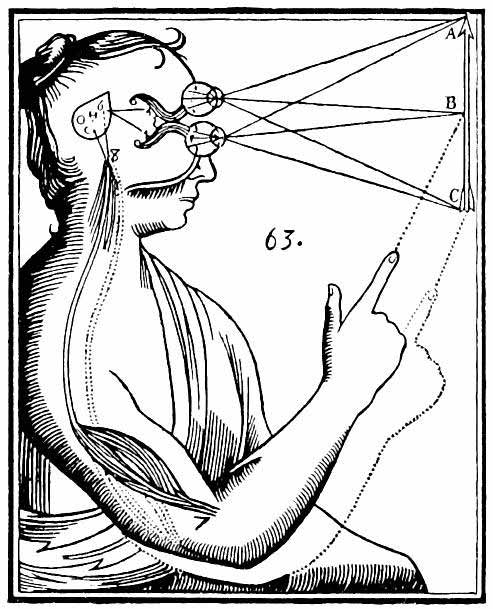
During the 1990ies, there was a wave of new research on the role of emotion in diverse areas such as psychology (e.g. Ellsworth & Scherer, 2003), neurology (e.g. LeDoux, 1996), medicine (e.g. Damasio, 1995), and sociology (e.g. Katz, 1999). Prior to this new wave of research, emotions had, as I mentioned, been considered to be a low-status topic of research, and researchers had mainly focused on how emotion got in the way of our rational thinking. Results at that point focused on issues like when getting really scared, pilots would get tunnel vision and stop being able to notice important changes in the flight’s surroundings. Being upset with a colleague and getting angry in the middle of a business meeting could sabotage the dialogue.  Or giving a presentation and becoming very nervous could make you loose the thread of the argument. Overall emotions were seen the less valued pair in the dualistic pair rational – emotional, and associated with body and female in the “mind – body”, “male – female” pairs. This dualistic conceptualisation goes back as far as to the Greek philosophers. In Western thinking, the division of mind and body was taken indisputable and, for example, Descartes looked for the gland that would connect the thoughts (inspired by God) with the actions of the body, Figure 12.1

René Descartes' illustration of dualism. Inputs are passed on by the sensory organs to the epiphysis in the brain and from there to the immaterial spirit.
Figure 12.1: René Descartes' illustration of dualism. Inputs are passed on by the sensory organs to the epiphysis in the brain and from there to the immaterial spirit.

But with this new wave of research in the 90ies, emotion was resurrected and given a new role. It became clear that emotions were the basis for behaving rationally. Without emotional processes we would not have survived. Being hunted by a predator (or enemy aircraft) requires focusing all our resources on escaping or attacking. Tunnel vision makes sense in that situation. Unless we can associate feelings of uneasiness with dangerous situations, as food we should not be eating, or people that aim to hurt us, we would make the same mistakes over and over, see Figure 12.2.

Focusing on enemy aircraft, getting tunnel vision.
Figure 12.2: Focusing on enemy aircraft, getting tunnel vision.

While fear and anger may seem as most important to our survival skills, our positive and more complex socially-oriented emotion experiences are also invaluable to our survival. If we do not understand the emotions of others in our group of primates, we cannot keep peace, share food, build alliances and friendships to share what the group can jointly create (Dunbar, 1997). To bring up our kids to function in this complex landscape of social relationships, experiences of shame, guilt, and embarrassment are used to foster their behaviour (Lutz 1986, Lutz 1988). But positive emotions also play an important role in bringing up our kids: conveying how proud we are of our kids, making them feel seen and needed by the adults, and unconditional love.

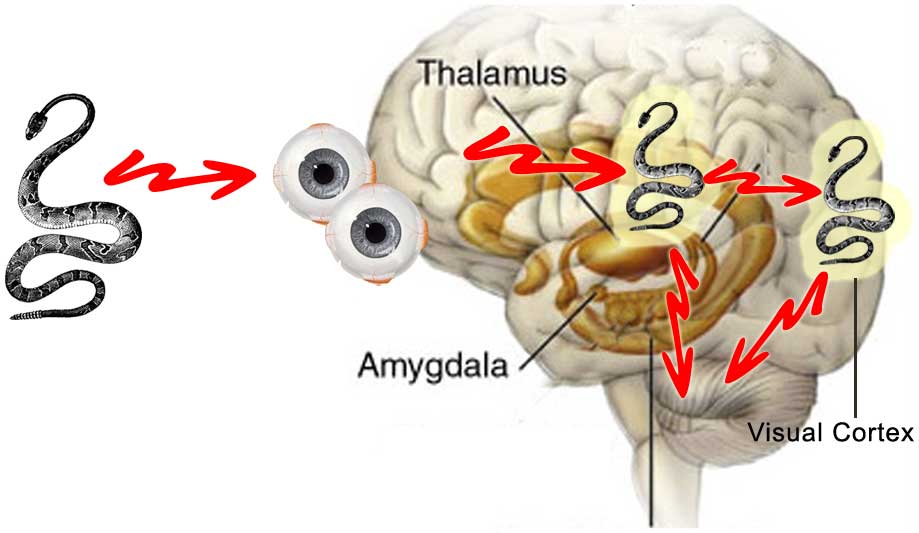
The new wave of research also questioned the old Cartesian dualistic division between mind and body. Emotional experiences are not residing in our minds or brains solely. They are experienced by our whole bodies: in hormone changes in our blood streams, nervous signals to muscles tensing or relaxing, blood rushing to different parts of the body, body postures, movements, facial expressions (Davidson et al., 2002). Our bodily reactions in turn feedback into our minds, creating experiences that regulate our thinking, in turn feeding back into our bodies. In fact, an emotional experience can start through body movements; for example, dancing wildly might make you happy. Neurologists have studied how the brain works and how emotion processes are a key part of cognition. Emotion processes are basically sitting in the middle of most processing going from frontal lobe processing in the brain, via brain stem to body and back (LeDoux, 1996), see Figure 12.3.

LeDoux’s model of fear when seeing a snake.
Figure 12.3: LeDoux’s model of fear when seeing a snake.

Bodily movements and emotion processes are tightly coupled. As discussed by the philosopher Maxine Sheets-Johnstone in The Corporeal Turn: A interdisciplinary reader, there is “a generative as well as expressive relationship between movement and emotion” (Sheets-Johnstone, 2009). Certain movements will generate emotion processes and vice-versa.

But an emotional experience is not only residing “inside” our bodies as processes going back and forth between different parts of our body, they are also in a sense spread over the social setting we are in (Katz, 1999, Lutz, 1986, Lutz 1988, Parkinson, 1996). Emotions are not (only) hard-wired processes in our brains, but changeable and interesting regulating processes for our social selves. As such, they are constructed in dialogue between ourselves and the culture and social settings we live in. Emotion is a social and dynamic communication mechanism. We learn how and when certain emotions are appropriate, and we learn the appropriate expressions of emotions for different cultures, contexts, and situations. The way we make sense of emotions is a combination of the experiential processes in our bodies and how emotions arise and are expressed in specific situations in the world, in interaction with others, coloured by cultural practices that we have learnt. We are physically affected by the emotional experiences of others. Smiles are contagious.

Catherine Lutz, for example, shows how a particular form of anger, named song by the people on the south Pacific atoll Ifaluk, serves an important socializing role in their society (Lutz, 1986, Lutz 1988). Song is, according to Lutz, “justifiable anger” and is used with kids and with those who are subordinate to you, to teach them appropriate behaviour in e.g. doing your fair share of the communal meal, failing to pay respect to elders, or acting socially inappropriately.

Ethnographic work by Jack Katz (1999) provides us with a rich account of how people individually and group-wise actively produce emotion as part of their social practices. He discusses, for example, how joy and laughter amongst visitors to a funny mirror show is produced and regulated between the friends visiting together. Moving to a new mirror, tentatively chuckling at the reflection, glancing at your friend, who in turn might move closer, might in the end result in ‘real’ laughter when standing together in front of the mirror. Katz also places this production of emotion into a larger complex social and societal setting when he discusses anger among car drivers in Los Angeles, see Figure 12.4. He shows how anger is produced as a consequence of a loss of embodiment with the car, the road, and the general experience of travelling. He connects the social situation on the road; the lack of communicative possibilities between cars and their drivers; our prejudice of other people’s driving skills related to their cultural background or ethnicity; etc.; and shows how all of it comes together explaining why anger is produced and when, for example, as we are cut off by another car. He even sees anger as a graceful way to regain a sense of embodiment.

Katz places the production of emotion into a larger complex social and societal setting when he discusses anger among car drivers in Los Angeles.
Figure 12.4: Katz places the production of emotion into a larger complex social and societal setting when he discusses anger among car drivers in Los Angeles.

12.2 Emotion in Technology?

A part of the new wave of research on emotion also affected research and innovation of new technology. In artificial intelligence, emotion had to be considered as an important regulatory process, determining behaviour in autonomous systems of various kinds, e.g. robots trying to survive in a dynamically changing world (see e.g. Cañamero, 2005).

In HCI, we understood the importance of considering users’ emotions explicitly in our design and evaluation processes. Broadly, the HCI research came to go in three different directions with three very different theoretical perspectives on emotion and design.

1. The first, widely known and very influential perspective is that of Rosalind Picard and her group at MIT, later picked up by many other groups, in Europe most notably by the HUMAINE network. The cognitivistically inspired design approach she named Affective Computing in her groundbreaking book from 1997.

2. The second design approach might be seen as a counter-reaction to Affective Computing. Instead of starting from a more traditional perspective on cognition and biology, the Affective Interaction approach starts from a constructive, culturally-determined perspective on emotion. Its most well-known proponents are Phoebe Sengers, Paul Dourish, Bill Gaver and to some extent myself (Boehner et al., 2007, Boehner et al. 2005, Gaver 2009, Sundström et al. 2007, Höök, 2006, Höök 2008, Höök 2009).

3. Finally, there are those who think that singling out emotion from the overall interaction leads us astray. Instead, they see emotion as part of a larger whole of experiences we may design for – we can name the movement Technology as Experience. In a sense, this is what traditional designers and artists have always worked with (see e.g. Dewey 1934) – creating for interesting experiences where some particular emotion is a cementing and congruous force that unites the different parts of the overall system of art piece and viewer/artist. Proponents of this direction are, for example, John McCarthy, Peter Wright, Don Norman and Bill Gaver (McCarthy & Wright, 2004, Norman, 2004, Gaver, 2009).

Let us develop these three directions in some more detail. They have obvious overlaps, and in particular, the Affective Interaction and Technology as Experience movements have many concepts and design aims in common. Still, if we simplify them and describe them as separate movements, it can help us to see the differences in their theoretical underpinnings. 

12.2.1 Affective Computing

The artificial intelligence (AI) field picked up the idea that human rational thinking depends on emotional processing. Rosalind Picard’s “Affective Computing” had a major effect on both the AI and HCI fields (Picard, 1997). Her idea, in short, was that it should be possible to create machines that relate to, arise from, or deliberately influence emotion or other affective phenomena. The roots of affective computing really came from neurology, medicine, and psychology. It implements a biologistic perspective on emotion processes in the brain, body, and interaction with others and with machines.

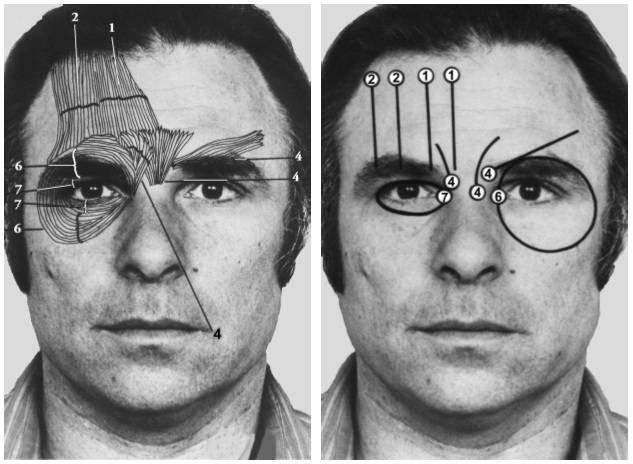
The most discussed and widespread approach in the design of affective computing applications is to construct an individual cognitive model of affect from what is often referred to as “first principles”, that is, the system generates its affective states and corresponding expressions from a set of general principles rather than having a set of hardwired signal-emotion pairs. This model is combined with a model that attempts to recognize the user’s emotional states through measuring the signs and signals we emit in face, body, voice, skin, or what we say related to the emotional processes going on. In Figure 12.5 we see for example how facial expressions, portraying different emotions, can be analysed and classified in terms of muscular movements.

Facial expressions from Ekman portraying anger, fear, disgust, surprose, happiness and sadness.
Figure 12.5: Facial expressions from Ekman portraying anger, fear, disgust, surprose, happiness and sadness.
Figure 5B: Facial muscles moving eyebrow and muscles around the eye when expressing different emotions.
Figure 12.6: Figure 5B: Facial muscles moving eyebrow and muscles around the eye when expressing different emotions.

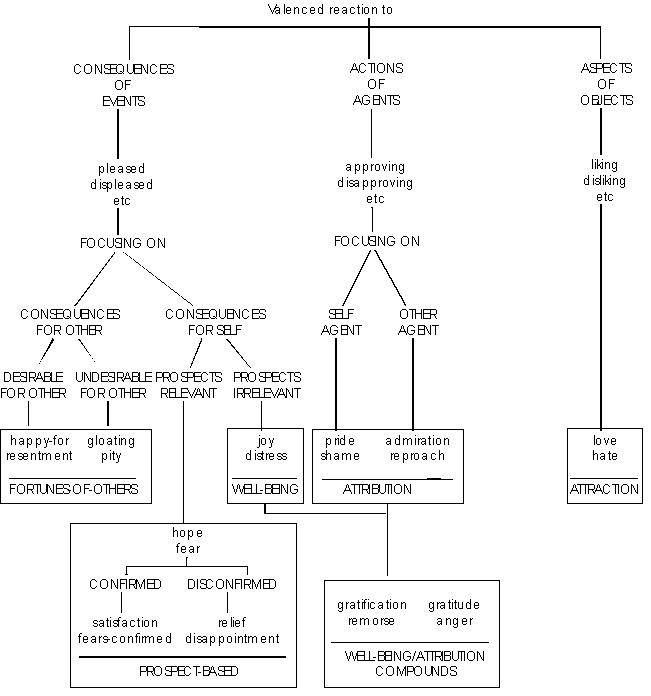
Emotions, or affects, in users are seen as identifiable states or at least identifiable processes. Based on the identified emotional state of the user, the aim is to achieve an interaction as life-like or human-like as possible, seamlessly adapting to the user’s emotional state and influencing it through the use of various expressions. This can be done through applying rules such as those brought forth by Ortony et al. 1988, see Figure 12.6.

A rule from the OCC-model (Ortony et al., 1988).
Figure 12.7: A rule from the OCC-model (Ortony et al., 1988).

This model has its limitations, both in its requirement for simplification of human emotion in order to model it, and in its difficult approach into how to infer the end-users emotional states through interpreting human behaviour through the signs and signals we emit. This said, it still provides for a very interesting way of exploring intelligence, both in machines and in people.

Examples of affective computing systems include, for example, Rosalind Picard and colleagues’ work on affective learning. It is well known that students’ results can be improved with the right encouragement and support (Kort et al., 2001). They therefore propose an emotion model built on James A. Russell’s circumplex model of affect relating phases of learning to emotions, see Figure 12.7. The idea is to build a learning companion that keeps track of what emotional state the student is in and from that decides what help she needs.
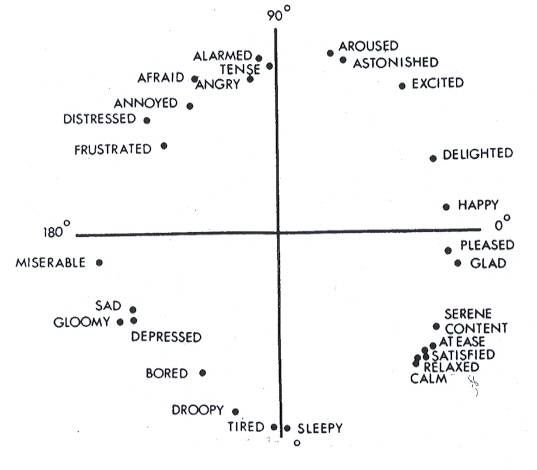
Russell's circumplex model of affect.
Figure 12.8: Russell's circumplex model of affect.

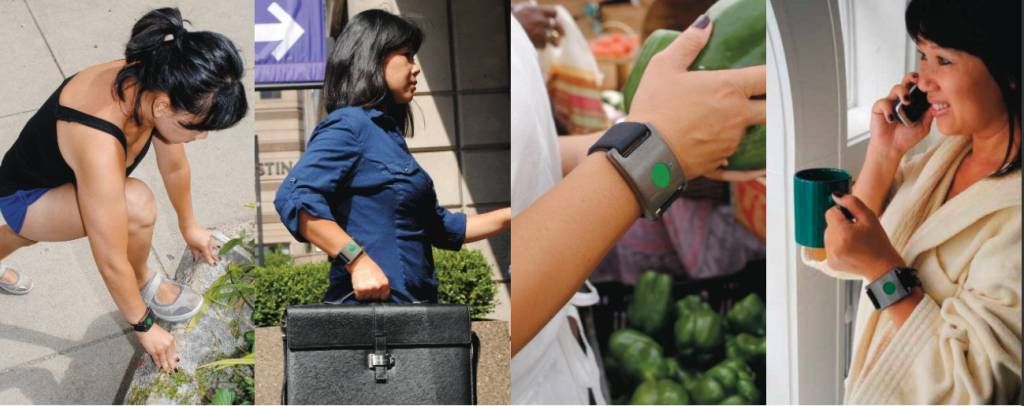
But the most interesting applications from Rosalind Picard’s group deal with important issues such as how to train autistic children to recognise emotional states in others and in themselves and act accordingly. In a recent spin-off company, named Affectiva, they put their understanding into commercial use – both for the autistic children, but also for recognising interest in commercials or dealing with stress in call centres. A sensor bracelet recognising Galvanic Skin Response (GSR) is used in their various applications, see Figure 12.8.

The bracelet, named Q Sensor, measures skin conductance which in turn is related to emotional arousal – both positive and negative.
Figure 12.9: The bracelet, named Q Sensor, measures skin conductance which in turn is related to emotional arousal – both positive and negative.

Other groups, like the HUMAINE network in Europe, starts from this way of seeing affective interaction.

Samples of Affector Output.
Figure 12.10: Samples of Affector Output.

12.2.2 Affective Interaction: The Interactional Approach

An affective interactional view is different from the affective computing approach in that it sees emotions as constructed in interaction, whereas a computer application supports people in understanding and experiencing their own emotions (Boehner et al., 2005, Boehner et al 2007, Höök et al., 2008, Höök 2008). An interactional perspective on design will not aim to detect a singular account of the “right” or “true” emotion of the user and tell them about it as in a prototypical affective computing application, but rather make emotional experiences available for reflection. Such a system creates a representation that incorporates people’s everyday experiences that they can reflect on. Users’ own, richer interpretation guarantees that it will be a more “true” account of what they are experiencing.

According to Kirsten Boehner & colleagues (2007)), the interactional approach to design:

  1. recognizes affect as a social and cultural product
  2. relies on and supports interpretive flexibility
  3. avoids trying to formalize the unformalizable
  4. supports an expanded range of communication acts
  5. focuses on people using systems to experience and understand emotions
  6. focuses on designing systems that stimulate reflection on and awareness of affect

Later, I and my colleagues added two minor modifications to this list (Höök et al., 2008):

  1. Modification of #1: The interactional approach recognizes affect as an embodied social, bodily and cultural product
  2. Modification of #3: The interactional approach is non-reductionist

The first change is related to the bodily aspects of emotional experiences. But explicitly pointing to them, we want to add some of the physical and bodily experiences that an interaction with an affective interactive system might entail. We also took a slightly different stance towards design principle number three, “the interactional approach avoids trying to formalize the unformalizable”, in Boehner and colleagues’ list of principles. To avoid reductionist ways of accounting for subjective or aesthetic experiences, Boehner and colleagues’ aim to protect these concepts by claiming that human experience is unique, interpretative, and ineffable. Such a position risks mystifying human experience, closing it off as ineffable and thereby enclosing it to be beyond study and discussion. While I wholeheartedly support the notion of unity of experience and support the idea of letting the magic of people’s lives remain unscathed, I do believe that it is possible to find a middle ground where we can actually speak about qualities of experiences and knowledge on how to design for them without reducing them to something less than the original. This does not in any way mean that the experiential strands, or qualities, are universal and the same for everyone. Instead they are subjective and experienced in their own way by each user (McCarthy & Wright, 2004).

A range of systems has been built to illustrate this approach, such as Affector (Sengers et al., 2005), the VIO (Kaye, 2006), eMoto (Sundström et al., 2009), Affective Diary (Ståhl et al., 2009) and Affective Health (Ferreira et al., 2010) – just to mention a few.

Affector is a distorted video window connecting neighbouring offices of two friends (and colleagues), see Figure 12.9. A camera located under the video screen captures video as well as 'filter' information such as light levels, colour, and movement. This filter information distorts the captured images of the friends that are then projected in the window of the neighbouring office. The friends determine amongst themselves what information is used as a filter and various kinds of distortion in order to convey a sense of each other's mood.

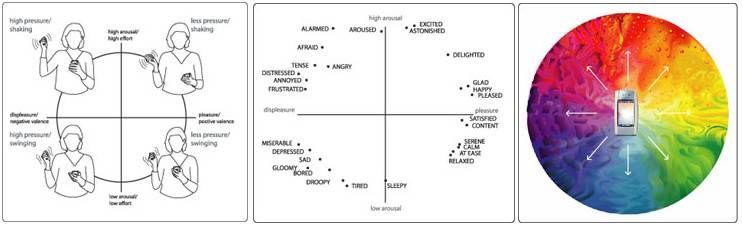
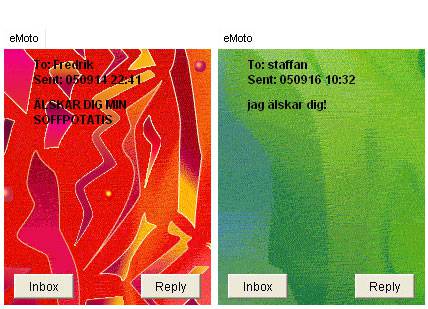
eMoto is an extended SMS-service for the mobile phone that lets users send text messages between mobile phones, but in addition to text, the messages also have colourful and animated shapes in the background (see examples in Figure 12.11). To choose an expression, you perform a set of gestures using the stylus pen (that comes with some mobile phones), which we had extended with sensors that could pick up on pressure and shaking movements. Users are not limited to any specific set of gestures but are free to adapt their gesturing style according to their personal preferences. The pressure and shaking movements can act as a basis for most emotional gestures people do, a basis that allows users to build their own gestures on top of these general characteristics, see Figure 12.11.

Different physical movements (left) that remind of the underlying affective experiences of the circumplex model of affect from Russell (middle), which is then mapped to a colourful, animated expression (right), also mapped to the circumplex model of affect.
Figure 12.11: Different physical movements (left) that remind of the underlying affective experiences of the circumplex model of affect from Russell (middle), which is then mapped to a colourful, animated expression (right), also mapped to the circumplex model of affect.
eMoto-messages sent to boyfriends in the final study of eMoto. On the left, a high energy expression of love from study participant Agnes to her boyfriend. On the right, Mona uses her favourite green colours to express her love for her boyfriend.
Figure 12.12: eMoto-messages sent to boyfriends in the final study of eMoto. On the left, a high energy expression of love from study participant Agnes to her boyfriend. On the right, Mona uses her favourite green colours to express her love for her boyfriend.

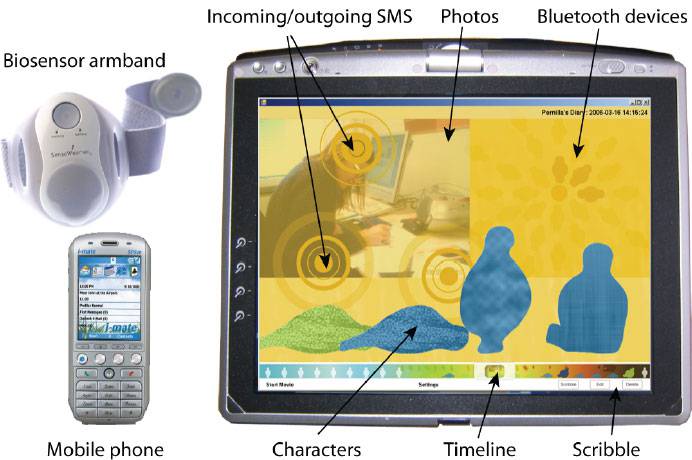
Affective Diary works as follows: as a person starts her day, she puts on a body sensor armband. During the day, the system collects time stamped sensor data picking up movement and arousal. At the same time, the system logs various activities on the mobile phone: text messages sent and received, photographs taken, and Bluetooth presence of other devices nearby. Once the person is back at home, she can transfer the logged data into her Affective Diary. The collected sensor data are presented as somewhat abstract, ambiguously shaped, and coloured characters placed along a timeline, see Figure 12.12. To help users reflect on their activities and physical reactions, the user can scribble diary-notes onto the diary or manipulate the photographs and other data, see example from one user in Figure 12.12.

The Affective Diary system. Bio-sensor data are represented by the blobby figures at the bottom of the screen. Mobile data are inserted in the top half of the screen along the same time-line as the blobby characters.
Figure 12.13: The Affective Diary system. Bio-sensor data are represented by the blobby figures at the bottom of the screen. Mobile data are inserted in the top half of the screen along the same time-line as the blobby characters.
A user says about this screendump: “[pointing at the orange character] And then I become like this, here I am kind of, I am kind of both happy and sad in some way and something like that. I like him and then it is so sad that we see each other so little. And then I cannot really show it.
Figure 12.14: A user says about this screendump: “[pointing at the orange character] And then I become like this, here I am kind of, I am kind of both happy and sad in some way and something like that. I like him and then it is so sad that we see each other so little. And then I cannot really show it.

As can be seen from all these three examples, an interactional approach to design tries to avoid reducing human experience to a set of measurements or inferences made by the system to interpret users’ emotional states. While the interaction of the system should not be awkward, the actual experiences sought might not only be positive ones. eMoto may allow you to express negative feelings about others. Affector may communicate your negative mood. Affective Diary might make negative patterns in your own behaviour painfully visible to you. An interactional approach is interested in the full (infinite) range of human experience possible in the world. 

12.2.3 Technology as Experience

While we have so far, in a sense, separated out emotion processes from other aspects of being in the world, there are those who posit that we need to take a holistic approach to understanding emotion. Emotion processes are part of our social ways of being in the world, they dye our dreams, hopes, and experiences of the world. If we aim to design for emotions, we need to place them in the larger picture of experiences, especially if we are going to address aspects of aesthetic experiences in our design processes (Gaver, 2009, McCarthy & Wright, 2004, Hassenzahl, 2008).

John Dewey, for example, distinguishes aesthetic experiences from other aspects of our life through placing it in-between two extremes on a scale (Dewey, 1934). On the one end of that scale,  we just drift and experience an unorganized flow of events in everyday life, and on the other end of the scale we experience events that do have a clear beginning and end but that only mechanically connect the events with one-another. Aesthetic experiences exist between those extremes. They have a beginning and an end; they can be uniquely named afterwards, e.g. “when I took those horseback riding lessons with Christian in Cambridge” (Höök, 2010), but in addition, the experience has a unity – there is a single quality that pervades the entire experience (Dewey 1934, p. 36-57):

An experience has a unity that gives it its name, that meal, that storm, that rupture of a friendship. The existence of this unity is constituted by a single quality that pervades the entire experience in spite of the variation of its constituent parts

In Dewey’s perspective, emotion is (Dewey, 1934 p. 44):

the moving and cementing force. It selects what is congruous and dyes what is selected with its color, thereby giving qualitative unity to materials externally disparate and dissimilar. It thus provides unity in and through the varied parts of an experience

However emotions are not static but change in time with the experience itself, just as a dramatic experience does (Dewey 1934, p. 43).

Joy, sorrow, hope, fear, anger, curiosity, are treated as if each in itself were a sort of entity that enters full-made upon the scene, an entity that may last a long time or a short time, but whose duration, whose growth and career, is irrelevant to its nature. In fact emotions are qualities, when they are significant, of a complex experience that moves and changes.

While an emotion process is not enough to create an aesthetic experience, emotions will be part of the experience and inseparable from the intellectual and bodily experiences. In such a holistic perspective, it will not make sense to talk about emotion processes as something separate from our embodied experience of being in the world.

Bill Gaver makes the same argument when discussing design for emotion (Gaver 2009). Rather than isolating emotion as if it is something that “can be canned as a tomato in a Campbell tomato soup” (as John Thackara phrased it when he criticised the work by Don Norman on the subject), we need to consider a broader view on interaction design, allowing for individual appropriation. Bill Gaver phrases it clearly when he writes:

Clearly, emotion is a crucial facet of experience. But saying that it is a ‘facet of experience’ suggests both that it is only one part of a more complex whole (the experience) and that it pertains to something beyond itself (an experience of something). It is that something—a chair, the home, the challenges of growing older—which is an appropriate object for design, and emotion is only one of many concerns that must be considered in addressing it. From this point of view, designing for emotion is like designing for blue: it makes a modifier a noun. Imagine being told to design something blue. Blue what? Whale? Sky? Suede shoes? The request seems nonsensical

If we look back at the Affector, eMoto, and Affective Diary systems, we see clearly that they are designed for something else than the isolation of emotion. Affector and eMoto are designed for and used for communication between people where emotion is one aspect of their overall communication. And, in fact, Affector turned out to not really be about emotion communication, but instead became a channel for a sympathetic mutual awareness of your friend in the other office.

12.3 Concluding remarks - some directions for the future

It seems obvious that we cannot ignore the importance of emotion processes when designing for experiences. On the other hand, designing as if emotion is a state that can be identified in users taken out of context, will not lead to interesting applications in this area. Instead, the knowledge on emotion processing needs to be incorporated in our overall design processes.

The work in all the three directions of emotion design outlined above contributes in different ways to our understanding of how to increase our knowledge on how to make emotion processes an important part of our design processes. The Affective Computing field has given us a range of tools for both affective input, such as facial recognition tools, voice recognition, body posture recognition, bio-sensor models, and tools for affective output e.g. emotion expression for characters in the interface or regulating robot behaviours. The Affective Interaction strand has contributed to an understanding of the socio-cultural aspects of emotion, situating them in their context, making sure that they are not only described as bodily processes beyond our control. The Technology as Experience-field has shifted our focus from emotion as an isolated phenomenon towards seeing emotion processes as one of the (important) aspects to consider when designing tools for people.

There are still many unresolved issues in all these three directions. In my own view, we have not yet done enough to understand and address the everyday, physical, and bodily experiences of emotion processes (e.g. Sundström et al., 2007, Ståhl et al., 2009, Höök et al., 2008, Ferreira et al., 2008, Ferreira et al., 2010, Sundström et al., 2009, Ferreira & Höök, 2011). Already Charles Darwin made a strong coupling between emotion and bodily movement (Darwin, 1872). Since then, researchers in areas as diverse as neurology (leDoux 1996, Davidson et al., 2003), philosophy and dance (Sheets-Johnstone, 1999, Laban & Lawrence, 1974), and theatre (Boal, 1992), describe the close coupling between readiness to action, muscular activity, and the co-occurrence of emotion.

I view our actual corporeal bodies as key in being in the world, in creating for experiences, learning and knowing, as Sheets-Johnstone has discussed (1999). Our bodies are not instruments or objects through which we communicate information. Communication is embodied – it involves our whole selves. In design, we have had a very limited view on what the body can do for us. Partly this was because the technology was not yet there to involve more senses, movements and richer modalities. Now, given novel sensing and actuator materials, there are many different kinds of bodily experiences we can envision designing for – mindfulness, affective loops, excitement, slow inwards listening, flow, reflection, or immersion (see e.g. Moen, 2006, Isbister & Höök, 2009, Hummels et al., 2007). In the recently emerging field of design for somaesthetics (Schiphorst, 2007), interesting aspects of bodily learning processes, leading to stronger body awareness are picked up and explicitly used in design. This can be contrasted with the main bulk of e.g. commercial sports applications, such as pedometers or pulse meters, where the body is often seen as an instrument or object for the mind, passively receiving sign and signals, but not actively being part of producing them. Recently, Purpura & colleagues (2011) made use of a critical design method to pinpoint some of the problems that follows from this view. Through describing a fake system, Fit4Life, measuring every aspect of what you eat, they arrive at a system that may whisper into your ear "I'm sorry, Dave, you shouldn't eat that. Dave, you know I don't like it when you eat donuts" just as you are about to grab a donut. This fake system shows how we may easily cross the thin line from persuasion to coercion, creating for technological control of our behavior and bodies. In my view, by designing applications with an explicit focus on aesthetics, somaesthetics, and empathy with ourselves and others, we can move beyond impoverished interaction modalities and treating our bodies as mere machines that can be trimmed and controlled, towards richer, more meaningful interactions based on our human ways of physically inhabiting our world.

We are just at the beginnings of unravelling many novel design possibilities as we approach emotions and experiences more explicitly in our design processes. This is a rich field of study that I hope will attract many young designers, design researchers and HCI-experts.


12.5 Commentary by Rosalind W. Picard

How to cite this commentary in your report

Picture of Rosalind W. Picard. © Rosalind W. Picard
Professor Rosalind W. Picard, Sc.D. is founder and director of the Affective Computing Research Group at the Massachusetts Institute of Technology (MIT) Media Laboratory, co-director of the Things That Think Consortium, the largest industrial sponsorship organization at the lab, and leader of the new and growing Autism & Communication Technology Initiative at MIT. She is co-founder, chie...   
Read more >> 

This was an interesting chapter for me to try to understand and there is a banquet here for discussion, although I only have time to address one of the main dishes.

First, I want to say that I greatly appreciate the work of Kia Höök and others she cites to develop technologies for enhancing people’s awareness of affect and helping people better reflect on and understand emotions, of self and others. I also deeply appreciate the work of designers to address holistic situations and design for people, including their feelings but also never only their feelings. These goals – creating interactions and designs that enhance affective understanding and that respond to the richness of human needs – are truly significant for improving much of what it means to be human. That said, I would like to correct an important misconception. Let me start with a story.

It was 1999 and Joe LeDoux, Antonio Damasio, and I had been invited to give talks on Emotion & Knowledge for the Barcelona Museum. The talks were simultaneously translated into multiple languages, giving me time to speak carefully and slowly in English, relying on the hard work of people more talented than I to translate into Catalan, Spanish, French, and more. It was a great experience overall – meeting fascinating people and engaging deeply in topics that were new and stimulating. But, there was one negative part that stands out in my memory.  At the reception, a dark, trim, middle-aged man came striding in my direction, red-faced, furrowed brow, gesturing sharply, and having a hard time speaking. I’ve never seen somebody so angry in a museum. I glanced around me, thinking he was targeting somebody nearby who tried to steal his wife, after all, I was just nibbling on a canape. But his anger was at me. I swallowed, listened carefully, and gradually came to understand that in the language he was hearing my talk translated, he heard me claim something to the effect of “We have built or could now build human emotion into computers.” I was actually extremely careful to NOT say that, but in his mind, I was denying the special feelings and experience we have that accompany human emotion, and reducing the great riches of our emotional experience entirely down to something like a text editor or game app. Listening to him, I realized that my careful choice of words in English, to say what we were doing precisely, and what I thought could be done, was translated inaccurately from my engineering culture, to his culture, which was social psychology.

In that reception, I learned, painfully, that what I meant by “modeling” was very different than what he heard when I said that word. I learned it was not enough to just be very careful with my words stating what we’re doing. I needed to also anticipate how people from different fields could misinterpret what I said. I needed to learn to make additional clarifying remarks of what I did not mean.  I should have said not only, “These are some of the mechanisms related to emotion that we are able to implement,” but also, “These are not all of what emotion is.” I should have said not only “by ‘mechanisms of’ I mean ‘Attempts to represent’,” but also, “Representing is not the same as reproducing.” I did not realize he would otherwise be led to the wrong conclusion.
 
Why do I bring up this story? Höök’s article refers to the Affective Computing approach as cognitivistic and reductionist, which is quite similar to the misunderstanding that happened in Barcelona in 1999.

When I speak or write of mechanisms of emotion, or models of emotion, I speak as an engineer trying to represent a complex phenomenon as best we can with tools we have: I do not confuse these representations with emotion itself. I am not a reductionist and Affective Computing is not reductionistic. I do not believe that emotion can be reduced to these representations, nor does Affective Computing claim this. I do not believe that emotion is “nothing but” the mechanisms we identify and build. The mechanisms we implement are not equivalent to the riches of human emotional experience, nor have I ever said that they will be: We have no evidence to make such claims. If people want to believe that emotions are entirely reducible to logical computation and bits, then that belief is based on faith, not science.

While people can write about any concept using information and bits, including emotion, I do not see evidence supporting the view that emotion can be fully reduced to bits and information. When I wrote Affective Computing, I knew many readers would be from AI, and would want to know how emotion might be implemented in machines, and so I described the parts of that process that I could envision. I was also very careful in my wording to not promote that such a method would be sufficient. However, I had not yet encountered the man in Barcelona, so one has to read my words carefully.

Unfortunately, if a person’s views are multi-dimensional, people will try to reduce them to one dimension, and conveniently peg them on one hook or the other. The process is rather like tidying up the foyer by hanging each jacket on whatever hook happens to be available and strong enough to hold it up. Cognitivism is a handy hook, promoting the belief that thought can be fully reduced to rules and algorithms.

Cognitivism was a strong influence for AI pioneers like my friend and colleague, Marvin Minsky, who kept telling me “Emotions are just a special kind of thought”, a sentence I disagreed with him on regularly and once get him to at least compromise by removing the word “just”. Marvin believed bodies were irrelevant, except during infancy when people needed to be touched, else (studies showed) they withered and died. I have met other pioneers in AI who thought similarly. I am not of their camp, and my writings in Affective Computing talk about the body and about aspects of conscious experience that we haven’t a clue how to implement in information and bits. There are some researchers who work in Affective Computing who hold a cognitivist view, but Affective Computing is not cognitivist.

Yes, Affective Computing includes some models and some researchers whose work might fit on a cognitivist hook, e.g. the cognitive rule-based models like OCC’s could hang on a cognitivist hook for people who believe that approach could fully account for emotion (I don’t). The stochastic signal-representing models of affect in speech or facial expression dynamics might hang on a different hook, and there are other hooks as well. The closet can be better organized than I have taken time to write about, especially as new garments keep arriving.  But don’t confuse the hooks with the house.

For some supportive examples, see “Chapter 1: Emotions are Physical and Cognitive” in Affective Computing (1997), containing some of my earliest writings on the need for a combined body-mind view in emotion research. That clearly does not fit on the cognitivist hook. Similarly, readers might be interested in the emphasis I placed on machines continusly co-creating interactions with people, taking into account not only emotion but also context and more, which resonates with the other areas Kia Höök’s article attempts to delineate (more examples are in “Chapter 8: Affective Wearables, see sections such as “Out of the lab and into the world.”) An affective technology does not have to use a formal AI model of emotion, or use discrete emotion recognition or a pattern classifier to fall under the area of affective computing.

But enough about organizing. I think the splitting and naming of pieces of a pie – whether it is an “affective computing pie” or some other kind of pie, is not as interesting as another question I see lurking behind the drive of some designers to separate themselves from a more objective engineering approach: Are emotions fully describable or are they ineffable?

In our work we have described emotion computationally and semantically, in numerous ways – discrete, dimensioned, numeric, semantic, as well as by quantifying creative behaviors, facial expressions, signal measurements of physiology and more. In no case do I think that we have “fully captured” human emotion with our models, methods, or descriptions. Something remains undescribed.

Affective computing often (but not always) tries to describe, objectively, more about emotion than has ever been described subjectively. Much of my work has pushed to make concrete, precise, in an engineering sense, measures of things that previously had only been addressed with words, self-report, questionnaires, whether applied to internal feelings or to outwardly observed behaviors. I am bothered by the way all subjective measurement methods are themselves influenced by emotion, and I want something more objective. Objective measures, however, do not imply reductionism any more than subjective measures imply reductionism. Both approaches “reduce” emotion to something – words, numbers, pictures, “blobby objects.” Using a representation is not being reductionistic. Reductionism is when people take an additional leap and say our emotions are “nothing but” what the computer is representing. The latter leap is one I have never promoted (except through mistranslated remarks).

When I closed my conversation with the man in Barcelona, we realized we were both deeply interested in better understanding emotion, and we realized that our perceived differences were actually not differences at all. Efforts to model do not imply a view of reductionism. Working to build representations that imitate some functions of emotions based on rules and categories does not mean cognitivism. Implementation of affective measures in bits does not mean emotion is only information. Affective computing creates tools toward greater goals – toward greater understanding of what makes us human. The man and I exchanged a hearty handshake and a smile before he departed.

I still have a lot to learn about communicating what we are trying to do with emotion – it’s a big topic, and it’s not one that just an engineering approach can conquer. I’m thrilled, as an engineer, to be sharing the journey with people from social psychology, design, neuroscience, AI, as well as many other arts and sciences.  Together we’ll figure out much more than if we set up different camps.

The original definition I gave of affective computing is broader than the one Kia paraphrases: Computing (includes machines, robots, phones, sensors, smart clothing, anything that can do computation) that relates to, arises from, or deliberately influences emotion or other affective phenomena. This was never just about AI or HCI, or about making intelligent machines, although those were the largest communities I was trying to convince to work on emotion at the time.

Perhaps I can be permitted to close, using the opening I wrote in 1997, which still rings true today:

In the course of this work I have come to appreciate all the more our own human needs for emotional development. It is my hope that this direction of research will encourage and enable us in this development – by no longer ignoring human emotions in human-computer interaction, by helping us become more aware of how we communicate, by providing testbeds for theories of emotion in learning and other functions, through animation of emotional characters and playful scenarios with which children can interact, by assisting scientists in collecting affective patterns, by helping advance research on understanding the role of emotion in preventive medicine, and more. It is my hope that affective computers, as tools to help us, will not just be more intelligent machines, but will also be companions in our endeavors to better understand how we are made, and so enhance our own humanity. (Preface to Affective Computing, 1997)


12.6 Commentary by Paul Hekkert

How to cite this commentary in your report

Picture of Paul Hekkert. © Paul Hekkert
Paul Hekkert is professor of Form Theory at the department of Industrial Design of Delft University of Technology. His main research interest is product experience, including product aesthetics, emotion, expressiveness, and attachment. Next, he is involved in design methodology and has co-developed an interaction-centred design approach, called ViP (Vision in Product design)....   
Read more >> 

Affective computing is an exiting discipline and Kristina Höök offers us some nice examples of what the field can bring. Wouldn't it be great if intelligent machines could somehow 'sense' what we feel when interacting with them and then adjust their actions accordingly? This is actually what the pioneers of affective computing saw as their challenge and this is what they have been after:

1. Is it possible to recognize people's emotional responses/states from their behavior, physiological responses or facial expressions, and
2. Can we make the system (e.g. computer, product, mobile device) take this information into account in appropriate responses? Rosalind Picard will correct me if I am wrong that these were and still are the main challenges of the AC discipline.

Is this reductionist? Sure it is, you can only measure a few indicators of people's emotional responses and each and every indicator (e.g. pressure exerted, skin conductance, heart rate variability, facial muscles) only tells a little part of the story. There are many behavioral, physiological and psychological sides to an emotion and we simply cannot tap them all. But what is the alternative? We want our measurements to be as non-invasive as possible. If we end up affecting people's behavior or even change their emotional states because of the way we are measuring, the whole purpose is lost. Preferably, we measure user's emotional responses without them being aware of it. The question is what each and every indicator of an emotion actually tells us (its validity) and how accurately – and unobtrusively – we can measure it. A lot of the work in AC has been put into these questions.

As an alternative, Kristina Höök proposes the "Interactional Approach" where the system allows users to reflect on their emotional experiences. This, however, does not eliminate the measurement problem as we can for example see in the "Affective Diary". This application registers movement and arousal as indicators of people's emotional state and transfers these data into shapes and colors as a form of feedback. If you aim to give people feedback on their feelings this is the 'appropriate response' you decided on and you have moved to the second challenge of AC: how to respond? And of course, the response you aim for very much depends on the type and function of the system. When I am typing a document in Word – as I am doing now – I do not want the system to give me continuous feedback on my emotional states, nor do I want to see these reflected in the words I type. But I may want the system to recognize that I am in a hurry, or impatient, or stressed, and subtly 'make me' slow down, without me being aware of it. Miguel Bruns Alonso recently explored this idea in the design of a pen that senses implicit behaviors related to restlessness and responds by providing inherent feedback to lower the stress level (Bruns Alonso et al., 2011).

So, is there an alternative to the measurement problem? In another example from Kristina Höök's chapter, she describes eMoto, an extended SMS-service that allows people to communicate their feelings in colorful and animated shapes. This type of 'measurement' – making users express their own emotions in words or images – only works when we are dealing with communication devices and is problematic for different reasons. First of all, it is obtrusive and not very recommendable if communicating emotions is not the design goal. But also, there are validity problems in people's verbal or non-verbal reports of their own emotions. All kind of social rules, demand characteristics (of the device?), and response styles may interfere with a valid report of your own feelings (see e.g. Mauss and Robinson, 2009 for a review of emotion measures).

And yes, I fully agree with Kristina that the role of our body is relatively unexplored in the AC field and offers a lot of potential, both to the recognition and response challenge. Given recent advances in cognitive science (see e.g. Johnson, 2007), where bodily experiences are increasingly recognized as being at the roots of our thinking and feeling, we may expect more and more studies – like Bruns Alonso's – in which our body is the main mediator. How else can we "grasp" the affective domain?

References

  • Bruns Alonso, M., Hummels, C.C.M., Keyson, D.V., & Hekkert, P. (Conditionally accepted). Measuring and adapting behavior during product interaction to influence affect. Personal and Ubiquitous Computing.
  • Johnson, M. (2007). The meaning of the body: Aesthetics of human understanding. Chicago: The University of Chicago Press.
  • Mauss, I.B. & Robinson, M.D. (2009). Measures of emotion: A review. Cognition and Emotion, 23, 209-237.


12.7 Commentary by Egon L. van den Broek

How to cite this commentary in your report

Picture of Egon L. van den Broek. © Egon L. van den Broek
Egon L. van den Broek, MSc (2001) in artificial intelligence, PhD (2005) in image retrieval, and PhD (2011) in affective computing. He is consultant and assistant professor (University of Twente and Radboud University Medical Center Nijmegen, The Netherlands). He guided 50+ students, has 150+ scientific publications, 5 patent applications, and various awards. Egon serves in boards of a...   
Read more >> 

On the bodily expressions of emotion, be aware: More than a century of research!

When thinking about this commentary, ideas popped up and emotions emerged. What to comment on? Kia Höök delivered an excellent chapter. She mentions three angles to approach emotion in technology from (cf. Van den Broek, 2011), namely: affective computing, affective interaction, and technology as experience. In this commentary, I will narrow the focus to affective computing solely. Furthermore, I have also chosen to take a step back and be so bold as to take a methodological perspective with a historical flavor. Why? Well, throughout the years I have discovered more and more literature that touches the core of affective computing but appears to be unknown (e.g., Arnold, 1968; Candland, 1962; Dunbar, 1954). This commentary is founded on two books from a time long before the term affective computing was coined, the 50s and 60s of the previous century. Both books are taken from completely distinct branches of science. Knowledge on science’s history can prevent us, both practitioners and scientists, from repeating mistakes. As such, this commentary touches upon the essence of science itself.

Kia Höök provides a concise overview of emotion in technology. She embraced affective interaction instead of affective computing. In contrast, in this commentary, I have taken the affective computing standpoint. Moreover, Kia Höök has taken a design perspective, where this commentary touches upon and questions the fundaments of emotions in technology. Lessons had been learned but have already been forgotten (Arnold, 1968; Candland, 1962; Dunbar, 1954). Consequently, affective computing tends to reinvent the wheel, at least to some extent. Yes, this is a bold claim, a very bold claim but I hope that after reading this commentary, you as a reader may share my concerns.

In 1954, 5 years before her death, Flanders Dunbar delivered the fourth edition of “Emotions and bodily changes: A survey of literature on psychosomatic interrelationships 1910-1953”. With this impressive volume, she provides an exhaustive and structured review of scientific literature of (roughly) the first half of the previous century on emotions and bodily changes. The volume's title is well chosen and reflects its content nicely. This makes this book undoubtedly valuable for the community of affective computing. However, as far as I know, outside my own work (e.g., Van den Broek, 2011), not a single reference is made to this book in any affective computing article, report, or book. I can only hope that I have missed quite a few ...

Flanders Dunbar starts her book (1954) with:

Nearly half a millennium B.C., Socrates came back from army service to report to his Greek countrymen that in one respect the barbarian Thracians were in advance of Greek civilization: They knew that the body could not be cured without the mind. “This,” he continued, “is the reason why the cure of many diseases is unknown to the physicians of Hellas, because they are ignorant of the whole.” It was Hippocrates, the Father of Medicine, who said: “In order to cure the human body it is necessary to have knowledge of the whole of things.” And Paracelsus wrote: “True medicine only arises from the creative knowledge of the last and deepest powers of the whole universe; only he who grasps the innermost nature of man, can cure him in earnest.” To us today this seems rather an impossible demand (p. 3).
 

Where the work of Dunbar illustrates that the origins of affective computing can be traced back to more than a century ago, this quote illustrates that knowledge on the interaction between body and mind was already known more than 25 centuries ago! Let us now identify some core concepts as mentioned in the quote from Dunbar (1954), which are crucial for affective computing.

The old Greek already noted that “the body could not be cured without the mind” (cf. Kia Höök’s chapter). So, both are indisputably related and, hence, in principle, the measurement of emotions should be feasible. This is well illustrated by the remark that “the cure of many diseases is unknown to the physicians of Hellas”, as the Greek culture was devoted to the body and not to the mind. Recent work confirmed this relation. For example, when chronic stress is experienced, similar physiological responses emerge as were present during the stressful events from which the stress originates. If such physiological responses persist, they can cause pervasive and structural chemical imbalances in people’s physiological systems, including their autonomic and central nervous system, their neuroendocrine system, their immune system, and even in their brain (Brosschot, 2010). This brings us to the need for the “knowledge of the whole of things”, a holistic view, perhaps closely related to what Kia Höök denotes as Technology as Experience. Although the previous enumeration of people’s physiological systems can give the impression that we are close to a holistic model, it should be noted that this is in sharp contrast with the current level of science. For example, with (chronic) stress, a thorough understanding is still missing. This can be explained by the complexity of human’s physiological systems, the continuous interaction of all systems, and their integral dynamic nature. However, Brosschot (2010) considers emotions as if these can be isolated and attributed to bodily processes only. I firmly agree with Kia Höök that dynamics beyond the body should also be taken into account. Moreover, as Kia Höök also notes, in relation to computing entities, the interaction consists of much more than emotions; however, the same is true when no computing is involved at all.

25 centuries ago scientists did not apply modern statistics; however, 1 century ago, scientists did already apply statistics; for example, Fisher invented the ANOVA class of statistical models in 1918. This provided the means to test and generalize findings on emotions and bodily changes and boosted the development of behavioral sciences in general (Dunbar, 1954). Moreover, this work fits into Rosalind W. Picard’s definition of affective computing: “… a set of ideas on what I call “affective computing,” computing that relates to, arises from, or influences emotions.” (Picard, 1995, p. 1) At least it fits when taken as the traditional interpretation of computing (i.e., to determine by mathematical means). However, the added value of affective computing would be its engineering component, in particular, signal processing and pattern recognition (Van den Broek, 2011). This would enable machines to sense emotions, reason about them, and perhaps develop them themselves. This would mark a new era of computing.

With the invention of computing machinery, shortly after World War II, a new type of statistics was developed: pattern recognition. In his edited volume “Methodologies of Pattern Recognition” (1969), Satosi Watanabe collected a set of papers that were presented or meant to be presented at the International Conference on Methodologies of Pattern Recognition in 1968. Watanabe started his book with defining pattern recognition:

To the layman’s ear, the term pattern recognition sounds like a very narrow esoteric field of electronic computer applications. But, actually, it is a vast and explicit endeavor at mechanization of the most fundamental human function of perception and concept formation (p. vii).
 

Watanabe denotes pattern recognition by computers as the “mechanization of the most fundamental human function of (i) perception and (ii) concept formation.”  Up to this date human pattern recognition in general is largely unsolved. We do not understand how we, as humans, process affective signals (Van den Broek, 2011). Moreover, the perception of signals and, subsequently, patterns is one thing; their interpretation in terms of emotions is something completely different. This issue refers to content validity; that is, (i) the agreement among experts on the domain of emotions; (ii) the degree to which a (low level) percept adequately represents an emotion; and (iii) the degree to which (a set of) percepts adequately represents all aspects of the emotions under investigation.

The issue of concept formation relates to the process of construct validation, which aims to develop a ground truth (or an ontology or semantic network), constructed around the emotions investigated. Such a framework requires theoretically grounded, observable, operational definitions of all constructs and the relations between them. Such a network aims to provide a verifiable theoretical framework. The lack of such a network is one of the most pregnant problems affective computing is coping with. Kia Höök describes emotions as if we can pinpoint them. Although intuitively this is indeed the case, in practice it proves to be very hard to define emotions (Duffy, 1941; Kleinginna & Kleinginna, 1981).

Par excellence, humans can recognize patterns in noisy environments. Moreover, the ease with which humans adapt to new situations, to new patterns remains striking. Moreover, this is in sharp contrast with the performance of signal processing and pattern recognition algorithms. Often, these perform well in a controlled environment; however, in the “real world” their performance deteriorates (Healey, 2008). This problem refers to the influence of the context on measurements, which is also denoted as ecological validity. Due to a lack of real world research, in general, the ecological validity of research on affective computing is limited and its use often still has to be shown in “real world” practice. However, as Kia Höök illustrates, some nice exceptions to this statement have been presented throughout the last decade.

In 1941, Elizabeth Duffy published her article “An explanation of ‘emotional’ phenomena without the use of the concept ‘emotion’” in which she starts by stating that she considers “… ‘emotion’, as a scientific concept, is worse than useless. … ‘Emotion’ apparently did not represent a separate and distinguishable condition.”  Although this statement is 60 years old it is still (or, again) up to date, perhaps even more than ever (cf. Kleinginna & Kleinginna, 1981). Almost fifty years later, in 1990, John T. Cacioppo and Louis G. Tassinary expressed a similar concern; however, they more generally addressed the complexity of psychophysiological relations. These “are conceptualized in terms of their specificity (e.g., one-to-one versus many-to-one) and their generality (e.g., situation or person specific versus cross-situational and pancultural).” (Cacioppo & Tassinary, 1990). They proposed a model, which yields four classes of psychophysiological relations: (a) outcomes, (b) concomitants, (c) markers, and (d) invariants.” Although Cacioppo and Tassinary (1990) discuss the influence of context, they do not operationalize it; hence, this discussion’s value for affective computing is limited. Nevertheless, articles such as this are food for thought. Regrettably, attempts such as this are rare in the community of affective computing; consequently, the field’s research methods are fragile and a solid theoretical framework is missing (Van den Broek, 2011).

To ensure sufficient advancement, it has been proposed to develop computing entities that respond on their user(s) physiological response(s), without the use of any interpretation of them in terms of emotions or cognitive processes (Tractinsky, 2004). This approach has been shown to be feasible for several areas of application. However, this approach also undermines the position of affective computing itself as a field of research. It suggests that emotion research has to mature further before affective computing can be brought to practice. This would be an honest conclusion but a crude one for the field of affective computing. It implies that affective computing should take a few steps back before making its leap forward. A good starting point for this process would be the hot topics on emotion research that Gross (2010, p. 215) summarized in his article “The future's so bright, I gotta wear shades” (see also Van den Broek, 2011).

Taken together, Kia Höök should be acknowledged for her concise overview of emotion in technology. In her chapter she takes the affective interaction standpoint. In contrast, with this commentary, I have taken an affective computing standpoint. Moreover, Kia Höök has taken a design perspective, where this commentary touches upon the fundaments of emotions in technology. I pose that if anything, affective computing has to learn more about its roots (e.g., Arnold, 1968; Candland, 1962; Dunbar, 1954); then, affective computing can and probably will have a bright future!

References

  • Arnold, M.B. (1968). The nature of emotion: Selected readings. Harmondsworth, Middlesex, England: Penguin Books Ltd.
  • Brosschot, J.F. (2010). Markers of chronic stress: Prolonged physiological activation and (un)conscious perseverative cognition. Neuroscience & Biobehavioral Reviews, 35(1), 46-50.
  • Cacioppo, J.T. and L. Tassinary, L.G. (1990). Inferring psychological significance from physiological signals. American Psychologist, 45(1), 16-28.
  • Candland, D.K. (1962). Emotion: Bodily change - An enduring problem in psychology, Selected readings. Princeton, NJ, USA: D. van Nostrand Company, Inc.
  • Duffy, E. (1941). An explanation of "emotional" phenomena without the use of the concept “emotion”. Journal of General Psychology, 25, 283-293.
  • Dunbar, F. (1954). Emotions and bodily changes: A survey of literature on psychosomatic interrelationships 1910—1953 (4th ed.). New York, NY, USA: Columbia University Press.
  • Fisher, R.A. (1918). The correlation between relatives on the supposition of Mendelian inheritance. Transactions of the Royal Society of Edinburgh, 52(2), 399-433.
  • Gross, J.J. (2010). The future's so bright, I gotta wear shades. Emotion Review, 2(3), 212-216.
  • Healey, J.A. (2008). Sensing affective experience. In J.H.D.M. Westerink, M. Ouwerkerk, T. Overbeek, W.F. Pasveer, and B. de Ruyter (Eds.), Probing Experience: From Academic Research to Commercial Propositions (Part II: Probing in order to feed back), Chapter 8, p. 91-100. Series: Philips Research Book Series, Vol. 8. Dordrecht, The Netherlands: Springer Science + Business Media B.V.
  • Kleinginna, P.R. and Kleinginna, A.M. (1981). A categorized list of emotion definitions, with a suggestion for a consensual definition. Motivation and Emotion, 5(4), 345-379.
  • Picard, R.W. (1995). Affective Computing. Technical Report No. 321. Perceptual Computing Section, M.I.T. Media Laboratory, Cambridge, MA, USA.
  • Tractinsky, N. (2004). Tools over solutions? Comments on Interacting with Computers special issue on affective computing. Interacting with Computers, 16(4), 751-757.
  • Van den Broek, E.L. (2011). Affective Signal Processing (ASP): Unraveling the mystery of emotions. PhD-thesis, Human Media Interaction (HMI), Faculty of Electrical Engineering, Mathematics, and Computer Science, University of Twente, Enschede, The Netherlands.
  • Watanabe, S. (1969). Methodologies of Pattern Recognition. New York, NY, USA: Academic Press, Inc.


12.8 Commentary by Joyce H. D. M. Westerink

How to cite this commentary in your report

Picture of Joyce H. D. M. Westerink. © Joyce H. D. M. Westerink
Joyce H.D.M. Westerink (1960) studied physics and took her Ph.D. in 1991 on the human-oriented topic of perceived image quality. She joined Philips Research and specialized on human perception, emotion and cognition related to consumer products. Written output of her work can be found in some 50 articles in books and international journals and 20 patents and patent applications....   
Read more >> 

Kristina Höök has given us an inspiring view of three directions of research targeted at the crossroads of technology and affect, namely (traditional) Affective Computing, Affective Interaction, and Technology as Experience. She emphasizes that each line of research has contributed to the development of applications for various types of users, since they are complementary in their approach. I can only underline this conclusion from my experiences in industrial research. A few aspects in particular I'd like to single out for further discussion.

Let me start with an assumption that is contained in this and many other texts and views on Affective Computing, but never stated explicitly, namely that for any viable application in this domain, you need a measurement of an emotion-relevant signal. This could be a camera signal, as in Affector, movement signals as in eMoto, or physiological signals as in the Affective Diary. Also much of our own effort has been spent in the pursuit of unobtrusive measurement techniques for emotion-related signals, like our skin conductance wristband (Ouwerkerk, 2011). However, to reach the goal of 'making a machine that deliberately ... influences emotion or other affective phenomena', measurement is not strictly needed. A case in point is any TV-set or MP3 player: we use them all the time to change our mood with music, or have a TV-show experience that propels us through a series of emotions. That it works is because people are similar in their reactions to a certain extent and because TV-show directors and music composers are very skilled in creating emotional experiences for the general audience, or for specific target groups. Nevertheless, in our domain of research, everyone tacitly assumes that measurement of emotion-related signals is necessary, and indeed it allows for a further refinement of the affective influencing. Especially for changes away from the average of the crowd, in the direction of adaptation to individuals. This means that ultimately, individual models are not only necessary in the Affective Interactional approach, as Kia Höök proposes, but also in the Affective Computing paradigm. With the emotion-related measurements aboard, we also immediately enter the domain of closed-loop applications (see Van Gerven et al., 2009, Van den Broek, 2011): the emotion-related measurements are interpreted in terms of affect, then a decision is made what actions are applicable (based on present and previous measurements), and these actions are executed, after which a new measurement is done to check the new situation, etc. etc. (see Figure 1). The closed-loop model basically describes that whenever there are measurement data available, they are used to try and achieve a better situation. In this way, one's (affective) state can be guided in a targeted direction. Our Affective Music Player (Janssen et al., 2011, Van der Zwaag et al., 2009), constructed in the best Affective-Computing tradition, can serve as an example: it measures my personal reactions to music, and uses this information to adapt the playlist to direct me (not others) to a certain chosen target mood. All in all, I conclude that emotion-related measurements, individual models, and closed-loop applications are tightly interlinked in any research line in our domain.

Emotional Closed Loop.
Figure 12.1: Emotional Closed Loop.

The affective closed loop in Figure 1 reserves a substantial part for interpretation of the emotion-related signal. This interpretation can be done by a human, as Kia Höök advocates along the lines of the Affective Interaction paradigm, and this human can either be the person that is measured (e.g. Affective Diary) or someone else (e.g. Affector). In both cases, the measurement information will be used to reflect on the situation measured, and if needed, to take action to change it (making it a closed loop indeed). If the raw emotion-related signals are presented, we will not stand the chance to lose information that is of value to the user, that is true. But on the other hand, this information might also be overwhelming (at least at first) and a user could benefit from help in the form of an interpretation made by an algorithm (in the Affecting Computing tradition). There is no need to make a choice between the two alternatives, we could think of implementing both. For instance, our electronic wristband does show the raw skin conductance/arousal patterns over the course of a day or week, but we can also give the user a discreet buzz (vibration alarm) whenever an algorithm interprets that tension has risen considerably. Of course, Kia Höök points out that it is difficult to make the correct interpretation as context is varying in many applications, and this is underlined by the fact that much of the research effort in affective computing has gone into algorithms deriving affective states from emotion-related signals. Nevertheless, there are options to try and overcome this: a technological approach is by adding additional sensors to monitor the context, like the accelerometer in our wristband that helps us estimate the activity level of the wearer and with that interpret the skin conductance signal. And another way out is by averaging over multiple measurements in varying circumstances to distil an overall effect. This is for instance done in our Affective Music Player, where the mood impact of a single song is modeled by taking the average affective effect (corrected for the Law of Initial Values) of multiple presentations, and this is proven to be good enough to select songs capable of directing one's mood to a certain state. Moreover, neither the raw emotion-related signal, nor its interpretation is presented to the user of our Affective Music Player: (s)he doesn't want to bother and only experiences that (s)he is brought into a different mood. Concluding, we find that both human and algorithm interpretation of emotion-related signals are important ingredients of future applications, and both are capable to deal with context to some extent.

Kia Höök argues that in normal life, emotions are always part of a larger experience, and that it is this larger experience that we need to support with our affective technology, in line with the Technology-as-Experience direction of research. This will certainly broaden the field of applications to include related fields in which emotions play a role. For example, emotions are important in communication, and building up relationships, and it is foreseeable that affective technologies can help (Janssen et al., 2010). It relates to the 'decide on actions' part of the closed loop in Figure 1: what do we want to do with the information gained? Nevertheless, the broadness of possible goals does not preclude that there are also applications that do have the goal to impact affect itself. A case in point is the Affective Music Player described before, which is exactly intended to direct affect, namely the mood. We have also shown (Van der Zwaag et al., 2011) that the optimal, individually selected, music can indeed help to prevent the emotion (or affective state) of anger in the frustrating traffic situations Kia Höök describes. On the other hand, I am not so sure whether consumers are interested in knowing or influencing their emotions. Despite the abundance of emotion-overloaded reality shows on TV, and despite the fact that emotion as a research topic has become fashionable in recent years, the general public still maintains a 'nice for others, not for me' attitude. In my view, this is related to the emotion/female versus rationality/male distinction Kia Höök mentions: The average male continues to see emotions as a female sign of weakness, of which they do not want to be reminded, not even if our measurement technology gives it a more masculine twist. For the females, it is the other way round: They do feel (more) comfortable with mood and emotions and acknowledge their impact on our everyday life, but they are less inclined to deploy masculine technology to alter them. For this reason also, I agree with Kia Höök , that our affective technologies are most likely to be used in applications that target a broader experience than that of affect alone.

To wrap up, let me highlight what I think is the most important message in Kia Höök 's story: That affective technologies will benefit from individual models (not only for human, but also for algorithm interpretation of the emotion-relate signals measured), and that they can be deployed in a wide range of applications extending far beyond the original domain of measuring and influencing affect. I am looking forward to see them appear incorporated in products and applications in the world around us....

References

  • Janssen, Bailenson, IJsselsteijn, & Westerink (2010), Intimate heartbeats: Opportunities for affective communication technology. IEEE Transactions on Affective Computing, Vol. 1, No 2, 72-80.
  • Janssen, Van den Broek, Westerink, Tune in to your emotions: A robust personalized affective music player, User Modeling and User-Adaptive Interaction, In Press.
  • Ouwerkerk (2011), Unobtrusive Emotions Sensing in Daily Life, in: Sensing Emotions. The Impact of Context on Experience Measurements (2011), Westerink, Krans, Ouwerkerk (eds.). Philips Research Book Series, volume 12, Springer, Dordrecht, The Netherlands, pages 21-39.
  • Van den Broek (2011), Affective Signal Processing, Unraveling the mystery of emotions, Ph.D. Thesis University of Twente.
  • Van der Zwaag, Westerink, Van den Broek (2009), Deploying music characteristics for an affective music player, Proceedings VOLUME I, 2009 International Conference on Affective Computing & Intelligent Interaction, ACII 2009, September 10-12, 2009, Amsterdam, The Netherlands, pages 459-465.
  • Van der Zwaag, Fairclough, Spiridon, Westerink (2011). The impact of music on affect during anger inducing drives. In S. Dmello et al. (Eds.), 4th international conference on affective computing and intelligent interaction. Part I, LNCS 6974 (pp. 407-416). Memphis, Tennessee, USA: Springer, Heidelberg.
  • Van Gerven, Farquhar, Schaefer, Vlek, Geuze, Nijholt, Ramsey, Haselager, Vuurpijl, Gielen and Desain (2009). The brain–computer interface cycle. Journal of Neural Engineering, Vol.6, No.4, 1-10.
 

12.4 Behind the scenes

Interviewing Kia Hook.
Figure 15: Interviewing Kia Hook.
Interviewing Kia Hook - setting up the equipment.
Figure 16: Interviewing Kia Hook - setting up the equipment.
Interviewing Kia Hook - setting up the equipment.
Figure 17: Interviewing Kia Hook - setting up the equipment.


12.9 User-contributed notes

Give us your opinion! Do you have any comments/additions
that you would like other visitors to see?

 
comment You (your email) say: May 7th, 2012
#1
Add a thoughtful commentary or note to this page ! 

your homepage, facebook profile, twitter, or the like
will be spam-protected
How many?
= e.g. "6"
By submitting you agree to the Site Terms
 

12.10 References

 what's this?

Boal, Augusto (1992): Games for Actors and Non-Actors. Routledge

Boehner, Kirsten, dePaula, Rogerio, Dourish, Paul and Sengers, Phoebe (2007): How emotion is made and measured. In International Journal of Human-Computer Studies, 65 (4) pp. 275-291

How we design and evaluate for emotions depends crucially on what we take emotions to be. In affective computing, affect is often taken to be another kind of information -- discrete units or states internal to an individual that can be transmitted in a loss-free manner from people to computational systems and back. While affective computing explicitly challenges the primacy of rationality in cognitivist accounts of human activity, at a deeper level it often relies on and reproduces the same information-processing model of cognition. Drawing on cultural, social, and interactional critiques of cognition which have arisen in human-computer interaction (HCI), as well as anthropological and historical accounts of emotion, we explore an alternative perspective on emotion as interaction: dynamic, culturally mediated, and socially constructed and experienced. We demonstrate how this model leads to new goals for affective systems -- instead of sensing and transmitting emotion, systems should support human users in understanding, interpreting, and experiencing emotion in its full complexity and ambiguity. In developing from emotion as objective, externally measurable unit to emotion as experience, evaluation, too, alters focus from externally tracking the circulation of emotional information to co-interpreting emotions as they are made in interaction.

© All rights reserved Boehner et al. and/or Academic Press

Boehner, Kirsten, dePaula, Rogerio, Dourish, Paul and Sengers, Phoebe (2005): Affect: from information to interaction. In: Bertelsen, Olav W., Bouvin, Niels Olof, Krogh, Peter Gall and Kyng, Morten (eds.) Proceedings of the 4th Decennial Conference on Critical Computing 2005 August 20-24, 2005, Aarhus, Denmark. pp. 59-68

While affective computing explicitly challenges the primacy of rationality in cognitivist accounts of human activity, at a deeper level it relies on and reproduces the same information-processing model of cognition. In affective computing, affect is often seen as another kind of information - discrete units or states internal to an individual that can be transmitted in a loss-free manner from people to computational systems and back. Drawing on cultural, social, and interactional critiques of cognition which have arisen in HCI, we introduce and explore an alternative model of emotion as interaction: dynamic, culturally mediated, and socially constructed and experienced. This model leads to new goals for the design and evaluation of affective systems - instead of sensing and transmitting emotion, systems should support human users in understanding, interpreting, and experiencing emotion in its full complexity and ambiguity.

© All rights reserved Boehner et al. and/or ACM Press

Cañamero, Lola (2005): Emotion understanding from the perspective of autonomous robots research. In Neural Networks, 18 (4) pp. 445-455

Damasio, Antonio R. (1995): Descartes' Error: Emotion, Reason, and the Human Brain. Harper Perennial

Darwin, Charles (0000): The Expression of the Emotions in Man and Animals. London, UK, John Murray

Davidson, Richard J., Scherer, Klaus R. and Goldsmith, H. Hill (2002b): Handbook of Affective Sciences. Oxford University Press, USA

Davidson, Richard J., Pizzagalli, Diego, Nitschke, Jack B. and Kalin, Ned H. (2002a): Parsing the subcomponents of emotion and disorders of emotion: perspectives from affective neuroscience. In: Davidson, Richard J., Scherer, Klaus R. and Goldsmith, H. Hill (eds.). "Handbook of Affective Sciences". Oxford University Press, USA

dePaula, Rogerio and Dourish, Paul (2005): Cognitive and Cultural Views of Emotions. In: Proceedings of the Human Computer Interaction Consortium Winter Meeting 2005, Douglas, CO, USA.

Dewey, John (1934): Art as Experience. Perigee Trade

Dunbar, Robin (1997): Grooming, Gossip, and the Evolution of Language. Harvard University Press

Dunbar, Robin (1998): Grooming, Gossip, and the Evolution of Language. Harvard University Press

Ellsworth, Phoebe C. and Scherer, Klaus R. (2003): Appraisal processes in emotion. In: Davidson, Richard J., Sherer, Klaus R. and Goldsmith, H. Hill (eds.). "Handbook of Affective Sciences". Oxford University Press, USA

Ferreira, Pedro and Höök, Kristina (2011): Bodily Orientations around Mobiles: Lessons learnt in Vanuatu. In: Proceedings of the ACM CHI Conference on Human Factors in Computing Systems 7-12 May, 2011, Vancouver, Canada.

Ferreira, Pedro, Sanches, Pedro, Höök, Kristina and Jaensson, Tove (2008): License to chill!: how to empower users to cope with stress. In: Proceedings of the Fifth Nordic Conference on Human-Computer Interaction 2008. pp. 123-132

There exists today a paucity of tools and devices that empower people to take control over their everyday behaviors and balance their stress levels. To overcome this deficit, we are creating a mobile service, Affective Health, where we aim to provide a holistic approach towards health by enabling users to make a connection between their daily activities and their own memories and subjective experiences. This construction is based upon values detected from certain bodily reactions that are then visualized on a mobile phone. Accomplishing this entailed figuring out how to provide real-time feedback without making the individual even more stressed, while also making certain that the representation empowered rather than controlled them. Useful design feedback was derived from testing two different visualizations on the mobile in a Wizard of Oz study. In short, we found that a successful design needs to: feel alive, allow for interpretative openness, include short-term history, and be updated in real-time. We also found that the interaction did not increase our participants stress reactions.

© All rights reserved Ferreira et al. and/or their publisher

Gaver, William (2009): Designing for emotion (among other things). In Philosophical Transactions of the Royal Society, 364 (1535) pp. 3597-3604

Using computational approaches to emotion in design appears problematic for a range of technical, cultural and aesthetic reasons. After introducing some of the reasons as to why I am sceptical of such approaches, I describe a prototype we built that tried to address some of these problems, using sensor-based inferencing to comment upon domestic ‘well-being’ in ways that encouraged users to take authority over the emotional judgements offered by the system. Unfortunately, over two iterations we concluded that the prototype we built was a failure. I discuss the possible reasons for this and conclude that many of the problems we found are relevant more generally for designs based on computational approaches to emotion. As an alternative, I advocate a broader view of interaction design in which open-ended designs serve as resources for individual appropriation, and suggest that emotional experiences become one of several outcomes of engaging with them.

© All rights reserved Gaver and/or Royal Society Publishing

Grosz, Elizabeth (1994): Volatile Bodies: Toward a Corporeal Feminism (Theories of Representation and Difference). Indiana University Press

Hummels, Caroline, Overbeeke, Kees and Klooster, Sietske (2007): Move to get moved: a search for methods, tools and knowledge to design for expressive and rich movement-based interaction. In Personal and Ubiquitous Computing, 11 (8) pp. 677-690

Hutchins, Edwin (1995): Cognition in the wild. Cambridge, Mass, MIT Press

Höök, Kristina (2009): Affective loop experiences: designing for interactional embodiment. In Philosophical Transactions of the Royal Society, 364 p. 3585–3595

Höök, Kristina (2008): Affective Loop Experiences - What Are They?. In: Oinas-Kukkonen, Harri, Hasle, Per F. V., Harjumaa, Marja, Segerståhl, Katarina and Øhrstrøm, Peter (eds.) PERSUASIVE 2008 - Persuasive Technology, Third International Conference June 4-6, 2008, Oulu, Finland. pp. 1-12

Höök, Kristina (2006): Designing familiar open surfaces. In: Proceedings of the Fourth Nordic Conference on Human-Computer Interaction 2006. pp. 242-251

While participatory design makes end-users part of the design process, we might also want the resulting system to be open for interpretation, appropriation and change over time to reflect its usage. But how can we design for appropriation? We need to strike a good balance between making the user an active co-constructor of system functionality versus making a too strong, interpretative design that does it all for the user thereby inhibiting their own creative use of the system. Through revisiting five systems in which appropriation has happened both within and outside the intended use, we are going to show how it can be possible to design with open surfaces. These open surfaces have to be such that users can fill them with their own interpretation and content, they should be familiar to the user, resonating with their real world practice and understanding, thereby shaping its use.

© All rights reserved Höök and/or ACM Press

Höök, Kristina (2010): Transferring qualities from horseback riding to design. In: Proceedings of the Sixth Nordic Conference on Human-Computer Interaction 2010. pp. 226-235

We see more and more attempts to design for bodily experiences with digital technology, but it is a notably challenging design task. What are the possible bodily experiences we may aim to design for, and how can we characterise them? By analysing a horseback riding experience, we came to identify the following themes: (1) how certain kinds of bodily experiences are best understood through experiencing them yourself -- the bodily ways of knowing, (2) how rhythm and balance create for particularly strong physical experiences of this kind, (3) how movement and emotion coincide in these experiences, (4) how the movement between seeing our own bodies as objects vs experiencing in and through our bodies is one of the ways we come to learn the language of expressing and understanding bodily action, and (5) how this in turn lets us describe the sensitive and delicate relationship of wordless signs and signals that represent, in the case described, two bodily agents -- a human and a horse. When the human-horse relationship is really successful, it can be described as rare moments of becoming a centaur. We translate these themes into design considerations for bodily interactions.

© All rights reserved Höök and/or his/her publisher

Höök, Kristina, Ståhl, Anna, Sundström, Petra and Laaksolaahti, Jarmo (2008): Interactional empowerment. In: Proceedings of ACM CHI 2008 Conference on Human Factors in Computing Systems April 5-10, 2008. pp. 647-656

We propose that an interactional perspective on how emotion is constructed, shared and experienced, may be a good basis for designing affective interactional systems that do not infringe on privacy or autonomy, but instead empowers users. An interactional design perspective may make use of design elements such as open-ended, ambiguous, yet familiar, interaction surfaces that users can use as a basis to make sense of their own emotions and their communication with one-another. We describe the interactional view on design for emotional communication, and provide a set of orienting design concepts and methods for design and evaluation that help translate the interactional view into viable applications. From an embodied interaction theory perspective, we argue for a non-dualistic, non-reductionist view on affective interaction design.

© All rights reserved Höök et al. and/or ACM Press

Isbister, Katherine and Höök, Kristina (2009): On being supple: in search of rigor without rigidity in meeting new design and evaluation challenges for HCI practitioners. In: Proceedings of ACM CHI 2009 Conference on Human Factors in Computing Systems 2009. pp. 2233-2242

In this paper, we argue that HCI practitioners are facing new challenges in design and evaluation that can benefit from the establishment of commonly valued use qualities, with associated strategies for producing and rigorously evaluating work. We present a particular use quality 'suppleness' as an example. We describe ways that use qualities can help shape design and evaluation process, and propose tactics for the CHI community to use to encourage the evolution of bodies of knowledge around use qualities.

© All rights reserved Isbister and Höök and/or ACM Press

Katz, Jack (2001): How Emotions Work. University of Chicago Press

Katz, Jack (1999): How Emotions Work. University of Chicago Press

Kaye, Joseph Jofish (2006): I just clicked to say I love you: rich evaluations of minimal communication. In: Olson, Gary M. and Jeffries, Robin (eds.) Extended Abstracts Proceedings of the 2006 Conference on Human Factors in Computing Systems April 22-27, 2006, Montréal, Québec, Canada. pp. 363-368

Kort, Barry, Reilly, Rob and Picard, Rosalind W. (2001): An Affective Model of Interplay between Emotions and Learning: Reengineering Educational Pedagogy - Building a Learning Companion. In: ICALT 2001 2001. pp. 43-48

Laban, Rudolf von and Lawrence, F. C. (1974): Effort: economy in body movement. Plays, inc

Ledoux, Joseph (1996): The Emotional Brain: The mysterious underpinnings of emotional life. Simon and Schuster

Ledoux, Joseph (1998): The Emotional Brain: The mysterious underpinnings of emotional life. Simon and Schuster

Longo, Giuseppe O. (2003): Body and Technology: Continuity or Discontinuity?. In: Fortunati, Leopoldina, Katz, James E. and Riccini, Raimonda (eds.). "Mediating the Human Body: Technology, Communication, and Fashion". Routledge

Lutz, Catherine (1986): Emotion, Thought, and Estrangement: Emotion as a Cultural Category. In Cultural Anthropology, 1 (3) pp. 287-309

Lutz, Catherine A. (1988): Unnatural Emotions: Everyday Sentiments on a Micronesian Atoll and Their Challenge to Western Theory. University of Chicago Press

McCarthy, John and Wright, Peter (2004): Technology as Experience. The MIT Press

Merleau-Ponty, Maurice (1958): Phenomenology of Perception. London, England, Routledge

Moen, Jin (2006). KinAesthetic Movement Interaction : Designing for the Pleasure of Motion (Doctoral Thesis). KTH

This thesis aims at identifying and exploring properties and design aspects of human movement when used as interaction modality between people and technology. The work has been carried out with a multidisciplinary approach and combines theories, methods and practices from various areas such as modern dance, pedagogy, behavioural science, human computer interaction and research through design.The research question asked in this work is: Which communicative aspects and properties of human full-body movement are important when designing for movement-based interaction, and how could such design be accomplished? This question has been dealt with through carrying out an explorative study of people experiencing dance-based human movement. The informants used were participants on a dance course called Physical Expression. On the basis of this study the following aspects of human movement were identified and discussed: Movement imitation, Movement generation, Natural movements, The meaning of movement, Personal space, Self-confidence, and Movement literacy. These notions were further explored, in relation to movement-based interaction design, through the design and implementation of an interaction concept and a research prototype called BodyBug. BodyBug can be described as an artefact that initiates and maintains bodily movements through its need to be fed with movement input. It gives the users a possibility to create and explore three-dimensional movements within a personal interaction space, both individually and in groups. BodyBug is a small device but does not necessary create small-scale interaction and movementsThe main findings from this research can be summarised in four theoretical notions that are related to human movement as a dynamic and communicative process: Movement Literacy, Personal Interaction Space, Imitate-React-Express and Social Acceptability. These notions reflect aspects of human movement such as the ability to verbalise, describe, sense and express intentions through human movement; the physical and emotional space we create when moving; the naturalness and understanding of movement; and finally, the social impact of movement. The design and implementation process of the interaction concept exemplifies how we can apply knowledge and physical experiences of human movement in concrete design for movement-based interaction. The design process of BodyBug is therefore described as a holistic design process. It also argues for the importance of, and need for, multidisciplinary competencies and contributions throughout the whole design process.This work has shown that making use of movement as interaction modality means to provide possibilities for getting to know one’s own movement pattern and thus utilising the kinaesthetic sense and kinaesthetic awareness. However, since movement-based interaction is still in its early phase, we need more experiences and physical examples of this kind of interaction in order to develop an increased knowledge of human movement as design material. We also need to further investigate how movement-based interaction is experienced, and to continue the search for the essence and physical grounding of human movement in relation to technology and computational artefacts. Some of the biggest challenges are to design for movement-based interaction without loosing the aspects of individual preferences and differences in movement, and to preserve the spontaneity and ambiguity in human movement. As shown in this thesis, one approach to deal with these issues is to design for the pleasure of motion.

© All rights reserved Moen and/or his/her publisher

Norman, Donald A. (2004): Emotional Design: Why We Love (Or Hate) Everyday Things. Basic Books

Ortony, Andrew, Clore, Gerald L. and Collins, Allan (1988): The Cognitive Structure of Emotions. Cambridge University Press

Ortony, Andrew, Clore, Gerald L. and Collins, Allan (1990): The Cognitive Structure of Emotions. Cambridge University Press

Parkinson, B. (1996): Emotions are social. In British Journal of Psychology, 87 p. 663–683

Picard, Rosalind W. (1997): Affective computing. Ma, USA, The MIT Press

Purpura, Stephen, Schwanda, Victoria, Williams, Kaiton, Stubler, William and Sengers, Phoebe (2011): Fit4life: the design of a persuasive technology promoting healthy behavior and ideal weight. In: Proceedings of ACM CHI 2011 Conference on Human Factors in Computing Systems 2011. pp. 423-432

This is a critical design paper offering a possible scenario of use intended to provoke reflection about values and politics of design in persuasive computing. We describe the design of a system -- Fit4Life -- that encourages individuals to address the larger goal of reducing obesity in society by promoting individual healthy behaviors. Using the Persuasive Systems Design Model [26], this paper outlines the Fit4Life persuasion context, the technology, its use of persuasive messages, and an experimental design to test the system's efficacy. We also contribute a novel discussion of the ethical and sociocultural considerations involved in our design, an issue that has remained largely unaddressed in the existing persuasive technologies literature [29].

© All rights reserved Purpura et al. and/or their publisher

Russell, James A. (1980): Circumplex Model of Affect. In Journal of Personality and Social Psychology, 39 (6) pp. 1161-1178

Sanches, Pedro, Höök, Kristina, Vaara, Elsa, Weymann, Claus, Bylund, Markus, Ferreira, Pedro, Peira, Nathalie and Sjölinder, Marie (2010): Mind the body!: designing a mobile stress management application encouraging personal reflection. In: Proceedings of DIS10 Designing Interactive Systems 2010. pp. 47-56

We have designed a stress management biofeedback mobile service for everyday use, aiding users to reflect on both positive and negative patterns in their behavior. To do so, we embarked on a complex multidisciplinary design journey, learning that: detrimental stress results from complex processes related to e.g. the subjective experience of being able to cope (or not) and can therefore not be measured and diagnosed solely as a bodily state. We learnt that it is difficult, sometimes impossible, to make a robust analysis of stress symptoms based on biosensors worn outside the laboratory environment they were designed for. We learnt that rather than trying to diagnose stress, it is better to mirror short-term stress reactions back to them, inviting their own interpretations and reflections. Finally, we identified several experiential qualities that such an interface should entail: ambiguity and openness to interpretation, interactive history of prior states, fluency and aliveness.

© All rights reserved Sanches et al. and/or their publisher

Schiphorst, Thecla (2007): Really, really small: the palpability of the invisible. In: Proceedings of the 2007 Conference on Creativity and Cognition 2007, Washington DC, USA. pp. 7-16

Our physical technology continues to grow smaller and smaller; so small that the computer itself is no longer seen as an object but a set of invisible distributed processes. Technology is becoming an inseparable aspect of experience, palpable yet invisible. At the same time, an extra-ordinary wealth of literature is emerging within human-computer interaction that is exploring experience, embodiment, subjectivity, and felt-life. This interest is often accompanied by research questions that are continuing to re-balance our understanding of the relationship between subjective and objective knowing, making, and doing. These emerging trends can be seen as a response to the phenomena of the really, really small: and marks a cognitive and creative shift from the visible to the invisible. This paper contextualizes the emerging recognition within HCI that there is value in designing for technology as experience, and offers a framework from the field of Somatics that can contribute to the discourse, particularly with regard to the body in everyday life. Somatics is exemplified through first-person methodologies and embodied approaches to learning and interacting. I present a set of design cases that demonstrate its application within HCI.

© All rights reserved Schiphorst and/or ACM Press

Sengers, Phoebe, Boehner, Kirsten, Warner, Simeon and Jenkins, Tom (2005): Evaluating Affector: Co-Interpreting What 'Works'. In: CHI 2005 Workshop on Innovative Approaches to Evaluating Affective Systems 2005.

Sheets-Johnstone, Maxine (2009): The Corporeal Turn: An Interdisciplinary Reader. Imprint Academic

Sheets-Johnstone, M. (1999): Emotion and Movement: A beginning Empirical-Phenomenological Analysis of Their Relationship. In Journal of Consciousness Studies, 6 (11) pp. 259-277

Shusterman, Richard (2008): Body Consciousness: A Philosophy of Mindfulness and Somaesthetics. Cambridge University Press

Ståhl, Anna, Höök, Kristina, Svensson, Martin, Taylor, Alex S. and Combetto, Marco (2009): Experiencing the Affective Diary. In Personal and Ubiquitous Computing, 13 (5) pp. 365-378

Sundström, Petra, Ståhl, Anna and Höök, Kristina (2007): In situ informants exploring an emotional mobile messaging system in their everyday practice. In International Journal of Human-Computer Studies, 65 (4) pp. 388-403

We have designed and built a mobile emotional messaging system named eMoto. With it, users can compose messages through using emotion-signalling gestures as input, rendering a message background of colours, shapes and animations expressing the emotional content. The design intent behind eMoto was that it should be engaging physically, intellectually and socially, and allow users to express themselves emotionally in all those dimensions, involving them in an affective loop experience. In here, we describe the user-centred design process that lead to the eMoto system, but focus mainly on the final study where we let five friends use eMoto for two weeks. The study method, which we name in situ informants, helped us enter and explore the subjective and distributed experiences of use, as well as how emotional communication unfolds in everyday practice when channelled through a system like eMoto. The in situ informants are on the one hand users of eMoto, but also spectators, that are close friends who observe and document user behaviour. Design conclusions include the need to support the sometimes fragile communication rhythm that friendships require -- expressing memories of the past, sharing the present and planning for the future. We saw that emotions are not singular state that exist within one person alone, but permeates the total situation, changing and drifting as a process between the two friends communicating. We also gained insights into the under-estimated but still important physical, sensual aspects of emotional communication. Experiences of the in situ informants method pointed to the need to involve participants in the interpretation of the data obtained, as well as establishing a closer connection with the spectators.

© All rights reserved Sundström et al. and/or Academic Press

Sundström, Petra, Jaensson, Tove, Höök, Kristina and Pommeranz, Alina (2009): Probing the potential of non-verbal group communication. In: GROUP09 - International Conference on Supporting Group Work 2009. pp. 351-360

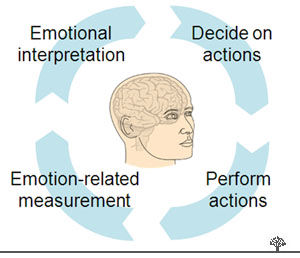
Designing for non-verbal communication using e.g. gestures and other bodily expressions is difficult. Hardware and software need to be co-designed and harmonize in order to not throw users out of their embodied experience. We aim to design for kinaesthetic expressions of emotion in communication between friends -- in this case, colleagues at work. A probe was built using sensor node technology designed to let users express themselves and their emotional state to a public and shared display where the expressions together formed a collective art piece expressing the individuals but also the group as a whole. Two groups of colleagues used the probe during two weeks. It came to serve as a channel in which some conflicts and expressions of social relations were acted out which were not openly discussed in the office. It exposed different roles and balances in relationships in the group. Finally, the probe taught us the importance of balancing the design for joint group expression and individual, personal expressions. The study also allowed the participants to experience the sensor node-'material' -- enabling a participatory design process.

© All rights reserved Sundström et al. and/or their publisher

Changes to this chapter

17 Jan 2012: Added
12 Jan 2012: Modified

About this chapter

Author(s): Kristina Höök
Editors: Rikke Friis Dam, Mads Soegaard and Allan Holstein-Rathlou
Reviewer 1: Name suppressed
Reviewer 2: Name suppressed

Peer-review is based on the reviewing guidelines and coordinated by the Reviewing Board.
Commentaries by: Rosalind W. Picard, Paul Hekkert, Egon L. van den Broek and Joyce H. D. M. Westerink
This encyclopedia chapter has undergone double-blinded peer-review by two reviewers based on the reviewing guidelines, language copy-editing, typesetting, and reference validation.

How to cite/reference this page
This is a printerfriendly version of http://www.interaction-design.org/encyclopedia/affective_computing.html

Licensed through a Creative Commons licence Open Access

We believe in Open Access and the democratization of knowledge. Unfortunately, world class educational materials are normally hidden behind payment systems or in expensive textbooks. If you want this to change, you should help us out! Kind thoughts are not enough - you need to act!
Copyright Terms
We do NOT use copyright as a restrictive instrument, but as an instrument to protect the author against misuse while encouraging redistribution and use of his/her work. As such, these copyright terms are designed for the author and the reader, not the publisher and the profit.

Except as otherwise noted, this page/work is copyright of Kristina Höök and The Interaction-Design.org Foundation (Chr. Molbechs Vej 4, DK-8000 Aarhus C, Denmark) and is licensed under the following terms:
  1. The Creative Commons Attribution-NoDerivs Licence
  2. The Interaction-Design.org Addendum to the Creative Commons licence

...with the exception of materials described in...:

  1. "Exceptions"

Furthermore, your use of Interaction-Design.org signifies your consent to:

  1. the "Site Terms and Conditions"
i. Creative Commons Attribution-NoDerivs 3.0 Unported

The Creative Commons Attribution-NoDerivs 3.0 Unported License

THE WORK (AS DEFINED BELOW) IS PROVIDED UNDER THE TERMS OF THIS CREATIVE COMMONS PUBLIC LICENSE ("CCPL" OR "LICENSE"). THE WORK IS PROTECTED BY COPYRIGHT AND/OR OTHER APPLICABLE LAW. ANY USE OF THE WORK OTHER THAN AS AUTHORIZED UNDER THIS LICENSE OR COPYRIGHT LAW IS PROHIBITED.

BY EXERCISING ANY RIGHTS TO THE WORK PROVIDED HERE, YOU ACCEPT AND AGREE TO BE BOUND BY THE TERMS OF THIS LICENSE. TO THE EXTENT THIS LICENSE MAY BE CONSIDERED TO BE A CONTRACT, THE LICENSOR GRANTS YOU THE RIGHTS CONTAINED HERE IN CONSIDERATION OF YOUR ACCEPTANCE OF SUCH TERMS AND CONDITIONS.

1. Definitions

  1. "Adaptation" means a work based upon the Work, or upon the Work and other pre-existing works, such as a translation, adaptation, derivative work, arrangement of music or other alterations of a literary or artistic work, or phonogram or performance and includes cinematographic adaptations or any other form in which the Work may be recast, transformed, or adapted including in any form recognizably derived from the original, except that a work that constitutes a Collection will not be considered an Adaptation for the purpose of this License. For the avoidance of doubt, where the Work is a musical work, performance or phonogram, the synchronization of the Work in timed-relation with a moving image ("synching") will be considered an Adaptation for the purpose of this License.
  2. "Collection" means a collection of literary or artistic works, such as encyclopedias and anthologies, or performances, phonograms or broadcasts, or other works or subject matter other than works listed in Section 1(f) below, which, by reason of the selection and arrangement of their contents, constitute intellectual creations, in which the Work is included in its entirety in unmodified form along with one or more other contributions, each constituting separate and independent works in themselves, which together are assembled into a collective whole. A work that constitutes a Collection will not be considered an Adaptation (as defined above) for the purposes of this License.
  3. "Distribute" means to make available to the public the original and copies of the Work through sale or other transfer of ownership.
  4. "Licensor" means the individual, individuals, entity or entities that offer(s) the Work under the terms of this License.
  5. "Original Author" means, in the case of a literary or artistic work, the individual, individuals, entity or entities who created the Work or if no individual or entity can be identified, the publisher; and in addition (i) in the case of a performance the actors, singers, musicians, dancers, and other persons who act, sing, deliver, declaim, play in, interpret or otherwise perform literary or artistic works or expressions of folklore; (ii) in the case of a phonogram the producer being the person or legal entity who first fixes the sounds of a performance or other sounds; and, (iii) in the case of broadcasts, the organization that transmits the broadcast.
  6. "Work" means the literary and/or artistic work offered under the terms of this License including without limitation any production in the literary, scientific and artistic domain, whatever may be the mode or form of its expression including digital form, such as a book, pamphlet and other writing; a lecture, address, sermon or other work of the same nature; a dramatic or dramatico-musical work; a choreographic work or entertainment in dumb show; a musical composition with or without words; a cinematographic work to which are assimilated works expressed by a process analogous to cinematography; a work of drawing, painting, architecture, sculpture, engraving or lithography; a photographic work to which are assimilated works expressed by a process analogous to photography; a work of applied art; an illustration, map, plan, sketch or three-dimensional work relative to geography, topography, architecture or science; a performance; a broadcast; a phonogram; a compilation of data to the extent it is protected as a copyrightable work; or a work performed by a variety or circus performer to the extent it is not otherwise considered a literary or artistic work.
  7. "You" means an individual or entity exercising rights under this License who has not previously violated the terms of this License with respect to the Work, or who has received express permission from the Licensor to exercise rights under this License despite a previous violation.
  8. "Publicly Perform" means to perform public recitations of the Work and to communicate to the public those public recitations, by any means or process, including by wire or wireless means or public digital performances; to make available to the public Works in such a way that members of the public may access these Works from a place and at a place individually chosen by them; to perform the Work to the public by any means or process and the communication to the public of the performances of the Work, including by public digital performance; to broadcast and rebroadcast the Work by any means including signs, sounds or images.
  9. "Reproduce" means to make copies of the Work by any means including without limitation by sound or visual recordings and the right of fixation and reproducing fixations of the Work, including storage of a protected performance or phonogram in digital form or other electronic medium.

2. Fair Dealing Rights. Nothing in this License is intended to reduce, limit, or restrict any uses free from copyright or rights arising from limitations or exceptions that are provided for in connection with the copyright protection under copyright law or other applicable laws.

3. License Grant. Subject to the terms and conditions of this License, Licensor hereby grants You a worldwide, royalty-free, non-exclusive, perpetual (for the duration of the applicable copyright) license to exercise the rights in the Work as stated below:

  1. to Reproduce the Work, to incorporate the Work into one or more Collections, and to Reproduce the Work as incorporated in the Collections; and,
  2. to Distribute and Publicly Perform the Work including as incorporated in Collections.
  3. For the avoidance of doubt:

    1. Non-waivable Compulsory License Schemes. In those jurisdictions in which the right to collect royalties through any statutory or compulsory licensing scheme cannot be waived, the Licensor reserves the exclusive right to collect such royalties for any exercise by You of the rights granted under this License;
    2. Waivable Compulsory License Schemes. In those jurisdictions in which the right to collect royalties through any statutory or compulsory licensing scheme can be waived, the Licensor waives the exclusive right to collect such royalties for any exercise by You of the rights granted under this License; and,
    3. Voluntary License Schemes. The Licensor waives the right to collect royalties, whether individually or, in the event that the Licensor is a member of a collecting society that administers voluntary licensing schemes, via that society, from any exercise by You of the rights granted under this License.

The above rights may be exercised in all media and formats whether now known or hereafter devised. The above rights include the right to make such modifications as are technically necessary to exercise the rights in other media and formats, but otherwise you have no rights to make Adaptations. Subject to Section 8(f), all rights not expressly granted by Licensor are hereby reserved.

4. Restrictions. The license granted in Section 3 above is expressly made subject to and limited by the following restrictions:

  1. You may Distribute or Publicly Perform the Work only under the terms of this License. You must include a copy of, or the Uniform Resource Identifier (URI) for, this License with every copy of the Work You Distribute or Publicly Perform. You may not offer or impose any terms on the Work that restrict the terms of this License or the ability of the recipient of the Work to exercise the rights granted to that recipient under the terms of the License. You may not sublicense the Work. You must keep intact all notices that refer to this License and to the disclaimer of warranties with every copy of the Work You Distribute or Publicly Perform. When You Distribute or Publicly Perform the Work, You may not impose any effective technological measures on the Work that restrict the ability of a recipient of the Work from You to exercise the rights granted to that recipient under the terms of the License. This Section 4(a) applies to the Work as incorporated in a Collection, but this does not require the Collection apart from the Work itself to be made subject to the terms of this License. If You create a Collection, upon notice from any Licensor You must, to the extent practicable, remove from the Collection any credit as required by Section 4(b), as requested.
  2. If You Distribute, or Publicly Perform the Work or Collections, You must, unless a request has been made pursuant to Section 4(a), keep intact all copyright notices for the Work and provide, reasonable to the medium or means You are utilizing: (i) the name of the Original Author (or pseudonym, if applicable) if supplied, and/or if the Original Author and/or Licensor designate another party or parties (e.g., a sponsor institute, publishing entity, journal) for attribution ("Attribution Parties") in Licensor's copyright notice, terms of service or by other reasonable means, the name of such party or parties; (ii) the title of the Work if supplied; (iii) to the extent reasonably practicable, the URI, if any, that Licensor specifies to be associated with the Work, unless such URI does not refer to the copyright notice or licensing information for the Work. The credit required by this Section 4(b) may be implemented in any reasonable manner; provided, however, that in the case of a Collection, at a minimum such credit will appear, if a credit for all contributing authors of the Collection appears, then as part of these credits and in a manner at least as prominent as the credits for the other contributing authors. For the avoidance of doubt, You may only use the credit required by this Section for the purpose of attribution in the manner set out above and, by exercising Your rights under this License, You may not implicitly or explicitly assert or imply any connection with, sponsorship or endorsement by the Original Author, Licensor and/or Attribution Parties, as appropriate, of You or Your use of the Work, without the separate, express prior written permission of the Original Author, Licensor and/or Attribution Parties.
  3. Except as otherwise agreed in writing by the Licensor or as may be otherwise permitted by applicable law, if You Reproduce, Distribute or Publicly Perform the Work either by itself or as part of any Collections, You must not distort, mutilate, modify or take other derogatory action in relation to the Work which would be prejudicial to the Original Author's honor or reputation.

5. Representations, Warranties and Disclaimer

UNLESS OTHERWISE MUTUALLY AGREED TO BY THE PARTIES IN WRITING, LICENSOR OFFERS THE WORK AS-IS AND MAKES NO REPRESENTATIONS OR WARRANTIES OF ANY KIND CONCERNING THE WORK, EXPRESS, IMPLIED, STATUTORY OR OTHERWISE, INCLUDING, WITHOUT LIMITATION, WARRANTIES OF TITLE, MERCHANTIBILITY, FITNESS FOR A PARTICULAR PURPOSE, NONINFRINGEMENT, OR THE ABSENCE OF LATENT OR OTHER DEFECTS, ACCURACY, OR THE PRESENCE OF ABSENCE OF ERRORS, WHETHER OR NOT DISCOVERABLE. SOME JURISDICTIONS DO NOT ALLOW THE EXCLUSION OF IMPLIED WARRANTIES, SO SUCH EXCLUSION MAY NOT APPLY TO YOU.

6. Limitation on Liability. EXCEPT TO THE EXTENT REQUIRED BY APPLICABLE LAW, IN NO EVENT WILL LICENSOR BE LIABLE TO YOU ON ANY LEGAL THEORY FOR ANY SPECIAL, INCIDENTAL, CONSEQUENTIAL, PUNITIVE OR EXEMPLARY DAMAGES ARISING OUT OF THIS LICENSE OR THE USE OF THE WORK, EVEN IF LICENSOR HAS BEEN ADVISED OF THE POSSIBILITY OF SUCH DAMAGES.

7. Termination

  1. This License and the rights granted hereunder will terminate automatically upon any breach by You of the terms of this License. Individuals or entities who have received Collections from You under this License, however, will not have their licenses terminated provided such individuals or entities remain in full compliance with those licenses. Sections 1, 2, 5, 6, 7, and 8 will survive any termination of this License.
  2. Subject to the above terms and conditions, the license granted here is perpetual (for the duration of the applicable copyright in the Work). Notwithstanding the above, Licensor reserves the right to release the Work under different license terms or to stop distributing the Work at any time; provided, however that any such election will not serve to withdraw this License (or any other license that has been, or is required to be, granted under the terms of this License), and this License will continue in full force and effect unless terminated as stated above.

8. Miscellaneous

  1. Each time You Distribute or Publicly Perform the Work or a Collection, the Licensor offers to the recipient a license to the Work on the same terms and conditions as the license granted to You under this License.
  2. If any provision of this License is invalid or unenforceable under applicable law, it shall not affect the validity or enforceability of the remainder of the terms of this License, and without further action by the parties to this agreement, such provision shall be reformed to the minimum extent necessary to make such provision valid and enforceable.
  3. No term or provision of this License shall be deemed waived and no breach consented to unless such waiver or consent shall be in writing and signed by the party to be charged with such waiver or consent.
  4. This License constitutes the entire agreement between the parties with respect to the Work licensed here. There are no understandings, agreements or representations with respect to the Work not specified here. Licensor shall not be bound by any additional provisions that may appear in any communication from You. This License may not be modified without the mutual written agreement of the Licensor and You.
  5. The rights granted under, and the subject matter referenced, in this License were drafted utilizing the terminology of the Berne Convention for the Protection of Literary and Artistic Works (as amended on September 28, 1979), the Rome Convention of 1961, the WIPO Copyright Treaty of 1996, the WIPO Performances and Phonograms Treaty of 1996 and the Universal Copyright Convention (as revised on July 24, 1971). These rights and subject matter take effect in the relevant jurisdiction in which the License terms are sought to be enforced according to the corresponding provisions of the implementation of those treaty provisions in the applicable national law. If the standard suite of rights granted under applicable copyright law includes additional rights not granted under this License, such additional rights are deemed to be included in the License; this License is not intended to restrict the license of any rights under applicable law.
ii. The Interaction-Design.org Addendum to the Creative Commons licence

The Interaction-Design.org Addendum to the Creative Commmons licence is a placeholder for additions to the Creative Commons licence, which are deemed necessary to include in consideration of Danish law and the operation of this site and The Interaction-Design.org Foundation.

1. Attribution

Attribution must be clearly given, i.e. the author's name, the title and URL of this work/publication/web page must clearly appear. The attribution must be given in a manner appropriate to the medium in which it is given: For example, electronic copies must include a clickable URL, which does not use the nofollow attribute value.

2. Updates

The Interaction-Design.org Foundation reserves the unilateral right to update, modify, change and alter its Site Terms and Conditions as well as Copyright Terms at any time. All such updates, modifications, changes and alterations are binding on all users and browsers of Interaction-Design.org and will be posted here.

iii. Exceptions

Exceptions

In some cases, a page/work may include content, such as an image, that is not covered by the copyright terms (i.e. "The Interaction-Design.org Addendum to the Creative Commons licence" and the "Creative Commons Attribution-NoDerivs 3.0 Unported"). When this is the case, we clearly label the content. For images, we also include the copyright label inside the image file (i.e. the full-resolution version) in metadata types like EXIF, IPTC, and XMP. We only include and label content with the following copyright terms:

  1. CC-Att-SA:
        Creative Commons Attribution-ShareAlike 3.0 Unported
        Legal Code (full licence text): http://creativecommons.org/licenses/by-sa/3.0/
  2. CC-Att-SA-2:
        Creative Commons Attribution-ShareAlike 2.0 Unported
        Legal Code (full licence text): http://creativecommons.org/licenses/by-sa/2.0/
  3. CC-Att-SA-3:
        Creative Commons Attribution-ShareAlike 3.0 Unported
        Legal Code (full licence text): http://creativecommons.org/licenses/by-sa/3.0/
  4. CC-Att-SA-1:
        Creative Commons Attribution-ShareAlike 1.0 Unported
        Legal Code (full licence text): http://creativecommons.org/licenses/by-sa/1.0/
  5. CC-Att-ND:
        Creative Commons Attribution-NoDerivs 3.0 Unported
        Legal Code (full licence text): http://creativecommons.org/licenses/by-nd/3.0/
  6. CC-Att-ND-1:
        Creative Commons Attribution-NoDerivs 1.0 Unported
        Legal Code (full licence text): http://creativecommons.org/licenses/by-nd/1.0/
  7. CC-Att-ND-2:
        Creative Commons Attribution-NoDerivs 2.0 Unported
        Legal Code (full licence text): http://creativecommons.org/licenses/by-nd/2.0/
  8. CC-Att-ND-3:
        Creative Commons Attribution-NoDerivs 3.0 Unported
        Legal Code (full licence text): http://creativecommons.org/licenses/by-nd/3.0/
  9. CC-Att:
        Creative Commons Attribution 3.0 Unported
        Legal Code (full licence text): http://creativecommons.org/licenses/by/3.0/
  10. CC-Att-2:
        Creative Commons Attribution 2.0 Unported
        Legal Code (full licence text): http://creativecommons.org/licenses/by/2.0/
  11. CC-Att-3:
        Creative Commons Attribution 3.0 Unported
        Legal Code (full licence text): http://creativecommons.org/licenses/by/3.0/
  12. CC-Att-1:
        Creative Commons Attribution 1.0 Unported
        Legal Code (full licence text): http://creativecommons.org/licenses/by/1.0/
  13. AllRightsReserved:
        All Rights Reserved. Materials used with permission. Permission to use has been granted exclusively to The Interaction-Design.org Foundation and/or the author of the given work/chapter, in which the copyrighted material is used. This permission constitutes a non-transferable license and, as such, only applies to The Interaction-Design.org Foundation. Therefore, no part of this material may be reproduced, stored in a retrieval system or transmitted in any form or by any means, electronic, recording or otherwise without prior written permission of the copyright holder.
  14. AllRightsReservedUsedWithoutPermission:
        All Rights Reserved. Non-free, copyrighted materials used without permission. The materials are used without permission of the copyright holder because the materials meet the legal criteria for Fair Use and/or because The Interaction-Design.org Foundation has not been able to contact the copyright holder. The most common cases are: 1) Cover art: Cover art from various items, for identification only in the context of critical commentary of that item (not for identification without critical commentary). 2) Team and corporate logos: For identification. 3) Other promotional material: Posters, programs, billboards, ads: For critical commentary. 4) Film and television screen shots: For critical commentary and discussion of the cinema and television. 5) Screenshots from software products: For critical commentary. 6) Paintings and other works of visual art: For critical commentary, including images illustrative of a particular technique or school. 7) Images with iconic status or historical importance: As subjects of commentary. 8) Images that are themselves subject of commentary.
  15. Pd:
        Public Domain (information that is common property and contains no original authorship)
  16. Trademarks and logos:
        All trademarks, logos, service marks, collective marks, design rights, personality rights or similar rights that are mentioned, used or cited on Interaction-Design.org are the property of their respective owners. The use of any trademark on Interaction-Design.org does not vest in the author or The Interaction-Design.org Foundation any trademark ownership rights in such trademarks, nor does the use of such trademarks imply any affiliation with or endorsement of The Interaction-Design.org Foundation and its authors by such owners. As such The Interaction-Design.org Foundation can not grant any rights to use any otherwise protected materials. Your use of any such or similar incorporeal property is at your own risk.

In addition, content linked from a page is not covered by one of our licenses unless specifically noted. For example, pages may link to videos or slide decks that are not covered. The design of Interaction-Design.org (graphics, html, client-side scripts, etc.) is copyright of Mads Soegaard.

iv. The Site Terms and Conditions

Please read these terms and conditions (the "Terms") carefully before using Interaction-Design.org. By using Interaction-Design.org you signify your consent to these Terms. If you do not agree to the Terms please do not use Interaction-Design.org. The Terms addresses your legal rights and obligations and includes important disclaimers and choice of law and forum provisions. Please read carefully.

1. Ownership of Interaction-Design.org

Interaction-Design.org is owned and operated by The Interaction-Design.org Foundation, a privately held corporation incorporated under the laws of Denmark, with office in Aarhus, Denmark.

Address:
The Interaction-Design.org Foundation
Att: Mads Soegaard
Chr. Molbechs Vej 4
DK-8000 Aarhus C.
Denmark

2. Choice of Law and Forum Provisions

Interaction-Design.org is run by The Interaction-Design.org Foundation, a privately held corporation residing in Aarhus, Denmark. You agree that these Terms and your use of Interaction-Design.org are governed by the laws of Denmark. You hereby consent to the exclusive jurisdiction and venue of the courts, tribunals, agencies and other dispute resolution organizations in Denmark in all disputes

  1. arising out of, relating to, or concerning Interaction-Design.org, The Interaction-Design.org Foundation, and/or these Terms
  2. in which Interaction-Design.org, The Interaction-Design.org Foundation, and/or these Terms is an issue or a material fact
  3. or in which Interaction-Design.org, The Interaction-Design.org Foundation, and/or these Terms is referenced in a paper filed in a court, tribunal, agency or other dispute resolution organization.

The Interaction-Design.org Foundation has endeavoured to comply with all legal requirements known to it in creating and maintaining Interaction-Design.org, but makes no representation that materials on Interaction-Design.org are appropriate or available for use in any particular jurisdiction. You are responsible for compliance with applicable laws. Any use in contravention of this provision or any provision of these Terms is at your own risk and, if any part of these Terms is invalid or unenforceable under applicable law, the invalid or unenforceable provision will be deemed superseded by a valid, enforceable provision that most closely matches the intent of the original provision and the remainder of these Terms shall govern such use.

3. Liability

Your use of and browsing Interaction-Design.org is at your own risk. The Interaction-Design.org Foundation does not warrant that the software used for Interaction-Design.org, and the information, material, and content on it, or any other services provided by means of Interaction-Design.org are error-free, or that their use will be uninterrupted. The Interaction-Design.org Foundation expressly disclaims all warranties related to the above-mentioned subject matter, including, without limitation, those of accuracy, condition, merchantability and fitness for particular purpose. Notwithstanding anything to the contrary on Interaction-Design.org, in no event shall The Interaction-Design.org Foundation be liable for any loss of profits, revenues, indirect, special, incidental, consequential, or other similar damages arising out of or in connection with Interaction-Design.org or out of the use of any of the services proposed by means of Interaction-Design.org.

4. Updates

The Interaction-Design.org Foundation reserves the unilateral right to update, modify, change and alter its Site Terms and Conditions as well as Copyright Terms at any time. All such updates, modifications, changes and alterations are binding on all users and browsers of Interaction-Design.org and will be posted here.

5. Legal Disclaimer

The Interaction-Design.org Foundation and its authors make no representations as to accuracy, completeness, currentness, suitability, or validity of any information, material, or content on Interaction-Design.org.

THE MATERIAL AND CONTENT POSTED ON INTERACTION-DESIGN.ORG ARE PROVIDED "AS IS" WITHOUT ANY EXPRESS WARRANTY OR IMPLIED WARRANTY OF ANY KIND INCLUDING WARRANTIES OF MERCHANTABILITY, NON-INFRINGEMENT OF INTELLECTUAL PROPERTY, OR FITNESS FOR ANY PARTICULAR PURPOSE. IN NO EVENT SHALL THE INTERACTION-DESIGN.ORG FOUNDATION BE LIABLE FOR ANY DAMAGES WHATSOEVER (INCLUDING, WITHOUT LIMITATION, DAMAGES FOR LOSS OF PROFITS, BUSINESS INTERRUPTION, LOSS OF INFORMATION) ARISING OUT OF THE USE OF OR INABILITY TO USE THE MATERIALS, EVEN IF THE INTERACTION-DESIGN.ORG FOUNDATION HAS BEEN ADVISED OF THE POSSIBILITY OF SUCH DAMAGES.

Because some jurisdictions prohibit the exclusion or limitation of liability for consequential and or incidental damages, the above limitation may not apply to you. Furthermore, The Interaction-Design.org Foundation does not warrant the accuracy or completeness of information of links or other items contained within these materials that have been provided by third parties.

6. Provision regarding change in attribution of copyrighted materials

Please contact us at mads@interaction-design.org if you, or your organization, wish to correct or change attribution or presentation of any image/material used on Interaction-Design.org, which you, or your organization, are the rightful copyright holder of. We will request that you submit proof of your ownership of the copyright on this material but will act immediately on any reasonable request.

7. Notice and prodecure for claims of copyright infringement

Every effort has been made by the individual contributing authors as well as The Interaction-Design.org Foundation to discover and contact copyright holders of artwork/illustrations/content used on Interaction-Design.org. To the extent that a copyright holder could not be found or an inadvertent permissions or copyright error was made, The Interaction-Design.org Foundation stands ready to remove content upon notice and request by a copyright holder. In the case that you believe that any content or other material provided through Interaction-Design.org infringes your copyright, you should notify The Interaction-Design.org Foundation of your infringement claim in accordance with the procedure set forth below.

We will process each notice of alleged infringement which The Interaction-Design.org Foundation receives and take appropriate action in accordance with applicable intellectual property laws. A notification of claimed copyright infringement should be emailed to mads@interaction-design.org (subject: "Takedown Request"). You may also contact us by mail at:

The Interaction-Design.org Foundation
Att: Mads Soegaard
Chr. Molbechs Vej 4
DK-8000 Aarhus C.
Denmark

To be effective, the notification must be in writing and contain the following information:

  1. an electronic or physical signature of the copyright owner or the person authorized to act on behalf of the owner of the copyright interest
  2. a description of the copyrighted work that you claim has been infringed
  3. a description of where the material that you claim is infringing is located on Interaction-Design.org that is reasonably sufficient to enable us to identify and locate the material;
  4. how The Interaction-Design.org Foundation can contact you, such as your address, telephone number, and email address
  5. a written statement by you that you have a good faith belief that the disputed use is not authorized by the copyright owner, its agent, or the law
  6. if you represent a publisher, a written statement by you that you have a good faith belief that the material has not been placed in the public domain, or licenced under another licence, before you acquired the copyright as this would possibly invalidate your copyright
  7. and a statement by you, made under penalty of perjury, that the above information in your notice is accurate and that you are the copyright owner or authorized to act on the copyright owner's behalf.

8. Trademarks and other rights

All trademarks, logos, service marks, collective marks, design rights, personality rights or similar rights that are mentioned, used or cited on Interaction-Design.org are the property of their respective owners. The use of any trademark on Interaction-Design.org does not vest in the author or The Interaction-Design.org Foundation any trademark ownership rights in such trademarks, nor does the use of such trademarks imply any affiliation with or endorsement of The Interaction-Design.org Foundation and its authors by such owners. As such The Interaction-Design.org Foundation can not grant any rights to use any otherwise protected materials. Your use of any such or similar incorporeal property is at your own risk.

9. Screenshots

Screenshots of copyrighted computer software, for which the copyright is held by the author(s) or the company that created the software, is believed to fall under the fair use doctrine in the US (and similar laws in other countries). It is believed that reproduction for purposes such as criticism, comment, news reporting, teaching, or research is not copyright infringement. If you reuse screenshots, as well as any other information on Interaction-Design.org, you do so at your own risk and under the copyright laws of your country.

10. Copyright of Abstracts

Abstracts in the Wiki Bibliography (/references/) are submitted by their authors who use the wiki to make their research as accessible as possible. When a page on Interaction-Design.org cites/references/lists a work from the bibliography, its abstract is included. However, abstracts have varying copyrights depending which publisher the work is published through. You should assume that an abstract is copyright, all rights reserved, of its publisher and/or author and therefore always use/cite abstracts according to Fair Use. You may visit the publisher's website to learn about the specific copyright terms (e.g. ACM, IEEE, or Springer) or contact the author directly. Bottom line: Cite/use abstracts according to the principles of fair use as it may otherwise be construed as a copyright infringement and subject to legal action.

11. User Submissions / User Content

You understand and acknowledge that additions to the Wiki Bibliography (including article abstracts), additions the Conference Calendar (including conference descriptions), user-contributed notes on each page (including text, photographs, graphics), or other materials posted by users on Interaction-Design.org ("Content") are the sole responsibility of the person from whom such Content originated. This means that you, and not The Interaction-Design.org Foundation, are entirely responsible for all Content that you upload, post or otherwise make available to other users of Interaction-Design.org.

When submitting content to Interaction-Design.org, you agree to not:

  1. impersonate any person or entity or falsely state or otherwise misrepresent your affiliation with a person or entity;
  2. upload, post or otherwise make available any Content that you do not have a right to make available under any law or under contractual or fiduciary relationships (such as inside information, proprietary and confidential information learned or disclosed as part of employment relationships or under nondisclosure agreements);
  3. upload, post or otherwise make available any Content that infringes any patent, trademark, trade secret, copyright or other proprietary rights ("Rights") of any party;
  4. upload, post or otherwise make available any Content that is unlawful, harmful, threatening, abusive, harassing, tortious, defamatory, vulgar, obscene, libelous, invasive of another's privacy, hateful, or racially, ethnically or otherwise objectionable;

You acknowledge that The Interaction-Design.org Foundation shall have the right to remove any Content that violates these Site Terms and Conditions or is otherwise objectionable.

12. Third Party Websites

If we provide links or pointers to other websites, no inference or assumption should be made that The Interaction-Design.org Foundation operates, controls, or is otherwise connected with these websites. When you click on a link within Interaction-Design.org, we will not warn you that you have left a Site and are subject to the terms and conditions (including privacy policies) of the destination website. In some cases it may be less obvious than others that you have left a Site and reached another website. Please be careful to read the terms of use and privacy policy of any website before you provide any confidential information or engage in any transactions. You should not rely on these Terms for another website. The Interaction-Design.org Foundation is not responsible for the content or practices of any other website. By using Interaction-Design.org, you acknowledge and agree that The Interaction-Design.org Foundation is not responsible or liable to you for any content or other materials hosted and served from any third party website.

13. Email communication: Confidential and proprietary information notice

Email messages sent from members of The Interaction-Design.org Foundation, including emails generated from the use of the interaction-design.org website, are proprietary to The Interaction-Design.org Foundation, and are intended solely for the use of the individual to whom they are addressed. Such messages may contain privileged or confidential information and should not be circulated or used for any purpose other than for what they are intended. If you receive a message from a member of The Interaction-Design.org Foundation in error, please notify the sender immediately. If you are not the intended recipient, you are hereby notified that you are strictly prohibited from using, copying, altering, or disclosing the contents of the message. The Interaction-Design.org Foundation accepts no responsibility for loss or damage arising from the use of the information transmitted by email message including damage from virus.

14. Usage conditions

Please make sure that you understand that the information provided by The Interaction-Design.org Foundation is being provided freely, and that no kind of agreement or contract is created between you and the owners, partners, users, or authors of this site, the owners of the servers upon which it is housed, the individual contributors of the The Interaction-Design.org Foundation, any project administrators, sysops or anyone else who is in any way connected with this project. If you choose to use or copy anything from from this site it does not create or imply any contractual or extracontractual liability on the part of The Interaction-Design.org Foundation or any of its members, partners, sponsors, contributors or other users. Your use of any such or similar incorporeal property is at your own risk.

15. Legal Disputes

Any dispute arising from the use of Interaction-Design.org or the interpretation of the terms is governed by the laws of Denmark, and shall be settled by the courts of Denmark. All communications regarding legal matters must be made in writing to

The Interaction-Design.org Foundation
Att: Mads Soegaard
Chr. Molbechs Vej 4
DK-8000 Aarhus C.
Denmark


About the author

Kristina Höök

Picture of Kristina Höök. © Kristina Höök
Has also published under the name of:
"Kristina Hook"

Personal Homepage:
http://www.sics.se/~kia

Current place of employment:
Stockholm University

Kristina Höök is a professor in Human-Machine Interaction at Stockholm University. She started and now works in the Mobile Life centre. She also upholds a part-time position at SICS (Swedish Institute of Computer Science).


About the author

Picture of Kristina Höök. © Kristina Höök
Kristina Höök is a professor in Human-Machine Interaction at Stockholm University. She started and now works in the Mobile Life centre. She also upholds a part-time position at SICS (Swedish Institute of Computer Science)....   
Read more >> 

Commentaries by:


Rosalind W. Picard

Picture of Rosalind W. Picard.

Professor Rosalind W. Picard, Sc.D. is founder and director of the Affective Computing Research Group at the Massachusetts Institute of Technology (MIT) Media Laboratory, co-director of the Things That Think Consortium, the largest industrial sponsorship organ...

More about Rosalind >>
 

Paul Hekkert

Picture of Paul Hekkert.

Paul Hekkert is professor of Form Theory at the department of Industrial Design of Delft University of Technology. His main research interest is product experience, including product aesthetics, emotion, expressiveness, and attachment. Next, he is involved in ...

More about Paul >>
 

Egon L. van den Broek

Picture of Egon L. van den Broek.

Egon L. van den Broek, MSc (2001) in artificial intelligence, PhD (2005) in image retrieval, and PhD (2011) in affective computing. He is consultant and assistant professor (University of Twente and Radboud University Medical Center Nijmegen, The Netherlands...

More about Egon >>
 

Joyce H. D. M. Westerink

Picture of Joyce H. D. M. Westerink.

Joyce H.D.M. Westerink (1960) studied physics and took her Ph.D. in 1991 on the human-oriented topic of perceived image quality. She joined Philips Research and specialized on human perception, emotion and cognition related to consumer products. Written output...

More about Joyce >>
 

Editors of this chapter:


Rikke Friis Dam

Picture of Rikke Friis Dam. Copyright of Rikke Friis Dam and Interaction-Design.org through the Creative Commons Share-Alike licence.

Rikke Dam holds a Master's Degree in philosophy from the University of Aarhus, a...

Read more >>
 

Mads Soegaard

Picture of Mads Soegaard. Copyright of Mads Soegaard and Interaction-Design.org through the Creative Commons Share-Alike licence.

Previously, I've worked at The Danish National Technological Institute worki...

Read more >>
 

Allan Holstein-Rathlou

Picture of Allan Holstein-Rathlou. Copyright of Allan Holstein-Rathlou and Interaction-Design.org through the Creative Commons Share-Alike licence.

I am a Master of Arts in Nordic Language and Literature and Philosophy. I have r...

Read more >>
 

Peer Reviewers

Reviewer 1: Name suppressed
Reviewer 2: Name suppressed

Peer-review is based on the reviewing guidelines and coordinated by the Reviewing Board.

Get Notified!

Get notified when new chapters are added to the encyclopedia!

Your Email
 

Featured chapter

Authoritative overview of Social Computing by Tom Erickson - veteran researcher at IBM Research Lab. It includes 9 HD videos filmed in Copenhagen.

Read Thomas's chapter